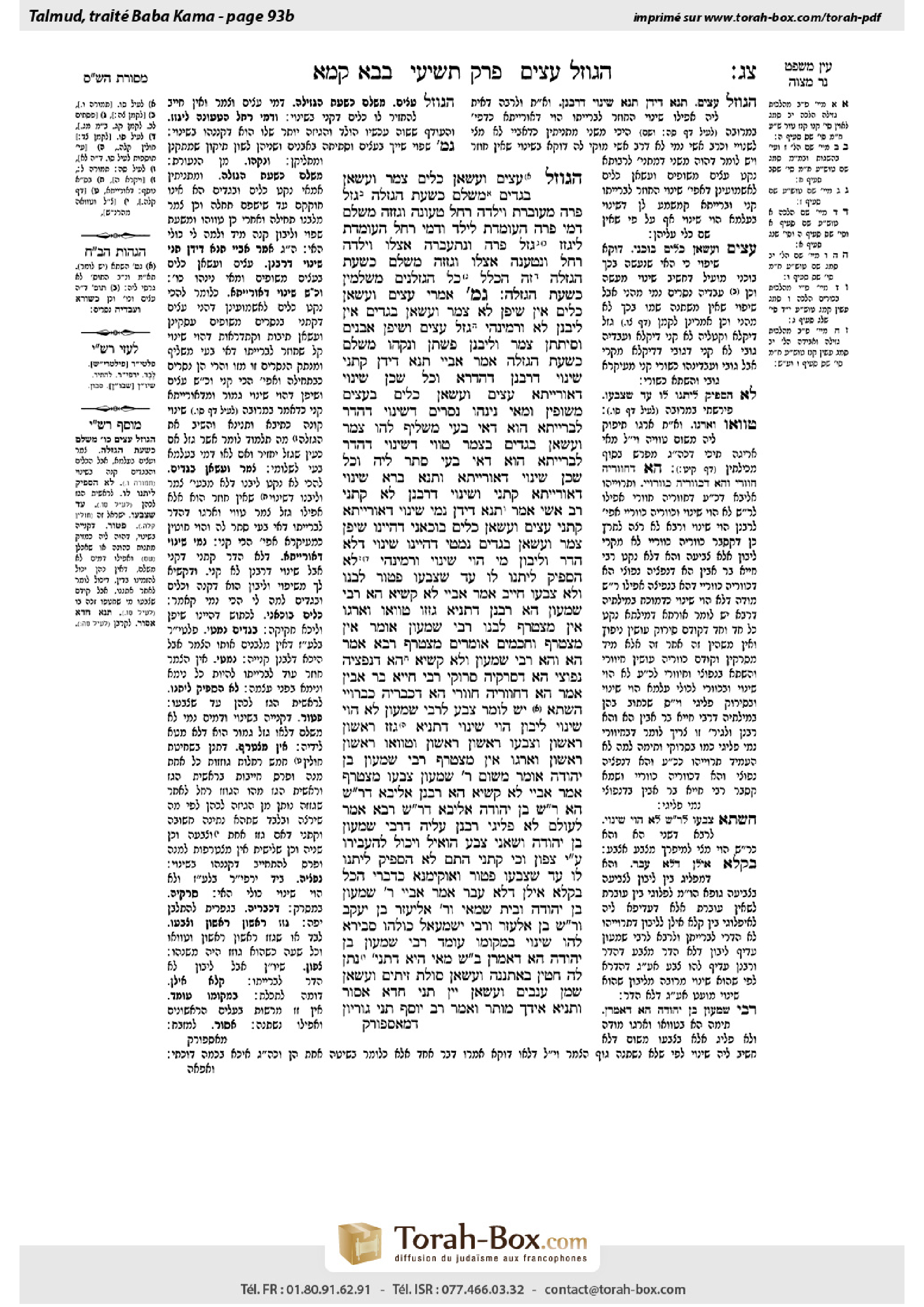
Bava Kamma 93b: Talmud study for Daf Yomi
Study the Talmud for Daf Yomi with scanned pages, Hebrew text, English translations from Sefaria and AI-generated French translations.
Passage selection and English or AI-generated French translation are available where the scan has annotations. Daf Study is independent of Torah-Box and Sefaria.
Browse Bava Kamma · בבא קמא · All tractatesBava Kamma 93b text and translations
This page of Bava Kamma includes the Aramaic text, an English translation and an AI-generated French translation, alongside the scan above.
בבא קמא צ״ג ב · Aramaic and Hebrew text
מַתְנִי׳ הַגּוֹזֵל עֵצִים וַעֲשָׂאָן כֵּלִים, צֶמֶר וַעֲשָׂאָן בְּגָדִים – מְשַׁלֵּם כִּשְׁעַת הַגְּזֵלָה.
גָּזַל פָּרָה מְעוּבֶּרֶת – וְיָלְדָה, רָחֵל טְעוּנָה – וּגְזָזָהּ; מְשַׁלֵּם דְּמֵי פָרָה הָעוֹמֶדֶת לֵילֵד, וּדְמֵי רָחֵל הָעוֹמֶדֶת לִיגָּזֵז.
גָּזַל פָּרָה – וְנִתְעַבְּרָה אֶצְלוֹ וְיָלְדָה, רָחֵל – וְנִטְעֲנָה אֶצְלוֹ וּגְזָזָהּ; מְשַׁלֵּם כִּשְׁעַת הַגְּזֵלָה. זֶה הַכְּלָל: כׇּל הַגַּזְלָנִים מְשַׁלְּמִין כִּשְׁעַת הַגְּזֵלָה.
גְּמָ׳ אָמְרִי: עֵצִים וַעֲשָׂאָן כֵּלִים – אִין, שִׁיפָּן – לָא; צֶמֶר וַעֲשָׂאָן בְּגָדִים – אִין, לִיבְּנָן – לָא.
וּרְמִינְהִי: גָּזַל עֵצִים וְשִׁיפָּן, אֲבָנִים וְסִיתְּתָן, צֶמֶר (וְלִיבְּנָן) [וְלִיבְּנוֹ], פִּשְׁתָּן וְנִקָּהוּ – מְשַׁלֵּם כִּשְׁעַת הַגְּזֵלָה.
אָמַר אַבָּיֵי: תַּנָּא דִּידַן קָתָנֵי שִׁינּוּי דְּרַבָּנַן – דְּהָדַר, וְכׇל שֶׁכֵּן שִׁינּוּי דְּאוֹרָיְיתָא;
עֵצִים וַעֲשָׂאָן כֵּלִים – בְּעֵצִים מְשׁוּפִּין, וּמַאי נִינְהוּ? נְסָרִים; דְּשִׁינּוּי דְּהָדַר לִבְרִיָּיתֵיהּ הוּא – דְּאִי בָּעֵי מְשַׁלֵּיף לְהוּ. צֶמֶר וַעֲשָׂאָן בְּגָדִים – בְּצֶמֶר טָווּי; דְּשִׁינּוּי דַּהֲדַר לִבְרִיָּיתֵיהּ הוּא – דְּאִי בָּעֵי סָתַר לֵיהּ. וְכׇל שֶׁכֵּן שִׁינּוּי דְּאוֹרָיְיתָא.
וְתַנָּא בָּרָא – שִׁינּוּי דְּאוֹרָיְיתָא קָתָנֵי, וְשִׁינּוּי דְּרַבָּנַן לָא קָתָנֵי.
רַב אָשֵׁי אָמַר, תַּנָּא דִּידַן נָמֵי שִׁינּוּי דְּאוֹרָיְיתָא קָתָנֵי: עֵצִים וַעֲשָׂאָן כֵּלִים – בּוּכָאנֵי, דְּהַיְינוּ שִׁיפָּן; צֶמֶר וַעֲשָׂאָן בְּגָדִים – נַמְטֵי, דְּהַיְינוּ שִׁינּוּי דְּלָא הָדַר.
וְלִיבּוּן מִי הָוֵי שִׁינּוּי? וּרְמִינְהִי: לֹא הִסְפִּיק לִיתְּנוֹ לוֹ עַד שֶׁצְּבָעוֹ – פָּטוּר. לִבְּנוֹ וְלֹא צְבָעוֹ – חַיָּיב!
אָמַר אַבָּיֵי: לָא קַשְׁיָא; הָא רַבִּי שִׁמְעוֹן, הָא רַבָּנַן. דְּתַנְיָא: גְּזָזוֹ, טְווֹאוֹ וַאֲרָגוֹ – אֵין מִצְטָרֵף. לִבְּנוֹ – רַבִּי שִׁמְעוֹן אוֹמֵר: אֵין מִצְטָרֵף, וַחֲכָמִים אוֹמְרִים: מִצְטָרֵף.
רָבָא אָמַר: הָא וְהָא רַבִּי שִׁמְעוֹן, וְלָא קַשְׁיָא; הָא דְּנַפְּצֵיהּ נַפּוֹצֵי, הָא דִּסַרְקֵיהּ סָרוֹקֵי.
רַבִּי חִיָּיא בַּר אָבִין אָמַר: הָא דְּחַוְּורֵיהּ חַוּוֹרֵי, הָא דְּכַבְרֵיהּ כַּבְרוֹיֵי.
הַשְׁתָּא יֵשׁ לוֹמַר צֶבַע לְרַבִּי שִׁמְעוֹן לָא הָוֵי שִׁינּוּי, לִיבּוּן הָוֵי שִׁינּוּי? דְּתַנְיָא: גָּזַז רִאשׁוֹן רִאשׁוֹן וּצְבָעוֹ, רִאשׁוֹן רִאשׁוֹן וּטְווֹאוֹ, רִאשׁוֹן רִאשׁוֹן וַאֲרָגוֹ – אֵין מִצְטָרֵף. רַבִּי שִׁמְעוֹן בֶּן יְהוּדָה אוֹמֵר מִשּׁוּם רַבִּי שִׁמְעוֹן: צְבָעוֹ – מִצְטָרֵף.
אָמַר אַבָּיֵי: לָא קַשְׁיָא; הָא רַבָּנַן אַלִּיבָּא דְּרַבִּי שִׁמְעוֹן, הָא רַבִּי שִׁמְעוֹן בֶּן יְהוּדָה אַלִּיבָּא דְּרַבִּי שִׁמְעוֹן.
רָבָא אָמַר: לְעוֹלָם לָא פְּלִיגִי רַבָּנַן עֲלֵיהּ דְּרַבִּי שִׁמְעוֹן בֶּן יְהוּדָה, וְשָׁאנֵי צֶבַע – הוֹאִיל וְיָכוֹל לְהַעֲבִירוֹ עַל יְדֵי צָפוֹן. וְכִי קָתָנֵי הָתָם: לֹא הִסְפִּיק לִיתְּנוֹ לוֹ עַד שֶׁצְּבָעוֹ – פָּטוּר, וְאוֹקִימְנָא כְּדִבְרֵי הַכֹּל; בְּקָלָא אִילָן דְּלָא עָבַר.
אָמַר אַבָּיֵי: רַבִּי שִׁמְעוֹן בֶּן יְהוּדָה, וּבֵית שַׁמַּאי, וְרַבִּי אֱלִיעֶזֶר בֶּן יַעֲקֹב, וְרַבִּי שִׁמְעוֹן בֶּן אֶלְעָזָר, וְרַבִּי יִשְׁמָעֵאל – כּוּלְּהוּ סְבִירָא לְהוּ: שִׁינּוּי בִּמְקוֹמוֹ עוֹמֵד. רַבִּי שִׁמְעוֹן בֶּן יְהוּדָה – הָא דַּאֲמַרַן.
בֵּית שַׁמַּאי מַאי הִיא? דְּתַנְיָא: נָתַן לָהּ חִטִּין בְּאֶתְנַנָּהּ, וַעֲשָׂאָן סוֹלֶת; זֵיתִים וַעֲשָׂאָן שֶׁמֶן; עֲנָבִים וַעֲשָׂאָן יַיִן – תָּנֵי חֲדָא: אָסוּר, וְתַנְיָא אִידַּךְ: מוּתָּר. וְאָמַר רַב יוֹסֵף, תָּנֵי גּוּרְיוֹן
Bava Kamma 93b · English translation
MISHNA: In the case of one who robs another of wood and fashions it into vessels, or one who robs another of wool and fashions it into garments, he pays the robbery victim according to the value of the goods at the time of the robbery, but he need not return the vessels or garments. He has acquired the stolen items because they had undergone a change.
If one robbed another of a pregnant cow and it then gave birth while in his possession, or if one robbed another of a ewe that was laden with wool and the robber then sheared it, the robber pays the value of a cow that is ready to give birth or the value of a ewe that is ready to be shorn. He pays the value of the animal at the time of the robbery, and the calf or the wool remains his.
If one robbed another of a cow, and it became pregnant in his possession, and it then gave birth; or if one robbed another of a ewe, and it became laden with wool in his possession, and he then sheared it, then the robber pays according to the value of the animal at the time of the robbery. This is the principle: All robbers pay according to the value of the stolen item at the time of the robbery.
GEMARA: The Sages say: It can be inferred from the mishna that if one robbed another of wood and fashioned it into vessels, yes, the robber acquires the wood due to the change. If he merely sanded it, no, the robber does not acquire it, as this is not a significant change. Similarly, if one robbed another of wool and fashioned it into garments, yes, he has acquired the wool due to the change. If he merely washed it, no, he has not acquired it.
And the Gemara raises a contradiction from a baraita: If one robbed another of wood and sanded it, or stones and smoothed them, or wool and washed it, or flax and cleaned it, he pays according to the value of the stolen item at the time of the robbery. This baraita teaches that even a change such as sanding wood is regarded as a significant change.
Abaye said: This does not contradict the mishna. The tanna of our mishna teaches the halakha with regard to a change deemed significant by rabbinic law, which is not deemed significant by Torah law, as it is reversible. And all the more so, if the robber effects a change deemed significant by Torah law, i.e., an irreversible change, he acquires the stolen item due to the change.
The Gemara explains: Accordingly, it must be that the case in the mishna, where the change is reversible, where one robbed another of wood and fashioned it into vessels, is stated with regard to one who robbed another of sanded wood. And what are they? Boards that the robber used to construct a vessel, which is a change in which the item can revert to its original state, as, if the robber desires, he can disassemble them. Similarly, the case of one who robbed another of wool and fashioned it into garments refers to wool that was already spun, as fashioning them into garments is a change in which the item can revert to its original state, as, if the robber desires, he can unravel them. The mishna teaches that the robber acquires the stolen item by making these changes, and all the more so the robber acquires the stolen item through a change deemed significant by Torah law.
Abaye continues his explanation: And the tanna of the baraita teaches the halakha with regard to a change deemed significant by Torah law, but he does not teach the halakha with regard to a change deemed significant by rabbinic law. It is possible that he maintains that the robber does not acquire the stolen item due to such a change.
Rav Ashi stated another answer: The tanna of our mishna is also teaching the halakha with regard to a change deemed significant by Torah law. The case in the mishna of one who robbed another of wood and fashioned it into vessels is referring to one who constructed pestles [bukhanei], which is analogous to the case mentioned in the baraita where one sanded them, since a pestle is formed by trimming the wood in an irreversible manner. Similarly, the case in the mishna of one who robbed another of wool and fashioned it into garments is referring to one who fashioned the wool into pieces of felt [namtei], which is an irreversible change.
The Gemara asks a question with regard to the baraita: But does washing effect a significant change, so that one who robs another of wool and washes it acquires the wool and pays its value at the time of robbery? And the Gemara raises a contradiction from a mishna that discusses the halakhot of the first of the sheared wool, which one must give to a priest (Ḥullin 135a): If the owner of the sheep did not manage to give the sheared wool to the priest before he dyed it, he is exempt from giving it to the priest, as the obligation is in effect only with regard to wool remaining in its original state. By contrast, if he washed it but did not dye it, he is obligated to give it to the priest. This indicates that washing does not effect a significant change.
Abaye said: It is not difficult. This baraita is in accordance with the opinion of Rabbi Shimon, whereas that mishna is in accordance with the opinion of the Rabbis, as it is taught in a baraita with regard to the first of the sheared wool: If one sheared it, spun it, and wove it, the sheared wool does not combine with the wool from other sheep to constitute the minimum quantity of wool for which one is obligated to give the first of the sheared wool to the priest. If one washed it, then Rabbi Shimon says that it does not combine with the wool of other sheep, as washing effects a significant change, and the Rabbis say that it combines with the wool of other sheep, as washing does not effect a significant change. Their opinions correspond to the opinions in the baraita and mishna previously quoted.
Rava stated another answer: This and that, i.e., both the mishna and the baraita, are in accordance with the opinion of Rabbi Shimon, and it is not difficult. This mishna is referring to a case where one untangled the strands of wool by hand before washing it. In this case, the washing is not fully effective, and does not effect a significant change. That baraita is referring to a case where one combed it before washing it. The washing is more effective and consequently effects a significant change.
Rabbi Ḥiyya bar Avin stated another answer: This mishna is referring to a case where one merely whitened it, which is not a significant change. That baraita is referring to a case where one bleached it with sulfur, which is a significant change.
Having demonstrated that, according to Rabbi Shimon, washing effects a significant change, the Gemara asks: Now that it can be said that, according to Rabbi Shimon, dye does not effect a significant change, as the Gemara will prove, can it be said that washing effects a significant change? As it is taught in a baraita: If he sheared sheep one by one and dyed the wool of each sheep before shearing the next sheep, or sheared them one by one and spun the wool, or sheared them one by one and wove the wool, then the wool sheared from the different sheep does not combine to constitute the minimum quantity of wool for which one is obligated to give the first of the sheared wool to the priest. Rabbi Shimon ben Yehuda says in the name of Rabbi Shimon: Even if he dyed it, it combines with the other wool. This indicates that, according to Rabbi Shimon, even dyeing the wool is not a significant change, so how could he maintain that washing it is?
Abaye said: This is not difficult. This statement, that washed wool does not combine with other wool, is the opinion of the Rabbis in accordance with the opinion of Rabbi Shimon, while that statement, that even dyed wool combines with other wool, is the opinion of Rabbi Shimon ben Yehuda in accordance with the opinion of Rabbi Shimon. There is a dispute as to what Rabbi Shimon rules with regard to this issue.
Rava said: Actually, the Rabbis do not disagree with Rabbi Shimon ben Yehuda, and they are also of the opinion that Rabbi Shimon holds that washing effects a significant change. And as for the apparent contradiction, dye is different and it does not effect a significant change, since one is able to remove it with soap [tzafon] and return the wool to its previous state. And when it is taught there, in the mishna cited above, that if one did not manage to give the sheared wool to the priest before he dyed it he is exempt, and this ruling was established in accordance with all opinions, it was not stated with regard to ordinary dye but with regard to indigo, which cannot be removed with soap and therefore effects a permanent and therefore significant change.
§ Abaye said: Rabbi Shimon ben Yehuda, and Beit Shammai, and Rabbi Eliezer ben Ya’akov, and Rabbi Shimon ben Elazar, and Rabbi Yishmael all hold that despite a change, the changed item remains in its place, i.e., the changed item is still considered to have the status it had before the change. The Gemara proceeds to prove that each of these tanna’im holds this way: The opinion of Rabbi Shimon ben Yehuda is that which we just said. He says that, according to Rabbi Shimon, even if the wool is dyed it still combines with the wool of other animals to constitute the minimum quantity of wool for which one is obligated to give the first of the sheared wool to the priest.
What is the source that indicates that Beit Shammai maintain that an item that undergoes a change is considered to have the same status that it had before the change? As it is taught in a baraita: If one gave a prostitute wheat as her payment, and she ground it and converted it into flour; or if he gave her olives, and she squeezed them and converted them into oil; or if he gave her grapes, and she squeezed them and converted them into wine; and if, in any of these cases, she subsequently consecrated the final product, it is taught in one baraita that it is prohibited to sacrifice them upon the altar as a meal-offering or libation, as the Torah states: “You shall not bring the hire of a harlot or the price of a dog into the House of the Lord your God” (Deuteronomy 23:19). And it is taught in another baraita that it is permitted, as the Gemara will explain. And Rav Yosef says: It was taught by Guryon
Bava Kamma 93b · Traduction française (IA)
MICHNA : Dans le cas d'une personne qui vole du bois à un autre et le transforme en objets, ou qui vole de la laine à un autre et la transforme en vêtements, il paie la valeur des biens au moment de la violation, mais il n'a pas besoin de rendre les objets ou les vêtements. Il a acquis les biens volés car ils avaient subi un changement.
Si une personne vole une vache enceinte à un autre et qu'elle donne naissance pendant qu'elle est en son possession, ou si une personne vole une brebis chargée de laine à un autre et que le voleur la tond alors, le voleur paie la valeur d'une vache prête à donner naissance ou la valeur d'une brebis prête à être tondu. Il paie la valeur de l'animal au moment de la violation, et le veau ou la laine reste à lui.
Si une personne vole une vache et qu'elle devient enceinte pendant qu'elle est en son possession et qu'elle donne naissance, ou si une personne vole une brebis et qu'elle devient chargée de laine pendant qu'elle est en son possession et qu'il la tond alors, alors le voleur paie selon la valeur de l'animal au moment de la violation. C'est le principe : tous les voleurs paient selon la valeur des biens volés au moment de la violation.
GUEMARA : Les Sages disent : On peut en déduire de la mitsna que si une personne vole du bois à un autre et le transforme en objets, oui, le voleur acquiert le bois en raison du changement. Si il le seulement poli, non, le voleur ne l'acquiert pas, car cela n'est pas un changement significatif. De même, si une personne vole de la laine à un autre et la transforme en vêtements, oui, il a acquis la laine en raison du changement. Si il la seulement lave, non, il ne l'a pas acquis.
Et la Guemara soulève une contradiction à partir d'une baraïta : Si une personne vole du bois à un autre et le poli, ou des pierres et les lisse, ou de la laine et la lave, ou du lin et le nettoie, il paie selon la valeur des biens volés au moment de la violation. Cette baraïta enseigne que même un changement tel que le poli du bois est considéré comme un changement significatif.
Abaye dit : cela ne contredit pas la mitsna. Le tanna de notre mitsna enseigne la halakha concernant un changement considéré comme significatif par la loi rabbinique, qui n'est pas considéré comme significatif par la loi divine, car il est réversible. Et encore plus, si le voleur effectue un changement considéré comme significatif par la loi divine, c'est-à-dire un changement irréversible, il acquiert les biens volés en raison du changement.
La Guemara explique : Ainsi, il doit être que le cas mentionné dans la Michna, où le changement est réversible, où une personne vole du bois à un autre et le transforme en objets, est mentionné concernant une personne qui vole du bois sablé. Et quels sont-ils ? Des planches que le voleur utilise pour construire un objet, qui est un changement dans lequel l'objet peut revenir à son état originel, car, si le voleur le désire, il peut les démonter. De même, le cas d'une personne qui vole de la laine à un autre et la transforme en vêtements fait référence à de la laine déjà tissée, car la transformation en vêtements est un changement dans lequel l'objet peut revenir à son état originel, car, si le voleur le désire, il peut les défaire. La Michna enseigne que le voleur acquiert les biens volés en les transformant ainsi, et encore plus, le voleur acquiert les biens volés grâce à un changement considéré comme significatif par la loi divine.
Abaye continue son explication : Et le tanna de la baraïta enseigne la halakha concernant un changement considéré comme significatif par la loi divine, mais il ne l'enseigne pas concernant un changement considéré comme significatif par la loi rabbinique. Il est possible qu'il maintienne que le voleur ne l'acquiert pas en raison de ce changement.
Rav Ashi a donné une autre réponse : le tanna de notre Michna enseigne également la halakha concernant un changement considéré comme significatif par la loi divine. Le cas mentionné dans la Michna d'une personne qui vole du bois à un autre et le transforme en objets fait référence à une personne qui construit des mortiers [bukhanei], ce qui est analogue au cas mentionné dans la baraïta où l'on sable, car un mortier est formé en tranchant le bois de manière irréversible. De même, le cas mentionné dans la Michna d'une personne qui vole de la laine à un autre et la transforme en vêtements fait référence à une personne qui transforme la laine en morceaux de tissu [namtei], ce qui est un changement irréversible.
La Guemara pose une question concernant la baraïta : Mais le lavage constitue-t-il un changement significatif, de sorte qu'une personne qui vole de la laine à un autre et la lave acquiert la laine et paie sa valeur au moment de la violation ? Et la Guemara soulève une contradiction à partir d'une mitsva qui discute des halakhot du premier de la laine tondue, que l'on doit donner à un prêtre (Ḥullin 135a) : Si l'propriétaire de la brebis n'a pas réussi à donner la laine tondue au prêtre avant de la teinter, il est exempt de lui donner, car l'obligation est en vigueur uniquement concernant la laine dans son état originel. En revanche, si l'on a lavé la laine mais n'a pas teint, il est tenu de lui donner. Cela indique que le lavage ne constitue pas un changement significatif.
Abaye dit : Ce n'est pas difficile. Cette baraïta est selon l'opinion de Rabbi Shimon, tandis que cette mitsva est selon l'opinion des Rabbins, car il est enseigné dans une baraïta concernant le premier de la laine tondue : Si l'on a tondu, filé et tissé la laine, la laine tondue ne se combine pas avec la laine d'autres brebis pour constituer la quantité minimale de laine pour laquelle l'on est tenu de donner le premier de la laine tondue au prêtre. Si l'on a lavé la laine, Rabbi Shimon dit qu'elle ne se combine pas avec la laine d'autres brebis, car le lavage constitue un changement significatif, et les Rabbins disent qu'elle se combine avec la laine d'autres brebis, car le lavage ne constitue pas un changement significatif. Leurs opinions correspondent aux opinions de la baraïta et de la mitsva mentionnées précédemment.
Rava a dit une autre réponse : Cela et cela, c'est-à-dire à la fois la mitsva et la baraïta, sont conformes à l'opinion du Rabbi Shimon, et ce n'est pas difficile. Cette mitsva fait référence à un cas où l'on a dénoué les fils de laine à la main avant de les laver. Dans ce cas, le lavage n'est pas pleinement efficace et ne provoque pas un changement significatif. Cette baraïta fait référence à un cas où l'on a brossé la laine avant de la laver. Le lavage est plus efficace et provoque donc un changement significatif.
Le Rabbi Ḥiyya bar Avin a dit une autre réponse : Cette mitsva fait référence à un cas où l'on a simplement blanchi la laine, ce qui n'est pas un changement significatif. Cette baraïta fait référence à un cas où l'on a blanchi la laine avec du soufre, ce qui est un changement significatif.
Ayant ainsi démontré que, selon le Rabbi Shimon, le lavage provoque un changement significatif, la Guemara pose la question : Maintenant que l'on peut dire que, selon le Rabbi Shimon, la teinture ne provoque pas un changement significatif, comme la Guemara le prouvera, peut-on dire que le lavage provoque un changement significatif ? Comme il est enseigné dans une baraïta : Si l'on a rasé les brebis une par une et teint la laine de chaque brebis avant de raser la suivante, ou si l'on a rasé les brebis une par une et tissé la laine, ou si l'on a rasé les brebis une par une et tissé la laine, alors la laine rasée des brebis différentes ne se combine-t-elle pas pour constituer la quantité minimale de laine pour laquelle l'on est tenu de donner la première laine rasée au prêtre ? Le Rabbi Shimon ben Yehuda dit au nom du Rabbi Shimon : Même si l'on a teint la laine, elle se combine avec l'autre laine. Cela indique que, selon le Rabbi Shimon, même la teinture de la laine ne provoque pas un changement significatif, donc comment peut-il maintenir que le lavage provoque un changement significatif ?
Abaye a dit : Ce n'est pas difficile. Cette déclaration, selon laquelle la laine lavée ne se combine pas avec d'autres laines, est l'opinion des Rabbins conformément à l'opinion du Rabbi Shimon, tandis que cette déclaration, selon laquelle même la laine teintée se combine avec d'autres laines, est l'opinion du Rabbi Shimon ben Yehuda conformément à l'opinion du Rabbi Shimon. Il existe un désaccord sur ce que le Rabbi Shimon décide à cet égard.
Rava a dit : En réalité, les Rabbins ne s'opposent pas au Rabbi Shimon ben Yehuda, et ils partagent également l'opinion que le Rabbi Shimon considère que le lavage provoque un changement significatif. Et quant à l'apparente contradiction, la teinture est différente et ne provoque pas un changement significatif, car l'on peut la retirer avec du savon [tzafon] et ramener la laine à son état initial. Et lorsqu'il est enseigné dans la Michna citée ci-dessus que si l'on n'a pas réussi à donner la laine rasée au prêtre avant de la teinter, il est exempt, et cette décision a été établie conformément à toutes les opinions, il n'a pas été dit en ce qui concerne une teinture ordinaire mais en ce qui concerne l'indigo, qui ne peut pas être retiré avec du savon et donc provoque un changement permanent et donc significatif.
§ Abaye a dit : Le Rabbi Shimon ben Yehuda, et Beit Shammai, et le Rabbi Eliezer ben Ya’akov, et le Rabbi Shimon ben Elazar, et le Rabbi Yishmael tous maintiennent que malgré un changement, l'objet changé reste à sa place, c'est-à-dire que l'objet changé est encore considéré comme ayant le statut qu'il avait avant le changement. La Guemara poursuit en prouvant que chaque tannaïm maintient cela ainsi : L'opinion du Rabbi Shimon ben Yehuda est celle que nous venons de dire. Il dit que, selon le Rabbi Shimon, même si la laine est teintée, elle se combine avec la laine des autres bêtes pour constituer la quantité minimale de laine pour laquelle l'on est tenu de donner la première laine rasée au prêtre.
Quelle est la source qui indique que Beit Shammai affirme qu'un objet qui subit un changement est considéré comme ayant le même statut qu'avant le changement ? Comme il est enseigné dans une baraïta : Si l'on a donné à une prostituée du blé comme rémunération, et elle l'a moulue et transformé en farine ; ou si l'on a donné à elle des olives, et elle les a pressées et transformées en huile ; ou si l'on a donné à elle des raisins, et elle les a pressés et transformés en vin ; et si, dans l'un de ces cas, elle a ensuite consacré le produit final, il est enseigné dans une baraïta qu'il est interdit de sacrifier ces produits sur l'autel en tant qu'offrande de table ou de libation, comme la Torah le dit : « Vous ne donnerez pas la rémunération d'une prostituée ou le prix d'un chien dans la Maison du Seigneur votre Dieu » (Deutéronome 23:19). Et il est enseigné dans une autre baraïta qu'il est permis, comme la Guemara le expliquera. Et Rav Yosef dit : Il a été enseigné par Guryon
Traduction française générée par IA à partir de l’édition anglaise de Sefaria. Vérifie toujours un passage avec le texte source.
Text from Sefaria: William Davidson Edition - Vocalized Aramaic (CC BY NC); William Davidson Edition - English (CC BY NC).