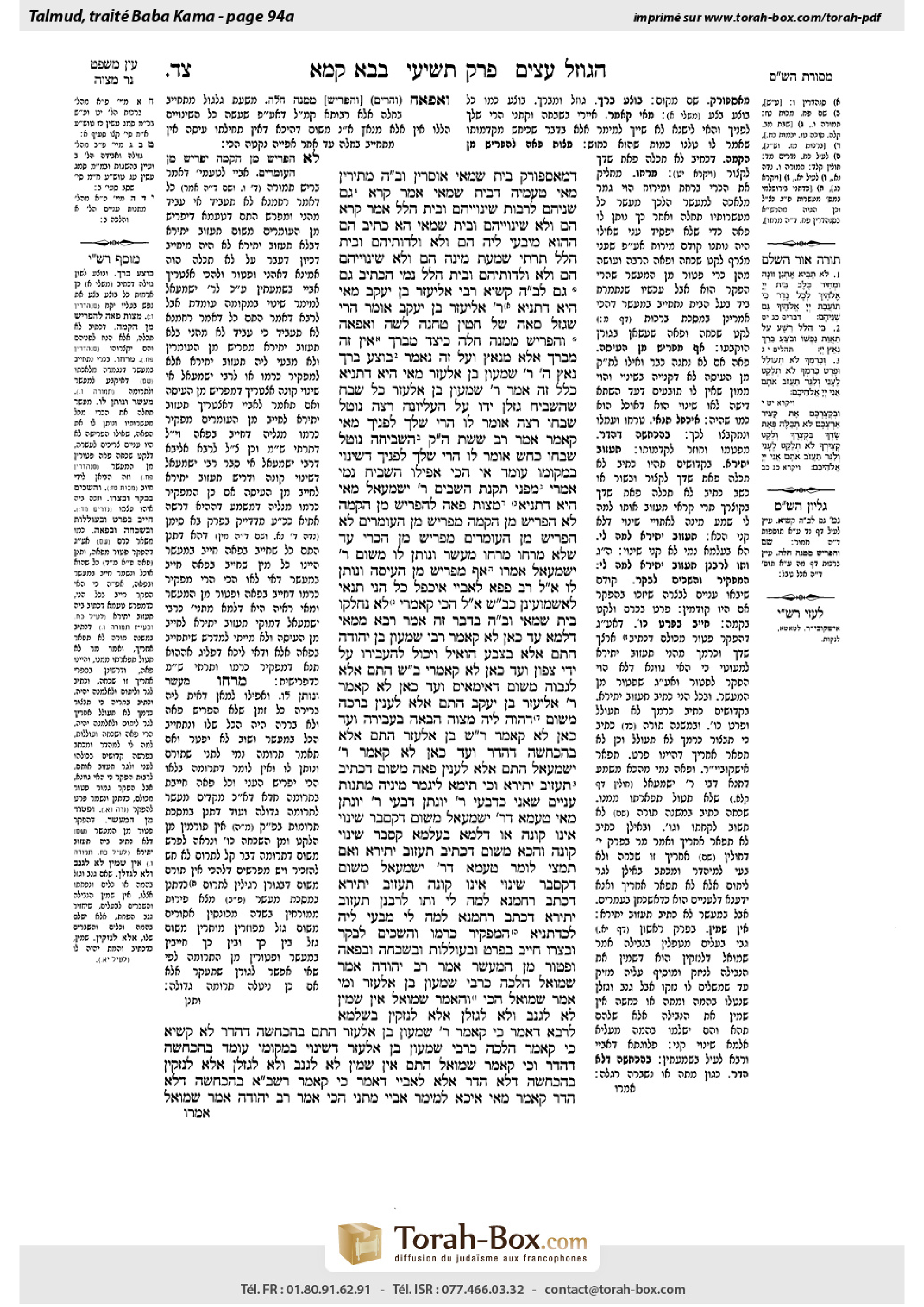
Bava Kamma 94a: Talmud study for Daf Yomi
Study the Talmud for Daf Yomi with scanned pages, Hebrew text, English translations from Sefaria and AI-generated French translations.
Passage selection and English or AI-generated French translation are available where the scan has annotations. Daf Study is independent of Torah-Box and Sefaria.
Browse Bava Kamma · בבא קמא · All tractatesBava Kamma 94a text and translations
This page of Bava Kamma includes the Aramaic text, an English translation and an AI-generated French translation, alongside the scan above.
בבא קמא צ״ד א · Aramaic and Hebrew text
דְּמֵאַסְפּוֹרַק: בֵּית שַׁמַּאי אוֹסְרִין, וּבֵית הִלֵּל מַתִּירִין. מַאי טַעְמֵיהּ דְּבֵית שַׁמַּאי? אָמַר קְרָא: ״גַּם שְׁנֵיהֶם״ – לְרַבּוֹת שִׁינּוּיֵיהֶם. וּבֵית הִלֵּל – אָמַר קְרָא: ״הֵם״ – וְלֹא שִׁינּוּיֵיהֶם.
וּבֵית שַׁמַּאי, הָא כְּתִיב ״הֵם״! הָהוּא מִיבְּעֵי לֵיהּ ״הֵם״ – וְלֹא וַלְדוֹתֵיהֶם. וּבֵית הִלֵּל – תַּרְתֵּי שָׁמְעַתְּ מִינַּהּ. ״הֵם״ וְלֹא שִׁינּוּיֵיהֶם, ״הֵם״ וְלֹא וַלְדוֹתֵיהֶם.
וּבֵית הִלֵּל נָמֵי, הָכְתִיב: ״גַּם״! ״גַּם״ לְבֵית הִלֵּל קַשְׁיָא.
רַבִּי אֱלִיעֶזֶר בֶּן יַעֲקֹב מַאי הִיא?
דְּתַנְיָא, רַבִּי אֱלִיעֶזֶר בֶּן יַעֲקֹב אוֹמֵר: הֲרֵי שֶׁגָּזַל סְאָה שֶׁל חִטִּין, טְחָנָהּ, לָשָׁהּ וַאֲפָאָהּ, וְהִפְרִישׁ מִמֶּנָּה חַלָּה, כֵּיצַד מְבָרֵךְ? אֵין זֶה מְבָרֵךְ אֶלָּא מְנָאֵץ! וְעַל זֶה נֶאֱמַר: ״בֹּצֵעַ בֵּרֵךְ נִאֵץ ה׳״.
רַבִּי שִׁמְעוֹן בֶּן אֶלְעָזָר מַאי הִיא? דְּתַנְיָא, כְּלָל זֶה אָמַר רַבִּי שִׁמְעוֹן בֶּן אֶלְעָזָר: כׇּל שֶׁבַח שֶׁהִשְׁבִּיחַ גַּזְלָן – יָדוֹ עַל הָעֶלְיוֹנָה. רָצָה נוֹטֵל שִׁבְחוֹ, רָצָה אוֹמֵר לוֹ: ״הֲרֵי שֶׁלְּךָ לְפָנֶיךָ״.
מַאי קָאָמַר? אָמַר רַב שֵׁשֶׁת, הָכִי קָאָמַר: הִשְׁבִּיחַ – נוֹטֵל שִׁבְחוֹ. כָּחַשׁ – אוֹמֵר לוֹ: ״הֲרֵי שֶׁלְּךָ לְפָנֶיךָ״, דְּשִׁינּוּי בִּמְקוֹמוֹ עוֹמֵד.
אִי הָכִי, אֲפִילּוּ הִשְׁבִּיחַ נָמֵי! אָמְרִי: מִפְּנֵי תַּקָּנַת הַשָּׁבִים.
רַבִּי יִשְׁמָעֵאל מַאי הִיא? דְּתַנְיָא: מִצְוַת פֵּאָה – לְהַפְרִישׁ מִן הַקָּמָה. לֹא הִפְרִישׁ מִן הַקָּמָה – מַפְרִישׁ מִן הָעוֹמָרִים. לֹא הִפְרִישׁ מִן הָעוֹמָרִים – מַפְרִישׁ מִן הַכְּרִי עַד שֶׁלֹּא מֵרְחוֹ.
מֵרְחוֹ – מְעַשֵּׂר וְנוֹתֵן לוֹ. מִשּׁוּם רַבִּי יִשְׁמָעֵאל אָמְרוּ: אַף מַפְרִישׁ מִן הָעִיסָּה וְנוֹתֵן לוֹ.
אֲמַר לֵיהּ רַב פָּפָּא לְאַבָּיֵי: אִיכְּפוּל כֹּל הָנֵי תַּנָּאֵי לְאַשְׁמוֹעִינַן כְּבֵית שַׁמַּאי?! אֲמַר לֵיהּ, הָכִי קָאָמְרִי: לֹא נֶחְלְקוּ בֵּית שַׁמַּאי וּבֵית הִלֵּל בְּדָבָר זֶה.
אָמַר רָבָא: מִמַּאי? דִּלְמָא עַד כָּאן לָא קָאָמַר רַבִּי שִׁמְעוֹן בֶּן יְהוּדָה הָתָם, אֶלָּא בְּצֶבַע – הוֹאִיל וְיָכוֹל לְהַעֲבִירוֹ עַל יְדֵי צָפוֹן;
וְעַד כָּאן לָא קָאָמְרִי בֵּית שַׁמַּאי הָתָם, אֶלָּא לְגָבוֹהַּ – מִשּׁוּם דְּאִימְּאִיס;
וְעַד כָּאן לָא קָאָמַר רַבִּי אֱלִיעֶזֶר בֶּן יַעֲקֹב הָתָם, אֶלָּא לְעִנְיַן בְּרָכָה – מִשּׁוּם דְּהָוֵה לֵיהּ מִצְוָה הַבָּאָה בַּעֲבֵירָה;
וְעַד כָּאן לָא קָאָמַר רַבִּי שִׁמְעוֹן בֶּן אֶלְעָזָר הָתָם אֶלָּא בְּהַכְחָשָׁה דְּהָדַר;
וְעַד כָּאן לָא קָאָמַר רַבִּי יִשְׁמָעֵאל הָתָם, אֶלָּא לְעִנְיַן פֵּאָה – מִשּׁוּם דִּכְתִיב ״תַּעֲזֹב״ יַתִּירָא! וְכִי תֵּימָא לִיגְמַר מִינֵּיהּ, מַתְּנוֹת עֲנִיִּים שָׁאנֵי!
כִּדְבָעֵי רַבִּי יוֹנָתָן – דְּבָעֵי רַבִּי יוֹנָתָן: מַאי טַעְמָא דְּרַבִּי יִשְׁמָעֵאל – מִשּׁוּם דְּקָסָבַר שִׁינּוּי אֵינוֹ קוֹנֶה? אוֹ דִלְמָא, בְּעָלְמָא קָסָבַר שִׁינּוּי קוֹנֶה; וְהָכָא מִשּׁוּם דִּכְתִיב ״תַּעֲזֹב״ יַתִּירָא?
וְאִם תִּמְצֵי לוֹמַר טַעְמָא דְּרַבִּי יִשְׁמָעֵאל מִשּׁוּם דְּקָסָבַר שִׁינּוּי אֵינוֹ קוֹנֶה, ״תַּעֲזֹב״ יַתִּירָא דִּכְתַב רַחֲמָנָא לְמָה לִי? וְתוּ, לְרַבָּנַן – ״תַּעֲזֹב״ יַתִּירָא דִּכְתַב רַחֲמָנָא לְמָה לִי?
מִבְּעֵי לֵיהּ לְכִדְתַנְיָא: הַמַּפְקִיר כַּרְמוֹ, וְהִשְׁכִּים לַבֹּקֶר וּבְצָרוֹ – חַיָּיב בְּפֶרֶט וּבְעוֹלֵלוֹת וּבְשִׁכְחָה וּבְפֵאָה, וּפָטוּר מִן הַמַּעֲשֵׂר.
אָמַר רַב יְהוּדָה אָמַר שְׁמוּאֵל: הֲלָכָה כְּרַבִּי שִׁמְעוֹן בֶּן אֶלְעָזָר.
וּמִי אָמַר שְׁמוּאֵל הָכִי?! וְהָאָמַר שְׁמוּאֵל: אֵין שָׁמִין לֹא לְגַנָּב וְלֹא לְגַזְלָן, אֶלָּא לִנְזָקִין.
בִּשְׁלָמָא לְרָבָא, דְּאָמַר: כִּי קָאָמַר רַבִּי שִׁמְעוֹן בֶּן אֶלְעָזָר הָתָם – בְּהַכְחָשָׁה דְּהָדַר, לָא קַשְׁיָא; כִּי קָאָמַר הֲלָכָה כְּרַבִּי שִׁמְעוֹן בֶּן אֶלְעָזָר, דְּשִׁינּוּי בִּמְקוֹמוֹ עוֹמֵד – בְּהַכְחָשָׁה דְּהָדַר, וְכִי קָאָמַר שְׁמוּאֵל הָתָם: אֵין שָׁמִין לֹא לְגַנָּב וְלֹא לְגַזְלָן, אֶלָּא לִנְזָקִין – בְּהַכְחָשָׁה דְּלָא הָדַר.
אֶלָּא לְאַבָּיֵי, דְּאָמַר: כִּי קָאָמַר רַבִּי שִׁמְעוֹן בֶּן אֶלְעָזָר – בְּהַכְחָשָׁה דְּלָא הָדַר קָאָמַר, מַאי אִיכָּא לְמֵימַר?
אַבָּיֵי מַתְנֵי הָכִי – אָמַר רַב יְהוּדָה אָמַר שְׁמוּאֵל:
Bava Kamma 94a · English translation
of Asporak: Beit Shammai prohibit sacrificing these items and Beit Hillel permit doing so. The Gemara clarifies: What is the reason of Beit Shammai? The Gemara answers: The verse states: “You shall not bring the hire of a harlot or the price of a dog into the House of the Lord your God for any vow; for even both of these are an abomination unto the Lord your God” (Deuteronomy 23:19). The word “even” is an amplification, which serves to include in the prohibition these items in their changed form. And what is the reason of Beit Hillel? The verse states “these” to emphasize that the prohibition applies only to these items in their initial form, but not in their changed form.
The Gemara asks: And according to Beit Shammai, isn’t the word “these” written in the verse, indicating an exclusion? The Gemara responds: Beit Shammai requires that word to indicate that “these” items are forbidden, but not the offspring of animals given as payment to the prostitute. The Gemara asks: And according to Beit Hillel, what is the source of that halakha? The Gemara answers: According to Beit Hillel, you learn two halakhot from this word, as follows: “These” items are forbidden in their initial form but not in their changed form, and “these” items are forbidden but not their offspring.
The Gemara asks: And according to Beit Hillel as well, isn’t the word “even” written in the verse, indicating an amplification? The Gemara answers: Indeed, the word “even” is difficult for Beit Hillel. It is not clear how they would interpret that word.
The Gemara continues: What is the source that indicates that Rabbi Eliezer ben Ya’akov holds that an item that undergoes a change is still considered to have the same status that it had before the change?
The Gemara answers: As it is taught in a baraita that Rabbi Eliezer ben Ya’akov says: In the case of one who robbed another of a se’a of wheat, then ground it, kneaded it, and baked it, and he then separated ḥalla from it, i.e., he separated the portion of the dough that one is required to separate and then give to a priest, how can he recite the blessing over the separation of ḥalla? This individual is not reciting a blessing, but rather he is blaspheming. And with regard to this it is stated: “The robber who recites a blessing blasphemes the Lord” (Psalms 10:3), which is referring to a robber who recites a blessing upon performing a mitzva with an item he stole. According to Rabbi Eliezer ben Ya’akov, although this wheat has been significantly changed, it is still considered a stolen item.
The Gemara continues: What is the source that indicates that Rabbi Shimon ben Elazar holds that an item that undergoes a change is still considered to have the same status that it had before the change? As it is taught in a baraita (Tosefta 10:2) that Rabbi Shimon ben Elazar stated this principle: With regard to any enhancement to the stolen animal in that it was enhanced by the actions of the robber, he has the advantage when repaying the owner. If he desires, he takes his enhancement, i.e., when he returns the animal, the robbery victim must pay the difference between its value at the time of the robbery and its current value, and if he desires he can return it to the owner and say to him: That which is yours is before you.
The Gemara expresses surprise: What is he saying? If the robber has a right to demand compensation for the enhancement to the animal, why would he ever return it without stating this demand? Rav Sheshet said that this is what he is saying: If the robber enhanced it, he takes his enhancement. If the animal was weakened, the robber says to him: That which is yours is before you, and no further compensation is required. This is because despite a change, the changed item remains in its place. Since the robber has not acquired it, he simply returns the item to the robbery victim.
The Gemara asks: If so, i.e., if the robber has not acquired it, then even if he enhanced it that should be the halakha as well. The item should still belong to the robbery victim and the robber should not be entitled to compensation. The Sages say in response: The fact that the robber has a right to demand compensation for the enhancement is due to an ordinance instituted for the penitent. In order to ease the burden of one who desires to repent, the Sages instituted that the robber be reimbursed for the increase in the value of the animal. Otherwise, a robber might refrain from returning a stolen item.
The Gemara continues: What is the source that indicates that Rabbi Yishmael holds that an item that undergoes a change is still considered to have the same status that it had before the change? The Gemara answers: As it is taught in a baraita: The ideal way to fulfill the mitzva of produce in the corner of the field, which is given to the poor [pe’a], is to separate it from the standing grain, i.e., grain that has not been harvested. If one did not separate it from the standing grain, he separates it from the sheaves of grain that have already been harvested. If he did not separate it from the sheaves, he separates it from the pile of grain, as long as he has not yet smoothed the pile.
If he smoothed the pile of grain, activating the obligation to tithe the produce, he first tithes the grain and then gives a portion of the tithed produce to the poor as pe’a, so that the poor will not have to tithe what they receive. Additionally, they said in the name of Rabbi Yishmael: If he did not separate pe’a during any of the aforementioned stages and he made a dough from the grain, he separates pe’a even from the dough and gives it to the poor. This indicates that even if the grain was changed, one is not exempt from the obligation of pe’a. The Gemara has now clarified the sources Abaye alluded to when he listed all the tanna’im who hold that despite a change, the changed item remains in its place.
Rav Pappa said to Abaye: Did all these tanna’im go to so much trouble in an effort [ikhpal] to teach us a halakha in accordance with the opinion of Beit Shammai, which is presumably not accepted as normative? Abaye said to Rav Pappa: This is what they are saying: Beit Shammai and Beit Hillel did not engage in a dispute with regard to this matter. All of the aforementioned tanna’im hold that even Beit Hillel agree that a change in the form of an item does not impact its status.
Rava said: From where can it be proven that all of the aforementioned tanna’im hold that an item that undergoes a change is still considered to have the same status that it had before the change? One can say that the reasons for their statements are due to other factors. Perhaps Rabbi Shimon ben Yehuda states his opinion, that it is not a significant change, there, in the case of the first of the sheared wool, only with regard to dye, which is a reversible change, since one is able to remove it with soap.
And perhaps Beit Shammai state their opinion there, in the case of a harlot, only with regard to an offering to the Most High, because of the fact that the item has become repugnant, in being used as payment for the services of a prostitute, and therefore it cannot be used for an offering even if its form has changed.
And perhaps Rabbi Eliezer ben Ya’akov states his opinion there, where one robbed another of wheat, only with regard to a blessing, because this is a mitzva that is performed through commission of a transgression, but this does not indicate that a change is insignificant with regard to other matters.
And perhaps Rabbi Shimon ben Elazar states his opinion there, where the condition of the animal changed, only with regard to weakening of the animal that is reversible. Since the animal’s value can be restored by fattening it, the weakening is not deemed a significant change.
And perhaps Rabbi Yishmael states his opinion there, where one separated pe’a at a late stage, only with regard to pe’a, because it is written: “You shall leave them for the poor” an additional time. It is mentioned twice, in Leviticus 19:10 and Leviticus 23:22. One of these terms is superfluous, indicating that pe’a must be given to the poor under all circumstances, even if the grain was changed and made into dough. And if you would say: Let us derive from pe’a that in other halakhic domains the status of an item is not affected by its undergoing a change, pe’a cannot function as a source because gifts to the poor are different from other halakhot.
The Gemara notes: Rava’s claim that no definitive conclusion with regard to the opinion of Rabbi Yishmael concerning a changed item is supported by the statement of another amora is like the dilemma raised by Rabbi Yonatan, as Rabbi Yonatan raises a dilemma: What is the reason for the ruling of Rabbi Yishmael? Is it because he holds that change does not cause one to acquire an item? Or perhaps he generally holds that change does cause one to acquire an item, but here, in the case of pe’a, it is different because the term “You shall leave” is written an additional time.
Having quoted Rabbi Yonatan’s dilemma, the Gemara asks: And if you say that the reason for the ruling of Rabbi Yishmael is that he holds that change does not cause one to acquire an item, why do I need the additional term “You shall leave,” which the Merciful One writes in the Torah? And furthermore, according to the opinion of the Rabbis, who hold that pe’a may not be taken from dough, why do I need the additional term “You shall leave” that the Merciful One writes?
The Gemara responds: This additional term is necessary for that which is taught in a baraita: One who renounced ownership of his vineyard and arose early in the morning before anyone else took possession of it and harvested it is obligated in the mitzva of individual fallen grapes left for the poor [peret], and in the mitzva of incompletely formed clusters of grapes left for the poor [olelot], and in the mitzva of forgotten clusters of grapes left for the poor and in the mitzva of pe’a. These are the four gifts to the poor that the Torah requires one to give from a vineyard. But he is exempt from the mitzva to tithe his produce, because this requirement does not apply to an ownerless field. The obligation to give gifts to the poor in this case is derived from the additional mention of the term “You shall leave.”
§ The Gemara returns to the discussion of a stolen item that underwent a change. Rav Yehuda says that Shmuel says: The halakha is in accordance with the opinion of Rabbi Shimon ben Elazar, who says that even if the stolen animal deteriorated, it is returned to the owner in its current state.
The Gemara expresses surprise: But did Shmuel actually say this? But doesn’t Shmuel say: One does not appraise the change in value, neither for a thief nor for a robber. Rather, they keep the stolen animal and pay back the victim with their own money; one appraises the change only for one obligated to pay for damage?
Granted, according to the opinion of Rava, who said earlier in response to Abaye: When Rabbi Shimon ben Elazar states his opinion there, he stated it only with regard to weakening of the animal that is reversible, this is not difficult: When Shmuel says that the halakha is in accordance with the opinion of Rabbi Shimon ben Elazar, who holds that despite a change, the changed item remains in its place, he stated this with regard to weakening of the animal which is reversible, in which case the change is insignificant. And when Shmuel says there: One does not appraise the change in value, neither for a thief nor for a robber, but rather one appraises the change only for one obligated to pay for damage, he stated this with regard to weakening of the animal that is irreversible.
But according to Abaye, who said that when Rabbi Shimon ben Elazar states his opinion, he states it even with regard to weakening of the animal which is irreversible, what can be said?
The Gemara responds: Abaye taught the statement of Shmuel like this: Rav Yehuda says that Shmuel says:
Bava Kamma 94a · Traduction française (IA)
d'Asporak : Beit Shammai interdit le sacrifice de ces objets, et Beit Hillel permet cela. La Guemara clarifie : Quel est le raisonnement de Beit Shammai ? La Guemara répond : La Parashah dit : « Tu ne porteras pas la rémunération d'une prostituée ni le prix d'un chien dans la Maison du Seigneur ton Dieu pour tout vœu ; car même ces deux-ci sont un abomination pour le Seigneur ton Dieu » (Deutéronome 23:19). Le mot « même » est une amplification, qui sert à inclure dans l'interdiction ces objets sous leur forme modifiée. Et quel est le raisonnement de Beit Hillel ? La Parashah dit « ces » pour souligner que l'interdiction s'applique uniquement à ces objets sous leur forme initiale, mais pas sous leur forme modifiée.
La Guemara demande : Et selon Beit Shammai, n'est-ce pas le mot « ces » qui est écrit dans la Parashah, indiquant une exclusion ? La Guemara répond : Beit Shammai exige que ce mot indique que « ces » objets sont interdits, mais pas les descendants des animaux donnés en paiement à la prostituée. La Guemara demande : Et selon Beit Hillel, quelle est la source de cette halakha ? La Guemara répond : Selon Beit Hillel, on apprend deux halakhot de ce mot, comme suit : « Ces » objets sont interdits sous leur forme initiale mais pas sous leur forme modifiée, et « ces » objets sont interdits mais pas leurs descendants.
La Guemara demande : Et selon Beit Hillel également, n'est-ce pas le mot « même » qui est écrit dans la Parashah, indiquant une amplification ? La Guemara répond : En effet, le mot « même » est difficile pour Beit Hillel. Il n'est pas clair comment ils l'interprèteraient.
La Guemara continue : Quelle est la source qui indique que Rabbi Eliezer ben Ya’akov considère qu’un objet qui subit un changement est encore considéré comme ayant le même statut qu’avant le changement ?
La Guemara répond : Comme il est enseigné dans une baraïta que Rabbi Eliezer ben Ya’akov dit : Dans le cas d’une personne qui a volé à un autre un se’a de blé, puis l’a moulu, pétri et cuit, et qu’il a ensuite séparé la challa, c’est-à-dire la portion de la pâte que l’on doit séparer et donner à un prêtre, comment peut-il réciter la bénédiction sur la séparation de la challa ? Cette personne ne récite pas une bénédiction, mais blasphème. Et sur cela il est dit : « Le voleur qui récite une bénédiction blasphème le Seigneur » (Psaumes 10:3), ce qui fait référence à un voleur qui récite une bénédiction en accomplissant une mitsva avec un objet volé. Selon Rabbi Eliezer ben Ya’akov, même si ce blé a subi un changement important, il est encore considéré comme un objet volé.
La Guemara continue : Quelle est la source qui indique que Rabbi Shimon ben Elazar considère qu’un objet qui subit un changement est encore considéré comme ayant le même statut qu’avant le changement ? Comme il est enseigné dans une baraïta (Tosefta 10:2) que Rabbi Shimon ben Elazar a dit ce principe : Concernant toute amélioration de l’animal volé, en ce sens qu’il a été amélioré par les actions du voleur, il a l’avantage lors du remboursement à l’propriétaire. S’il le désire, il prend son amélioration, c’est-à-dire, lorsqu’il rend l’animal, le propriétaire doit payer la différence entre sa valeur au moment du vol et sa valeur actuelle, et s’il le désire, il peut le rendre à l’propriétaire et lui dire : Ce qui est tien est devant toi.
La Guemara exprime une surprise : Qu'est-ce qu'il dit ? Si le voleur a le droit de demander une compensation pour l'amélioration de l'animal, pourquoi retournerait-il l'animal sans faire cette demande ? Rav Sheshet a dit que c'est ce qu'il dit : Si le voleur a amélioré l'animal, il prend son amélioration. Si l'animal a été affaibli, le voleur dit à lui : Ce qui est tien est devant toi, et aucune compensation supplémentaire n'est requise. Cela est dû au fait que malgré le changement, l'objet modifié reste à sa place. Puisque le voleur n'a pas acquis l'objet, il le rend simplement à la victime du vol.
La Guemara demande : Si c'est ainsi, c'est-à-dire si le voleur n'a pas acquis l'objet, alors même s'il l'a amélioré, cela devrait être la halakha également. L'objet devrait toujours appartenir à la victime du vol et le voleur ne devrait pas être autorisé à demander une compensation. Les Sages répondent : Le fait que le voleur ait le droit de demander une compensation pour l'amélioration est dû à un décret institué pour le repentant. Afin de faciliter la charge de celui qui désire se repentir, les Sages ont institué que le voleur soit récompensé pour l'augmentation de la valeur de l'animal. Sinon, un voleur pourrait hésiter à rendre un objet volé.
La Guemara continue : Quelle est la source qui indique que Rabbi Yishmael considère qu'un objet qui subit un changement est encore considéré comme ayant le même statut qu'avant le changement ? La Guemara répond : Comme il est enseigné dans une baraïta : La manière idéale de remplir la mitsva de la production dans la limite du champ, qui est donnée aux pauvres [pe’a], est de séparer cette production du blé en tas, c'est-à-dire du blé qui n'a pas encore été récolté. Si l'on n'a pas séparé cette production du blé en tas, on la sépare des gerbes de blé déjà récoltées. Si l'on n'a pas séparé cette production des gerbes, on la sépare du tas de blé, tant qu'on n'a pas encore lissé le tas.
Si l'on a lissé le tas de blé, activant l'obligation de dîmer le produit, on dîme d'abord le blé, puis on donne une portion de la dîme aux pauvres en tant que pe'a, afin que les pauvres ne doivent pas dîmer ce qu'ils reçoivent. De plus, ils ont dit en nom de Rabbi Yishmael : Si l'on n'a pas séparé la pe'a à l'une des étapes mentionnées ci-dessus et qu'on a fait de la pâte à partir du blé, on sépare la pe'a même de la pâte et on la donne aux pauvres. Cela indique que même si le blé a subi un changement, l'obligation de pe'a n'est pas dispensée. La Guemara a maintenant clarifié les sources auxquelles Abaye faisait référence lorsqu'il a listé tous les tannaïm qui considèrent que malgré le changement, l'objet modifié reste à sa place.
Rav Pappa dit à Abaye : Les tanna’im ont-ils tous pris tant de peine pour nous enseigner une halakha conformément à l’opinion de Beit Shammai, qui n’est pas normalement acceptée ? Abaye répondit à Rav Pappa : C’est ce qu’ils veulent dire : Beit Shammai et Beit Hillel n’ont pas eu de débat sur cette question. Tous les tanna’im mentionnés ci-dessus affirment que même Beit Hillel est d’accord pour dire qu’un changement de forme d’un objet ne modifie pas son statut.
Rava dit : D’où peut-on déduire que tous les tanna’im mentionnés ci-dessus affirment qu’un objet qui subit un changement est toujours considéré comme ayant le même statut qu’avant le changement ? On pourrait dire que les raisons de leurs déclarations sont dues à d’autres facteurs. Peut-être que Rabbi Shimon ben Yehuda exprime son opinion là, dans le cas des premières laines de mouton, uniquement en ce qui concerne la teinture, qui est un changement réversible, puisque l’on peut le retirer avec du savon.
Et peut-être que Beit Shammai expriment leur opinion là, dans le cas d’une prostituée, uniquement en ce qui concerne un sacrifice à l’Éternel, à cause du fait que l’objet est devenu répugnant en raison de son utilisation comme paiement pour les services d’une prostituée, et donc il ne peut être utilisé comme sacrifice même si sa forme a changé.
Et peut-être que Rabbi Eliezer ben Ya’akov exprime son opinion là, dans le cas où l’on a volé du blé à quelqu’un, uniquement en ce qui concerne une bénédiction, puisque c’est une mitsva accomplie par la commission d’un péché, mais cela ne montre pas que le changement est insignifiant en ce qui concerne d’autres questions.
Et peut-être que Rabbi Shimon ben Elazar exprime son opinion là, dans le cas où la condition de l’animal a changé, uniquement en ce qui concerne le déclin de l’animal qui est réversible. Puisque la valeur de l’animal peut être restaurée en le nourrissant, ce déclin n’est pas considéré comme un changement significatif.
Et peut-être que Rabbi Yishmael exprime son opinion là, dans le cas où l’on a séparé la pe’a à un moment tardif, uniquement en ce qui concerne la pe’a, puisque cela est écrit : « Vous laisserez [les récoltes] aux pauvres » une fois de plus. Il est mentionné deux fois, dans Lévitique 19:10 et Lévitique 23:22. L’un de ces termes est superflu, indiquant que la pe’a doit être donnée aux pauvres en tout cas, même si la récolte a changé et est devenue du pain. Et si l’on disait : Prenons la pe’a comme source pour dire que dans d’autres domaines halakhiques le statut d’un objet n’est pas affecté par son changement, la pe’a ne peut pas fonctionner comme source, car les dons aux pauvres sont différents des autres halakhot.
La Guemara note : L’affirmation de Rava selon laquelle aucune conclusion définitive ne peut être tirée de l’opinion de Rabbi Yishmael concernant un objet changé n’est pas soutenue par la déclaration d’un autre amora, comme le dilemme soulevé par Rabbi Yonatan, car Rabbi Yonatan soulève un dilemme : Quelle est la raison de la décision de Rabbi Yishmael ? Est-ce parce qu’il considère que le changement ne permet pas l’acquisition d’un objet ? Ou peut-être qu’il considère généralement que le changement permet l’acquisition d’un objet, mais ici, dans le cas de la pe’a, c’est différent, à cause du fait que le terme « Vous laisserez » est écrit une fois de plus.
Ayant cité le dilemme de Rabbi Yonatan, la Guemara demande : Et si l’on dit que la raison de la décision de Rabbi Yishmael est qu’il considère que le changement ne permet pas l’acquisition d’un objet, pourquoi ai-je besoin du terme supplémentaire « Vous laisserez » que l’Éternel a écrit dans la Torah ? Et de plus, selon l’opinion des Rabbins, qui considèrent que la pe’a ne peut pas être prise à partir de pain, pourquoi ai-je besoin du terme supplémentaire « Vous laisserez » que l’Éternel a écrit ?
La Guemara répond : Ce terme supplémentaire est nécessaire pour ce qui est enseigné dans une baraïta : Celui qui a renoncé à la propriété de son domaine de vigne et s’est levé tôt le matin avant que personne d’autre ne prenne possession et ne récolte, est tenu de la mitsva des raisins tombés individuellement laissés aux pauvres [peret], et de la mitsva des grappes incomplètes laissées aux pauvres [olelot], et de la mitsva des grappes oubliées laissées aux pauvres, et de la mitsva de la pe’a. Ces sont les quatre dons aux pauvres que la Torah exige de donner d’un domaine de vigne. Mais il est exempt de la mitsva de titrer ses récoltes, car cette exigence ne s’applique pas à un domaine sans propriétaire. L’obligation de donner des dons aux pauvres dans ce cas est dérivée du terme supplémentaire « Vous laisserez ».
§ La Guemara reprend la discussion sur un objet volé qui a subi un changement. Rav Yehuda dit que Shmuel dit : La halakha suit l’opinion de Rabbi Shimon ben Elazar, qui dit que même si l’animal volé s’est détérioré, il est rendu à l’propriétaire dans son état actuel.
La Guemara exprime une surprise : Mais Shmuel a-t-il vraiment dit cela ? Mais ne dit-il pas Shmuel : On ne valorise pas le changement de valeur, ni pour un voleur ni pour un voleur, plutôt on garde l’objet volé et on rembourse la victime avec ses propres deniers ; on valorise le changement uniquement pour celui qui est tenu de payer pour un dommage ?
D’accord, selon l’opinion de Rava, qui avait dit plus tôt en réponse à Abaye : Lorsque Rabbi Shimon ben Elazar exprime son opinion là, il l’a exprimée uniquement en ce qui concerne le déclin de l’animal qui est réversible, cela n’est pas difficile : Lorsque Shmuel dit que la halakha suit l’opinion de Rabbi Shimon ben Elazar, qui considère que malgré le changement, l’objet reste en place, il l’a dit en ce qui concerne le déclin de l’animal qui est réversible, dans lequel cas le changement est insignifiant. Et lorsque Shmuel dit là : On ne valorise pas le changement de valeur, ni pour un voleur ni pour un voleur, mais plutôt on valorise le changement uniquement pour celui tenu de payer pour un dommage, il l’a dit en ce qui concerne le déclin de l’animal qui est irréversible.
Mais selon Abaye, qui affirmait que lorsque Rabbi Shimon ben Elazar exprime son opinion, il l'exprime même concernant un affaiblissement de l'animal qui est irréversible, que peut-on dire ?
La Guemara répond : Abaye a enseigné la déclaration de Shmuel ainsi : Rav Yehuda dit que Shmuel dit :
Traduction française générée par IA à partir de l’édition anglaise de Sefaria. Vérifie toujours un passage avec le texte source.
Text from Sefaria: William Davidson Edition - Vocalized Aramaic (CC BY NC); William Davidson Edition - English (CC BY NC).