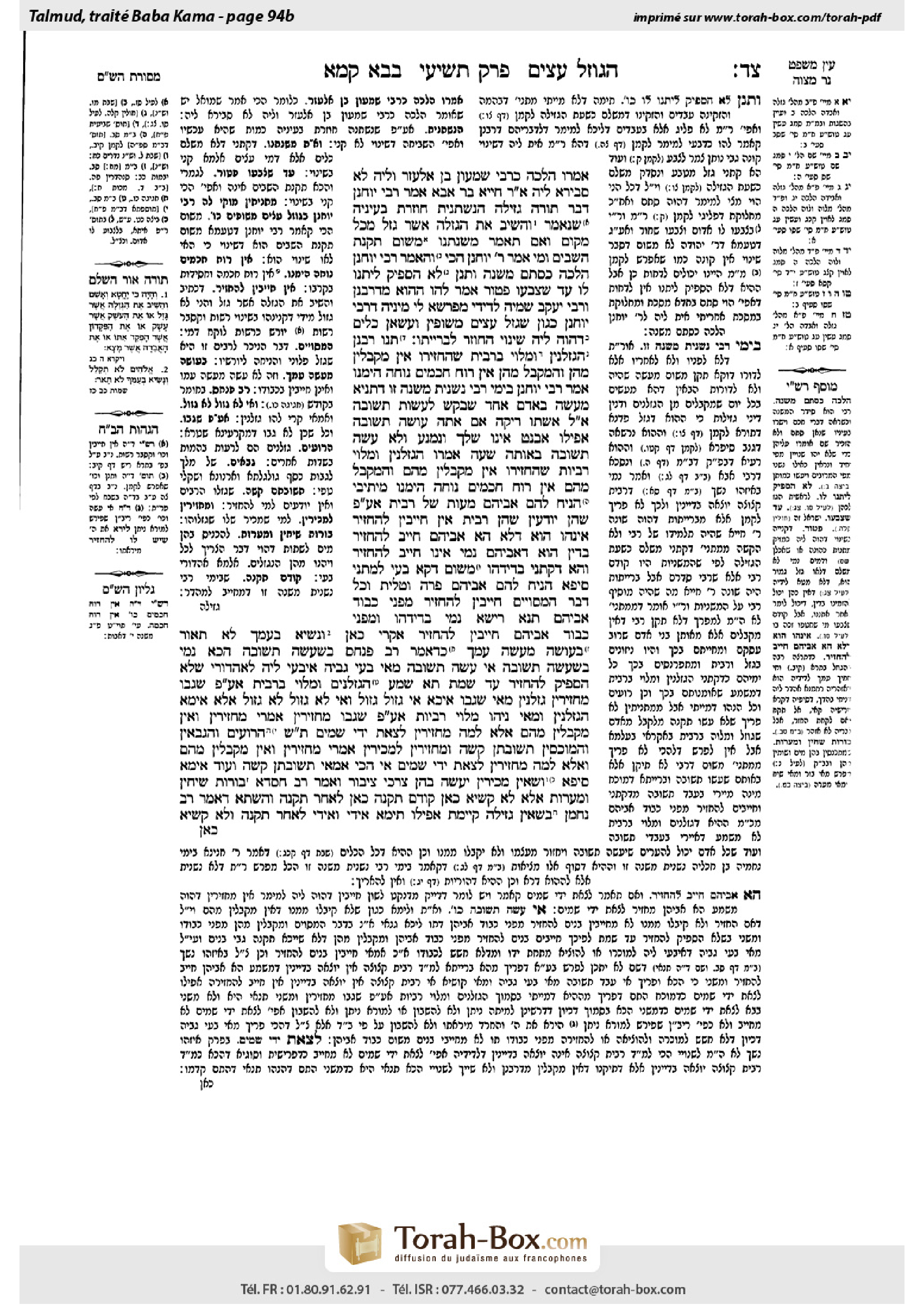
Bava Kamma 94b: Talmud study for Daf Yomi
Study the Talmud for Daf Yomi with scanned pages, Hebrew text, English translations from Sefaria and AI-generated French translations.
Passage selection and English or AI-generated French translation are available where the scan has annotations. Daf Study is independent of Torah-Box and Sefaria.
Browse Bava Kamma · בבא קמא · All tractatesBava Kamma 94b text and translations
This page of Bava Kamma includes the Aramaic text, an English translation and an AI-generated French translation, alongside the scan above.
בבא קמא צ״ד ב · Aramaic and Hebrew text
אָמְרוּ הֲלָכָה כְּרַבִּי שִׁמְעוֹן בֶּן אֶלְעָזָר. וְלֵיהּ לָא סְבִירָא לֵיהּ.
אָמַר רַבִּי חִיָּיא בַּר אַבָּא אָמַר רַבִּי יוֹחָנָן: דְּבַר תּוֹרָה – גְּזֵילָה הַנִּשְׁתַּנֵּית, חוֹזֶרֶת בְּעֵינֶיהָ. שֶׁנֶּאֱמַר: ״וְהֵשִׁיב אֶת הַגְּזֵלָה אֲשֶׁר גָּזָל״ – מִכׇּל מָקוֹם. וְאִם תֹּאמַר: מִשְׁנָתֵנוּ! מִשּׁוּם תַּקָּנַת הַשָּׁבִים.
וּמִי אָמַר רַבִּי יוֹחָנָן הָכִי?! וְהָאָמַר רַבִּי יוֹחָנָן: הֲלָכָה כִּסְתַם מִשְׁנָה, וּתְנַן: לֹא הִסְפִּיק לִיתְּנוֹ לוֹ עַד שֶׁצְּבָעוֹ – פָּטוּר!
אֲמַר לְהוּ הַהוּא מִדְּרַבָּנַן – וְרַבִּי יַעֲקֹב שְׁמֵיהּ: לְדִידִי מִפָּרְשָׁא לִי מִינֵּיהּ דְּרַבִּי יוֹחָנָן – כְּגוֹן שֶׁגָּזַל עֵצִים מְשׁוּפִּין וַעֲשָׂאָן כֵּלִים, דְּהָוֵה לֵיהּ שִׁינּוּי הַחוֹזֵר לִבְרִיָּיתוֹ.
תָּנוּ רַבָּנַן: הַגַּזְלָנִין וּמַלְוֵי בְּרִבִּית שֶׁהֶחְזִירוּ – אֵין מְקַבְּלִין מֵהֶן. וְהַמְקַבֵּל מֵהֶן – אֵין רוּחַ חֲכָמִים נוֹחָה הֵימֶנּוּ.
אָמַר רַבִּי יוֹחָנָן: בִּימֵי רַבִּי נִשְׁנֵית מִשְׁנָה זוֹ. דְּתַנְיָא: מַעֲשֶׂה בְּאָדָם אֶחָד שֶׁבִּקֵּשׁ לַעֲשׂוֹת תְּשׁוּבָה, אָמְרָה לוֹ אִשְׁתּוֹ: רֵיקָה! אִם אַתָּה עוֹשֶׂה תְּשׁוּבָה, אֲפִילּוּ אַבְנֵט אֵינוֹ שֶׁלְּךָ! וְנִמְנַע וְלֹא עָשָׂה תְּשׁוּבָה. בְּאוֹתָהּ שָׁעָה אָמְרוּ: הַגַּזְלָנִין וּמַלְוֵי רִבִּיּוֹת שֶׁהֶחְזִירוּ – אֵין מְקַבְּלִין מֵהֶם, וְהַמְקַבֵּל מֵהֶם – אֵין רוּחַ חֲכָמִים נוֹחָה הֵימֶנּוּ.
מֵיתִיבִי: הִנִּיחַ לָהֶם אֲבִיהֶם מָעוֹת שֶׁל רִבִּית, אַף עַל פִּי שֶׁהֵן יוֹדְעִין שֶׁהֵן רִבִּית – אֵין חַיָּיבִין לְהַחְזִיר. אִינְהוּ הוּא דְּלָא, הָא אֲבִיהֶם חַיָּיב לְהַחְזִיר.
בְּדִין הוּא דַּאֲבִיהֶם נָמֵי אֵינוֹ חַיָּיב לְהַחְזִיר; וְהָא דְּקָתָנֵי בְּדִידְהוּ – מִשּׁוּם דְּקָא בָּעֵי לְמִתְנֵי סֵיפָא: ״הִנִּיחַ לָהֶם אֲבִיהֶם פָּרָה וְטַלִּית וְכׇל דָּבָר הַמְסוּיָּים – חַיָּיבִין לְהַחְזִיר מִפְּנֵי כְּבוֹד אֲבִיהֶם״, תְּנָא רֵישָׁא נָמֵי בְּדִידְהוּ.
וּמִפְּנֵי כְּבוֹד אֲבִיהֶם – חַיָּיבִין לְהַחְזִיר? אֶקְרֵי כָּאן: ״וְנָשִׂיא בְעַמְּךָ לֹא תָאֹר״ – בְּעוֹשֶׂה מַעֲשֵׂה עַמְּךָ?!
כִּדְאָמַר רַב פִּנְחָס: בְּשֶׁעָשָׂה תְּשׁוּבָה; הָכָא נָמֵי, בְּשֶׁעָשָׂה תְּשׁוּבָה. אִי עָשָׂה תְּשׁוּבָה, מַאי בָּעֵי גַּבֵּיהּ? אִיבְּעִי לֵיהּ לְאַהְדּוֹרֵי! שֶׁלֹּא הִסְפִּיק לְהַחְזִיר עַד שֶׁמֵּת.
תָּא שְׁמַע: הַגַּזְלָנִים וּמַלְוֵי בְּרִבִּית, אַף עַל פִּי שֶׁגָּבוּ – מַחֲזִירִין.
גַּזְלָנִין – מַאי ״שֶׁגָּבוּ״ אִיכָּא? אִי גְּזוּל – גְּזוּל, וְאִי לָא גְּזוּל – לָא גְּזוּל! אֶלָּא אֵימָא: הַגַּזְלָנִין, וּמַאי נִיהוּ – מַלְוֵי רִבִּיּוֹת; אַף עַל פִּי שֶׁגָּבוּ – מַחְזִירִין! אָמְרִי: מַחְזִירִין, וְאֵין מְקַבְּלִין מֵהֶם.
אֶלָּא לָמָּה מַחְזִירִין? לָצֵאת יְדֵי שָׁמַיִם.
תָּא שְׁמַע: הָרוֹעִים וְהַגַּבָּאִין וְהַמּוֹכְסִין – תְּשׁוּבָתָן קָשָׁה, וּמַחְזִירִין לְמַכִּירִין!
אָמְרִי: מַחְזִירִין, וְאֵין מְקַבְּלִין מֵהֶם. וְאֶלָּא לָמָּה מַחְזִירִין? לָצֵאת יְדֵי שָׁמַיִם. אִי הָכִי, אַמַּאי תְּשׁוּבָתָן קָשָׁה?
וְעוֹד, אֵימָא סֵיפָא: וְשֶׁאֵין מַכִּירִין – יַעֲשֶׂה בָּהֶן צׇרְכֵי צִיבּוּר, וְאָמַר רַב חִסְדָּא: בּוֹרוֹת, שִׁיחִין וּמְעָרוֹת! אֶלָּא לָא קַשְׁיָא; כָּאן קוֹדֶם תַּקָּנָה, כָּאן לְאַחַר תַּקָּנָה.
וְהַשְׁתָּא דְּאָמַר רַב נַחְמָן: בְּשֶׁאֵין גְּזֵילָה קַיֶּימֶת – אֲפִילּוּ תֵּימָא אִידֵּי וְאִידֵּי לְאַחַר תַּקָּנָה; וְלָא קַשְׁיָא,
Bava Kamma 94b · English translation
Some said that the halakha is in accordance with the opinion of Rabbi Shimon ben Elazar, but Shmuel himself does not hold accordingly.
The Gemara continues the discussion of acquisition of a stolen item due to a change it underwent. Rabbi Ḥiyya bar Abba says that Rabbi Yoḥanan says: By Torah law, a stolen item that has changed is returned as is, as it is stated: “And he shall restore that which he took by robbery” (Leviticus 5:23). This indicates that he shall return it in any case, even if it has been changed. And if you say: In our mishna it is stated that if the stolen item is changed the robber gives monetary compensation rather than returning the item, that policy was instituted by the Sages due to the ordinance instituted for the penitent.
The Gemara asks: But did Rabbi Yoḥanan actually say that? But doesn’t Rabbi Yoḥanan say: The halakha is in accordance with an unattributed mishna, and we learned in a mishna with regard to first of the sheared wool (Ḥullin 135a): If the owner of the sheep did not manage to give the sheared wool to the priest before he dyed it, he is exempt from giving it to the priest. This indicates that dyeing the wool is a significant change.
One of the Rabbis, whose name was Rabbi Ya’akov, said to them: It was explained to me directly by Rabbi Yoḥanan that he was referring to a case where he robbed another of sanded wood and fashioned it into vessels, which is a change in which the item can revert to its original state. Consequently, the robber does not acquire the item by Torah law, but rather due to the ordinance instituted for the penitent.
§ Having mentioned the ordinance instituted for the penitent, the Gemara discusses other details of this ordinance. The Sages taught in a baraita (Tosefta, Shevi’it 8:11): With regard to robbers or usurers that returned either the stolen item or the interest to the one from whom they took it, one should not accept it from them. And with regard to one who does accept it from them, the Sages are displeased with him, since by doing so he discourages those who wish to repent.
Rabbi Yoḥanan says: This mishna, i.e., the statement of the Tosefta, was taught in the days of Rabbi Yehuda HaNasi, as it is taught in a baraita: There was an incident with regard to one man who desired to repent after having been a thief for many years. His wife said to him: Empty one [reika], if you repent you will have to return all the stolen items to their rightful owners, and even the belt that you are wearing is not yours, and he refrained and did not repent. At that time, the Sages said: With regard to robbers or usurers that returned either the stolen item or the interest to the one from whom they took it, one should not accept it from them. And concerning one who does accept it from them, the Sages are displeased with him.
The Gemara raises an objection from a baraita: With regard to children whose deceased father left them money paid as interest, although they know that it is interest, they are not obligated to return it. The Gemara infers: They, the children, are the ones that are not obligated to return it, but their father would have been obligated to return it, and his victims may accept his money.
The Gemara responds: By right, the baraita should have taught that their father also would not have been obligated to return it. And the fact that the baraita teaches this halakha with regard to the children is because of the fact that the baraita wants to teach a halakha in the latter clause: If their deceased father left them a cow, or a garment, or any other specific item he had stolen or taken as interest, they are obligated to return it due to the honor of their father, so that the item not serve as a reminder to all that their father transgressed. Since this halakha needs to be stated specifically with regard to the children, the first clause of the baraita is also taught with regard to them.
The Gemara asks: But is it true that due to the honor of their father they are obligated to return the item or money? I will read here the verse: “You shall not revile God, nor curse a ruler of your people” (Exodus 22:27), from which the Sages inferred that the prohibition against cursing a ruler is in effect only with regard to a ruler that acts as a member of your people, i.e., in accordance with Torah law. One who curses a wicked ruler does not violate this prohibition. Similarly, if one’s father is wicked, the mitzva to honor him should not apply. Why would his children have to return items that he stole due to his honor?
The Gemara responds: It is like that which Rav Pineḥas said concerning a different case: This is a case where he repented. Here too, it is a case where the father repented, and since he is no longer wicked, his children are obligated to honor him. The Gemara asks: If he repented, what was the stolen item or interest doing with him? He should have returned it while he was still alive. The Gemara responds: It is a case where he did not manage to return it before he died. Consequently, the children must return the items in order to uphold their father’s honor.
The Gemara raises another contradiction: Come and hear the statement of another baraita: With regard to robbers and usurers, although they collected the stolen item or interest, they return it.
The Gemara first clarifies the meaning of the baraita: In the case of robbers, what collection is there, i.e., why did the baraita use the term: Collected, in this context? If they robbed, they robbed and did not collect anything; and if they did not rob, they did not rob and cannot be called robbers at all. Rather, emend the text of the baraita to say: With regard to robbers, and who are they, i.e., what is meant by the term: Robbers? It is referring to usurers. The Gemara resumes its citation of the baraita: Although they collected the interest, they must return it. This is contrary to the ruling of the Tosefta that if robbers and usurers return what they have taken, it is not accepted. The Gemara explains: Say that this baraita means that they return it, but one does not accept it from them.
The Gemara asks: But why do they return it if it will not be accepted? The Gemara responds: In order to fulfill their obligation to Heaven. In order to fully repent, they must at least offer to return to the debtors the interest they took unlawfully.
The Gemara raises a contradiction from another source. Come and hear the statement of another baraita: With regard to shepherds who allow their animals to graze in other people’s fields, thereby stealing from the owners; or tax collectors who are hired to collect taxes on behalf of the government and collect excessive sums; or tax collectors who purchase the right to collect taxes themselves and collect unlawfully, their repentance is difficult, since they steal from the public. It is difficult for them to find every one of their victims in order to pay them restitution, and they must return what they have stolen to whomever they recognize as victims of their theft. This baraita indicates that thieves do return what they have stolen.
The Gemara answers: Say that they return it, but one does not accept it from them. The Gemara asks: But why do they return it if it will not be accepted? The Gemara responds: In order to fulfill their obligation to Heaven. The Gemara asks: If so, if they are not actually obligated to return what they have stolen, why is their repentance difficult?
And furthermore, say the latter clause of the baraita: And as for the money belonging to those that they do not recognize as their victims, they should use that money for community needs. And Rav Ḥisda says: This means providing pits, ditches, and caves, which benefit the general public. This indicates that a thief actually does pay back what he has stolen. Rather, this contradiction must be resolved differently. It is not difficult: Here, where the baraita states that he must actually return what he has stolen, it is referring to a time before the ordinance for the penitent was instituted. There, where the baraita states that one does not accept the repayment from a robber, it is referring to a time after the ordinance was instituted.
The Gemara adds: And now that Rav Naḥman says that when the Sages say that he does not return what he has stolen, they refer only to a case where the stolen item does not exist in its initial form, and you can even say that this and that, both baraitot, are referring to a time after the ordinance was instituted, and it is not difficult.
Bava Kamma 94b · Traduction française (IA)
Certains dirent que la halakha suit l'opinion de Rabbi Shimon ben Elazar, mais Shmuel lui-même ne l'adopte pas.
La Guemara continue la discussion sur l'acquisition d'un objet volé en raison du changement qu'il a subi. Rabbi Ḥiyya bar Abba dit que Rabbi Yoḥanan dit : Selon la loi divine, un objet volé qui a subi un changement est rendu tel quel, comme il est dit : « Et il rendra ce qu'il a volé par vol » (Lévitique 5:23). Cela indique qu'il doit le rendre dans tous les cas, même s'il a subi un changement. Et si l'on dit : Dans notre mitsna, il est dit que si l'objet volé a subi un changement, le voleur paie une compensation monétaire plutôt que de rendre l'objet, cette politique a été instituée par les Sages en raison de l'ordonnance instituée pour le repentant.
La Guemara pose la question : Mais Rabbi Yoḥanan a-t-il vraiment dit cela ? Mais ne dit-il pas Rabbi Yoḥanan : La halakha suit une mitsna non attribuée, et nous avons appris dans une mitsna concernant le premier du laine tondue (Ḥullin 135a) : Si l'propriétaire du mouton n'a pas réussi à donner la laine tondue au prêtre avant de la teindre, il est exempt de lui donner la laine. Cela indique que la teinture de la laine est un changement significatif.
Un des Rabbins, dont le nom était Rabbi Ya’akov, dit à ceux-ci : Il m’a été expliqué directement par Rabbi Yoḥanan qu’il faisait référence à un cas où il avait volé du bois sablé et l’avait transformé en vases, ce qui est un changement dans lequel l’objet peut revenir à son état originel. Ainsi, le voleur ne possède pas l’objet selon la loi divine, mais plutôt en raison de l’ordonnance instituée pour le repentant.
§ Ayant mentionné l’ordonnance instituée pour le repentant, la Guemara discute d’autres détails de cette ordonnance. Les Sages ont enseigné dans une baraïta (Tosefta, Shevi’it 8:11) : Concernant les voleurs ou les usuriers qui ont rendu soit l’objet volé soit l’intérêt à celui d’qui ils l’avaient pris, on ne doit pas accepter cela d’eux. Et concernant celui qui accepte cela d’eux, les Sages sont mécontents, car cela décourage ceux qui souhaitent se repentir.
Rabbi Yoḥanan dit : Cette mitsva, c’est-à-dire l’affirmation de la Tosefta, a été enseignée aux jours de Rabbi Yehuda HaNasi, comme il est enseigné dans une baraïta : Il y avait un incident concernant un homme qui souhaitait se repentir après avoir été voleur pendant plusieurs années. Sa femme lui dit : Vide un [reika], si tu te repentiras, tu devras rendre tous les objets volés à leurs propriétaires légitimes, et même la ceinture que tu portes n’est pas tienne, et il s’est abstenu et n’a pas se repentir. À cette époque, les Sages dirent : Concernant les voleurs ou les usuriers qui ont rendu soit l’objet volé soit l’intérêt à celui d’qui ils l’avaient pris, on ne doit pas accepter cela d’eux. Et concernant celui qui accepte cela d’eux, les Sages sont mécontents.
La Guemara soulève une objection tirée d'une baraïta : Concernant les enfants dont le père décédé a laissé à ses enfants de l'argent payé comme intérêt, bien qu'ils sachent que c'est de l'intérêt, ils ne sont pas obligés de le rendre. La Guemara infère : Ce sont les enfants qui ne sont pas obligés de le rendre, mais leur père aurait été obligé de le rendre, et leurs victimes peuvent accepter son argent.
La Guemara répond : Selon la loi, la baraïta aurait dû enseigner que leur père n'était pas non plus obligé de le rendre. Et le fait que la baraïta enseigne cette halakha concernant les enfants est en raison du fait que la baraïta veut enseigner une halakha dans la clause ultérieure : Si leur père décédé a laissé à ses enfants une vache, ou une robe, ou tout autre objet qu'il avait volé ou pris comme intérêt, ils sont obligés de le rendre en raison de l'honneur de leur père, afin que l'objet ne serve pas de rappel à tous que leur père a transgressé. Puisque cette halakha doit être spécifiquement enseignée concernant les enfants, la première clause de la baraïta est également enseignée concernant eux.
La Guemara pose la question : Mais est-ce vrai que, en raison de l'honneur de leur père, ils sont obligés de rendre l'objet ou l'argent ? Je lirai ici la parole : « Tu ne diras pas le Seigneur, ni maudirais-tu le chef de ton peuple » (Exode 22:27), d'après laquelle les Sages ont inféré que l'interdiction de maudire un chef est en vigueur uniquement concernant un chef qui agit comme membre de ton peuple, c'est-à-dire selon la loi divine. Celui qui maudit un chef méchant ne viole pas cette interdiction. De même, si un père est méchant, la mitsva d'honorer son père ne devrait pas s'appliquer. Pourquoi ses enfants devraient-ils rendre les objets qu'il a volés en raison de son honneur ?
La Guemara répond : C'est comme ce que Rav Pinéhas a dit concernant un cas différent : C'est un cas où il s'est repenti. Ici aussi, c'est un cas où le père s'est repenti, et puisque désormais il n'est plus méchant, ses enfants sont obligés d'honorer son. La Guemara pose la question : Si il s'est repenti, que faisait l'objet volé ou l'intérêt avec lui ? Il aurait dû le rendre pendant qu'il était encore vivant. La Guemara répond : C'est un cas où il n'a pas réussi à le rendre avant sa mort. Ainsi, les enfants doivent rendre les objets afin de maintenir l'honneur de leur père.
La Guemara soulève une autre contradiction : Viens écouter la déclaration d'une autre baraïta : Concernant les voleurs et les usuriers, bien qu'ils aient collecté l'objet volé ou l'intérêt, ils le rendent.
La Guemara commence par clarifier le sens de la baraïta : Dans le cas des voleurs, quelle collecte y a-t-il, c'est-à-dire pourquoi la baraïta utilise le terme : Collecté, dans ce contexte ? S'ils ont volé, ils ont volé et n'ont pas collecté quoi que ce soit ; et s'ils n'ont pas volé, ils n'ont pas volé et ne peuvent être appelés voleurs du tout. Plutôt, corrigez le texte de la baraïta pour dire : En ce qui concerne les voleurs, et qui sont-ils, c'est-à-dire quel est le sens du terme : Voleurs ? Il s'agit des usuriers. La Guemara reprend son citation de la baraïta : Bien qu'ils aient collecté l'intérêt, ils doivent le rendre. Cela contredit la décision de la Tosefta qui stipule que si des voleurs et des usuriers rendent ce qu'ils ont pris, cela n'est pas accepté. La Guemara explique : Dites que cette baraïta signifie qu'ils doivent le rendre, mais on ne l'accepte pas d'eux.
La Guemara pose la question : Mais pourquoi doivent-ils le rendre si cela ne sera pas accepté ? La Guemara répond : Pour remplir leur obligation envers Dieu. Afin de se repentir pleinement, ils doivent au moins offrir de rendre à leurs créanciers l'intérêt qu'ils ont pris illégalement.
La Guemara soulève une contradiction à partir d'une autre source. Venez écouter la déclaration d'une autre baraïta : En ce qui concerne les bergers qui permettent à leurs bêtes de paître dans les champs des autres, en volant ainsi les propriétaires ; ou les recueillers d'impôts qui sont engagés par l'État à recouvrer des impôts et recourent à des montants excessifs ; ou les recueillers d'impôts qui achètent le droit de recouvrer des impôts eux-mêmes et recourent illégalement, leur repentir est difficile, car ils volent le public. Il est difficile pour eux de trouver chaque victime de leurs vols afin de leur rendre réparation, et ils doivent rendre ce qu'ils ont volé à ceux qu'ils reconnaissent comme victimes de leur vol. Cette baraïta indique que les voleurs rendent effectivement ce qu'ils ont volé.
La Guemara répond : Dites qu'ils le rendent, mais on ne l'accepte pas d'eux. La Guemara pose la question : Mais pourquoi doivent-ils le rendre si cela ne sera pas accepté ? La Guemara répond : Pour remplir leur obligation envers le Royaume des Cieux. La Guemara pose la question : Si tel est le cas, pourquoi leur repentir est-il difficile si ils ne sont pas réellement obligés de rendre ce qu'ils ont volé ?
Et de plus, dites la dernière partie de la baraïta : Et concernant l'argent appartenant à ceux qu'ils ne reconnaissent pas comme leurs victimes, ils doivent utiliser cet argent pour les besoins de la communauté. Et Rav Ḥisda dit : Cela signifie fournir des fossés, des déblais et des grottes, qui profitent au public en général. Cela indique que le voleur rend effectivement ce qu'il a volé. Plutôt, cette contradiction doit être résolue différemment. Il n'est pas difficile : Ici, où la baraïta stipule qu'il doit effectivement rendre ce qu'il a volé, il s'agit d'une époque avant l'ordonnance pour le repentir. Là, où la baraïta stipule qu'on ne l'accepte pas du voleur, il s'agit d'une époque après l'ordonnance a été instituée.
La Guemara ajoute : Et maintenant que Rav Naḥman dit que lorsque les Sages disent qu'il ne doit pas rendre ce qu'il a volé, ils font référence uniquement au cas où l'objet volé n'existe plus sous sa forme initiale, et vous pouvez même dire que cette et celle, les deux baraïtes, font référence à une époque après l'ordonnance a été instituée, et il n'est pas difficile.
Traduction française générée par IA à partir de l’édition anglaise de Sefaria. Vérifie toujours un passage avec le texte source.
Text from Sefaria: William Davidson Edition - Vocalized Aramaic (CC BY NC); William Davidson Edition - English (CC BY NC).