Bava Kamma 95a: Talmud study for Daf Yomi
Study the Talmud for Daf Yomi with scanned pages, Hebrew text, English translations from Sefaria and AI-generated French translations.
Passage selection and English or AI-generated French translation are available where the scan has annotations. Daf Study is independent of Torah-Box and Sefaria.
Browse Bava Kamma · בבא קמא · All tractatesBava Kamma 95a text and translations
This page of Bava Kamma includes the Aramaic text, an English translation and an AI-generated French translation, alongside the scan above.
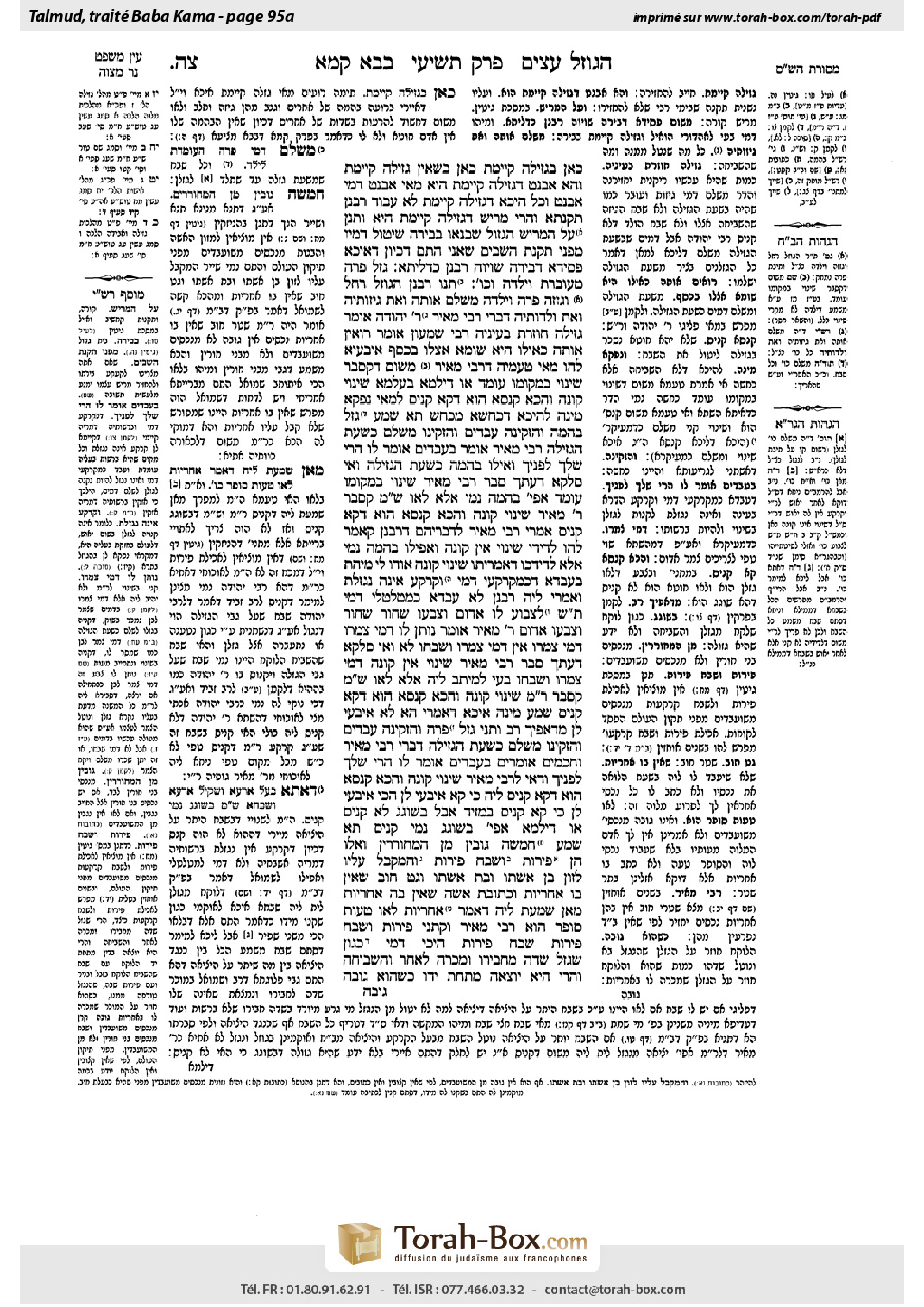
בבא קמא צ״ה א · Aramaic and Hebrew text
כָּאן בִּגְזֵילָה קַיֶּימֶת, כָּאן בְּשֶׁאֵין גְּזֵילָה קַיֶּימֶת. וְהָא אַבְנֵט – דִּגְזֵילָה קַיֶּימֶת הִיא! מַאי ״אַבְנֵט״ – דְּמֵי אַבְנֵט.
וְכֹל הֵיכָא דִּגְזֵילָה קַיֶּימֶת, לָא עֲבוּד רַבָּנַן תַּקַּנְתָּא?! וַהֲרֵי מָרִישׁ, דִּגְזֵילָה קַיֶּימֶת הִיא; וּתְנַן: עַל הַמָּרִישׁ הַגָּזוּל שֶׁבְּנָאוֹ בַּבִּירָה, שֶׁיִּטּוֹל דָּמָיו – מִפְּנֵי תַּקָּנַת הַשָּׁבִים! שָׁאנֵי הָתָם, דְּכֵיוָן דְּאִיכָּא פְּסֵידָא דְבִירָה – שַׁוְּיוּהָ רַבָּנַן כִּדְלֵיתַהּ.
גָּזַל פָּרָה מְעוּבֶּרֶת וְיָלְדָה וְכוּ׳. תָּנוּ רַבָּנַן: הַגּוֹזֵל רָחֵל וּגְזָזָהּ, פָּרָה וְיָלְדָה – מְשַׁלֵּם אוֹתָהּ וְאֶת גִּיזּוֹתֶיהָ וְאֶת וַלְדוֹתֶיהָ, דִּבְרֵי רַבִּי מֵאִיר. רַבִּי יְהוּדָה אוֹמֵר: גְּזֵילָה חוֹזֶרֶת בְּעֵינֶיהָ. רַבִּי שִׁמְעוֹן אוֹמֵר: רוֹאִין אוֹתָהּ כְּאִילּוּ הִיא שׁוּמָא אֶצְלוֹ בְּכֶסֶף.
אִיבַּעְיָא לְהוּ: מַאי טַעְמֵיהּ דְּרַבִּי מֵאִיר – מִשּׁוּם דְּקָסָבַר: שִׁינּוּי בִּמְקוֹמוֹ עוֹמֵד? אוֹ דִילְמָא, בְּעָלְמָא שִׁינּוּי קוֹנֶה, וְהָכָא קְנָסָא הוּא דְּקָא קָנֵיס?
לְמַאי נָפְקָא מִינַּהּ? לְהֵיכָא דִּכְחַשָׁה מִכְחָשׁ.
תָּא שְׁמַע: גָּזַל בְּהֵמָה וְהִזְקִינָה, עֲבָדִים וְהִזְקִינוּ – מְשַׁלֵּם כִּשְׁעַת הַגְּזֵילָה. רַבִּי מֵאִיר אוֹמֵר, בַּעֲבָדִים אוֹמֵר לוֹ: ״הֲרֵי שֶׁלְּךָ לְפָנֶיךָ״. וְאִילּוּ בְּהֵמָה – כִּשְׁעַת הַגְּזֵילָה;
וְאִי סָלְקָא דַּעְתָּךְ סָבַר רַבִּי מֵאִיר שִׁינּוּי בִּמְקוֹמוֹ עוֹמֵד, אֲפִילּוּ בְּהֵמָה נָמֵי! אֶלָּא לָאו שְׁמַע מִינַּהּ, קָסָבַר רַבִּי מֵאִיר שִׁינּוּי קוֹנֶה – וְהָכָא קְנָסָא הוּא דְּקָא קָנֵיס?
אָמְרִי, רַבִּי מֵאִיר לְדִבְרֵיהֶם דְּרַבָּנַן קָאָמַר לְהוּ: לְדִידִי – שִׁינּוּי אֵין קוֹנֶה, וַאֲפִילּוּ בְּהֵמָה נָמֵי. אֶלָּא לְדִידְכוּ, דְּאָמְרִיתוּ שִׁינּוּי קוֹנֶה – אוֹדוֹ לִי מִיהַת בְּעַבְדָּא, דְּכִמְקַרְקְעֵי דָּמֵי, וְקַרְקַע אֵינָהּ נִגְזֶלֶת! וְאָמְרִי לֵיהּ רַבָּנַן: לָא, עַבְדָּא כְּמִטַּלְטְלִי דָּמֵי.
תָּא שְׁמַע: לִצְבּוֹעַ לוֹ אָדוֹם וּצְבָעוֹ שָׁחוֹר, שָׁחוֹר וּצְבָעוֹ אָדוֹם – רַבִּי מֵאִיר אוֹמֵר: נוֹתֵן לוֹ דְּמֵי צַמְרוֹ. דְּמֵי צַמְרוֹ – אִין, דְּמֵי צַמְרוֹ וְשִׁבְחוֹ – לָא; וְאִי סָלְקָא דַּעְתָּךְ סָבַר רַבִּי מֵאִיר שִׁינּוּי אֵין קוֹנֶה, דְּמֵי צַמְרוֹ וְשִׁבְחוֹ בָּעֵי לְמִיתַּב לֵיהּ!
אֶלָּא לָאו שְׁמַע מִינַּהּ, קָסָבַר רַבִּי מֵאִיר שִׁינּוּי קוֹנֶה, וְהָכָא קְנָסָא הוּא דְּקָא קָנֵיס? שְׁמַע מִינַּהּ.
אִיכָּא דְאָמְרִי: הָא – לָא אִיבְּעִי לַן; מִדְּאָפֵיךְ רַב וְתָנֵי: ״גָּזַל פָּרָה וְהִזְקִינָה, עֲבָדִים וְהִזְקִינוּ – מְשַׁלֵּם כִּשְׁעַת הַגְּזֵילָה, דִּבְרֵי רַבִּי מֵאִיר. וַחֲכָמִים אוֹמְרִים: בַּעֲבָדִים – אוֹמֵר לוֹ: הֲרֵי שֶׁלְּךָ לְפָנֶיךָ״ – וַדַּאי לְרַבִּי מֵאִיר שִׁינּוּי קוֹנֶה, וְהָכָא קְנָסָא הוּא דְּקָא קָנֵיס לֵיהּ.
כִּי קָא אִיבְּעִי לַן – הָכִי אִיבְּעִי לַן: כִּי קָא קָנֵיס – בְּמֵזִיד, אֲבָל בְּשׁוֹגֵג לָא קָנֵיס; אוֹ דִילְמָא אֲפִילּוּ בְּשׁוֹגֵג נָמֵי קָנֵיס?
תָּא שְׁמַע: חֲמִשָּׁה גּוֹבִין מִן הַמְחוֹרָרִין,
וְאֵלּוּ הֵן: פֵּירוֹת, וּשְׁבַח פֵּירוֹת, וְהַמְקַבֵּל עָלָיו לָזוּן בֶּן אִשְׁתּוֹ וּבַת אִשְׁתּוֹ, וְגֵט חוֹב שֶׁאֵין בּוֹ אַחְרָיוּת, וּכְתוּבַּת אִשָּׁה שֶׁאֵין בָּהּ אַחְרָיוּת.
מַאן שָׁמְעַתְּ לֵיהּ דְּאָמַר: אַחְרָיוּת – לָאו טָעוּת סוֹפֵר הוּא? רַבִּי מֵאִיר; וְקָתָנֵי: פֵּירוֹת וּשְׁבַח פֵּירוֹת.
שְׁבַח פֵּירוֹת הֵיכִי דָּמֵי? כְּגוֹן שֶׁגָּזַל שָׂדֶה מֵחֲבֵירוֹ וּמְכָרָהּ לְאַחֵר, וְהִשְׁבִּיחָהּ, וַהֲרֵי הִיא יוֹצְאָה מִתַּחַת יָדוֹ. כְּשֶׁהוּא גּוֹבֶה,
Bava Kamma 95a · English translation
Here, the baraita that rules that one may accept the stolen item is referring to a case where the stolen item still exists. There, the baraita that rules not to accept it even if the robber seeks only to fulfill his obligation to Heaven is referring to a case where the stolen item does not still exist. The Gemara asks: But the incident in which the robber’s wife told him that he would have to return even the belt, which was the impetus for instituting the ordinance for the penitents, was a case where the stolen item still exists, in which case the robber would be obligated to return it even after the ordinance was instituted. The Gemara answers: What is meant by: Even the belt? The value of the belt, but the actual belt was no longer in his possession.
The Gemara asks: And is it so that the Sages did not institute an ordinance for the penitent anywhere that the stolen item still exists? But there is the case of a beam, which is a stolen item that still exists, and we learned in a mishna (Gittin 55a): With regard to a stolen beam that the robber built into a building, the Sages instituted that the robbery victim should take its monetary value and not the actual beam because of the ordinance instituted for the penitent, i.e., so that the penitent not be required to destroy his house. This indicates that the ordinance instituted for the penitent is in effect even when the stolen item still exists. The Gemara answers: There it is different. Since in that case there is the loss of the entire building, the Sages treat the beam as though it were not in existence.
§ The mishna teaches: If one robbed another of a pregnant cow, and it then gave birth while in the robber’s possession, or if one robbed another of a ewe that was laden with wool and the robber then sheared it, he pays the owner the value of a cow that is ready to give birth, or the value of a ewe that is ready to be shorn. In connection with this, the Sages taught in a baraita: One who robs another of a ewe and sheared it, and similarly, one who robs another of a cow and it gave birth, must pay it and its sheared wool or it and its offspring; this is the statement of Rabbi Meir. Rabbi Yehuda says: A stolen item is returned as is. Rabbi Shimon says: A stolen item is viewed as though it had been monetarily appraised at the time of the robbery, and the robber pays only that amount.
The Gemara clarifies the different opinions in this baraita. A dilemma was raised before the Sages: What is the reasoning of Rabbi Meir, who holds that the robber returns the animal and its sheared wool or the animal and its offspring? Is it due to the fact that he holds that despite a change, the changed item remains in its place? Despite its changes, the animal always remained in the possession of the robbery victims, and consequently any increase in value belongs to them. Or, perhaps Rabbi Meir generally holds that one acquires an item due to a change in it, and therefore the wool or offspring should belong to the robber by right, but here it is a penalty that he imposes, which forces the robber to return items that are technically his.
The Gemara explains: In what case does the reasoning of Rabbi Meir make a practical difference? In a case where the stolen item was devalued since the time of the robbery. If Rabbi Meir’s reason is that despite a change, the changed item remains in its place, it is returned as is, even if its current value is less than what its value had been at the time of the robbery. But if he requires the robber to return the item itself because of a penalty, and by right the robber acquired the animal due to the change, then in this case, where the value decreased, the robber would be required to return what its value had been at the time of the robbery.
The Gemara attempts to find a solution to this question: Come and hear what was taught in the mishna (96b): If one robbed another of an animal and it aged while in his possession, consequently diminishing its value, or if one robbed another of slaves and they aged, he pays according to the value of the stolen item at the time of the robbery. Rabbi Meir says: With regard to slaves, the robber says to the owner: That which is yours is before you. The Gemara comments: But this indicates that with regard to an animal that aged while in the possession of the robber Rabbi Meir concedes to the first tanna, and he too holds that he pays according to what its value had been at the time of the robbery.
The Gemara continues: And if it enters your mind to say that Rabbi Meir holds that despite a change, the changed item remains in its place, then the animal should be returned as it is in the case of the animal that aged, as well. Rather, must one not conclude from the mishna that Rabbi Meir holds that one acquires an item due to a change in the item, but here, in the case of a stolen animal that subsequently was shorn or gave birth, the payment of wool or offspring is a penalty with which he penalizes the robber, so that the robber will not benefit from the increased value of the stolen item?
The Sages say in response: Rabbi Meir’s reasoning cannot be proven from the mishna, since it is possible to say that Rabbi Meir is speaking to the Rabbis in accordance with the Rabbis’ own statement. His statement should be understood as follows: According to my own opinion, one does not acquire an item due to a change in the item, and an animal that was stolen and then aged should be returned as it is now, as well. But according to you, who say that one acquires an item due to a change in it, agree with me in any event that with regard to a slave, he is returned as is. This is because his legal status is like that of real estate, and real estate cannot be stolen. And the Rabbis say to him in response: No, for the purpose of robbery, the legal status of a slave is like that of movable property.
The Gemara again attempts to find a solution to the question: Come and hear what was taught in the mishna (100b): If one gave wool to a dyer to dye it red for him and he dyed it black, or to dye it black and he dyed it red, Rabbi Meir says: The dyer gives the owner of the wool the value of his wool, since the dyer violated the owner’s wishes. It can be inferred from this mishna: The value of his wool, yes, he must give it; but the value of his wool and its enhancement, i.e., the amount by which the value of the wool increased because it was dyed, no, he need not give it. And if it enters your mind to say that Rabbi Meir holds that one does not acquire an item due to a change in the item, the dyer should be required to return the value of his wool and its enhancement to the owner, as it never left the owner’s possession.
Rather, isn’t it correct to conclude from the mishna that Rabbi Meir holds that one acquires an item due to a change in the item, but here, in the case of a stolen animal that was subsequently shorn or gave birth, the payment of wool or offspring is a penalty with which he penalizes the robber, so that the robber will not benefit from the increased value of the stolen item? The Gemara affirms this: Learn from the mishna that this is indeed the reasoning of Rabbi Meir.
There are those who say: This, i.e., Rabbi Meir’s reasoning, was never in question for us. Why not? From the fact that Rav reversed the opinions in the mishna on 96b and taught it as follows: If one robbed another of an animal and it aged, or if one robbed another of slaves and they aged, he pays according to what their value had been at the time of the robbery; this is the statement of Rabbi Meir. And the Rabbis say: With regard to slaves, the robber says to the owner: That which is yours is before you. Certainly, then, according to the opinion of Rabbi Meir, one acquires an item due to a change in the item, which is why the robber pays according to what its value had been at the time of the robbery. But here, in the case of the cow that gave birth or the ewe that was shorn, the payment of offspring or wool is a penalty with which he penalizes the robber.
The Gemara continues the alternative explanation. When we asked the question, this is how we asked it: When Rabbi Meir penalizes the robber, is it only for one who robbed intentionally, but if one took an item from its owner unintentionally, Rabbi Meir does not penalize the robber? Or perhaps he penalizes even one who took an item from its owner unintentionally.
The Gemara tries to resolve this question: Come and hear a proof from a baraita: Five types of monetary claims are collected only from unsold [meḥorarin] property, i.e., property that is still in possession of its owner and has not been sold in the meantime.
And these are they: Produce, and the enhanced value of produce. Even if one has the right to the produce of a particular property, or the gain accrued from that produce, he cannot claim this payment from liened property. The Gemara continues with the list of monetary claims collected from unsold property: And one who accepts upon himself at the time of his betrothal the obligation to provide sustenance for his wife’s son or his wife’s daughter from a previous marriage; and a promissory note that has no property guarantee, i.e., a document that does not explicitly state that all of the properties of the debtor will serve to guarantee payment of the debt; and similarly, a woman’s marriage contract that has no property guarantee.
The Gemara clarifies: Whom did you hear that says that omission of the guarantee of the sale from the document is not a scribal error? It is Rabbi Meir. There is a dispute between Rabbi Meir and the Rabbis with regard to a promissory note that does not contain a property guarantee. According to the Rabbis, it was omitted in error and is always considered as having been written in the document. Rabbi Meir holds that a promissory note that does not contain a property guarantee cannot be used to collect property that has been liened or sold; it can be used to collect only unsold property. This baraita is therefore in accordance with Rabbi Meir’s opinion. And the baraita teaches that produce and the enhanced value of produce are collected only from unsold property.
The Gemara clarifies: What are the circumstances in which he collects the enhanced value of produce? It is a case where one robbed another of a field, and then sold it to another, and the purchaser enhanced it, and it is now leaving the possession of the purchaser because the robbery victim has proved in court that this field is his. When the purchaser collects from the robber who sold him this field, in order to recoup what he had paid,
Bava Kamma 95a · Traduction française (IA)
Ici, la baraïta qui stipule qu'on peut accepter l'objet volé fait référence à un cas où l'objet volé existe encore. Là, la baraïta qui stipule qu'on ne doit pas l'accepter même si le voleur cherche seulement à remplir son obligation envers le Ciel fait référence à un cas où l'objet volé n'existe plus. La Guemara pose la question : Mais l'incident où la femme du voleur lui a dit qu'il devait rendre même la ceinture, qui a été le motif de l'ordonnance instituée pour les repentis, était un cas où l'objet volé existait encore, dans lequel cas le voleur aurait été tenu de le rendre même après l'institution de l'ordonnance. La Guemara répond : De quoi parle-t-on lorsqu'on dit : Même la ceinture ? La valeur de la ceinture, mais la ceinture elle-même n'était plus en son possession.
La Guemara pose la question : Et est-ce que les Sages n'ont pas institué une ordonnance pour le repentir nulle part où l'objet volé existe encore ? Mais il y a le cas d'un poteau, qui est un objet volé qui existe encore, et nous avons appris dans une mitsva (Gittin 55a) : Concernant un poteau volé que le voleur a intégré dans un bâtiment, les Sages ont institué que le propriétaire du vol devrait prendre sa valeur monétaire et non l'objet lui-même, en raison de l'ordonnance instituée pour le repentir, c'est-à-dire afin que le repentir ne soit pas tenu de détruire sa maison. Cela indique que l'ordonnance instituée pour le repentir est en vigueur même lorsque l'objet volé existe encore. La Guemara répond : C'est différent là. Puisque dans ce cas il y a la perte de l'ensemble du bâtiment, les Sages traitent le poteau comme s'il n'existait pas.
§ La mitsna enseigne : Si l'on a volé à un autre un taureau enceinte, et qu'il a ensuite donné naissance tout en étant en possession du voleur, ou si l'on a volé à un autre une brebis chargée de laine et que le voleur a ensuite déshairé la brebis, il paie au propriétaire la valeur d'un taureau prêt à donner naissance, ou la valeur d'une brebis prête à être déshairée. En ce qui concerne cela, les Sages ont enseigné dans une baraïta : Celui qui vole à un autre une brebis et la déshairé, et de même celui qui vole à un autre un taureau et qu'il a donné naissance, doit payer la brebis et sa laine déshairée ou le taureau et ses petits ; c'est la déclaration de Rabbi Meir. Rabbi Yéhuda dit : L'objet volé est rendu tel quel. Rabbi Shimon dit : L'objet volé est considéré comme s'il avait été évalué monétairment au moment du vol, et le voleur paie seulement cette somme.
La Guemara clarifie les différentes opinions dans cette baraïta. Un dilemme a été soulevé devant les Sages : Quel est le raisonnement de Rabbi Meir, qui affirme que le voleur rend l'animal et sa laine déshairée ou l'animal et ses petits ? Est-ce en raison du fait qu'il considère que malgré un changement, l'objet modifié reste à sa place ? Malgré ses changements, l'animal reste toujours en possession du propriétaire volé, et par conséquent toute augmentation de valeur appartient à lui. Ou, peut-être Rabbi Meir considère généralement que l'on acquiert un objet en raison d'un changement dans cet objet, et par conséquent la laine ou les petits devraient appartenir au voleur par droit, mais ici il s'agit d'une sanction qu'il impose, qui force le voleur à rendre des objets qui sont techniquement à lui.
La Guemara explique : Dans quel cas le raisonnement de Rabbi Meir fait-il une différence pratique ? Dans un cas où l'objet volé a perdu de sa valeur depuis le moment du vol. Si le raisonnement de Rabbi Meir est que malgré un changement, l'objet modifié reste à sa place, il est rendu tel quel, même si sa valeur actuelle est inférieure à ce qu'elle était au moment du vol. Mais si il exige que le voleur rende l'objet lui-même en raison d'une sanction, et par droit le voleur a acquis l'animal en raison du changement, alors dans ce cas, où la valeur a diminué, le voleur serait tenu de rendre ce qu'il valait au moment du vol.
La Guemara tente de trouver une solution à cette question : Viens écouter ce qui a été enseigné dans la mitsna (96b) : Si l'on a volé à un autre un animal et qu'il a vieilli tout en étant en possession du voleur, ce qui a diminué sa valeur, ou si l'on a volé à un autre des esclaves et qu'ils ont vieilli, il paie selon la valeur de l'objet volé au moment du vol. Rabbi Meir dit : Concernant les esclaves, le voleur dit au propriétaire : Ce qui est à toi est devant toi. La Guemara commente : Mais cela indique que concernant un animal qui a vieilli tout en étant en possession du voleur, Rabbi Meir reconnaît la première opinion, et il aussi considère qu'il paie selon ce qu'il valait au moment du vol.
La Guemara continue : Et si cela entre en votre tête de dire que Rabbi Meir considère que malgré un changement, l'objet modifié reste à sa place, alors l'animal devrait être rendu tel quel dans le cas de l'animal qui a vieilli, tout comme cela. Plutôt, ne devons-nous pas conclure à partir de la mitsna que Rabbi Meir considère que l'on acquiert un objet en raison d'un changement dans l'objet, mais ici, dans le cas d'un animal volé qui a ensuite été déshairé ou a donné naissance, le paiement de la laine ou des petits est une sanction avec laquelle il sanctionne le voleur, afin que le voleur ne bénéficie pas de la valeur augmentée de l'objet volé.
Les Sages répondent : Le raisonnement de Rabbi Meir ne peut pas être prouvé à partir de la mitsna, car il est possible de dire que Rabbi Meir parle aux Rabbins selon leur propre déclaration. Son déclaration devrait être comprise comme suit : Selon mon propre avis, l'on ne peut pas acquérir un objet en raison d'un changement dans l'objet, et un animal volé qui a vieilli devrait être rendu tel quel. Mais selon vous, qui dites que l'on acquiert un objet en raison d'un changement dans l'objet, vous convenez avec moi dans tous les cas que concernant un esclave, il est rendu tel quel. Cela est dû au fait que son statut juridique est comme celui d'une propriété immobilière, et la propriété immobilière ne peut pas être volée. Et les Rabbins répondent à lui : Non, en raison du vol, le statut juridique d'un esclave est comme celui d'un bien mobile.
La Guemara tente à nouveau de trouver une solution à la question : Viens écouter ce qui a été enseigné dans la mitsva (100b) : Si l'on donne du laine à un teinturier pour le teindre en rouge et qu'il le teint en noir, ou si l'on lui donne du laine pour le teindre en noir et qu'il le teint en rouge, Rabbi Meïr dit : Le teinturier doit donner à l'propriétaire de la laine la valeur de sa laine, car le teinturier a violé les souhaits de l'propriétaire. On peut en déduire de cette mitsva : La valeur de sa laine, oui, il doit la donner ; mais la valeur de sa laine et son accroissement, c'est-à-dire la quantité par laquelle la valeur de la laine a augmenté en raison de la teinture, non, il n'a pas besoin de la donner. Et si vous pensez que Rabbi Meïr considère que l'on ne peut acquérir un objet en raison d'un changement dans l'objet, le teinturier devrait être tenu de rendre la valeur de sa laine et son accroissement à l'propriétaire, car cela n'a jamais quitté la possession de l'propriétaire.
Plutôt, n'est-ce pas correct de conclure de la mitsva que Rabbi Meïr considère que l'on peut acquérir un objet en raison d'un changement dans l'objet, mais ici, dans le cas d'un animal volé qui a ensuite été rasé ou qui a donné naissance, le paiement de la laine ou des petits est une sanction avec laquelle on sanctionne le voleur, afin que le voleur ne profite pas de la valeur accrue de l'objet volé ? La Guemara confirme cela : Apprenez de la mitsva que c'est effectivement la raison de Rabbi Meïr.
Certains disent : Cela, c'est-à-dire la raison de Rabbi Meïr, n'était jamais en question pour nous. Pourquoi pas ? Parce que Rav a inversé les opinions de la mitsna sur 96b et les a enseignées ainsi : Si l'on a volé un animal à un autre et qu'il a vieilli, ou si l'on a volé des esclaves à un autre et qu'ils ont vieilli, il paie selon la valeur qu'ils avaient au moment du vol ; c'est l'opinion de Rabbi Meïr. Et les Rabbins disent : En ce qui concerne les esclaves, le voleur dit à l'propriétaire : Ce qui est à toi est devant toi. Cela étant, selon l'opinion de Rabbi Meïr, l'on acquiert un objet en raison d'un changement dans l'objet, ce qui explique pourquoi le voleur paie selon la valeur qu'avait l'objet au moment du vol. Mais ici, dans le cas de la vache qui a donné naissance ou de l'agneau qui a été rasé, le paiement de la progéniture ou de la laine est une sanction avec laquelle on sanctionne le voleur.
La Guemara continue l'explication alternative. Quand nous avons posé la question, c'est ainsi que nous l'avons posée : Quand Rabbi Meïr sanctionne le voleur, est-ce seulement pour celui qui a volé intentionnellement, mais si l'on a pris un objet de son propriétaire sans intention, Rabbi Meïr ne sanctionne-t-il pas le voleur ? Ou peut-être sanctionne-t-il même celui qui a pris un objet de son propriétaire sans intention.
La Guemara tente de résoudre cette question : Viens écouter une preuve d'une baraïta : Cinq types de revendications monétaires sont collectés uniquement à partir de biens non vendus [meḥorarin], c'est-à-dire de biens qui sont encore en possession de leur propriétaire et n'ont pas été vendus en attendant.
Et ce sont ceux-ci : Les produits, et la valeur accrue des produits. Même si l'on a le droit aux produits d'une propriété particulière, ou à la valeur acquise de ces produits, on ne peut pas réclamer ce paiement à partir de biens liés. La Guemara continue avec la liste des revendications monétaires collectées à partir de biens non vendus : Et celui qui s'est engagé, au moment de son mariage, à fournir aux enfants de son épouse ou aux filles de son épouse d'un précédent mariage, la subsistance ; et un billet de change qui n'a pas de garantie de propriété, c'est-à-dire un document qui ne précise pas explicitement que toutes les propriétés du débiteur serviront à garantir le paiement de la dette ; et de même, un contrat de mariage d'une femme qui n'a pas de garantie de propriété.
La Guemara clarifie : De qui avez-vous entendu dire que l'omission de la garantie de la vente dans le document n'est pas une erreur de scribe ? C'est Rabbi Meïr. Il y a un désaccord entre Rabbi Meïr et les Rabbins concernant un billet de change qui ne contient pas de garantie de propriété. Selon les Rabbins, cela a été omis par erreur et est toujours considéré comme ayant été écrit dans le document. Rabbi Meïr considère qu'un billet de change qui ne contient pas de garantie de propriété ne peut être utilisé pour collecter des biens liés ou vendus ; il peut être utilisé uniquement pour collecter des biens non vendus. Cette baraïta est donc en accord avec l'opinion de Rabbi Meïr. Et la baraïta enseigne que les produits et la valeur accrue des produits sont collectés uniquement à partir de biens non vendus.
La Guemara clarifie : Quelles sont les circonstances dans lesquelles il collecte la valeur accrue des produits ? C'est le cas où l'on a volé un champ à un autre et l'a ensuite vendu à un autre, et l'acheteur a amélioré ce champ, et il est maintenant en train de quitter la possession de l'acheteur car le propriétaire du vol a prouvé en justice que ce champ est le sien. Quand l'acheteur collecte auprès du voleur qui lui a vendu ce champ, afin de récupérer ce qu'il a payé,
Traduction française générée par IA à partir de l’édition anglaise de Sefaria. Vérifie toujours un passage avec le texte source.
Text from Sefaria: William Davidson Edition - Vocalized Aramaic (CC BY NC); William Davidson Edition - English (CC BY NC).