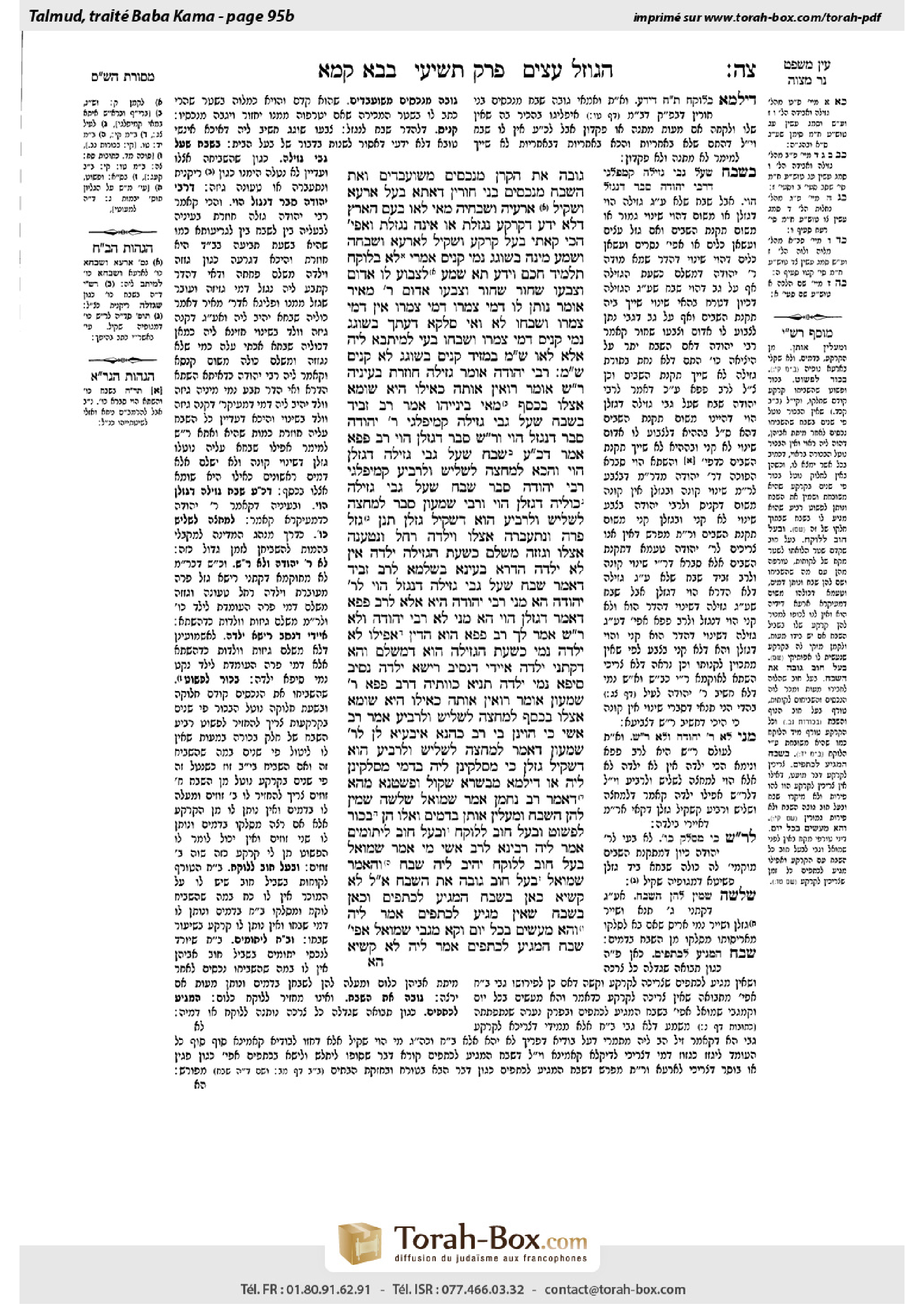
Bava Kamma 95b: Talmud study for Daf Yomi
Study the Talmud for Daf Yomi with scanned pages, Hebrew text, English translations from Sefaria and AI-generated French translations.
Passage selection and English or AI-generated French translation are available where the scan has annotations. Daf Study is independent of Torah-Box and Sefaria.
Browse Bava Kamma · בבא קמא · All tractatesBava Kamma 95b text and translations
This page of Bava Kamma includes the Aramaic text, an English translation and an AI-generated French translation, alongside the scan above.
בבא קמא צ״ה ב · Aramaic and Hebrew text
גּוֹבֶה אֶת הַקֶּרֶן מִנְּכָסִים מְשׁוּעְבָּדִים, וְאֶת הַשֶּׁבַח מִנְּכָסִים בְּנֵי חוֹרִין. דְּאָתֵא בַּעַל אַרְעָא, וְשָׁקֵיל אַרְעֵיהּ וּשְׁבָחֵיהּ.
מַאי, לָאו בְּעַם הָאָרֶץ – דְּלָא יָדַע דְּקַרְקַע נִגְזֶלֶת אוֹ אֵינָהּ נִגְזֶלֶת, וַאֲפִילּוּ הָכִי קָאָתֵי בַּעַל קַרְקַע וְשָׁקֵיל לְאַרְעָא וּשְׁבָחַהּ, וּשְׁמַע מִינַּהּ: בְּשׁוֹגֵג נָמֵי קָנֵיס? אָמְרִי: לָא; בְּלוֹקֵחַ תַּלְמִיד חָכָם, וְיָדַע.
תָּא שְׁמַע: לִצְבּוֹעַ לוֹ אָדוֹם וּצְבָעוֹ שָׁחוֹר, שָׁחוֹר וּצְבָעוֹ אָדוֹם – רַבִּי מֵאִיר אוֹמֵר: נוֹתֵן לוֹ דְּמֵי צַמְרוֹ. דְּמֵי צַמְרוֹ – אִין, דְּמֵי צַמְרוֹ וְשִׁבְחוֹ – לָא;
וְאִי סָלְקָא דַעְתָּךְ בְּשׁוֹגֵג נָמֵי קָנֵיס, דְּמֵי צַמְרוֹ וְשִׁבְחוֹ בָּעֵי לְמִיתְּבָא לֵיהּ! אֶלָּא לָאו שְׁמַע מִינַּהּ: בְּמֵזִיד קָנֵיס, בְּשׁוֹגֵג לָא קָנֵיס? שְׁמַע מִינַּהּ.
רַבִּי יְהוּדָה אוֹמֵר: גְּזֵילָה חוֹזֶרֶת בְּעֵינֶיהָ. רַבִּי שִׁמְעוֹן אוֹמֵר: רוֹאִין אוֹתָהּ כְּאִילּוּ הִיא שׁוּמָא אֶצְלוֹ בְּכֶסֶף. מַאי בֵּינַיְיהוּ?
אָמַר רַב זְבִיד: בְּשֶׁבַח שֶׁעַל גַּבֵּי גְּזֵילָה קָמִיפַּלְגִי – רַבִּי יְהוּדָה סָבַר: דְּנִגְזָל הָוֵי, וְרַבִּי שִׁמְעוֹן סָבַר: דְּגַזְלָן הָוֵי.
רַב פָּפָּא אָמַר: דְּכוּלֵּי עָלְמָא, שֶׁבַח שֶׁעַל גַּבֵּי גְּזֵילָה – דְּגַזְלָן הָוֵי; וְהָכָא לְמֶחֱצָה, לִשְׁלִישׁ וְלִרְבִיעַ קָמִיפַּלְגִי – רַבִּי יְהוּדָה סָבַר: שֶׁבַח שֶׁעַל גַּבֵּי גְּזֵילָה – כּוּלֵּיהּ דְּגַזְלָן הָוֵי, וְרַבִּי שִׁמְעוֹן סָבַר: לְמֶחֱצָה, לִשְׁלִישׁ וְלִרְבִיעַ הוּא דְּשָׁקֵיל גַּזְלָן.
תְּנַן: גָּזַל פָּרָה, וְנִתְעַבְּרָה אֶצְלוֹ וְיָלְדָה; רָחֵל, וְנִטְעֲנָה אֶצְלוֹ וּגְזָזָהּ – מְשַׁלֵּם כִּשְׁעַת הַגְּזֵילָה. יָלְדָה – אִין, לֹא יָלְדָה – הָדְרָא בְּעֵינָא;
בִּשְׁלָמָא לְרַב זְבִיד, דְּאָמַר: שֶׁבַח שֶׁעַל גַּבֵּי גְּזֵילָה – דְּנִגְזָל הָוֵי לְרַבִּי יְהוּדָה; הָא מַנִּי – רַבִּי יְהוּדָה הִיא. אֶלָּא לְרַב פָּפָּא, דְּאָמַר: דְּגַזְלָן הָוֵי – הָא מַנִּי? לָא רַבִּי יְהוּדָה, וְלָא רַבִּי שִׁמְעוֹן!
אָמַר לְךָ רַב פָּפָּא: הוּא הַדִּין אֲפִילּוּ לֹא יָלְדָה נָמֵי – כִּשְׁעַת הַגְּזֵילָה הוּא דִּמְשַׁלֵּם, וְהָא דְּקָתָנֵי ״יָלְדָה״ – אַיְּידֵי דְּנָסֵיב רֵישָׁא ״יָלְדָה״, נָסֵיב סֵיפָא נָמֵי ״יָלְדָה״.
תַּנְיָא כְּווֹתֵיהּ דְּרַב פָּפָּא, רַבִּי שִׁמְעוֹן אוֹמֵר: רוֹאִין אוֹתָהּ כְּאִילּוּ הִיא שׁוּמָא אֶצְלוֹ בְּכֶסֶף – לְמֶחֱצָה, לִשְׁלִישׁ וְלִרְבִיעַ.
אָמַר רַב אָשֵׁי: כִּי הֲוֵינַן בֵּי רַב כָּהֲנָא, אִיבַּעְיָא לַן: לְרַבִּי שִׁמְעוֹן דְּאָמַר לְמֶחֱצָה, לִשְׁלִישׁ וְלִרְבִיעַ הוּא דְּשָׁקֵיל גַּזְלָן, כִּי מְסַלְּקִינַן לֵיהּ – בִּדְמֵי מְסַלְּקִינַן לֵיהּ, אוֹ דִילְמָא מִבִּשְׂרָא שָׁקֵיל?
וּפְשַׁטְנָא מֵהָא דְּאָמַר רַב נַחְמָן אָמַר שְׁמוּאֵל: שְׁלֹשָׁה שָׁמִין לָהֶן הַשֶּׁבַח, וּמַעֲלִין אוֹתָן בְּדָמִים; וְאֵלּוּ הֵן: בְּכוֹר לְפָשׁוּט,
וּבַעַל חוֹב לְלוֹקֵחַ, וּבַעַל חוֹב לִיתוֹמִים.
אֲמַר לֵיהּ רָבִינָא לְרַב אָשֵׁי, מִי אָמַר שְׁמוּאֵל: בַּעַל חוֹב לְלוֹקֵחַ יָהֵיב לֵיהּ שֶׁבַח? וְהָאָמַר שְׁמוּאֵל: בַּעַל חוֹב גּוֹבֶה אֶת הַשֶּׁבַח! אֲמַר לֵיהּ: לָא קַשְׁיָא, כָּאן בְּשֶׁבַח הַמַּגִּיעַ לִכְתֵפַיִם, וְכָאן בְּשֶׁבַח שֶׁאֵין מַגִּיעַ לִכְתֵפַיִם.
אֲמַר לֵיהּ: וְהָא מַעֲשִׂים בְּכׇל יוֹם, וְקָא מַגְבֵּי שְׁמוּאֵל אֲפִילּוּ שֶׁבַח הַמַּגִּיעַ לִכְתֵפַיִם! אֲמַר לֵיהּ: לָא קַשְׁיָא;
Bava Kamma 95b · English translation
he can collect the principal, i.e., what he paid for the field, from the robber’s liened property that has been sold. But he can collect the enhanced value, i.e., the value of the improvements made to the field, only from unsold property. Why are both of these collected from the robber? Because the owner of the field came and took both his land and its enhanced value.
The Gemara clarifies: What, is it not speaking of a purchaser who is an ignoramus, who does not know whether property can be stolen or cannot be stolen, and when he purchased stolen land from the robber, he did so unintentionally, since he was under the mistaken impression that this land belonged to the robber who sold it? And even so, the owner of the land can come and take the land and its enhanced value. And if so, one may learn from the baraita that Rabbi Meir penalizes even one who acquires stolen items unintentionally. The Sages say in response: No, it is speaking of a purchaser who is a Torah scholar, and he knew that the robber had no right to sell this land. The purchaser is therefore penalized and is required to return the enhanced value of the land as well.
The Gemara again tries to determine the scope of the penalty: Come and hear what was taught in a mishna (100b): If one gave wool to a dyer to dye it red for him and he dyed it black, or to dye it black and he dyed it red, Rabbi Meir says: The dyer gives the owner of the wool the value of his wool, since the dyer violated the owner’s instructions. It can be inferred from the mishna: The value of his wool, yes, he must give; but the value of his wool and its enhanced value, i.e., the amount by which the value of the wool increased because it was dyed, no, he is not required to give.
And if it enters your mind to say that Rabbi Meir penalizes one who acquires a stolen item unintentionally as well, the dyer should be required to return the value of his wool and its enhancement to him. Rather, must one not conclude from the mishna that if it was done intentionally, Rabbi Meir penalizes the robber, but if it was done unintentionally he does not penalize him? The Gemara affirms: Learn from the mishna that this indeed is the reasoning of Rabbi Meir.
§ The Gemara continues its discussion of the baraita. Rabbi Yehuda says: A stolen item is returned as is. Rabbi Shimon says: The stolen item is viewed as though it had been monetarily appraised at the time of the robbery. The Gemara asks: What is the difference between them, since ostensibly they agree that the robber does not return the value of the enhancement to the robbery victim?
Rav Zevid says: They disagree with regard to enhancement that is still upon the stolen item. The disagreement concerns a case where the enhancement occurred while the stolen item was in the possession of the robber, and when he returned the item it was still enhanced. Therefore, he did not keep any of the enhancement. Rabbi Yehuda holds that the enhancement belongs to the one who was robbed, and Rabbi Shimon holds that it belongs to the robber.
Rav Pappa said that the disagreement between Rabbi Yehuda and Rabbi Shimon can be explained differently: Everyone agrees that the enhancement that is still upon the stolen item belongs to the robber, and here they disagree with regard to whether the robber can keep one-half, or one-third, or one-fourth of the value of the enhancement, and the remainder is kept by the owner of the animal. Rabbi Yehuda holds that the enhancement that is still upon the stolen item belongs entirely to the robber, and Rabbi Shimon holds that the robber takes one-half, or one-third, or one-fourth of the value of the enhancement. In other words, he is treated as a shepherd or rancher and receives the share of the enhancement that local custom dictates be paid to that type of laborer.
The Gemara cites a proof for Rav Zevid’s explanation: We learned in the mishna (93b): If one robbed another of a cow, and it became pregnant in his possession, and it then gave birth; or if one robbed another of a ewe, and it became laden with wool in his possession, and he then sheared it, the robber pays according to the value of the animal at the time of the robbery. The Gemara infers from the mishna: If the cow gave birth, yes, he pays the value of the animal at the time of the theft, but if the cow did not give birth and is still pregnant, it is returned as is.
Granted, according to the explanation of Rav Zevid, who says that according to the opinion of Rabbi Yehuda, enhancement that is still upon the stolen item belongs to the one who was robbed, in accordance with whose opinion is this mishna? It is in accordance with the opinion of Rabbi Yehuda, as the pregnant cow is returned as is. But according to the explanation of Rav Pappa, who says that everyone agrees that the enhancement belongs to the robber, in accordance with whose opinion is this mishna? It is not in accordance with the opinion of Rabbi Yehuda, nor is it in accordance with the opinion of Rabbi Shimon, as the robber does not retain any of the enhanced value.
The Gemara responds: Rav Pappa could have said to you that the inference is incorrect: The same is true that even if it did not give birth, the robber pays according to the value of the animal at the time of the robbery, and the enhanced value due to the pregnancy is returned to him. And that which the mishna teaches: It then gave birth, cannot serve as the basis for an inference pertaining to this discussion. As the tanna needs to cite that it gave birth in the first clause of the mishna, since in that case he acquires the animal due to the change in its condition, therefore he cites that it gave birth in the latter clause as well, but it need not have given birth. It cannot be inferred from this mishna that an animal that has not given birth is returned as is.
The Gemara notes: It is taught in a baraita in accordance with the explanation of Rav Pappa. The baraita states: Rabbi Shimon says: The stolen item is viewed as though it had been monetarily appraised at the time of the theft, for the purpose of keeping one-half, or one-third, or one-fourth of the value of the enhancement.
Rav Ashi said: When we were studying in the study hall of Rav Kahana, we were asked a question: According to the opinion of Rabbi Shimon, who says that the robber takes one-half, or one-third, or one-fourth of the value of the enhancement; when we remove the robber, taking the stolen animal from him and paying him a portion of the enhanced value, do we remove him by paying him his share with money? Or, perhaps he takes his portion from the meat of the animal.
And we resolved the dilemma from that which Rav Naḥman says that Shmuel says: In three cases, the court appraises the enhanced value for the parties involved in enhancing a field, and they are paid in money rather than by being given a portion of the property, and these are they: A firstborn son who makes payment to a regular son. This is a case where two sons, one firstborn and the other not, inherit a field from their father. Before it is divided, they both work and enhance the field. When the time comes to divide the field, the firstborn son, who receives a double portion, must pay his brother for the enhancement that the latter contributed to the former’s portion. This payment is given in money rather than land.
And the second case is that of a creditor who is obligated to a purchaser, i.e., a creditor who collects the debt from lands that were sold by the debtor. He pays money to the purchaser for the enhancements generated by the purchaser but does not pay him in land. And the third case is that of a creditor who is obligated to orphans, i.e., a creditor who collects land from the orphans of his debtor. He must pay them for any enhancements done by the orphans after their father’s death. This payment is also given in money rather than land.
The Gemara discusses Shmuel’s statement. Ravina said to Rav Ashi: Did Shmuel actually say that a creditor gives the purchaser any of the enhanced value at all? But doesn’t Shmuel say: A creditor collects all of the enhanced value? Rav Ashi said to him: This is not difficult. Here, where Shmuel stated that a creditor does not collect the enhanced value, it was with regard to a case where there was enhancement that reaches shoulders [shevaḥ hammaggia likhtefayim], i.e., the produce that grew due to the improvements made by the purchaser is fully grown and ripened and can now be harvested and carried upon one’s shoulders. But there, where Shmuel stated that a creditor does collect the enhanced value, it was with regard to a case where there was enhancement that does not reach shoulders, i.e., its growth is not complete.
Ravina said to him: But there were daily incidents of this type, and Shmuel would collect from purchasers even enhancement that reached shoulders. Rav Ashi said to him: This is not difficult.
Bava Kamma 95b · Traduction française (IA)
il peut récupérer le principal, c'est-à-dire ce qu'il a payé pour le champ, du bien du voleur qui a été vendu. Mais il peut récupérer la valeur augmentée, c'est-à-dire la valeur des améliorations apportées au champ, uniquement du bien non vendu. Pourquoi ces deux éléments sont-ils récupérés auprès du voleur ? Parce que l'propriétaire du champ est venu et a pris à la fois son terrain et sa valeur augmentée.
La Guemara clarifie : Qu'est-ce que cela signifie, n'est-ce pas parler d'un acheteur qui est un ignorant, qui ne sait pas si un bien peut être volé ou non, et lorsqu'il a acheté un terrain volé auprès du voleur, il l'a fait sans intention, car il avait l'impression fausse que ce terrain appartenait au voleur qui le vendait ? Et même ainsi, l'propriétaire du terrain peut venir et prendre le terrain et sa valeur augmentée. Et si c'est ainsi, on peut apprendre de la baraïta que le maître Rami punit même celui qui acquiert des objets volés sans intention. Les Sages répondent : Non, il s'agit d'un acheteur qui est un savant de la Torah, et il savait que le voleur n'avait pas le droit de vendre ce terrain. L'acheteur est donc puni et doit rendre la valeur augmentée du terrain.
La Guemara essaie à nouveau de déterminer l'étendue de la sanction : Viens et écoute ce qui a été enseigné dans une mitsva (100b) : Si l'on donne du laine à un teinturier pour la teindre en rouge et qu'il la teint en noir, ou si l'on lui demande de la teindre en noir et qu'il la teint en rouge, le maître Rami dit : Le teinturier doit donner à l'propriétaire de la laine la valeur de sa laine, car le teinturier a violé les instructions de l'propriétaire. On peut en déduire de la mitsva : la valeur de sa laine, oui, il doit la donner ; mais la valeur de sa laine et sa valeur augmentée, c'est-à-dire la quantité par laquelle la valeur de la laine a augmenté en raison de la teinture, non, il n'est pas tenu de la donner.
Et si l'idée vous vient de dire que le maître Rami punit également celui qui acquiert un objet volé sans intention, le teinturier devrait être tenu de rendre la valeur de sa laine et son amélioration à l'propriétaire. Plutôt, ne devons-nous pas conclure de la mitsva que si cela a été fait intentionnellement, le maître Rami punit le voleur, mais si cela a été fait sans intention, il ne le punit pas ? La Guemara confirme : Apprenez de la mitsva que c'est effectivement la raison du maître Rami.
§ La Guemara continue sa discussion de la baraïta. Le maître Yéhuda dit : Un objet volé est rendu tel quel. Le maître Shimon dit : L'objet volé est considéré comme s'il avait été évalué monétairement au moment du vol. La Guemara pose une question : Quelle est la différence entre eux, puisque, en apparence, ils s'accordent sur le fait que le voleur ne rend pas la valeur de l'amélioration à la victime ?
Rav Zévid dit : Ils divergent concernant l'amélioration qui reste sur l'objet volé. Le désaccord porte sur un cas où l'amélioration s'est produite pendant que l'objet volé était en possession du voleur, et lorsqu'il a rendu l'objet, il était encore amélioré. Ainsi, il n'a pas conservé aucune de l'amélioration. Le maître Yéhuda considère que l'amélioration appartient à celui qui a été volé, et le maître Shimon considère qu'elle appartient au voleur.
Rav Pappa dit que le désaccord entre le maître Yéhuda et le maître Shimon peut être expliqué différemment : Tout le monde s'accorde sur le fait que l'amélioration qui reste sur l'objet volé appartient au voleur, et ici ils divergent concernant la part que le voleur peut conserver de la valeur de l'amélioration, et la part restante est conservée par l'propriétaire de l'animal. Le maître Yéhuda considère que l'amélioration qui reste sur l'objet volé appartient entièrement au voleur, et le maître Shimon considère que le voleur prend une moitié, ou un tiers, ou un quart de la valeur de l'amélioration. En d'autres termes, il est traité comme un berger ou un éleveur et reçoit la part de l'amélioration qui est, selon la coutume locale, due à ce type de travailleur.
La Guemara cite une preuve pour l'explication de Rav Zévid : Nous avons appris dans la mitsna (93b) : Si l'on a volé un taureau à un autre, et qu'il est devenu enceinte pendant sa possession, et qu'il a ensuite donné naissance à un veau ; ou si l'on a volé une brebis à un autre, et qu'elle est devenue chargée de laine pendant sa possession, et qu'on a ensuite coupé la laine, le voleur paie selon la valeur de l'animal au moment du vol. La Guemara en déduit de la mitsna : Si le taureau a donné naissance à un veau, oui, il paie la valeur de l'animal au moment du vol, mais si le taureau n'a pas donné naissance et est encore enceinte, il est rendu tel quel.
Admettons, selon l'explication de Rav Zévid, qui dit que selon l'opinion du maître Yéhuda, l'amélioration qui reste sur l'objet volé appartient à celui qui a été volé, selon quelle opinion est cette mitsna ? C'est selon l'opinion du maître Yéhuda, car le taureau enceinte est rendu tel quel. Mais selon l'explication de Rav Pappa, qui dit que tout le monde s'accorde sur le fait que l'amélioration appartient au voleur, selon quelle opinion est cette mitsna ? C'est ni selon l'opinion du maître Yéhuda, ni selon celle du maître Shimon, car le voleur ne conserve aucune valeur améliorée.
La Guemara répond : Rav Pappa aurait pu dire que l'inférence est incorrecte : La même chose est vraie même si elle n'a pas donné naissance, le voleur paie selon la valeur de l'animal au moment du vol, et la valeur améliorée due à la grossesse est rendue à lui. Et ce que la mitsna enseigne : elle a donné naissance, ne peut pas servir de base pour une inférence concernant cette discussion. Comme le tanna a besoin de citer qu'elle a donné naissance dans la première partie de la mitsna, puisque dans ce cas il acquiert l'animal en raison du changement de son état, il cite donc qu'elle a donné naissance dans la seconde partie de la mitsna également, mais elle n'avait pas besoin de donner naissance. On ne peut en déduire de cette mitsna que l'animal qui n'a pas donné naissance est rendu tel quel.
La Guemara note : Il est enseigné dans une baraïta selon l'explication de Rav Pappa. La baraïta dit : Rabbi Shimon dit : L'objet volé est considéré comme s'il avait été évalué monétairment au moment du vol, afin de conserver la moitié, ou le tiers, ou le quart de la valeur de l'amélioration.
Rav Ashi dit : Quand nous étudiions dans la salle de study de Rav Kahana, nous avons été posé une question : Selon l'opinion de Rabbi Shimon, qui dit que le voleur prend la moitié, ou le tiers, ou le quart de la valeur de l'amélioration ; quand nous enlevons le voleur, en prenant l'animal volé de ses mains et en lui payant une part de la valeur améliorée, enlevons-nous lui en lui payant sa part en argent ? Ou, peut-être qu'il prend sa part de la viande de l'animal.
Et nous avons résolu ce dilemme à partir de ce que Rav Naḥman dit que Shmuel dit : Dans trois cas, la cour évalue la valeur de l'amélioration pour les parties impliquées dans l'amélioration d'un champ, et ils sont payés en argent plutôt qu'en recevant une part de la propriété, et ces cas sont les suivants : Le premier fils qui paie un fils ordinaire. C'est le cas où deux fils, l'un premier fils et l'autre non, héritent d'un champ de leur père. Avant la division, ils travaillent tous les deux et améliorent le champ. Lorsque vient le temps de diviser le champ, le premier fils, qui reçoit une double part, doit payer à son frère pour l'amélioration que le dernier a contribué à sa part. Ce paiement est donné en argent plutôt que en terre.
Et le deuxième cas est celui du créancier qui est obligé à un acheteur, c'est-à-dire un créancier qui récupère la dette à partir de terres vendues par le débiteur. Il paie de l'argent à l'acheteur pour les améliorations générées par l'acheteur, mais ne paie pas en terre. Et le troisième cas est celui du créancier qui est obligé aux orphelins, c'est-à-dire un créancier qui récupère la terre des orphelins de son débiteur. Il doit payer pour toute amélioration faite par les orphelins après la mort de leur père. Ce paiement est également donné en argent plutôt que en terre.
La Guemara discute de l'affirmation de Shmuel. Ravina dit à Rav Ashi : A-t-il vraiment dit que le créancier donne à l'acheteur quelque part de la valeur améliorée ? Mais ne dit-il pas Shmuel : Le créancier récupère toute la valeur améliorée ? Rav Ashi dit à lui : Ce n'est pas difficile. Ici, où Shmuel a dit que le créancier ne récupère pas la valeur améliorée, c'était dans le cas où l'amélioration atteint les épaules [shevaḥ hammaggia likhtefayim], c'est-à-dire la production qui a grandi en raison des améliorations faites par l'acheteur est pleinement mûre et peut être récoltée et transportée sur les épaules. Mais là, où Shmuel a dit que le créancier récupère la valeur améliorée, c'était dans le cas où l'amélioration ne atteint pas les épaules, c'est-à-dire sa croissance n'est pas complète.
Ravina dit à lui : Mais il y avait quotidiennement des cas de ce type, et Shmuel récupérait même de l'amélioration qui atteignait les épaules auprès des acheteurs. Rav Ashi dit à lui : Ce n'est pas difficile.
Traduction française générée par IA à partir de l’édition anglaise de Sefaria. Vérifie toujours un passage avec le texte source.
Text from Sefaria: William Davidson Edition - Vocalized Aramaic (CC BY NC); William Davidson Edition - English (CC BY NC).