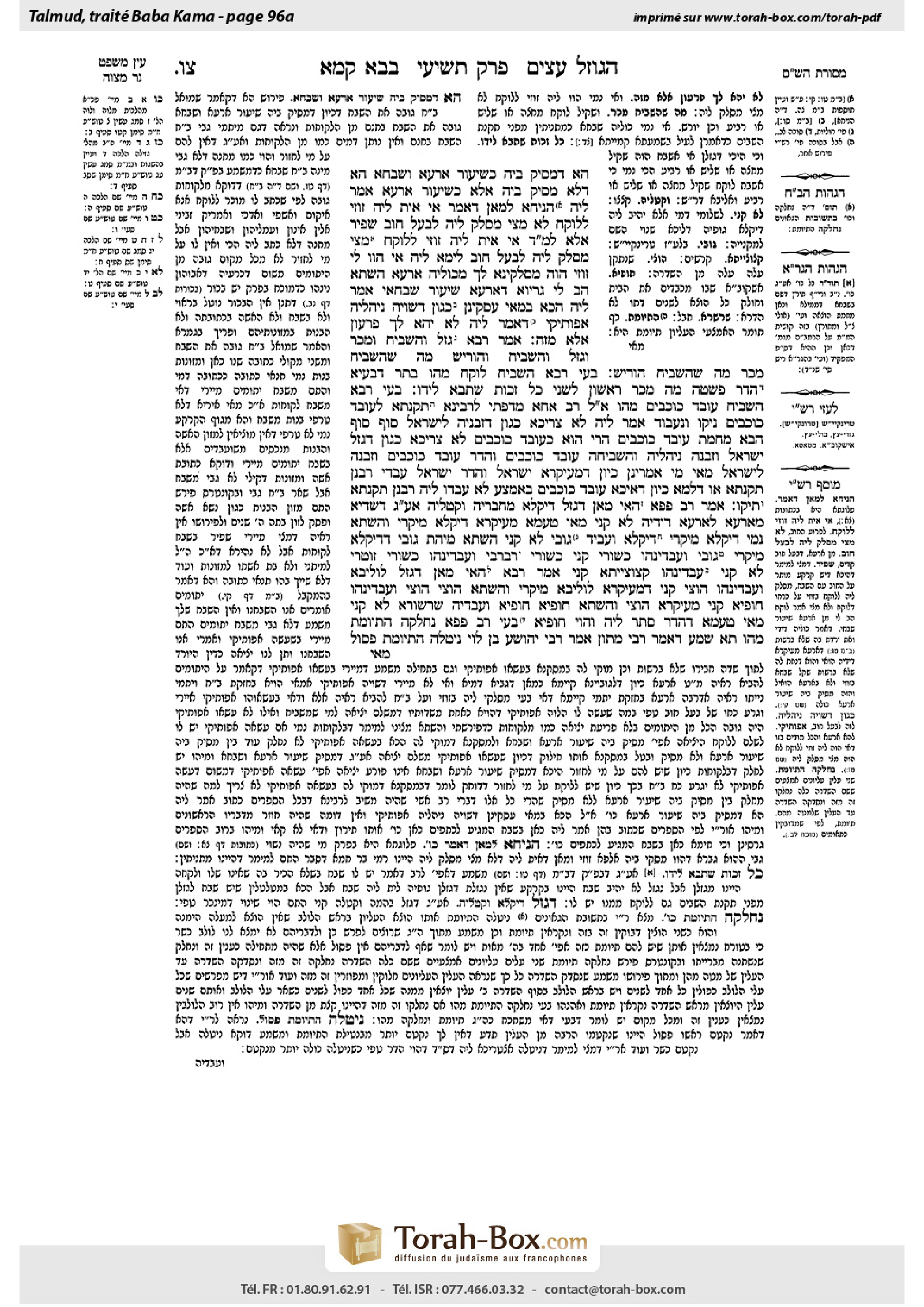
Bava Kamma 96a: Talmud study for Daf Yomi
Study the Talmud for Daf Yomi with scanned pages, Hebrew text, English translations from Sefaria and AI-generated French translations.
Passage selection and English or AI-generated French translation are available where the scan has annotations. Daf Study is independent of Torah-Box and Sefaria.
Browse Bava Kamma · בבא קמא · All tractatesBava Kamma 96a text and translations
This page of Bava Kamma includes the Aramaic text, an English translation and an AI-generated French translation, alongside the scan above.
בבא קמא צ״ו א · Aramaic and Hebrew text
הָא דְּמַסֵּיק בֵּיהּ כְּשִׁיעוּר אַרְעָא וּשְׁבָחָא, הָא דְּלָא מַסֵּיק בֵּיהּ אֶלָּא כְּשִׁיעוּר אַרְעָא.
אֲמַר לֵיהּ, הָנִיחָא לְמַאן דְּאָמַר: אִי אִית לֵיהּ זוּזֵי לְלוֹקֵחַ – לָא מָצֵי מְסַלֵּק לֵיהּ לְבַעַל חוֹב, שַׁפִּיר. אֶלָּא לְמַאן דְּאָמַר: אִי אִית לֵיהּ זוּזֵי לְלוֹקֵחַ – מָצֵי מְסַלֵּק לֵיהּ לְבַעַל חוֹב, לֵימָא לֵיהּ: אִי הֲווֹ לִי זוּזֵי – הֲוָה מְסַלֵּיקְנָא לָךְ מִכּוּלֵּיהּ אַרְעָא, הַשְׁתָּא – הַב לִי גְּרִיוָא דְאַרְעָא שִׁיעוּר שְׁבָחַאי!
אֲמַר לֵיהּ: הָכָא בְּמַאי עָסְקִינַן – כְּגוֹן דְּשַׁוְּיַהּ נִיהֲלֵיהּ אַפּוֹתֵיקֵי, דַּאֲמַר לֵיהּ: לֹא יְהֵא לְךָ פֵּרָעוֹן אֶלָּא מִזֶּה.
אָמַר רָבָא: גָּזַל וְהִשְׁבִּיחַ וּמָכַר, וְגָזַל וְהִשְׁבִּיחַ וְהוֹרִישׁ – מַה שֶּׁהִשְׁבִּיחַ מָכַר, מַה שֶּׁהִשְׁבִּיחַ הוֹרִישׁ.
בָּעֵי רָבָא: הִשְׁבִּיחַ לוֹקֵחַ, מַהוּ? בָּתַר דְּבַעְיַהּ, הֲדַר פַּשְׁטַהּ: מָה מָכַר רִאשׁוֹן לַשֵּׁנִי? כׇּל זְכוּת שֶׁתָּבֹא לְיָדוֹ.
בָּעֵי רָבָא: הִשְׁבִּיחַ גּוֹי, מַהוּ? אֲמַר לֵיהּ רַב אַחָא מִדִּפְתִּי לְרָבִינָא: תַּקַּנְתָּא לְגוֹי נֵיקוּ וְנַעְבֵּיד?! אֲמַר לֵיהּ: לָא צְרִיכָא, כְּגוֹן דְּזַבְּנֵיהּ לְיִשְׂרָאֵל. סוֹף סוֹף, הַבָּא מֵחֲמַת גּוֹי הֲרֵי הוּא כְּגוֹי!
לָא צְרִיכָא, כְּגוֹן דְּגַזְלַ[הּ] יִשְׂרָאֵל וְזַבְּנַהּ נִיהֲלֵיהּ, וְהִשְׁבִּיחָהּ גּוֹי, וַהֲדַר גּוֹי וְזַבְּנַהּ לְיִשְׂרָאֵל. מַאי? מִי אָמְרִינַן כֵּיוָן דְּמֵעִיקָּרָא יִשְׂרָאֵל וַהֲדַר יִשְׂרָאֵל – עָבְדִי רַבָּנַן תַּקַּנְתָּא, אוֹ דִלְמָא כֵּיוָן דְּאִיכָּא גּוֹי בָּאֶמְצַע – לָא עֲבַדוּ לֵיהּ רַבָּנַן תַּקַּנְתָּא? תֵּיקוּ.
אָמַר רַב פָּפָּא: הַאי מַאן דִּגְזַל דִּיקְלָא מֵחַבְרֵיהּ וְקַטְלֵיהּ, אַף עַל גַּב דְּשַׁדְיֵאּ מֵאַרְעָא לְאַרְעָא דִּידֵיהּ, לָא קְנֵי. מַאי טַעְמָא? מֵעִיקָּרָא ״דִּיקְלָא״ מִיקְּרֵי, וְהַשְׁתָּא נָמֵי ״דִּיקְלָא״ מִיקְּרֵי. דִּיקְלָא (וַעֲבֵיד) [וְעַבְדֵיהּ] גּוּבֵּי, לָא קָנֵי. הַשְׁתָּא מִיהַת ״גּוּבֵּי דְּדִיקְלָא״ מִיקְּרֵי.
גּוּבֵּי וְעַבְדִינְהוּ כְּשׁוּרֵי – קָנֵי. כְּשׁוּרֵי רַבְרְבֵי וְעַבְדִינְהוּ כְּשׁוּרֵי זוּטְרֵי – לָא קָנֵי. עַבְדִינְהוּ קְצוּצְיָיתָא – קָנֵי.
אָמַר רָבָא: הַאי מַאן דִּגְזַל לוּלִיבָּא וְעַבְדִינְהוּ הוּצֵי – קָנֵי. דְּמֵעִיקָּרָא ״לוּלִיבָּא״ מִיקְּרֵי, וְהַשְׁתָּא ״הוּצֵי״. הוּצֵי וְעַבְדִינְהוּ חוּפְיָא – קָנֵי. מֵעִיקָּרָא ״הוּצֵי״, וְהַשְׁתָּא ״חוּפְיָא״. חוּפְיָא וְעַבְדֵיהּ שַׁרְשׁוּרָא – לָא קָנֵי. מַאי טַעְמָא? דַּהֲדַר סָתַר לֵיהּ וְהָוֵי חוּפְיָא.
בָּעֵי רַב פָּפָּא: נֶחְלְקָה הַתְּיוֹמֶת, מַהוּ? תָּא שְׁמַע, דְּאָמַר רַבִּי מָתוּן אָמַר רַבִּי יְהוֹשֻׁעַ בֶּן לֵוִי: נִיטְּלָה הַתְּיוֹמֶת – פָּסוּל.
Bava Kamma 96a · English translation
This ruling, that Shmuel would collect the enhanced value, is for a case where the creditor is owed by the debtor the amount of the value of the land and the enhanced value. That ruling, that Shmuel would not collect the value of the enhancement, is for a case where the creditor is owed by the debtor only the amount of the value of the land.
Ravina said to him: This works out well according to the one who says: If the purchaser of the field has money, he still cannot remove the creditor from the land, i.e., the creditor has the right to collect the land. This is well. But according to the one who says: If the purchaser of the field has money, he can remove the creditor from the land, i.e., the purchaser can choose to pay him money instead, let the purchaser say: If I had money, I would remove you from all of the land; now that I do not have sufficient money to pay what you are owed, give me at least a se’a [griva] of land, which is the amount of my enhancement.
Rav Ashi said to him: With what are we dealing here? We are dealing with a case where the debtor set aside this field as designated repayment for him, as he said to him: You shall not be repaid from anything but this, in which case he clearly has a lien on this field and nothing else.
§ The Gemara continues the discussion of a stolen item that has been enhanced. Rava says: If one robbed another of an item and enhanced it and sold it to another, and similarly, if one robbed another of an item and enhanced it and then died and bequeathed it, he sold that which he enhanced and bequeathed that which he enhanced. And the robbery victim, should he wish to recover the stolen item, must pay the purchaser or heir for the enhanced value.
Rava raises a dilemma related to the aforementioned halakha: What is the halakha if a purchaser enhanced the stolen item? Must the robbery victim pay the purchaser for the enhanced value or not? After Rava raised the dilemma, he then resolved it: What has the first person sold to the second in any sale? He has sold any rights that will come into his possession. Since the robber had the rights to the value of his enhancements to the stolen item, he sold those rights to the purchaser as well.
Rava raises a dilemma: What is the halakha if a gentile robber enhanced the value of a stolen item? Rav Aḥa of Difti said to Ravina: Shall we arise and institute an ordinance for the benefit of a gentile? Ravina said to him: This question is not necessary except where it was the case that a gentile sold it to a Jew. Rava was asking if the Jew needs to return the enhanced value. The Gemara comments: Ultimately, one who comes to possess an item due to purchasing it from a gentile is like a gentile himself because, as stated previously, in any sale the purchaser’s rights are identical to the seller’s. Since the Sages did not institute ordinances for the benefit of gentiles, the Jewish purchaser does not have those rights either.
The Gemara explains: This question is not necessary except where it was the case that a Jew robbed another of the item and sold it to a gentile, and the gentile enhanced it, and then the gentile went back and sold it to another Jew. What is the halakha in this case? Do we say: Since it was initially stolen by a Jew and was then acquired by a Jew, the Sages did institute an ordinance? Or, perhaps since there is the ownership of a gentile intervening, the Sages did not institute an ordinance. The Gemara comments: The dilemma shall stand unresolved.
§ The mishna teaches that if one robbed another of wood and fashioned it into vessels, he acquired the wood due to the change. The Gemara discusses what qualifies as a change. Rav Pappa said: With regard to this one who robbed another of a palm tree and cut it down, although he threw it from the land of the robbery victim to his own land, he did not acquire it. What is the reason for this? The tree was initially called a palm tree, and now, although it has been cut down, it is also called a palm tree, so the change to the item is not sufficiently significant for the robber to acquire it. Moreover, if one robbed another of a palm tree and made it into logs, he did not acquire it, since now, in any event, they are called palm tree logs.
By contrast, if one robbed another of logs and fashioned them into beams, he has acquired them, since this change is significant. If one robbed another of large beams and fashioned them into small beams, he did not acquire them, since they are still called beams. If he fashioned them into boards, he did acquire them.
Rava said: This one who robbed another of a palm frond and fashioned it into leaves [hutzei], i.e., he removed the leaves from the spine, has acquired it, since initially it was called a palm frond and now it is called leaves. One who robbed another of leaves and fashioned them into a broom has acquired them, since initially they were called leaves, and now they are called a broom. One who robbed another of a broom and fashioned it into a rope has not acquired it. What is the reason for this? The reason is that he can go back and unravel it, and it will once again be a broom.
Rav Pappa raises a dilemma: What is the halakha if the central twin-leaf became split, i.e., is this considered a change through which a stolen lulav would be acquired? The Gemara cites a proof: Come and hear that which Rabbi Matun says that Rabbi Yehoshua ben Levi says: If the central twin-leaf was removed, the lulav is unfit.
Bava Kamma 96a · Traduction française (IA)
Cette décision, selon laquelle Shmuel récupérerait la valeur augmentée, s'applique à un cas où le créancier est dû par le débiteur la valeur du terrain ainsi que la valeur augmentée. Cette autre décision, selon laquelle Shmuel ne récupérerait pas la valeur de l'amélioration, s'applique à un cas où le créancier est dû par le débiteur uniquement la valeur du terrain.
Ravina dit à lui : Cela s'aligne bien selon celui qui dit : Si l'acheteur du terrain a de l'argent, il ne peut pas expulser le créancier du terrain, c'est-à-dire que le créancier a le droit de récupérer le terrain. Cela est bien. Mais selon celui qui dit : Si l'acheteur du terrain a de l'argent, il peut expulser le créancier du terrain, c'est-à-dire que l'acheteur peut choisir de payer de l'argent à la place, disons à l'acheteur : Si j'avais de l'argent, je t'expulserais de tout le terrain ; maintenant que je n'ai pas assez d'argent pour payer ce que tu dois, donne-moi au moins un se'a [griva] de terrain, qui est la quantité de mon amélioration.
Rav Ashi dit à lui : Avec quoi sommes-nous en train de travailler ? Nous travaillons avec un cas où le débiteur a désigné ce terrain comme paiement pour lui, comme il a dit à lui : Tu ne seras pas récompensé à partir de quelque chose d'autre que cela, dans ce cas il a clairement un droit de préférence sur ce terrain et sur rien d'autre.
§ La Guemara poursuit la discussion d'un objet volé qui a été amélioré. Rava dit : Si l'un a volé à un autre un objet et l'a amélioré puis l'a vendu à un autre, et de même, si l'un a volé à un autre un objet et l'a amélioré puis est décédé et a légué cet objet, il a vendu ce qu'il a amélioré et a légué ce qu'il a amélioré. Et le victime du vol, s'il souhaite récupérer l'objet volé, doit payer à l'acheteur ou à l'héritier la valeur de l'amélioration.
Rava soulève un dilemme lié à la halakha mentionnée précédemment : Quelle est la halakha si un acheteur a amélioré l'objet volé ? Doit le victime du vol payer l'acheteur pour la valeur de l'amélioration ou non ? Après que Rava ait soulevé ce dilemme, il l'a résolu ainsi : Qu'a vendu la première personne à la deuxième dans toute vente ? Il a vendu tout droit qui lui appartenait. Puisque le voleur avait le droit à la valeur de ses améliorations sur l'objet volé, il a vendu ces droits à l'acheteur également.
Rava soulève un dilemme : Quelle est la halakha si un voleur païen a amélioré la valeur d'un objet volé ? Rav Aḥa de Difti dit à Ravina : Devons-nous nous lever et instituer une ordonnance en faveur d'un païen ? Ravina dit à lui : Cette question n'est nécessaire que dans le cas où un païen l'avait vendu à un Juif. Rava posait la question si le Juif devait rendre la valeur améliorée. La Guemara commente : Finalement, celui qui possède un objet en achetant à un païen est comme un païen lui-même, car, comme mentionné précédemment, dans toute vente les droits de l'acheteur sont identiques à ceux du vendeur. Puisque les Sages n'ont pas institué d'ordonnances en faveur des païens, l'acheteur juif n'a pas non plus ces droits.
La Guemara explique : Cette question n'est nécessaire que dans le cas où un Juif a volé un objet à un autre et l'a vendu à un païen, et ce dernier a amélioré l'objet, puis le païen est revenu et l'a vendu à un autre Juif. Quelle est la halakha dans ce cas ? Disons-nous : Puisque l'objet a été d'abord volé par un Juif et ensuite acquis par un Juif, les Sages ont institué une ordonnance ? Ou, peut-être, puisque l'ownership d'un païen intervient, les Sages n'ont pas institué une ordonnance. La Guemara commente : Ce dilemme restera sans solution.
§ La mitsna enseigne que si l'un a volé à un autre du bois et l'a façonné en objets, il a acquis le bois grâce au changement. La Guemara discute de ce qui constitue un changement. Rav Pappa dit : En ce qui concerne celui qui a volé un palmier à un autre et l'a coupé, bien qu'il l'ait jeté du territoire du victime du vol vers son propre terrain, il n'a pas acquis l'objet. Quelle est la raison de cela ? Le palmier était initialement appelé un palmier, et maintenant, bien qu'il ait été coupé, il est encore appelé un palmier, donc le changement de l'objet n'est pas suffisamment significatif pour que le voleur l'acquière. De plus, si l'un a volé un palmier à un autre et l'a transformé en troncs, il n'a pas acquis l'objet, car, en tout cas, ils sont appelés des troncs de palmier.
Par contraste, si l'un a volé des troncs et les a transformés en poutres, il les a acquis, car ce changement est significatif. Si l'un a volé des grandes poutres et les a transformées en petites poutres, il n'a pas acquis l'objet, car elles sont encore appelées des poutres. Si l'un les a transformées en planches, il les a acquis.
Rava dit : Celui qui a volé une feuille de palmier et l'a transformé en feuilles [hutzei], c'est-à-dire qu'il a retiré les feuilles du tronc, a acquis l'objet, car initialement il était appelé une feuille de palmier et maintenant il est appelé des feuilles. Celui qui a volé des feuilles et les a transformées en balai a acquis l'objet, car initialement elles étaient appelées des feuilles, et maintenant elles sont appelées un balai. Celui qui a volé un balai et l'a transformé en corde n'a pas acquis l'objet. Quelle est la raison de cela ? La raison est qu'il peut revenir en arrière et dénouer la corde, et elle redeviendra un balai.
Rav Pappa soulève un dilemme : Quelle est la halakha si la feuille centrale jumelle s'est séparée, c'est-à-dire est-ce que cela est considéré comme un changement par lequel un lulav volé serait acquis ? La Guemara cite une preuve : Viens écouter ce que dit Rabbi Matun, qui rapporte que Rabbi Yehoshua ben Levi a dit : Si la feuille centrale jumelle a été retirée, le lulav est inutilisable.
Traduction française générée par IA à partir de l’édition anglaise de Sefaria. Vérifie toujours un passage avec le texte source.
Text from Sefaria: William Davidson Edition - Vocalized Aramaic (CC BY NC); William Davidson Edition - English (CC BY NC).