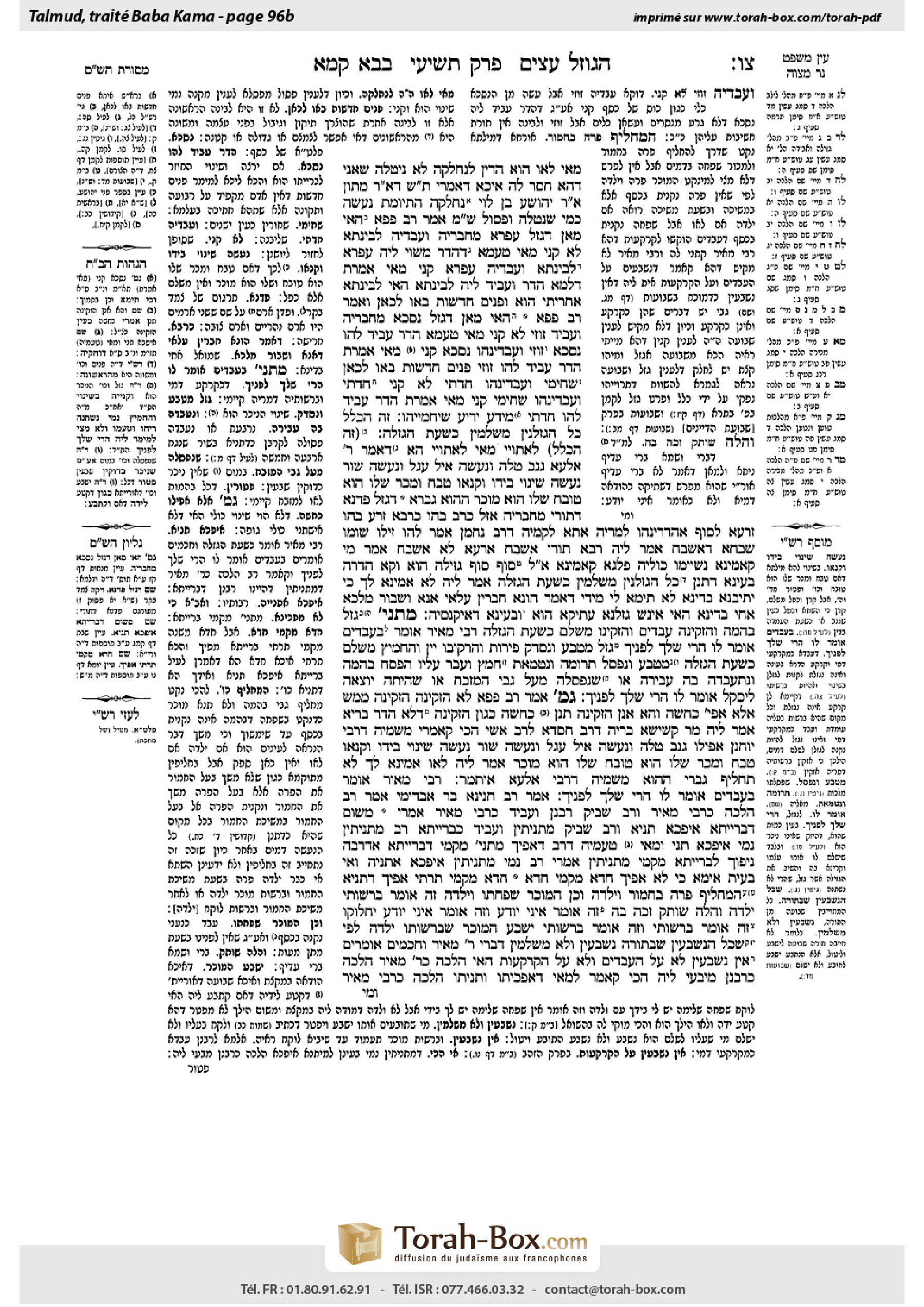
Bava Kamma 96b: Talmud study for Daf Yomi
Study the Talmud for Daf Yomi with scanned pages, Hebrew text, English translations from Sefaria and AI-generated French translations.
Passage selection and English or AI-generated French translation are available where the scan has annotations. Daf Study is independent of Torah-Box and Sefaria.
Browse Bava Kamma · בבא קמא · All tractatesBava Kamma 96b text and translations
This page of Bava Kamma includes the Aramaic text, an English translation and an AI-generated French translation, alongside the scan above.
בבא קמא צ״ו ב · Aramaic and Hebrew text
מַאי, לָאו הוּא הַדִּין לְנֶחְלְקָה? לָא; נִיטְּלָה שָׁאנֵי, דְּהָא חֲסַר לֵהּ.
אִיכָּא דְּאָמְרִי: תָּא שְׁמַע, דְּאָמַר רַבִּי מָתוּן אָמַר רַבִּי יְהוֹשֻׁעַ בֶּן לֵוִי: נֶחְלְקָה הַתְּיוֹמֶת – נַעֲשָׂה כְּמִי שֶׁנִּטְּלָה, וּפָסוּל! שְׁמַע מִינַּהּ.
אָמַר רַב פָּפָּא: הַאי מַאן דִּגְזַל עַפְרָא מֵחַבְרֵיהּ, וְעַבְדֵיהּ לְבֵינְתָּא – לָא קָנֵי. מַאי טַעְמָא? דְּהָדַר מְשַׁוֵּי לֵיהּ עַפְרָא. לְבֵינְתָּא וְעַבְדַיהּ עַפְרָא – קָנֵי. מַאי אָמְרַתְּ – דִּלְמָא הָדַר וְעָבֵיד לֵיהּ לְבֵינְתָּא? הַאי לְבֵינְתָּא אַחֲרִיתִי הוּא, וּפָנִים חֲדָשׁוֹת בָּאוּ לְכָאן.
וְאָמַר רַב פָּפָּא: הַאי מַאן דִּגְזַל נְסָכָא מֵחַבְרֵיהּ, (וְעָבֵיד) [וְעַבְדֵיהּ] זוּזֵי – לָא קָנֵי. מַאי טַעְמָא? הָדַר עָבֵיד לְהוּ נְסָכָא. זוּזֵי וְעַבְדִינְהוּ נְסָכָא – קָנֵי. מַאי אָמְרַתְּ – הָדַר עָבֵיד לְהוּ זוּזֵי? פָּנִים חֲדָשׁוֹת בָּאוּ לְכָאן.
שְׁחִימֵי וְעַבְדִינְהוּ חַדְתֵי – לָא קָנֵי. חַדְתֵי וְעַבְדִינְהוּ שְׁחִימֵי – קָנֵי. מַאי אָמְרַתְּ – הָדַר עָבֵיד לְהוּ חַדְתֵי? מִידָּע יְדִיעַ שִׁיחְמַיְיהוּ.
זֶה הַכְּלָל: כׇּל הַגַּזְלָנִין מְשַׁלְּמִין כִּשְׁעַת הַגְּזֵלָה. ״זֶה הַכְּלָל״ לְאֵתוֹיֵי מַאי? לְאֵתוֹיֵי הָא דְּאָמַר רַבִּי אִלְעָא: גָּנַב טָלֶה וְנַעֲשָׂה אַיִל, עֵגֶל וְנַעֲשָׂה שׁוֹר – נַעֲשָׂה שִׁינּוּי בְּיָדוֹ, וּקְנָאוֹ. טָבַח וּמָכַר – שֶׁלּוֹ הוּא טוֹבֵחַ, שֶׁלּוֹ הוּא מוֹכֵר.
הָהוּא גַּבְרָא דִּגְזַל פַּדָּנָא דְּתוֹרֵי מֵחַבְרֵיהּ, אֲזַל כְּרַב בְּהוּ כְּרָבָא, זְרַע בְּהוּ זַרְעָא. לְסוֹף אַהְדְּרִינְהוּ לְמָרֵיהּ. אֲתָא לְקַמֵּיהּ דְּרַב נַחְמָן, אֲמַר לְהוּ: זִילוּ שׁוּמוּ שְׁבָחָא דְּאַשְׁבַּח.
אֲמַר לֵיהּ רָבָא: תּוֹרֵי אַשְׁבֻּח, אַרְעָא לָא אַשְׁבַּח?! אָמַר: מִי קָאָמֵינָא נְשַׁיְּימוּ כּוּלֵּיהּ? פַּלְגָא קָאָמֵינָא! אֲמַר לֵיהּ: סוֹף סוֹף, גְּזֵילָה הוּא – וְקָא הָדְרָה בְּעֵינַאּ, דִּתְנַן: כׇּל הַגַּזְלָנִין מְשַׁלְּמִין כִּשְׁעַת הַגְּזֵלָה!
אֲמַר לֵיהּ: לָא אָמֵינָא לָךְ, כִּי יָתֵיבְנָא בְּדִינָא לָא תֵּימָא לִי מִידֵּי, דְּאָמַר הוּנָא חַבְרִין עֲלַאי: ״אֲנָא וְשַׁבּוּר מַלְכָּא – אַחֵי בְּדִינָא״? הַאי אִינָשׁ גַּזְלָנָא עַתִּיקָא הוּא, וּבָעֵינָא דְּאֶיקְנְסֵיהּ.
מַתְנִי׳ גָּזַל בְּהֵמָה וְהִזְקִינָה, עֲבָדִים וְהִזְקִינוּ – מְשַׁלֵּם כִּשְׁעַת הַגְּזֵלָה. רַבִּי מֵאִיר אוֹמֵר: בַּעֲבָדִים – אוֹמֵר לוֹ: ״הֲרֵי שֶׁלְּךָ לְפָנֶיךָ״.
גָּזַל מַטְבֵּעַ וְנִסְדַּק; פֵּירוֹת וְהִרְקִיבוּ; יַיִן וְהֶחְמִיץ – מְשַׁלֵּם כִּשְׁעַת הַגְּזֵלָה.
מַטְבֵּעַ וְנִפְסַל; תְּרוּמָה וְנִטְמֵאת; חָמֵץ וְעָבַר עָלָיו הַפֶּסַח; בְּהֵמָה וְנִתְעַבְּדָה בָּהּ עֲבֵירָה, אוֹ שֶׁנִּפְסְלָה מֵעַל גַּבֵּי הַמִּזְבֵּחַ, אוֹ שֶׁהָיְתָה יוֹצְאָה לִיסָּקֵל – אוֹמֵר לוֹ: ״הֲרֵי שֶׁלְּךָ לְפָנֶיךָ״.
גְּמָ׳ אָמַר רַב פָּפָּא: לֹא ״הִזְקִינָה״ – הִזְקִינָה מַמָּשׁ, אֶלָּא אֲפִילּוּ כָּחֲשָׁה. וְהָא אֲנַן ״הִזְקִינָה״ תְּנַן! כָּחֲשָׁה כְּגוֹן הִזְקִינָה, דְּלָא הָדְרָ[א] בָּרְיָא.
אֲמַר לֵיהּ מָר קַשִּׁישָׁא בְּרֵיהּ דְּרַב חִסְדָּא לְרַב אָשֵׁי, הָכִי קָאָמְרִי מִשְּׁמֵיהּ דְּרַבִּי יוֹחָנָן: אֲפִילּוּ גָּנַב טָלֶה וְנַעֲשָׂה אַיִל, עֵגֶל וְנַעֲשָׂה שׁוֹר – נַעֲשָׂה שִׁינּוּי בְּיָדוֹ, וּקְנָאוֹ. טָבַח וּמָכַר – שֶׁלּוֹ הוּא טוֹבֵחַ, שֶׁלּוֹ הוּא מוֹכֵר. אֲמַר לֵיהּ, לָאו אָמֵינָא לָךְ: לָא תַּחְלֵיף גַּבְרֵי? הָהוּא מִשְּׁמֵיהּ דְּרַבִּי אִלְעָא אִיתְּמַר.
רַבִּי מֵאִיר אוֹמֵר, בַּעֲבָדִים אוֹמֵר לוֹ: ״הֲרֵי שֶׁלְּךָ לְפָנֶיךָ״. אָמַר רַב חֲנִינָא בַּר אַבְדִּימִי אָמַר רַב: הֲלָכָה כְּרַבִּי מֵאִיר. וְרַב שָׁבֵיק רַבָּנַן וְעָבֵיד כְּרַבִּי מֵאִיר? אָמְרִי: מִשּׁוּם דְּבָרַיְיתָא אִיפְּכָא תָּנְיָא. וְרַב שָׁבֵיק מַתְנִיתִין וְעָבֵיד כְּבָרַיְיתָא? רַב – מַתְנִיתִין נָמֵי אִיפְּכָא תָּנֵי.
וּמַאי טַעְמֵיהּ דְּרַב דְּאָפֵיךְ מַתְנִיתִין מִקַּמֵּי דְּבָרַיְיתָא? אַדְּרַבָּה, נֵיפוֹךְ לְבָרַיְיתָא מִקַּמֵּי מַתְנִיתִין! אָמְרִי: רַב נָמֵי מַתְנִיתִין אִיפְּכָא אַתְנוּיָהּ.
וְאִי בָּעֵית אֵימָא: כִּי לָא אָפֵיךְ – חֲדָא מִקַּמֵּי חֲדָא; חֲדָא מִקַּמֵּי תַּרְתֵּי – אָפֵיךְ.
דְּתַנְיָא: הַמַּחְלִיף פָּרָה בַּחֲמוֹר, וְיָלְדָה; וְכֵן הַמּוֹכֵר שִׁפְחָתוֹ, וְיָלְדָה; זֶה אוֹמֵר ״בִּרְשׁוּתִי יָלְדָה״, וְהַלָּה שׁוֹתֵק – זָכָה בָּהּ. זֶה אוֹמֵר ״אֵינִי יוֹדֵעַ״, וְזֶה אוֹמֵר ״אֵינִי יוֹדֵעַ״ – יַחְלוֹקוּ.
זֶה אוֹמֵר ״בִּרְשׁוּתִי״ וְזֶה אוֹמֵר ״בִּרְשׁוּתִי״ – יִשָּׁבַע הַמּוֹכֵר שֶׁבִּרְשׁוּתוֹ יָלְדָה, לְפִי שֶׁכׇּל הַנִּשְׁבָּעִין שֶׁבַּתּוֹרָה – נִשְׁבָּעִין וְלֹא מְשַׁלְּמִין; דִּבְרֵי רַבִּי מֵאִיר.
וַחֲכָמִים אוֹמְרִים: אֵין נִשְׁבָּעִין לֹא עַל הָעֲבָדִים וְלֹא עַל הַקַּרְקָעוֹת.
הַאי ״הֲלָכָה כְּרַבִּי מֵאִיר״?! ״הֲלָכָה כְּרַבָּנַן״ מִיבְּעֵי לֵיהּ! הָכִי קָאָמַר: לְמַאי דְּאָפְכִיתוּ וְתָנֵיתוּ, הֲלָכָה כְּרַבִּי מֵאִיר.
Bava Kamma 96b · English translation
What, is it not that the same is true for a case where the central twin-leaf became split, i.e., that this lulav has been rendered unfit to be used for the mitzva, and the robber has acquired the lulav as a result of this change? The Gemara answers: No, the case where it was removed is different, as the result is that it is lacking, and an incomplete lulav is certainly unfit. But if the leaf remains in place, albeit split, it does not necessarily render the lulav unfit. The lulav has not been changed and therefore the robber does not acquire it.
There are those who say that the question was resolved as follows: Come and hear that which Rabbi Matun says that Rabbi Yehoshua ben Levi says: If the central twin-leaf became split, it becomes like a lulav whose central twin-leaf was completely removed, and it is unfit. If so, learn from his statement that if the central twin-leaf became split, the robber has acquired the lulav as a result of the change.
§ Rav Pappa said: This one who robbed another of earth and fashioned it into a brick has not acquired it due to the change. What is the reason for this? It is that he can return it and convert it back into earth. By contrast, if he robbed another of a brick, and by crushing it turned it into earth, he has acquired it due to the change. If you say: Perhaps he will return it and fashion it into a brick? This is a different brick, and a new entity has arrived, i.e., entered into existence, here.
And Rav Pappa also said: This one who robbed another of a bar of silver [naskha] and fashioned it into coins has not acquired it due to the change. What is the reason for this? He can return it and by melting the coins turn them into a bar of silver. By contrast, if he robbed another of coins and fashioned them into a bar of silver, he has acquired them due to the change. What do you say in response to this, that perhaps he will return and fashion them into coins? These are new coins, and a new entity has arrived here.
Rav Pappa continues: If the stolen coins were black [sheḥimei], i.e., old and used, and he made them as new by cleaning them thoroughly, he has not acquired them. By contrast, if however, they were new, and he made them black, he has acquired them. What do you say in response to this, that perhaps he will return and make them new by cleaning them? Their blackness is already known, and therefore the coins have been changed irreversibly.
§ The mishna teaches: This is the principle: All robbers pay according to the value of the stolen item at the time of the robbery. The Gemara asks: What is added by the phrase: This is the principle? The Gemara replies: It serves to add that which Rabbi Ela says: If one stole a lamb and during the time that it was in the thief’s possession it became a ram, or if one stole a calf and it became an ox, then a change occurred while the animal was in his possession, and he has acquired it due to the change. If he then slaughtered or sold the animal, he slaughters his own animal and he sells his own animal, and he does not become liable to pay the penalty of four or five times the value of the animal.
The Gemara relates: There was a certain man who robbed another of a pair [padna] of oxen. He then went and plowed his field with them, and sowed seeds with them, and eventually returned them to their owner. The robbery victim came before Rav Naḥman to claim payment from the robber. Rav Naḥman said to the robbery victim and the robber: Go estimate the amount by which the value of the land was enhanced during the time that the pair of oxen was in the possession of the robber, and the robber must pay that amount.
Rava said to Rav Naḥman: Did the oxen alone enhance the value of the land? Did the land not become enhanced in and of itself? Perhaps not all of the enhanced value of the land was due to the labor performed by the oxen. Rav Naḥman said: Did I say that they should estimate and give him all of the enhanced value? I said only half. Rava said to him: Ultimately, it is a stolen item and is returned as it was at the time of the robbery, as we learned in a mishna: All robbers pay according to the value of the stolen item at the time of the robbery. Why should the robber also pay the owner half the value of the enhancement?
Rav Naḥman said to Rava: Didn’t I tell you that when I am sitting in judgment, do not say anything to me, i.e., do not question or comment upon my rulings. An indication that my rulings should not be questioned is as our friend Huna has said about me, that King Shapur and I are brothers with regard to monetary laws, i.e., with regard to monetary laws, my opinion is equal to that of Shmuel. This man is an experienced robber, and I wish to penalize him. Therefore, I compelled him to pay the enhanced value, although by right he is not obligated to do so.
MISHNA: If one robbed another of an animal and it aged while in his possession, consequently diminishing its value, or if one robbed another of Canaanite slaves and they aged while in his possession, they have been changed. The robber therefore pays according to the value of the stolen item at the time of the robbery. Rabbi Meir says: With regard to Canaanite slaves, he says to the robbery victim: That which is yours is before you.
If one robbed another of a coin and it cracked, thereby reducing its value; or if one robbed another of produce and it rotted; or if one robbed another of wine and it fermented, then he pays according to the value of the stolen item at the time of the robbery.
If he robbed another of a coin and it was invalidated by the government; or if he robbed another of teruma and it became ritually impure; or if he robbed another of leavened bread and Passover elapsed over it, and therefore it is prohibited to derive benefit from it; or if he robbed another of an animal and a sin was performed with it, thereby disqualifying it for use as an offering; or if the animal was disqualified from being sacrificed upon the altar for some other reason; or if the animal was going out to be stoned because it gored and killed a person at some point after the robbery, the robber says to the robbery victim: That which is yours is before you. In all of these cases, although the value of the stolen item has been diminished or altogether lost, since the change is not externally discernible, the robber returns the item in its current state.
GEMARA: With regard to the mishna’s statement that one who robbed another of an animal that aged pays what its value was at the time of the robbery, Rav Pappa says: It is not so that aged means that it actually aged. But even if the animal was weakened, which is a less significant change, it is still considered changed, and the robber has acquired the animal. The Gemara asks: But didn’t we learn in the mishna that it aged, indicating that a lesser change, e.g., weakening, is not significant? The Gemara responds: Rav Pappa was speaking of weakening that is like aging, i.e., the animal became so weak that it will not return to its former health.
Mar Kashisha, son of Rav Ḥisda, said to Rav Ashi: This is what they say in the name of Rabbi Yoḥanan: Even if one stole a lamb and it became a ram, or a calf and it became an ox, it is considered that a change occurred while the animal was in the robber’s possession, and he has acquired it due to this change. If he then slaughtered or sold the animal, he slaughters his own animal and he sells his own animal, and he does not become liable to pay the penalty of four or five times the value of the animal. Rav Ashi said to him: Didn’t I say to you: Do not exchange the names of the men in whose name you are transmitting words of Torah? That statement was stated in the name of Rabbi Ela, not in the name of Rabbi Yoḥanan.
§ The mishna teaches that Rabbi Meir says: With regard to Canaanite slaves, he says to the robbery victim: That which is yours is before you. The Gemara comments: Rav Ḥanina bar Avdimi says that Rav says: The halakha is in accordance with the opinion of Rabbi Meir. The Gemara asks: And would Rav set aside the opinion of the Rabbis, who are the majority, and practice the halakha in accordance with the opinion of Rabbi Meir? The Sages say: It is because it is taught in a baraita in the opposite manner, i.e., with the opinions reversed, so that the Rabbis, rather than Rabbi Meir, hold that with regard to slaves the robber says: That which is yours is before you. The Gemara asks: And would Rav set aside the mishna and practice the halakha in accordance with the statement of the baraita? The Gemara responds: Rav also teaches the mishna in the opposite manner.
And what is the reasoning of Rav, who reversed the opinions in the mishna in light of the baraita? On the contrary, let him reverse the opinions in the baraita in light of the mishna. The Sages say in response: Rav also learned the mishna in the opposite manner. Rav did not decide to reverse the opinions in the mishna. In the text of the mishna that he utilized, the opinions were the same as in the baraita.
And if you wish, say instead that Rav did in fact decide to reverse the opinions in the mishna, based upon the principle: When he does not reverse a mishna due to a baraita, it is when there is one mishna that he will not reverse in light of one baraita. But he would reverse one mishna in light of two baraitot, and in this case there is a second baraita in which the opinions are the reverse of those found in the mishna.
The second baraita is as it is taught in the Tosefta (Bava Metzia 8:23–24): In the case of one who exchanges a cow for a donkey, and in the meantime the cow gave birth; and similarly, in the case of one who sells his Canaanite maidservant, and in the meantime she gave birth, if in either of these cases the purchaser and seller have a dispute as to when the birth took place, where this one says: She gave birth at the time that she was in my possession and therefore the offspring is mine, and the other is silent, then the one who stated definitively that she gave birth while in his possession has acquired the offspring. If this one says: I do not know, and that one says: I do not know, then they shall divide the value of the offspring.
The baraita continues: If this one says: She gave birth while in my possession, and that one says: She gave birth while in my possession, then the seller must take an oath that she gave birth while in his possession, as anyone who is obligated to take an oath that is enumerated in the Torah takes an oath and does not pay; this is the statement of Rabbi Meir. In this case, since the seller initially had possession of the animal or the maidservant, he is considered the defendant, and therefore it is sufficient for him to take an oath to exempt himself from payment and maintain possession of the offspring.
The baraita continues: And the Rabbis say that one does not take an oath concerning either Canaanite slaves or concerning land. This indicates that according to the opinion of the Rabbis, Canaanite slaves have the legal status of land, whereas according to the opinion of Rabbi Meir, they do not. It follows, then, that in the mishna here as well, it is the Rabbis, and not Rabbi Meir, who maintain that, with regard to slaves, one says: That which is yours is before you, as one does with regard to land.
The Gemara asks: If it is true that the opinion that the mishna attributed to Rabbi Meir was attributed by Rav to the Rabbis, then this phrase: The halakha is in accordance with the opinion of Rabbi Meir, is imprecise. Rav should have said that the halakha is in accordance with the opinion of the Rabbis. The Gemara responds: This is what Rav is saying: According to the way that you have reversed the opinions in the mishna, and you taught that Rabbi Meir says that the robber says to the robbery victim: That which is yours is before you, then the halakha is in accordance with the opinion of Rabbi Meir, despite the fact that according to Rav, this is the opinion of the Rabbis.
Bava Kamma 96b · Traduction française (IA)
Qu'est-ce que cela signifie, que cela est également vrai dans le cas où la feuille centrale jumelle s'est brisée, c'est-à-dire que ce lulav est devenu inutilisable pour la mitsva, et que le voleur a acquis le lulav en raison de ce changement ? La Guemara répond : Non, le cas où la feuille a été retirée est différent, car le résultat est qu'elle est manquante, et un lulav incomplet est certainement inutilisable. Mais si la feuille reste en place, bien qu'elle soit brisée, cela ne rend pas nécessairement le lulav inutilisable. Le lulav n'a pas été modifié, et par conséquent le voleur ne l'acquiert pas.
Certains disent que la question a été résolue ainsi : Viens écouter ce que dit Rabbi Matun, qui rapporte Rabbi Yéhoshua ben Lévi : Si la feuille centrale jumelle s'est brisée, elle devient comme un lulav dont la feuille centrale jumelle a été entièrement retirée, et elle est inutilisable. Si c'est ainsi, apprends-en à partir de sa déclaration que si la feuille centrale jumelle s'est brisée, le voleur a acquis le lulav en raison du changement.
§ Rav Pappa dit : Celui qui a volé de la terre à un autre et l'a façonnée en un briquet n'a pas acquis cela en raison du changement. Pourquoi ? Parce qu'il peut le rendre et le convertir à nouveau en terre. À l'inverse, si il a volé un briquet à un autre et l'a écrasé pour le transformer en terre, il a acquis cela en raison du changement. Si tu dis : Peut-être qu'il le rendra et le façonnera à nouveau en briquet ? C'est un autre briquet, et un nouveau être est arrivé, c'est-à-dire est entré en existence, ici.
Et Rav Pappa a également dit : Celui qui a volé une barre d'argent [naskha] à un autre et l'a façonnée en monnaies n'a pas acquis cela en raison du changement. Pourquoi ? Parce qu'il peut le rendre et, en fondant les monnaies, les transformer à nouveau en barre d'argent. À l'inverse, si l'on a volé des monnaies à un autre et les a transformées en barre d'argent, il a acquis cela en raison du changement. Que dis-tu en réponse à cela, que peut-être il le rendra et le façonnera à nouveau en monnaies ? Ces sont de nouvelles monnaies, et un nouveau être est arrivé ici.
Rav Pappa continue : Si les monnaies volées étaient noires [sheḥimei], c'est-à-dire anciennes et utilisées, et qu'il les a rendues neuves en les nettoyant soigneusement, il n'a pas acquis cela. À l'inverse, si cependant elles étaient neuves, et qu'il les a rendues noires, il a acquis cela. Que dis-tu en réponse à cela, que peut-être il les rendra à nouveau neuves en les nettoyant ? Leur noirceur est déjà connue, et par conséquent les monnaies ont été modifiées irréversiblement.
§ La mitsna enseigne : C'est le principe : tous les voleurs paient selon la valeur de l'objet volé au moment du vol. La Guemara demande : Quel est l'ajout de la phrase : C'est le principe ? La Guemara répond : Elle sert à ajouter ce que dit Rabbi Ela : Si l'on a volé un agneau et qu'au cours du temps où il était en possession du voleur il est devenu un bêta, ou si l'on a volé un veau et qu'il est devenu un taureau, alors un changement s'est produit pendant que l'animal était en sa possession, et il a acquis cela en raison du changement. Si ensuite il a tué ou vendu l'animal, il tue son propre animal et il vend son propre animal, et il ne devient pas responsable de la peine de quatre ou cinq fois la valeur de l'animal.
La Guemara relate : Il y avait un certain homme qui avait volé à un autre un couple [padna] de bœufs. Il est ensuite allé cultiver son champ avec eux, et semer des graines avec eux, et finalement les a rendus à leur propriétaire. La victime du vol est venue devant Rav Naḥman pour réclamer le paiement au voleur. Rav Naḥman a dit à la victime du vol et au voleur : Allez estimer la quantité par laquelle la valeur du terrain a été augmentée pendant le temps où le couple de bœufs était en possession du voleur, et le voleur doit payer cette quantité.
Rava a dit à Rav Naḥman : Le bœuf seul a-t-il augmenté la valeur du terrain ? Le terrain n'a-t-il pas été augmenté en soi-même ? Peut-être que ce n'était pas toute l'augmentation de valeur du terrain qui était due au travail effectué par les bœufs. Rav Naḥman a dit : Ai-je dit qu'ils devaient estimer et lui donner toute l'augmentation de valeur ? J'ai dit seulement la moitié. Rava a dit à lui : Finalement, c'est un objet volé et est rendu tel qu'il était au moment du vol, comme nous avons appris dans une mitsna : Tous les voleurs paient selon la valeur de l'objet volé au moment du vol. Pourquoi le voleur devrait-il aussi payer à l'owner la moitié de l'augmentation de valeur ?
Rav Naḥman a dit à Rava : N'as-tu pas dit que lorsqu'on me trouve en jugement, ne dis rien à mon sujet, c'est-à-dire ne pose pas de questions ni ne commentes mes décisions. Une indication que mes décisions ne doivent pas être contestées est comme notre ami Huna a dit à mon sujet, que le roi Shapur et moi sommes frères en matière de lois monétaires, c'est-à-dire en matière de lois monétaires, mon avis est égal à celui de Shmuel. Ce homme est un voleur expérimenté, et je veux le pénaliser. Par conséquent, j'ai contraint lui à payer l'augmentation de valeur, bien que par droit il ne soit pas obligé de le faire.
MICHNA : Si l'on a volé un animal à un autre et qu'il a vieilli pendant sa possession, ce qui a diminué sa valeur, ou si l'on a volé des esclaves cananéens et qu'ils ont vieilli pendant leur possession, ils ont été modifiés. Le voleur paie donc selon la valeur de l'objet volé au moment du vol. Rabbi Méir dit : En ce qui concerne les esclaves cananéens, il dit à la victime du vol : Ce qui est à toi est devant toi.
Si l'on a volé une monnaie à un autre et qu'elle s'est fissurée, ce qui a réduit sa valeur ; ou si l'on a volé un produit et qu'il s'est pourri ; ou si l'on a volé du vin et qu'il a fermenté, alors il paie selon la valeur de l'objet volé au moment du vol.
Si l'on a volé à un autre une pièce de monnaie et qu'elle a été annulée par l'État ; ou si l'on a volé à un autre de la terouma et qu'elle est devenue impure rituellement ; ou si l'on a volé à un autre du pain levé et que le Pessah est passé sur celui-ci, et donc il est interdit d'en tirer un bénéfice ; ou si l'on a volé à un autre un animal et qu'un péché a été commis avec celui-ci, ce qui le rend inéligible à l'offrande ; ou si l'animal était disqualifié pour être sacrifié sur l'autel pour une autre raison ; ou si l'animal était en train d'être lapidé parce qu'il avait écrasé et tué une personne à un moment postérieur au vol, le voleur dit au victime du vol : Ce qui t'appartient est devant toi. Dans tous ces cas, bien que la valeur de l'objet volé ait été diminuée ou perdue entièrement, puisque ce changement n'est pas perceptible à l'extérieur, le voleur rend l'objet dans son état actuel.
GUEMARA : En ce qui concerne la déclaration de la michna selon laquelle celui qui a volé un animal âgé paie ce qu'il valait au moment du vol, Rav Pappa dit : Ce n'est pas que l'âge signifie qu'il a réellement vieilli. Mais même si l'animal était affaibli, ce qui est un changement moins important, il est considéré comme changé, et le voleur a acquis l'animal. La Guemara pose la question : Mais n'avons-nous pas appris dans la michna que l'animal avait vieilli, indiquant que ce changement mineur, par exemple l'affaiblissement, n'est pas significatif ? La Guemara répond : Rav Pappa parlait d'un affaiblissement similaire à l'âge, c'est-à-dire que l'animal était si affaibli qu'il ne retrouverait pas sa santé antérieure.
Mar Kashisha, fils de Rav Ḥisda, dit à Rav Ashi : C'est ce que l'on dit au nom de Rabbi Yoḥanan : Même si l'on a volé une agnelle et qu'elle est devenue un bélier, ou un veau et qu'il est devenu un taureau, on considère qu'un changement s'est produit pendant que l'animal était en possession du voleur, et il a acquis l'animal à cause de ce changement. Si ensuite il a sacrifié ou vendu l'animal, il sacrifie son propre animal et il vend son propre animal, et il ne devient pas responsable de la peine de quatre ou cinq fois la valeur de l'animal. Rav Ashi dit à lui : N'ai-je pas dit à toi : Ne permets pas d'échanger les noms des hommes dont tu transmets les paroles de la Torah ? Cette déclaration a été faite au nom de Rabbi Ela, pas au nom de Rabbi Yoḥanan.
§ La michna enseigne que Rabbi Meir dit : En ce qui concerne les esclaves cananéens, il dit au victime du vol : Ce qui t'appartient est devant toi. La Guemara commente : Rav Ḥanina bar Avdimi dit que Rav dit : La halakha est selon l'opinion de Rabbi Meir. La Guemara pose la question : Et serait-ce que Rav met de côté l'opinion des Sages, qui sont la majorité, et pratique la halakha selon l'opinion de Rabbi Meir ? Les Sages disent : C'est parce qu'il est enseigné dans une baraïta dans le sens opposé, c'est-à-dire avec les opinions inversées, de sorte que les Sages, plutôt que Rabbi Meir, tiennent que concernant les esclaves le voleur dit : Ce qui t'appartient est devant toi. La Guemara pose la question : Et serait-ce que Rav met de côté la michna et pratique la halakha selon la déclaration de la baraïta ? La Guemara répond : Rav a aussi appris la michna dans le sens opposé.
Et que l'on dise plutôt que Rav a en effet décidé d'inverser les opinions dans la michna, en se basant sur le principe : Lorsqu'il ne renverse pas une michna en raison d'une baraïta, c'est lorsque l'on a une seule michna qu'il ne renverse pas en raison d'une seule baraïta. Mais il renverrait une michna en raison de deux baraitot, et dans ce cas, il y a une seconde baraïta dans laquelle les opinions sont inversées par rapport à celles trouvées dans la michna.
Et la deuxième baraïta est telle qu'elle est enseignée dans la Tosefta (Bava Metzia 8:23–24) : Dans le cas où l'on échange un taureau contre un âne, et pendant ce temps le taureau a donné naissance à un petit, et de même, dans le cas où l'on vend son esclave cananéenne, et pendant ce temps elle a donné naissance à un petit, si dans l'un ou l'autre de ces cas le acheteur et le vendeur ont une dispute sur le moment de la naissance, où l'un dit : Elle a donné naissance pendant qu'elle était en ma possession et donc le petit est mien, et l'autre est muet, alors celui qui a affirmé définitivement qu'elle a donné naissance pendant qu'elle était en sa possession a acquis le petit. Si l'un dit : Je ne sais pas, et que l'autre dit : Je ne sais pas, alors ils partageront la valeur du petit.
La baraïta continue : Et si l'un dit : Elle a donné naissance pendant qu'elle était en ma possession, et que l'autre dit : Elle a donné naissance pendant qu'elle était en ma possession, alors le vendeur doit prendre un serment qu'elle a donné naissance pendant qu'elle était en sa possession, car tout celui qui est tenu de prendre un serment énuméré dans la Torah prend un serment et ne paie pas ; c'est l'opinion de Rabbi Meir. Dans ce cas, puisque le vendeur avait initialement la possession de l'animal ou de l'esclave, il est considéré comme le défendeur, et donc il suffit qu'il prenne un serment pour s'exonorer de payer et conserver le petit.
La baraïta continue : Si l'un dit : Elle a donné naissance pendant qu'elle était en mon possession, et que l'autre dit : Elle a donné naissance pendant qu'elle était en mon possession, alors le vendeur doit prendre un serment qu'elle a donné naissance pendant qu'elle était en sa possession, car tout celui qui est tenu de prendre un serment dont l'énumération est dans la Torah prend un serment et ne paie pas ; c'est la déclaration de Rabbi Meir. Dans ce cas, puisque le vendeur avait initialement la possession de l'animal ou de la servante, il est considéré comme l'accusé, et par conséquent il suffit qu'il prenne un serment pour s'exonorer du paiement et conserver la descendance.
Et les Rabbins disent qu'on ne prend pas de serment concernant les esclaves cananéens ou concernant la terre. Cela indique que selon l'opinion des Rabbins, les esclaves cananéens ont le statut juridique de la terre, tandis que selon l'opinion de Rabbi Meir, ils n'en ont pas. Il en suit donc que dans la michna ici aussi, c'est les Rabbins, et non Rabbi Meir, qui maintiennent que, concernant les esclaves, on dit : Ce qui t'appartient est devant toi, comme on le fait concernant la terre.
Le Guemara pose la question : Si c'est vrai que l'opinion attribuée par la Michna à Rabbi Meir a été attribuée par Rav aux Rabbins, alors cette phrase : la halakha suit l'opinion de Rabbi Meir, est imprecise. Rav aurait dû dire que la halakha suit l'opinion des Rabbins. Le Guemara répond : C'est ce que Rav dit : Selon la manière dont vous avez inversé les opinions dans la Michna, et que vous avez enseigné que Rabbi Meir dit que le voleur dit au victime du vol : Ce qui est à toi est devant toi, alors la halakha suit l'opinion de Rabbi Meir, malgré le fait que selon Rav, c'est l'opinion des Rabbins.
Traduction française générée par IA à partir de l’édition anglaise de Sefaria. Vérifie toujours un passage avec le texte source.
Text from Sefaria: William Davidson Edition - Vocalized Aramaic (CC BY NC); William Davidson Edition - English (CC BY NC).