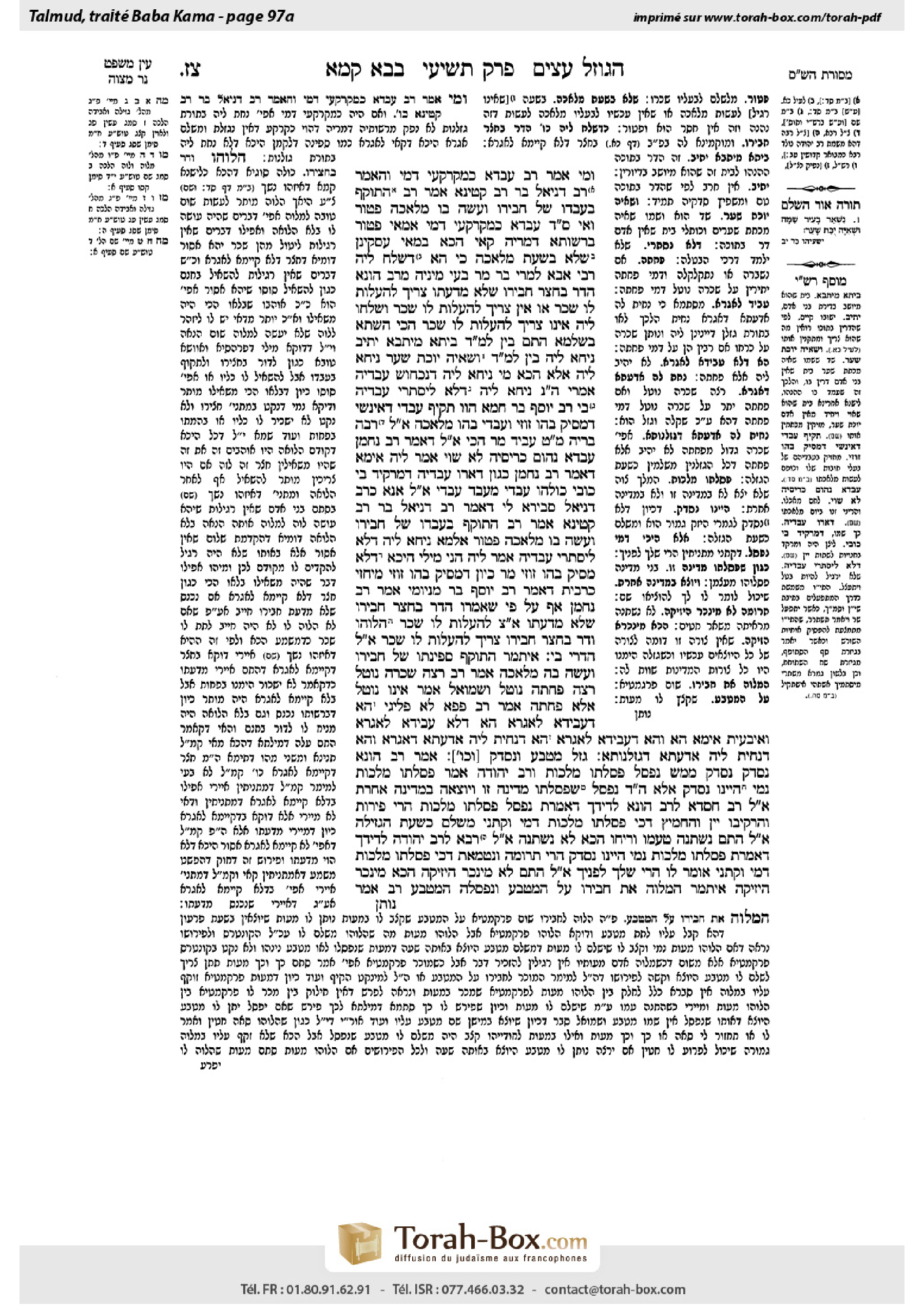
Bava Kamma 97a: Talmud study for Daf Yomi
Study the Talmud for Daf Yomi with scanned pages, Hebrew text, English translations from Sefaria and AI-generated French translations.
Passage selection and English or AI-generated French translation are available where the scan has annotations. Daf Study is independent of Torah-Box and Sefaria.
Browse Bava Kamma · בבא קמא · All tractatesBava Kamma 97a text and translations
This page of Bava Kamma includes the Aramaic text, an English translation and an AI-generated French translation, alongside the scan above.
בבא קמא צ״ז א · Aramaic and Hebrew text
וּמִי אָמַר רַב עַבְדָּא כִּמְקַרְקְעֵי דָּמֵי? וְהָאָמַר רַב דָּנִיאֵל בַּר רַב קַטִּינָא אָמַר רַב: הַתּוֹקֵף בְּעַבְדּוֹ שֶׁל חֲבֵירוֹ וְעָשָׂה בּוֹ מְלָאכָה – פָּטוּר. וְאִי סָלְקָא דַעְתָּךְ עַבְדָּא כִּמְקַרְקְעֵי דָּמֵי, אַמַּאי פָּטוּר? בִּרְשׁוּתָא דְּמָרֵיהּ קָאֵי!
הָכָא בְּמַאי עָסְקִינַן – שֶׁלֹּא בִּשְׁעַת מְלָאכָה. כִּי הָא דִּשְׁלַח לֵיהּ רַבִּי אַבָּא לְמָרֵי בַּר מָר, בְּעִי מִינֵּיהּ מֵרַב הוּנָא: הַדָּר בַּחֲצַר חֲבֵירוֹ שֶׁלֹּא מִדַּעְתּוֹ, צָרִיךְ לְהַעֲלוֹת לוֹ שָׂכָר אוֹ אֵין צָרִיךְ לְהַעֲלוֹת לוֹ שָׂכָר? וּשְׁלַחוּ לֵיהּ: אֵינוֹ צָרִיךְ לְהַעֲלוֹת לוֹ שָׂכָר.
הָכִי הַשְׁתָּא?! בִּשְׁלָמָא הָתָם, בֵּין לְמַאן דְּאָמַר בֵּיתָא מְיַתְּבָא יָתֵיב – נִיחָא לֵיהּ, בֵּין לְמַאן דְּאָמַר ״וּשְׁאִיָּה יֻכַּת שָׁעַר״ – נִיחָא לֵיהּ.
אֶלָּא הָכָא, מִי נִיחָא לֵיהּ דְּנִכְחוֹשׁ עַבְדֵּיהּ? אָמְרִי: הָכִי נָמֵי, נִיחָא לֵיהּ דְּלָא לִיסְתְּרֵי עַבְדֵּיהּ.
(בֵּי) רַב יוֹסֵף בַּר חָמָא הֲווֹ[ה] תָּקֵיף עַבְדֵי דְּאִינָשֵׁי דְּמַסֵּיק בְּהוּ זוּזֵי, וְעָבֵד בְּהוּ מְלָאכָה. אֲמַר לֵיהּ רַבָּה בְּרֵיהּ: מַאי טַעְמָא עָבֵיד מָר הָכִי? אֲמַר לֵיהּ, דְּאָמַר רַב נַחְמָן: עַבְדָּא – נְהוֹם כְּרֵיסֵיהּ לָא שָׁוֵי. אֲמַר לֵיהּ: אֵימָא דְּאָמַר רַב נַחְמָן כְּגוֹן דָּארוּ עַבְדֵּיהּ – דִּמְרַקֵּיד בֵּי כוּבֵּי; כּוּלְּהוּ עַבְדֵי מֶעְבָּד עָבְדִי!
אֲמַר לֵיהּ: אֲנָא כְּרַב דָּנִיאֵל סְבִירָא לִי – דְּאָמַר רַב דָּנִיאֵל בַּר רַב קַטִּינָא אָמַר רַב: הַתּוֹקֵף בְּעַבְדּוֹ שֶׁל חֲבֵירוֹ וְעָשָׂה בּוֹ מְלָאכָה – פָּטוּר. אַלְמָא נִיחָא לֵיהּ, דְּלָא לִיסְתְּרֵי עַבְדֵּיהּ.
אֲמַר לֵיהּ: הָנֵי מִילֵּי הֵיכָא דְּלָא מַסֵּיק בְּהוּ זוּזֵי; מָר, כֵּיוָן דְּמַסֵּיק בְּהוּ זוּזֵי – מִחֲזֵי כְּרִבִּית. דְּאָמַר רַב יוֹסֵף בַּר מִנְיוֹמֵי אָמַר רַב נַחְמָן, אַף עַל פִּי שֶׁאָמְרוּ: הַדָּר בַּחֲצַר חֲבֵירוֹ שֶׁלֹּא מִדַּעְתּוֹ – אֵין צָרִיךְ לְהַעֲלוֹת לוֹ שָׂכָר, הִלְוָהוּ וְדָר בַּחֲצַר חֲבֵירוֹ – צָרִיךְ לְהַעֲלוֹת לוֹ שָׂכָר! אֲמַר לֵיהּ: הֲדַרִי בִּי.
אִיתְּמַר: הַתּוֹקֵף סְפִינָתוֹ שֶׁל חֲבֵירוֹ וְעָשָׂה בָּהּ מְלָאכָה, אָמַר רַב: רָצָה – שְׂכָרָהּ נוֹטֵל, רָצָה – פְּחָתָהּ נוֹטֵל. וּשְׁמוּאֵל אָמַר: אֵינוֹ נוֹטֵל אֶלָּא פְּחָתָהּ.
אָמַר רַב פָּפָּא: לָא פְּלִיגִי; הָא דַּעֲבִידָא לְאַגְרָא, הָא דְּלָא עֲבִידָא לְאַגְרָא. וְאִיבָּעֵית אֵימָא: הָא וְהָא דַּעֲבִידָא לְאַגְרָא; הָא דִּנְחֵית לֵיהּ אַדַּעְתָּא דְּאַגְרָא, וְהָא דִּנְחֵית לֵיהּ אַדַּעְתָּא דְּגַזְלָנוּתָא.
גָּזַל מַטְבֵּעַ וְנִסְדַּק [וְכוּ׳]. אָמַר רַב הוּנָא: ״נִסְדַּק״ – נִסְדַּק מַמָּשׁ, ״נִפְסַל״ – פְּסָלַתּוּ מַלְכוּת.
וְרַב יְהוּדָה אָמַר: פְּסָלַתּוּ מַלְכוּת נָמֵי – הַיְינוּ נִסְדַּק. אֶלָּא הֵיכִי דָּמֵי ״נִפְסַל״? שֶׁפְּסָלַתּוּ מְדִינָה זוֹ, וְיוֹצֵא בִּמְדִינָה אַחֶרֶת.
אֲמַר לֵיהּ רַב חִסְדָּא לְרַב הוּנָא: לְדִידָךְ דְּאָמְרַתְּ ״נִפְסַל״ – פְּסָלַתּוּ מַלְכוּת; הֲרֵי פֵּירוֹת וְהִרְקִיבוּ, יַיִן וְהֶחְמִיץ – דְּכִי פְּסָלַתּוּ מַלְכוּת דָּמֵי; וְקָתָנֵי: מְשַׁלֵּם כִּשְׁעַת הַגְּזֵילָה!
אֲמַר לֵיהּ: הָתָם נִשְׁתַּנָּה טַעְמוֹ וְרֵיחוֹ, הָכָא לֹא נִשְׁתַּנָּה.
אֲמַר לֵיהּ רָבָא לְרַב יְהוּדָה: לְדִידָךְ דְּאָמְרַתְּ פְּסָלַתּוּ מַלְכוּת נָמֵי הַיְינוּ ״נִסְדַּק״; הֲרֵי תְּרוּמָה וְנִטְמֵאת, דְּכִי פְּסָלַתּוּ מַלְכוּת דָּמֵי, וְקָתָנֵי: אוֹמֵר לוֹ ״הֲרֵי שֶׁלְּךָ לְפָנֶיךָ״!
אֲמַר לֵיהּ: הָתָם לָא מִינְּכַר הֶיזֵּיקַהּ, הָכָא מִינְּכַר הֶיזֵּיקַהּ.
אִיתְּמַר: הַמַּלְוֶה אֶת חֲבֵירוֹ עַל הַמַּטְבֵּעַ, וְנִפְסַל הַמַּטְבֵּעַ, רַב אָמַר:
Bava Kamma 97a · English translation
And did Rav actually say that the legal status of a Canaanite slave is like that of real estate? But doesn’t Rav Daniel bar Rav Ketina say that Rav says: One who seizes another’s Canaanite slave and performs labor with him is exempt from paying the master for the labor of the slave? And if it enters your mind to say that, in Rav’s opinion, the legal status of a slave is like that of real estate, why is he exempt from paying? A slave, like real estate, is always in the possession of his owner, wherever he might be. Therefore, the one who seized him did not steal the slave, in which case he could simply return him. Rather, he made use of a slave belonging to another and should be liable to pay for the master’s loss of the slave’s labor.
The Gemara answers: With what are we dealing here? We are dealing with a case where the one who seized the slave forced him to perform labor when it was not during regular working hours. Consequently, he did not prevent the slave from performing labor for his master. Since the owner did not incur any loss, the one who seized the slave is not obligated to pay for the benefit that he derived from the slave. This is like that message that Rabbi Abba sent to Mari bar Mar: Ask Rav Huna concerning one who resides in another’s courtyard without the owner’s knowledge: Does he need to pay him rent, or does he not need to pay him rent? And they sent to him in response: He does not need to pay him rent, since the owner of the property did not incur any monetary loss.
The Gemara rejects this comparison: How can these cases be compared? Granted, there, in the case of a courtyard, whether the reasoning for that halakha is according to the one who says: An inhabited house remains habitable, and it is therefore satisfactory for the owner of the property to have someone residing in his courtyard, or whether the reasoning is according to the one who says that since the verse states: “In the city is left desolation, and the gate is smitten unto ruin” (Isaiah 24:12), which indicates that a desolate house will fall into ruin but an inhabited house will be maintained, either way it is satisfactory for the owner that one stay in his courtyard. Consequently, the one who resides there need not pay rent.
But here, in the case of a slave, is it satisfactory for him that his slave be weakened by performing labor for another? The Sages say: Indeed, it is satisfactory for him that the work habits of his slave not be undone.
The Gemara records a related incident. Members of the house of Rav Yosef bar Ḥama would, with his approval, seize the slaves of people who owed him money, and they would work them against the will of the owners. Rabba, son of Rav Yosef bar Ḥama, said to him: What is the reason that the Master does this, i.e., seizes and uses these slaves? Rav Yosef bar Ḥama said to him: As Rav Naḥman says: A slave is not worth even the bread in his stomach. When the slaves work for me and eat in my home, I am not causing the owners any monetary loss. Rav Yosef bar Ḥama’s son said to him: I will say that Rav Naḥman said this with regard to specific slaves, such as his slave Daru, who only dances among the wine barrels [kuvei] and does not perform any labor. All other slaves perform labor, and their labor is worth more than their board.
Rav Yosef bar Ḥama said to him: I hold in accordance with the opinion of Rav Daniel, as Rav Daniel bar Rav Ketina says that Rav says: One who seizes another’s slave and performs labor with him is exempt from paying the master for the labor of the slave. Apparently, it is satisfactory for the master that the work habits of his slave not be undone.
Rabba said to him: This statement of Rav Daniel applies when the one who seizes the slave is not owed money by the owner of the slave. But since the Master is owed money by the owner of the slave, this has the appearance of interest, as Rav Yosef bar Minyumi says that Rav Naḥman says: Although the Sages said that one who resides in another’s courtyard without his knowledge does not need to pay him rent, if one lent money to another, and then resided in the courtyard of another, i.e., that of his creditor, he needs to pay him rent, to avoid the appearance of interest. Rav Yosef bar Ḥama said to him: I retract my opinion, and will no longer seize the slaves of my debtors.
It was stated: In the case of one who seizes another’s ship and performs labor with it, what payment can the ship’s owner claim? Rav says that he may choose: If he wishes, he can take the cost of the ship’s rent, and if he wishes, he can take the amount by which the value of the ship was diminished by being used for this labor, whichever amount is larger. And Shmuel says: He can take only the amount by which the value of the ship was diminished.
Rav Pappa said: They do not disagree. They were addressing different cases: This, i.e., Rav’s statement, is referring to a ship that is commonly available for rental. That, i.e., Shmuel’s statement, is referring to a ship that is not commonly available for rental. And if you wish, say instead: This and that statement are both referring to a ship that is commonly available for rental. This, Rav’s statement, is referring to a case where the one who seized the ship descended, i.e., took possession, with the intention of renting the ship. He pays for the rental. That, Shmuel’s statement, is referring to a case where the one who seized the ship descended with the intention of robbery, to use it without paying. He is regarded as a robber and pays only the amount by which its value was diminished.
§ The mishna teaches: If one robbed another of a coin and it cracked, he pays the value of the coin at the time of the robbery, as he has acquired it due to its change. But if the coin was invalidated, he says: That which is yours is before you. Since this is not a significant change, he has not acquired it. The Sages disagree with regard to the explanation of this halakha. Rav Huna says: When the mishna states that the coin cracked, it means that it actually cracked; when it says that the coin was invalidated, it means that it was invalidated by the government and is therefore unfit for use.
And Rav Yehuda says: A coin invalidated by the government is the same as a coin that is cracked, because its complete loss of value is a significant change. But what are the circumstances of the mishna, in which a coin that was invalidated is not considered changed? It is a case where a coin was invalidated by the government in this province, and the residents there can no longer use it, but the coin still circulates and is in use in another province.
The Gemara clarifies Rav Huna’s opinion. Rav Ḥisda said to Rav Huna: According to your opinion, that you said that the term invalidated means that the coin was invalidated by the government, and the mishna rules that in that case the robber can return it as is, there is a difficulty. But what of the cases in the mishna of one who robbed another of produce and it rotted or one who robbed another of wine and it fermented, which are similar to a coin that was invalidated by the government, since none of these items are fit for use, and the mishna teaches that the robber pays according to their value at the time of the robbery because they underwent a change? Why would the halakha be different in the case of a coin that was invalidated by the government?
Rav Huna said to him: There, in the cases of produce and wine, its taste and its smell changed. Here, in the case of the coin that was invalidated, the coin itself did not change.
The Gemara clarifies Rav Yehuda’s opinion. Rava said to Rav Yehuda: According to your opinion, that you said that a coin that was invalidated by the government is the same as one that cracked, and the mishna rules that in that case the robber pays according to its value at the time of the robbery, there is a difficulty. But what of the case in the mishna of one who robbed another of teruma and it became impure, which is similar to a coin that was invalidated by the government, and the mishna teaches that the robber says to the robbery victim: That which is yours is before you.
Rav Yehuda said to him: There, in the case of teruma, the damage is not evident, since it is impossible to tell the difference between pure and impure items. Here, in the case of the coin, the damage is evident, since one can tell by looking at it that it is the type of coin that was invalidated.
§ With regard to a coin that was invalidated, it was stated that there was a dispute concerning the question: In the case of one who lends money to another on the condition that he repay the loan using a particular kind of coin, and that coin becomes invalidated, Rav says:
Bava Kamma 97a · Traduction française (IA)
Et Rav a-t-il vraiment dit que le statut juridique d’un esclave cananéen est comme celui d’un bien immobilier ? Mais ne dit pas Rav Daniel bar Rav Ketina que Rav dit : Celui qui s’emparerait d’un esclave cananéen d’un autre et l’obligerait à travailler serait exempt de payer son maître pour le travail de l’esclave ? Et si vous pensez que, selon l’avis de Rav, le statut juridique d’un esclave est comme celui d’un bien immobilier, pourquoi est-il exempt de payer ? Un esclave, comme un bien immobilier, est toujours en possession de son propriétaire, où qu’il soit. Ainsi, celui qui s’est emparé de lui n’a pas volé l’esclave, et il pourrait simplement le rendre. En revanche, il a utilisé un esclave appartenant à un autre et devrait être tenu responsable de la perte subie par son maître.
La Guemara répond : De quoi sommes-nous en train de parler ? Nous parlons d’un cas où celui qui s’est emparé de l’esclave l’a forcé à travailler en dehors des heures de travail normales. Ainsi, il n’a pas empêché l’esclave de travailler pour son maître. Puisque le propriétaire n’a subi aucune perte, celui qui s’est emparé de l’esclave n’est pas tenu de payer pour le bénéfice qu’il a tiré de l’esclave. C’est comme ce message que Rabbi Abba a envoyé à Mari bar Mar : Demande à Rav Huna concernant celui qui habite dans le courtil d’un autre sans le savoir : Doit-il payer un loyer, ou non ? Et ils lui ont répondu : Il n’a pas besoin de payer un loyer, puisque le propriétaire du bien n’a subi aucune perte monétaire.
La Guemara rejette cette comparaison : Comment peuvent ces cas être comparés ? En effet, là, dans le cas d’un courtil, la raison de cette halakha est-elle selon celui qui dit : Une maison habitée reste habitable, et il est donc satisfaisant pour le propriétaire de voir quelqu’un habiter dans son courtil, ou selon celui qui dit que puisque la Bible dit : « Dans la ville il y a la désolation, et la porte est frappée à la ruine » (Yachout 24:12), ce qui indique qu’une maison déserte tombera en ruine mais une maison habitée restera entretenue, de toute façon il est satisfaisant pour le propriétaire que quelqu’un reste dans son courtil. Ainsi, celui qui y demeure n’a pas besoin de payer un loyer.
Mais ici, dans le cas d’un esclave, est-il satisfaisant pour lui que son esclave soit affaibli en travaillant pour un autre ? Les Sages disent : En effet, il est satisfaisant pour lui que les habitudes de travail de son esclave ne soient pas compromises.
La Guemara rapporte un incident lié à cela. Les membres de la maison de Rav Yosef bar Ḥama, avec son accord, s’emparaient des esclaves de personnes qui lui devaient de l’argent, et ils les forçaient à travailler contre la volonté de leurs propriétaires. Rabba, fils de Rav Yosef bar Ḥama, lui dit : Quelle est la raison que le Maître fait cela, c’est-à-dire s’emparer et utiliser ces esclaves ? Rav Yosef bar Ḥama lui répondit : Comme Rav Naḥman dit : Un esclave n’est pas même d’une valeur égale au pain dans son estomac. Lorsque les esclaves travaillent pour moi et mangent chez moi, je ne cause aucun préjudice monétaire aux propriétaires. Rav Yosef bar Ḥama, fils, lui dit : Je dirai que Rav Naḥman a dit cela concernant des esclaves spécifiques, tels que son esclave Daru, qui ne danse qu’entre les barriques de vin [kuvei] et ne travaille pas. Tous les autres esclaves travaillent, et leur travail est plus précieux que leur nourriture.
Rav Yosef bar Ḥama lui dit : Je suis d’avec l’opinion de Rav Daniel, comme Rav Daniel bar Rav Ketina dit que Rav dit : Celui qui s’emporte d’un esclave d’un autre et l’oblige à travailler est exempt de payer son maître pour le travail de l’esclave. Apparemment, il est satisfaisant pour le maître que les habitudes de travail de son esclave ne soient pas compromises.
Rabba lui dit : Cette déclaration de Rav Daniel s’applique lorsque celui qui s’emporte de l’esclave n’est pas dû de l’argent par le propriétaire de l’esclave. Mais puisque le Maître est dû de l’argent par le propriétaire de l’esclave, cela a l’air d’un intérêt, comme Rav Yosef bar Minyumi dit que Rav Naḥman dit : Bien que les Sages aient dit que celui qui habite dans le courtil d’un autre sans son accord n’a pas besoin de lui payer un loyer, si l’on a prêté de l’argent à quelqu’un et qu’on habite dans le courtil de quelqu’un d’autre, c’est-à-dire celui de son créancier, il faut lui payer un loyer, pour éviter l’apparence d’un intérêt. Rav Yosef bar Ḥama lui dit : Je retire mon opinion, et je ne séquestrerai plus les esclaves de mes créanciers.
Il fut dit : Dans le cas où l’on s’emporte d’un bateau et l’on utilise son travail, quel paiement peut réclamer le propriétaire du bateau ? Rav dit qu’il peut choisir : S’il le souhaite, il peut prendre le coût du loyer du bateau, et s’il le souhaite, il peut prendre la somme par laquelle la valeur du bateau a été diminuée par son utilisation, laquelle que soit la plus grande. Et Shmuel dit : Il ne peut prendre que la somme par laquelle la valeur du bateau a été diminuée.
Rav Pappa dit : Ils ne sont pas en désaccord. Ils parlaient de cas différents : Celui-ci, c’est-à-dire la déclaration de Rav, fait référence à un bateau disponible couramment à la location. Celui-là, c’est-à-dire la déclaration de Shmuel, fait référence à un bateau non disponible couramment à la location. Et si vous le souhaitez, dites plutôt : Ces deux déclarations font référence à un bateau disponible couramment à la location. Celui-ci, la déclaration de Rav, fait référence à un cas où celui qui s’est emparé du bateau a descendu, c’est-à-dire s’est emparé, avec l’intention de le louer. Il paie pour le loyer. Celui-là, la déclaration de Shmuel, fait référence à un cas où celui qui s’est emparé du bateau a descendu avec l’intention de voler, pour l’utiliser sans payer. Il est considéré comme un voleur et paie seulement la somme par laquelle sa valeur a été diminuée.
§ La mitsva enseigne : Si l’on a volé à un autre une pièce de monnaie et qu’elle s’est fissurée, il paie la valeur de la pièce au moment du vol, car il l’a acquis en raison de sa transformation. Mais si la pièce a été invalidée, il dit : Ce qui est à toi est devant toi. Puisque cela n’est pas un changement significatif, il ne l’a pas acquis. Les Sages s’entendent sur l’explication de cette halakha. Rav Huna dit : Lorsque la mitsva dit que la pièce s’est fissurée, cela signifie qu’elle s’est fissurée effectivement ; lorsqu’elle dit que la pièce a été invalidée, cela signifie qu’elle a été invalidée par l’autorité et est donc inutilisable.
Et Rav Yéhuda dit : Une pièce annulée par l'État est comme une pièce cassée, car la perte totale de sa valeur est un changement significatif. Mais quels sont les circonstances de la mésorah, dans laquelle une pièce annulée n'est pas considérée comme changée ? C'est le cas où une pièce a été annulée par l'État dans cette province, et les habitants ne peuvent plus l'utiliser, mais la pièce circule et est utilisée dans une autre province.
La Guemara clarifie l'opinion de Rav Huna. Rav Ḥisda dit à Rav Huna : Selon votre opinion, que vous avez dit que le terme « annulé » signifie que la pièce a été annulée par l'État, et que la mésorah règle que dans ce cas le voleur peut rendre la pièce telle quelle, il y a une difficulté. Mais qu'en est-il des cas de la mésorah d'une personne qui a volé des produits à un autre et qu'ils ont pourri, ou d'une personne qui a volé du vin à un autre et qu'il a fermenté, qui sont semblables à une pièce annulée par l'État, puisque ces objets ne sont plus utilisables, et la mésorah enseigne que le voleur paie selon leur valeur au moment du vol, car ils ont subi un changement ? Pourquoi la halakha serait-elle différente dans le cas d'une pièce annulée par l'État ?
Rav Huna dit à lui : Là, dans les cas de produits et de vin, leur goût et leur odeur ont changé. Ici, dans le cas de la pièce annulée, la pièce elle-même n'a pas changé.
La Guemara clarifie l'opinion de Rav Yéhuda. Rava dit à Rav Yéhuda : Selon votre opinion, que vous avez dit qu'une pièce annulée par l'État est comme une pièce cassée, et que la Michna règle que dans ce cas le voleur paie selon sa valeur au moment du vol, il y a une difficulté. Mais qu'en est-il du cas de la Michna d'une personne qui a volé de la terouma et qu'elle est devenue impure, qui est semblable à une pièce annulée par l'État, et la Michna enseigne que le voleur dit à la victime du vol : Ce qui est à toi est devant toi.
Rav Yehuda dit à lui : Là, dans le cas de la terouma, le dommage n'est pas évident, car on ne peut pas distinguer entre les objets purs et impurs. Ici, dans le cas de la pièce, le dommage est évident, car on peut voir par son aspect qu'il s'agit d'une pièce annulée.
§ En ce qui concerne une pièce annulée, il a été dit qu'il y avait un débat concernant la question : Dans le cas d'une personne qui prête de l'argent à une autre sur la condition qu'elle rembourse le prêt avec une pièce particulière, et que cette pièce devient annulée, Rav dit :
Traduction française générée par IA à partir de l’édition anglaise de Sefaria. Vérifie toujours un passage avec le texte source.
Text from Sefaria: William Davidson Edition - Vocalized Aramaic (CC BY NC); William Davidson Edition - English (CC BY NC).