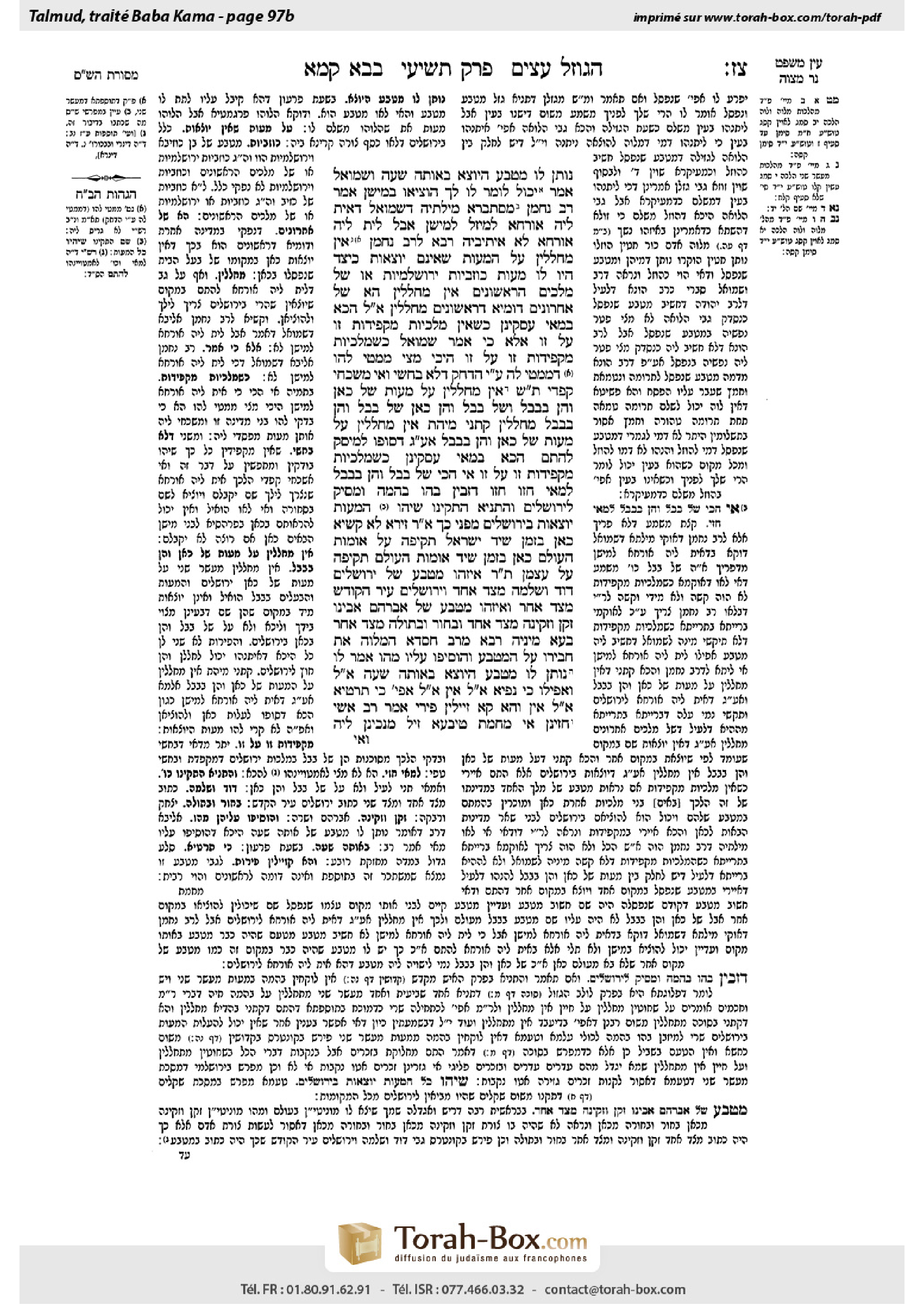
Bava Kamma 97b: Talmud study for Daf Yomi
Study the Talmud for Daf Yomi with scanned pages, Hebrew text, English translations from Sefaria and AI-generated French translations.
Passage selection and English or AI-generated French translation are available where the scan has annotations. Daf Study is independent of Torah-Box and Sefaria.
Browse Bava Kamma · בבא קמא · All tractatesBava Kamma 97b text and translations
This page of Bava Kamma includes the Aramaic text, an English translation and an AI-generated French translation, alongside the scan above.
בבא קמא צ״ז ב · Aramaic and Hebrew text
נוֹתֵן לוֹ מַטְבֵּעַ הַיּוֹצֵא בְּאוֹתָהּ שָׁעָה. וּשְׁמוּאֵל אָמַר: יָכוֹל לוֹמַר לוֹ, לֵךְ הוֹצִיאוֹ בְּמֵישָׁן. אָמַר רַב נַחְמָן: מִסְתַּבְּרָא מִילְּתֵיהּ דִּשְׁמוּאֵל – דְּאִית לֵיהּ אוֹרְחָא לְמֵיזַל לְמֵישָׁן, אֲבָל לֵית לֵיהּ אוֹרְחָא – לָא.
אֵיתִיבֵיהּ רָבָא לְרַב נַחְמָן: אֵין מְחַלְּלִין עַל הַמָּעוֹת שֶׁאֵינָם יוֹצְאוֹת. כֵּיצַד? הָיוּ לוֹ מָעוֹת כּוֹזְבִיּוֹת יְרוּשַׁלְמִיּוֹת, אוֹ שֶׁל מְלָכִים הָרִאשׁוֹנִים – אֵין מְחַלְּלִין. הָא שֶׁל אַחֲרוֹנִים דּוּמְיָא דְרִאשׁוֹנִים – מְחַלְּלִין!
אֲמַר לֵיהּ: הָכָא בְּמַאי עָסְקִינַן – כְּשֶׁאֵין מַלְכִיּוֹת מַקְפִּידוֹת זוֹ עַל זוֹ.
אֶלָּא כִּי אָמַר שְׁמוּאֵל – כְּשֶׁמַּלְכִיּוֹת מַקְפִּידוֹת זוֹ עַל זוֹ. הֵיכִי מָצֵי מַמְטֵי לְהוּ? דְּמַמְטֵי לְה[וּ] עַל יְדֵי הַדְּחָק; דְּלָא בָּחֲשִׁי, וְאִי מַשְׁכְּחִי קָפְדִי.
תָּא שְׁמַע: אֵין מְחַלְּלִין עַל מָעוֹת שֶׁל כָּאן וְהֵן בְּבָבֶל, וְשֶׁל בָּבֶל וְהֵן כָּאן. שֶׁל בָּבֶל וְהֵן בְּבָבֶל – מְחַלְּלִין. קָתָנֵי מִיהַת: אֵין מְחַלְּלִין עַל מָעוֹת שֶׁל כָּאן וְהֵן בְּבָבֶל – אַף עַל גַּב דְּסוֹפוֹ לְמִיסַּק לְהָתָם!
הָכָא בְּמַאי עָסְקִינַן – כְּשֶׁמַּלְכִיּוֹת מַקְפִּידוֹת זוֹ עַל זוֹ. אִי הָכִי, שֶׁל בָּבֶל וְהֵן בְּבָבֶל לְמַאי חֲזוּ? חֲזוּ דְּזָבֵין בְּהוּ בְּהֵמָה, וּמַסֵּיק לִירוּשָׁלַיִם.
וְהָתַנְיָא: הִתְקִינוּ שֶׁיְּהוּ הַמָּעוֹת יוֹצְאוֹת בִּירוּשָׁלַיִם מִפְּנֵי כָּךְ! אָמַר רַבִּי זֵירָא, לָא קַשְׁיָא: כָּאן בִּזְמַן שֶׁיַּד יִשְׂרָאֵל תַּקִּיפָה עַל אוּמּוֹת הָעוֹלָם, כָּאן בִּזְמַן שֶׁיַּד אוּמּוֹת הָעוֹלָם תַּקִּיפָה עַל עַצְמָן.
תָּנוּ רַבָּנַן: אֵיזֶהוּ מַטְבֵּעַ שֶׁל יְרוּשָׁלַיִם? דָּוִד וּשְׁלֹמֹה מִצַּד אֶחָד, וִירוּשָׁלַיִם עִיר הַקּוֹדֶשׁ מִצַּד אַחֵר. וְאֵיזֶהוּ מַטְבֵּעַ שֶׁל אַבְרָהָם אָבִינוּ? זָקֵן וּזְקֵינָה מִצַּד אֶחָד, וּבָחוּר וּבְתוּלָה מִצַּד אַחֵר.
בְּעָא מִינֵּיהּ רָבָא מֵרַב חִסְדָּא: הַמַּלְוֶה אֶת חֲבֵירוֹ עַל הַמַּטְבֵּעַ, וְהוֹסִיפוּ עָלָיו, מַהוּ? אָמַר לוֹ: נוֹתֵן לוֹ מַטְבֵּעַ הַיּוֹצֵא בְּאוֹתָהּ שָׁעָה. אֲמַר לֵיהּ: וַאֲפִילּוּ כִּי נָפְיָא? אֲמַר לֵיהּ: אִין. אֲמַר לֵיהּ: אֲפִילּוּ כִּי תְּרִטָיא? אֲמַר לֵיהּ: אִין.
וְהָא קָא זָיְילִין פֵּירֵי! אָמַר רַב אָשֵׁי: חָזֵינַן; אִי מֵחֲמַת טִיבְעָא זִיל – מְנַכֵּינַן לֵיהּ,
Bava Kamma 97b · English translation
The debtor gives him a coin that is in circulation at that time with which he repays the loan. And Shmuel says that the debtor can say to the creditor: I am giving you a coin like the one you gave me, although you cannot utilize it here. Go spend it in Meishan, i.e., a distant place where this coin is still in circulation. Rav Naḥman said: Shmuel’s statement is reasonable when the creditor has a way to go to Meishan, i.e., he intends to travel there, and therefore the debtor can tell him to spend the coin when he arrives at his destination. But if he has no way to go to Meishan, i.e., he does not intend to go there, the debtor may not give him these coins. Rather, he must give him coins that are in circulation in their current location.
Rava raised an objection to Rav Naḥman from a baraita (Tosefta, Ma’aser Sheni 1:6): One cannot desacralize second-tithe produce by transferring its sanctity onto coins that are not in circulation. How so? If one had coins of bar Kokheva [Kozeviyyot], coins of Jerusalem, or coins of earlier kings, all of which are no longer in use, one cannot desacralize second-tithe produce by transferring its sanctity onto them. Rava infers: But if one had coins of later, i.e., current, kings, that are similar to the coins of the earlier kings in that they have been invalidated in his location, since they are still valid elsewhere, one can desacralize the second-tithe produce by transferring its sanctity onto them. The baraita does not make a distinction as to whether the owner of the produce intends to travel to the location where those coins are in use or not.
Rav Naḥman said to him: With what are we dealing here in the baraita? We are dealing with a case where the kingdoms are not particular with one another. They allow a coin that has been invalidated in their province to be taken out of their borders and spent in a province where it is valid. Since these coins can be given to those planning to travel to the location where it is valid, it is considered to be a valid coin even in the location of the one desacralizing the second-tithe produce.
The Gemara asks: But, according to this explanation, when Shmuel said that the debtor can repay his debt with invalidated coins only if the creditor intends to travel to a location where they are valid, he is speaking of a case where the kingdoms are particular with each other. If so, how can he bring these coins to Meishan without the authorities confiscating them? The Gemara responds: Shmuel is discussing a case where the creditor can bring them with difficulty, as in a case where the authorities do not search, but if they find any invalid coins they are particular to confiscate them. It is therefore possible to bring these coins into the other kingdom. Nevertheless, since the authorities are particular, one who does not plan to travel there will not be able to exchange these coins with anyone in his location.
The Gemara questions Shmuel’s opinion: Come and hear what was taught in a baraita (Tosefta, Ma’aser Sheni 1:6): One cannot desacralize second-tithe produce by transferring its sanctity onto money of Eretz Yisrael, i.e., here, when they, the coins and their owner, are in Babylonia. And one cannot do so onto money of Babylonia when they, the coins and their owner, are here in Eretz Yisrael. If one uses money of Babylonia and they are in Babylonia, one can desacralize the second-tithe produce. In any event, the baraita teaches: One cannot desacralize second-tithe produce by transferring its sanctity onto money of Eretz Yisrael, here, when they are in Babylonia. And this is stated even though they will ultimately ascend to there, Eretz Yisrael, as the very purpose of transferring the sanctity to the coins is to spend them in Jerusalem.
The Gemara answers: With what are we dealing here? We are dealing with a case where the kingdoms are especially particular with one another, and it is impossible to transport coins from one location to the other. The Gemara asks: If so, if the kingdoms are especially particular with one another, then with regard to the case in the baraita, in which sanctity is transferred onto money of Babylonia and they are in Babylonia, for what are these coins fit? In any case they cannot be brought to Jerusalem. The Gemara responds: They are fit for purchasing an animal with them in Babylonia that will be brought up to Jerusalem.
With regard to the statement of the baraita, that one cannot desacralize second-tithe produce by transferring its sanctity onto Babylonian money when in Eretz Yisrael, the Gemara asks: But isn’t it taught in a baraita: The Sages instituted that all money shall circulate in Jerusalem because of this reason, i.e., so that Jews from all locations will be able to use their local currencies? Rabbi Zeira said: This is not difficult. Here, the baraita that states that all money is valid in Jerusalem is referring to a time when the authority of the Jewish people is dominant over the nations of the world and could enforce the rabbinic enactments. There, the baraita that states that sanctity may not be transferred onto Babylonian money when in Eretz Yisrael, is referring to a time when the authority of the nations of the world is dominant over them, i.e., the Jews, at which time foreign currency was not usable in Jerusalem.
Having mentioned the coins of Jerusalem, the Gemara notes: The Sages taught: What is the coin of ancient Jerusalem? The names David and Solomon were inscribed on one side, and Jerusalem the Holy City was on the other side. And what is the coin of Abraham our forefather? An old man and an old woman, representing Abraham and Sarah, were inscribed on one side, and a young man and a young woman, representing Isaac and Rebecca, were on the other side.
§ Rava inquired of Rav Ḥisda: What is the halakha in the case of one who lends money to another on the condition that he repay the loan in coin, i.e., with the specific denomination of a currency, and the government added to the size of the coin, so that a coin of the same denomination now weighs more? Is the debtor obligated to return the newly adjusted coin, or can he repay the debt according to the prior weight of the coin that he borrowed? Rav Ḥisda said to him: He gives him the coin that is in circulation at the time of the payment. Rava said to him: And is this the halakha even if the new coin is as large as a sieve? Rav Ḥisda said to him: Yes. Rava said to him: And is this the halakha even if it is as large as a quarter-kav [tartiya]? Rav Ḥisda said to him: Yes.
Rava challenged: But by increasing the weight of this coin, the produce has decreased in price, and since more produce can be purchased with this coin, giving it to the creditor as repayment is a form of interest. Rav Ashi said: We examine the situation: If the produce decreased in price due to the change in the weight of the coin, the debt is reduced for the debtor and the creditor is repaid with coins that equal the prior value of the loan.
Bava Kamma 97b · Traduction française (IA)
Le débiteur lui donne une pièce en circulation à cette époque avec laquelle il rembourse le prêt. Et Shmuel dit que le débiteur peut dire au créancier : Je te donne une pièce semblable à celle que tu m'as donnée, même si tu ne peux pas l'utiliser ici. Va la dépenser à Meishan, c'est-à-dire un lieu éloigné où cette pièce est encore en circulation. Rav Naḥman dit : L'affirmation de Shmuel est raisonnable lorsque le créancier a un moyen d'aller à Meishan, c'est-à-dire s'il prévoit de voyager là-bas, et donc le débiteur peut lui dire de dépenser la pièce lorsqu'il arrivera à son destination. Mais si le créancier n'a pas de moyen d'aller à Meishan, c'est-à-dire s'il ne prévoit pas de voyager là-bas, le débiteur ne peut pas lui donner ces pièces. Il doit plutôt lui donner des pièces en circulation à leur lieu actuel.
Rava a soulevé une objection contre Rav Naḥman à partir d'une baraïta (Tosefta, Ma’aser Sheni 1:6) : On ne peut pas désholocauster les produits de la dîme secondaire en transférant leur sanctité sur des pièces non en circulation. Comment cela se passe-t-il ? Si l'on avait des pièces de Bar Kochba [Kozeviyyot], des pièces de Jérusalem, ou des pièces des rois précédents, toutes non plus en circulation, on ne peut pas désholocauster les produits de la dîme secondaire en transférant leur sanctité sur elles. Rava en déduit : Mais si l'on avait des pièces des rois ultérieurs, c'est-à-dire actuels, qui sont semblables aux pièces des rois précédents dans le sens où elles sont invalidées dans son lieu, puisqu'elles sont encore valides ailleurs, on peut désholocauster les produits de la dîme secondaire en transférant leur sanctité sur elles. La baraïta ne fait pas de distinction quant à l'intention de l'propriétaire des produits de voyager vers le lieu où ces pièces sont en circulation.
Rav Naḥman a dit à lui : Avec quels objets sommes-nous en train de travailler dans la baraïta ? Nous travaillons avec un cas où les royaumes ne sont pas particuliers les uns envers les autres. Ils permettent qu'une pièce invalidée dans leur province soit sortie de leurs frontières et dépensée dans une province où elle est valide. Puisque ces pièces peuvent être données à ceux qui prévoient de voyager vers le lieu où elles sont valides, elles sont considérées comme des pièces valides même dans le lieu du désholocauste des produits de la dîme secondaire.
La Guemara pose une question : Mais, selon cette explication, lorsque Shmuel disait que le débiteur peut rembourser sa dette avec des pièces invalidées uniquement si le créancier prévoit de voyager vers un lieu où elles sont valides, il parlait d'un cas où les royaumes sont particuliers les uns envers les autres. Si c'est le cas, comment peut-il apporter ces pièces à Meishan sans que les autorités ne les confisquent ? La Guemara répond : Shmuel parle d'un cas où le créancier peut les apporter avec difficulté, comme dans un cas où les autorités ne cherchent pas, mais si elles trouvent des pièces invalidées, elles sont particuliers à les confisquer. Il est donc possible d'apporter ces pièces dans l'autre royaume. Cependant, puisque les autorités sont particuliers, celui qui ne prévoit pas de voyager là-bas ne pourra pas échanger ces pièces avec quiconque dans son lieu.
La Guemara questionne l'opinion de Shmuel : Viens écouter ce qui a été enseigné dans une baraïta (Tosefta, Ma’aser Sheni 1:6) : On ne peut pas désacraliser les produits de la dîme secondaire en transférant leur sanctité sur les monnaies d'Éretz Yisrael, c'est-à-dire ici, lorsque les pièces et leur propriétaire sont en Babylonie. Et on ne peut pas non plus le faire sur les monnaies de Babylonie lorsque les pièces et leur propriétaire sont ici en Éretz Yisrael. Si l'on utilise des monnaies de Babylonie et qu'elles sont en Babylonie, on peut désacraliser les produits de la dîme secondaire. En tout cas, la baraïta enseigne : On ne peut pas désacraliser les produits de la dîme secondaire en transférant leur sanctité sur les monnaies d'Éretz Yisrael, ici, lorsque les pièces et leur propriétaire sont en Babylonie. Et cela est dit même si elles finiront par monter là-bas, en Éretz Yisrael, car le but de transférer la sanctité vers les pièces est de les dépenser à Jérusalem.
La Guemara répond : Avec quels objets sommes-nous en train de travailler ? Nous travaillons avec un cas où les royaumes sont particuliers les uns envers les autres, et il est impossible de transporter des pièces d'un lieu à l'autre. La Guemara pose une question : Si c'est le cas, alors concernant le cas de la baraïta, où la sanctité est transférée sur des monnaies de Babylonie et qu'elles sont en Babylonie, pour quel usage ces pièces sont-elles adaptées ? En tout cas, elles ne peuvent pas être apportées à Jérusalem. La Guemara répond : Elles sont adaptées pour acheter un animal à Babylonie qui sera ensuite apporté à Jérusalem.
Concernant l'affirmation de la baraïta, que l'on ne peut pas désholocauster les produits de la dîme secondaire en transférant leur sanctité sur les monnaies de Babylonie lorsqu'on est en Éretz Yisrael, la Guemara pose une question : Mais n'est-ce pas enseigné dans une baraïta : Les Sages ont institué que toutes les monnaies circulent à Jérusalem à cause de cette raison, c'est-à-dire afin que les Juifs de tous les lieux puissent utiliser leurs monnaies locales ? Rabbi Zeira a dit : Ce n'est pas difficile. Ici, la baraïta qui dit que toutes les monnaies sont valides à Jérusalem fait référence à une époque où l'autorité du peuple juif dominait sur les nations du monde et pouvait faire respecter les édicts rabbiniques. Là, la baraïta qui dit que la sanctité ne peut pas être transférée sur les monnaies de Babylonie lorsqu'on est en Éretz Yisrael fait référence à une époque où l'autorité des nations du monde dominait sur eux, c'est-à-dire les Juifs, à l'époque où les monnaies étrangères n'étaient pas utilisables à Jérusalem.
Ayant mentionné les pièces de Jérusalem, la Guemara note : Les Sages ont enseigné : Quelle est la pièce de Jérusalem antique ? Le nom de David et celui de Salomon étaient inscrits sur un côté, et Jérusalem, la Ville Sainte, sur l'autre côté. Et quelle est la pièce d'Abraham notre père ? Un vieillard et une vieille femme, représentant Abraham et Sara, étaient inscrits sur un côté, et un jeune homme et une jeune femme, représentant Isaac et Rebecca, sur l'autre côté.
§ Rava demanda à Rav Ḥisda : Quel est le halakha dans le cas où l'on prête de l'argent à un autre en conditionnant le remboursement à la monnaie, c'est-à-dire à la dénomination spécifique d'une monnaie, et que le gouvernement a augmenté la taille de la monnaie, de sorte qu'une monnaie de la même dénomination pèse maintenant davantage ? Le débiteur est-il tenu de rendre la nouvelle monnaie ajustée, ou peut-il rembourser la dette selon le poids précédent de la monnaie qu'il a empruntée ? Rav Ḥisda répondit à Rava : Il lui donne la monnaie en circulation au moment du paiement. Rava dit à Rav Ḥisda : Et c'est-ce que la halakha est même si la nouvelle monnaie est aussi grande qu'un tamis ? Rav Ḥisda répondit : Oui. Rava dit à Rav Ḥisda : Et c'est-ce que la halakha est même si elle est aussi grande qu'un quart de kav [tartiya] ? Rav Ḥisda répondit : Oui.
Rava contesta : Mais en augmentant le poids de cette monnaie, le prix des produits a diminué, et puisque plus de produits peuvent être achetés avec cette monnaie, donner celle-ci au créancier comme remboursement constituerait un intérêt. Rav Ashi dit : Nous examinons la situation : Si le prix des produits a diminué en raison du changement de poids de la monnaie, la dette est réduite pour le débiteur et le créancier est remboursé avec des monnaies égales à la valeur précédente du prêt.
Traduction française générée par IA à partir de l’édition anglaise de Sefaria. Vérifie toujours un passage avec le texte source.
Text from Sefaria: William Davidson Edition - Vocalized Aramaic (CC BY NC); William Davidson Edition - English (CC BY NC).