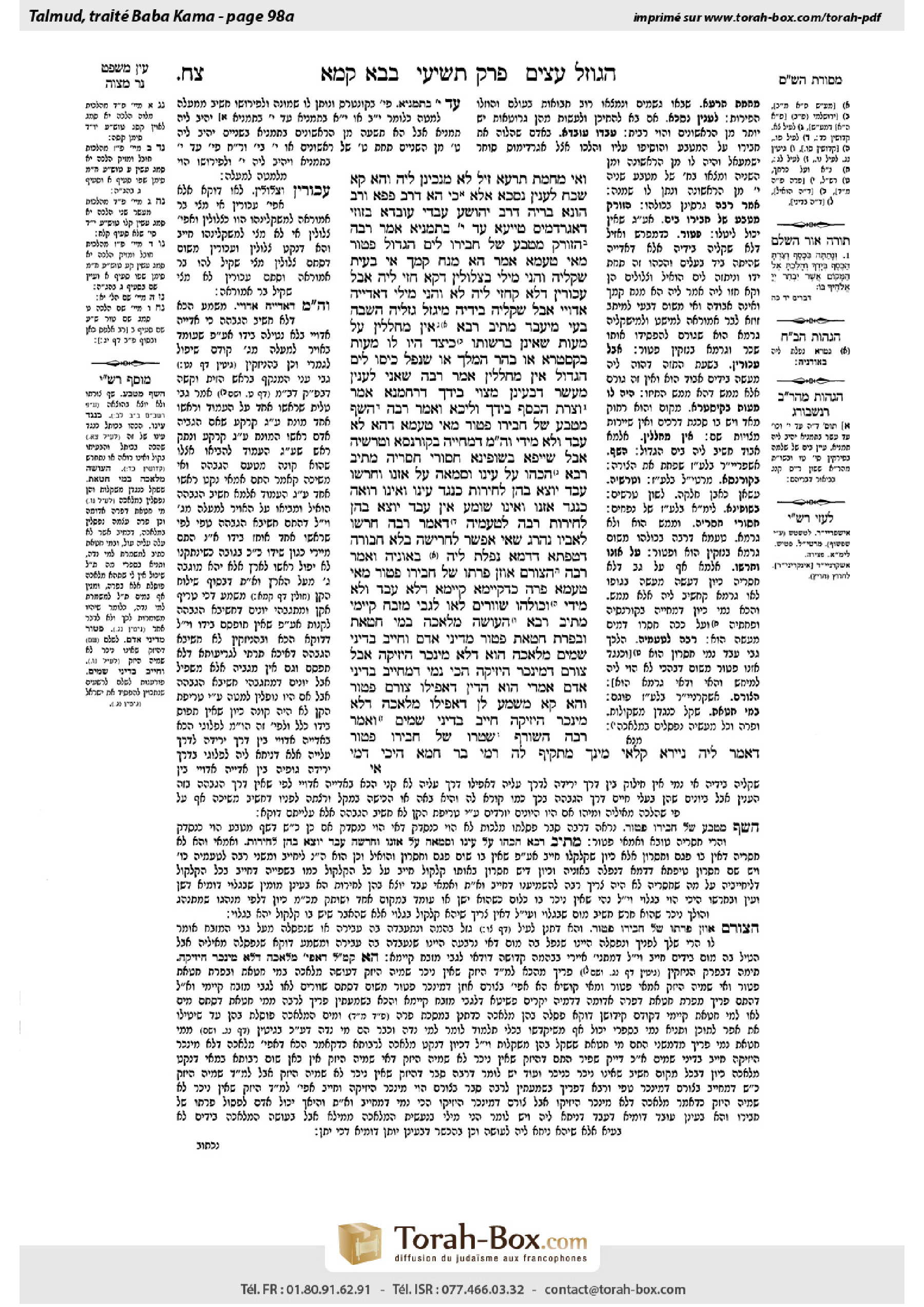
Bava Kamma 98a: Talmud study for Daf Yomi
Study the Talmud for Daf Yomi with scanned pages, Hebrew text, English translations from Sefaria and AI-generated French translations.
Passage selection and English or AI-generated French translation are available where the scan has annotations. Daf Study is independent of Torah-Box and Sefaria.
Browse Bava Kamma · בבא קמא · All tractatesBava Kamma 98a text and translations
This page of Bava Kamma includes the Aramaic text, an English translation and an AI-generated French translation, alongside the scan above.
בבא קמא צ״ח א · Aramaic and Hebrew text
וְאִי מֵחֲמַת תַּרְעָא זִיל – לָא מְנַכֵּינַן לֵיהּ.
וְהָא קָא שָׁבַח לְעִנְיַן נְסָכָא! אֶלָּא כִּי הָא דְּרַב פָּפָּא וְרַב הוּנָא בְּרֵיהּ דְּרַב יְהוֹשֻׁעַ עָבְדִי עוֹבָדָא בְּזוּזֵי דַּאֲגַרְדְּמִיס טַיָּיעָא, עַד עֲשָׂרָה בִּתְמָנְיָא.
אָמַר רַבָּה: הַזּוֹרֵק מַטְבֵּעַ שֶׁל חֲבֵירוֹ לַיָּם הַגָּדוֹל – פָּטוּר. מַאי טַעְמָא? אָמַר: הָא מַנַּח קַמָּךְ, אִי בָּעֵית שִׁקְלֵיהּ. וְהָנֵי מִילֵּי בִּצְלוּלִין – דְּקָא חָזֵי לֵיהּ, אֲבָל עֲכוּרִין – דְּלָא קָחָזֵי לֵיהּ, לָא. וְהָנֵי מִילֵּי דְּאַדְּיֵיהּ אַדּוֹיֵי, אֲבָל שַׁקְלֵיהּ בִּידֵיהּ – מִיגְזָל גַּזְלֵיהּ; הֲשָׁבָה בָּעֵי מֶיעְבַּד.
מֵתִיב רָבָא: אֵין מְחַלְּלִין עַל מָעוֹת שֶׁאֵינָן בִּרְשׁוּתוֹ. כֵּיצַד? הָיוּ לוֹ מָעוֹת בְּקַסְטְרָא אוֹ בְּהַר הַמֶּלֶךְ, אוֹ שֶׁנָּפַל כִּיסוֹ לַיָּם הַגָּדוֹל – אֵין מְחַלְּלִין! אָמַר רַבָּה: שָׁאנֵי לְעִנְיַן מַעֲשֵׂר, דְּבָעֵינַן מָצוּי בְּיָדְךָ; דְּרַחֲמָנָא אָמַר: ״וְצַרְתָּ הַכֶּסֶף בְּיָדְךָ״, וְלֵיכָּא.
וְאָמַר רַבָּה: הַשָּׁף מַטְבֵּעַ שֶׁל חֲבֵירוֹ – פָּטוּר. מַאי טַעְמָא? דְּהָא לָא עֲבַד וְלָא מִידֵּי. וְהָנֵי מִילֵּי דְּמַחְיֵיהּ בְּקוּרְנָסָא וְטַרְשֵׁיהּ, אֲבָל שַׁיְיפֵהּ בְּשׁוֹפִינָא – חַסּוֹרֵי חַסְּרֵיהּ.
מֵתִיב רָבָא: הִכָּהוּ עַל עֵינוֹ וְסִמְּאָהּ, עַל אׇזְנוֹ (וְחֵרְשׁוֹ) [וְחֵרְשָׁהּ] – עֶבֶד יוֹצֵא בָּהֶן לְחֵירוּת. כְּנֶגֶד עֵינוֹ וְאֵינוֹ רוֹאֶה, כְּנֶגֶד אׇזְנוֹ וְאֵינוֹ שׁוֹמֵע –ַ אֵין עֶבֶד יוֹצֵא בָּהֶן לְחֵירוּת.
רַבָּה לְטַעְמֵיהּ, דְּאָמַר רַבָּה: חֵרְשׁוֹ לְאָבִיו – נֶהֱרָג; שֶׁאִי אֶפְשָׁר לַחֲרִישָׁה בְּלֹא חַבּוּרָה, דְּטִפְּתָא דִּדְמָא נְפַלַת לֵיהּ בְּאוּנֵּיהּ.
וְאָמַר רַבָּה: הַצּוֹרֵם אוֹזֶן פָּרָתוֹ שֶׁל חֲבֵירוֹ – פָּטוּר. מַאי טַעְמָא? פָּרָה כִּדְקָיְימָא קָיְימָא, דְּלָא עֲבַד וְלָא מִידֵּי; וְכוּלְּהוּ שְׁווֹרִים לָאו לְגַבֵּי מִזְבֵּחַ קָיְימִי.
מֵתִיב רָבָא: הָעוֹשֶׂה מְלָאכָה בְּמֵי חַטָּאת וּבְפָרַת חַטָּאת – פָּטוּר מִדִּינֵי אָדָם, וְחַיָּיב בְּדִינֵי שָׁמַיִם. מְלָאכָה הוּא דְּלָא מִינְּכַר הֶיזֵּיקַהּ; אֲבָל צוֹרֵם – דְּמִינְּכַר הֶיזֵּיקַהּ, הָכִי נָמֵי דִּמְחַיֵּיב בְּדִינֵי אָדָם!
אָמְרִי: הוּא הַדִּין דַּאֲפִילּוּ צוֹרֵם פָּטוּר, וְהָא קָא מַשְׁמַע לַן – דַּאֲפִילּוּ מְלָאכָה דְּלָא מִינְּכַר הֶיזֵּיקַהּ, חַיָּיב בְּדִינֵי שָׁמַיִם.
וְאָמַר רַבָּה: הַשּׂוֹרֵף שְׁטָרוֹ שֶׁל חֲבֵירוֹ – פָּטוּר. דַּאֲמַר לֵיהּ: נְיָירָא קְלַאי מִינָּךְ. מַתְקֵיף לַהּ רָמֵי בַּר חָמָא: הֵיכִי דָּמֵי?
Bava Kamma 98a · English translation
And if the produce decreased in price due to the market value, the debt is not reduced for him.
The Gemara challenges: But the value of the coin has been enhanced for the purpose of melting it down into a bar of metal. Since this coin now contains a larger quantity of metal, if it were to be melted it would be worth more than an earlier coin of the same type, so it should be considered interest. Rather, in this case one must act in accordance with how Rav Pappa and Rav Huna, son of Rav Yehoshua, acted when they performed an action with the dinars of Agardamis the Arab merchant [tayya’a]: They considered up to ten old coins to be the equivalent of eight new coins. Since ten old coins were equivalent in value to eight new coins, they paid eight new coins in exchange for ten old ones.
§ Rabba says: One who throws another’s coin into the Great Sea is exempt from liability. What is the reason for this? He can say: The coin is resting before you; if you wish, take it. The Gemara comments: And this statement applies only if the coin is in translucent water, where the owner of the coin can see the coin, but in turbid water, where he cannot see the coin, it does not apply, and the one that threw it will be liable to compensate the owner. And this statement applies only when he rolled the coin into the sea without picking it up, but if he took the coin with his hands and threw it into the sea, he has robbed the owner of it, and the robber is required to perform the mitzva of returning the coin to its owner.
Rava raises an objection to the statement of Rabba from a baraita (Tosefta, Ma’aser Sheni 1:6): One cannot desacralize second tithe by transferring its sanctity onto money that is not in his possession. How so? If he had money in a fortress [kastera], or in the King’s Mountain [Har HaMelekh], or if his purse fell into the Great Sea, one may not desacralize second tithe by transferring its sanctity onto that money. This indicates that money that fell into the Great Sea is considered lost. Rabba said: This is not difficult; it is different with regard to second tithe, since it is necessary that the money be found in the hand of the one who wishes to desacralize the tithe, as the Merciful One states in the Torah: “Then you shall turn it into money, and bind up the money in your hand, and shall go to the place that the Lord your God shall choose” (Deuteronomy 14:25), and if it is in the Great Sea, it is not in his hand, but nevertheless it is not considered lost.
And Rabba also says: One who effaces the image of another’s coin is exempt from paying damages, even though he caused the coin to lose value. What is the reason for this? As he did not do anything, the coin remains the same size as before. The Gemara comments: And this statement applies only in a case where he struck it with a hammer [kurnesa] and flattened it; but if he filed it with a file [shofina] he must pay the amount of the reduction in value, since he caused it to diminish in size.
Rava raises an objection to the statement of Rabba from a baraita (Tosefta 9:26): If a master struck his slave on his eye and blinded it, or on his ear and deafened it, the slave is emancipated by means of these injuries. If he struck the slave near his eye and as a result he does not see, or near his ear and he does not hear, the slave is not emancipated by means of these injuries. The first clause indicates that one is liable for damage caused even if it is not visible damage.
The Gemara responds: Rabba conforms to his standard line of reasoning, as Rabba says: One who deafens his father is put to death, even though no bruise is visible, because it is impossible for deafening to occur without a bruise, as it is certain that a drop of blood fell into his ear from the blow, even if it is not visible from the outside. Striking someone in the ear in a manner that causes deafness results in a significant physical change, while striking a coin with a hammer does not detract from the actual size of the coin.
And Rabba also says: One who slits the ear of another’s cow is exempt from paying damages, even though this cow is no longer fit to be sacrificed as an offering due to the injury. What is the reason for this? As the cow was available for many uses until now, so it is still available for those uses now, since the one who slit its ear did not do anything to damage the cow in a substantial way. And concerning the fact that it is rendered disqualified from being sacrificed as an offering, not all oxen stand near the altar, i.e., most animals are not sacrificed as offerings anyway, so it is not considered a loss.
Rava raises an objection from a baraita: One who performs a task with the water of purification, i.e., the water that is mixed with the ashes of the red heifer and sprinkled upon one who has become impure as part of the purification ritual, or with the red heifer of purification, whose ashes are mixed with springwater and sprinkled on those who have contracted impurity imparted by a corpse on the third and seventh days of their impurity, is exempt according to human laws, since he has not caused any discernible damage, but is liable according to the laws of Heaven. It may be inferred from here that one is exempt from liability according to human laws only if he performed a task with those items, since the damage that he caused is not evident, but in the case of one who slits the ear, where the damage is evident, he is indeed liable according to human laws.
The Sages say in response: The same is true that even one who slits the ear is exempt according to human laws, and the baraita that specified cases where the damage is not evident teaches us this: That even one who performs a task with the water of purification or the red heifer, where the damage is not evident, is liable according to the laws of Heaven.
And Rabba also says: One who burns another’s promissory note is exempt, as the one who burned it can say to him: I have burned only your paper, and he is not held liable for the fact that the creditor will no longer be able to prove that he had provided the loan. Rami bar Ḥama objects to this: What are the circumstances?
Bava Kamma 98a · Traduction française (IA)
Et si la valeur du produit avait diminué en raison de la valeur du marché, la dette ne diminue pas pour lui.
La Guemara pose un défi : Mais la valeur de la monnaie a été augmentée à l'effet de la fondre pour en faire une barre de métal. Puisque cette monnaie contient maintenant une quantité plus grande de métal, si elle était fondue, elle vaudrait plus qu'une monnaie plus ancienne du même type, donc elle devrait être considérée comme un intérêt. Cependant, dans ce cas, on doit agir selon la manière dont Rav Pappa et Rav Huna, fils de Rav Yéhoshua, agissaient lorsqu'ils effectuaient une action avec les dinars d'Agardamis, le marchand arabe [tayya’a] : Ils considéraient dix monnaies anciennes comme équivalentes à huit nouvelles. Puisque dix monnaies anciennes équivalaient en valeur à huit nouvelles, ils payaient huit nouvelles en échange de dix anciennes.
§ Rabba dit : Celui qui jette une monnaie d'autrui dans la Mer Morte est exempt de responsabilité. Quelle est la raison de cela ? Il peut dire : La monnaie est en repos devant toi ; si tu le désires, prends-la. La Guemara commente : Et cette déclaration s'applique uniquement si la monnaie est dans de l'eau transparente, où l'propriétaire de la monnaie peut la voir, mais dans de l'eau trouble, où il ne peut pas la voir, elle ne s'applique pas, et celui qui l'a jetée sera tenu responsable de compenser l'propriétaire. Et cette déclaration s'applique uniquement lorsqu'il a lancé la monnaie dans la mer sans la ramasser, mais si il a pris la monnaie avec ses mains et l'a jetée dans la mer, il a volé l'propriétaire, et le voleur est tenu de remplir la mitsva de rendre la monnaie à son propriétaire.
Rava soulève une objection contre la déclaration de Rabba à partir d'une baraïta (Tosefta, Ma'aser Sheni 1:6) : On ne peut pas désholérifier le dixième second en transférant sa sanctité sur de l'argent qui n'est pas en sa possession. Comment cela ? Si il avait de l'argent dans un fort [kastera], ou dans la Montagne du Roi [Har HaMelekh], ou si sa bourse était tombée dans la Mer Morte, on ne peut pas désholérifier le dixième second en transférant sa sanctité sur cet argent. Cela indique que l'argent tombé dans la Mer Morte est considéré comme perdu. Rabba dit : Ce n'est pas difficile ; c'est différent concernant le dixième second, car il est nécessaire que l'argent soit trouvé dans la main de celui qui veut désholérifier le dixième, comme le Tout-Puissant le dit dans la Torah : « Alors tu le convertiras en argent, et tu le mettras dans ta main, et tu iras au lieu que l'Éternel ton Dieu aura choisi » (Deutéronome 14:25), et si il est dans la Mer Morte, il n'est pas dans sa main, mais néanmoins il n'est pas considéré comme perdu.
Et Rabba dit aussi : Celui qui efface l'image d'une monnaie d'autrui est exempt de payer des dommages, même s'il a fait perdre de la valeur à la monnaie. Quelle est la raison de cela ? Comme il n'a rien fait, la monnaie reste de la même taille qu'avant. La Guemara commente : Et cette déclaration s'applique uniquement dans le cas où il l'a frappée avec un marteau [kurnesa] et l'a aplatie ; mais si il l'a usée avec un ponceau [shofina], il doit payer la somme de la réduction de valeur, car il a fait diminuer sa taille.
Rava soulève une objection contre la déclaration de Rabba à partir d'une baraïta (Tosefta 9:26) : Si un maître frappe son esclave à l'œil et le rend aveugle, ou à l'oreille et le rend sourd, l'esclave est libéré par ces blessures. Si il frappe l'esclave près de l'œil et en conséquence il ne voit pas, ou près de l'oreille et il ne perçoit pas, l'esclave n'est pas libéré par ces blessures. La première clause indique que l'on est responsable des dommages causés même s'ils ne sont pas visibles.
La Guemara répond : Rabba suit sa ligne de raisonnement habituelle, car Rabba dit : Celui qui rend sourd son père est puni de mort, même s'il n'y a pas de contusion visible, car il est impossible que la surdité se produise sans une contusion, car il est certain qu'une goutte de sang est tombée dans son oreille à cause du coup, même si elle n'est pas visible de l'extérieur. Frapper quelqu'un à l'oreille de manière à le rendre sourd provoque un changement physique important, tandis que frapper une monnaie avec un marteau ne diminue pas la taille réelle de la monnaie.
Et Rabba dit aussi : Celui qui sectionne l'oreille d'une vache d'autrui est exempt de payer des dommages, même si cette vache n'est plus apte à être sacrifiée en offrande en raison de la blessure. Quelle est la raison de cela ? Comme la vache était disponible pour de nombreuses utilisations jusqu'à présent, elle est encore disponible pour ces utilisations maintenant, car celui qui a sectionné son oreille n'a pas fait de dommage substantiel à la vache. Et concernant le fait qu'elle est rendue inapte à être sacrifiée en offrande, pas tous les taureaux sont présents près de l'autel, c'est-à-dire la plupart des animaux ne sont pas sacrifiés en offrandes de toute façon, donc cela n'est pas considéré comme une perte.
Rava soulève une objection tirée d'une baraïta : Celui qui accomplît une tâche avec l'eau de purification, c'est-à-dire l'eau mélangée aux cendres de la vache rouge et aspergée sur celui qui est devenu impur en vertu du rituel de purification, ou avec la vache rouge de purification, dont les cendres sont mélangées à l'eau de source et aspergées sur ceux qui ont contracté l'impureté transmise par un cadavre aux troisième et septième jours de leur impureté, est exempt selon les lois humaines, car il n'a pas causé de dommage discernable, mais est responsable selon les lois du Ciel. On peut en déduire ici que l'on est exempt de responsabilité selon les lois humaines uniquement si l'on a accompli une tâche avec ces objets, car le dommage qu'il a causé n'est pas évident, mais dans le cas de celui qui sectionne l'oreille, où le dommage est évident, il est effectivement responsable selon les lois humaines.
Les Sages répondent en disant : La même chose est vraie, même celui qui sectionne l'oreille est exempt selon les lois humaines, et la baraïta qui spécifie les cas où le dommage n'est pas évident nous enseigne cela : que même celui qui accomplît une tâche avec l'eau de purification ou la vache rouge, où le dommage n'est pas évident, est responsable selon les lois du Ciel.
Et Rabba aussi dit : Celui qui brûle une note de promesse d'autrui est exempt, car celui qui l'a brûlée peut lui dire : J'ai brûlé seulement votre papier, et il n'est pas tenu responsable du fait que le créancier ne pourra plus prouver qu'il avait prêté l'argent. Rami bar Ḥama s'oppose à cela : Quelles sont les circonstances ?
Traduction française générée par IA à partir de l’édition anglaise de Sefaria. Vérifie toujours un passage avec le texte source.
Text from Sefaria: William Davidson Edition - Vocalized Aramaic (CC BY NC); William Davidson Edition - English (CC BY NC).