Bava Kamma 98b: Talmud study for Daf Yomi
Study the Talmud for Daf Yomi with scanned pages, Hebrew text, English translations from Sefaria and AI-generated French translations.
Passage selection and English or AI-generated French translation are available where the scan has annotations. Daf Study is independent of Torah-Box and Sefaria.
Browse Bava Kamma · בבא קמא · All tractatesBava Kamma 98b text and translations
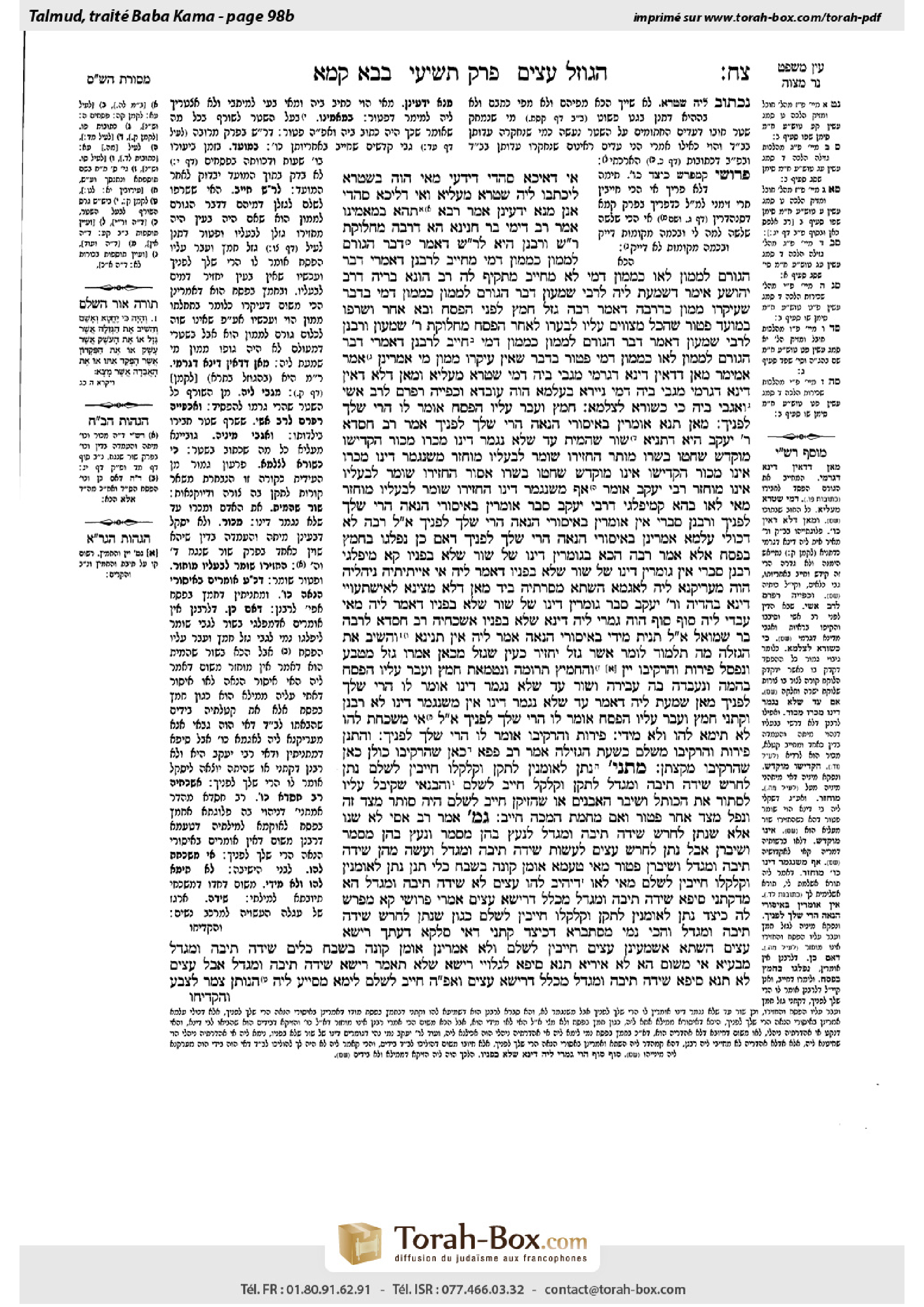
This page of Bava Kamma includes the Aramaic text, an English translation and an AI-generated French translation, alongside the scan above.
בבא קמא צ״ח ב · Aramaic and Hebrew text
אִי דְּאִיכָּא סָהֲדִי דְּיָדְעִי מַאי הֲוָה בִּשְׁטָרָא, לִיכְתְּבוּ לֵיהּ שְׁטָרָא מְעַלְּיָא! וְאִי דְּלֵיכָּא סָהֲדִי, אֲנַן מְנָא יָדְעִינַן? אָמַר רָבָא: תְּהֵא בְּמַאֲמִינוֹ.
אָמַר רַב דִּימִי בַּר חֲנִינָא: הָא דְּרַבָּה – מַחֲלוֹקֶת רַבִּי שִׁמְעוֹן וְרַבָּנַן הִיא. לְרַבִּי שִׁמְעוֹן דְּאָמַר דָּבָר הַגּוֹרֵם לְמָמוֹן כְּמָמוֹן דָּמֵי – מְחַיֵּיב; לְרַבָּנַן דְּאָמְרִי דָּבָר הַגּוֹרֵם לְמָמוֹן לָאו כְּמָמוֹן דָּמֵי – לָא מְחַיֵּיב.
מַתְקֵיף לַהּ רַב הוּנָא בְּרֵיהּ דְּרַב יְהוֹשֻׁעַ: אֵימַר דְּשָׁמְעַתְּ לֵיהּ לְרַבִּי שִׁמְעוֹן דָּבָר הַגּוֹרֵם לְמָמוֹן כְּמָמוֹן דָּמֵי – בְּדָבָר שֶׁעִיקָּרוֹ מָמוֹן, כִּדְרַבָּה; דְּאָמַר רַבָּה: גָּזַל חָמֵץ לִפְנֵי הַפֶּסַח, וּבָא אַחֵר וּשְׂרָפוֹ בַּמּוֹעֵד – פָּטוּר, שֶׁהַכֹּל מְצֻוִּוים עָלָיו לְבַעֲרוֹ. לְאַחַר הַפֶּסַח – מַחְלוֹקֶת רַבִּי שִׁמְעוֹן וְרַבָּנַן;
לְרַבִּי שִׁמְעוֹן דְּאָמַר דָּבָר הַגּוֹרֵם לְמָמוֹן כְּמָמוֹן דָּמֵי – חַיָּיב, לְרַבָּנַן דְּאָמְרִי דָּבָר הַגּוֹרֵם לְמָמוֹן לָאו כְּמָמוֹן דָּמֵי – פָּטוּר. בְּדָבָר שֶׁאֵין עִיקָּרוֹ מָמוֹן מִי אָמְרִינַן?
אָמַר אַמֵּימָר: מַאן דְּדָאֵין דִּינָא דְּגַרְמֵי – מַגְבֵּי בֵּיהּ דְּמֵי שְׁטָרָא מְעַלְּיָא, וּמַאן דְּלָא דָּאֵין דִּינָא דְּגַרְמֵי – מַגְבֵּי בֵּיהּ דְּמֵי נְיָירָא בְּעָלְמָא. הֲוָה עוֹבָדָא וְכַפְיֵיהּ רַפְרָם לְרַב אָשֵׁי, וְאַגְבִּי בֵּיהּ כִּי כְּשׁוּרָא לְצַלְמָא.
חָמֵץ וְעָבַר עָלָיו הַפֶּסַח – אוֹמֵר לוֹ: ״הֲרֵי שֶׁלְּךָ לְפָנֶיךָ״. מַאן תַּנָּא אוֹמְרִין בְּאִיסּוּרֵי הֲנָאָה ״הֲרֵי שֶׁלְּךָ לְפָנֶיךָ״? אָמַר רַב חִסְדָּא: רַבִּי יַעֲקֹב הִיא. דְּתַנְיָא: שׁוֹר שֶׁהֵמִית; עַד שֶׁלֹּא נִגְמַר דִּינוֹ – מְכָרוֹ מָכוּר, הִקְדִּישׁוֹ מוּקְדָּשׁ, שְׁחָטוֹ – בְּשָׂרוֹ מוּתָּר, הֶחְזִירוֹ שׁוֹמֵר לִבְעָלָיו – מוּחְזָר.
מִשֶּׁנִּגְמַר דִּינוֹ – מְכָרוֹ אֵינוֹ מָכוּר, הִקְדִּישׁוֹ אֵינוֹ מוּקְדָּשׁ, שְׁחָטוֹ – בְּשָׂרוֹ אָסוּר, הֶחְזִירוֹ שׁוֹמֵר לִבְעָלָיו – אֵינוֹ מוּחְזָר. רַבִּי יַעֲקֹב אוֹמֵר: אַף מִשֶּׁנִּגְמַר דִּינוֹ, הֶחְזִירוֹ שׁוֹמֵר לִבְעָלָיו – מוּחְזָר.
מַאי, לָאו בְּהָא קָמִיפַּלְגִי – דְּרַבִּי יַעֲקֹב סָבַר: אוֹמְרִין בְּאִיסּוּרֵי הֲנָאָה ״הֲרֵי שֶׁלְּךָ לְפָנֶיךָ״, וְרַבָּנַן סָבְרִי: אֵין אוֹמְרִין בְּאִיסּוּרֵי הֲנָאָה ״הֲרֵי שֶׁלְּךָ לְפָנֶיךָ״?
אֲמַר לֵיהּ רַבָּה: לָא, דְּכוּלֵּי עָלְמָא אָמְרִינַן בְּאִיסּוּרֵי הֲנָאָה ״הֲרֵי שֶׁלְּךָ לְפָנֶיךָ״; דְּאִם כֵּן, נִפְלְגוּ בְּחָמֵץ בַּפֶּסַח. אֶלָּא אָמַר רַבָּה: הָכָא בְּגוֹמְרִין דִּינוֹ שֶׁל שׁוֹר שֶׁלֹּא בְּפָנָיו קָא מִיפַּלְגִי –
רַבָּנַן סָבְרִי: אֵין גּוֹמְרִין דִּינוֹ שֶׁל שׁוֹר שֶׁלֹּא בְּפָנָיו, דַּאֲמַר לֵיהּ: אִי אַיְיתִיתֵיהּ נִיהֲלַיה – הֲוָה מַעְרֵיקְנָא לֵיהּ לְאַגְמָא, הַשְׁתָּא מְסַרְתֵּיהּ בְּיַד מַאן דְּלָא מָצֵינָא לְאִישְׁתַּעוֹיֵי דִּינָא בַּהֲדֵיהּ! וְרַבִּי יַעֲקֹב סָבַר: גּוֹמְרִין דִּינוֹ שֶׁל שׁוֹר שֶׁלֹּא בְּפָנָיו, דַּאֲמַר לֵיהּ: מַאי עֲבַדִי לֵיהּ? סוֹף סוֹף הֲוָה גָּמְרִי לֵיהּ (דִּינָא) [לְדִינֵיהּ] שֶׁלֹּא בְּפָנָיו.
אַשְׁכְּחֵיהּ רַב חִסְדָּא לְרַבָּה בַּר שְׁמוּאֵל, אֲמַר לֵיהּ: תְּנֵית מִידֵּי בְּאִיסּוּרֵי הֲנָאָה? אֲמַר לֵיהּ: אִין, תְּנֵינָא: ״וְהֵשִׁיב אֶת הַגְּזֵלָה״; מָה תַּלְמוּד לוֹמַר ״אֲשֶׁר גָּזַל״? יַחֲזִיר כְּעֵין שֶׁגָּזַל.
מִכָּאן אָמְרוּ: גָּזַל מַטְבֵּעַ וְנִפְסַל, פֵּירוֹת וְהִרְקִיבוּ, יַיִן וְהֶחְמִיץ, תְּרוּמָה וְנִטְמֵאת, חָמֵץ וְעָבַר עָלָיו הַפֶּסַח, בְּהֵמָה וְנֶעֶבְדָה בָּהּ עֲבֵירָה, וְשׁוֹר עַד שֶׁלֹּא נִגְמַר דִּינוֹ – אוֹמֵר לוֹ: ״הֲרֵי שֶׁלְּךָ לְפָנֶיךָ״.
מַאן שָׁמְעַתְּ לֵיהּ דְּאָמַר: עַד שֶׁלֹּא נִגְמַר דִּינוֹ – אִין, מִשֶּׁנִּגְמַר דִּינוֹ – לָא? רַבָּנַן; וְקָתָנֵי: חָמֵץ וְעָבַר עָלָיו הַפֶּסַח – אוֹמֵר לוֹ ״הֲרֵי שֶׁלְּךָ לְפָנֶיךָ״! אֲמַר לֵיהּ: אִי מַשְׁכַּחַתְּ לְהוּ, לָא תֵּימָא לְהוּ וְלָא מִידֵּי.
פֵּירוֹת וְהִרְקִיבוּ – אוֹמֵר לוֹ: ״הֲרֵי שֶׁלְּךָ לְפָנֶיךָ״. וְהָתְנַן: פֵּירוֹת וְהִרְקִיבוּ – מְשַׁלֵּם כִּשְׁעַת הַגְּזֵילָה! אָמַר רַב פָּפָּא: כָּאן שֶׁהִרְקִיבוּ כּוּלָּן, כָּאן שֶׁהִרְקִיבוּ מִקְצָתָן.
מַתְנִי׳ נָתַן לָאוּמָּנִין לְתַקֵּן, וְקִלְקְלוּ – חַיָּיבִין לְשַׁלֵּם. נָתַן לְחָרָשׁ שִׁידָּה תֵּיבָה וּמִגְדָּל לְתַקֵּן, וְקִלְקֵל – חַיָּיב לְשַׁלֵּם. וְהַבַּנַּאי שֶׁקִּיבֵּל עָלָיו לִסְתּוֹר אֶת הַכּוֹתֶל, וְשִׁיבֵּר הָאֲבָנִים אוֹ שֶׁהִזִּיקָן – חַיָּיב לְשַׁלֵּם. הָיָה סוֹתֵר מִצַּד זֶה וְנָפַל מִצַּד אַחֵר – פָּטוּר; וְאִם מֵחֲמַת הַמַּכָּה – חַיָּיב.
גְּמָ׳ אָמַר רַב אַסִּי: לֹא שָׁנוּ אֶלָּא שֶׁנָּתַן לְחָרָשׁ שִׁידָּה תֵּיבָה וּמִגְדָּל – לִנְעֹץ בָּהֶן מַסְמֵר, וְנָעַץ בָּהֶן מַסְמֵר וְשִׁיבְּרָן; אֲבָל נָתַן לְחָרָשׁ עֵצִים לַעֲשׂוֹת שִׁידָּה תֵּיבָה וּמִגְדָּל, וְעָשָׂה מֵהֶן שִׁידָּה תֵּיבָה וּמִגְדָּל וְשִׁיבְּרָן – פָּטוּר.
מַאי טַעְמָא? אוּמָּן קוֹנֶה בִּשְׁבַח כְּלִי.
תְּנַן: נָתַן לָאוּמָּנִין וְקִלְקְלוּ – חַיָּיבִין לְשַׁלֵּם. מַאי, לָאו דְּיָהֵיב לְהוּ עֵצִים? לָא, שִׁידָּה תֵּיבָה וּמִגְדָּל.
הָא מִדְּקָתָנֵי סֵיפָא: שִׁידָּה תֵּיבָה וּמִגְדָּל, מִכְּלָל דְּרֵישָׁא – עֵצִים! אָמְרִי: פָּרוֹשֵׁי קָא מְפָרֵשׁ לַהּ – כֵּיצַד נָתַן לָאוּמָּנִין לְתַקֵּן וְקִלְקְלוּ חַיָּיבִין לְשַׁלֵּם? כְּגוֹן שֶׁנָּתַן לְחָרָשׁ שִׁידָּה תֵּיבָה וּמִגְדָּל.
וְהָכִי נָמֵי מִסְתַּבְּרָא – דְּ״כֵיצַד״ קָתָנֵי. דְּאִי סָלְקָא דַעְתָּךְ רֵישָׁא עֵצִים; הַשְׁתָּא אַשְׁמְעִינַן עֵצִים חַיָּיבִין לְשַׁלֵּם – וְלָא אָמְרִינַן אוּמָּן קוֹנֶה בִּשְׁבַח כֵּלִים; שִׁידָּה תֵּיבָה וּמִגְדָּל מִבַּעְיָא?
אִי מִשּׁוּם הָא – לָא אִירְיָא. תְּנָא סֵיפָא לְגַלּוֹיֵי רֵישָׁא, שֶׁלֹּא תֹּאמַר: רֵישָׁא שִׁידָּה תֵּיבָה וּמִגְדָּל – אֲבָל עֵצִים לָא; תְּנָא סֵיפָא: שִׁידָּה תֵּיבָה וּמִגְדָּל – מִכְּלָל דְּרֵישָׁא עֵצִים, וַאֲפִילּוּ הָכִי חַיָּיב לְשַׁלֵּם.
לֵימָא מְסַיַּיע לֵיהּ: הַנּוֹתֵן צֶמֶר לַצַבָּע,
Bava Kamma 98b · English translation
If there are witnesses who know what was written in the promissory note, they should write a new, proper, promissory note for him, and there will not be any loss. And if there are no witnesses, how do we know what was written in the promissory note in order to assess liability? Rava says: Let it refer to a case where the one who burned the promissory note trusts the creditor with regard to the details of the promissory note. Despite the concession of the one who burned the promissory note with regard to the amount of the debt, Rabba holds that he is exempt, since the value of the debt is not inherent in the actual paper.
Rav Dimi bar Ḥanina said: This statement of Rabba is the subject of a dispute between Rabbi Shimon and the Rabbis. According to the opinion of Rabbi Shimon, who says that an item that causes financial loss is considered to have monetary value, the one who burned the promissory note is liable. According to the opinion of the Rabbis, who say that an item that causes financial loss is not considered to have monetary value, he is not liable. Rabba holds in accordance with the Rabbis, and therefore rules that one who burns a promissory note is exempt from liability.
Rav Huna, son of Rav Yehoshua, objects to this: Say that you heard the opinion of Rabbi Shimon, that an item that causes financial loss is considered to have monetary value, with regard to a case where he damaged an item that has intrinsic monetary value, in accordance with the statement of Rabba. As Rabba says: If one robbed another of leavened bread before Passover, and another came and burned it during the festival of Passover, when the leavened bread had already become forbidden, the one who burned it is exempt from paying the robber, as all are commanded to destroy the leavened bread, and he therefore performed a mitzva. If he burned it after Passover, that is the matter of dispute between Rabbi Shimon and the Rabbis.
Rav Huna, son of Rav Yehoshua, explains: According to the opinion of Rabbi Shimon, who says that an item that causes financial loss is considered to have monetary value, the one who burned it is liable, and he must pay the robber. Although it is prohibited to derive benefit from leavened bread, the robber could have returned it to the victim and been exempt from liability. Now that it has been burned, the robber will have to pay the monetary value of the leavened bread at the time of the theft. According to the opinion of the Rabbis, who say that an item that causes financial loss is not considered to have monetary value, he is exempt. But with regard to an item such as a promissory note, which has no intrinsic monetary value, do we say that in Rabbi Shimon’s opinion it too is considered to have monetary value?
The Gemara cites a ruling for the case where one burns the promissory note of another. Ameimar said: The one who rules that there is liability for damage caused by indirect action collects, in this case, the value of a proper promissory note, i.e., the amount of the debt, from the one who burned the promissory note. The one who rules that there is no liability for damage caused by indirect action collects, in this case, merely the value of the paper. The Gemara relates that there was an incident like this one, and Rafram forced Rav Ashi, who had burned a document in his youth, to pay damages, and he collected payment, in this case, as if he had damaged a beam used for crafting a sculpture, i.e., he paid him the value of the debt listed in the promissory note.
§ The mishna teaches that if one robbed another of leavened bread, and Passover elapsed over it, and it is therefore prohibited to derive benefit from it, the robber says to his victim: That which is yours is before you. The Gemara asks: Who is the tanna who taught that with regard to items from which benefit is forbidden one says: That which is yours is before you? Rav Ḥisda said: It is the opinion of Rabbi Ya’akov, as it is taught in a baraita (Tosefta 5:4): If there was an ox that killed a person and is consequently liable to be stoned, and before the court sentenced it the owner sold the ox, the sale is valid; if he consecrated it, the consecration is valid; if he slaughtered it, its flesh is permitted; if a bailee returned it to its owner, it is returned.
The baraita continues: By contrast, from when it was sentenced to be stoned it is prohibited to derive benefit from it, and if the owner sold it, the sale is not valid; if he consecrated it, the consecration is not valid; if he slaughtered it, its flesh is forbidden; if a bailee returned it to its owner, it is not returned, as once it is prohibited to derive benefit from it, the ox is worthless. Rabbi Ya’akov says: Even after it was sentenced, if a bailee returned it to its owner, it is returned.
Rav Ḥisda completes his analysis: What, is it not that they disagree about this issue, that Rabbi Ya’akov holds that with regard to items from which benefit is forbidden one can say: That which is yours is before you, and the Rabbis hold that with regard to items from which benefit is forbidden one cannot say: That which is yours is before you?
Rabba said to him in response: No. It may be that everyone agrees that with regard to items from which benefit is forbidden one can say: That which is yours is before you, and the ruling of the mishna is also in accordance with the opinion of the Rabbis. As if so, i.e., if it were true that the dispute in the baraita between the Rabbis and Rabbi Ya’akov concerns the general question of returning an item from which benefit is forbidden, they should disagree with regard to the case of leavened bread on Passover and whether it can be returned as is, since this is a clear case of an item from which benefit is forbidden. Rather, Rabba said: Here, in the baraita, they disagree with regard to a different issue: Can an ox be sentenced in its absence?
Rabba explains the dispute: The Rabbis hold that an ox may not be sentenced in its absence, and therefore the bailee is liable to pay. The reason is that when the ox is returned after its sentencing, the owner may say to the bailee: Had you brought the ox to me before sentencing, I would have chased it away into the marsh, preventing the sentencing from taking place. Now, since you did not return it to me before it was given to the court, you have given it to one with whom I cannot litigate, as the court was sure to sentence it. Therefore you must pay me and not return the ox. And Rabbi Ya’akov holds that an ox may be sentenced even in its absence, and the claim of the owner of the ox is not accepted. The reason is that the bailee may say to the owner in response: What did I do to the ox? Ultimately it would have been sentenced in its absence and rendered forbidden.
The Gemara relates an incident: Rav Ḥisda, who stated that the mishna is in accordance with the opinion of Rabbi Ya’akov and not the Rabbis, found Rabba bar Shmuel and said to him: Did you learn anything with regard to the halakhot of returning stolen items from which benefit is forbidden? Rabba bar Shmuel said to him: Yes, we learned a baraita: The verse states: “Then it shall be, if he has sinned, and is guilty, that he shall restore the item that he robbed” (Leviticus 5:23). What is the meaning when the verse states: “That he robbed”? It means that the robber must return the same item that he robbed.
The baraita continues: From here the Sages stated that if one robbed another of a coin and it was invalidated, or of produce and it rotted, or of wine and it fermented, or of teruma and it became ritually impure, or of leavened bread and Passover elapsed over it, or of an animal and a sin was performed with it, or of an ox that had not been sentenced, he can say to the robbery victim: That which is yours is before you.
The Gemara notes: Who did you hear say that before the ox was sentenced it can be returned, but after it was sentenced it cannot? It is the Rabbis, who disagree with Rabbi Ya’akov in the baraita; and this baraita teaches that if one robbed another of leavened bread and Passover elapsed over it, he can say to the robbery victim: That which is yours is before you. This disproves the analysis of Rav Ḥisda, as even the Rabbis agree that an item from which benefit is forbidden is returned as is. Rav Ḥisda said to Rabba bar Shmuel: If you find the Sages, do not say anything to them, i.e., do not publicize that I erred.
§ The Gemara discusses the baraita, which states that if one robbed another of produce and it rotted, he can say to the robbery victim: That which is yours is before you. The Gemara asks: But didn’t we learn in the mishna (96b): If one robbed another of produce and it rotted, he pays compensation according to the value of the stolen item at the time of the robbery? Rav Pappa said: Here, the mishna is referring to a case where the stolen produce all rotted, which constitutes a significant change. The robber acquires the produce and must pay what its value was at the time of the robbery. There, the baraita is referring to a case where part of the stolen produce rotted. In such a case the robber may return it and say: That which is yours is before you.
MISHNA: If one gave items to craftsmen to fix and they damaged them, the craftsmen are liable to pay for the damage. For example, if one gave a chest, a box, or a cabinet to a carpenter to fix, and he damaged it, he is liable to pay. And a builder who committed to demolish a wall and while demolishing it he broke the stones, or who damaged them, is liable to pay. If he was demolishing on this side of the wall, and the wall fell from another side and caused damage, he is exempt from liability. But if a stone fell and caused damage due to the force of the blow, he is liable.
GEMARA: The mishna teaches that if one gave a carpenter a chest, a box, or a cabinet to fix, and he damaged it, the carpenter is liable to pay for the damage. Rav Asi says: The Sages taught that a carpenter is liable to pay damages only in a case where one gave the carpenter a chest, a box, or a cabinet to drive a nail into them, i.e., he gave the carpenter complete vessels to repair, and he drove the nail into them and broke them. But if one gave wood to a carpenter to build a chest, a box, or a cabinet, and he built a chest, a box, or a cabinet from the wood, and before giving it to the owner the carpenter broke them, he is exempt from paying for the damage caused to these vessels, and must pay only for the damage caused to the wood.
What is the reason for this? It is because a craftsman acquires ownership rights through the enhancement of the vessel. The craftsman is considered to have acquired the vessel through his work, which enhances its value, and it remains in his possession until he returns it to the owners. Consequently, if he damages the vessel in any way, he is damaging his own item, and must return only the value of the raw materials to the owners.
The Gemara attempts to contradict Rav Asi’s statement: We learned in the mishna that if one gave items to craftsmen to fix and they damaged them, they are liable to pay for the damage. What, is it not referring to a case where he gave them wood, and they nevertheless pay the owner the value of a vessel? The Gemara responds: No, it is referring to a case where he gave them a chest, a box, or a cabinet to repair.
The Gemara asks: But from the fact that the latter clause of the mishna teaches about a chest, a box, or a cabinet, it may be inferred that the first clause of the mishna is referring to wood. The Sages say in response: The latter clause is explaining the first clause. After stating that the craftsmen are liable to pay damages, the mishna explains: In what case is it so that if one gave items to craftsmen to fix, and they damaged them, they are liable to pay? It is with regard to a case where one gave a carpenter a chest, a box, or a cabinet.
The Gemara notes: And so too, it is reasonable to say that the latter clause of the mishna teaches in what case the first clause deems them liable, as, if it enters your mind to think that the first clause is referring to a case where he gave wood, one could ask: Now that the mishna told us that if one gave wood, the craftsman is liable to pay the value of a vessel, and we do not say that a craftsman acquires ownership rights through the enhancement of vessels, is it necessary to tell us that if one gave a chest, a box, or a cabinet, the craftsman is liable to pay damages?
The Gemara dismisses this proof: If it is due to that reason, i.e., if that is the manner in which the explanation of the mishna is refuted, there is no conclusive argument, because that claim can be refuted by saying that the tanna taught the latter clause to shed light on the first clause, so that you would not say that the first clause is referring to a case where one gave the carpenter a chest, a box, or a cabinet, but had he given wood, the carpenter would not be liable. Therefore, the mishna teaches the case of one who gave a carpenter a chest, a box, or a cabinet in the latter clause, and it follows by inference that the first clause discusses one who gave the carpenter wood, and even so the carpenter is liable to pay damages. It is therefore impossible to prove Rav Asi’s statement from the mishna.
The Gemara suggests: Let us say that a mishna (100b) supports the opinion of Rav Asi: With regard to one who gives wool to a dyer
Bava Kamma 98b · Traduction française (IA)
Si des témoins savent ce qui est écrit sur l'acte de créance, ils doivent écrire un nouveau acte de créance correct pour lui, et il n'y aura pas de perte. Et si aucun témoin n'est présent, comment savons-nous ce qui est écrit sur l'acte de créance afin d'évaluer la responsabilité ? Rava dit : Cela concerne un cas où celui qui a brûlé l'acte de créance fait confiance au créancier concernant les détails de l'acte de créance. Malgré le compromis de celui qui a brûlé l'acte de créance concernant le montant de la dette, Rabba considère qu'il est exempt, car la valeur de la dette ne réside pas dans le papier lui-même.
Rav Dimi bar Ḥanina dit : Cette déclaration de Rabba est l'objet d'un débat entre Rabbi Shimon et les Rabbins. Selon l'opinion de Rabbi Shimon, qui affirme qu'un objet qui cause une perte financière est considéré comme ayant une valeur monétaire, celui qui a brûlé l'acte de créance est responsable. Selon l'opinion des Rabbins, qui affirment qu'un objet qui cause une perte financière n'est pas considéré comme ayant une valeur monétaire, il n'est pas responsable. Rabba suit l'opinion des Rabbins et donc déclare que celui qui brûle un acte de créance est exempt de responsabilité.
Rav Huna, fils de Rav Yehoshua, s'oppose à cela : Dites que vous avez entendu l'opinion de Rabbi Shimon, qui affirme qu'un objet qui cause une perte financière est considéré comme ayant une valeur monétaire, concernant un cas où il a endommagé un objet ayant une valeur monétaire intrinsèque, conformément à la déclaration de Rabba. Comme Rabba dit : Si l'on a volé du pain aisé avant Pâque, et que quelqu'un est venu et l'a brûlé pendant la fête de Pâque, lorsque le pain aisé était déjà interdit, celui qui l'a brûlé est exempt de payer au voleur, car tous sont commandés à détruire le pain aisé, et il a donc accompli une mitsva. Si l'on l'a brûlé après Pâque, c'est la question de débat entre Rabbi Shimon et les Rabbins.
Rav Huna, fils de Rav Yehoshua, explique : Selon l'opinion de Rabbi Shimon, qui affirme qu'un objet qui cause une perte financière est considéré comme ayant une valeur monétaire, celui qui l'a brûlé est responsable et doit payer au voleur. Bien que l'usage du pain aisé soit interdit, le voleur aurait pu le rendre au victime et être exempt de responsabilité. Maintenant que l'objet a été brûlé, le voleur devra payer la valeur du pain aisé à l'époque du vol. Selon l'opinion des Rabbins, qui affirment qu'un objet qui cause une perte financière n'est pas considéré comme ayant une valeur monétaire, il est exempt. Mais concernant un objet tel qu'un acte de créance, qui n'a pas de valeur monétaire intrinsèque, disons-nous que, selon l'opinion de Rabbi Shimon, il est également considéré comme ayant une valeur monétaire ?
La Guemara cite un jugement concernant le cas où l'on brûle l'acte de créance d'un autre. Ameimar dit : Celui qui affirme que la responsabilité pour les dommages causés par une action indirecte est applicable collecte, dans ce cas, la valeur d'un acte de créance correct, c'est-à-dire le montant de la dette, de celui qui a brûlé l'acte de créance. Celui qui affirme qu'il n'y a pas de responsabilité pour les dommages causés par une action indirecte collecte, dans ce cas, seulement la valeur du papier. La Guemara rapporte qu'il y avait un incident similaire, et Rafram força Rav Ashi, qui avait brûlé un document dans son jeune âge, à payer des dommages, et il collecta le paiement, dans ce cas, comme s'il avait endommagé un poteau utilisé pour sculpter, c'est-à-dire qu'il paya la valeur de la dette indiquée dans l'acte de créance.
§ La mitsna enseigne que si l'on a volé du pain aisé à quelqu'un, et que Pâque est passé et qu'il est donc interdit d'en tirer un bénéfice, le voleur dit à sa victime : Ce qui est à toi est devant toi. La Guemara pose la question : Qui est le tanna qui a enseigné que concernant les objets dont on ne peut tirer un bénéfice on dit : Ce qui est à toi est devant toi ? Rav Ḥisda dit : C'est l'opinion de Rabbi Ya'akov, comme il est enseigné dans une baraïta (Tosefta 5:4) : Si un bœuf a tué une personne et est donc réputé coupable de lapidation, et avant que le tribunal ne l'ait condamné l'propriétaire a vendu le bœuf, la vente est valide ; s'il l'a consacré, la consécration est valide ; s'il l'a sacrifié, sa viande est permise ; si un dépositaire a rendu le bœuf à son propriétaire, il est rendu.
La baraïta continue : En revanche, à partir du moment où il a été condamné à la lapidation, il est interdit de tirer un bénéfice de lui, et si l'owner le vend, la vente n'est pas valide ; s'il le consacre, la consécration n'est pas valide ; s'il le sacrifie, sa viande est interdite ; si un dépositaire le rend à son propriétaire, il n'est pas rendu, car une fois qu'il est interdit de tirer un bénéfice de lui, le bœuf est considéré comme sans valeur. Rabbi Yaakov dit : Même après qu'il ait été condamné, si un dépositaire le rend à son propriétaire, il est rendu.
Rav Ḥisda termine son analyse : Qu'est-ce que cela signifie, n'est-ce pas qu'ils débattent sur cette question, que Rabbi Yaakov affirme que concernant les objets dont on ne peut tirer un bénéfice on peut dire : Ce qui est à toi est devant toi, et les Rabbins affirment que concernant les objets dont on ne peut tirer un bénéfice on ne peut pas dire : Ce qui est à toi est devant toi ?
Rabba répondit à lui en disant : Non. Il peut être que tout le monde convienne que concernant les objets dont on ne peut tirer un bénéfice, on peut dire : Ce qui est à toi est devant toi, et le jugement de la mitsna est également selon l'opinion des Rabbins. Car si c'était vrai que le débat dans la baraïta entre les Rabbins et Rabbi Ya'akov concernait la question générale du retour d'un objet dont on ne peut tirer un bénéfice, ils devraient s'opposer concernant le cas du pain aisé à Pâque et savoir s'il peut être rendu tel quel, car c'est un cas clair d'un objet dont on ne peut tirer un bénéfice. Plutôt, Rabba dit : Ici, dans la baraïta, ils débattent concernant une autre question : peut-on condamner un bœuf en son absence ?
Rabba explique le débat : Les Rabbins affirment qu'un bœuf ne peut être condamné en son absence, et par conséquent le gardien est tenu de payer. La raison est que lorsque le bœuf est rendu après sa condamnation, l'owner peut dire au gardien : Si tu m'avais apporté le bœuf avant la condamnation, je l'aurais chassé dans la marais, empêchant ainsi la condamnation de s'appliquer. Maintenant, puisque tu n'as pas rendu le bœuf à moi avant qu'il ne soit remis au tribunal, tu l'as donné à une personne avec laquelle je ne peux pas engager un litige, car le tribunal était certain de le condamner. Par conséquent, tu dois me payer et ne pas rendre le bœuf. Et Rabbi Ya'akov affirme qu'un bœuf peut être condamné même en son absence, et la revendication de l'owner du bœuf n'est pas acceptée. La raison est que le gardien peut répondre à l'owner en disant : Qu'ai-je fait au bœuf ? Finalement, il aurait été condamné en son absence et rendu interdit.
Le Guemara rapporte un incident : Rav Ḥisda, qui affirmait que la mitsna est conforme à l'opinion de Rabbi Ya'akov et non celle des Rabbins, a trouvé Rabba bar Shmuel et lui a dit : As-tu appris quelque chose concernant les halakhot de la restitution d'objets volés dont le bénéfice est interdit ? Rabba bar Shmuel lui a répondu : Oui, nous avons appris une baraïta : La parole dit : « Alors il sera, s'il a péché et est coupable, qu'il rendra l'objet qu'il a volé » (Lévitique 5:23). Quelle est la signification lorsque la parole dit : « Qu'il a volé » ? Cela signifie que le voleur doit rendre l'objet même qu'il a volé.
La baraïta continue : D'où les Sages ont déclaré que si l'on a volé à un autre une pièce et qu'elle a été invalidée, ou des produits et qu'ils ont pourri, ou du vin et qu'ils ont fermenté, ou de terouma et qu'elle est devenue impure, ou du pain levé et que la Pâque est passée sur lui, ou d'un animal et qu'un péché a été commis avec lui, ou d'un bœuf qui n'avait pas été condamné, il peut dire au voleur : Ce qui est à toi est devant toi.
Le Guemara note : Qui t'a dit que avant que le bœuf ne soit condamné il peut être rendu, mais après il ne peut pas ? C'est les Rabbins, qui s'opposent à Rabbi Ya'akov dans la baraïta ; et cette baraïta enseigne que si l'on a volé à un autre du pain levé et que la Pâque est passée sur lui, il peut dire au voleur : Ce qui est à toi est devant toi. Cela infirme l'analyse de Rav Ḥisda, car même les Rabbins admettent que l'objet dont le bénéfice est interdit est rendu tel quel. Rav Ḥisda a dit à Rabba bar Shmuel : Si tu trouves les Sages, ne dis rien à eux, c'est-à-dire ne publie pas que j'ai eu tort.
§ Le Guemara discute de la baraïta, qui stipule que si l'on a volé à un autre des produits et qu'ils ont pourri, il peut dire au voleur : Ce qui est à toi est devant toi. Le Guemara pose la question : Mais n'avons-nous pas appris dans la mitsna (96b) : Si l'on a volé à un autre des produits et qu'ils ont pourri, il paie une compensation selon la valeur de l'objet volé au moment du vol ? Rav Pappa a dit : Ici, la mitsna fait référence à un cas où tous les produits volés ont pourri, ce qui constitue un changement significatif. Le voleur acquiert les produits et doit payer ce qu'ils valaient au moment du vol. Là, la baraïta fait référence à un cas où une partie des produits volés a pourri. Dans ce cas, le voleur peut les rendre et dire : Ce qui est à toi est devant toi.
MICHNA : Si l'on a donné des objets à des artisans pour les réparer et qu'ils les ont endommagés, les artisans sont tenus de payer pour le dommage. Par exemple, si l'on a donné un coffre, une boîte ou un armoire à un charpentier pour les réparer et qu'il les a endommagés, il est tenu de payer. Et un maçon qui s'est engagé à démolir un mur et qui, en le démolissant, a cassé les pierres, ou les a endommagées, est tenu de payer. Si il démolissait du côté de ce mur et que le mur est tombé du côté opposé et a causé un dommage, il est exempt de responsabilité. Mais si une pierre est tombée et a causé un dommage en raison de la force du coup, il est tenu.
GUEMARA : La mitsna enseigne que si l'on a donné à un charpentier un coffre, une boîte ou un armoire pour les réparer et qu'il les a endommagés, le charpentier est tenu de payer pour le dommage. Rav Asi dit : Les Sages ont enseigné que le charpentier est tenu de payer des dommages uniquement dans un cas où l'on a donné au charpentier un coffre, une boîte ou un armoire pour y fixer un clou, c'est-à-dire qu'on a donné au charpentier des objets complets à réparer, et il a fixé un clou dedans et les a cassés. Mais si l'on a donné du bois à un charpentier pour construire un coffre, une boîte ou un armoire, et qu'il a construit un coffre, une boîte ou un armoire à partir du bois, et avant de le rendre à l'propriétaire, le charpentier a cassé ces objets, il est exempt de payer pour le dommage causé à ces objets, et doit payer uniquement pour le dommage causé au bois.
Quelle est la raison de cela ? C'est parce que le maître d'œuvre acquiert les droits de propriété par l'amélioration de l'objet. Le maître d'œuvre est considéré comme ayant acquis l'objet par son travail, qui augmente sa valeur, et il reste en possession jusqu'à ce qu'il le rende à l'propriétaire. Par conséquent, s'il endommage l'objet de quelque manière que ce soit, il endommage son propre objet, et doit rendre seulement la valeur des matières premières à l'propriétaire.
Le Guemara tente de contredire l'affirmation de Rav Asi : Nous avons appris dans la mitsna que si l'on donne des objets aux artisans pour les réparer et qu'ils les endommagent, ils sont tenus de payer pour le dommage. Qu'est-ce que cela ne fait pas référence à un cas où l'on donne du bois et qu'ils paient tout de même à l'owner la valeur d'un objet ? Le Guemara répond : Non, cela fait référence à un cas où l'on donne un coffre, une boîte ou un armoire à réparer.
Le Guemara pose la question : Mais à partir du fait que la dernière partie de la mitsna enseigne concernant un coffre, une boîte ou un armoire, on peut en déduire que la première partie de la mitsna fait référence au bois. Les Sages répondent : La dernière partie explique la première partie. Après avoir dit que les artisans sont tenus de payer des dommages, la mitsna explique : Dans quel cas est-ce que si l'on donne des objets aux artisans pour les réparer et qu'ils les endommagent, ils sont tenus de payer ? C'est concernant un cas où l'on donne à un charpentier un coffre, une boîte ou un armoire.
La Guemara note : De même, il est raisonnable de dire que la seconde clause de la mitsna enseigne dans quel cas la première clause considère qu'ils sont redevables, car, si l'on pense que la première clause fait référence à un cas où l'on donne du bois, on pourrait demander : Maintenant que la mitsna nous a dit que si l'on donne du bois, le maître d'œuvre est redevable de la valeur d'un objet, et qu'on ne dit pas qu'un maître d'œuvre acquiert des droits de propriété par l'amélioration des objets, est-il nécessaire de nous dire que si l'on donne un coffre, une boîte ou un armoire, le maître d'œuvre est redevable de dommages ?
La Guemara rejette cette preuve : Si c'est à cause de cela, c'est-à-dire si c'est ainsi que l'explication de la mitsna est réfutée, il n'y a pas d'argument concluant, car cette affirmation peut être réfutée en disant que le tanna a enseigné la seconde clause afin d'éclairer la première, de sorte que l'on ne dise pas que la première clause fait référence à un cas où l'on donne au charpentier un coffre, une boîte ou un armoire, mais s'il avait donné du bois, le charpentier ne serait pas redevable. Ainsi, la mitsna enseigne le cas où l'on donne au charpentier un coffre, une boîte ou un armoire dans la seconde clause, et il s'ensuit par déduction que la première clause discute d'une personne qui donne au charpentier du bois, et même ainsi, le charpentier est redevable de dommages. Il est donc impossible de prouver l'opinion de Rav Asi à partir de la mitsna.
La Guemara suggère : Disons qu'une mitsna (100b) soutient l'opinion de Rav Asi : En ce qui concerne celui qui donne du laine à un teinturier
Traduction française générée par IA à partir de l’édition anglaise de Sefaria. Vérifie toujours un passage avec le texte source.
Text from Sefaria: William Davidson Edition - Vocalized Aramaic (CC BY NC); William Davidson Edition - English (CC BY NC).