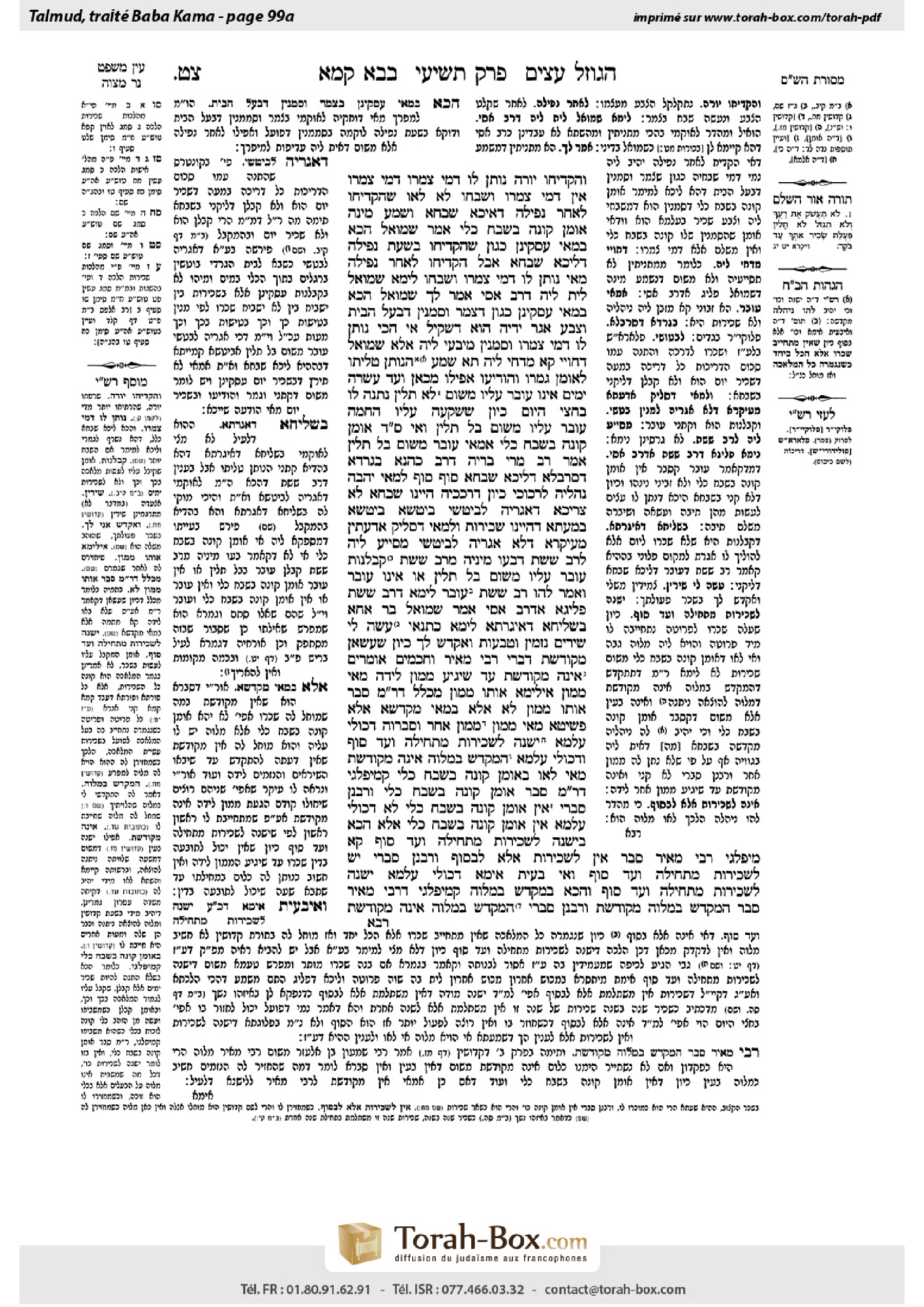
Bava Kamma 99a: Talmud study for Daf Yomi
Study the Talmud for Daf Yomi with scanned pages, Hebrew text, English translations from Sefaria and AI-generated French translations.
Passage selection and English or AI-generated French translation are available where the scan has annotations. Daf Study is independent of Torah-Box and Sefaria.
Browse Bava Kamma · בבא קמא · All tractatesBava Kamma 99a text and translations
This page of Bava Kamma includes the Aramaic text, an English translation and an AI-generated French translation, alongside the scan above.
בבא קמא צ״ט א · Aramaic and Hebrew text
וְהִקְדִּיחוֹ יוֹרָה – נוֹתֵן לוֹ דְּמֵי צַמְרוֹ. דְּמֵי צַמְרוֹ – אִין, דְּמֵי צַמְרוֹ וְשִׁבְחוֹ – לָא; לָאו שֶׁהִקְדִּיחוֹ לְאַחַר נְפִילָה, דְּאִיכָּא שְׁבָחָא, וּשְׁמַע מִינַּהּ אוּמָּן קוֹנֶה בִּשְׁבַח כְּלִי?
אָמַר שְׁמוּאֵל: הָכָא בְּמַאי עָסְקִינַן – כְּגוֹן שֶׁהִקְדִּיחוֹ בִּשְׁעַת נְפִילָה, דְּלֵיכָּא שְׁבָחָא. אֲבָל הִקְדִּיחוֹ לְאַחַר נְפִילָה מַאי? נוֹתֵן לוֹ דְּמֵי צַמְרוֹ וְשִׁבְחוֹ?! לֵימָא שְׁמוּאֵל לֵית לֵיהּ דְּרַב אַסִּי?
אָמַר לָךְ שְׁמוּאֵל: הָכָא בְּמַאי עָסְקִינַן – כְּגוֹן דְּצֶמֶר וְסַמָּנִין דְּבַעַל הַבַּיִת, וְצַבָּע אֲגַר יְדֵיהּ הוּא דְּשָׁקֵיל.
אִי הָכִי, ״נוֹתֵן לוֹ דְּמֵי צַמְרוֹ וְסַמָּנִין״ מִיבְּעֵי לֵיהּ! אֶלָּא שְׁמוּאֵל דַּחוֹיֵי קָא מְדַחֵי לֵיהּ.
תָּא שְׁמַע: הַנּוֹתֵן טַלִּיתוֹ לְאוּמָּן; גְּמָרוֹ וְהוֹדִיעוֹ – אֲפִילּוּ מִכָּאן וְעַד עֲשָׂרָה יָמִים אֵינוֹ עוֹבֵר עָלָיו מִשּׁוּם ״לֹא תָלִין״. נְתָנָהּ לוֹ בַּחֲצִי הַיּוֹם – כֵּיוָן שֶׁשָּׁקְעָה עָלָיו הַחַמָּה, עוֹבֵר עָלָיו מִשּׁוּם ״בַּל תָּלִין״.
וְאִי סָלְקָא דַּעְתָּךְ אוּמָּן קוֹנֶה בִּשְׁבַח כְּלִי, אַמַּאי עוֹבֵר מִשּׁוּם ״בַּל תָּלִין״?
אָמַר רַב מָרִי בְּרֵיהּ דְּרַב כָּהֲנָא: בְּגִרְדָּא דְסַרְבָּלָא, דְּלֵיכָּא שְׁבָחָא.
סוֹף סוֹף, לְמַאי יַהֲבַהּ נִהֲלֵיהּ – לְרַכּוֹכֵי; כֵּיוָן דְּרַכְּכֵיהּ, הַיְינוּ שְׁבָחָא! לָא צְרִיכָא, דְּאַגְרֵיהּ לְבִיטְשֵׁי – בִּיטְשָׁא בִּיטְשָׁא בְּמָעֲתָא, דְּהַיְינוּ שְׂכִירוּת.
וּלְמַאי דִּסְלֵיק אַדַּעְתִּין מֵעִיקָּרָא דְּלָא אַגְרֵיהּ לְבִיטְשֵׁי, מְסַיַּיע לֵיהּ לְרַב שֵׁשֶׁת – דִּבְעוֹ מִינֵּיהּ מֵרַב שֵׁשֶׁת: קַבְּלָנוּת, עוֹבֵר עָלָיו מִשּׁוּם ״בַּל תָּלִין״, אוֹ אֵינוֹ עוֹבֵר? וַאֲמַר לְהוּ רַב שֵׁשֶׁת: עוֹבֵר.
לֵימָא דְּרַב שֵׁשֶׁת פְּלִיגָא אַדְּרַב אַסִּי? אָמַר שְׁמוּאֵל בַּר אַחָא: בִּשְׁלִיחָא דְאִיגַּרְתָּא.
לֵימָא כְּתַנָּאֵי? ״עֲשֵׂה לִי שֵׁירִים, נְזָמִין וְטַבָּעוֹת, וְאֶקַּדֵּשׁ לָךְ״, כֵּיוָן שֶׁעֲשָׂאָן – מְקוּדֶּשֶׁת, דִּבְרֵי רַבִּי מֵאִיר. וַחֲכָמִים אוֹמְרִים: אֵינָהּ מְקוּדֶּשֶׁת עַד שֶׁיַּגִּיעַ מָמוֹן לְיָדָהּ.
מַאי ״מָמוֹן״? אִילֵּימָא אוֹתוֹ מָמוֹן, מִכְּלָל דְּרַבִּי מֵאִיר סָבַר אוֹתוֹ מָמוֹן לָא?! אֶלָּא בְּמַאי [כּוּ] מִקַּדְּשָׁא? אֶלָּא פְּשִׁיטָא, מַאי ״מָמוֹן״ – מָמוֹן אַחֵר;
וְסַבְרוּהָ דְּכוּלֵּי עָלְמָא יֶשְׁנָהּ לִשְׂכִירוּת מִתְּחִילָּה וְעַד סוֹף; וּדְכוּלֵּי עָלְמָא הַמְקַדֵּשׁ בְּמִלְוָה אֵינָהּ מְקוּדֶּשֶׁת.
מַאי, לָאו בְּאוּמָּן קוֹנֶה בִּשְׁבַח כְּלִי קָמִיפַּלְגִי? דְּרַבִּי מֵאִיר סָבַר: אוּמָּן קוֹנֶה בִּשְׁבַח כְּלִי, וְרַבָּנַן סָבְרִי: אֵין אוּמָּן קוֹנֶה בִּשְׁבַח כְּלִי?
לָא, דְּכוּלֵּי עָלְמָא אֵין אוּמָּן קוֹנֶה בִּשְׁבַח כְּלִי; אֶלָּא הָכָא בְּיֶשְׁנָהּ לִשְׂכִירוּת מִתְּחִילָּה וְעַד סוֹף קָא מִיפַּלְגִי –
רַבִּי מֵאִיר סָבַר: אֵין לִשְׂכִירוּת אֶלָּא לְבַסּוֹף, וְרַבָּנַן סָבְרִי: יֵשׁ לִשְׂכִירוּת מִתְּחִילָּה וְעַד סוֹף.
וְאִי בָּעֵית אֵימָא: דְּכוּלֵּי עָלְמָא יֶשְׁנָהּ לִשְׂכִירוּת מִתְּחִילָּה וְעַד סוֹף, וְהָכָא בִּמְקַדֵּשׁ בְּמִלְוָה קָמִיפַּלְגִי – דְּרַבִּי מֵאִיר סָבַר: הַמְקַדֵּשׁ בְּמִלְוָה – מְקוּדֶּשֶׁת, וְרַבָּנַן סָבְרִי: הַמְקַדֵּשׁ בְּמִלְוָה – אֵינָהּ מְקוּדֶּשֶׁת.
Bava Kamma 99a · English translation
and it was burned in the cauldron in which it was dyed, the dyer gives the owner the value of his wool. The Gemara infers: The value of his wool, yes, the dyer must pay that amount, but the value of the wool and its enhanced value, no, he need not pay. The Gemara suggests: Is this not referring to a case where the wool was burned after falling into the cauldron and the dye had taken hold, so that there is enhanced value, and one can learn from the mishna that a craftsman acquires ownership rights through the enhancement of the vessel, and therefore the dyer need not pay the enhanced value?
Shmuel said: This is not a proof. With what are we dealing here? We are dealing with a case where the wool was burned at the moment of falling into the cauldron, before the dye had taken hold, so that there is no enhancement. The Gemara asks: But according to this opinion, what would the halakha be if it was burned after falling into the cauldron, when the dye had taken hold? Would the dyer give the owner the value of his wool and its enhancement? Shall we say that Shmuel does not accept the statement of Rav Asi, and holds that a craftsman does not acquire ownership rights through the enhancement of the vessel?
The Gemara rejects this statement. Shmuel could have said to you: With what are we dealing here in the mishna? We are dealing with a case where the wool and herbs used in the dye both belong to the homeowner, and the dyer is taking only the payment of his hand, i.e., the wages for his labor, and nothing else. In this case, the craftsman does not acquire ownership rights through the enhancement of the vessel, but in a case where the craftsman provides the materials, he does acquire such rights.
The Gemara asks: If so, i.e., if the homeowner’s herbs were also ruined by the dyer, the mishna should have said that the dyer gives the owner the value of his wool and herbs, not just the value of his wool. Rather, Shmuel is merely dismissing the Gemara’s proof with regard to the statement of Rav Asi that a craftsman acquires a vessel through its enhancement, by saying that the mishna could be understood otherwise. He does not, however, state his own opinion on this matter.
The Gemara offers another suggestion: Come and hear a proof from a baraita: With regard to one who gave his garment to a craftsman, and the craftsman concluded the work and notified the owner that the work was complete, even if the owner delays paying the craftsman from now until ten days henceforth, he does not violate, for this delay, the prohibition of: “You shall not oppress your neighbor, nor rob him; the wages of a hired worker shall not abide with you all night until the morning” (Leviticus 19:13). If the craftsman gave the garment to him at midday, then once the sun has set and the owner has not paid him, the owner does violate, for this delay, the prohibition against delaying the payment of wages.
The Gemara concludes: And if it enters your mind to say that a craftsman acquires ownership rights through the enhancement of the vessel, why does the owner violate the prohibition against delaying the payment of wages? It is as if the craftsman acquired the garment, and the payment is considered to be a purchase of the garment by the owner, rather than a wage.
The Gemara responds: Rav Mari, son of Rav Kahana, said: The baraita is stating the halakha with regard to the laundering of a thick garment, where there is no enhancement of the garment. Therefore, the craftsman does not acquire it.
The Gemara asks: Ultimately, to what end did the owner of the garment give it to the craftsman? He gave it to him in order to soften it. Once he has softened it, that is its enhancement, and the craftsman has therefore acquired it. The Gemara responds: No; it is necessary to teach this halakha in a case where the owner hired the craftsman for treading, i.e., to forcefully tread on the garment in water until it softens, with the owner paying the craftsman a ma’a coin for each tread. The difference is that this is considered hired labor, where the craftsman is paid based on the amount of times he performed an action, and not contractual labor, where he is paid based on the outcome, in this case, a softened garment.
The Gemara comments: And with regard to what entered our minds initially, that the owner did not hire the worker for treading but rather he hired him like a craftsman based on the assumption that the garment would be returned laundered, this supports the opinion of Rav Sheshet. As they asked Rav Sheshet: If one hires a contractor, who is not paid an hourly wage but is paid upon the completion of his task, and the one who hired him does not pay him on the day that he completes the work, does he violate, for this delay, the prohibition against delaying the payment of wages, or does he not violate the prohibition? And Rav Sheshet said to them: He does violate the prohibition.
The Gemara asks: Shall we say based on this statement that Rav Sheshet disagrees with the statement of Rav Asi, who holds that a craftsman acquires ownership rights through the enhancement of the vessel, and his payment is not considered to be a wage? Shmuel bar Aḥa said: Rav Sheshet is discussing a specific type of contractor, and he stated his ruling with regard to an agent tasked with the delivery of a letter, in which case, since the contractor’s only task is to deliver the letter, there is no enhancement through which he might acquire ownership rights. Consequently the prohibition against delaying the payment of wages applies.
The Gemara suggests: Let us say that the statement of Rav Asi, that a craftsman acquires ownership rights through the enhancement of the vessel, is the subject of a dispute between tanna’im. As it is taught in a baraita: If a woman gave gold to a goldsmith, instructing him: Fashion bracelets, earrings, or rings for me, and I will be betrothed to you as payment for your work, then once he has fashioned them she is betrothed; this is the statement of Rabbi Meir. And the Rabbis say: She is not betrothed until money enters her possession.
The Gemara asks: What is this money mentioned by the Rabbis? If we say it means that very money, i.e., the rings she ordered, then by inference Rabbi Meir holds that even that very money is not required in order for the betrothal to take effect. But with what does he betroth her? He has given her nothing but the jewelry. Rather, it is obvious. To what money are the Rabbis referring? They must be referring to when he betroths her via other money, i.e., the payment she owes him for his service. According to the opinion of the Rabbis, in order for the betrothal to take effect he must give her additional money, while according to Rabbi Meir the betrothal takes effect when he gives her the jewelry.
The Gemara prefaces its explanation of the connection to the issue at hand by delineating two assumptions: And those who say that Rabbi Meir and the Rabbis are engaging in a dispute with regard to the issue of a craftsman acquiring ownership rights through the enhancement of a vessel assumed that everyone agrees that the obligation to pay a wage is incurred continuously from the beginning of the period he was hired to its end, i.e., the obligation to pay for a service begins when the hired party commences work, and the sum owed increases as he proceeds. The fact that he is not paid from the time he commences work establishes the wages as a debt. Consequently, the wages now have the status of a loan. And they also assumed that everyone agrees that with regard to one who betroths a woman with a loan that she is not betrothed. She therefore cannot be betrothed to him by not having to pay the wages for his work.
Based on these assumptions, the Gemara asks: What, is it not that they disagree with regard to whether a craftsman acquires ownership rights through the enhancement of the vessel? As Rabbi Meir holds that a craftsman acquires ownership rights through the enhancement of the vessel, and since he owns the enhanced value of the vessel, when he gives the jewelry to her he is giving her something valuable of his own, and she is betrothed. And the Rabbis hold that a craftsman does not acquire ownership rights through the enhancement of the vessel, and since a craftsman, in this case, the goldsmith, does not own the jewelry, he cannot betroth a woman with it.
The Gemara rejects this explanation of the dispute: No, it is possible that everyone agrees that a craftsman does not acquire ownership rights through the enhancement of the vessel, but here they disagree with regard to the issue of whether the obligation to pay a wage is incurred continuously from the beginning of the period he was hired to its end.
Rabbi Meir holds that the obligation to pay a wage is incurred only at the end of the period for which he was hired, i.e., the owner is obligated to pay only when the work is complete, and therefore the goldsmith’s wages do not have the status of a loan, but of a sum of money that she becomes obligated to give him at that time. If he gives her the jewelry without asking for that money, it is as though he gave the money from his wages to her, and she may be betrothed with it. And the Rabbis hold that the obligation to pay a wage is incurred continuously from the beginning of the period he was hired to its end, and therefore his wages have the status of a loan, and she cannot be betrothed with them and must be given additional money.
And if you wish, say instead that everyone agrees that the obligation to pay a wage is incurred continuously from the beginning of the period he was hired to its end, and here they disagree with regard to one who betroths a woman with a loan. As Rabbi Meir holds that with regard to one who betroths a woman with a loan, she is betrothed. And the Rabbis hold that with regard to one who betroths a woman with a loan, she is not betrothed.
Bava Kamma 99a · Traduction française (IA)
et il fut brûlé dans la marmite dans laquelle il avait été teint, le teinteur donne à l'owner la valeur de son laine. La Guemara déduit : La valeur de sa laine, oui, le teinteur doit payer cette somme, mais la valeur de la laine et sa valeur augmentée, non, il n'a pas besoin de payer. La Guemara suggère : N'est-ce pas un cas où la laine avait été brûlée après avoir tombé dans la marmite et que le teint avait pris, de sorte qu'il y avait une valeur augmentée, et qu'on peut apprendre de la mitsva que l'artisan acquiert des droits d'ownership par l'amélioration du récipient, et donc le teinteur n'a pas besoin de payer la valeur augmentée ?
Shmuel dit : Ce n'est pas une preuve. Avec quoi sommes-nous en train de nous occuper ici ? Nous sommes en train de nous occuper d'un cas où la laine avait été brûlée au moment de sa chute dans la marmite, avant que le teint ne prenne, de sorte qu'il n'y avait pas d'amélioration. La Guemara pose la question : Mais selon cet avis, quelle serait la halakha si la laine avait été brûlée après sa chute dans la marmite, lorsque le teint avait pris ? Le teinteur donnerait-il à l'owner la valeur de sa laine et de son amélioration ? Dirons-nous que Shmuel ne reconnaît pas l'avis de Rav Asi, et qu'il considère que l'artisan ne peut pas acquérir des droits d'ownership par l'amélioration du récipient ?
La Guemara rejette cette déclaration. Shmuel aurait pu dire à vous : Avec quoi sommes-nous en train de nous occuper dans la mitsva ? Nous sommes en train de nous occuper d'un cas où la laine et les herbes utilisées pour le teint appartenaient tous deux à l'owner, et le teinteur ne prenait que la rémunération de son travail, c'est-à-dire la rémunération pour son travail, et rien d'autre. Dans ce cas, l'artisan ne peut pas acquérir des droits d'ownership par l'amélioration du récipient, mais dans un cas où l'artisan fournit les matériaux, il peut acquérir de tels droits.
La Guemara pose la question : Si tel est le cas, c'est-à-dire si les herbes de l'homme qui possède avaient également été détruites par le teinteur, la Michna devrait avoir dit que le teinteur donne à l'homme qui possède la valeur de sa laine et de ses herbes, et non seulement la valeur de sa laine. Par conséquent, Shmuel n'est pas simplement en train de rejeter la preuve de la Guemara concernant l'avis de Rav Asi que l'artisan acquiert un récipient par son amélioration, en disant que la Michna pourrait être interprétée autrement. Il ne déclare cependant pas son propre avis sur cette question.
La Guemara propose une autre suggestion : Viens écouter une preuve d'une baraïta : Concernant celui qui a donné son vêtement à un artisan, et l'artisan a terminé le travail et a informé l'homme qui possède que le travail était achevé, même si l'homme qui possède retarde le paiement à l'artisan de maintenant jusqu'à dix jours plus tard, il ne viole pas, pour ce retard, l'interdiction de : « Vous ne devriez pas opprimer votre prochain, ni le voler ; les salaires d'un ouvrier ne doivent pas rester avec vous toute la nuit jusqu'au matin » (Lévitique 19:13). Si l'artisan avait donné le vêtement à l'homme qui possède à midi, puis une fois que le soleil est couché et que l'homme qui possède n'a pas payé, l'homme qui possède viole, pour ce retard, l'interdiction de retarder le paiement des salaires.
La Guemara conclut : Et si cela entre dans votre esprit de dire que l'artisan acquiert des droits d'propriété par l'amélioration du récipient, pourquoi l'homme qui possède viole-t-il l'interdiction de retarder le paiement des salaires ? C'est comme si l'artisan avait acquis le vêtement, et le paiement est considéré comme un achat du vêtement par l'homme qui possède, plutôt qu'un salaire.
La Guemara répond : Rav Mari, fils de Rav Kahana, dit : La baraïta énonce la halakha concernant le lavage d'un vêtement épais, où il n'y a pas d'amélioration du vêtement. Par conséquent, l'artisan ne l'acquiert pas.
La Guemara pose la question : Finalement, à quel effet l'propriétaire du vêtement a-t-il donné ce dernier à l'artisan ? Il l'a donné pour le ramollir. Une fois qu'il l'a ramollie, c'est son amélioration, et l'artisan a donc acquis le vêtement. La Guemara répond : Non ; il est nécessaire d'enseigner cette halakha dans un cas où l'propriétaire a engagé l'artisan pour le tressage, c'est-à-dire pour tasser fortement le vêtement dans l'eau jusqu'à ce qu'il soit ramollie, en payant à l'artisan une monnaie pour chaque tressage. La différence est que cela est considéré comme un travail payé par l'heure, où l'artisan est payé selon le nombre d'actions qu'il a effectuées, et non un travail contractuel, où il est payé selon le résultat, dans ce cas, un vêtement ramollie.
La Guemara commente : Et concernant ce qui nous est entré dans l'esprit initialement, que l'propriétaire n'avait pas engagé l'ouvrier pour le tressage mais plutôt l'avait engagé comme un artisan en supposant que le vêtement serait rendu lavé, cela soutient l'avis de Rav Sheshet. Comme ils ont interrogé Rav Sheshet : Si l'on engage un entrepreneur, qui n'est pas payé par l'heure mais est payé à la fin de sa tâche, et que l'homme qui l'a engagé ne lui paie pas le jour où il a terminé le travail, viole-t-il, pour ce retard, l'interdiction de retarder le paiement des salaires, ou ne viole-t-il pas l'interdiction ? Et Rav Sheshet a dit à ceux-ci : Il viole l'interdiction.
La Guemara pose la question : Dirons-nous, à partir de cette déclaration, que Rav Sheshet est en désaccord avec l'avis de Rav Asi, qui considère que l'artisan acquiert des droits d'ownership par l'amélioration du récipient, et que son paiement n'est pas considéré comme un salaire ? Shmuel bar Aḥa dit : Rav Sheshet discute d'un type spécifique d'entrepreneur, et il a formulé son jugement concernant un agent chargé de la livraison d'une lettre, dans lequel cas, puisque la tâche de l'entrepreneur est seulement de livrer la lettre, il n'y a pas d'amélioration par laquelle il pourrait acquérir des droits d'ownership. Par conséquent, l'interdiction de retarder le paiement des salaires s'applique.
La Guemara suggère : Disons que l'avis de Rav Asi, que l'artisan acquiert des droits d'ownership par l'amélioration du récipient, est l'objet d'un débat entre les tannaïm. Comme il est enseigné dans une baraïta : Si une femme a donné de l'or à un orfèvre, en lui disant : Fais des bracelets, des boucles d'oreille ou des bagues pour moi, et je te donnerai en mariage comme paiement pour ton travail, alors une fois qu'il a fait ces objets, elle est mariée ; c'est l'avis de Rabbi Meir. Et les Rabbins disent : Elle n'est pas mariée jusqu'à ce que l'argent entre en sa possession.
La Guemara pose la question : De quel argent parle les Sages ? Si nous disons qu'il s'agit de cet argent-là, c'est-à-dire les bagues qu'elle a commandées, alors par déduction Rabbi Meïr considère que même cet argent-là n'est pas requis pour que la betrothal prenne effet. Mais avec quel argent la betrothal a-t-il lieu ? Il lui a donné rien de plus que les bijoux. Plutôt, c'est évident. De quel argent les Sages parlent-ils ? Ils doivent parler de l'argent avec lequel il la betrothe par un autre moyen, c'est-à-dire le paiement qu'elle doit lui pour son service. Selon l'opinion des Sages, afin que la betrothal prenne effet, il doit lui donner un argent supplémentaire, tandis que selon l'opinion de Rabbi Meïr, la betrothal prend effet lorsque il lui donne les bijoux.
La Guemara introduit son explication de la connexion avec l'objet principal en délimitant deux hypothèses : Et ceux qui disent que Rabbi Meïr et les Sages sont en désaccord concernant la question d'un artisan acquisant des droits de propriété par l'amélioration d'un objet supposent que tout le monde convient que l'obligation de payer un salaire s'engage continuellement depuis le début de la période où il a été embauché jusqu'à la fin, c'est-à-dire que l'obligation de payer pour un service commence lorsque la personne embauchée commence à travailler, et la somme due augmente à mesure qu'il progresse. Le fait qu'il ne soit pas payé depuis le début du travail établit le salaire comme une dette. Par conséquent, les salaires ont désormais le statut d'un prêt. Et ils supposent également que tout le monde convient que concernant celui qui betrothe une femme avec un prêt, elle n'est pas betrothe. Elle ne peut donc pas être betrothe par le fait qu'elle ne doive pas payer le salaire pour son travail.
En se basant sur ces hypothèses, la Guemara pose la question : Qu'est-ce que cela signifie, qu'ils sont en désaccord concernant le fait qu'un artisan acquière des droits de propriété par l'amélioration d'un objet ? Comme Rabbi Meïr considère qu'un artisan acquiert des droits de propriété par l'amélioration d'un objet, et qu'il possède la valeur améliorée de l'objet, lorsqu'il donne les bijoux à elle, il lui donne quelque chose de précieux qui lui appartient, et elle est mariée. Et les Sages considèrent qu'un artisan ne peut pas acquérir des droits de propriété par l'amélioration d'un objet, et comme un artisan, dans ce cas, le bijoutier, ne possède pas les bijoux, il ne peut pas marier une femme avec eux.
La Guemara rejette cette explication du désaccord : Non, il est possible que tout le monde convienne qu'un artisan ne peut pas acquérir des droits de propriété par l'amélioration d'un objet, mais ici ils sont en désaccord concernant la question de savoir si l'obligation de payer un salaire s'engage continuellement depuis le début de la période où il a été embauché jusqu'à la fin.
Rabbi Meïr considère que l'obligation de payer un salaire s'engage uniquement à la fin de la période pour laquelle il a été embauché, c'est-à-dire que l'propriétaire est tenu de payer uniquement lorsque le travail est achevé, et par conséquent les salaires du bijoutier n'ont pas le statut d'un prêt, mais d'une somme d'argent que elle est tenue de lui donner à ce moment-là. Si il lui donne les bijoux sans demander cet argent, cela équivaut à lui donner l'argent de ses salaires, et elle peut être mariée avec cela. Et les Sages considèrent que l'obligation de payer un salaire s'engage continuellement depuis le début de la période où il a été embauché jusqu'à la fin, et par conséquent ses salaires ont le statut d'un prêt, et elle ne peut pas être mariée avec eux et doit être donnée un argent supplémentaire.
Et si vous le souhaitez, dites plutôt que tout le monde convient que l'obligation de payer un salaire s'engage continuellement depuis le début de la période où il a été embauché jusqu'à la fin, et ici ils sont en désaccord concernant celui qui fiance une femme avec un prêt. Comme Rabbi Meïr considère que concernant celui qui fiance une femme avec un prêt, elle est fiancée. Et les Sages considèrent que concernant celui qui fiance une femme avec un prêt, elle n'est pas fiancée.
Traduction française générée par IA à partir de l’édition anglaise de Sefaria. Vérifie toujours un passage avec le texte source.
Text from Sefaria: William Davidson Edition - Vocalized Aramaic (CC BY NC); William Davidson Edition - English (CC BY NC).