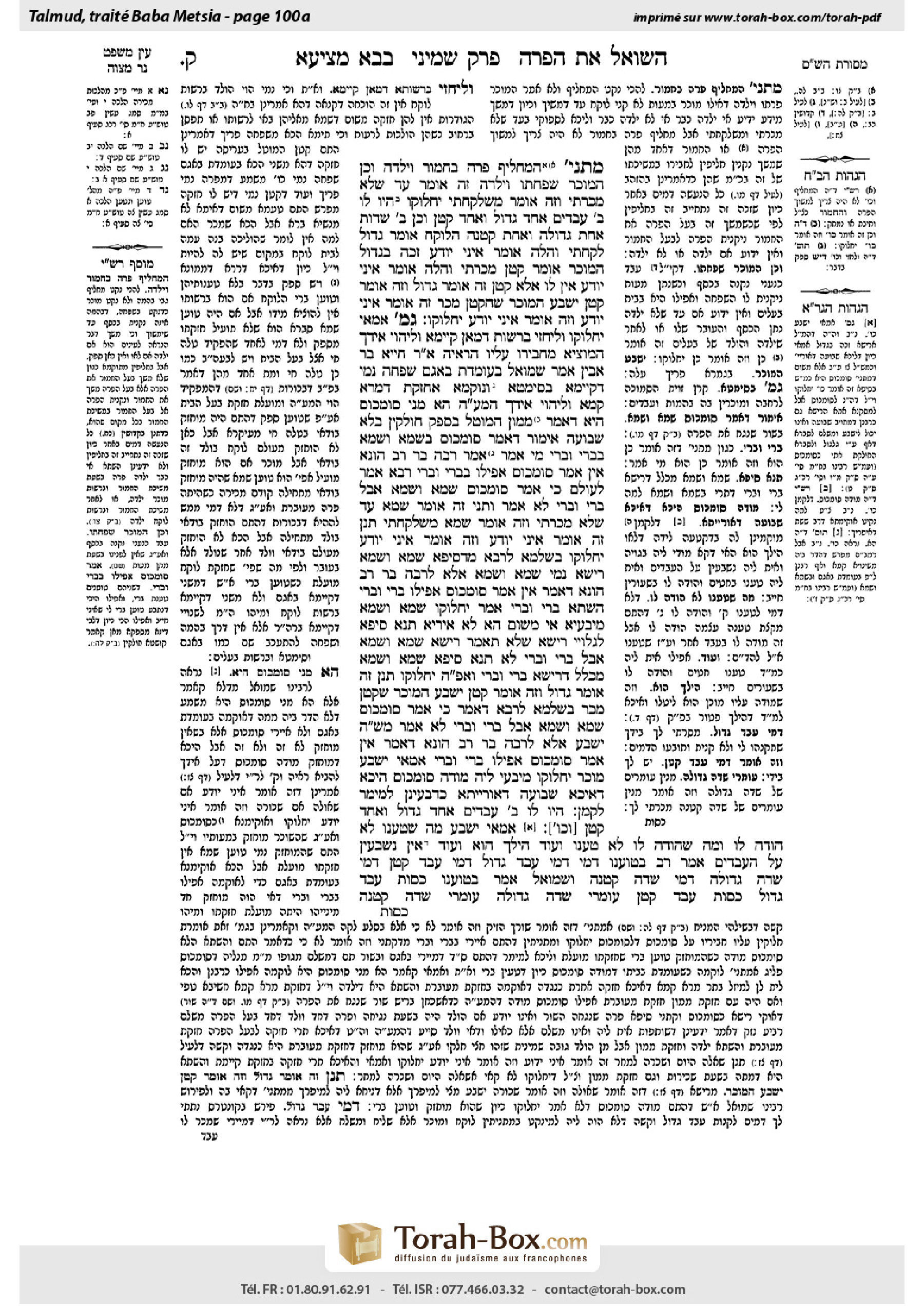
Bava Metzia 100a: Talmud study for Daf Yomi
Study the Talmud for Daf Yomi with scanned pages, Hebrew text, English translations from Sefaria and AI-generated French translations.
Passage selection and English or AI-generated French translation are available where the scan has annotations. Daf Study is independent of Torah-Box and Sefaria.
Browse Bava Metzia · בבא מציעא · All tractatesBava Metzia 100a text and translations
This page of Bava Metzia includes the Aramaic text, an English translation and an AI-generated French translation, alongside the scan above.
בבא מציעא ק׳ א · Aramaic and Hebrew text
מַתְנִי׳ הַמַּחְלִיף פָּרָה בַּחֲמוֹר וְיָלְדָה, וְכֵן הַמּוֹכֵר שִׁפְחָתוֹ וְיָלְדָה, זֶה אוֹמֵר: עַד שֶׁלֹּא מָכַרְתִּי, וְזֶה אוֹמֵר: מִשֶּׁלָּקַחְתִּי – יַחְלוֹקוּ.
הָיוּ לוֹ שְׁנֵי עֲבָדִים, אֶחָד גָּדוֹל וְאֶחָד קָטָן, וְכֵן שְׁתֵּי שָׂדוֹת, אַחַת גְּדוֹלָה וְאַחַת קְטַנָּה.
הַלּוֹקֵחַ אוֹמֵר: גָּדוֹל לָקַחְתִּי, וְהַלָּה אוֹמֵר: אֵינִי יוֹדֵעַ – זָכָה בַּגָּדוֹל.
הַמּוֹכֵר אוֹמֵר: קָטָן מָכַרְתִּי, וְהַלָּה אוֹמֵר: אֵינִי יוֹדֵעַ – אֵין לוֹ אֶלָּא קָטָן.
זֶה אוֹמֵר גָּדוֹל וְזֶה אוֹמֵר קָטָן – יִשָּׁבַע הַמּוֹכֵר שֶׁהַקָּטָן מָכַר.
זֶה אוֹמֵר: אֵינִי יוֹדֵעַ, וְזֶה אוֹמֵר: אֵינִי יוֹדֵעַ – יַחְלוֹקוּ.
גְּמָ׳ אַמַּאי יַחְלוֹקוּ? וְלִיחְזֵי בִּרְשׁוּת דְּמַאן קָיְימָא, וְלֶהֱוֵי אִידַּךְ הַמּוֹצִיא מֵחֲבֵירוֹ עָלָיו הָרְאָיָה!
אָמַר רַב חִיָּיא בַּר אָבִין אָמַר שְׁמוּאֵל: בְּעוֹמֶדֶת בַּאֲגַם. שִׁפְחָה נָמֵי דְּקָיְימָא בְּסִימְטָא.
וְנוֹקְמַהּ אַחֲזָקָה דְּמָרַהּ קַמָּא, וְלִיהְוֵי אִידַּךְ הַמּוֹצִיא מֵחֲבֵירוֹ עָלָיו הָרְאָיָה!
הָא מַנִּי – סוֹמְכוֹס הִיא, דְּאָמַר: מָמוֹן הַמּוּטָּל בְּסָפֵק חוֹלְקִין בְּלֹא שְׁבוּעָה.
אֵימוֹר דְּאָמַר סוֹמְכוֹס בְּשֶׁמָּא וְשֶׁמָּא, בְּבָרִי וּבָרִי מִי אָמַר?
אָמַר רַבָּה בַּר רַב הוּנָא: אִין, אָמַר סוֹמְכוֹס אֲפִילּוּ בְּבָרִי וּבָרִי.
רָבָא אָמַר: לְעוֹלָם כִּי אָמַר סוֹמְכוֹס שֶׁמָּא וְשֶׁמָּא, אֲבָל בָּרִי וּבָרִי לָא אָמַר. וּתְנִי: זֶה אוֹמֵר שֶׁמָּא עַד שֶׁלֹּא מָכַרְתִּי, וְזֶה אוֹמֵר שֶׁמָּא מִשֶּׁלָּקַחְתִּי.
תְּנַן: זֶה אוֹמֵר אֵינִי יוֹדֵעַ וְזֶה אוֹמֵר אֵינִי יוֹדֵעַ – יַחְלוֹקוּ.
בִּשְׁלָמָא לְרָבָא מִדְּסֵיפָא שֶׁמָּא וְשֶׁמָּא – רֵישָׁא נָמֵי שֶׁמָּא וְשֶׁמָּא. אֶלָּא לְרַבָּה בַּר רַב הוּנָא, דְּאָמַר: אִין, אָמַר סוֹמְכוֹס אֲפִילּוּ בָּרִי וּבָרִי, הַשְׁתָּא בָּרִי וּבָרִי אָמַר יַחְלוֹקוּ, שֶׁמָּא וְשֶׁמָּא מִיבַּעְיָא?
אִי מִשּׁוּם הָא – לָא אִירְיָא: תְּנָא סֵיפָא לְגַלּוֹיֵי רֵישָׁא, שֶׁלֹּא תֹּאמַר רֵישָׁא שֶׁמָּא וְשֶׁמָּא, אֲבָל בָּרִי וּבָרִי לָא. תְּנָא סֵיפָא: שֶׁמָּא וְשֶׁמָּא, מִכְּלָל דְּרֵישָׁא בָּרִי וּבָרִי, וַאֲפִילּוּ הָכִי יַחְלוֹקוּ.
תְּנַן: זֶה אוֹמֵר גָּדוֹל וְזֶה אוֹמֵר קָטָן – יִשָּׁבַע הַמּוֹכֵר שֶׁקָּטָן מָכַר.
בִּשְׁלָמָא לְרָבָא דְּאָמַר: כִּי אָמַר סוֹמְכוֹס שֶׁמָּא וְשֶׁמָּא, אֲבָל בָּרִי וּבָרִי לָא אָמַר – מִשּׁוּם הָכִי יִשָּׁבַע. אֶלָּא לְרַבָּה בַּר רַב הוּנָא דְּאָמַר: אִין, אָמַר סוֹמְכוֹס אֲפִילּוּ בָּרִי וּבָרִי – אַמַּאי יִשָּׁבַע מוֹכֵר? יַחְלוֹקוּ מִיבְּעֵי לֵיהּ!
מוֹדֶה סוֹמְכוֹס הֵיכָא דְּאִיכָּא שְׁבוּעָה דְאוֹרָיְיתָא, כִּדְבָעֵינַן לְמֵימַר לְקַמַּן.
הָיוּ לוֹ שְׁנֵי עֲבָדִים אֶחָד גָּדוֹל וְאֶחָד קָטָן (וְכוּ׳). אַמַּאי יִשָּׁבַע? מַה שֶּׁטְּעָנוֹ לֹא הוֹדָה לוֹ, וּמַה שֶּׁהוֹדָה לוֹ לֹא טְעָנוֹ!
וְעוֹד: הֵילָךְ הוּא.
וְעוֹד: אֵין נִשְׁבָּעִין עַל הָעֲבָדִים!
אָמַר רַב: בְּטוֹעֲנוֹ דָּמִים, דְּמֵי עֶבֶד גָּדוֹל, דְּמֵי עֶבֶד קָטָן. דְּמֵי שָׂדֶה גְּדוֹלָה, דְּמֵי שָׂדֶה קְטַנָּה.
וּשְׁמוּאֵל אָמַר: בְּטוֹעֲנוֹ כְּסוּת עֶבֶד גָּדוֹל, כְּסוּת עֶבֶד קָטָן. עוֹמְרֵי שָׂדֶה גְּדוֹלָה, עוֹמְרֵי שָׂדֶה קְטַנָּה.
Bava Metzia 100a · English translation
MISHNA: With regard to one who exchanges a cow for a donkey, such that by virtue of the cow owner’s act of acquisition on the donkey, the donkey’s erstwhile owner simultaneously acquires the cow, wherever it happens to be located, and afterward the cow is found to have calved; and similarly, with regard to one who sells his Canaanite maidservant, with the acquisition effected by the buyer giving him money, and afterward she is found to have given birth to a child, who will be a slave belonging to his mother’s master, at times it is uncertain whether the offspring was born before or after the transaction. If this seller says: The birth occurred before I sold the cow or maidservant, and so the offspring belongs to me, and that buyer says: The birth occurred after I purchased the cow or maidservant, and so the offspring belongs to me, they divide the value of the offspring between them.
The mishna continues: There is a case of one who had two Canaanite slaves, one large, worth more on the slave market, and one small, worth less on the slave market, and similarly, one who had two fields, one large and one small. He sold one of them, and there was a dispute between the buyer and the seller concerning which one was sold.
If the buyer says: I purchased the large one, and the other one, i.e., the seller, says: I do not know which I sold; the buyer is entitled to take the large one.
If the seller says: I sold the small one, and the other one, i.e., the buyer, says: I do not know which one I purchased; the buyer is entitled to take only the small one.
If this one says: The large one was sold, and that one says: The small one was sold, then the seller takes an oath that it was the small one that he sold, and then the buyer takes the small one.
If this one says: I do not know which one was sold, and that one says: I do not know which one was sold, they divide the disputed amount between them.
GEMARA: The Gemara asks: In the first clause of the mishna, why do the two parties divide the value of the offspring between them? Instead, let us see in whose domain the offspring currently is. That person has presumptive ownership of the offspring, and the other person will be considered to be the one who is exacting property from another, and accordingly, the burden of proof rests upon him. Since he cannot prove his claim, he is not entitled to take the offspring.
The Gemara answers: Rabbi Ḥiyya bar Avin says that Shmuel says: The mishna is referring to a case where the calf is standing in the marsh, i.e., it is in the domain of neither the buyer nor the seller, and so neither one has presumptive ownership. And with regard to the maidservant also, this is a case where the child is found in an alley which does not belong to either the buyer or the seller.
The Gemara asks further: But even if the offspring is not in either party’s domain, establish it to be in the presumptive ownership of its original owner, i.e., the seller, as he certainly owned the offspring when it was still a fetus. And so the other person will be considered to be the one who is exacting property from another, and accordingly, the burden of proof rests upon him. Since he cannot prove his claim, he is not entitled to take the offspring.
The Gemara answers: In accordance with whose opinion is the ruling of this mishna, that the parties divide the value of the offspring equally? It is in accordance with the opinion of Sumakhos, who says: When there is property of uncertain ownership, the parties divide it equally without the need to take an oath.
The Gemara challenges this: Say that Sumakhos says his ruling when there is a conflict between an uncertain claim and an uncertain claim, as each party admits that his claim to the property is uncertain, but did he say his ruling when there is a conflict between a certain claim and a certain claim, as each party claims to be certain that the property belongs to him?
The Gemara offers two opinions concerning the ruling of Sumakhos. Rabba bar Rav Huna said: Yes, Sumakhos says his ruling even when there is a conflict between a certain claim and a certain claim.
Another opinion: Rava said: Actually, when Sumakhos said his ruling, it applies only where there is a conflict between an uncertain claim and an uncertain claim, but when there is a conflict between a certain claim and a certain claim, he did not say his ruling. And in order that the mishna not pose a difficulty, emend it to refer to uncertain claims and teach: This seller says: Perhaps the birth occurred before I sold the cow or maidservant, and that buyer says: Perhaps the birth occurred after I purchased the cow or maidservant.
The Gemara challenges Rabba bar Rav Huna’s opinion: We learned in the mishna: If this one says: I do not know which one was sold, and that one says: I do not know which one was sold, they divide the disputed amount between them.
Granted, according to the opinion of Rava, from the fact that the last clause of the mishna is referring to a case where there is a conflict between an uncertain claim and an uncertain claim, one can say that the first clause as well is referring to a case in which there is a conflict between an uncertain claim and an uncertain claim. But according to the opinion of Rabba bar Rav Huna, who said: Yes, Sumakhos says his ruling even when there is a conflict between a certain claim and a certain claim, there is the following difficulty: Now that the mishna teaches that even when there is a conflict between a certain claim and a certain claim Sumakhos says that the parties divide the disputed amount between them, is it necessary for the mishna to state that where there is a conflict between an uncertain claim and an uncertain claim the parties divide the disputed amount between them?
The Gemara rejects the question: If the difficulty is due only to that reason, there is no conclusive argument. One can say that the mishna taught the latter clause to shed light on the first clause, so that you will not say that the ruling in the first clause applies only where there is a conflict between an uncertain claim and an uncertain claim, but where there is a conflict between a certain claim and a certain claim the ruling in the first clause does not apply, and the disputed amount is not divided. To dispel this notion, the mishna teaches the last clause, which is referring to a conflict between an uncertain claim and an uncertain claim; and then by inference, the first clause must refer to a case where there is a conflict between a certain claim and a certain claim, and nevertheless, the parties divide the disputed amount between them.
The Gemara again challenges Rabba bar Rav Huna’s opinion: We learned in the mishna: If this one says: The large one was sold, and that one says: The small one was sold, then the seller takes an oath that it was the small one that he sold, and then the buyer takes the small one.
Granted, according to the opinion of Rava, who said that when Sumakhos says his ruling it applies only where there is a conflict between an uncertain claim and an uncertain claim, but when there is a conflict between a certain claim and a certain claim he did not say his ruling, it is due to that reason that in the clause in the mishna in which each party offers a certain claim, the seller takes an oath. But according to the opinion of Rabba bar Rav Huna, who said: Yes, Sumakhos says his ruling even when there is a conflict between a certain claim and a certain claim, why does the mishna rule that the seller takes an oath; the mishna should have ruled that they divide the disputed amount between them.
The Gemara answers: Sumakhos concedes that where there is a requirement for one of the parties to take an oath required by Torah law the disputed amount is not divided, as we will need to say below to resolve another challenge to Sumakhos’ opinion.
§ The mishna teaches: In a case of one who had two Canaanite slaves, one large, worth more on the slave market, and one small, worth less on the slave market, and the buyer and seller disagree as to whether it was the large slave or the small slave that was sold, the seller takes an oath that it was the small one that he sold, and then the buyer takes the small one. The Gemara asks: Why does the seller take an oath? An oath is required only when a defendant admits to part of the claim made against him, but in this case, that which the buyer claimed from the seller, i.e., the larger slave, the seller did not admit to at all, and that which the seller admitted to, i.e., the smaller slave, the buyer had not claimed from him.
And furthermore, with regard to the small slave, this is a case of: Here you are. The seller is not merely admitting that he is liable to give the slave in the future, but allows the buyer to take possession of the slave immediately. As Rav Sheshet explains on 4a, one who offers the disputed item immediately is not considered to be one who admits to part of a claim, and is exempt by Torah law from taking an oath.
And furthermore, one does not take an oath concerning a claim about slaves, but only concerning claims about movable property. For these three reasons, there should be no requirement to take an oath.
Rav said: The mishna is referring to a case where the buyer claims money from the seller, not a slave or a field; the buyer claims that he gave the seller money equal to the value of a large slave and the seller admits to having received money equal to the value of a small slave. And in the case of the field, the buyer claims that he gave the seller money equal to the value of a large field, and the seller admits to having received money equal to the value of a small field.
And Shmuel said: The mishna is referring to a case where the buyer claims he purchased a garment of a large slave, and the seller admits to having sold him a garment of a small slave. And in the case of the field, the buyer claims he purchased the sheaves yielded by a large field, and the seller admits to having sold him the sheaves yielded by a small field.
Bava Metzia 100a · Traduction française (IA)
MICHNA : Concernant celui qui échange une vache contre un âne, de sorte que par l'acte d'acquisition du propriétaire de la vache sur l'âne, le propriétaire antérieur de l'âne acquiert simultanément la vache, où qu'elle se trouve, et ensuite la vache est trouvée avoir donné naissance à un veau ; de même, concernant celui qui vend sa servante cananéenne, avec l'acquisition effectuée par l'acheteur en lui donnant de l'argent, et ensuite elle est trouvée avoir donné naissance à un enfant, qui sera esclave appartenant à son maître, à certains moments il est incertain si l'enfant a été né avant ou après la transaction. Si ce vendeur dit : La naissance s'est produite avant que je ne vende la vache ou la servante, et donc l'enfant m'appartient, et que cet acheteur dit : La naissance s'est produite après que j'ai acheté la vache ou la servante, et donc l'enfant m'appartient, ils divisent la valeur de l'enfant entre eux.
La mishna continue : Il y a un cas où une personne avait deux servantes cananéennes, une grande, plus valorisée sur le marché des esclaves, et une petite, moins valorisée sur le marché des esclaves, et de même, une personne avait deux champs, un grand et un petit. Il a vendu l'un d'eux, et il y a eu un litige entre l'acheteur et le vendeur concernant celui qui avait été vendu.
Si l'acheteur dit : J'ai acheté la grande, et l'autre, c'est-à-dire le vendeur, dit : Je ne sais pas lequel j'ai vendu ; l'acheteur a le droit de prendre la grande.
Si le vendeur dit : J'ai vendu la petite, et l'autre, c'est-à-dire l'acheteur, dit : Je ne sais pas lequel j'ai acheté ; l'acheteur a le droit de prendre seulement la petite.
Si l'un dit : La grande a été vendue, et l'autre dit : La petite a été vendue, alors le vendeur prend un serment qu'il a vendu la petite, et ensuite l'acheteur prend la petite.
Si l'un dit : Je ne sais pas lequel a été vendu, et l'autre dit : Je ne sais pas lequel a été vendu, ils divisent la somme en litige entre eux.
GUEMARA : La Guemara pose la question : Dans la première clause de la mishna, pourquoi les deux parties divisent-elles la valeur de l'offspring entre elles ? Au lieu de cela, examinons dans quel domaine l'offspring se trouve actuellement. Cette personne a la propriété présumée de l'offspring, et l'autre personne sera considérée comme celle qui exige une propriété d'une autre, et par conséquent, la charge de la preuve incombe à lui. Puisque il ne peut prouver son allégation, il n'a pas le droit de prendre l'offspring.
La Guemara répond : Rabbi Ḥiyya bar Avin dit que Shmuel dit : La mishna fait référence à un cas où le veau est dans la marécage, c'est-à-dire qu'il est dans le domaine de ni l'acheteur ni le vendeur, et par conséquent, ni l'un ni l'autre n'a la propriété présumée. Et concernant la servante également, c'est un cas où l'enfant est trouvé dans une allée qui n'appartient à ni l'acheteur ni le vendeur.
La Guemara pose une question supplémentaire : Mais même si l'offspring n'est pas dans le domaine de l'une ou l'autre des parties, établissez-le dans la propriété présumée de son propriétaire originel, c'est-à-dire le vendeur, car il possédait certainement l'offspring lorsqu'il était encore un fœtus. Et par conséquent, l'autre personne sera considérée comme celle qui exige une propriété d'une autre, et par conséquent, la charge de la preuve incombe à lui. Puisque il ne peut prouver son allégation, il n'a pas le droit de prendre l'offspring.
La Guemara répond : Selon l'opinion de qui est le jugement de cette Michna, que les parties divisent la valeur des rejetons de manière égale ? C'est selon l'opinion de Sumakhos, qui dit : Lorsqu'il y a une propriété de propriété incertaine, les parties divisent cette propriété de manière égale sans avoir besoin de prendre un serment.
La Guemara conteste cela : Disons que Sumakhos dit son jugement lorsqu'il y a un conflit entre une revendication incertaine et une revendication incertaine, car chaque partie admet que sa revendication à la propriété est incertaine, mais a-t-il dit son jugement lorsqu'il y a un conflit entre une revendication certaine et une revendication certaine, car chaque partie affirme être certain que la propriété lui appartient ?
La Guemara propose deux opinions concernant le jugement de Sumakhos. Rabba bar Rav Huna dit : Oui, Sumakhos dit son jugement même lorsqu'il y a un conflit entre une revendication certaine et une revendication certaine.
Une autre opinion : Rava dit : En réalité, lorsque Sumakhos a énoncé son jugement, cela s'applique uniquement lorsqu'il y a un conflit entre une revendication incertaine et une revendication incertaine, mais lorsqu'il y a un conflit entre une revendication certaine et une revendication certaine, il n'a pas énoncé son jugement. Et afin que la mishna ne pose pas de difficulté, modifiez-la pour qu'elle fasse référence à des revendications incertaines et enseignez : Ce vendeur dit : Peut-être la naissance s'est produite avant que je ne vende la vache ou la servante, et que l'acheteur dit : Peut-être la naissance s'est produite après que j'ai acheté la vache ou la servante.
La Guemara remet en question l'opinion de Rabba bar Rav Huna : Nous avons appris dans la mishna : Si l'un dit : Je ne sais pas lequel a été vendu, et l'autre dit : Je ne sais pas lequel a été vendu, ils divisent la somme en litige entre eux.
Il est vrai, selon l'opinion de Rava, que le dernier verset de la michna fait référence à un cas où il y a un conflit entre une revendication incertaine et une autre revendication incertaine, on peut dire que le premier verset également fait référence à un cas où il y a un conflit entre une revendication incertaine et une autre revendication incertaine. Mais selon l'opinion de Rabba bar Rav Huna, qui dit : Oui, Sumakhos donne son avis même lorsqu'il y a un conflit entre une revendication certaine et une autre revendication certaine, il y a un problème : Maintenant que la michna enseigne que même lorsqu'il y a un conflit entre une revendication certaine et une autre revendication certaine, Sumakhos dit que les parties divisent la somme en litige entre elles, est-il nécessaire que la michna indique que dans le cas où il y a un conflit entre une revendication incertaine et une autre revendication incertaine, les parties divisent la somme en litige entre elles ?
La Guemara rejette cette question : Si le problème vient uniquement de cette raison, il n'y a pas d'argument concluant. On peut dire que la michna a enseigné le dernier verset afin d'éclairer le premier, de sorte que vous ne disiez pas que la décision du premier verset s'applique uniquement dans le cas où il y a un conflit entre une revendication incertaine et une autre revendication incertaine, mais dans le cas où il y a un conflit entre une revendication certaine et une autre revendication certaine, la décision du premier verset ne s'applique pas et la somme en litige n'est pas divisée. Pour éliminer cette idée, la michna enseigne le dernier verset, qui fait référence à un conflit entre une revendication incertaine et une autre revendication incertaine ; et par conséquent, on peut déduire que le premier verset fait référence à un cas où il y a un conflit entre une revendication certaine et une autre revendication certaine, et pourtant, les parties divisent la somme en litige entre elles.
La Guemara remet à nouveau en question l'opinion de Rabba bar Rav Huna : Nous avons appris dans la michna : Si l'un dit : L'adulte a été vendu, et l'autre dit : L'enfant a été vendu, alors le vendeur prend l'œuf qu'il a vendu était l'enfant, et ensuite l'acheteur prend l'enfant.
Il est vrai, selon l'opinion de Rava, qui dit que lorsque Sumakhos donne son avis, cela s'applique uniquement dans le cas où il y a un conflit entre une revendication incertaine et une autre revendication incertaine, mais lorsque il y a un conflit entre une revendication certaine et une autre revendication certaine, il n'a pas dit son avis, c'est pour cette raison que dans la clause de la michna où chaque partie présente une revendication certaine, le vendeur prend l'œuf. Mais selon l'opinion de Rabba bar Rav Huna, qui dit : Oui, Sumakhos donne son avis même lorsqu'il y a un conflit entre une revendication certaine et une autre revendication certaine, pourquoi la michna dit que le vendeur prend l'œuf ; la michna aurait dû dire que les parties divisent la somme en litige entre elles.
La Guemara répond : Sumakhos reconnaît que dans le cas où il y a une obligation pour l'une des parties de prendre l'œuf selon la loi divine, la somme en litige n'est pas divisée, comme nous devrons dire plus tard pour résoudre un autre défi à l'opinion de Sumakhos.
§ La Michna enseigne : Dans un cas où l'on a deux esclaves cananéens, l'un grand, plus cher sur le marché des esclaves, et l'autre petit, moins cher sur le marché des esclaves, et l'acheteur et le vendeur s'entendent sur le fait que c'est l'esclave grand ou l'esclave petit qui a été vendu, le vendeur prend l'œuf qu'il a vendu était l'esclave petit, et ensuite l'acheteur prend l'esclave petit. La Guemara demande : Pourquoi le vendeur prend l'œuf ? L'œuf est requis uniquement lorsque le défendeur admet une partie de la revendication portée contre lui, mais dans ce cas, ce que l'acheteur réclame du vendeur, c'est l'esclave grand, le vendeur n'a pas admis du tout, et ce que le vendeur admet, c'est l'esclave petit, l'acheteur n'a pas réclamé.
Et de plus, concernant l'esclave petit, c'est un cas de : Voici. Le vendeur n'est pas seulement d'admettre qu'il est tenu de donner l'esclave à l'avenir, mais il permet à l'acheteur de prendre possession de l'esclave immédiatement. Comme explique Rav Sheshet sur 4a, celui qui offre immédiatement l'objet en litige n'est pas considéré comme celui qui admet une partie d'une revendication, et est exempt selon la loi divine de prendre l'œuf.
Et de plus, on ne prend pas l'œuf concernant une revendication sur les esclaves, mais uniquement concernant les revendications sur les biens mobiliers. Pour ces trois raisons, il ne devrait pas y avoir de nécessité de prendre l'œuf.
Rav dit : La michna fait référence à un cas où l'acheteur réclame de l'argent au vendeur, pas un esclave ou un champ ; l'acheteur réclame qu'il a donné au vendeur de l'argent équivalent à la valeur d'un esclave grand, et le vendeur admet avoir reçu de l'argent équivalent à la valeur d'un esclave petit. Et dans le cas du champ, l'acheteur réclame qu'il a donné au vendeur de l'argent équivalent à la valeur d'un champ grand, et le vendeur admet avoir reçu de l'argent équivalent à la valeur d'un champ petit.
Et Shmuel dit : La michna fait référence à un cas où l'acheteur réclame qu'il a acheté une robe d'un esclave grand, et le vendeur admet avoir vendu une robe d'un esclave petit. Et dans le cas du champ, l'acheteur réclame qu'il a donné au vendeur de l'argent équivalent à la valeur des épis produits par un champ grand, et le vendeur admet avoir reçu de l'argent équivalent à la valeur des épis produits par un champ petit.
Traduction française générée par IA à partir de l’édition anglaise de Sefaria. Vérifie toujours un passage avec le texte source.
Text from Sefaria: William Davidson Edition - Vocalized Aramaic (CC BY NC); William Davidson Edition - English (CC BY NC).