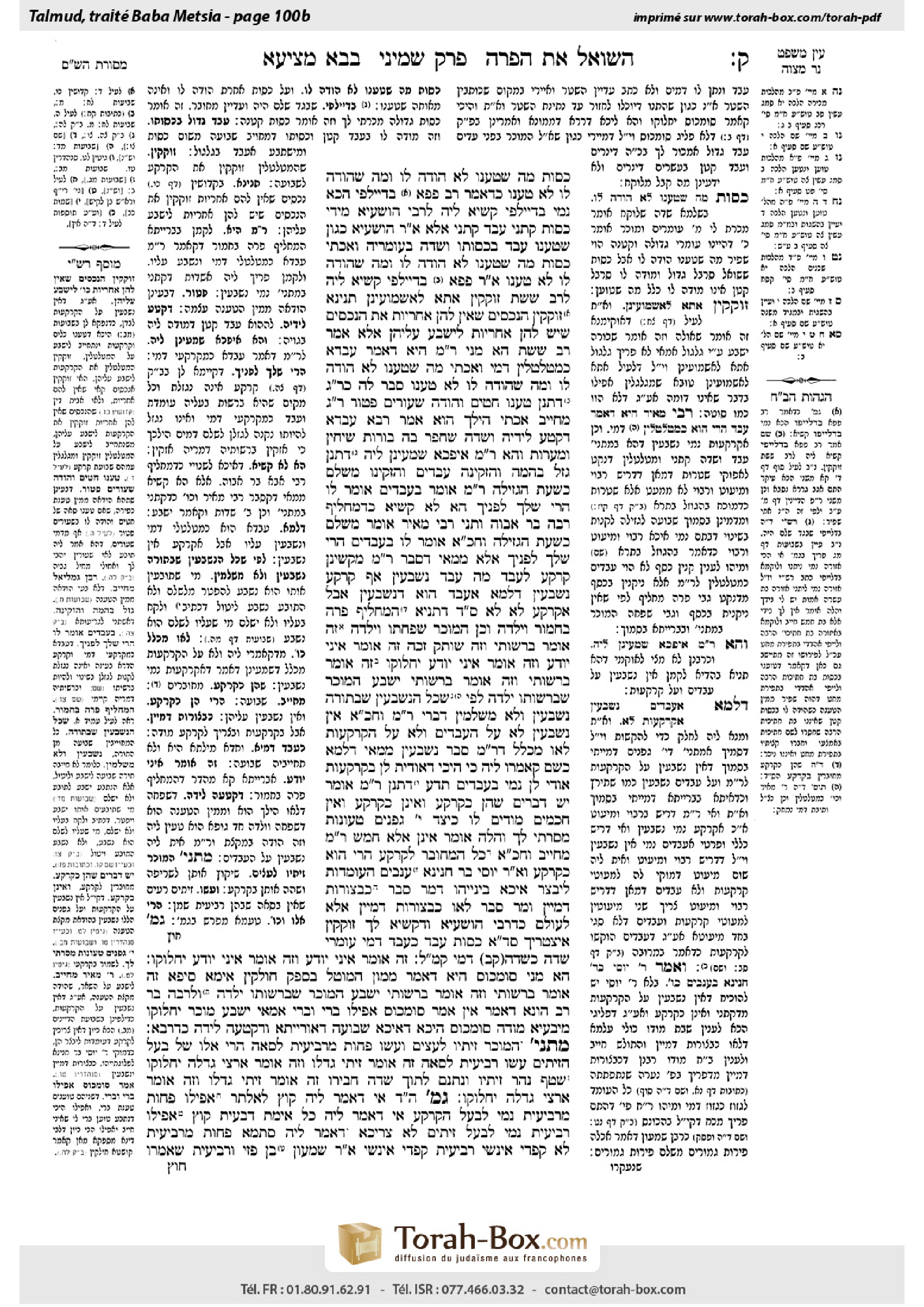
Bava Metzia 100b: Talmud study for Daf Yomi
Study the Talmud for Daf Yomi with scanned pages, Hebrew text, English translations from Sefaria and AI-generated French translations.
Passage selection and English or AI-generated French translation are available where the scan has annotations. Daf Study is independent of Torah-Box and Sefaria.
Browse Bava Metzia · בבא מציעא · All tractatesBava Metzia 100b text and translations
This page of Bava Metzia includes the Aramaic text, an English translation and an AI-generated French translation, alongside the scan above.
בבא מציעא ק׳ ב · Aramaic and Hebrew text
כְּסוּת, מַה שֶּׁטְּעָנוֹ לֹא הוֹדָה לוֹ, וּמַה שֶּׁהוֹדָה לוֹ לֹא טְעָנוֹ. כִּדְאָמַר רַב פָּפָּא בִּדְלַיְיפִי – הָכָא נָמֵי בִּדְלַיְיפִי.
קַשְׁיָא לֵיהּ לְרַבִּי הוֹשַׁעְיָא: מִידֵּי ״כְּסוּת״ קָתָנֵי? ״עֶבֶד״ קָתָנֵי!
אֶלָּא אָמַר רַבִּי הוֹשַׁעְיָא: כְּגוֹן שֶׁטְּעָנוֹ עֶבֶד בִּכְסוּתוֹ וְשָׂדֶה בָּעוֹמָרֶיהָ. וְאַכַּתִּי כְּסוּת, מַה שֶּׁטְּעָנוֹ – לֹא הוֹדָה לוֹ, וּמַה שֶּׁהוֹדָה לוֹ – לֹא טְעָנוֹ! אָמַר רַב פָּפָּא: בִּדְלַיְיפִי.
קַשְׁיָא לֵיהּ לְרַב שֵׁשֶׁת: זוֹקְקִין אֲתָא לְאַשְׁמוֹעִינַן?! תְּנֵינָא: זוֹקְקִין הַנְּכָסִים שֶׁאֵין לָהֶן אַחְרָיוּת אֶת הַנְּכָסִים שֶׁיֵּשׁ לָהֶן אַחְרָיוּת לִישָּׁבַע עֲלֵיהֶן.
אֶלָּא אָמַר רַב שֵׁשֶׁת: הָא מַנִּי – רַבִּי מֵאִיר הִיא, דְּאָמַר: עַבְדָּא כְּמִטַּלְטְלִין דָּמֵי.
וְאַכַּתִּי: מַה שֶּׁטְּעָנוֹ – לֹא הוֹדָה לוֹ, וּמַה שֶּׁהוֹדָה לוֹ – לֹא טְעָנוֹ! סָבַר לַהּ כְּרַבָּן גַּמְלִיאֵל. דִּתְנַן: טְעָנוֹ חִטִּים וְהוֹדָה שְׂעוֹרִים – פָּטוּר, רַבָּן גַּמְלִיאֵל מְחַיֵּיב.
אַכַּתִּי הֵילָךְ הוּא! אָמַר רָבָא: עַבְדָּא דִּקְטַע לִידֵיהּ, וְשָׂדֶה שֶׁחָפַר בָּהּ בּוֹרוֹת שִׁיחִין וּמְעָרוֹת.
וְהָא רַבִּי מֵאִיר אִיפְּכָא שָׁמְעִינַן לֵיהּ, דִּתְנַן: גָּזַל בְּהֵמָה וְהִזְקִינָה, עֲבָדִים וְהִזְקִינוּ – מְשַׁלֵּם כִּשְׁעַת הַגְּזֵילָה. רַבִּי מֵאִיר אוֹמֵר: בַּעֲבָדִים אוֹמֵר לוֹ ״הֲרֵי שֶׁלְּךָ לְפָנֶיךָ״!
הָא לָא קַשְׁיָא, כִּדְמַחְלֵיף רַבָּה בַּר אֲבוּהּ וְתָנֵי, רַבִּי מֵאִיר אוֹמֵר: מְשַׁלֵּם כִּשְׁעַת הַגְּזֵילָה, וַחֲכָמִים אוֹמְרִים: אוֹמֵר לוֹ בַּעֲבָדִים ״הֲרֵי שֶׁלְּךָ לְפָנֶיךָ״.
אֶלָּא מִמַּאי דְּסָבַר רַבִּי מֵאִיר מַקְּשִׁינַן קַרְקַע לְעֶבֶד: מָה עֶבֶד נִשְׁבָּעִין – אַף קַרְקַע נִשְׁבָּעִין? דִּלְמָא אַעֶבֶד הוּא דְּנִשְׁבָּעִין, אֲבָל אַקַּרְקַע לָא!
לָא סָלְקָא דַּעְתָּךְ, דְּתַנְיָא: הַמַּחְלִיף פָּרָה בַּחֲמוֹר וְיָלְדָה, וְכֵן הַמּוֹכֵר שִׁפְחָתוֹ וְיָלְדָה,
זֶה אוֹמֵר: בִּרְשׁוּתִי, וְזֶה שׁוֹתֵק – זָכָה.
זֶה אוֹמֵר: ״אֵינִי יוֹדֵעַ״, וְזֶה אוֹמֵר: ״אֵינִי יוֹדֵעַ״ – יַחְלוֹקוּ.
זֶה אוֹמֵר: ״בִּרְשׁוּתִי״, וְזֶה אוֹמֵר: ״בִּרְשׁוּתִי״ – יִשָּׁבַע הַמּוֹכֵר שֶׁבִּרְשׁוּתוֹ יָלְדָה, לְפִי שֶׁכׇּל הַנִּשְׁבָּעִין שֶׁבַּתּוֹרָה נִשְׁבָּעִין וְלֹא מְשַׁלְּמִין, דִּבְרֵי רַבִּי מֵאִיר. וַחֲכָמִים אוֹמְרִים: אֵין נִשְׁבָּעִין לֹא עַל הָעֲבָדִים וְלֹא עַל הַקַּרְקָעוֹת.
לָאו מִכְּלָל דְּרַבִּי מֵאִיר סָבַר נִשְׁבָּעִין!
מִמַּאי? דִּלְמָא ״כְּשֵׁם״ קָאָמְרוּ לֵיהּ: כִּי הֵיכִי דְּאוֹדֵית לַן בְּקַרְקָעוֹת – אוֹדִי לַן נָמֵי בַּעֲבָדִים.
תִּדַּע, דִּתְנַן, רַבִּי מֵאִיר אוֹמֵר: יֵשׁ דְּבָרִים שֶׁהֵן כַּקַּרְקַע וְאֵינָן כַּקַּרְקַע. וְאֵין חֲכָמִים מוֹדִים לוֹ. כֵּיצַד? עֶשֶׂר גְּפָנִים טְעוּנוֹת מָסַרְתִּי לָךְ, וְהַלָּה אוֹמֵר: אֵינָן אֶלָּא חָמֵשׁ, רַבִּי מֵאִיר מְחַיֵּיב. וַחֲכָמִים אוֹמְרִים: כׇּל הַמְחוּבָּר לַקַּרְקַע – הֲרֵי הוּא כַּקַּרְקַע.
וְאָמַר רַבִּי יוֹסֵי בַּר חֲנִינָא: עֲנָבִים הָעוֹמְדוֹת לִיבָּצֵר אִיכָּא בֵּינַיְיהוּ. דְּמָר סָבַר: כִּבְצוּרוֹת דָּמְיָין, וּמָר סָבַר: לָאו כִּבְצוּרוֹת דָּמְיָין.
אֶלָּא לְעוֹלָם כִּדְרַבִּי הוֹשַׁעְיָא, וּדְקַשְׁיָא לָךְ זוֹקְקִין? אִיצְטְרִיךְ: סָלְקָא דַּעְתָּךְ אָמֵינָא כְּסוּת עֶבֶד כְּעֶבֶד דָּמֵי, עוֹמְרֵי שָׂדֶה כְּשָׂדֶה דָּמֵי, קָא מַשְׁמַע לַן.
זֶה אוֹמֵר: ״אֵינִי יוֹדֵעַ״, וְזֶה אוֹמֵר: ״אֵינִי יוֹדֵעַ״ – יַחְלוֹקוּ. הָא מַנִּי – סוֹמְכוֹס הִיא, דְּאָמַר: מָמוֹן הַמּוּטָּל בְּסָפֵק – חוֹלְקִין.
אֵימָא סֵיפָא: זֶה אוֹמֵר ״בִּרְשׁוּתִי״ וְזֶה אוֹמֵר ״בִּרְשׁוּתִי״ – יִשָּׁבַע הַמּוֹכֵר שֶׁבִּרְשׁוּתוֹ יָלְדָה, וּלְרַבָּה בַּר רַב הוּנָא, דְּאָמַר: אִין, אָמַר סוֹמְכוֹס אֲפִילּוּ בָּרִי וּבָרִי, אַמַּאי יִשָּׁבַע מוֹכֵר? ״יַחְלוֹקוּ״ מִיבַּעְיָא!
מוֹדֶה סוֹמְכוֹס הֵיכָא דְּאִיכָּא שְׁבוּעָה דְּאוֹרָיְיתָא, וּדְקַטְעַהּ לִידַהּ כִּדְרָבָא.
מַתְנִי׳ הַמּוֹכֵר זֵיתָיו לְעֵצִים, וְעָשׂוּ פָּחוֹת מֵרְבִיעִית לַסְּאָה – הֲרֵי אֵלּוּ שֶׁל בַּעַל הַזֵּיתִים.
עָשׂוּ רְבִיעִית לַסְּאָה, זֶה אוֹמֵר: ״זֵיתַי גִּדֵּלוּ״, וְזֶה אוֹמֵר: ״אַרְצִי גִּדֵּלָה״ – יַחְלוֹקוּ.
שָׁטַף נָהָר זֵיתָיו וּנְתָנָם לְתוֹךְ שְׂדֵה חֲבֵירוֹ, זֶה אוֹמֵר: ״זֵיתַי גִּדֵּלוּ״, וְזֶה אוֹמֵר: ״אַרְצִי גִּדֵּלָה״ – יַחְלוֹקוּ.
גְּמָ׳ הֵיכִי דָּמֵי? אִי דַּאֲמַר לֵיהּ קוֹץ לְאַלְתַּר – אֲפִילּוּ פָּחוֹת מֵרְבִיעִית נָמֵי לְבַעַל הַקַּרְקַע. אִי דַּאֲמַר לֵיהּ כֹּל אֵימַת דְּבָעֵית קוֹץ – אֲפִילּוּ רְבִיעִית נָמֵי לְבַעַל זֵיתִים!
לָא צְרִיכָא, דַּאֲמַר לֵיהּ סְתָמָא: פָּחוֹת מֵרְבִיעִית – לָא קָפְדִי אִינָשֵׁי, רְבִיעִית – קָפְדִי אִינָשֵׁי.
אָמַר רַבִּי שִׁמְעוֹן בֶּן פַּזִּי: וּרְבִיעִית שֶׁאָמְרוּ –
Bava Metzia 100b · English translation
The Gemara challenges Shmuel’s interpretation: If the dispute is over which size garment was sold, the seller should not be required to take an oath, as that which the buyer claimed from him, the seller did not admit to at all, and that which the seller admitted to, the buyer had not claimed from him. The Gemara answers: Shmuel was referring to a case like that which Rav Pappa said below: The dispute is with regard to a garment that was formed from several pieces of cloth that were attached together. Here too, the dispute is with regard to a garment that was formed from several pieces of cloth that were attached together, and the disagreement was about how much of that garment was actually sold.
Rabbi Hoshaya found Shmuel’s interpretation difficult: Does the mishna teach: A garment? No, it teaches: A slave. How can Shmuel claim the dispute was about a garment?
Rather, Rabbi Hoshaya said: The mishna is referring to a case where the buyer claimed a large slave along with his garment, or where he claimed a large field along with its sheaves. Since the seller admits to the part of the claim about the garment or sheaves, he is required to take an oath about them. Once he is required to take that oath, it can be extended to require him to take an oath even concerning the claim about the slave or field itself. The Gemara asks: But still, in the dispute over which type of garment was sold, that which the buyer claimed from him, the seller did not admit to at all, and that which the seller admitted to, the buyer had not claimed from him. The Gemara answers: Rav Pappa said: The dispute is with regard to a garment that was formed from several pieces of cloth that were attached together, and the dispute concerns how much of that garment was actually sold.
Rav Sheshet found Rabbi Hoshaya’s interpretation difficult: Does the mishna come only to teach us the halakha of binding? But we already learned that halakha in a mishna (Kiddushin 26a): Generally, one is not obligated to take an oath concerning the denial of a claim with regard to land. In a legal dispute involving both land and movable property, if the defendant admits to part of the claim with regard to the movable property, thereby rendering himself obligated to take an oath denying any responsibility for the remaining property, the movable property binds the property that serves as a guarantee, i.e., the land, so that he is forced to take an oath concerning the land as well.
Rather, Rav Sheshet said: In accordance with whose opinion is this mishna? It is Rabbi Meir, who said: The legal status of a slave is like that of movable property. Even if the dispute is over the slave alone, the seller can be required to take an oath.
The Gemara asks: But still, if the dispute is over which slave was sold, then that which the buyer claimed from him, the seller did not admit to at all, and that which the seller admitted to, the buyer had not claimed from him. The seller should not therefore be required to take an oath. The Gemara answers: The tanna of the mishna holds in accordance with the opinion of Rabban Gamliel, as we learned in a mishna (Shevuot 38b): If one claimed wheat from another, and the defendant admitted only to owing him barley, the defendant is exempt from having to take an oath; but Rabban Gamliel deems him liable.
The Gemara asks: Still, with regard to the small slave, this is a case of: Here you are, as the slave is immediately available to be taken. The small slave is not considered part of the buyer’s claim, as his claim is limited to the difference between the values of the slaves, and that amount is being entirely denied. Consequently, there should be no requirement to take an oath. To resolve this difficulty, Rava said: In the case of the slave, the mishna is referring to a case where, after the sale, the seller severed the slave’s hand, and in the case of the field, it is a case where, after the sale, the seller dug pits, ditches and caves in it, and therefore he cannot say: Here you are.
The Gemara offers another challenge to Rav Sheshet’s interpretation: But didn’t Rabbi Meir teach us the opposite? As we learned in a mishna (Bava Kamma 96b): If one robbed another of an animal and it aged and declined in value while in his possession, or if one robbed another of Canaanite slaves and they aged, since they are no longer in the condition that they were in when he robbed them, he cannot return them in their current state to his victim; rather, he pays according to their value at the time of the robbery. Rabbi Meir says: With regard to slaves, he says to the victim: That which is yours is before you and no compensation is required. Apparently, Rabbi Meir holds that the legal status of a slave is like that of land, and not, as Rav Sheshet said, like that of movable property.
The Gemara answers: That is not difficult. Rav Sheshet apparently holds like Rabba bar Avuh, who reverses the attribution of the opinions in that mishna and teaches: Rabbi Meir says: He pays according to their value at the time of the robbery. And the Rabbis say: With regard to slaves, he says to the victim: That which is yours is before you and no compensation is required.
Since Rav Sheshet interprets the mishna as referring to a case where the dispute is over the slave alone and interprets it to be in accordance with the opinion of Rabbi Meir, he apparently also assumes that Rabbi Meir holds that an oath is taken even with regard to a claim of land, as his explanation would need to account for the case in the mishna concerning a dispute over the small or large field. The Gemara questions this assumption: But given that Rabbi Meir said only that the legal status of a slave is like that of movable property, from where does Rav Sheshet learn that Rabbi Meir holds that we compare land to a slave, so that just as for a claim about a slave, an oath is taken, so too, for a claim about land, an oath is taken? Perhaps Rabbi Meir holds that an oath is taken only on a claim about a slave but not on a claim about land.
The Gemara answers: It should not enter your mind that Rabbi Meir makes a distinction between slaves and land in this regard, as it is taught in a baraita: With regard to one who exchanges a cow for a donkey, such that by virtue of the cow owner’s act of acquisition on the donkey, the donkey’s erstwhile owner simultaneously acquires the cow, wherever it happens to be located, and afterward the cow is found to have calved; and similarly, with regard to one who sells his Canaanite maidservant, with the acquisition effected by the buyer giving him money, and afterward she is found to have given birth to a child, who will be a slave belonging to his mother’s master, at times it is uncertain whether the offspring was born before or after the transaction.
If this seller says: The birth occurred while the cow or maidservant was still in my possession, and that buyer remains silent, the seller is entitled to take the offspring.
If this one says: I do not know what happened, and that one says: I do not know what happened, they divide the value of the offspring between them.
If this seller says: The birth occurred while the cow or maidservant was still in my possession, and that buyer says: The birth occurred after the cow or maidservant was already in my possession, then the seller takes an oath stating that the cow or maidservant gave birth in his possession and he is then entitled to take the offspring. This is because for anyone who takes an oath required by Torah law, he takes the oath and does not have to pay. This is the statement of Rabbi Meir. And the Rabbis say: One does not take an oath, not on a claim concerning slaves and not on a claim concerning land.
The Gemara explains its proof from this baraita: Since the Rabbis replied to Rabbi Meir that an oath is not taken on a claim concerning slaves or land, is it not correct that by inference, Rabbi Meir holds that one can take an oath on a claim concerning either slaves or land?
The Gemara rejects this inference: But from where is this inferred? Perhaps the Rabbis are speaking to him utilizing the style of: Just as, and they are saying as follows: Just as you concede to us with regard to land, concede to us also with regard to slaves.
The Gemara adds: Know that Rabbi Meir holds that one does not take an oath for a claim concerning land, as we learned in a mishna (Shevuot 42b): Rabbi Meir says: There are some matters that have a legal status like that of land, but nevertheless, with regard to oaths they are not treated like land and so one takes an oath with regard to them. But the Rabbis do not concede to Rabbi Meir that this is the halakha. How so? If one claims: I delivered ten vines laden with grapes to you, and the other says: There were only five; Rabbi Meir deems him liable to take an oath of one who admits to part of a claim. But the Rabbis say: Anything that is attached to the ground has a legal status like that of land, so no oath is taken with regard to them.
The Gemara clarifies the scope of the dispute: And Rabbi Yosei bar Ḥanina says: The difference between them is only in a case of grapes that are ready to be picked, as one Sage, Rabbi Meir, holds: They are considered as though they were already harvested, meaning that they are regarded as movable property, with regard to which an oath is taken. And the other Sage, the Rabbis, holds: They are not considered as though they were about to be picked, meaning that they are regarded as land, with regard to which an oath is not taken. Evidently, Rabbi Meir agrees that an oath is not taken concerning land.
Rather, actually the mishna can be explained only in accordance with the interpretation of Rabbi Hoshaya, cited above. And with regard to that which posed a difficulty to you, namely that according to his explanation, the novelty of the mishna is only that movable property binds land so that one can be required to take an oath with regard to it, and that halakha is already taught in the mishna in tractate Kiddushin, one can explain that it was necessary to also teach this in the mishna here, because it might enter your mind to say that the garment of a slave is like the slave himself, or that sheaves of a field are like the field itself. If so, there would be no basis to require an oath, even one based on the claims about the garment and sheaves themselves. Therefore, the mishna teaches us that they are considered distinct items and the claims concerning them require the seller to take an oath which can then be extended to require an oath for the claim concerning the slave or land.
§ The Gemara analyzes one of the clauses of the baraita cited above: In a case in which it is unclear when the cow or maidservant gave birth, if this one says: I do not know what happened, and that one says: I do not know what happened, they divide the value of the offspring between them. The Gemara asks: In accordance with whose opinion is this? It is in accordance with the opinion of Sumakhos, who says: When there is property of uncertain ownership, the parties divide it equally between them.
The Gemara questions this attribution: If so, say and try to explain accordingly the latter clause of that baraita: If this seller says: The birth occurred while the cow or maidservant was still in my possession, and that buyer says: The birth occurred after the cow or maidservant was already in my possession, then the seller takes an oath stating that it gave birth in his possession, and he is then entitled to take the offspring. The Gemara explains the difficulty: But according to the opinion of Rabba bar Rav Huna, who says: Yes, Sumakhos said his ruling even in a case in which there is a conflict between a certain claim and a certain claim, why does the mishna rule that the seller takes an oath; the mishna should have ruled that they divide the value of the disputed offspring between them.
The Gemara answers: Sumakhos concedes that where there is a requirement for one of the parties to take an oath required by Torah law, that the disputed amount is not divided. And furthermore, this is not a case in which the seller could say: Here you are, because the case is where after the sale, the seller severed the slave’s hand, just like in the explanation of Rava above.
MISHNA: In the case of one who sells his olive trees to another so he can chop them down and use them for their wood, and before he chopped them down they yielded olives, if the olives are of a quality that could provide the value of less than a quarter-log of oil per se’a of olives, these olives are the property of the new owner of the olive trees, i.e., the buyer.
If they yielded olives that could provide the value of a quarter-log or more of oil per se’a of olives, and this one, the buyer, says: My olive trees yielded the olives and so I have a right to them, and that one, the seller, says: The nourishment from my land yielded the olives and so I have a right to them, then they divide the olives between them.
In the event that a river swept away one’s olive trees and deposited them in the field of another, and they took root there and yielded olives, this one, i.e., the owner of the trees, says: My olive trees yielded the olives and so I have a right to them, and that one, i.e., the owner of the field, says: The nourishment from my land yielded the olives and so I have a right to them, then they divide the olives between them.
GEMARA: The Gemara asks: What are the circumstances of the sale? If this is a case where before the sale the seller said to the buyer: Cut down the trees immediately, then clearly he is particular that the buyer not derive benefit from the nourishment provided by his land. Therefore, even if the olives yielded could provide less than the value of a quarter-log of oil per se’a of olives, they will belong to the owner of the land, i.e., the seller. Conversely, if the case is where he said to him: Cut down the trees whenever you want, then it is clear that he is not particular about the buyer deriving benefit from the nourishment provided by his land. Therefore, even if the olives yielded could provide the value of a quarter-log or more of oil per se’a of olives, they will belong to the owner of the olive trees, i.e., the buyer.
The Gemara explains: No, the ruling is necessary in a case where the seller said to him to cut down the trees, without specification about when he should do so. Accordingly, if the olives yielded produce less than the value of a quarter-log of oil per se’a of olives, then since people are generally not particular to receive their share of such olives, the buyer may keep them. But where the olives yielded produce the value of a quarter-log or more of oil per se’a of olives, people are generally particular to receive their share of such olives; consequently, they divide the olives between them.
Rabbi Shimon ben Pazi says: And the value of the quarter-log that they mentioned in the mishna
Bava Metzia 100b · Traduction française (IA)
La Guemara remet en question l'interprétation de Shmuel : Si le débat porte sur la taille de la robe vendue, le vendeur ne devrait pas être tenu de jurer, car ce que l'acheteur affirme du vendeur, le vendeur n'a pas du tout admis, et ce que le vendeur admet, l'acheteur n'a pas réclamé. La Guemara répond : Shmuel faisait référence à un cas semblable à celui que Rav Pappa a dit plus bas : le débat porte sur une robe formée de plusieurs morceaux de tissu assemblés. Ici aussi, le débat porte sur une robe formée de plusieurs morceaux de tissu assemblés, et le désaccord concerne la quantité réelle de cette robe qui a été vendue.
Rabbi Hoshaya trouvait l'interprétation de Shmuel difficile : La Michna enseigne-t-elle : un vêtement ? Non, elle enseigne : un esclave. Comment Shmuel peut-il affirmer que le débat portait sur un vêtement ?
Plutôt, Rabbi Hoshaya a dit : La Michna fait référence à un cas où l'acheteur réclamait un esclave grand ainsi que sa robe, ou où il réclamait un champ grand ainsi que ses épis. Puisque le vendeur admet la partie de la réclamation concernant la robe ou les épis, il est tenu de jurer à leur sujet. Une fois qu'il est tenu de jurer à leur sujet, cela peut être étendu pour exiger qu'il jure également concernant la réclamation concernant l'esclave ou le champ lui-même. La Guemara demande : Mais encore, dans le cas de la dispute sur le type de robe vendue, ce que l'acheteur réclamait du vendeur, le vendeur n'avait pas du tout admis, et ce que le vendeur admettait, l'acheteur n'avait pas réclamé. La Guemara répond : Rav Pappa a dit : le débat porte sur une robe formée de plusieurs morceaux de tissu assemblés, et le débat concerne la quantité réelle de cette robe qui a été vendue.
Rav Sheshet trouvait l'interprétation de Rabbi Hoshaya difficile : La Michna vient-elle uniquement enseigner la halakha du lien ? Mais nous avons déjà appris cette halakha dans une Michna (Kiddushin 26a) : généralement, on n'est pas tenu de jurer concernant la négation d'une réclamation en ce qui concerne la terre. Dans un litige impliquant à la fois la terre et les biens mobiliers, si le défendeur admet une partie de la réclamation concernant les biens mobiliers, ce qui le rend tenu de jurer pour nier toute responsabilité concernant les autres biens, les biens mobiliers lient les biens qui servent de garantie, c'est-à-dire la terre, de sorte qu'il est contraint de jurer également concernant la terre.
Plutôt, Rav Sheshet a dit : selon l'opinion de qui est cette Michna ? C'est Rabbi Meir, qui a dit : le statut juridique de l'esclave est comme celui des biens mobiliers. Même si le débat porte uniquement sur l'esclave, le vendeur peut être tenu de jurer.
La Guemara demande : Mais encore, si le débat porte sur l'esclave vendu, alors ce que l'acheteur réclamait du vendeur, le vendeur n'avait pas du tout admis, et ce que le vendeur admettait, l'acheteur n'avait pas réclamé. Le vendeur ne devrait donc pas être tenu de jurer. La Guemara répond : le tanna de la Michna suit l'opinion de Rabban Gamliel, comme nous l'avons appris dans une Michna (Shevuot 38b) : si l'un réclamait du blé à un autre, et le défendeur admettait seulement d'être dû du froment, le défendeur est exempt de devoir jurer ; mais Rabban Gamliel considère qu'il est responsable.
La Guemara demande : toutefois, concernant l'esclave petit, c'est un cas de : voici, car l'esclave est immédiatement disponible à être pris. L'esclave petit n'est pas considéré comme faisant partie de la réclamation de l'acheteur, car sa réclamation est limitée à la différence des valeurs des esclaves, et cette somme est entièrement niée. Par conséquent, il ne devrait pas y avoir de nécessité de jurer. Pour résoudre cette difficulté, Rava a dit : concernant l'esclave, la Michna fait référence à un cas où, après la vente, le vendeur a sectionné la main de l'esclave, et concernant le champ, c'est un cas où, après la vente, le vendeur a creusé des fossés, des canaux et des grottes dans celui-ci, et donc il ne peut pas dire : voici.
La Guemara présente un autre défi à l'interprétation de Rav Sheshet : mais n'a-t-on pas appris que Rabbi Meir enseignait l'opposé ? Comme nous l'avons appris dans une Michna (Bava Kamma 96b) : si l'un vole un animal à un autre et qu'il vieillit et décline en valeur pendant qu'il est en sa possession, ou si l'un vole des esclaves cananéens et qu'ils vieillissent, puisqu'ils ne sont plus dans l'état où ils étaient lors de leur vol, il ne peut pas les rendre à leur victime dans leur état actuel ; il paie selon leur valeur au moment du vol. Rabbi Meir dit : concernant les esclaves, il dit à la victime : ce qui est à toi est devant toi et aucune compensation n'est requise. Apparemment, Rabbi Meir considère que le statut juridique de l'esclave est comme celui de la terre, et non, comme Rav Sheshet l'a dit, comme celui des biens mobiliers.
La Guemara répond : Ce n'est pas difficile. Rav Sheshet semble suivre Rabba bar Avuh, qui inverse l'attribution des opinions dans cette Michna et enseigne : Rabbi Meir dit : il paie selon leur valeur au moment du vol. Et les Rabbins disent : concernant les esclaves, il dit à la victime : ce qui est à toi est devant toi et aucune compensation n'est requise.
Puisque Rav Sheshet interprète la Michna comme faisant référence à un cas où le débat porte uniquement sur l'esclave et l'interprète selon l'opinion de Rabbi Meir, il semble aussi supposer que Rabbi Meir considère que l'œuf est pris même concernant une réclamation de terre, car son explication devrait tenir compte du cas de la Michna concernant un débat sur un petit ou grand champ. La Guemara questionne cette hypothèse : mais étant donné que Rabbi Meir a dit seulement que le statut juridique de l'esclave est comme celui des biens mobiliers, d'où Rav Sheshet tire-t-il que Rabbi Meir considère que l'on compare la terre à l'esclave, de sorte que justement comme pour une réclamation concernant l'esclave, on jure, ainsi pour une réclamation concernant la terre, on jure ? Peut-être Rabbi Meir considère que l'œuf est pris uniquement pour une réclamation concernant l'esclave mais pas pour une réclamation concernant la terre.
Le Guemara répond : Il ne faut pas penser que le maître Rami fasse une distinction entre les esclaves et la terre à cet égard, car cela est enseigné dans une baraïta : En ce qui concerne celui qui échange une vache contre un âne, de sorte que par l'acte d'acquisition du propriétaire de la vache sur l'âne, le propriétaire précédent de l'âne acquiert simultanément la vache, où qu'elle se trouve, et ensuite la vache est trouvée enceinte ; de même, en ce qui concerne celui qui vend sa servante cananite, avec l'acquisition effectuée par l'acheteur en lui donnant de l'argent, et ensuite elle est trouvée enceinte, et l'enfant qu'elle donnera naîtra esclave appartenant à son maître, à certains moments il est incertain si l'enfant est né avant ou après la transaction.
Si ce vendeur dit : La naissance s'est produite alors que la vache ou la servante était encore en mon possession, et que l'acheteur reste muet, le vendeur a le droit de prendre l'enfant.
Si l'un dit : Je ne sais pas ce qui s'est passé, et l'autre dit : Je ne sais pas ce qui s'est passé, ils partagent la valeur de l'enfant entre eux.
Si ce vendeur dit : La naissance s'est produite alors que la vache ou la servante était encore en son possession, et que l'acheteur dit : La naissance s'est produite après que la vache ou la servante eut déjà été en son possession, alors le vendeur prend un serment affirmant que la vache ou la servante a donné naissance en son possession, et il a alors le droit de prendre l'enfant. Cela est ainsi parce que celui qui prend un serment requis par la loi divine prend le serment et n'a pas à payer. C'est l'opinion du maître Rami. Et les Sages disent : On ne prend pas de serment, ni concernant les esclaves, ni concernant la terre.
Le Guemara explique sa preuve à partir de cette baraïta : Puisque les Sages ont répondu au maître Rami que le serment n'est pas pris concernant les esclaves ou la terre, n'est-ce pas correct que par déduction, le maître Rami considère que l'on peut prendre un serment concernant les esclaves ou la terre ?
Le Guemara rejette cette déduction : Mais d'où cette déduction est-elle tirée ? Peut-être les Sages parlent à lui en utilisant le style suivant : Comme, et ils disent ainsi : Comme vous cédez à nous concernant la terre, cédez aussi à nous concernant les esclaves.
Le Guemara ajoute : Sachez que le maître Rami considère que l'on ne prend pas de serment concernant une revendication liée à la terre, comme nous l'avons appris dans une Michna (Shevuot 42b) : Le maître Rami dit : Il y a des choses dont le statut juridique est comme celui de la terre, mais néanmoins, concernant les serments, elles ne sont pas traitées comme la terre et donc on prend un serment à leur égard. Mais les Sages ne reconnaissent pas à la maître Rami que c'est la halakha. Comment cela ? Si l'un dit : J'ai livré dix vignes chargées de raisins à vous, et l'autre dit : Il n'y avait que cinq ; le maître Rami considère qu'il est tenu de prendre un serment de celui qui admet une partie de la revendication. Mais les Sages disent : Tout ce qui est attaché au sol a un statut juridique comme celui de la terre, donc on ne prend pas de serment à leur égard.
Le Guemara clarifie l'étendue du débat : Et le maître Yosei bar Hanina dit : La différence entre eux est seulement dans le cas des raisins prêts à être récoltés, car un Sage, le maître Rami, considère : Ils sont considérés comme s'ils étaient déjà récoltés, c'est-à-dire qu'ils sont regardés comme des biens mobiliers, à l'égard desquels on prend un serment. Et l'autre Sage, les Sages, considère : Ils ne sont pas considérés comme s'ils étaient prêts à être récoltés, c'est-à-dire qu'ils sont regardés comme la terre, à l'égard desquels on ne prend pas de serment. Évidemment, le maître Rami est d'accord que le serment n'est pas pris concernant la terre.
En réalité, la Michna peut être expliquée uniquement selon l'interprétation du maître Hoshaya, cité ci-dessus. Et concernant ce qui posait un problème à vous, à savoir que selon son explication, la nouveauté de la Michna est seulement que les biens mobiliers lient la terre de sorte qu'on puisse être tenu de prendre un serment à leur égard, et que cette halakha est déjà enseignée dans la Michna du traité Kiddushin, on peut expliquer que cela était nécessaire d'enseigner cela ici dans la Michna, car il pourrait entrer en vous l'idée que la robe d'un esclave est comme l'esclave lui-même, ou que les épis d'un champ sont comme le champ lui-même. Si tel est le cas, il n'y aurait pas de fondement pour exiger un serment, même celui basé sur les revendications concernant la robe et les épis eux-mêmes. Ainsi, la Michna nous enseigne que ces choses sont considérées comme des objets distincts et les revendications concernant ces objets exigent que le vendeur prenne un serment, ce qui peut ensuite être étendu à exiger un serment concernant la revendication concernant l'esclave ou la terre.
§ Le Guemara analyse l'une des clauses de la baraïta citée ci-dessus : Dans le cas où il est incertain quand la vache ou la servante a donné naissance, si l'un dit : Je ne sais pas ce qui s'est passé, et l'autre dit : Je ne sais pas ce qui s'est passé, ils partagent la valeur de l'enfant entre eux. Le Guemara demande : Selon l'opinion de qui est-ce ? C'est selon l'opinion de Sumakhos, qui dit : Lorsqu'il y a une propriété de propriété incertaine, les parties partagent équitablement entre elles.
Le Guemara questionne cette attribution : Si tel est le cas, dites et essayez d'expliquer selon cela la dernière clause de cette baraïta : Si ce vendeur dit : La naissance s'est produite alors que la vache ou la servante était encore en mon possession, et que l'acheteur dit : La naissance s'est produite après que la vache ou la servante était déjà en ma possession, alors le vendeur prend un serment affirmant qu'elle a donné naissance en son possession, et il a alors le droit de prendre l'enfant. Le Guemara explique la difficulté : Mais selon l'opinion de Rabba bar Rav Huna, qui dit : Oui, Sumakhos a dit sa décision même dans le cas où il y a un conflit entre une certaine revendication et une autre revendication, pourquoi le mitsna règle-t-il que le vendeur prenne un serment ; le mitsna devrait avoir réglé que les parties partagent la valeur de l'enfant disputé entre elles.
La Guemara répond : Sumakhos admet que lorsqu'il y a une obligation pour l'une des parties de prendre un serment selon la loi divine, le montant en litige n'est pas divisé. De plus, ce n'est pas un cas où le vendeur pourrait dire : Ici vous avez, car le cas est celui où, après la vente, le vendeur a sectionné la main de l'esclave, tout comme dans l'explication de Rava ci-dessus.
MICHNA : Dans le cas où l'on vend ses arbres à olives à un autre afin qu'il les coupe et les utilise pour leur bois, et avant qu'il ne les coupe, ils ont produit des olives, si ces olives sont de telle qualité qu'elles ne peuvent fournir une valeur égale à moins d'un quart de log d'huile par se'a d'olives, ces olives appartiennent à l'acheteur, c'est-à-dire au nouveau propriétaire des arbres à olives.
Si elles ont produit des olives dont la valeur est égale à un quart de log ou plus d'huile par se'a d'olives, et que l'acheteur dit : Mes arbres à olives ont produit ces olives, donc j'ai le droit de les garder, et que le vendeur dit : La nourriture de mon terrain a produit ces olives, donc j'ai le droit de les garder, alors ils divisent les olives entre eux.
Dans le cas où un fleuve emporte les arbres à olives d'une personne et les dépose dans le champ d'une autre, et qu'ils prennent racine là-bas et produisent des olives, celui-ci, c'est-à-dire le propriétaire des arbres, dit : Mes arbres à olives ont produit ces olives, donc j'ai le droit de les garder, et celui-là, c'est-à-dire le propriétaire du champ, dit : La nourriture de mon terrain a produit ces olives, donc j'ai le droit de les garder, alors ils divisent les olives entre eux.
GUEMARA : La Guemara pose la question : Quelles sont les circonstances de la vente ? Si c'est un cas où avant la vente, le vendeur a dit à l'acheteur : Coupe les arbres immédiatement, alors clairement il est particulier que l'acheteur ne bénéficie pas de la nourriture fournie par son terrain. Par conséquent, même si les olives produites sont inférieures à la valeur d'un quart de log d'huile par se'a d'olives, elles appartiendront au propriétaire du terrain, c'est-à-dire au vendeur. À l'inverse, si le cas est celui où il a dit : Coupe les arbres quand tu veux, alors il est clair qu'il n'est pas particulier que l'acheteur bénéficie de la nourriture fournie par son terrain. Par conséquent, même si les olives produites sont égales à la valeur d'un quart de log ou plus d'huile par se'a d'olives, elles appartiendront au propriétaire des arbres à olives, c'est-à-dire à l'acheteur.
La Guemara explique : Non, la décision est nécessaire dans un cas où le vendeur a dit à l'acheteur de couper les arbres, sans préciser quand il devait le faire. Ainsi, si les olives produites sont inférieures à la valeur d'un quart de log d'huile par se'a d'olives, puisque les gens ne sont généralement pas particuliers à recevoir leur part de telles olives, l'acheteur peut les garder. Mais dans le cas où les olives produites sont égales à la valeur d'un quart de log ou plus d'huile par se'a d'olives, les gens sont généralement particuliers à recevoir leur part de telles olives ; par conséquent, ils divisent les olives entre eux.
Rabbi Shimon ben Pazi dit : Et la valeur du quart de log mentionné dans la Michna
Traduction française générée par IA à partir de l’édition anglaise de Sefaria. Vérifie toujours un passage avec le texte source.
Text from Sefaria: William Davidson Edition - Vocalized Aramaic (CC BY NC); William Davidson Edition - English (CC BY NC).