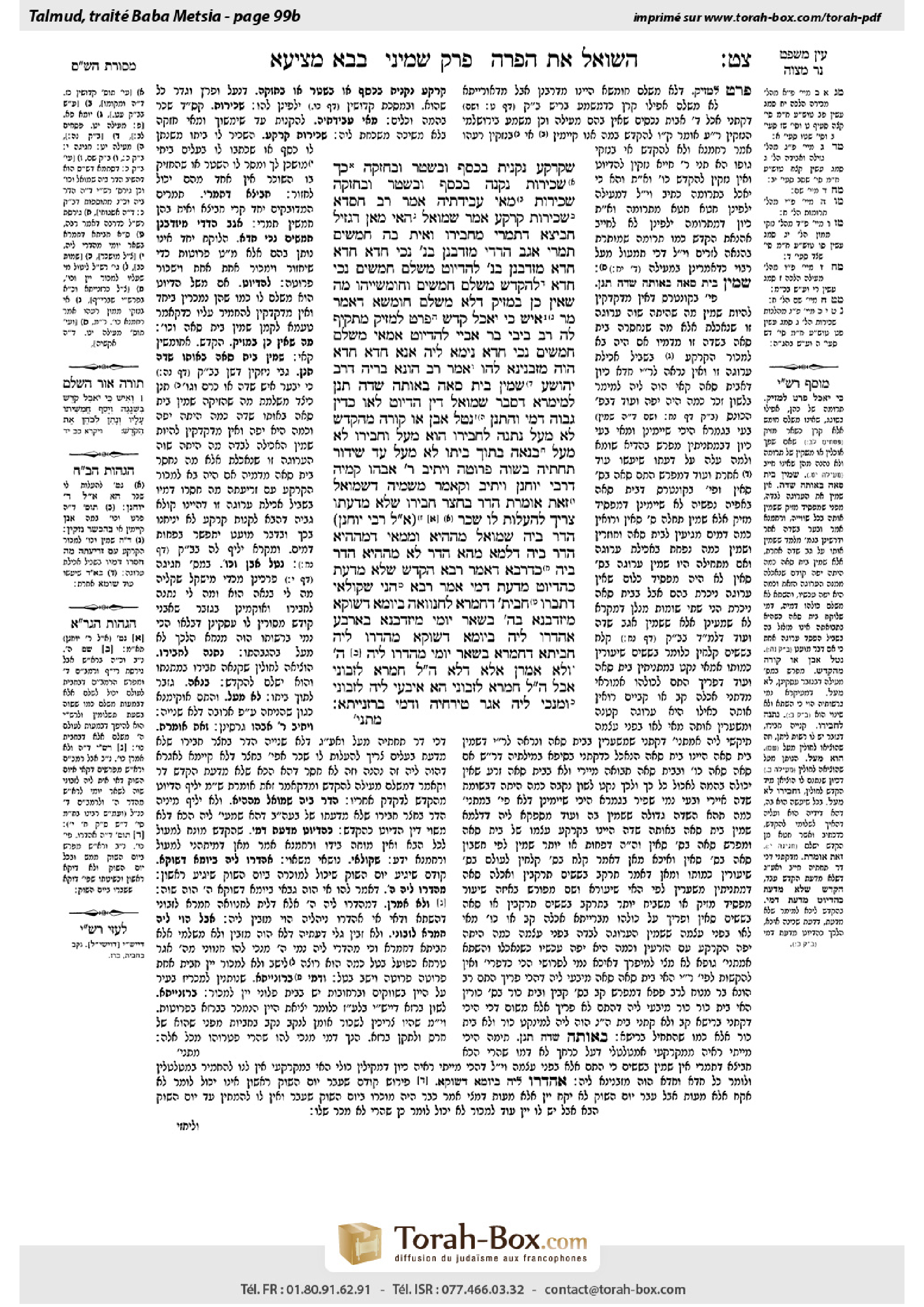
Bava Metzia 99b: Talmud study for Daf Yomi
Study the Talmud for Daf Yomi with scanned pages, Hebrew text, English translations from Sefaria and AI-generated French translations.
Passage selection and English or AI-generated French translation are available where the scan has annotations. Daf Study is independent of Torah-Box and Sefaria.
Browse Bava Metzia · בבא מציעא · All tractatesBava Metzia 99b text and translations
This page of Bava Metzia includes the Aramaic text, an English translation and an AI-generated French translation, alongside the scan above.
בבא מציעא צ״ט ב · Aramaic and Hebrew text
שֶׁקַּרְקַע נִקְנֵית בְּכֶסֶף וּבִשְׁטָר וּבַחֲזָקָה – כָּךְ שְׂכִירוּת נִקְנֵית בְּכֶסֶף וּבִשְׁטָר וּבַחֲזָקָה. שְׂכִירוּת מַאי עֲבִידְתַּיהּ? אָמַר רַב חִסְדָּא: שְׂכִירוּת קַרְקַע.
אָמַר שְׁמוּאֵל: הַאי מַאן דְּגָזֵיל חֲבִיצָא דְתַמְרֵי מֵחַבְרֵיהּ וְאִית בַּהּ חַמְשִׁין תַּמְרֵי, אַגַּב הֲדָדֵי מִזְדַּבְּנָן בְּחַמְשִׁין נְכֵי חֲדָא, חֲדָא חֲדָא מִזְדַּבְּנָן בְּחַמְשִׁין.
לְהֶדְיוֹט – מְשַׁלֵּם חַמְשִׁין נְכֵי חֲדָא, לְהֶקְדֵּשׁ – מְשַׁלֵּם חַמְשִׁין וְחוּמְשַׁיְיהוּ, מַה שֶּׁאֵין כֵּן בְּמַזִּיק – דְּלָא מְשַׁלֵּם חוּמְשָׁא. דְּאָמַר מָר: ״וְאִישׁ כִּי יֹאכַל קֹדֶשׁ״ – פְּרָט לְמַזִּיק.
מַתְקֵיף לַהּ רַב בִּיבִי בַּר אַבָּיֵי: לְהֶדְיוֹט אַמַּאי מְשַׁלֵּם חַמְשִׁין נְכֵי חֲדָא? נֵימָא לֵיהּ: אֲנָא חֲדָא חֲדָא הֲוָה מְזַבְּנִינָא לְהוּ?
אָמַר רַב הוּנָא בְּרֵיהּ דְּרַב יְהוֹשֻׁעַ: ״שָׁמִין בֵּית סְאָה בְּאוֹתָהּ שָׂדֶה״ תְּנַן.
לְמֵימְרָא דְּסָבַר שְׁמוּאֵל דִּין הֶדְיוֹט לָאו כְּדִין גָּבוֹהַּ דָּמֵי? וְהָתְנַן: נָטַל אֶבֶן אוֹ קוֹרָה מֵהֶקְדֵּשׁ – לֹא מָעַל, נְתָנָהּ לַחֲבֵירוֹ – הוּא מָעַל, וַחֲבֵירוֹ לֹא מָעַל. בְּנָאָהּ בְּתוֹךְ בֵּיתוֹ – לֹא מָעַל עַד שֶׁיָּדוּר תַּחְתֶּיהָ בְּשָׁוֶה פְּרוּטָה.
וִיתֵיב רַבִּי אֲבָהוּ קַמֵּיהּ דְּרַבִּי יוֹחָנָן, וְיָתֵיב וְקָאָמַר מִשְּׁמֵיהּ דִּשְׁמוּאֵל: זֹאת אוֹמֶרֶת, הַדָּר בַּחֲצַר חֲבֵירוֹ שֶׁלֹּא מִדַּעְתּוֹ צָרִיךְ לְהַעֲלוֹת לוֹ שָׂכָר. אֲמַר לֵיהּ רַבִּי יוֹחָנָן, הֲדַר בֵּיהּ שְׁמוּאֵל מֵהַהִיא.
וּמִמַּאי דְּמֵהַהִיא הֲדַר בֵּיהּ, דִּלְמָא מֵהָא הֲדַר? לָא, מֵהַהִיא הֲדַר בֵּיהּ כִּדְרָבָא. דְּאָמַר רָבָא: הֶקְדֵּשׁ שֶׁלֹּא מִדַּעַת – כְּהֶדְיוֹט מִדַּעַת דָּמֵי.
אָמַר רָבָא: הָנֵי שָׁקוֹלָאֵי דִּתְבַרוּ חָבִיתָא דְּחַמְרָא לְחַנְווֹאָה, בְּיוֹמָא דְשׁוּקָא מִיזְדַּבְּנָא בְּחָמֵשׁ, בִּשְׁאָר יוֹמֵי מִיזְדַּבְּנָא בְּאַרְבַּע. אַהְדַּרוּ לֵיהּ בְּיוֹמָא דְשׁוּקָא – מַהְדְּרוּ לֵיהּ חָבִיתָא דְחַמְרָא, בִּשְׁאָר יוֹמֵי – מַהְדְּרוּ לֵיהּ חָמֵשׁ.
וְלָא אֲמַרַן אֶלָּא דְּלָא הֲוָה לֵיהּ חַמְרָא לְזַבּוֹנֵי, אֲבָל הֲוָה לֵיהּ חַמְרָא לְזַבּוֹנֵי – הָא אִיבְּעִי לֵיהּ לְזַבּוֹנֵי.
וּמְנַכֵּי לֵיהּ אֲגַר טִירְחֵיהּ וּדְמֵי בַּרְזַנְיָיתָא.
Bava Metzia 99b · English translation
land is acquired either through the buyer giving money to the seller, or by the seller giving the buyer a bill of sale, or by the buyer performing an act of taking possession, so too, a rental is acquired either through the renter giving money to the owner, or by the owner giving the renter a rental document, or by the renter performing an act of taking possession. Based on the assumption that the baraita is referring to rental of movable property, the Gemara asks: With regard to the case of renting in the baraita, what is its purpose, i.e., why is it mentioned in connection with acts of acquisition that are effective with regard to land? Rav Ḥisda said: The baraita is referring to the rental of land.
§ Apropos the mention in the previous discussion of one who misuses consecrated property, the Gemara cites a related matter. Shmuel says: In the case of one who robs another of a cake [ḥavitza] of pressed dates, and in the cake there are fifty dates, which, when sold together, sell for fifty-less-one perutot and when they are sold one by one, they sell for fifty perutot, the sum that the robber is liable to pay as compensation to the robbery victim depends on who the robbery victim is.
If one robbed, and is paying compensation to, a common person [hedyot], he pays fifty-less-one perutot. If one robbed another of a cake that was consecrated to the Temple treasury and he is paying compensation to the Temple treasury, he pays fifty perutot and an additional one-fifth of the value as a fine for having misused consecrated property for each one of the cakes. This is not so with regard to one liable for causing damage to consecrated property, who does not pay the additional one-fifth payment, as the Master says: The verse states: “And a man, if he eats sacrificial food in error, he should add its fifth on it” (Leviticus 22:14). By specifying that one who eats consecrated property is liable to pay the one-fifth payment, the verse excludes one who is liable for causing damage from that requirement.
Rav Beivai bar Abaye objects to this: Why, when he pays compensation to a common person, does he pay fifty-less-one? Let the victim say to the robber: I would have sold them one by one and received fifty perutot for them; you should therefore compensate me for that entire amount.
Rav Huna, son of Rav Yehoshua, said: We learned in a mishna (Bava Kamma 55b): If an animal causes damage to another’s field, the court appraises a large piece of land with an area required for sowing one se’a of seed [beit se’a] in that field, including the garden bed in which the damage took place. The court appraises how much it was worth before the animal damaged it and how much is it worth now, and the owner must pay the difference. The court appraises not only the garden bed that was eaten or trampled, but rather the depreciation in value of the bed as part of the surrounding area. This results in a smaller payment, as the damage appears less significant in the context of a larger area. In this case as well, the value of the entire cake is evaluated, not what it would be worth were one to divide it into smaller units.
The Gemara asks: Is this to say that Shmuel holds that the halakha of compensation paid to a common person is not like the halakha of compensation paid to the Most High, i.e., to the Temple treasury? But didn’t we learn in a mishna (Me’ila 19b): One who physically took a stone or a cross beam from among items consecrated to the Temple treasury is not considered to have misused consecrated property. If he gave it to another, he is considered to have misused consecrated property, but that other person is not considered to have misused consecrated property. If, after taking a stone or cross beam that was consecrated property one built it into the structure of his house, he is not considered to have misused consecrated property until he resides underneath it, thereby deriving benefit of the value of one peruta.
And Rabbi Abbahu was sitting before Rabbi Yoḥanan, and he was sitting and saying in the name of Shmuel, in reference to that mishna: That is to say: One who resides in another’s courtyard without his knowledge must pay him rent. Just as one is considered to derive benefit from a cross beam by residing underneath it and must pay for that benefit, so too, one is considered to derive benefit from the courtyard by residing in it, and he must pay for that benefit. It is apparent from this statement of Shmuel that the halakhot of compensating a common person are similar to and can be derived from those of the Temple treasury. This contradicts Shmuel’s previous statement in the Gemara. Rabbi Yoḥanan said to him in resolution of this difficulty: Shmuel retracted that statement of his.
The Gemara asks: But from where is it apparent that he retracted that statement concerning residing in another’s courtyard; perhaps he retracted this ruling, concerning one who stole a cake of pressed dates? The Gemara answers: No, it must be that statement, concerning residing in another’s courtyard, that he retracted, in accordance with the statement of Rava. As Rava says: Using consecrated property without the Temple treasurer’s knowledge is like using property belonging to a common person with his knowledge. Since, ultimately, the true owner of consecrated property is God, benefit from it is always considered to be have been derived with the owner’s knowledge. Consequently, one cannot derive an inference from the halakha of deriving benefit from consecrated property to a case of deriving benefit from a common person’s property without his knowledge. Accordingly, it is more reasonable that Shmuel retracted his ruling about residing in another’s courtyard.
The Gemara cites another ruling concerning differing rates of compensation: Rava says: With regard to these porters who broke a shopkeeper’s barrel of wine, which on market day sells for five dinars and on other days sells for four dinars, if they restore its value to him on market day, then it is sufficient if they compensate him with a barrel of wine, which he could then sell for five dinars. If they wish to repay him on other days, i.e., on a non-market day, they must compensate him with five dinars. They cannot discharge their debt by giving him a barrel of wine, as on those days it is worth only four dinars.
The Gemara qualifies Rava’s ruling: And we said that the porters must pay five dinars on a non-market day only in a case in which the shopkeeper did not have other barrels of wine to sell on that market day and consequently lost out on a potential sale worth five dinars. But if he had another barrel of wine to sell, then he should have sold it. The fact he did not sell the wine he had demonstrates that the porters did not cause him to lose out on a sale worth five dinars.
The Gemara further qualifies Rava’s ruling: And when the porters pay the five dinars, they deduct from it the usual value of the shopkeeper’s effort in selling a barrel and the usual cost of tapping a barrel, as the shopkeeper was spared these costs.
Bava Metzia 99b · Traduction française (IA)
La terre est acquise soit par le acheteur qui donne de l'argent au vendeur, soit par le vendeur qui donne au acheteur un contrat de vente, soit par l'acheteur qui effectue un acte d'acquisition. De même, un bail est acquis soit par le locataire qui donne de l'argent au propriétaire, soit par le propriétaire qui donne au locataire un contrat de bail, soit par le locataire qui effectue un acte d'acquisition. Sur la base de l'hypothèse que la baraïta fait référence à un bail de biens mobiliers, la Guemara pose la question : En ce qui concerne le cas de bail mentionné dans la baraïta, quel est son but, c'est-à-dire pourquoi est-il mentionné en lien avec des actes d'acquisition efficaces concernant la terre ? Rav Ḥisda dit : La baraïta fait référence au bail de la terre.
§ En ce qui concerne la mention précédente d'une personne qui abuser de biens consacrés, la Guemara cite une affaire liée. Shmuel dit : Dans le cas d'une personne qui vole à un autre un gâteau de dattes pressées, et dans ce gâteau il y a cinquante dattes, qui, lorsqu'ils sont vendus ensemble, se vendent à quarante-neuf perutot, et lorsqu'ils sont vendus individuellement, ils se vendent à cinquante perutot, le montant que le voleur est tenu de payer en compensation à la victime dépend de qui est la victime.
Si l'on a volé et qu'on paie la compensation à un homme ordinaire [hedyot], on paie quarante-neuf perutot. Si l'on a volé un gâteau qui était consacré au trésor du Temple et qu'on paie la compensation au trésor du Temple, on paie cinquante perutot et une addition d'un cinquième de la valeur comme amendes pour avoir abusé des biens consacrés pour chaque gâteau. Ce n'est pas le cas pour celui qui est tenu de payer des dommages causés aux biens consacrés, qui ne paie pas cette addition d'un cinquième, car le Maître dit : L'Écriture dit : « Et si un homme mange un aliment sacré par erreur, il devra ajouter un cinquième sur cela » (Lévitique 22:14). En spécifiant que celui qui mange un aliment sacré est tenu de payer le cinquième, l'Écriture exclut celui qui est tenu de payer des dommages de cette exigence.
Rav Beivai bar Abaye s'oppose à cela : Pourquoi, lorsqu'il paie la compensation à un homme ordinaire, paie-t-il quarante-neuf perutot ? Que la victime dise au voleur : J'aurais vendu chacun séparément et aurais reçu cinquante perutot pour eux ; tu dois donc me compenser pour cette somme totale.
Rav Huna, fils de Rav Yehoshua, dit : Nous avons appris dans une mitsna (Bava Kamma 55b) : Si un animal cause des dommages dans un champ d'autrui, la cour évalue une grande parcelle de terre avec une surface nécessaire pour semer un se'a de grain [beit se'a] dans ce champ, y compris le lit où les dommages ont eu lieu. La cour évalue combien cela valait avant que l'animal n'ait causé les dommages et combien il vaut maintenant, et l'propriétaire doit payer la différence. La cour évalue non seulement le lit qui a été mangé ou foulé, mais plutôt la dépréciation de valeur du lit en tant que partie du terrain environnant. Cela entraîne un paiement plus faible, car le dommage semble moins important dans le contexte d'une grande surface. Dans ce cas également, la valeur du gâteau entier est évaluée, pas ce qu'il serait valable si l'on divisait le gâteau en unités plus petites.
La Guemara pose la question : Est-ce que cela signifie que Shmuel considère que la halakha de la compensation versée à un homme ordinaire n’est pas comme celle de la compensation versée au Très Haut, c’est-à-dire au trésor du Temple ? Mais n’avons-nous pas appris dans une mitsna (Me’ila 19b) : Celui qui a physiquement pris une pierre ou une poutre parmi les biens consacrés au trésor du Temple n’est pas considéré comme ayant abusé des biens consacrés. S’il les a donnés à un autre, il est considéré comme ayant abusé des biens consacrés, mais ce dernier n’est pas considéré comme ayant abusé des biens consacrés. S’il a pris une pierre ou une poutre consacrée et l’a construite dans la structure de sa maison, il n’est pas considéré comme ayant abusé des biens consacrés jusqu’à ce qu’il y demeure, en tirant ainsi avantage de la valeur d’une peruta.
Et Rabbi Abbahu était assis devant Rabbi Yoḥanan, et il était assis et disait en nom de Shmuel, en référence à cette mitsna : Cela signifie : Celui qui demeure dans le courtil d’autrui sans son accord doit lui payer un loyer. Tout comme on considère que l’on tire avantage d’une poutre en demeurant sous elle et doit payer pour ce bénéfice, de même on considère que l’on tire avantage du courtil en y demeurant, et il doit payer pour ce bénéfice. Il est évident de cette déclaration de Shmuel que les halakhot de la compensation versée à un homme ordinaire sont semblables et peuvent être déduites de celles versées au trésor du Temple. Cela contredit la déclaration précédente de Shmuel dans la Guemara. Rabbi Yoḥanan dit à lui pour résoudre cette difficulté : Shmuel a rétracté cette déclaration.
La Guemara pose la question : Mais d'où est-il évident qu'il a rétracté cette déclaration concernant la demeure dans le courtil d'autrui ; peut-être a-t-il rétracté cette décision concernant celui qui a volé un gâteau de dattes pressées ? La Guemara répond : Non, il doit être que cette déclaration concernant la demeure dans le courtil d'autrui est celle qu'il a rétractée, conformément à la déclaration de Rava. Comme Rava dit : Utiliser des biens consacrés sans la connaissance du trésorier du Temple est comme utiliser des biens appartenant à un homme ordinaire avec son accord. Puisque, finalement, le véritable propriétaire des biens consacrés est Dieu, le bénéfice en provenant est toujours considéré comme avoir été tiré avec la connaissance du propriétaire. Par conséquent, on ne peut pas déduire une inférence de la halakha du bénéfice tiré des biens consacrés à un cas de bénéfice tiré des biens d'un homme ordinaire sans son accord. Ainsi, il est plus raisonnable que Shmuel ait rétracté sa décision concernant la demeure dans le courtil d'autrui.
La Guemara cite une autre décision concernant les taux de réparation différents : Rava dit : En ce qui concerne ces porteurs qui ont cassé une barrique de vin d’un marchand, qui se vend à cinq dinars le jour du marché et à quatre dinars les autres jours, si ils restaurent sa valeur à lui le jour du marché, il suffit qu'ils lui compensent avec une barrique de vin, qu'il pourra ensuite vendre à cinq dinars. Si ils souhaitent rembourser à d'autres jours, c'est-à-dire un jour non de marché, ils doivent lui payer cinq dinars. Ils ne peuvent pas s'acquitter de leur dette en lui donnant une barrique de vin, car à ces jours-là, elle ne vaut que quatre dinars.
La Guemara précise la décision de Rava : Et nous avons dit que les porteurs doivent payer cinq dinars un jour non de marché uniquement dans le cas où le marchand n'avait pas d'autres barriques de vin à vendre ce jour-là sur le marché et a donc perdu une vente potentielle de cinq dinars. Mais si il avait une autre barrique de vin à vendre, il aurait dû la vendre. Le fait qu'il n'ait pas vendu le vin qu'il avait montre que les porteurs n'ont pas causé à ce dernier de perte d'une vente de cinq dinars.
La Guemara précise davantage la décision de Rava : Et lorsque les porteurs paient les cinq dinars, ils déduisent de ce montant la valeur habituelle de l'effort du marchand pour vendre une barrique et le coût habituel de percer une barrique, car le marchand a été épargné ces coûts.
Traduction française générée par IA à partir de l’édition anglaise de Sefaria. Vérifie toujours un passage avec le texte source.
Text from Sefaria: William Davidson Edition - Vocalized Aramaic (CC BY NC); William Davidson Edition - English (CC BY NC).