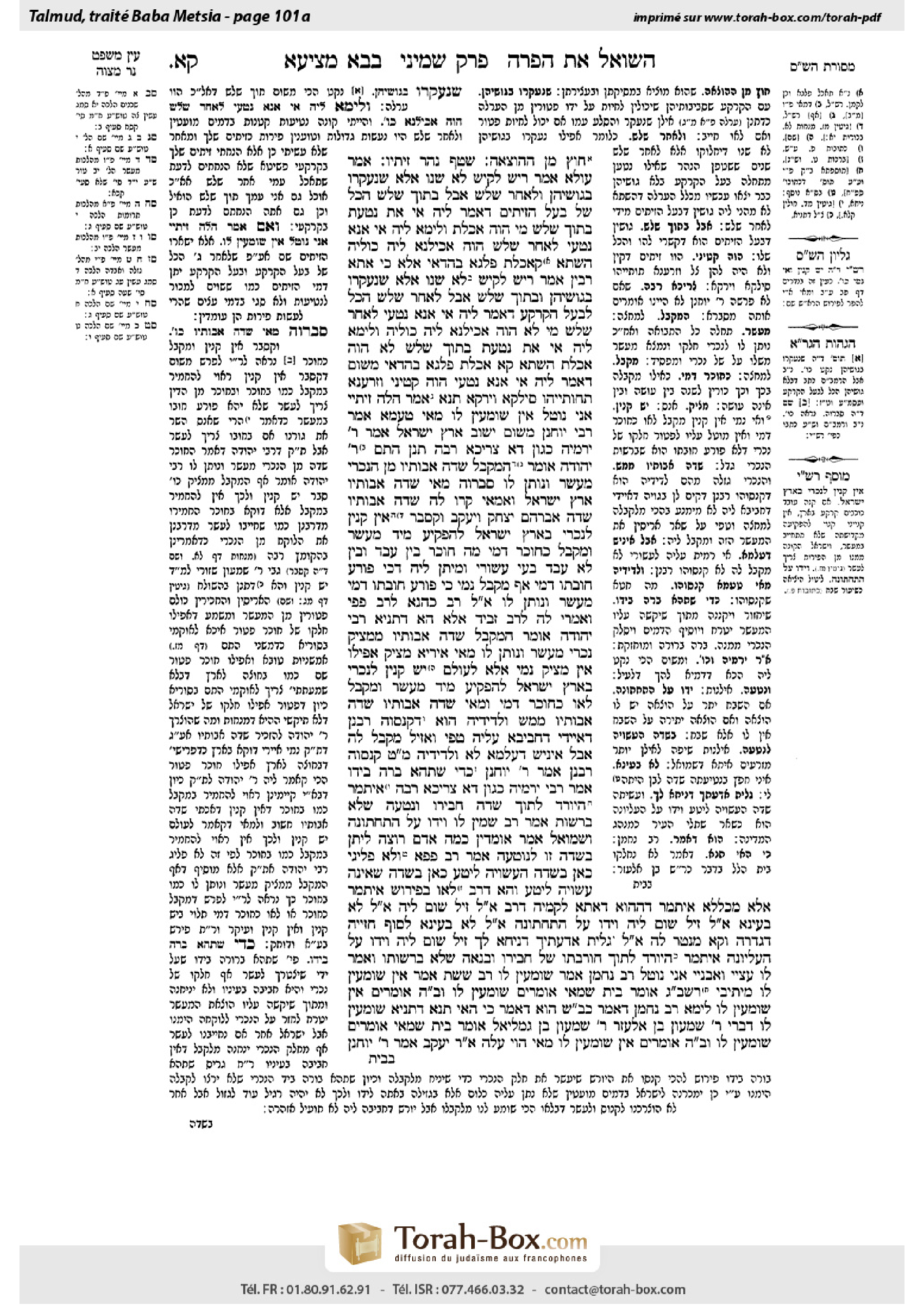
Bava Metzia 101a: Talmud study for Daf Yomi
Study the Talmud for Daf Yomi with scanned pages, Hebrew text, English translations from Sefaria and AI-generated French translations.
Passage selection and English or AI-generated French translation are available where the scan has annotations. Daf Study is independent of Torah-Box and Sefaria.
Browse Bava Metzia · בבא מציעא · All tractatesBava Metzia 101a text and translations
This page of Bava Metzia includes the Aramaic text, an English translation and an AI-generated French translation, alongside the scan above.
בבא מציעא ק״א א · Aramaic and Hebrew text
חוּץ מִן הַהוֹצָאָה.
שָׁטַף נָהָר זֵיתָיו. אָמַר עוּלָּא אָמַר רֵישׁ לָקִישׁ: לֹא שָׁנוּ אֶלָּא שֶׁנֶּעֶקְרוּ בְּגוּשֵׁיהֶן, וּלְאַחַר שָׁלֹשׁ.
אֲבָל בְּתוֹךְ שָׁלֹשׁ – הַכֹּל שֶׁל בַּעַל הַזֵּיתִים. דַּאֲמַר לֵיהּ: אִי אַתְּ נְטַעְתְּ בְּתוֹךְ שָׁלֹשׁ, מִי הֲוָה אָכְלַתְּ?
וְלֵימָא לֵיהּ: אִי אֲנָא נְטַעִי, לְאַחַר שָׁלֹשׁ הֲוָה אָכֵילְנָא לֵיהּ כּוּלֵּיהּ. הַשְׁתָּא קָאָכְלַתְּ פַּלְגָא בַּהֲדַאי!
אֶלָּא כִּי אֲתָא רָבִין, אָמַר רֵישׁ לָקִישׁ: לֹא שָׁנוּ אֶלָּא שֶׁנֶּעֶקְרוּ בְּגוּשֵׁיהֶן וּבְתוֹךְ שָׁלֹשׁ, אֲבָל לְאַחַר שָׁלֹשׁ הַכֹּל לְבַעַל הַקַּרְקַע. דַּאֲמַר לֵיהּ: אִי אֲנָא נְטַעִי לְאַחַר שָׁלֹשׁ, מִי לָא הֲוָה אָכֵילְנָא לֵיהּ כּוּלֵּיהּ?
וְלֵימָא לֵיהּ: אִי אַתְּ נְטַעְתְּ – בְּתוֹךְ שָׁלֹשׁ לָא הֲוָה אָכְלַתְּ, הַשְׁתָּא קָא אָכְלַתְּ פַּלְגָא בַּהֲדַאי? מִשּׁוּם דַּאֲמַר לֵיהּ: אִי אֲנָא נְטַעִי – הֲוָה קַטִּינֵי וּזְרַעְנָא תְּחוֹתַיְיהוּ סִילְקָא וְיַרְקָא.
תָּנָא: אָמַר הַלָּה ״זֵיתַיי אֲנִי נוֹטֵל״ – אֵין שׁוֹמְעִין לוֹ. מַאי טַעְמָא? אָמַר רַבִּי יוֹחָנָן: מִשּׁוּם יִשּׁוּב אֶרֶץ יִשְׂרָאֵל. אָמַר רַבִּי יִרְמְיָה: כְּגוֹן דָּא צְרִיכָא רַבָּה.
תְּנַן הָתָם, רַבִּי יְהוּדָה אוֹמֵר: הַמְקַבֵּל שָׂדֶה אֲבוֹתָיו מִן הַנׇּכְרִי – מְעַשֵּׂר וְנוֹתֵן לוֹ.
סַבְרוּהָ מַאי ״שְׂדֵה אֲבוֹתָיו״ – אֶרֶץ יִשְׂרָאֵל, וְאַמַּאי קָרוּ לַהּ ״שְׂדֵה אֲבוֹתָיו״ – שְׂדֵה אַבְרָהָם יִצְחָק וְיַעֲקֹב.
וְקָסָבַר: אֵין קִנְיָן לְנׇכְרִי בְּאֶרֶץ יִשְׂרָאֵל לְהַפְקִיעַ מִיַּד מַעֲשֵׂר.
וּמְקַבֵּל – כְּחוֹכֵר דָּמֵי. מָה חוֹכֵר, בֵּין עֲבַד וּבֵין לָא עֲבַד, בָּעֵי עַשּׂוֹרֵי וּמִיתַּן לֵיהּ, דְּכִי פּוֹרֵעַ חוֹבָתוֹ דָּמֵי. אַף מְקַבֵּל נָמֵי כִּי פּוֹרֵעַ חוֹבָתוֹ דָּמֵי, מְעַשֵּׂר וְנוֹתֵן לוֹ.
אֲמַר לֵיהּ רַב כָּהֲנָא לְרַב פַּפִּי, וְאָמְרִי לַהּ לְרַב זְבִיד: אֶלָּא הָא דְּתַנְיָא, רַבִּי יְהוּדָה אוֹמֵר: הַמְקַבֵּל שָׂדֶה אֲבוֹתָיו מִמֵּצִיק נׇכְרִי מְעַשֵּׂר וְנוֹתֵן לוֹ, מַאי אִירְיָא מֵצִיק? אֲפִילּוּ אֵין מֵצִיק – נָמֵי!
אֶלָּא: לְעוֹלָם יֵשׁ קִנְיָן לְנׇכְרִי בְּאֶרֶץ יִשְׂרָאֵל לְהַפְקִיעַ מִיַּד מַעֲשֵׂר, וּמְקַבֵּל לָאו כְּחוֹכֵר דָּמֵי.
וּמַאי ״שְׂדֵה אֲבוֹתָיו״ – שְׂדֵה אֲבוֹתָיו מַמָּשׁ. וּלְדִידֵיהּ הוּא דְּקַנְסוּהּ רַבָּנַן, דְּאַיְּידֵי דַּחֲבִיבָא עֲלֵיהּ טָפֵי וְאָזֵיל מְקַבֵּל לַהּ. אֲבָל אִינִישׁ דְּעָלְמָא – לָא.
וּלְדִידֵיהּ מַאי טַעְמָא קַנְסוּהּ רַבָּנַן? אָמַר רַבִּי יוֹחָנָן: כְּדֵי שֶׁתְּהֵא בָּרָה בְּיָדוֹ.
אָמַר רַבִּי יִרְמְיָה: כְּגוֹן דָּא צְרִיכָא רַבָּה.
אִיתְּמַר: הַיּוֹרֵד לְתוֹךְ שְׂדֵה חֲבֵירוֹ וּנְטָעָהּ שֶׁלֹּא בִּרְשׁוּת, אָמַר רַב: שָׁמִין לוֹ, וְיָדוֹ עַל הַתַּחְתּוֹנָה. וּשְׁמוּאֵל אָמַר: אוֹמְדִין כַּמָּה אָדָם רוֹצֶה לִיתֵּן בְּשָׂדֶה זוֹ לְנוֹטְעָהּ.
אָמַר רַב פָּפָּא וְלָא פְּלִיגִי: כָּאן – בְּשָׂדֶה הָעֲשׂוּיָה לִיטַּע, כָּאן – בְּשָׂדֶה שֶׁאֵינָהּ עֲשׂוּיָה לִיטַּע.
וְהָא דְּרַב לָאו בְּפֵירוּשׁ אִיתְּמַר, אֶלָּא מִכְּלָלָא אִיתְּמַר. דְּהָהוּא דַּאֲתָא לְקַמֵּיהּ דְּרַב, אֲמַר לֵיהּ: זִיל שׁוּם לֵיהּ. אֲמַר לֵיהּ: לָא בָּעֵינָא. אֲמַר לֵיהּ: זִיל שׁוּם לֵיהּ, וְיָדוֹ עַל הַתַּחְתּוֹנָה. אֲמַר לֵיהּ: לָא בָּעֵינָא.
לְסוֹף חַזְיֵיהּ דְּגַדְרַהּ וְקָא מְנַטַּר לַהּ. אֲמַר לֵיהּ גַּלִּית אַדַּעְתָּיךְ דְּנִיחָא לָךְ, זִיל שׁוּם לֵיהּ, וְיָדוֹ עַל הָעֶלְיוֹנָה.
אִיתְּמַר: הַיּוֹרֵד לְתוֹךְ חוּרְבָּתוֹ שֶׁל חֲבֵירוֹ וּבְנָאָהּ שֶׁלֹּא בִּרְשׁוּתוֹ, וְאָמַר לוֹ: עֵצַיי וַאֲבָנַיי אֲנִי נוֹטֵל, רַב נַחְמָן אָמַר: שׁוֹמְעִין לוֹ, רַב שֵׁשֶׁת אָמַר: אֵין שׁוֹמְעִין לוֹ.
מֵיתִיבִי, רַבָּן שִׁמְעוֹן בֶּן גַּמְלִיאֵל אוֹמֵר: בֵּית שַׁמַּאי אוֹמְרִים: שׁוֹמְעִין לוֹ, וּבֵית הִלֵּל אוֹמְרִים: אֵין שׁוֹמְעִין לוֹ. לֵימָא רַב נַחְמָן דְּאָמַר כְּבֵית שַׁמַּאי?
הוּא דְּאָמַר כִּי הַאי תַּנָּא, דְּתַנְיָא: שׁוֹמְעִין לוֹ, דִּבְרֵי רַבִּי שִׁמְעוֹן בֶּן אֶלְעָזָר. רַבָּן שִׁמְעוֹן בֶּן גַּמְלִיאֵל אוֹמֵר, בֵּית שַׁמַּאי אוֹמְרִים: שׁוֹמְעִין לוֹ, וּבֵית הִלֵּל אוֹמְרִים: אֵין שׁוֹמְעִין לוֹ.
מַאי הָוֵי עֲלַהּ? אָמַר רַבִּי יַעֲקֹב אָמַר רַבִּי יוֹחָנָן:
Bava Metzia 101a · English translation
is exclusive of the expense of processing the olives to produce oil.
§ The mishna teaches: In the event that a river swept away one’s olive trees and deposited them in the field of another, and they took root there and yielded olives, then the olives are divided between the owner of the trees and the owner of the field. Ulla says that Reish Lakish says: They taught this only about a case where the olive trees were uprooted and relocated together with their clods of earth in which they grew; and the ruling is with regard to olives that grew after three years since the trees took root in the new field. After three years there is no longer any prohibition of orla (see Leviticus 19:23) on the olives even if one presumes that the olives were nourished from the field owner’s land.
But during the first three years after the trees took root in the new field, everything that grows is the property of the owner of the olive trees, as he can say to the owner of the field: Even if you had planted the trees yourself at the time that they took root in your field, would you have eaten the olives during the first three years? If you claim that the nourishment from your land yielded the olives, the olives will be prohibited as orla. The only reason for them to be permitted is if it is assumed that they were nourished only from the clods of earth in which they were initially planted over three years ago, in which case they should belong entirely to me, as the owner of both the trees and the clods.
The Gemara asks: But let the owner of the field say to him: If I had uprooted your trees from my field and instead planted my own trees, then after three years I could have consumed all of the olives yielded by them. Now that I let your trees remain and so you have a right to consume half with me, in return I should be entitled to half the yield during the first three years as well.
The Gemara suggests another interpretation: Rather, when Ravin came from Eretz Yisrael to Babylonia he said in the name of Reish Lakish: They taught this only about a case where the olive trees were uprooted and relocated together with their clods of earth in which they grew, and the ruling is with regard to olives that grew during the first three years since the trees took root in the new field. But after the first three years, everything that grows is the property of the owner of the land, as he can say to the owner of the trees: If I had uprooted your trees from my field and instead planted my own trees, then after three years, could I not have consumed all of the olives produced by them?
The Gemara asks: But let the owner of the trees say to him: Even if you had planted trees yourself at the time my trees took root in your field, then during the first three years you would not have consumed their fruit at all. How, then, can you come now and claim you are entitled to consume half of the olives together with me during those first three years? The Gemara answers: He has a right to demand half of the olives due to the fact that the owner of the field can say to the owner of the trees: If I had uprooted your trees from my field and instead planted my own trees, they would be slender plants that do not cast heavy shadows, and I would have planted chard [silka] and vegetables underneath the trees and made a significant profit. Since, instead, I let your trees remain, in return I should be entitled to half of the fruit during the first three years.
§ The Sages taught in a baraita: If the other one, the owner of the trees, said: I am uprooting and taking my olive trees back, the court does not listen to him. What is the reason? Rabbi Yoḥanan said: Due to the desire to promote the settling of Eretz Yisrael, it is inappropriate to uproot trees. Upon hearing this ruling, Rabbi Yirmeya said: For rulings such as this, it is necessary to have a great Sage explain it, as that reason is not self-evident.
We learned in a mishna there (Demai 6:2): Rabbi Yehuda says that one who receives a field of his ancestors from a gentile under a sharecropping agreement, i.e., he is granted the right to cultivate the land and keep its produce in return for giving a portion of the produce to the gentile owner, must first tithe the produce grown in that field and only then give the gentile his portion from among the tithed produce.
Initially, when the Sages studied this mishna, they assumed the following interpretation: What is the meaning of: A field of his ancestors? It is a reference to any field in Eretz Yisrael. And why did they call it: A field of his ancestors? Because it is a field of his forefathers, Abraham, Isaac, and Jacob.
According to this interpretation, the mishna is referring to a field which was legitimately acquired by the gentile and to which the Jew has no claim. The Gemara explains why the Jewish sharecropper is required to tithe the produce he will give the landowner: And the reason the sharecropper tithes that produce is that the tanna holds that a gentile’s acquisition of land in Eretz Yisrael does not abrogate its sanctity with regard to separating tithes from its produce.
And Rabbi Yehuda also holds that the obligation of one who receives a field of his ancestors, i.e., a sharecropper, to pay the landowner is like that of a tenant farmer, i.e., just as a tenant farmer, whether the field produces a crop or whether it does not produce a crop, is required to procure produce from somewhere, tithe it, and then give it to the landowner, as he is like one paying his debt, so too, one who receives, i.e., a sharecropper, is also like one paying his debt, and he must consequently first tithe the produce and then give it to the landowner. Since his obligation to the landowner is regarded as a debt, apparently before the produce is given to the landowner, it belongs to the tenant farmer or sharecropper, who is therefore required to tithe it.
Rav Kahana said to Rav Pappi, and some say that he said it to Rav Zevid: But this explanation is challenged by that which is taught in a baraita: Rabbi Yehuda says that one who receives a field of his ancestors under a sharecropping agreement, from a gentile oppressor who seized it, first tithes produce and then gives the gentile his portion. According to the Sages’ initial understanding, why does the baraita specifically refer to an oppressor who stole the land? Even if the gentile was not an oppressor, the ruling of the baraita would also apply.
Rather, the tanna of the mishna holds that a gentile’s acquisition of land in Eretz Yisrael abrogates its sanctity with regard to separating tithes from its produce, and he also holds that the obligation of one who receives, i.e., a sharecropper, to pay the landowner is not like that of a tenant farmer. Since under the sharecropping arrangement the landowner retains a percentage stake in the yield, when the sharecropper provides the landowner with a portion of the produce, he is not considered to be paying a debt to him, but simply to be providing the landowner with the latter’s own produce. Therefore, fundamentally the sharecropper should not have to tithe the produce before giving it to the landowner. The requirement to do so is a fine the Sages imposed upon him, as the Gemara will explain.
And, according to this explanation, what is the meaning of: A field of his ancestors? It is referring to a field that belonged to his actual ancestors, of whom he is their heir, and it was then seized by a gentile. And it is only him whom the Sages penalized and required to take tithes from produce before giving it to the gentile oppressor, as, since the land is dear to him, he will more readily go and receive it in a sharecropping arrangement from the gentile, despite the Sages’ requirement. But with regard to another person of the world at large, the Sages did not penalize him, as no one else would be willing to receive the land under such disadvantageous terms.
This explains why the Sages limited the fine to a person who has an ancestral claim to the field, but what is the reason that the Sages penalized him? Rabbi Yoḥanan says: It was in order to encourage him to purchase the field, so that it will be clearly in his possession. The disadvantageous conditions will make it preferable for him to purchase the land outright from the gentile instead of entering into a sharecropping arrangement with him.
Upon hearing this ruling, Rabbi Yirmeya said: For rulings such as this, it is necessary to have a great Sage to explain it.
§ An amoraic dispute was stated with regard to one who entered another’s field and planted trees in it without the permission of the owner of the field. Since the owner of the field profits from the planter’s actions, he is required to pay him. Rav says: The court appraises both the expenses for the one who planted the trees and the value of the improvements and the planter is at a disadvantage, i.e., the owner of the field pays the lesser of the two amounts. And Shmuel says: The court estimates how much a person would be willing to give for someone to plant trees in this field, and that is how much the owner of the field must pay.
Rav Pappa said: And Rav and Shmuel do not disagree. Here, Shmuel’s ruling is with regard to a field that is designated for planting, while there, Rav’s ruling is with regard to a field that is not designated for planting.
The Gemara notes: And this ruling of Rav was not stated explicitly; rather, it was stated implicitly. As there was a certain person who came before Rav after someone had planted trees in that person’s field. Rav said to him: Go and have the court appraise both the expenses for the one who planted the trees and the value of the improvements. The owner of the field said to him: I do not want these trees; why should I pay for them? Rav said to him: Go and have the court appraise both the expenses for the one who planted the trees and the value of the improvements, and he is at a disadvantage, i.e., you are obligated to pay him only the lesser of the two amounts. The owner of the field again said to him: I do not want these trees; why should I pay for them? Rav did not persist with his ruling, indicating that he conceded that the owner of the field was not obligated to pay.
Eventually, Rav saw that the owner of the field had fenced in the field and was safeguarding the trees. Rav said to him: By doing so you have demonstrated your opinion that having those trees in your field is satisfactory to you. Therefore, I rule that you should go and have the court appraise both the expenses for the one who planted the trees and the value of the improvements, and he has the advantage, i.e., you are obligated to pay him the greater of the two amounts.
§ An amoraic dispute was stated with regard to one who entered another’s ruin and built it up using his own materials but without the landowner’s permission, and then later, the builder said to the landowner: I will dismantle the structure and take my timber and my stones back. Rav Naḥman says: The court listens to him and he is allowed to do so. Rav Sheshet says: The court does not listen to him and he is not allowed to do so.
The Gemara raises an objection to Rav Naḥman’s ruling from a baraita (Tosefta, Bava Kamma 10:6) about the same case: Rabban Shimon ben Gamliel says: Beit Shammai say that the court listens to him, and Beit Hillel say that the court does not listen to him. The Gemara explains the difficulty posed: Shall we say that Rav Naḥman said his ruling in accordance with the opinion of Beit Shammai? That is untenable, as this is not listed as one of the specific exceptions to the principle that the halakha is always in accordance with the opinion of Beit Hillel.
The Gemara answers: Rav Naḥman states his opinion in accordance with the opinion of that tanna, i.e., Rabbi Shimon ben Elazar, as it is taught in a baraita: According to both Beit Hillel and Beit Shammai, the court listens to him; this is the statement of Rabbi Shimon ben Elazar. Rabban Shimon ben Gamliel says: Beit Shammai say that the court listens to him, and Beit Hillel say that the court does not listen to him.
The Gemara inquires: What halakhic conclusion was reached about this matter? Rabbi Ya’akov said that Rabbi Yoḥanan said:
Bava Metzia 101a · Traduction française (IA)
cela exclut les frais de transformation des olives en huile.
§ La Michna enseigne : Si un fleuve emporte les oliviers d'une personne et les dépose dans le champ d'un autre, et qu'ils prennent racine là-bas et produisent des olives, alors les olives sont partagées entre l'propriétaire des arbres et l'propriétaire du champ. Ulla dit que Reish Lakish dit : Ils ont enseigné cela uniquement dans le cas où les oliviers ont été arrachés et transférés ensemble avec les morceaux de terre dans lesquels ils ont grandi ; et la décision concerne les olives qui ont grandi après trois ans depuis que les arbres ont pris racine dans le nouveau champ. Après trois ans, il n'y a plus de prohibition d'orla (voir Lévitique 19:23) sur les olives même si l'on suppose qu'ils ont été nourris par le terrain de l'propriétaire du champ.
Mais pendant les trois premières années après que les arbres ont pris racine dans le nouveau champ, tout ce qui pousse appartient à l'propriétaire des oliviers, car il peut dire à l'propriétaire du champ : Même si tu avais planté les arbres toi-même au moment où ils ont pris racine dans ton champ, aurais-tu mangé les olives pendant les trois premières années ? Si tu affirmes que la nourriture provenant de ton terrain a produit les olives, ces olives seront interdites comme orla. La seule raison pour lesquelles elles sont permises est si l'on suppose qu'ils ont été nourris uniquement par les morceaux de terre dans lesquels ils ont été plantés il y a trois ans, dans ce cas ils devraient entièrement appartenir à moi, car je suis à la fois l'propriétaire des arbres et des morceaux de terre.
Le Guemara pose la question : Mais que l'propriétaire du champ dise à l'autre : Si j'avais arraché tes arbres de mon champ et planté mes propres arbres à la place, après trois ans j'aurais pu consommer toutes les olives produites par eux. Maintenant que je laisse tes arbres rester, tu as le droit de consommer la moitié avec moi, en retour je devrais avoir le droit à la moitié de la récolte pendant les trois premières années également.
Le Guemara suggère une autre interprétation : Plutôt, lorsque Ravin est venu d'Eretz Yisrael vers Babylone, il a dit au nom de Reish Lakish : Ils ont enseigné cela uniquement dans le cas où les oliviers ont été arrachés et transférés ensemble avec les morceaux de terre dans lesquels ils ont grandi, et la décision concerne les olives qui ont grandi pendant les trois premières années après que les arbres ont pris racine dans le nouveau champ. Mais après les trois premières années, tout ce qui pousse appartient à l'propriétaire du terrain, car il peut dire à l'propriétaire des arbres : Si j'avais arraché tes arbres de mon champ et planté mes propres arbres à la place, après trois ans, ne pourrais-je pas avoir consommé toutes les olives produites par eux ?
Le Guemara pose la question : Mais laisse l'propriétaire des arbres dire à lui : Même si tu avais planté des arbres toi-même au moment où mes arbres ont pris racine dans ton champ, tu n'aurais pas mangé leurs fruits pendant les trois premières années. Comment alors peux-tu maintenant revendiquer le droit de consommer la moitié des olives avec moi pendant ces trois premières années ? Le Guemara répond : Il a le droit de demander la moitié des olives en raison du fait que l'propriétaire du champ peut dire à l'propriétaire des arbres : Si j'avais arraché tes arbres de mon champ et planté mes propres arbres à la place, ils seraient des jeunes arbres qui ne jettent pas d'ombre lourde, et j'aurais planté des chardons et des légumes sous les arbres et réalisé un profit considérable. Puisque, au contraire, j'ai laissé tes arbres rester, en retour je devrais avoir le droit à la moitié des fruits pendant les trois premières années.
§ Les Sages ont enseigné dans une baraïta : Si l'autre, l'propriétaire des arbres, dit : Je vais arracher et emporter mes oliviers, la cour ne l'écoute pas. Quelle est la raison ? Rabbi Yoḥanan a dit : En raison du désir de promouvoir l'installation en Eretz Yisrael, il n'est pas approprié d'arracher des arbres. En entendant cette décision, Rabbi Yirmeya a dit : Pour des décisions telles que celle-ci, il est nécessaire d'avoir un grand Sage pour l'expliquer, car cette raison n'est pas évidente.
Nous avons appris dans une Michna là (Demai 6:2) : Rabbi Yehuda dit que celui qui reçoit un champ de ses ancêtres d'un non-Juif sous un contrat de partage de récolte, c'est-à-dire qu'il est autorisé à cultiver le terrain et à conserver sa récolte en échange de lui donner une part de la récolte au propriétaire non-Juif, doit d'abord sanctifier la récolte produite dans ce champ et ne donner ensuite à l'propriétaire non-Juif sa part que parmi la récolte sanctifiée.
Initialement, lorsque les Sages ont étudié cette Michna, ils ont supposé l'interprétation suivante : Quelle est la signification de : un champ de ses ancêtres ? C'est une référence à tout champ en Eretz Yisrael. Et pourquoi l'appellent-ils : un champ de ses ancêtres ? Parce qu'il s'agit d'un champ de ses ancêtres, Abraham, Isaac et Jacob.
Selon cette interprétation, la Michna fait référence à un champ qui a été légitimement acquis par le non-Juif et auquel le Juif n'a pas de revendication. La Guemara explique pourquoi le cultivateur juif est tenu de sanctifier la récolte qu'il donnera au propriétaire du terrain : Et la raison pour laquelle le cultivateur sanctifie cette récolte est que le tanna considère que l'acquisition d'un terrain par un non-Juif en Eretz Yisrael ne supprime pas sa sainteté en ce qui concerne la séparation des dîmes de sa récolte.
Et Rabbi Yehuda tient également que l'obligation de celui qui reçoit un champ de ses ancêtres, c'est-à-dire un cultivateur de partage, de payer au propriétaire du terrain est comme celle d'un fermier, c'est-à-dire tout comme un fermier, qu'importe si le champ produit une récolte ou non, est tenu de procurer une récolte ailleurs, de la sanctifier et de la donner au propriétaire du terrain, car il est comme celui qui paie sa dette. De même, celui qui reçoit, c'est-à-dire un cultivateur de partage, est aussi comme celui qui paie sa dette, et il doit donc nécessairement d'abord sanctifier la récolte et ensuite la donner au propriétaire du terrain. Puisque son obligation envers le propriétaire du terrain est considérée comme une dette, apparemment avant que la récolte ne soit donnée au propriétaire du terrain, elle appartient au fermier ou au cultivateur de partage, qui est donc tenu de la sanctifier.
Rav Kahana a dit à Rav Pappi, et certains disent qu'il l'a dit à Rav Zevid : Mais cette explication est mise en doute par ce qui est enseigné dans une baraïta : Rabbi Yéhuda dit que celui qui reçoit un champ de ses ancêtres sous un contrat de partage de récolte, d'un non-Juif oppresseur qui l'a enlevé, doit d'abord titrer les produits et ensuite donner au non-Juif sa part. Selon la compréhension initiale des Sages, pourquoi la baraïta fait-elle spécifiquement mention d'un oppresseur qui a volé la terre ? Même si le non-Juif n'était pas un oppresseur, la décision de la baraïta s'appliquerait tout aussi bien.
Plutôt, le tanna de la mitsna maintient que l'acquisition d'un non-Juif d'un champ en Eretz Yisraël annule sa sanctité en ce qui concerne la séparation des dixièmes de ses produits, et il maintient également que l'obligation de celui qui reçoit, c'est-à-dire un partageur, de payer au propriétaire du terrain n'est pas comme celle d'un fermier. Sous le contrat de partage, le propriétaire conserve une part du rendement, donc lorsque le partageur donne au propriétaire une part des produits, il n'est pas considéré comme payant une dette, mais simplement comme lui donnant ses propres produits. Ainsi, fondamentalement, le partageur ne devrait pas avoir à titrer les produits avant de les donner au propriétaire. La nécessité de le faire est une amende imposée par les Sages, comme l'explique la Guemara.
Et, selon cette explication, quelle est la signification de : un champ de ses ancêtres ? Il s'agit d'un champ appartenant réellement à ses ancêtres, dont il est l'héritier, et qui a été ensuite enlevé par un non-Juif. Et c'est uniquement lui que les Sages ont pénalisé et exigé de prendre les dixièmes des produits avant de les donner au non-Juif oppresseur, car, puisque la terre lui est chère, il sera plus enclin à la recevoir sous un contrat de partage avec le non-Juif, malgré la condition des Sages. Mais concernant une autre personne du monde, les Sages n'ont pas pénalisé celle-ci, car personne d'autre ne serait prêt à recevoir la terre sous des conditions aussi défavorables.
Cela explique pourquoi les Sages ont limité l'amende à une personne ayant un droit ancestral sur le champ, mais quelle est la raison pour laquelle les Sages l'ont pénalisé ? Rabbi Yoḥanan dit : C'était afin d'encourager lui à acheter le champ, de sorte qu'il sera clairement en possession de celui-ci. Les conditions défavorables feront que ce soit préférable pour lui d'acheter le terrain directement du non-Juif plutôt que d'entrer dans un contrat de partage avec lui.
En entendant cette décision, Rabbi Yirmeya a dit : Pour des décisions telles que celle-ci, il est nécessaire d'avoir un grand Sage pour les expliquer.
§ Un débat entre les amoraim a été évoqué concernant celui qui entre dans un champ d'autrui et plante des arbres sans l'autorisation du propriétaire du champ. Puisque le propriétaire du champ bénéficie des actions du planter, il est tenu de lui payer. Rav dit : Le tribunal évalue à la fois les dépenses pour celui qui a planté les arbres et la valeur des améliorations, et le planter est désavantagé, c'est-à-dire que le propriétaire du champ paie la moindre des deux quantités. Et Shmuel dit : Le tribunal estime combien une personne serait prête à donner pour que quelqu'un plante des arbres dans ce champ, et c'est cette somme que le propriétaire du champ doit payer.
Rav Pappa a dit : Et Rav et Shmuel ne sont pas en désaccord. Ici, la décision de Shmuel concerne un champ destiné à la plantation, tandis que là, la décision de Rav concerne un champ non destiné à la plantation.
La Guemara note : Et cette décision de Rav n'a pas été formulée explicitement ; elle a été formulée implicitement. En effet, il y avait un certain homme qui est venu devant Rav après que quelqu'un ait planté des arbres dans son champ. Rav a dit à lui : Va et fais apprécier à la fois les dépenses pour celui qui a planté les arbres et la valeur des améliorations. Le propriétaire du champ a dit à lui : Je n'ai pas envie de ces arbres ; pourquoi devrais-je les payer ? Rav a dit à lui : Va et fais apprécier à la fois les dépenses pour celui qui a planté les arbres et la valeur des améliorations, et il est désavantagé, c'est-à-dire que tu es tenu de lui payer seulement la moindre des deux quantités. Le propriétaire du champ a à nouveau dit à lui : Je n'ai pas envie de ces arbres ; pourquoi devrais-je les payer ? Rav n'a pas persisté avec sa décision, indiquant qu'il a concédé que le propriétaire du champ n'était pas tenu de payer.
Finalement, Rav a vu que le propriétaire du champ avait clôturé le champ et protégeait les arbres. Rav a dit à lui : En faisant cela, tu as montré que posséder ces arbres dans ton champ te satisfaisait. Ainsi, je déclare que tu dois aller faire évaluer à la fois les dépenses pour celui qui a planté les arbres et la valeur des améliorations, et il a le droit, c'est-à-dire que tu es tenu de lui payer le plus grand montant des deux.
§ Un débat entre les amoraim a été évoqué concernant celui qui entre dans les ruines d'autrui et les reconstruit avec ses propres matériaux sans l'autorisation du propriétaire du terrain, et ensuite, le constructeur dit au propriétaire du terrain : Je démonterai la structure et je prendrai mes bois et mes pierres. Rav Naḥman dit : Le tribunal écoute et il est autorisé à le faire. Rav Sheshet dit : Le tribunal ne l'écoute pas et il n'est pas autorisé à le faire.
La Guemara soulève une objection contre la décision de Rav Naḥman à partir d'une baraïta (Tosefta, Bava Kamma 10:6) sur le même cas : Rabban Shimon ben Gamliel dit : Beit Shammai disent que le tribunal écoute, et Beit Hillel disent que le tribunal ne l'écoute pas. La Guemara explique la difficulté : Devons-nous dire que Rav Naḥman a formulé sa décision selon l'opinion de Beit Shammai ? Cela est inacceptable, car cela n'est pas mentionné comme l'une des exceptions spécifiques au principe que la halakha est toujours en conformité avec l'opinion de Beit Hillel.
La Guemara répond : Rav Naḥman exprime son opinion conformément à celle de ce tanna, c'est-à-dire Rabbi Šimon ben Elazar, comme il est enseigné dans une baraïta : Selon les deux Beit Hillel et Beit Shammai, le tribunal écoute ; c'est la déclaration de Rabbi Šimon ben Elazar. Rabban Šimon ben Gamliel dit : Beit Shammai disent que le tribunal l'écoute, et Beit Hillel disent que le tribunal ne l'écoute pas.
La Guemara interroge : quelle conclusion halakhique a été tirée à propos de cette question ? Rabbi Ya’akov dit que Rabbi Yoḥanan a dit :
Traduction française générée par IA à partir de l’édition anglaise de Sefaria. Vérifie toujours un passage avec le texte source.
Text from Sefaria: William Davidson Edition - Vocalized Aramaic (CC BY NC); William Davidson Edition - English (CC BY NC).