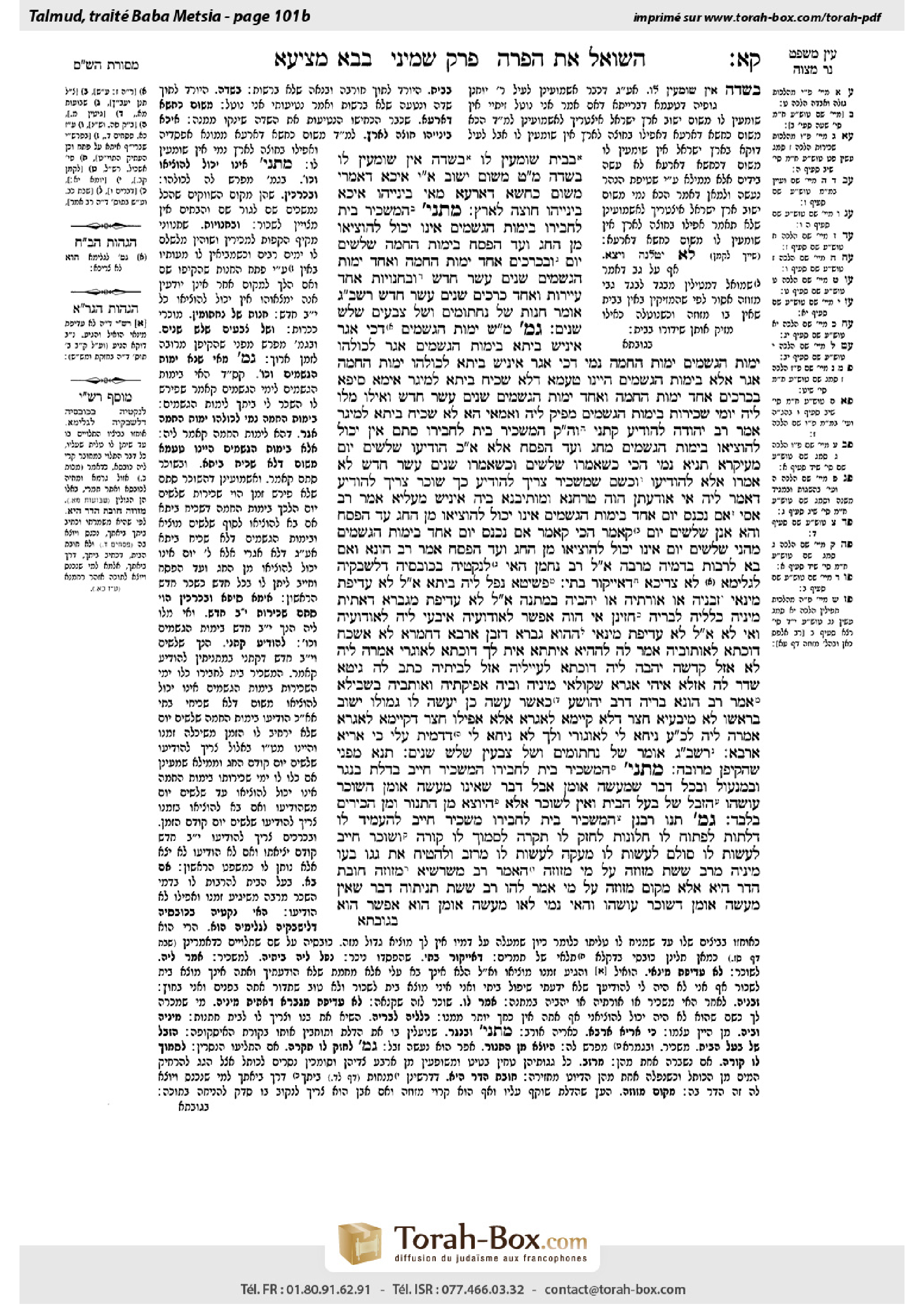
Bava Metzia 101b: Talmud study for Daf Yomi
Study the Talmud for Daf Yomi with scanned pages, Hebrew text, English translations from Sefaria and AI-generated French translations.
Passage selection and English or AI-generated French translation are available where the scan has annotations. Daf Study is independent of Torah-Box and Sefaria.
Browse Bava Metzia · בבא מציעא · All tractatesBava Metzia 101b text and translations
This page of Bava Metzia includes the Aramaic text, an English translation and an AI-generated French translation, alongside the scan above.
בבא מציעא ק״א ב · Aramaic and Hebrew text
בְּבַיִת – שׁוֹמְעִין לוֹ. בְּשָׂדֶה – אֵין שׁוֹמְעִין לוֹ.
בְּשָׂדֶה מַאי טַעְמָא – מִשּׁוּם יִשּׁוּב אֶרֶץ יִשְׂרָאֵל. אִיכָּא דְאָמְרִי: מִשּׁוּם כַּחְשָׁא דְאַרְעָא. מַאי בֵּינַיְיהוּ? אִיכָּא בֵּינַיְיהוּ חוּצָה לָאָרֶץ.
מַתְנִי׳ הַמַּשְׂכִּיר בַּיִת לַחֲבֵירוֹ בִּימוֹת הַגְּשָׁמִים – אֵינוֹ יָכוֹל לְהוֹצִיאוֹ מִן הֶחָג וְעַד הַפֶּסַח. בִּימוֹת הַחַמָּה, שְׁלֹשִׁים יוֹם. וּבַכְּרַכִּים, אֶחָד יְמוֹת הַחַמָּה וְאֶחָד יְמוֹת הַגְּשָׁמִים – שְׁנֵים עָשָׂר חֹדֶשׁ. וּבַחֲנוּיוֹת, אֶחָד עֲיָירוֹת וְאֶחָד כְּרַכִּים – שְׁנֵים עָשָׂר חֹדֶשׁ. רַבָּן שִׁמְעוֹן בֶּן גַּמְלִיאֵל אוֹמֵר: חֲנוּת שֶׁל נַחְתּוֹמִים וְשֶׁל צַבָּעִים שָׁלֹשׁ שָׁנִים.
גְּמָ׳ מַאי שְׁנָא יְמוֹת הַגְּשָׁמִים, דְּכִי אָגַר אִינִישׁ בֵּיתָא בִּימוֹת הַגְּשָׁמִים אָגַר לְכוּלְּהוּ יְמוֹת הַגְּשָׁמִים, יְמוֹת הַחַמָּה נָמֵי, דְּכִי אָגַר אִינִישׁ בֵּיתָא לְכוּלְּהוּ יְמוֹת הַחַמָּה אָגַר! אֶלָּא בִּימוֹת הַגְּשָׁמִים הַיְינוּ טַעְמָא: דְּלָא שְׁכִיחַ בֵּיתָא לְמֵיגַר.
אֵימָא סֵיפָא: בַּכְּרַכִּים, אֶחָד יְמוֹת הַחַמָּה וְאֶחָד יְמוֹת הַגְּשָׁמִים שְׁנֵים עָשָׂר חֹדֶשׁ, וְאִילּוּ מְלוֹ לֵיהּ יוֹמֵי שְׂכִירוּת בִּימוֹת הַגְּשָׁמִים, מַפֵּיק לֵיהּ, וְאַמַּאי? הָא לָא שְׁכִיחַ בֵּיתָא לְמֵיגַר!
אָמַר רַב יְהוּדָה, לְהוֹדִיעַ קָתָנֵי. וְהָכִי קָאָמַר: הַמַּשְׂכִּיר בַּיִת לַחֲבֵירוֹ סְתָם – אֵין יָכוֹל לְהוֹצִיאוֹ בִּימוֹת הַגְּשָׁמִים מֵחַג וְעַד הַפֶּסַח, אֶלָּא אִם כֵּן הוֹדִיעוֹ שְׁלֹשִׁים יוֹם מֵעִיקָּרָא.
תַּנְיָא נָמֵי הָכִי: כְּשֶׁאָמְרוּ שְׁלֹשִׁים, וּכְשֶׁאָמְרוּ שְׁנֵים עָשָׂר חֹדֶשׁ – לֹא אָמְרוּ אֶלָּא לְהוֹדִיעוֹ. וּכְשֵׁם שֶׁמַּשְׂכִּיר צָרִיךְ לְהוֹדִיעַ, כָּךְ שׂוֹכֵר צָרִיךְ לְהוֹדִיעַ, דְּאָמַר לֵיהּ: אִי אוֹדַעְתַּן, הֲוָה טָרַחְנָא וּמוֹתֵיבְנָא בֵּיהּ אִינִישׁ מְעַלְּיָא.
אָמַר רַב אַסִּי: אִם נִכְנַס יוֹם אֶחָד בִּימוֹת הַגְּשָׁמִים – אֵינוֹ יָכוֹל לְהוֹצִיאוֹ מִן הֶחָג עַד הַפֶּסַח. וְהָא אֲנַן שְׁלֹשִׁים יוֹם קָאָמַר! הָכִי קָאָמַר: אִם נִכְנַס יוֹם אֶחָד בִּימוֹת הַגְּשָׁמִים, מֵהָנֵי שְׁלֹשִׁים יוֹם – אֵינוֹ יָכוֹל לְהוֹצִיאוֹ מִן הַחַג וְעַד הַפֶּסַח.
אָמַר רַב הוּנָא: וְאִם בָּא לְרַבּוֹת בְּדָמֶיהָ מְרַבֶּה. אֲמַר לֵיהּ רַב נַחְמָן: הַאי לִנְקְטֵיהּ בְּכוּבְסֵיהּ דְּלִשְׁבְּקֵיהּ לִגְלִימֵאּ?! לָא צְרִיכָא דְּאִיַּיקּוּר בָּתֵּי.
פְּשִׁיטָא נְפַל לֵיהּ בֵּיתָא – אֲמַר לֵיהּ: לָא עֲדִיפַתְּ מִינַּאי.
זַבְּנֵיהּ אוֹ אוֹרְתֵיהּ אוֹ יַהֲבֵיהּ בְּמַתָּנָה – אֲמַר לֵיהּ: לָא עֲדִיפַתְּ מִגַּבְרָא דַּאֲתֵית מִינֵּיהּ.
כַּלְּלֵיהּ לִבְרֵיהּ, חָזֵינַן: אִי הֲוָה אֶפְשָׁר לְאוֹדוֹעֵיהּ – אִיבְּעִי לֵיהּ לְאוֹדוֹעֵי, וְאִי לָא – אָמַר לֵיהּ: לָא עֲדִיפַתְּ מִינַּאי.
הָהוּא גַּבְרָא דִּזְבַן אַרְבָּא דְחַמְרָא. לָא אַשְׁכַּח דּוּכְתָּא לְאוֹתוֹבֵיהּ. אֲמַר לֵיהּ לְהַהִיא אִיתְּתָא: אִית לָךְ דּוּכְתָּא לְאוֹגוֹרַי? אֲמַרָה לֵיהּ: לָא. אֲזַל קַדְּשַׁהּ יְהַבָה לֵיהּ דּוּכְתָּא לְעַיֹּילֵיהּ. אֲזַל לְבֵיתֵיהּ כְּתַב לַהּ גִּיטָּא, שַׁדַּר לַהּ. אֲזַלָא אִיהִי, אֲגַרָא שָׁקוֹלָאֵי מִינֵּיהּ וּבֵיהּ, אַפֵּיקְתֵּיהּ וְאוֹתְבֵיהּ בִּשְׁבִילָא. אָמַר רַב הוּנָא בְּרֵיהּ דְּרַב יְהוֹשֻׁעַ: ״כַּאֲשֶׁר עָשָׂה כֵּן יֵעָשֶׂה לּוֹ גְּמוּלוֹ יָשׁוּב בְּרֹאשׁוֹ״.
לָא מִיבַּעְיָא חָצֵר דְּלָא קָיְימָא לְאַגְרָא, אֶלָּא אֲפִילּוּ חָצֵר דְּקָיְימָא לְאַגְרָא, אָמְרָה לֵיהּ: לְכוּלֵּי עָלְמָא נִיחָא לִי לְאוֹגוֹרֵי וְלָךְ לָא נִיחָא לִי, דְּדָמֵית עֲלַי כִּי אַרְיָא אָרְבָא.
רַבָּן שִׁמְעוֹן בֶּן גַּמְלִיאֵל אוֹמֵר: שֶׁל נַחְתּוֹמִים וְשֶׁל צַבָּעִין שָׁלֹשׁ שָׁנִים. תָּנָא: מִפְּנֵי שֶׁהֶקֵּיפָן מְרוּבֶּה.
מַתְנִי׳ הַמַּשְׂכִּיר בַּיִת לַחֲבֵירוֹ, הַמַּשְׂכִּיר חַיָּיב בַּדֶּלֶת, בַּנֶּגֶר וּבַמַּנְעוּל, וּבְכׇל דָּבָר שֶׁמַּעֲשֵׂה אוּמָּן. אֲבָל דָּבָר שֶׁאֵינוֹ מַעֲשֵׂה אוּמָּן – הַשּׂוֹכֵר עוֹשֵׂהוּ.
הַזֶּבֶל שֶׁל בַּעַל הַבַּיִת, וְאֵין לַשּׂוֹכֵר אֶלָּא הַיּוֹצֵא מִן הַתַּנּוּר וּמִן הַכִּירַיִם בִּלְבַד.
גְּמָ׳ תָּנוּ רַבָּנַן: הַמַּשְׂכִּיר בַּיִת לַחֲבֵירוֹ, מַשְׂכִּיר חַיָּיב לְהַעֲמִיד לוֹ דְּלָתוֹת, לִפְתּוֹחַ לוֹ חַלּוֹנוֹת, לְחַזֵּק לוֹ תִּקְרָה, לִסְמוֹךְ לוֹ קוֹרָה. וְשׂוֹכֵר חַיָּיב לַעֲשׂוֹת לוֹ סוּלָּם, לַעֲשׂוֹת לוֹ מַעֲקֶה, לַעֲשׂוֹת לוֹ מַרְזֵב וּלְהָטִיחַ אֶת גַּגּוֹ.
בְּעוֹ מִינֵּיהּ מֵרַב שֵׁשֶׁת: מְזוּזָה עַל מִי? מְזוּזָה?! הָאָמַר רַב מְשַׁרְשְׁיָא: מְזוּזָה חוֹבַת הַדָּר הִיא. אֶלָּא: מְקוֹם מְזוּזָה עַל מִי?
אֲמַר לְהוּ רַב שֵׁשֶׁת: תְּנֵיתוּהָ, דָּבָר שֶׁאֵין מַעֲשֵׂה אוּמָּן – הַשּׂוֹכֵר עוֹשֵׂהוּ, וְהַאי נָמֵי לָאו מַעֲשֵׂה אוּמָּן הוּא, אֶפְשָׁר הוּא
Bava Metzia 101b · English translation
In the case of a house, the court listens to him, but in the case of a field, the court does not listen to him.
The Gemara asks: In the case of a field, what is the reason that the court does not listen to him? It is that due to the desire to promote the settling of Eretz Yisrael, it is inappropriate to uproot trees. There are those who say that it is for a different reason: It is due to the weakening of the land already caused by the tree roots, as it made the land unsuitable for other uses. Therefore, the owner of the trees may not just take them and leave the land in its worsened condition. The Gemara asks: What is the practical difference between these reasons? The practical difference between them is whether outside of Eretz Yisrael, the one who planted the trees may uproot them.
MISHNA: In the case of one who rents out a house in a town to another in the rainy season, the owner cannot evict the renter from the house from the festival of Sukkot until Passover. If the rental was in the summer, he must give thirty days’ notice before he can evict him. And for a house located in the cities [uvakerakim], both in the summer and in the rainy season he must give twelve months’ notice. And for shops that he rented out, both in towns and in cities, he must give twelve months’ notice. Rabban Shimon ben Gamliel says: For a baker’s shop or a dyer’s shop, one must give three years’ notice.
GEMARA: The Gemara asks: What is different about the rainy season that one cannot evict his renter? The Gemara suggests: Because when a person rents a house during the rainy season, it is presumed that he rents it for the entire rainy season. The Gemara challenges this: But in the summer as well, the same halakha should apply, because when a person rents a house, he rents it for the entire summer. The Gemara offers a different explanation: Rather, in the rainy season, this is the reason that he cannot evict him: It is because at that time, houses for renting are not found on the market. Since alternative housing is not available, even if he is renting the house month by month, one cannot evict him.
The Gemara asks: If that is the reason for the first clause of the mishna, say and try to explain accordingly the latter clause that states: And for a house located in the cities, both in the summer and in the rainy season, one must give twelve months’ notice. It arises from this ruling that if the twelve month rental period would be completed during the rainy season, he could evict him then. But why is this acceptable, given that houses for renting are not found on the market at that time?
Given this difficulty, the Gemara offers a different interpretation of the mishna: Rav Yehuda said: The mishna teaches about the requirement to give notice before eviction, and this is what it is saying: Although in general in a case of one who rents out a house to another without specification of when the rental period will end, both the landlord and the renter can end the rental whenever they so decide, the landlord cannot evict the renter during the rainy season, i.e., from the festival of Sukkot until Passover, unless he gives him notice of thirty days from the outset, i.e., before the rainy season begins. Since it would still be summer, it would be possible for the renter to find alternate housing. But if a fixed rental period was agreed upon, the renter may be evicted upon its completion without prior notice.
This is also taught in a baraita: When they said, in the mishna: Thirty days, and when they said: Twelve months, they said it only with regard to the requirement to give notice before eviction. And just as a landlord needs to give notice to his renter before he evicts him, so too a renter needs to give notice to his landlord before he can terminate the rental. The Gemara explains why the renter must give notice: As the landlord can say to him: Had you given me notice, I would have exerted myself to find and settle a respectable person in my house.
Rav Asi says: If one day of the rental enters into the rainy season without notice being given, then the landlord cannot evict the renter from the festival of Sukkot until Passover. The Gemara challenges this: But didn’t we say that he must be given thirty days’ notice? Rav Asi’s ruling indicates that if notice was given even a day before Sukkot, that would be sufficient. The Gemara explains: This is what Rav Asi is saying: If one day of these thirty days of notice enters into the rainy season without notice being given, i.e., if notice was given fewer than thirty days before Sukkot, then the landlord cannot evict the renter from the festival of Sukkot until Passover.
Rav Huna said: And if the landlord comes to increase the rental fee, he may increase it without prior notice. Rav Naḥman said to him: One who does so is like this person who grabbed another by his testicles so that he would relinquish his cloak, i.e., he has not provided the person with a true choice. By increasing the rent, one is effectively evicting him and so he should have to give thirty days’ notice. The Gemara defends Rav Huna’s opinion: No, the ruling is necessary in a case where the rental of houses became more expensive. Since the landlord would lose out by preserving the rent, it is acceptable for him to increase the rent without prior notice.
§ It is obvious that if the house in which the landlord lives fell down, then he can evict his renter from the house that he is renting to him, without giving notice, as he can say to him: You are no better than me. Since the landlord needs to find a new house to live in, he can demand that he should move into his rental property and it should be his renter who must look for new housing. He cannot be expected to have given notice, as he could not have foreseen that his house would fall down.
If a landlord sold the rental property to another, or bequeathed it to his heirs, or gave it to another person as a gift, the renter can say to the new owner: You are no better than the person from whom your ownership of the property came. Since he was required to give me notice before evicting me, so must you.
If a landlord marries off his son, and wishes to evict his current renter to provide a home for the newly married couple, then we see: If it was possible for him to have given notice, as the couple had already been engaged for some time, then he is required to give notice and cannot evict his renter otherwise, but if it was not possible to give timely notice, then he can say to his renter: You are no better than me and my needs. I need the property now for my son, so it should be you who should go and find alternate housing.
The Gemara relates: There was a certain man who purchased a boat laden with wine. He was unable to find a place to store it. He said to a certain woman: Do you have place to rent to me? She said to him: No. He was aware that she did own a suitable place, so he went and betrothed her, and then she gave him a lease on the place for him to bring in his wine there. He went back to his home and wrote a bill of divorce for her, which he then sent to her. Upon receiving the bill of divorce and realizing that the betrothal had been nothing more than a ruse, she went and hired porters, paying them from the wine itself, and instructed them to take the wine out of her place and put it on the road. Upon being presented with this case, Rav Huna, son of Rav Yehoshua, said, paraphrasing Obadiah 1:15: Like he did, so shall be done to him, his repayment shall come back on his head; she was entitled to do as she did.
The Gemara explains Rav Huna’s ruling: It is not necessary to state that the woman is entitled to evict the man if the place she rented out to him was a courtyard that did not stand to be rented out, in which case she is not expected to rent it to anyone; rather, even if it was a courtyard that stands to be rented out, she could say to him: It is amenable for me to rent the place to everyone else, but it is not amenable to me to rent it to you, as you are to me like a preying lion. Since you deceived me, I do not wish to have any dealings with you.
§ The mishna teaches: Rabban Shimon ben Gamliel says: For a baker’s shop or a dyer’s shop, one must give three years’ notice. It was taught in a baraita (Tosefta 8:27): The need for this unusually long period of notice is due to the fact that the length of the credit extended by these businesses to their customers is extensive. They must be provided with enough time to collect their debts before being forced to relocate.
MISHNA: If one rents out a house to another, the landlord bears the responsibility for providing the door, for providing the bolt, for providing the lock, and for providing every item in the house that is essential for normal living and requires the work of a craftsman to provide it. But with regard to an item that does not require the work of a craftsman, the renter is responsible to make it.
The manure found in the courtyard of a rented house is the property of the landlord, and the renter has rights only to the ashes that come out of the oven and the stove, which can also be used as a fertilizer.
GEMARA: The Sages taught in a baraita: If one rents out a house to another, the landlord bears the responsibility to install doors for it, to open windows in its walls to provide light for it, to strengthen its ceiling, and to support its cross beam. And the renter bears the responsibility to make a ladder for it to provide access to the roof, to erect a parapet for its roof (see Deuteronomy 22:8), to construct a gutter for it to carry away rain which falls on the roof, and to plaster its roof so that rain does not leak through it.
The students in the study hall raised a dilemma before Rav Sheshet: Upon whom is the obligation to affix a mezuza (see Deuteronomy 6:9)? The Gemara expresses surprise at the question: Why did they ask about a mezuza; doesn’t Rav Mesharshiyya say: Affixing a mezuza is the obligation of the resident? It is certainly the responsibility of the renter. The Gemara emends the dilemma: Rather, their dilemma was: Upon whom is the responsibility to prepare the place where the mezuza will be affixed, e.g., to bore a slit in a stone doorpost to insert the mezuza there?
Rav Sheshet said to them: You learned this in the mishna: With regard to an item that does not require the work of a craftsman, the renter is responsible to make it. And this task is also something that does not require the work of a craftsman, as it is possible
Bava Metzia 101b · Traduction française (IA)
Dans le cas d'une maison, la cour écoute, mais dans le cas d'un champ, la cour ne l'écoute pas.
La Guemara pose la question : Dans le cas d'un champ, pourquoi la cour ne l'écoute pas ? C'est parce que, en raison du désir de promouvoir la colonisation de la Terre d'Israël, il est inapproprié de déraciner les arbres. Certains disent que c'est pour une autre raison : c'est en raison de la détérioration du sol déjà causée par les racines des arbres, ce qui a rendu le sol inadapté à d'autres usages. Ainsi, le propriétaire des arbres ne peut pas simplement les prendre et laisser le sol dans un état pire. La Guemara pose la question : Quelle est la différence pratique entre ces raisons ? La différence pratique entre elles est de savoir si, en dehors de la Terre d'Israël, la personne qui a planté les arbres peut les déraciner.
MICHNA : Dans le cas d'une personne qui loue une maison d'une ville à une autre pendant la saison des pluies, le propriétaire ne peut pas expulser le locataire de la maison du festival de la Sucque jusqu'à Pessah. Si le loyer a été donné en été, il doit donner trente jours d'avance avant de pouvoir expulser le locataire. Et pour une maison située dans les villes [uvakerakim], qu'en été ou en saison des pluies, il doit donner un an d'avance. Et pour les boutiques qu'il a louées, qu'en ville ou en ville, il doit donner un an d'avance. Rabban Shimon ben Gamliel dit : Pour une boulangerie ou une teurie, on doit donner trois ans d'avance.
GUEMARA : La Guemara pose la question : Qu'est-ce qui diffère dans la saison des pluies qui empêche l'expulsion du locataire ? La Guemara suggère : Parce que lorsque quelqu'un loue une maison pendant la saison des pluies, on suppose qu'il la loue pour toute la saison des pluies. La Guemara conteste cela : Mais en été également, la même halakha devrait s'appliquer, car lorsque quelqu'un loue une maison, il la loue pour tout l'été. La Guemara propose une autre explication : Plutôt, en saison des pluies, c'est pour cette raison qu'on ne peut pas l'expulser : C'est parce que, à cette époque, les maisons à louer ne sont pas disponibles sur le marché. Puisque l'alternative de logement n'est pas disponible, même si on loue la maison mois par mois, on ne peut pas l'expulser.
La Guemara pose la question : Si c'est la raison du premier verset de la Michna, expliquez alors de la même manière le second verset qui dit : Et pour une maison située dans les villes, qu'en été ou en saison des pluies, on doit donner un an d'avance. Il découle de cette décision que si la période de location de un an serait terminée pendant la saison des pluies, on pourrait l'expulser alors. Mais pourquoi cela est-il acceptable, étant donné que les maisons à louer ne sont pas disponibles sur le marché à cette époque ?
Face à cette difficulté, la Guemara propose une autre interprétation de la Michna : Rav Yehuda dit : La Michna enseigne la nécessité de donner un préavis avant l'expulsion, et c'est ce qu'elle dit : Bien que, dans le cas général, lorsqu'une personne loue une maison à une autre sans préciser la fin de la période de location, à la fois le propriétaire et le locataire peuvent terminer la location à leur guise, le propriétaire ne peut pas expulser le locataire pendant la saison des pluies, c'est-à-dire du festival de la Sucque jusqu'à Pessah, à moins qu'il ne lui donne un préavis de trente jours dès le début, c'est-à-dire avant la saison des pluies. Puisque ce serait encore l'été, il serait possible au locataire de trouver un logement alternatif. Mais si une période de location fixe a été convenue, le locataire peut être expulsé à la fin de cette période sans préavis préalable.
Cela est également enseigné dans une baraïta : Lorsqu'ils ont dit, dans la Michna : Trente jours, et lorsqu'ils ont dit : Un an, ils l'ont dit uniquement en ce qui concerne la nécessité de donner un préavis avant l'expulsion. Et tout comme le propriétaire a besoin de donner un préavis à son locataire avant de l'expulser, de même le locataire a besoin de donner un préavis à son propriétaire avant de pouvoir résilier le bail. La Guemara explique pourquoi le locataire doit donner un préavis : Parce que le propriétaire peut lui dire : Si tu m'avais donné un préavis, j'aurais fait l'effort de trouver et de loger une personne respectable dans ma maison.
Rav Asi dit : Si un jour de la location entre dans la saison des pluies sans que le préavis ne soit donné, alors le propriétaire ne peut pas expulser le locataire du festival de la Sucque jusqu'à Pessah. La Guemara conteste cela : Mais n'avons-nous pas dit qu'il doit être donné un préavis de trente jours ? La décision de Rav Asi indique que si le préavis a été donné même un jour avant la Sucque, cela suffirait. La Guemara explique : C'est ce que Rav Asi dit : Si un jour de ces trente jours de préavis entre dans la saison des pluies sans que le préavis ne soit donné, c'est-à-dire si le préavis a été donné moins de trente jours avant la Sucque, alors le propriétaire ne peut pas expulser le locataire du festival de la Sucque jusqu'à Pessah.
Rav Huna dit : Et si le propriétaire vient augmenter le loyer, il peut l'augmenter sans préavis. Rav Naḥman lui dit : Celui qui fait cela est comme cette personne qui a attrapé un autre par ses testicules afin qu'il lui rende son manteau, c'est-à-dire qu'il n'a pas offert à la personne un choix véritable. En augmentant le loyer, on expulse effectivement la personne et donc il devrait donner un préavis de trente jours. La Guemara défend l'opinion de Rav Huna : Non, la décision est nécessaire dans un cas où le loyer des maisons est devenu plus cher. Puisque le propriétaire perdrait en préservant le loyer, il est acceptable qu'il l'augmente sans préavis préalable.
§ Il est évident que si la maison dans laquelle le propriétaire vit s'effondre, alors il peut expulser son locataire de la maison qu'il lui loue sans donner de préavis, car il peut lui dire : Tu n'es pas meilleur que moi. Puisque le propriétaire a besoin de trouver une nouvelle maison où habiter, il peut exiger que le locataire s'installe dans sa propriété louée et que ce soit le locataire qui doive chercher un logement nouveau. On ne peut pas s'attendre à ce qu'il ait donné un préavis, car il n'avait pas prévu que sa maison s'effondre.
Si un propriétaire vend la propriété louée à un autre, ou la léguera à ses héritiers, ou la donne à une autre personne en tant que cadeau, le locataire peut dire au nouveau propriétaire : Tu n'es pas meilleur que la personne de laquelle tu as acquis la propriété. Puisque celui-ci était tenu de lui donner un préavis avant de le faire expulser, tu dois aussi le faire.
Si un propriétaire marie son fils et souhaite expulser son locataire actuel afin de fournir un logement au nouveau couple, alors nous voyons : Si c'était possible de donner un préavis, comme le couple avait déjà été fiancé pendant un certain temps, il est tenu de donner un préavis et ne peut pas expulser son locataire autrement, mais si ce n'était pas possible de donner un préavis à temps, il peut dire à son locataire : Tu n'es pas meilleur que moi et mes besoins. J'ai besoin de cette propriété maintenant pour mon fils, donc c'est toi qui devrais trouver un autre logement.
La Guemara rapporte : Il y avait un certain homme qui acheta un bateau chargé de vin. Il ne trouva pas de place pour le stocker. Il demanda à une certaine femme : As-tu une place à louer ? Elle répondit : Non. Il savait qu'elle possédait une place adaptée, donc il la betrotha, puis elle lui donna un bail pour qu'il puisse amener son vin là. Il rentra chez lui et écrivit un divorce pour elle, qu'il envoya ensuite à elle. En recevant le divorce et en réalisant que le betrothement avait été une ruse, elle embaucha des porteurs, payant avec le vin lui-même, et les instruisit de prendre le vin de sa place et de le mettre sur la route. En présentant ce cas, Rav Huna, fils de Rav Yéhoshua, dit, paraphrasant Obadiah 1:15 : Comme il a fait, ainsi sera-t-il fait à lui, sa rétribution reviendra sur sa tête ; elle avait le droit de faire ce qu'elle a fait.
La Guemara explique la décision de Rav Huna : Il n'est pas nécessaire de dire que la femme a le droit d'expulser l'homme si la place qu'elle a louée à lui était un courtil qui ne pouvait être loué, dans ce cas elle n'était pas tenue de le louer à quelqu'un ; plutôt, même si c'était un courtil qui pouvait être loué, elle pouvait dire à lui : Cela me convient de louer la place à tout le monde, mais cela ne me convient pas de le louer à toi, car tu es pour moi comme un lion prédateur. Puisque tu m'as trompé, je ne veux plus avoir affaire à toi.
§ La mitsna enseigne : Rabban Shimon ben Gamliel dit : Pour un boulanger ou un teinturier, on doit donner trois ans de préavis. Il a été enseigné dans une baraïta (Tosefta 8:27) : La nécessité de cette période de préavis extrêmement longue est due au fait que la durée du crédit accordé par ces entreprises à leurs clients est importante. Ils doivent être donnés assez de temps pour récupérer leurs dettes avant d'être contraints de se déplacer.
MITSNA : Si l'on loue une maison à un autre, le propriétaire est tenu de fournir la porte, le verrou, la serrure, et tout objet dans la maison essentiel à la vie normale et nécessitant le travail d'un artisan pour être fourni. Mais concernant un objet ne nécessitant pas le travail d'un artisan, le locataire est tenu de le faire.
Le crottin trouvé dans le courtil d'une maison louée appartient au propriétaire, et le locataire a des droits seulement aux cendres qui sortent de la cheminée et de la cuisinière, qui peuvent aussi être utilisés comme engrais.
GUEMARA : Les Sages ont enseigné dans une baraïta : Si l'on loue une maison à un autre, le propriétaire est tenu d'installer des portes, d'ouvrir des fenêtres dans ses murs pour y apporter de la lumière, de renforcer son plafond et de soutenir sa poutre transversale. Et le locataire est tenu de construire une échelle pour y accéder au toit, d'élever un parapet pour son toit (voir Deutéronome 22:8), de construire un gouttière pour transporter la pluie qui tombe sur le toit, et de plaquer son toit pour que la pluie ne traverse pas.
Les étudiants dans la salle de étude posèrent une question avant Rav Sheshet : À qui incombe l'obligation d'installer une mezuza (voir Deutéronome 6:9) ? La Guemara exprime de la surprise à cette question : Pourquoi ont-ils posé cette question sur une mezuza ; ne dit pas Rav Mesharshiyya : L'installation d'une mezuza est l'obligation du résident ? C'est certainement la responsabilité du locataire. La Guemara modifie la question : Plutôt, leur question était : À qui incombe la responsabilité de préparer la place où la mezuza sera installée, par exemple, de percer une fente dans un poteau de porte en pierre pour y insérer la mezuza ?
Rav Sheshet dit à eux : Vous avez appris cela dans la mitsna : Concernant un objet ne nécessitant pas le travail d'un artisan, le locataire est tenu de le faire. Et cette tâche est aussi quelque chose qui ne nécessite pas le travail d'un artisan, car c'est possible
Traduction française générée par IA à partir de l’édition anglaise de Sefaria. Vérifie toujours un passage avec le texte source.
Text from Sefaria: William Davidson Edition - Vocalized Aramaic (CC BY NC); William Davidson Edition - English (CC BY NC).