Bava Metzia 102a: Talmud study for Daf Yomi
Study the Talmud for Daf Yomi with scanned pages, Hebrew text, English translations from Sefaria and AI-generated French translations.
Passage selection and English or AI-generated French translation are available where the scan has annotations. Daf Study is independent of Torah-Box and Sefaria.
Browse Bava Metzia · בבא מציעא · All tractatesBava Metzia 102a text and translations
This page of Bava Metzia includes the Aramaic text, an English translation and an AI-generated French translation, alongside the scan above.
בבא מציעא ק״ב א · Aramaic and Hebrew text
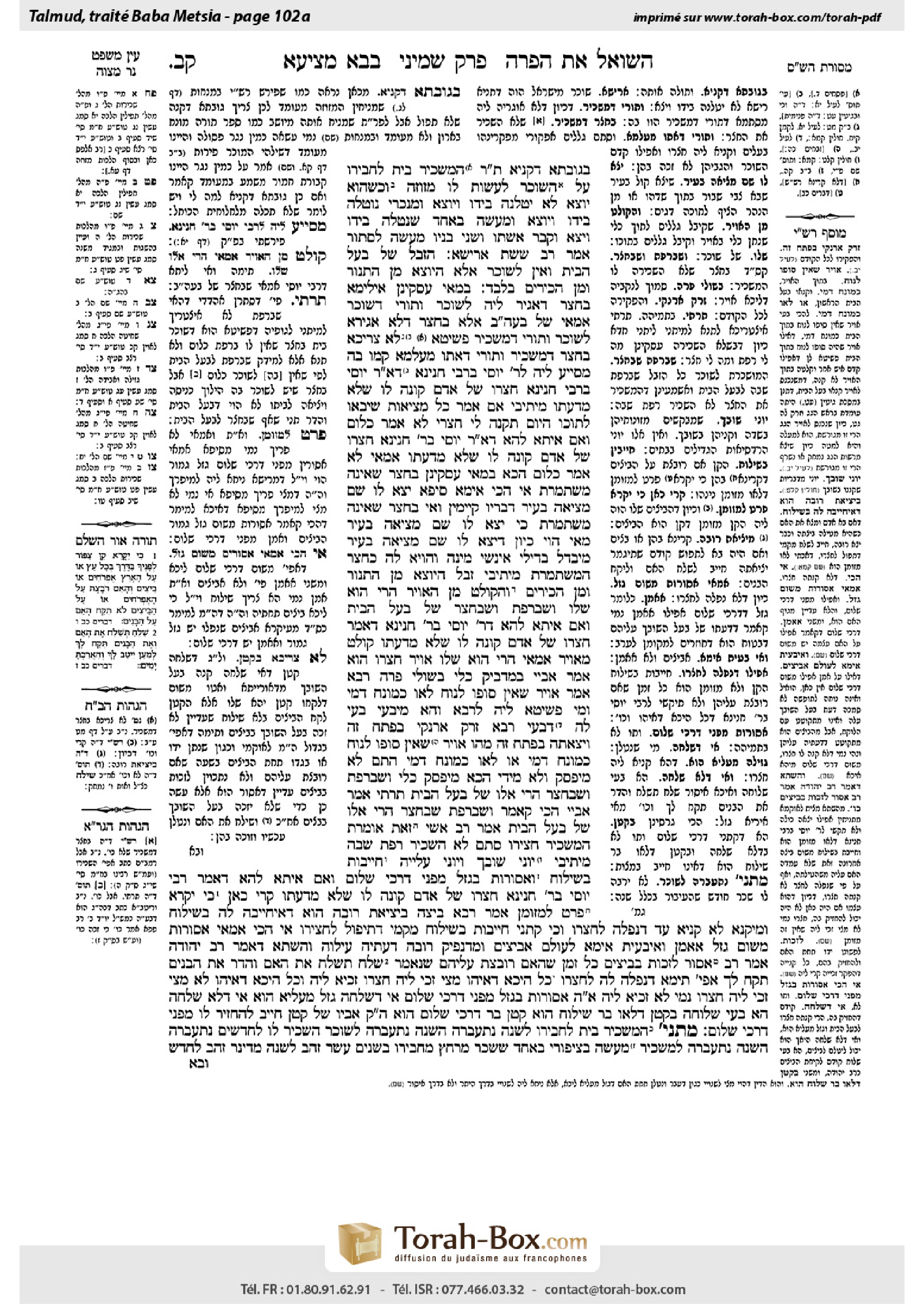
בְּגוּבְתָּא דְּקַנְיָא.
תָּנוּ רַבָּנַן: הַמַּשְׂכִּיר בַּיִת לַחֲבֵירוֹ – עַל הַשּׂוֹכֵר לַעֲשׂוֹת לוֹ מְזוּזָה, וּכְשֶׁהוּא יוֹצֵא – לֹא יִטְּלֶנָּה בְּיָדוֹ וְיֵצֵא. וּמִנׇּכְרִי, נוֹטְלָהּ בְּיָדוֹ וְיוֹצֵא. וּמַעֲשֶׂה בְּאֶחָד שֶׁנְּטָלָהּ בְּיָדוֹ וְיָצָא, וְקָבַר אִשְׁתּוֹ וּשְׁנֵי בָּנָיו.
מַעֲשֶׂה לִסְתּוֹר?! אָמַר רַב שֵׁשֶׁת: אַרֵישָׁא.
הַזֶּבֶל שֶׁל בַּעַל הַבַּיִת, וְאֵין לַשּׂוֹכֵר אֶלָּא הַיּוֹצֵא מִן הַתַּנּוּר וּמִן הַכִּירַיִם בִּלְבַד. בְּמַאי עָסְקִינַן? אִילֵימָא בְּחָצֵר דַּאֲגִירָ[א] לֵיהּ לְשׂוֹכֵר וְתוֹרֵי דְּשׂוֹכֵר – אַמַּאי שֶׁל בַּעַל הַבַּיִת? אֶלָּא בְּחָצֵר דְּלָא אֲגִירָא לְשׂוֹכֵר וְתוֹרֵי דְּמַשְׂכִּיר, פְּשִׁיטָא!
לָא צְרִיכָא: בְּחָצֵר דְּמַשְׂכִּיר, וְתוֹרֵי דְּאָתוּ מֵעָלְמָא קָמוּ בַּהּ.
מְסַיַּיע לֵיהּ לְרַבִּי יוֹסֵי בְּרַבִּי חֲנִינָא. דְּאָמַר רַבִּי יוֹסֵי בְּרַבִּי חֲנִינָא: חֲצֵרוֹ שֶׁל אָדָם קוֹנָה לוֹ שֶׁלֹּא מִדַּעְתּוֹ.
מֵיתִיבִי: אִם אָמַר ״כׇּל מְצִיאוֹת שֶׁיָּבֹאוּ לְתוֹכוֹ הַיּוֹם תִּקְנֶה לִי חֲצֵרִי״ – לֹא אָמַר כְּלוּם. וְאִם אִיתָא לְהָא דְּאָמַר רַבִּי יוֹסֵי בְּרַבִּי חֲנִינָא חֲצֵרוֹ שֶׁל אָדָם קוֹנָה לוֹ שֶׁלֹּא מִדַּעְתּוֹ, אַמַּאי לֹא אָמַר כְּלוּם?
הָכָא בְּמַאי עָסְקִינַן – בְּחָצֵר שֶׁאֵינָהּ מִשְׁתַּמֶּרֶת.
אִי הָכִי אֵימָא סֵיפָא: יָצָא לוֹ שֵׁם מְצִיאָה בָּעִיר – דְּבָרָיו קַיָּימִין. וְאִי בְּחָצֵר שֶׁאֵינָהּ מִשְׁתַּמֶּרֶת, כִּי יָצָא לוֹ שֵׁם מְצִיאָה בָּעִיר, מַאי הָוֵי?
כֵּיוָן דְּיָצָא לוֹ שֵׁם מְצִיאָה בָּעִיר – מִיבְדָּל בְּדִילִי אִינָשֵׁי מִינַּהּ, וְהָוְיָא לַהּ כְּחָצֵר הַמִּשְׁתַּמֶּרֶת.
מֵיתִיבִי: זֶבֶל הַיּוֹצֵא מִן הַתַּנּוּר וּמִן הַכִּירַיִם וְהַקּוֹלֵט מִן הָאֲוִיר – הֲרֵי הוּא שֶׁלּוֹ, וְשֶׁבָּרֶפֶת וְשֶׁבֶּחָצֵר – שֶׁל בַּעַל הַבַּיִת. וְאִם אִיתָא לְהָא דְּרַבִּי יוֹסֵי בְּרַבִּי חֲנִינָא, דְּאָמַר חֲצֵרוֹ שֶׁל אָדָם קוֹנָה לוֹ שֶׁלֹּא מִדַּעְתּוֹ, קוֹלֵט מֵאֲוִיר אַמַּאי הֲרֵי הוּא שֶׁלּוֹ? אֲוִיר חֲצֵרוֹ הוּא!
אָמַר אַבָּיֵי: בְּמַדְבִּיק כְּלִי בְּשׁוּלֵי פָרָה.
רָבָא אָמַר: אֲוִיר שֶׁאֵין סוֹפוֹ לָנוּחַ – לָאו כְּמוּנָּח דָּמֵי.
וּמִי פְּשִׁיטָא לֵיהּ לְרָבָא? וְהָא מִיבְעֵי בָּעֵי לַהּ, דְּבָעֵי רָבָא: זָרַק אַרְנָקִי בְּפֶתַח זֶה וְיָצָאתָה בְּפֶתַח זֶה, מַהוּ? אֲוִיר שֶׁאֵין סוֹפוֹ לָנוּחַ כְּמוּנָּח דָּמֵי, אוֹ לָאו כְּמוּנָּח דָּמֵי?
הָתָם לָא מַיפְסֵק וְלָא מִידֵּי, הָכָא מַיפְסֵק כְּלִי.
וְשֶׁבָּרֶפֶת וְשֶׁבֶּחָצֵר, הֲרֵי אֵלּוּ שֶׁל בַּעַל הַבַּיִת. תַּרְתֵּי?
אָמַר אַבָּיֵי, הָכִי קָאָמַר: וְשֶׁבָּרֶפֶת שֶׁבֶּחָצֵר – הֲרֵי אֵלּוּ שֶׁל בַּעַל הַבַּיִת. אָמַר רַב אָשֵׁי, זֹאת אוֹמֶרֶת: הַמַּשְׂכִּיר חֲצֵירוֹ סְתָם – לֹא הִשְׂכִּיר רֶפֶת שֶׁבָּהּ.
מֵיתִיבִי: יוֹנֵי שׁוֹבָךְ וְיוֹנֵי עֲלִיָּיה חַיָּיבוֹת בְּשִׁילּוּחַ, וַאֲסוּרוֹת בְּגָזֵל מִפְּנֵי דַּרְכֵי שָׁלוֹם.
וְאִם אִיתָא לְהָא דְּאָמַר רַבִּי יוֹסֵי בְּרַבִּי חֲנִינָא: חֲצֵרוֹ שֶׁל אָדָם קוֹנָה לוֹ שֶׁלֹּא מִדַּעְתּוֹ. קְרִי כָּאן ״כִּי יִקָּרֵא״ – פְּרָט לִמְזוּמָּן!
אָמַר רָבָא: בֵּיצָה בִּיצִיאַת רוּבָּהּ הוּא דְּאִיחַיַּיבָה לַהּ בְּשִׁילּוּחַ, וּמִיקְנָא לָא קַנְיָא עַד דְּנָפְלָה לַחֲצֵרוֹ, וְכִי קָתָנֵי ״חַיָּיבוֹת בְּשִׁילּוּחַ״ – מִקַּמֵּי דְּתִיפּוֹל לַחֲצֵירוֹ.
אִי הָכִי, אַמַּאי אֲסוּרוֹת מִשּׁוּם גָּזֵל! אַאִמָּן.
וְאִיבָּעֵית אֵימָא: לְעוֹלָם אַבֵּיצִים, וּמִדְּנָפֵיק רוּבַּהּ דַּעְתֵּיהּ עִילָּוַהּ.
וְהַשְׁתָּא דְּאָמַר רַב יְהוּדָה אָמַר רַב: אָסוּר לִזְכּוֹת בַּבֵּיצִים כׇּל זְמַן שֶׁהָאֵם רוֹבֶצֶת עֲלֵיהֶם, שֶׁנֶּאֱמַר: ״שַׁלֵּחַ תְּשַׁלַּח אֶת הָאֵם״ וַהֲדַר ״אֶת הַבָּנִים תִּקַּח לָךְ״. אֲפִילּוּ תֵּימָא דִּנְפַלָה לַהּ לַחֲצֵרוֹ, כֹּל הֵיכָא דְּאִיהוּ מָצֵי זָכֵי לֵיהּ – חֲצֵרוֹ זָכְיָא לֵיהּ, וְכֹל הֵיכָא דְּאִיהוּ לָא מָצֵי זָכֵי לֵיהּ – חֲצֵרוֹ נָמֵי לָא זָכְיָא לֵיהּ.
אִי הָכִי: אֲסוּרוֹת בְּגָזֵל מִפְּנֵי דַּרְכֵי שָׁלוֹם? אִי דְּשַׁלְּחַהּ – גָּזֵל מְעַלְּיָא הוּא, אִי דְּלָא שַׁלְּחַהּ – הָא בָּעֵי שַׁלּוֹחַהּ!
בְּקָטָן דְּלָאו בַּר שִׁילּוּחַ הוּא. קָטָן בַּר דַּרְכֵי שָׁלוֹם הוּא? הָכִי קָאָמַר: אָבִיו שֶׁל קָטָן חַיָּיב לְהַחְזִיר לוֹ מִפְּנֵי דַּרְכֵי שָׁלוֹם.
מַתְנִי׳ הַמַּשְׂכִּיר בַּיִת לַחֲבֵירוֹ לְשָׁנָה, נִתְעַבְּרָה הַשָּׁנָה – נִתְעַבְּרָה לַשּׂוֹכֵר. הִשְׂכִּיר לוֹ לָחֳדָשִׁים, נִתְעַבְּרָה הַשָּׁנָה – נִתְעַבְּרָה לַמַּשְׂכִּיר.
מַעֲשֶׂה בְּצִיפּוֹרִי בְּאֶחָד שֶׁשָּׂכַר מֶרְחָץ מֵחֲבֵירוֹ בִּשְׁנֵים עָשָׂר זָהָב לְשָׁנָה, מִדִּינַר זָהָב לְחֹדֶשׁ,
Bava Metzia 102a · English translation
to insert a mezuza inside a hollow reed and then affix the whole arrangement to the doorpost.
The Sages taught in a baraita: If one rents out a house to another, the responsibility to prepare a mezuza for it and affix it is upon the renter. And when he leaves, he may not take it in his hand and leave with it; rather, he must leave it there. But if he rented a house from a gentile, he may take it in his hand and leave with it. And there was an incident in which a renter took his mezuza in his hand and left with it, and as a punishment he eventually buried his wife and two sons.
The Gemara asks: Was the incident cited to contradict the ruling immediately preceding it, which permits one to take the mezuza? Rav Sheshet said: The incident relates to the first clause.
§ The mishna teaches: The manure found in the courtyard of a rented house, is the property of the landlord, and the renter has rights only to the ashes that come out of the oven and the stove, which can also be used as a fertilizer. The Gemara asks: With what are we dealing? If we say that the mishna is referring to a courtyard that is rented out to the renter, or where the manure was produced by the oxen of the renter, then why should it be the property of the landlord? It is clearly the property of the renter. Rather, the mishna must be referring to a courtyard that is not rented out to the renter, and the manure was produced by the oxen of the landlord. The Gemara asks: But if so, the ruling is obvious and need not have been taught.
The Gemara answers: No, the ruling is necessary in a case where the manure is in a courtyard of the landlord, and the source of the manure was oxen that came from the world at large and stood in the courtyard and produced the manure. The mishna rules that in such a case, the manure belongs to the landlord.
The Gemara suggests: That ruling in the mishna that any manure deposited in the landlord’s courtyard belongs to him supports the ruling of Rabbi Yosei, son of Rabbi Ḥanina, as Rabbi Yosei, son of Rabbi Ḥanina, says: A person’s courtyard effects acquisition for him of an item placed in it, even without his knowledge.
The Gemara raises an objection to this ruling from a baraita: If one says: Any lost items that come into my courtyard today, my courtyard should effect acquisition of them for me, he has not said anything of legal significance, and does not acquire those items. The Gemara explains the objection: And if it is so, that this ruling that Rabbi Yosei, son of Rabbi Ḥanina, says is correct, i.e., that a person’s courtyard effects acquisition for him of an item placed in it, even without his knowledge, then why has he not said anything of legal significance?
The Gemara resolves the difficulty: With what are we dealing here in the baraita? We are dealing with a courtyard that is not secured, as the halakha is that such a courtyard does not effect acquisition of items for its owner.
The Gemara questions this resolution: If so, say and try to explain accordingly the latter clause of the baraita that states: If knowledge of the existence of that lost item spread through the town, his statement stands and his courtyard acquires it. The Gemara explains the difficulty: And if the baraita is referring to a courtyard that is not secured, even where knowledge of the existence of that lost item spread through the town, what of it? Such a courtyard is unable to effect acquisition for its owner of items placed in it.
The Gemara answers: Once knowledge of the existence of that lost item spreads though the town, people withdraw themselves from it, as they assume that the owner of the courtyard will take it. Therefore, no one will even try to take it and the courtyard will be like a secured courtyard which can effect acquisition of items for its owner.
The Gemara raises an objection to Rabbi Yosei’s ruling from a baraita: Refuse of the oven and of the stove, i.e., ashes, and that which is collected in the renter’s vessel from the airspace of the courtyard, is the renter’s property. And refuse that is in the cowshed and in the courtyard, i.e., the manure, is the property of the landlord. The Gemara explains the question: And if it is so, that this ruling that Rabbi Yossi, son of Rabbi Ḥanina, says is correct, i.e., that a person’s courtyard effects acquisition for him of an item placed in it even without his knowledge, then with regard to refuse collected from the airspace of the courtyard, why is it the renter’s property? It was first in the airspace of the landlord’s courtyard, and should consequently be acquired by him immediately.
Abaye said: The baraita is referring to a case where the renter attached his vessel to a cow’s rear. Any manure produced by the cow would immediately enter the renter’s vessel, without first entering the airspace of the courtyard, and the renter would consequently acquire it.
Rava said: An item in the airspace of a courtyard that will not eventually come to rest in the courtyard itself is not regarded as though it had come to rest. Accordingly, even if the refuse traveled through the airspace of the courtyard, since it was always on course to enter the renter’s vessel, it is not acquired by means of the landlord’s courtyard.
The Gemara asks: And is this principle really so obvious to Rava? But didn’t he raise it as a dilemma? As Rava raised a dilemma: If one cast a purse through this doorway of a house and it went through the house and exited through that doorway, what is the halakha? Is an item in the airspace of a courtyard that will not eventually come to rest in the courtyard itself regarded as though it had come to rest, or is it not regarded as though it had come to rest?
The Gemara explains that Rava’s dilemma concerned a different case: There, in the case of the purse, nothing at all interposes between the purse and the floor of the house, and therefore Rava was unsure about the halakha. Here, where the renter’s vessel interposes, it was obvious to Rava that the renter’s vessel effects acquisition of the item.
The Gemara analyzes the latter clause of the above cited baraita: And refuse that is in the cowshed and in the courtyard is the property of the landlord. The Gemara asks: Can these two statements coincide? By stating that the refuse in the cowshed belongs to the landlord, it indicates that the refuse in the courtyard belongs to the renter. How, then, can the baraita continue to rule that even the refuse in the courtyard belongs to the landlord?
Abaye said that this is what the baraita is saying: And refuse that is in the cowshed that is located in the courtyard rented out to the renter is the property of the landlord. Extrapolating from Abaye’s statement, Rav Ashi said: That is to say that one who rents out his courtyard without specification of what is included in the rental agreement has not rented out a cowshed that is located in it.
The Gemara raises an objection to Rabbi Yosei’s ruling from another baraita: There is a mitzva to dispatch a mother bird if one wishes to take eggs from her nest (Deuteronomy 22:6–7). The mitzva applies only if the bird and eggs are ownerless. Doves of a dovecote and doves of an attic are subject to the obligation of dispatching the mother bird, as they are ownerless. Nevertheless, they are subject to the prohibition of robbery, due to a rabbinic ordinance to maintain the ways of peace.
The Gemara explains the question: And if it is so, that this ruling that Rabbi Yosei, son of Rabbi Ḥanina, says is correct, i.e., that a person’s courtyard effects acquisition for him of an item placed in it even without his knowledge, then a dovecote or attic will effect acquisition for its owner of any eggs inside them. Accordingly, one should apply here the principle that the mitzva to dispatch the mother bird from upon her nest applies only: “If it happened before you” (Deuteronomy 22:6) which excludes a bird or egg that is readily accessible, such as one that one owns, from the mitzva to dispatch the mother. Yet the baraita rules that the mitzva does apply in this case.
Rava said: It is from the time of the emergence of the majority of an egg from a mother bird’s body that one becomes subject to the obligation of dispatching her from upon her eggs. And the owner of a courtyard does not acquire the egg until it fully emerges and falls into his courtyard. And therefore, when the baraita teaches that in the case of doves of a dovecote and of an attic, one is subject to the obligation of dispatching the mother bird, it is referring to a time before the egg falls into his courtyard.
The Gemara asks: If that is so, that the baraita is referring to a case where the egg has not fully emerged, why does the baraita rule that they are forbidden by rabbinic law for others to take due to the prohibition of robbery? The Gemara answers: That ruling of the baraita is referring to their mother, i.e., the mother bird.
And if you wish, say instead: Actually, that ruling is referring to the eggs, and the reason the Sages enacted that taking them is robbery is because once the majority of an egg emerges, the dovecote or attic’s owner’s mind is upon the eggs to acquire them, although technically he will not acquire them until they fully emerge.
And now that Rav Yehuda says that Rav says: It is prohibited to acquire the eggs as long as the mother bird is upon them, as it is first stated: “Send away the mother” and only then: “And take the young for yourself” (Deuteronomy 22:7), even if you say that the eggs fully emerged and fell into his courtyard, he will not acquire them, because in any case in which a courtyard owner is able to acquire an item by himself, his courtyard can effect acquisition of it for him, but in any case in which he is unable to acquire an item by himself, his courtyard cannot effect acquisition of it for him either.
The Gemara asks: If that is so, that the baraita is referring to a case where the courtyard cannot effect acquisition of the eggs for him, why does the baraita rule: They are subject to the prohibition of robbery, due to a rabbinic ordinance to maintain the ways of peace? If one dispatched the mother bird, in which case the courtyard would automatically effect acquisition of the eggs, then taking them would be full-fledged robbery, and if one did not dispatch the mother bird, doesn’t he need to dispatch her before it is permitted to take the eggs? Either way, one will have transgressed Torah law. Why, then, does the baraita refer to a rabbinic prohibition of robbery, rather than one by Torah law?
The Gemara answers: The baraita is referring to a minor, who is not subject to the mitzva of dispatching the mother bird. The Gemara challenges this answer based on the latter clause of the baraita: Is a minor subject to the rabbinic prohibition of robbery enacted to maintain the ways of peace? The Gemara explains: This is what the latter clause of the baraita is saying: The father of a minor who took such eggs is obligated to return them to the owner of the dovecote or attic, due to the rabbinic prohibition of robbery instituted to maintain the ways of peace.
MISHNA: In the case of one who rents out a house to another for a year and then the year was intercalated, adding an additional month to that year, the fact that it was intercalated is to the benefit of the renter. Since the rental was defined in terms of a year, the additional month is automatically included, and the renter need not pay additional rent for it. If a landlord rented out a house to another for a year, with the price set as a certain sum for each of the months, and then the year was intercalated, the fact that it was intercalated is to the benefit of the landlord.
An incident occurred in Tzippori involving one who rented a bathhouse from another where they stated that the rent would be: Twelve gold dinars per year, a gold dinar per month, and then the year was intercalated.
Bava Metzia 102a · Traduction française (IA)
insérer une mezuza dans un roseau creux et ensuite fixer l'ensemble au chamfer.
Les Sages enseignent dans une baraïta : Si l'on loue une maison à un autre, la responsabilité de préparer une mezuza et de la fixer incombe au locataire. Et lorsqu'il part, il ne peut pas la prendre en main et partir avec elle ; il doit la laisser là. Mais si l'on loue une maison à un non-Juif, il peut la prendre en main et partir avec elle. Il y avait un cas où un locataire avait pris sa mezuza en main et était parti, et comme punition, il a fini par enterrer sa femme et ses deux fils.
Le Guemara pose la question : Ce cas cité vise-t-il à contredire la décision précédente qui permet de prendre la mezuza ? Rav Sheshet dit : Ce cas concerne la première clause.
§ La mitsna enseigne : Le crottin trouvé dans le jardin d'une maison louée appartient au propriétaire, et le locataire n'a droit qu'aux cendres provenant de la cheminée et de la cuisinière, qui peuvent aussi être utilisés comme engrais. Le Guemara pose la question : De quoi sommes-nous en train de parler ? Si nous disons que la mitsna fait référence à un jardin loué au locataire, ou si le crottin provient des bœufs du locataire, pourquoi devrait-il appartenir au propriétaire ? C'est clairement la propriété du locataire. Plutôt, la mitsna doit faire référence à un jardin non loué au locataire, et le crottin provient des bœufs du propriétaire. Le Guemara pose la question : Mais si c'est ainsi, la décision est évidente et n'aurait pas besoin d'être enseignée.
Le Guemara répond : Non, la décision est nécessaire dans un cas où le crottin est dans le jardin du propriétaire, et la source du crottin provient de bœufs venant du monde entier et se trouvant dans le jardin et produisant le crottin. La mitsna déclare que dans ce cas, le crottin appartient au propriétaire.
Le Guemara suggère : Cette décision dans la mitsna qui stipule que tout crottin déposé dans le jardin du propriétaire appartient à lui soutient la décision de Rabbi Yosei, fils de Rabbi Ḥanina, car Rabbi Yosei, fils de Rabbi Ḥanina, dit : Le jardin d'une personne acquiert pour elle un objet placé dedans, même sans sa connaissance.
Le Guemara soulève une objection contre cette décision, tirée d'une baraïta : Si l'on dit : Toute chose perdue qui entre dans mon jardin aujourd'hui, mon jardin doit acquérir pour moi cette chose, il n'a pas dit quelque chose de juridiquement significatif, et ne possède pas ces choses. Le Guemara explique l'objection : Et si c'est ainsi, que cette décision que Rabbi Yosei, fils de Rabbi Ḥanina, dit est correcte, c'est-à-dire que le jardin d'une personne acquiert pour elle un objet placé dedans, même sans sa connaissance, pourquoi n'a-t-il pas dit quelque chose de juridiquement significatif ?
Le Guemara résout cette difficulté : De quoi sommes-nous en train de parler dans cette baraïta ? Nous parlons d'un jardin non sécurisé, car la halakha est que ce genre de jardin ne permet pas l'acquisition des objets pour son propriétaire.
Le Guemara questionne cette résolution : Si c'est ainsi, expliquez et essayez de clarifier la clause ultérieure de la baraïta qui stipule : Si la connaissance de l'existence de cette chose perdue s'est répandue dans la ville, sa déclaration est valable et son jardin l'acquiert. Le Guemara explique la difficulté : Et si la baraïta fait référence à un jardin non sécurisé, même où la connaissance de l'existence de cette chose perdue s'est répandue dans la ville, qu'est-ce que cela change ? Ce genre de jardin ne peut pas permettre l'acquisition pour son propriétaire des objets placés dedans.
Le Guemara répond : Une fois que la connaissance de l'existence de cette chose perdue s'est répandue dans la ville, les gens se retirent d'elle, car ils supposent que le propriétaire du jardin la prendra. Ainsi, personne ne tentera même de la prendre et le jardin sera comme un jardin sécurisé qui peut permettre l'acquisition des objets pour son propriétaire.
Le Guemara soulève une objection contre la décision de Rabbi Yosei à partir d'une baraïta : Les cendres de la cheminée et de la cuisinière, c'est-à-dire les cendres, et ce qui est collecté dans le récipient du locataire de l'air du jardin, appartiennent au locataire. Et les cendres qui sont dans la stab et dans le jardin, c'est-à-dire la crottin, appartiennent au propriétaire. Le Guemara explique la question : Et si c'est ainsi, que cette décision que Rabbi Yossi, fils de Rabbi Ḥanina, dit est correcte, c'est-à-dire que le jardin d'une personne acquiert pour elle un objet placé dedans même sans sa connaissance, alors concernant les cendres collectées de l'air du jardin, pourquoi appartiennent-elles au locataire ? Elles étaient d'abord dans l'air du jardin du propriétaire, et devraient donc être acquises par lui immédiatement.
Abaye dit : La baraïta fait référence à un cas où le locataire a attaché son récipient à la queue d'une vache. Toute crottin produite par la vache entrerait immédiatement dans le récipient du locataire, sans entrer d'abord dans l'air du jardin, et le locataire l'acquerrait ainsi.
Rava dit : Un objet dans l'air d'un jardin qui ne finira pas par se poser dans le jardin lui-même n'est pas considéré comme s'il avait déjà été posé. Ainsi, même si les détritus ont traversé l'air du jardin, puisqu'ils étaient toujours en route pour entrer dans le récipient du locataire, ils ne sont pas acquis par le jardin du propriétaire.
Le Guemara pose la question : Et est-ce que ce principe est vraiment si évident pour Rava ? Mais n'a-t-il pas soulevé ce dilemme ? Comme Rava a soulevé un dilemme : Si l'on jette un sac par cette porte d'une maison et qu'il traverse la maison et sort par cette autre porte, quelle est la halakha ? Un objet dans l'air d'un jardin qui ne finira pas par se poser dans le jardin lui-même est-il considéré comme s'il avait déjà été posé, ou non ?
La Guemara explique que le dilemme de Rava concernait un cas différent : là, dans le cas du sac, rien ne se trouve entre le sac et le plancher de la maison, et donc Rava était incertain quant à la halakha. Ici, où le vaisseau du locataire s'interpose, il était évident pour Rava que le vaisseau du locataire effectuait l'acquisition de l'objet.
La Guemara analyse la seconde partie de la baraïta citée ci-dessus : Et les détritus qui sont dans l'étable et dans la cour sont la propriété du propriétaire. La Guemara demande : Ces deux affirmations peuvent-elles coïncider ? En indiquant que les détritus dans l'étable appartiennent au propriétaire, cela suggère que les détritus dans la cour appartiennent au locataire. Comment, alors, la baraïta peut-elle continuer à déclarer que même les détritus dans la cour appartiennent au propriétaire ?
Abaye dit que c'est ce que la baraïta dit : Et les détritus qui sont dans l'étable située dans la cour louée au locataire sont la propriété du propriétaire. En extrapolant de la déclaration d'Abaye, Rav Ashi dit : Cela signifie que celui qui loue sa cour sans préciser ce qui est inclus dans le contrat de location n'a pas loué une étable située dedans.
La Guemara soulève une objection contre la décision de Rabbi Yosei à partir d'une autre baraïta : Il y a une mitsva de faire partir le volatile si l'on veut prendre les œufs de son nid (Deutéronome 22:6-7). La mitsva s'applique uniquement si le volatile et les œufs sont sans propriétaire. Les moineaux d'une basse-cour et les moineaux d'un grenier sont soumis à l'obligation de faire partir le volatile, car ils sont sans propriétaire. Cependant, ils sont soumis à l'interdiction de vol, en raison d'un ordonnance rabbinique pour maintenir les voies de la paix.
La Guemara explique la question : Et si c'est ainsi, que cette décision que Rabbi Yosei, fils de Rabbi Ḥanina, dit est correcte, c'est-à-dire que la cour d'une personne effectue l'acquisition pour lui d'un objet placé dedans même sans son savoir, alors une basse-cour ou un grenier effectuerait l'acquisition pour son propriétaire de tout œuf à l'intérieur. Ainsi, on devrait appliquer ici le principe que la mitsva de faire partir le volatile de son nid s'applique uniquement : « Si cela t'est arrivé » (Deutéronome 22:6), ce qui exclut un volatile ou un œuf facilement accessible, comme celui que l'on possède, de la mitsva de faire partir le volatile. Cependant, la baraïta déclare que la mitsva s'applique dans ce cas.
Rava dit : C'est à partir du moment où la majorité d'un œuf sort du corps de la volatile que l'on devient sujet à l'obligation de faire partir celle-ci de ses œufs. Et le propriétaire d'une cour n'acquiert l'œuf qu'une fois qu'il est totalement sorti et tombe dans sa cour. Et donc, lorsque la baraïta enseigne que dans le cas des moineaux d'une basse-cour et d'un grenier, l'obligation de faire partir la volatile s'applique, elle fait référence à un moment avant que l'œuf ne tombe dans sa cour.
La Guemara demande : Si c'est ainsi, que la baraïta fait référence à un cas où l'œuf n'a pas totalement émergé, pourquoi la baraïta déclare-t-elle que ces œufs sont interdits à l'égard des autres par l'interdiction de vol en raison d'une ordonnance rabbinique ? La Guemara répond : Cette décision de la baraïta fait référence à leur mère, c'est-à-dire à la volatile mère.
Et si tu veux, dis plutôt : En réalité, cette décision fait référence aux œufs, et la raison pour laquelle les Sages ont institué que leur prise est un vol est que dès que la majorité d'un œuf émerge, l'esprit du propriétaire de la basse-cour ou du grenier est sur les œufs pour les acquérir, bien qu'au niveau technique il ne les acquière pas avant qu'ils ne soient totalement émergés.
Et maintenant que Rav Yehuda dit que Rav dit : Il est interdit d'acquérir les œufs tant que la volatile est sur eux, car il est d'abord dit : « Envoie loin la mère » et seulement ensuite : « Et prends les petits pour toi » (Lévitique 22:7), même si tu dis que l'œuf est totalement émergé et est tombé dans sa cour, il ne les acquiert pas, car en tout cas où un propriétaire de cour est capable d'acquérir un objet par lui-même, sa cour peut effectuer l'acquisition de celui-ci pour lui, mais en tout cas où il n'est pas capable d'acquérir un objet par lui-même, sa cour ne peut pas non plus effectuer l'acquisition de celui-ci pour lui.
La Guemara demande : Si c'est ainsi, que la baraïta fait référence à un cas où la cour ne peut pas effectuer l'acquisition des œufs pour lui, pourquoi la baraïta déclare-t-elle : Ils sont soumis à l'interdiction de vol, en raison d'une ordonnance rabbinique pour maintenir les voies de la paix ? Si l'on a expulsé la volatile, dans ce cas la cour aurait automatiquement effectué l'acquisition des œufs, alors prendre ceux-ci serait un vol complet, et si l'on n'a pas expulsé la volatile, n'a-t-on pas besoin d'expulser celle-ci avant qu'il ne soit permis de prendre les œufs ? Quel que soit le cas, l'on a transgressé la loi divine. Pourquoi, alors, la baraïta fait-elle référence à une interdiction rabbinique de vol plutôt qu'à une interdiction divine ?
La Guemara répond : La baraïta fait référence à un mineur, qui n'est pas sujet à la mitsva d'expulser la volatile. La Guemara conteste cette réponse en se basant sur la seconde partie de la baraïta : Un mineur est-il sujet à l'interdiction rabbinique de vol instituée pour maintenir les voies de la paix ? La Guemara explique : C'est ce que la seconde partie de la baraïta dit : Le père d'un mineur qui a pris de tels œufs est tenu de les rendre au propriétaire de la basse-cour ou du grenier, en raison de l'interdiction rabbinique de vol instituée pour maintenir les voies de la paix.
MICHNA : Dans le cas d'une personne qui loue une maison à un autre pour un an, et ensuite l'année a été intercalée, ajoutant un mois supplémentaire à cette année, le fait qu'elle ait été intercalée est en faveur du locataire. Puisque le loyer a été défini en termes d'une année, le mois supplémentaire est automatiquement inclus, et le locataire n'a pas besoin de payer un loyer supplémentaire pour celui-ci. Si un propriétaire loue une maison à un autre pour un an, avec le prix fixé à une somme déterminée pour chaque mois, et ensuite l'année a été intercalée, le fait qu'elle ait été intercalée est en faveur du propriétaire.
Un incident s'est produit à Tzippori concernant une personne qui louait une salle de bain à un autre, où ils ont indiqué que le loyer serait : Douze dinars d'or par an, un dinar d'or par mois, et ensuite l'année a été intercalée.
Traduction française générée par IA à partir de l’édition anglaise de Sefaria. Vérifie toujours un passage avec le texte source.
Text from Sefaria: William Davidson Edition - Vocalized Aramaic (CC BY NC); William Davidson Edition - English (CC BY NC).