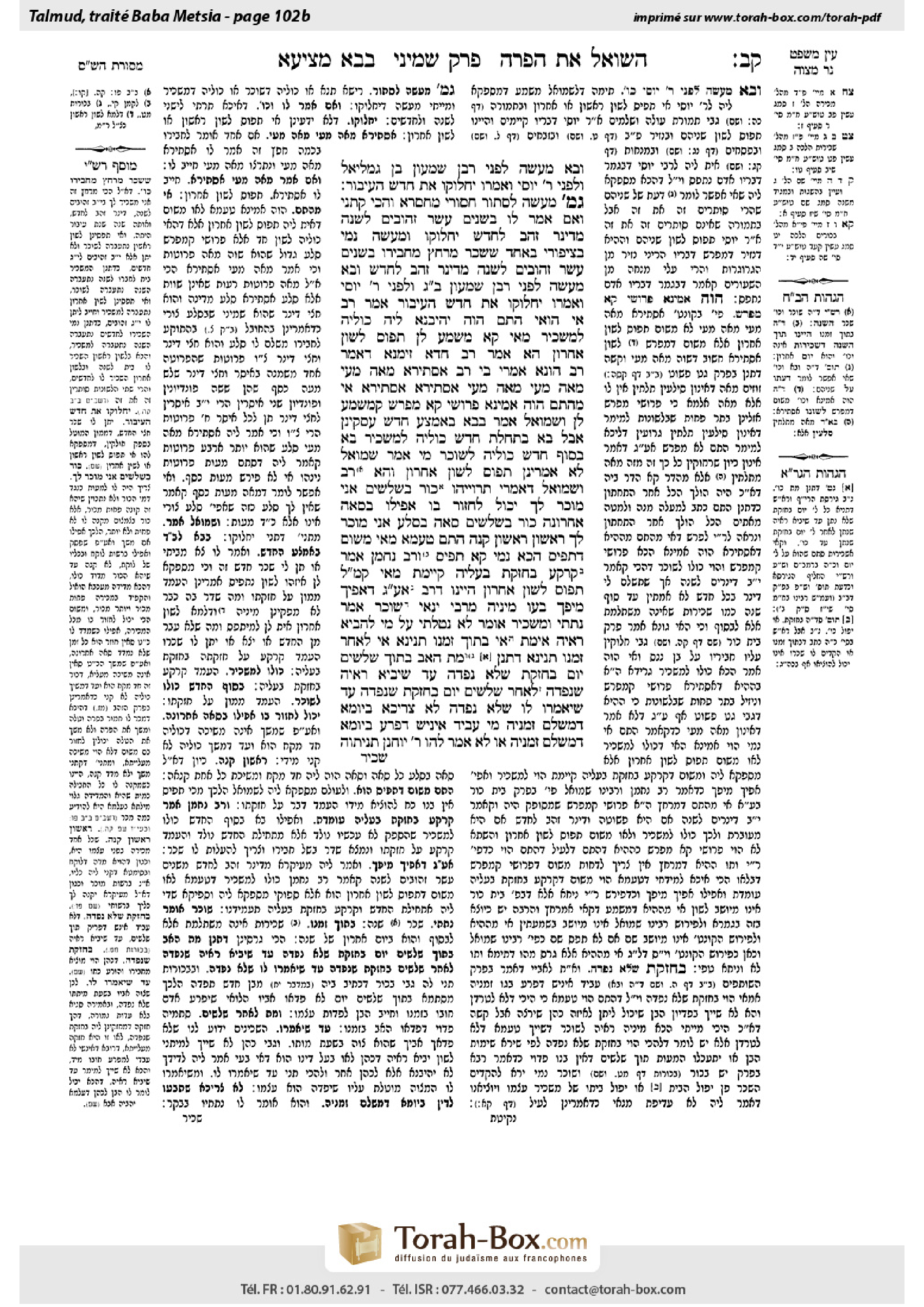
Bava Metzia 102b: Talmud study for Daf Yomi
Study the Talmud for Daf Yomi with scanned pages, Hebrew text, English translations from Sefaria and AI-generated French translations.
Passage selection and English or AI-generated French translation are available where the scan has annotations. Daf Study is independent of Torah-Box and Sefaria.
Browse Bava Metzia · בבא מציעא · All tractatesBava Metzia 102b text and translations
This page of Bava Metzia includes the Aramaic text, an English translation and an AI-generated French translation, alongside the scan above.
בבא מציעא ק״ב ב · Aramaic and Hebrew text
וּבָא מַעֲשֶׂה לִפְנֵי רַבָּן שִׁמְעוֹן בֶּן גַּמְלִיאֵל וְלִפְנֵי רַבִּי יוֹסֵי, וְאָמְרוּ: יַחְלוֹקוּ אֶת חֹדֶשׁ הָעִיבּוּר.
גְּמָ׳ מַעֲשֶׂה לִסְתּוֹר?! חַסּוֹרֵי מְחַסְּרָא וְהָכִי קָתָנֵי: וְאִם אָמַר לוֹ בִּשְׁנֵים עָשָׂר זְהוּבִים לְשָׁנָה מִדִּינַר זָהָב לְחֹדֶשׁ – יַחְלוֹקוּ. וּמַעֲשֶׂה נָמֵי בְּצִיפּוֹרִי בְּאֶחָד שֶׁשָּׂכַר מֶרְחָץ מֵחֲבֵירוֹ בִּשְׁנֵים עָשָׂר זְהוּבִים לְשָׁנָה מִדִּינַר זָהָב לְחֹדֶשׁ, וּבָא מַעֲשֶׂה לִפְנֵי רַבָּן שִׁמְעוֹן בֶּן גַּמְלִיאֵל וְלִפְנֵי רַבִּי יוֹסֵי, וְאָמְרוּ: יַחְלוֹקוּ אֶת חֹדֶשׁ הָעִיבּוּר.
אָמַר רַב: אִי הֲוַאי הָתָם, הֲוָה יָהֵיבְנָא לֵיהּ כּוּלֵּיהּ לְמַשְׂכִּיר.
מַאי קָא מַשְׁמַע לַן? ״תְּפוֹס לָשׁוֹן אַחֲרוֹן״!
הָא אָמַר רַב חֲדָא זִימְנָא. דְּאָמַר רַב הוּנָא, אָמְרִי בֵּי רַב: ״אִסְתֵּירָא מְאָה מָעֵי״ – מְאָה מָעֵי. ״מְאָה מָעֵי אִסְתֵּירָא״ – אִסְתֵּירָא.
אִי מֵהָתָם, הֲוָה אָמֵינָא: פָּרוֹשֵׁי קָא מְפָרֵשׁ, קָמַשְׁמַע לַן.
וּשְׁמוּאֵל אָמַר: בְּבָא בְּאֶמְצַע חֹדֶשׁ עָסְקִינַן. אֲבָל בָּא בִּתְחִלַּת חֹדֶשׁ – כּוּלֵּיהּ לְמַשְׂכִּיר, בָּא בְּסוֹף חֹדֶשׁ – כּוּלֵּיהּ לְשׂוֹכֵר.
מִי אָמַר שְׁמוּאֵל לָא אָמְרִינַן ״תְּפוֹס לָשׁוֹן אַחֲרוֹן״? וְהָא רַב וּשְׁמוּאֵל דְּאָמְרִי תַּרְוַיְיהוּ: כּוֹר בִּשְׁלֹשִׁים אֲנִי מוֹכֵר לָךְ – יָכוֹל לַחֲזוֹר בּוֹ אֲפִילּוּ בִּסְאָה אַחֲרוֹנָה! כּוֹר בִּשְׁלֹשִׁים, סְאָה בְּסֶלַע אֲנִי מוֹכֵר לָךְ – רִאשׁוֹן רִאשׁוֹן קָנָה.
הָתָם טַעְמָא מַאי – מִשּׁוּם דְּתָפֵיס, הָכָא נָמֵי קָא תָפֵיס.
וְרַב נַחְמָן אָמַר: קַרְקַע בְּחֶזְקַת בְּעָלֶיהָ קַיֶּימֶת. מַאי קָא מַשְׁמַע לַן – ״תְּפוֹס לָשׁוֹן אַחֲרוֹן״, הַיְינוּ דְּרַב? אַף עַל גַּב דְּאָפֵיךְ מֵיפָךְ.
בְּעוֹ מִינֵּיהּ מֵרַבִּי יַנַּאי: שׂוֹכֵר אָמַר נָתַתִּי, וּמַשְׂכִּיר אָמַר לֹא נָטַלְתִּי – עַל מִי לְהָבִיא רְאָיָה?
אֵימַת? אִי בְּתוֹךְ זְמַנּוֹ – תְּנֵינָא, אִי לְאַחַר זְמַנּוֹ – תְּנֵינָא. דִּתְנַן: מֵת הָאָב בְּתוֹךְ שְׁלֹשִׁים יוֹם – בְּחֶזְקַת שֶׁלֹּא נִפְדָּה עַד שֶׁיָּבִיא רְאָיָה שֶׁנִּפְדָּה. לְאַחַר שְׁלֹשִׁים יוֹם – בְּחֶזְקַת שֶׁנִּפְדָּה, עַד שֶׁיֹּאמְרוּ לוֹ שֶׁלֹּא נִפְדָּה.
לָא צְרִיכָא: בְּיוֹמָא דְּמִשְׁלַם זִמְנֵיהּ. מִי עֲבִיד אִינִישׁ דְּפָרַע בְּיוֹמָא דְּמִשְׁלַם זִמְנֵיהּ, אוֹ לָא?
אֲמַר לְהוּ רַבִּי יוֹחָנָן, תְּנֵיתוּהָ:
Bava Metzia 102b · English translation
And this incident came to court before Rabban Shimon ben Gamliel and before Rabbi Yosei, and they said: The two expressions have contradictory implications, and it is uncertain which expression should be followed. Therefore, the landlord and the renter should divide the intercalary month between them, i.e., the renter should pay half a gold dinar for it.
GEMARA: The Gemara asks: Was an incident cited to contradict the mishna’s initial ruling? The Gemara explains: The latter clause is incomplete and this is what it is teaching: But if the landlord said to the renter that the rent would be: Twelve gold dinars per year, a gold dinar per month, and then the year was intercalated, the intercalary month should be divided between them. And in addition, an incident like this occurred in Tzippori involving one who rented a bathhouse from another, and they stated that the rent would be: Twelve gold dinars per year, a gold dinar per month, and then the year was intercalated. And this incident came to court before Rabban Shimon ben Gamliel and before Rabbi Yosei, and they said: The landlord and the renter should divide the intercalary month between them.
Rav said: If I had been there, as a judge, I would have given the entire month to the landlord and ruled that the renter must pay for it. Rav understood that the statement defining the rent should be understood based on the final expression used, i.e., a gold dinar per month.
The Gemara asks: What is Rav teaching us? Could he be teaching that when a statement consists of two expressions with contradictory implications one should attend only to the last statement?
But didn’t Rav already say that one time before, as Rav Huna said with regard to a case in which a seller fixed the price for an item using two different expressions that indicate different amounts and the buyer agreed and took the item: They say in the study hall of Rav that if the seller said: An asteira, one hundred coins, i.e., copper perutot, then the buyer must pay him one hundred coins, despite the fact that an asteira is a coin worth ninety-six perutot. And if the seller said: One hundred coins, an asteira, the buyer must pay him an asteira. It is already apparent from this ruling that Rav holds that one should rule according to the final expression. Why did he restate his opinion with regard to the case of the intercalary month?
The Gemara explains: If Rav’s opinion were known from there, I would say that the second expression is explaining the first, and that is the reason to follow it. But one would still not know the halakha in a case in which the second expression undeniably contradicts the first. Therefore, Rav teaches us that in all cases one acts in accordance with the final expression.
And Shmuel said in explanation of the ruling of Rabban Shimon ben Gamliel and Rabbi Yosei: In the mishna, we are dealing with a case where the landlord came before the court in the middle of the month. Only in that case is the disputed month divided between them. But if he came at the beginning of the month, the entire month’s rent would be awarded to the landlord, and if he came at the end of the month, the entire month’s rent would be awarded to the renter. The reason is that it is uncertain whether or not one always acts in accordance with the final expression, and, consequently, whether the renter must pay for the extra month. With regard to upcoming days of rental, since the landlord has possession of the property, he can demand rent. And with regard to days that have already passed, where the question is whether the renter must pay for them, since he is in possession of his money, he cannot be made to pay. Shmuel does not hold that only the second statement is followed.
The Gemara asks: Did Shmuel actually say that we do not say that one should attend only to the last statement? But don’t Rav and Shmuel both say: If a seller says to a buyer: I am selling you a kor of grain for thirty sela, then he can renege on the sale even while transferring to him the last se’a of grain. As a kor is equal to thirty se’a, it is apparent that each se’a is being sold for one sela, but since that breakdown was not made explicit, the sale of the entire kor is considered as a single entity. Until the entire kor has been transferred, the sale does not take effect. If the seller used two expressions: I am selling you a kor of grain for thirty sela, a se’a per sela, then the buyer acquires each of the thirty se’a of grain one by one, immediately upon each being transferred to him, and the seller cannot renege on the sale of any se’a that has taken place. Although the implications of the seller’s two expressions are contradictory, Shmuel rules that one should act in accordance with the final expression.
The Gemara explains: There, in the case of the grain, Shmuel’s ruling was not due to the fact that we attend to the final expression, since it is uncertain whether or not we do. Rather, what is the reason for his ruling? It is due to the fact that the buyer has already taken hold of the grain and consequently has presumptive ownership of it. Here too, in the case of the bathhouse, each party is holding onto the basis of his claim, i.e., the landlord has possession of his property and the renter has possession of his money, and it is only due to this reason that Shmuel rules as he does.
And Rav Naḥman said: I would have ruled that since the halakha is that land is always in its owner’s possession, even when rented out, the landlord is entitled to the entire month’s rent. The Gemara asks: What is Rav Naḥman teaching us? Could his ruling be based on saying that one should attend only to the last statement? But then this is identical to the ruling of Rav. The Gemara clarifies: Rav Naḥman’s ruling is unlike Rav’s, as Rav Naḥman would award the extra month to the landlord even where the order of the two expressions is reversed. Rather, as he explained, his ruling is based on the fact the landlord has possession of the property.
§ The Sages raised a dilemma before Rabbi Yannai: If a renter says to his landlord: I already gave the rental fee to you, and the landlord says: I did not take any payment from you, upon whom is the burden of proof?
The Gemara clarifies the dilemma: When did the renter make his claim? If it was during his rental period, we already learned the halakha in this case and the Sages would not have asked about it. Similarly, if it was after his rental period, we already learned the halakha in that case as well. As we learned in a mishna (Bekhorot 49a): A father is obligated to redeem his firstborn son after the son is thirty days old by paying five shekels to a priest. If the father died within thirty days of the birth, the son has the presumptive status of being unredeemed, until he brings a proof that he was redeemed. If he died after thirty days, the son has the presumptive status of having been redeemed, until people tell him that he was not redeemed. It is apparent from this mishna that a person is presumed not to pay money before he must, and he is presumed to have paid money once he is required to do so. This logic can be applied to the paying of a rental fee.
The Gemara explains: No, it is necessary to raise the dilemma in a case where the renter makes his claim on the day on which his rental period is completed. The dilemma is whether a person is apt to pay his debts on the very day on which the period in which to pay them is completed, or he is not.
Rabbi Yoḥanan said to them: Also this, you have already learned in a mishna (111a):
Bava Metzia 102b · Traduction française (IA)
Et cet incident est venu devant Rabban Shimon ben Gamliel et devant Rabbi Yosei, et ils dirent : Les deux expressions ont des implications contradictoires, et il est incertain quelle expression doit être suivie. Ainsi, le propriétaire et le locataire devraient diviser le mois intercalaire entre eux, c'est-à-dire que le locataire devrait payer la moitié d'un dinar d'or pour cela.
GUEMARA : La Guemara demande : Y a-t-il eu un incident cité pour contredire la décision de la Michna ? La Guemara explique : La dernière clause est incomplète et c'est cela qu'elle enseigne : Mais si le propriétaire a dit au locataire que le loyer serait : Douze dinars d'or par an, un dinar d'or par mois, et ensuite l'année a été intercalée, le mois intercalaire devrait être divisé entre eux. Et en outre, un incident similaire s'est produit à Tzippori concernant une personne qui a loué une salle de bain à un autre, et ils ont dit que le loyer serait : Douze dinars d'or par an, un dinar d'or par mois, et ensuite l'année a été intercalée. Et cet incident est venu devant la cour devant Rabban Shimon ben Gamliel et devant Rabbi Yosei, et ils dirent : Le propriétaire et le locataire devraient diviser le mois intercalaire entre eux.
Rav dit : Si j'avais été là, en tant que juge, j'aurais donné tout le mois au propriétaire et décidé que le locataire devait le payer. Rav comprenait que l'expression définissant le loyer devait être interprétée selon l'expression finale utilisée, c'est-à-dire un dinar d'or par mois.
La Guemara demande : Qu'est-ce que Rav nous enseigne ? Pourrait-il enseigner que lorsqu'une déclaration comporte deux expressions avec des implications contradictoires, on doit se baser uniquement sur l'expression finale ?
Mais n'avait-il pas déjà dit cela auparavant, comme Rav Huna l'a dit concernant un cas où un vendeur fixait le prix d'un objet à l'aide de deux expressions indiquant des montants différents et l'acheteur acceptait et prenait l'objet : Ils disent dans la salle de étude de Rav que si le vendeur disait : Un asteira, cent pièces, c'est-à-dire des perutot en cuivre, l'acheteur doit lui payer cent pièces, malgré le fait qu'un asteira est une pièce valant quatre-vingt-seize perutot. Et si le vendeur disait : Cent pièces, un asteira, l'acheteur doit lui payer un asteira. Il est déjà évident de cette décision que Rav considère que l'on doit agir selon l'expression finale. Pourquoi a-t-il répété son opinion concernant le cas du mois intercalaire ?
La Guemara explique : Si l'opinion de Rav était connue là, je dirais que l'expression secondaire explique la première, et c'est la raison de la suivre. Mais on ne saurait pas encore la halakha dans un cas où l'expression secondaire contredit clairement la première. Ainsi, Rav nous enseigne que dans tous les cas, on agit selon l'expression finale.
Et Shmuel a dit, en expliquant la décision de Rabban Shimon ben Gamliel et de Rabbi Yosei : Dans la Michna, nous sommes en présence d'un cas où le propriétaire est venu devant la cour au milieu du mois. Seulement dans ce cas le mois disputé est divisé entre eux. Mais si le propriétaire est venu au début du mois, l'intégralité du loyer du mois est attribué au propriétaire, et si le propriétaire est venu à la fin du mois, l'intégralité du loyer du mois est attribué au locataire. La raison est que c'est incertain si l'on agit toujours selon l'expression finale, et par conséquent, si le locataire doit payer pour le mois supplémentaire. Concernant les jours à venir de location, puisque le propriétaire possède la propriété, il peut exiger le loyer. Et concernant les jours déjà passés, où la question est de savoir si le locataire doit payer pour eux, puisque c'est lui qui possède son argent, il ne peut être contraint de payer. Shmuel ne considère pas que seul l'expression finale soit suivie.
La Guemara demande : A-t-il vraiment dit Shmuel que nous ne disons pas que l'on doit se baser uniquement sur l'expression finale ? Mais n'ont pas Rav et Shmuel tous les deux dit : Si un vendeur dit à un acheteur : Je vends à toi un kor de blé pour trente sela, il peut annuler la vente même pendant la remise du dernier se'a de blé. Comme un kor est égal à trente se'a, il est évident que chaque se'a est vendu pour un sela, mais puisque cette décomposition n'a pas été explicite, la vente du kor entier est considérée comme un seul entité. Jusqu'à ce que l'intégralité du kor ait été transférée, la vente ne prend effet. Si le vendeur a utilisé deux expressions : Je vends à toi un kor de blé pour trente sela, un se'a par sela, l'acheteur acquiert chaque des trente se'a de blé un par un, immédiatement après chaque transfert, et le vendeur ne peut pas annuler la vente de tout se'a déjà transféré. Bien que les implications des deux expressions du vendeur soient contradictoires, Shmuel décide que l'on doit agir selon l'expression finale.
La Guemara explique : Là, dans le cas du blé, la décision de Shmuel n'était pas due au fait que nous suivons l'expression finale, puisque c'est incertain. Quelle est la raison de sa décision ? C'est en raison du fait que l'acheteur a déjà pris possession du blé et donc possède de manière présumée. Ici aussi, dans le cas de la salle de bain, chaque partie tient à la base de son argument, c'est-à-dire que le propriétaire possède sa propriété et le locataire possède son argent, et c'est pour cette raison que Shmuel décide ainsi.
Et Rav Naḥman a dit : Je jugerais que puisque la halakha est que la terre est toujours en possession de son propriétaire, même lorsqu'elle est louée, le propriétaire est dû le loyer entier du mois. La Guemara demande : Qu'est-ce que Rav Naḥman nous enseigne ? Pourrait-ce être basé sur le fait de dire que l'on doit se baser uniquement sur l'expression finale ? Mais alors cela est identique à la décision de Rav. La Guemara clarifie : La décision de Rav Naḥman est différente de celle de Rav, car Rav Naḥman attribuerait le mois supplémentaire au propriétaire même si l'ordre des deux expressions est inversé. Plutôt, comme il l'a expliqué, sa décision est basée sur le fait que le propriétaire possède la propriété.
§ Les Sages ont posé un dilemme devant Rabbi Yannai : Si un locataire dit à son propriétaire : J'ai déjà versé le loyer, et le propriétaire dit : Je n'ai pas reçu de paiement de ta part, sur qui incombe la charge de la preuve ?
La Guemara clarifie ce dilemme : À quel moment le locataire a-t-il formulé sa revendication ? Si c'était pendant sa période de location, nous avons déjà appris la halakha dans ce cas et les Sages ne l'auraient pas posé. De même, si c'était après la fin de sa période de location, nous avons déjà appris la halakha dans ce cas également. Comme nous l'avons appris dans une mitsva (Bekhorot 49a) : Un père est tenu de racheter son premier-né après que ce dernier ait atteint l'âge de trente jours, en payant cinq sicles à un prêtre. Si le père meurt dans les trente jours suivant la naissance, le fils a le statut présomptif de ne pas avoir été racheté, jusqu'à ce qu'il apporte une preuve qu'il a été racheté. Si le père meurt après trente jours, le fils a le statut présomptif d'avoir été racheté, jusqu'à ce que les gens lui disent qu'il n'a pas été racheté. Il est évident à partir de cette mitsva que la personne est présomptivement considérée comme ne pas avoir payé d'argent avant qu'elle ne le doive, et qu'elle est présomptivement considérée comme avoir payé l'argent une fois qu'elle est tenu de le faire. Cette logique peut être appliquée au paiement du loyer.
La Guemara explique : Non, il est nécessaire de poser ce dilemme dans un cas où le locataire formule sa revendication le jour où sa période de location s'achève. Le dilemme est de savoir si une personne est enclined à payer ses dettes le jour même où la période dans laquelle il doit les payer s'achève, ou non.
Rabbi Yoḥanan a dit à eux : Aussi cela, vous l'avez déjà appris dans une mitsna (111a) :
Traduction française générée par IA à partir de l’édition anglaise de Sefaria. Vérifie toujours un passage avec le texte source.
Text from Sefaria: William Davidson Edition - Vocalized Aramaic (CC BY NC); William Davidson Edition - English (CC BY NC).