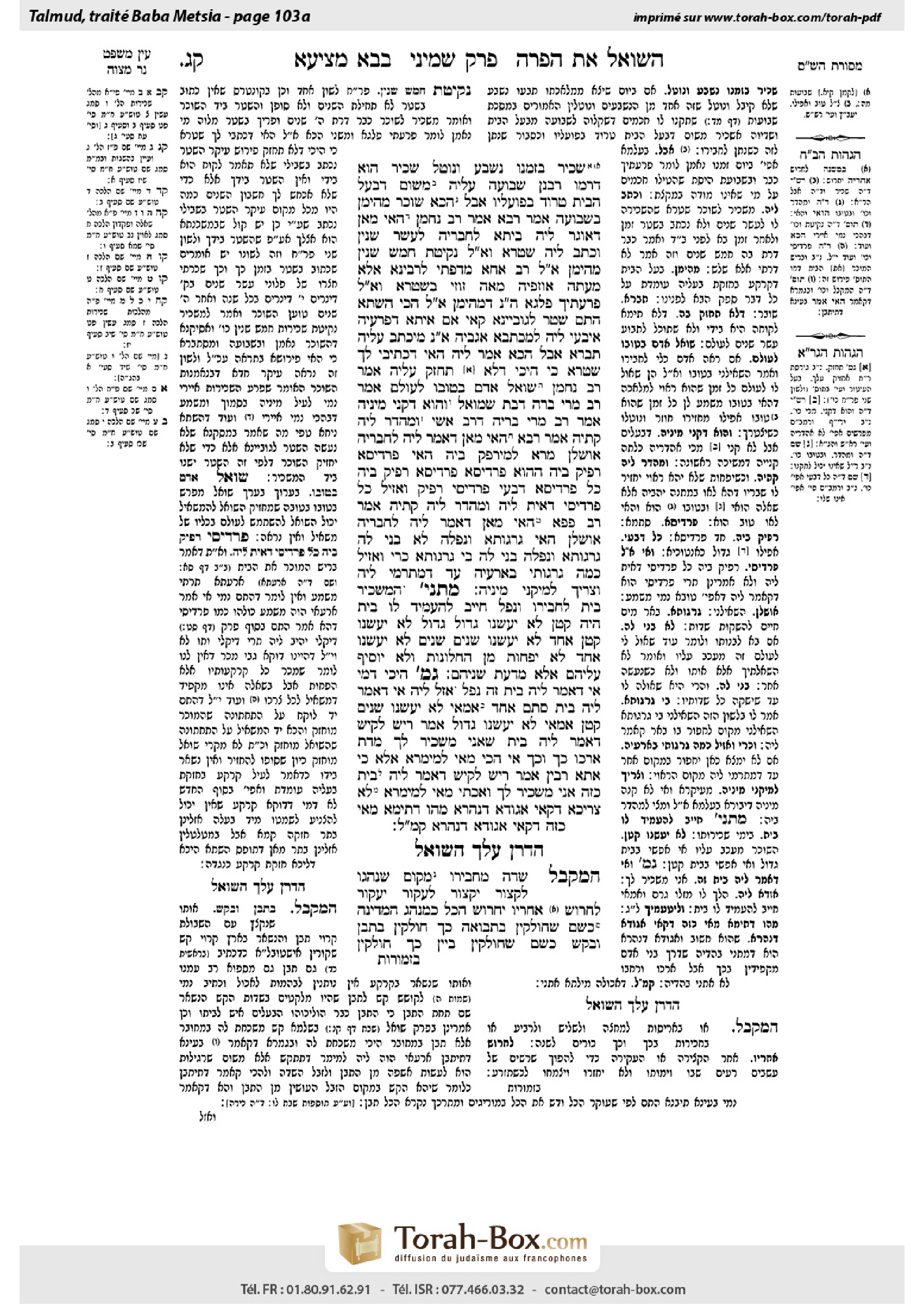
Bava Metzia 103a: Talmud study for Daf Yomi
Study the Talmud for Daf Yomi with scanned pages, Hebrew text, English translations from Sefaria and AI-generated French translations.
Passage selection and English or AI-generated French translation are available where the scan has annotations. Daf Study is independent of Torah-Box and Sefaria.
Browse Bava Metzia · בבא מציעא · All tractatesBava Metzia 103a text and translations
This page of Bava Metzia includes the Aramaic text, an English translation and an AI-generated French translation, alongside the scan above.
בבא מציעא ק״ג א · Aramaic and Hebrew text
שָׂכִיר בִּזְמַנּוֹ, נִשְׁבָּע וְנוֹטֵל.
שָׂכִיר הוּא דִּרְמוֹ רַבָּנַן שְׁבוּעָה עֲלֵיהּ, מִשּׁוּם דְּבַעַל הַבַּיִת טָרוּד בְּפוֹעֲלָיו. אֲבָל הָכָא, שׂוֹכֵר מְהֵימַן בִּשְׁבוּעָה.
אָמַר רָבָא אָמַר רַב נַחְמָן: הַאי מַאן דְּאוֹגַר לֵיהּ בֵּיתָא לְחַבְרֵיהּ לַעֲשַׂר שְׁנִין, וּכְתַב לֵיהּ שְׁטָרָא, וַאֲמַר לֵיהּ: נְקִיטַתְּ חֲמֵשׁ שְׁנִין – מְהֵימַן. אֲמַר לֵיהּ רַב אַחָא מִדִּפְתִּי לְרָבִינָא: אֶלָּא מֵעַתָּה, אוֹזְפֵיהּ מְאָה זוּזֵי בִּשְׁטָרָא, וַאֲמַר לֵיהּ: פְּרַעְתִּיךָ פַּלְגָא – הָכִי נָמֵי דִּמְהֵימַן?
אֲמַר לֵיהּ: הָכִי הַשְׁתָּא?! הָתָם – שְׁטַר לְגוּבְיָינָא קָאֵי, אִם אִיתָא דְּפַרְעֵיהּ – אִיבְּעִי לֵיהּ לְמִכְתַּבא אַגַּבֵּיהּ, אִי נָמֵי מִיכְתַּב עֲלֵיהּ תְּבָרָא. אֲבָל הָכָא, אָמַר לֵיהּ: הַאי דִּכְתַיבִי לָךְ שְׁטָרָא – כִּי הֵיכִי דְּלָא תַּחְזֵק עֲלֵיהּ.
אָמַר רַב נַחְמָן: שׁוֹאֵל אָדָם בְּטוּבוֹ לְעוֹלָם.
אָמַר רַב מָרִי בְּרַהּ דְּבַת שְׁמוּאֵל, וְהוּא (דִּקְנֵי) [דִּקְנוֹ] מִינֵּיהּ.
אָמַר רַב מָרִי בְּרֵיהּ דְּרַב אָשֵׁי: וּמַהְדַּר לֵיהּ קַתֵּיהּ.
אָמַר רָבָא: הַאי מַאן דַּאֲמַר לֵיהּ לְחַבְרֵיהּ: ״אוֹשְׁלַן מָרָא לְמִירְפַּק בֵּיהּ הַאי פַּרְדֵּיסָא״ – רָפֵיק בֵּיהּ הָהוּא פַּרְדֵּיסָא. ״פַּרְדֵּיסָא״ – רָפֵיק בֵּיהּ כֹּל פַּרְדֵּיסָא דְּבָעֵי. ״פַּרְדֵּיסֵי״ – רָפֵיק וְאָזֵיל כֹּל פַּרְדֵּיסֵי דְּאִית לֵיהּ, וּמַהְדַּר לֵיהּ קַתֵּיהּ.
אָמַר רַב פָּפָּא, הַאי מַאן דְּאָמַר לֵיהּ לְחַבְרֵיהּ: ״אוֹשְׁלַן הַאי גַּרְגּוּתָא״ וְנָפְלָה – לָא בָּנֵי לַהּ. ״גַּרְגּוּתָא״ וְנָפְלָה – בָּנֵי לַהּ. ״בֵּי גַרְגּוּתָא״ – כָּרֵי וְאָזֵיל כַּמָּה גַּרְגּוּתֵי בְּאַרְעֵיהּ עַד דְּמִתְרְמֵי לֵיהּ, וְצָרִיךְ לְמִיקְנֵי מִינֵּיהּ.
מַתְנִי׳ הַמַּשְׂכִּיר בַּיִת לַחֲבֵירוֹ וְנָפַל – חַיָּיב לְהַעֲמִיד לוֹ בַּיִת. הָיָה קָטָן – לֹא יַעֲשֶׂנּוּ גָּדוֹל, גָּדוֹל – לֹא יַעֲשֶׂנּוּ קָטָן. אֶחָד – לֹא יַעֲשֶׂנּוּ שְׁנַיִם, שְׁנַיִם – לֹא יַעֲשֶׂנּוּ אֶחָד. לֹא יִפְחוֹת מִן הַחַלּוֹנוֹת וְלֹא יוֹסִיף עֲלֵיהֶם, אֶלָּא מִדַּעַת שְׁנֵיהֶם.
גְּמָ׳ הֵיכִי דָּמֵי? אִי דַּאֲמַר לֵיהּ: ״בַּיִת זֶה״, נְפַל אֲזַל לֵיהּ. אִי דַּאֲמַר לֵיהּ: ״בַּיִת סְתָם״, אֶחָד אַמַּאי לֹא יַעֲשֶׂנּוּ שְׁנַיִם, קָטָן אַמַּאי לֹא יַעֲשֶׂנּוּ גָּדוֹל!
אָמַר רֵישׁ לָקִישׁ: דַּאֲמַר לֵיהּ ״בַּיִת שֶׁאֲנִי מַשְׂכִּיר לְךָ מִדַּת אׇרְכּוֹ כָּךְ וְכָךְ״.
אִי הָכִי מַאי לְמֵימְרָא?
אֶלָּא כִּי אֲתָא רָבִין אָמַר רֵישׁ לָקִישׁ, דְּאָמַר לֵיהּ: ״בֵּית כָּזֶה אֲנִי מַשְׂכִּיר לָךְ״. וְאַכַּתִּי מַאי לְמֵימְרָא? לָא צְרִיכָא: דְּקָאֵי אַגּוּדָּא דְנַהְרָא. מַהוּ דְּתֵימָא: מַאי ״כָּזֶה״ – דְּקָאֵי אַגּוּדָּא דְנַהְרָא, קָא מַשְׁמַע לַן.
הֲדַרַן עֲלָךְ הַשּׁוֹאֵל
מַתְנִי׳ הַמְקַבֵּל שָׂדֶה מֵחֲבֵירוֹ, מָקוֹם שֶׁנָּהֲגוּ לִקְצוֹר – יִקְצוֹר, לַעֲקוֹר – יַעֲקוֹר, לַחְרוֹשׁ אַחֲרָיו – יַחְרוֹשׁ, הַכֹּל כְּמִנְהַג הַמְּדִינָה. כְּשֵׁם שֶׁחוֹלְקִין בַּתְּבוּאָה, כָּךְ חוֹלְקִין בַּתֶּבֶן וּבַקַּשׁ. כְּשֵׁם שֶׁחוֹלְקִין בַּיַּיִן, כָּךְ חוֹלְקִין
Bava Metzia 103a · English translation
If a hired laborer claims his wages at the proper time, on the day his wages are due, and the employer claims to have already paid him, the laborer takes an oath that he did not receive his wages and takes his wages. So too, in the case of rent, if the landlord demands payment, and the renter claims to have paid, the landlord should be able to take an oath and then take the payment.
The Gemara explains: Generally, one takes an oath to exempt oneself from paying, not to collect. And it is specifically in the case of a hired laborer that the Sages imposed an oath upon him, due to the fact that the employer is busy with his workers and might mistakenly think he paid a particular worker when in fact he had paid a different one. But here, in the case of rent, where there is no such concern, the renter is deemed credible that he already paid the rent, provided that he takes an oath.
§ Rava says that Rav Naḥman says: In the case of one who rented out a house to another for ten years and had written him an undated document attesting to that fact, and later the landlord said to the renter: You have already taken five years of your rental period, he is deemed credible. The burden of proof is not on the landlord, and the renter cannot use the document to demonstrate that he has a right to rent for ten more years. Rav Aḥa of Difti said to Ravina: If that is so, then if one lent a hundred dinars to another, with a promissory note, and later, the borrower said to him: I have already repaid you half the loan, so too should he be deemed credible? This is not the halakha.
Ravina said to him: How can these cases be compared? There, in the case of the loan, the promissory note exists to allow the lender to collect the debt, and if it is so that the borrower repaid part of the debt, the lender should have written that fact on the note itself; alternatively, he could have written a receipt to enable the borrower to prove he had paid. But here, in the case of rent, the landlord could say to the renter: The fact that I wrote the document for your rental of the property was only in order to ensure that you would not be able to establish a presumptive ownership of the property and thereby be able to claim it belongs to you. Therefore, the bill cannot be used to prove that the renter has a right to occupy the property.
§ Rav Naḥman says: A person may borrow another’s utensil in its good working order forever, i.e., if he requests to borrow it as long as it is in good working order, then even after returning it to the owner, he may continue to take it and use it indefinitely and the owner cannot prevent him from doing so.
Rav Mari, son of the daughter of Shmuel, said: And that is only if he performed an act of acquisition concerning this right with the owner. Otherwise, once he returns the utensil to the owner, he can no longer borrow it again without his consent.
Rav Mari, son of Rav Ashi, said: And if the utensil breaks, the borrower may no longer keep it but must return its handle, i.e., the remaining parts, to the owner.
Rava says: In the case of one who says to another: Lend me a hoe in order to dig up this orchard, he may use it only to dig up that orchard that he specified. If he said: Lend it to me to dig up an orchard, then he may use it to dig up any one orchard that he desires. If he said: Lend it to me to dig up orchards, then he may use it to dig up all the orchards he has, however numerous they are. And in all these cases, if it breaks, he must return its handle, i.e., the remaining parts, to the owner.
Rav Pappa says: In the case of one who says to another: Lend me this well for me to use to irrigate my fields, and then its walls fell down, the borrower may not rebuild it and then use it, as he had specified that he was borrowing that particular well. If he said: Lend me a well, and then its walls fell down, the borrower may rebuild that well and use it, but may not take a different well. If he said: Lend me a place in your land for a well, he may continually dig many different wells in the lender’s land until he happens upon a water source that is suitable for his needs. But in order to have this indefinite right, he needs to perform an act of acquisition concerning this right with the owner.
MISHNA: In the case of one who rented out a house to another, and then the house fell, the landlord is obligated to provide the renter with another house. If the original house was small, the landlord may not construct a large house as a replacement, and if the original was large, he may not construct a small house as a replacement. If the original had one room, he may not construct the replacement with two rooms, and if the original had two rooms, he may not construct the replacement with one. He may not reduce the number of windows, nor add to them, except with the agreement of both of them.
GEMARA: What are the circumstances of the mishna’s case? If it is a case where the landlord said to the renter: I am renting this house to you, once it has fallen, it has gone and the rental agreement does not obligate the landlord to provide another one. If it is a case where the landlord said to him: I am renting a house to you, without specification, then even if the original house had one room, why may the landlord not construct its replacement with two rooms, and if the original was small, why may the landlord not construct a large house as a replacement?
Reish Lakish said: The case is where he said to him: The house that I am renting to you, the measurement of its length is such and such, and its width is such and such. Since he did not specify a specific house, he is obligated to provide a replacement, but it must be of a similar size and structure.
The Gemara asks: If that is so, what is the purpose of stating this ruling; it is obvious?
Rather, when Ravin came, he said that Reish Lakish said: The case is where he said: I am renting to you a house like this. The Gemara persists: But still, what is the purpose of stating this ruling; it is obvious. The Gemara answers: No, the ruling is necessary where the house the landlord spoke of was standing on the bank of a river. Lest you say that what the landlord meant by saying: A house like this, was that he would provide the renter with a house that stands on the bank of a river, therefore, the mishna teaches us that if he uses such an expression, it is taken to refer to the dimensions and structure of the house.
MISHNA: With regard to one who receives a field from another to cultivate, either as a tenant farmer, who, in exchange for the right to farm the land, gives a set amount of the produce to the owner, or as a sharecropper, who cultivates the land and receives a set proportion of the produce, the halakha is as follows: In a location where those cultivating the land were accustomed to cut the produce, this one must cut it as well. In a location where they were accustomed to uproot the produce, not to cut it with a sickle or a scythe, this one must uproot it as well. If they were accustomed to plow the land after harvesting the produce, this one must plow as well. All farming of the land shall be conducted in accordance with regional custom. Just as the halakha is that the owner of the field and the one cultivating it divide the produce, so too the halakha is that they divide the stubble and the straw. Just as the halakha is that the owner of the field and the one cultivating it divide the wine, so too the halakha is that they divide
Bava Metzia 103a · Traduction française (IA)
Si un ouvrier engagé affirme avoir reçu ses salaires à temps, le jour où ils sont dus, et que le patron affirme avoir déjà payé, l'ouvrier jure qu'il n'a pas reçu ses salaires et récupère ses salaires. De même, dans le cas d'un loyer, si le propriétaire exige le paiement, et que le locataire affirme avoir payé, le propriétaire doit pouvoir jurer et ensuite récupérer le paiement.
La Guemara explique : Généralement, on jure pour s'exonorer de payer, pas pour réclamer. Et c'est spécifiquement dans le cas d'un ouvrier engagé que les Sages ont imposé un serment à l'ouvrier, en raison du fait que le patron est occupé avec ses ouvriers et pourrait penser avoir payé un ouvrier particulier alors qu'en réalité il avait payé un autre. Mais ici, dans le cas du loyer, où il n'y a pas de telle préoccupation, le locataire est considéré comme crédible s'il affirme avoir déjà payé le loyer, à condition qu'il jure.
§ Rava dit que Rav Naḥman dit : Dans le cas d'une personne qui a loué une maison à un autre pendant dix ans et a écrit un document non daté attestant de cela, et plus tard le propriétaire dit au locataire : Tu as déjà pris cinq ans de ton période de location, il est considéré comme crédible. La charge de la preuve ne revient pas au propriétaire, et le locataire ne peut pas utiliser le document pour prouver qu'il a le droit de louer pendant dix ans de plus. Rav Aḥa de Difti a dit à Ravina : Si c'est ainsi, alors si une personne prête cent dinars à une autre avec une promesse de remboursement, et plus tard le prêteur dit à l'emprunteur : J'ai déjà remboursé la moitié du prêt, devrait-il aussi être considéré comme crédible ? Ce n'est pas la halakha.
Ravina lui dit : Comment peuvent ces cas être comparés ? Là, dans le cas du prêt, la promesse de remboursement existe pour permettre au prêteur de récupérer le prêt, et si c'est le cas que l'emprunteur a remboursé une partie du prêt, le prêteur aurait dû inscrire cela sur la promesse de remboursement lui-même ; ou bien il aurait pu écrire un reçu pour permettre à l'emprunteur de prouver qu'il avait payé. Mais ici, dans le cas du loyer, le propriétaire pourrait dire au locataire : Le fait que j'ai écrit le document pour votre location de la propriété était uniquement afin de garantir que vous ne pourriez pas établir un droit de propriété présumé et ainsi revendiquer qu'elle vous appartient. Par conséquent, le document ne peut être utilisé pour prouver que le locataire a le droit de s'installer dans la propriété.
§ Rav Naḥman dit : Une personne peut emprunter un ustensile d'un autre en bon état indéfiniment, c'est-à-dire, si elle demande de l'emprunter tant qu'il est en bon état, alors même après l'avoir rendu à l'propriétaire, elle peut continuer à l'utiliser indéfiniment et le propriétaire ne peut pas l'en empêcher.
Rav Mari, fils de la fille de Shmuel, dit : Et cela n'est valable que s'il a accompli un acte d'acquisition concernant ce droit avec le propriétaire. Sinon, une fois qu'il a rendu l'ustensile au propriétaire, il ne peut plus l'emprunter à nouveau sans son accord.
Rav Mari, fils de Rav Ashi, dit : Et si l'ustensile se brise, l'emprunteur ne peut plus le garder mais doit rendre son manche, c'est-à-dire les parties restantes, au propriétaire.
Rava dit : Dans le cas d'une personne qui dit à une autre : Prête-moi ce faux pour déterrer ce verger, il peut l'utiliser uniquement pour déterrer ce verger qu'il a spécifié. Si il dit : Prête-moi ce faux pour déterrer un verger, alors il peut l'utiliser pour déterrer n'importe quel verger qu'il désire. Si il dit : Prête-moi ce faux pour déterrer des vergers, alors il peut l'utiliser pour déterrer tous les vergers qu'il a, quels qu'en soient le nombre. Et dans tous ces cas, si cela se brise, il doit rendre son manche, c'est-à-dire les parties restantes, au propriétaire.
Rav Pappa dit : Dans le cas d'une personne qui dit à une autre : Prête-moi ce puits pour que je puisse arroser mes champs, et ensuite ses murs s'effondrent, l'emprunteur ne peut pas le reconstruire et ensuite l'utiliser, car il a spécifié qu'il empruntait ce puits particulier. Si il dit : Prête-moi un puits, et ensuite ses murs s'effondrent, l'emprunteur peut reconstruire ce puits et l'utiliser, mais ne peut pas prendre un autre puits. Si il dit : Prête-moi un endroit dans ton terrain pour un puits, il peut continuellement creuser plusieurs puits différents dans le terrain du propriétaire jusqu'à ce qu'il trouve une source d'eau adaptée à ses besoins. Mais afin d'avoir ce droit indéfini, il doit accomplir un acte d'acquisition concernant ce droit avec le propriétaire.
MICHNA : Dans le cas d'une personne qui a loué une maison à une autre, et que la maison s'effondre, le propriétaire est tenu de fournir à l'locataire une autre maison. Si la maison originale était petite, le propriétaire ne peut pas construire une grande maison en remplacement, et si la maison originale était grande, il ne peut pas construire une petite maison en remplacement. Si la maison originale avait une pièce, il ne peut pas construire un remplacement avec deux pièces, et si la maison originale avait deux pièces, il ne peut pas construire un remplacement avec une pièce. Il ne peut pas réduire le nombre de fenêtres, ni en ajouter, sauf avec le consentement des deux parties.
GUEMARA : Quelles sont les circonstances du cas de la mishna ? Si c'est un cas où le propriétaire a dit au locataire : Je loue cette maison à toi, une fois qu'elle s'effondre, elle est perdue et le contrat de location ne tient pas lieu de lui fournir une autre. Si c'est un cas où le propriétaire a dit à lui : Je loue une maison à toi sans précision, alors même si la maison originale avait une pièce, pourquoi le propriétaire ne peut-il pas construire un remplacement avec deux pièces, et si la maison originale était petite, pourquoi le propriétaire ne peut-il pas construire une grande maison en remplacement ?
Reish Lakish dit : Le cas est celui où il a dit à lui : La maison que je loue à toi, la mesure de sa longueur est telle et telle, et sa largeur est telle et telle. Puisqu'il n'a pas spécifié une maison particulière, il est tenu de fournir un remplacement, mais il doit être de la même taille et structure.
La Guemara demande : Si c'est ainsi, à quoi sert d'énoncer cette décision ? C'est évident ?
Plutôt, lorsque Ravin est arrivé, il a dit que Reïsh Lakish a dit : Le cas est celui où il a dit : Je loue à toi une maison comme celle-ci. La Guemara persiste : Mais tout de même, à quoi sert de formuler cette décision ; cela est évident. La Guemara répond : Non, la décision est nécessaire dans le cas où la maison dont le propriétaire parlait était située sur la rive d'un fleuve. De peur que l'on ne dise que ce que le propriétaire entendait par : une maison comme celle-ci, c'était qu'il fournirait à l'occupant une maison située sur la rive d'un fleuve, donc la Miqna nous apprend que si l'on utilise une telle expression, cela est compris comme faisant référence aux dimensions et à la structure de la maison.
MIQNA : Concernant celui qui reçoit un champ d'un autre pour le cultiver, soit comme fermier, qui, en échange du droit de cultiver la terre, donne une quantité déterminée des récoltes à l'propriétaire, soit comme partageant la récolte, qui cultive la terre et reçoit une proportion déterminée des récoltes, la halakha est la suivante : Dans un lieu où ceux qui cultivaient la terre étaient habitués à couper les récoltes, celui-ci doit aussi les couper. Dans un lieu où ils étaient habitués à arracher les récoltes, sans les couper avec une faux ou un sécateur, celui-ci doit aussi les arracher. Si ils étaient habitués à labourer la terre après avoir récolté les produits, celui-ci doit aussi labourer. Toute culture de la terre doit être faite selon les coutumes locales. Tout comme la halakha est que l'propriétaire du champ et celui qui le cultive partagent les récoltes, de même la halakha est que partagent les épis et les pailles. Tout comme la halakha est que l'propriétaire du champ et celui qui le cultive partagent le vin, de même la halakha est que partagent
Traduction française générée par IA à partir de l’édition anglaise de Sefaria. Vérifie toujours un passage avec le texte source.
Text from Sefaria: William Davidson Edition - Vocalized Aramaic (CC BY NC); William Davidson Edition - English (CC BY NC).