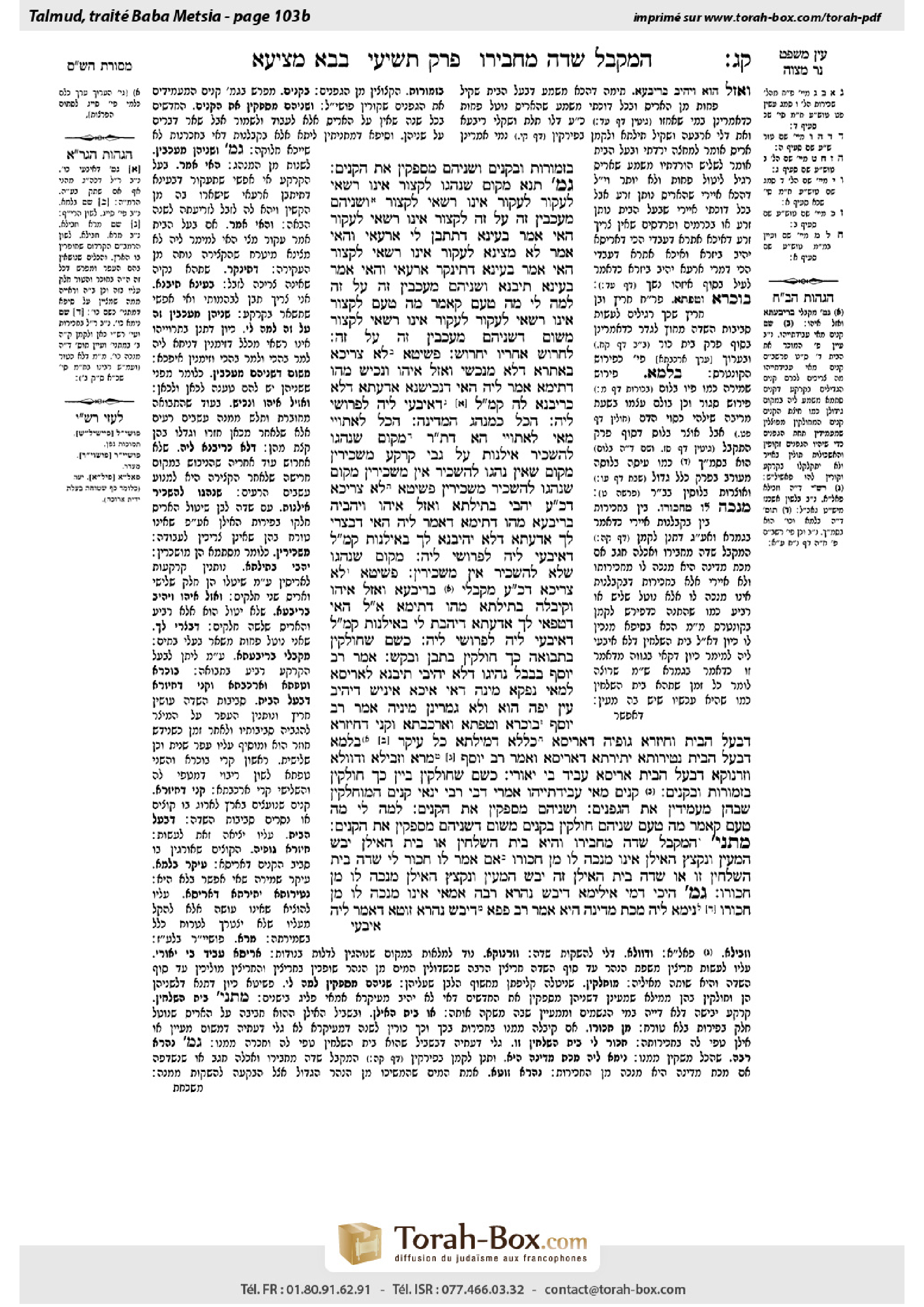
Bava Metzia 103b: Talmud study for Daf Yomi
Study the Talmud for Daf Yomi with scanned pages, Hebrew text, English translations from Sefaria and AI-generated French translations.
Passage selection and English or AI-generated French translation are available where the scan has annotations. Daf Study is independent of Torah-Box and Sefaria.
Browse Bava Metzia · בבא מציעא · All tractatesBava Metzia 103b text and translations
This page of Bava Metzia includes the Aramaic text, an English translation and an AI-generated French translation, alongside the scan above.
בבא מציעא ק״ג ב · Aramaic and Hebrew text
בַּזְּמוֹרוֹת וּבַקָּנִים, וּשְׁנֵיהֶם מְסַפְּקִין אֶת הַקָּנִים.
גְּמָ׳ תָּנָא: מְקוֹם שֶׁנָּהֲגוּ לִקְצוֹר – אֵינוֹ רַשַּׁאי לַעֲקוֹר, לַעֲקוֹר – אֵינוֹ רַשַּׁאי לִקְצוֹר, וּשְׁנֵיהֶם מְעַכְּבִין זֶה עַל זֶה.
לִקְצוֹר אֵינוֹ רַשַּׁאי לַעֲקוֹר, הַאי אָמַר: בָּעֵינָא דְּתִתַּבַּן לִי אַרְעַאי, וְהַאי אָמַר: לָא מָצֵינָא. לַעֲקוֹר אֵינוֹ רַשַּׁאי לִקְצוֹר, הַאי אָמַר: בָּעֵינָא דְּתִינַּקַּר אַרְעַאי, וְהַאי אָמַר: בָּעֵינָא תִּיבְנָא.
וּשְׁנֵיהֶם מְעַכְּבִין זֶה עַל זֶה, לְמָה לִי? מַה טַּעַם קָאָמַר: מַה טַּעַם לִקְצוֹר אֵינוֹ רַשַּׁאי לַעֲקוֹר, לַעֲקוֹר אֵינוֹ רַשַּׁאי לִקְצוֹר – מִשּׁוּם דִּשְׁנֵיהֶם מְעַכְּבִין זֶה עַל זֶה.
לַחְרוֹשׁ אַחֲרָיו – יַחְרֹשׁ. פְּשִׁיטָא! לָא צְרִיכָא: בְּאַתְרָא דְּלָא מְנַכְּשִׁי – וַאֲזַל אִיהוּ וְנַכֵּישׁ. מַהוּ דְּתֵימָא: אֲמַר לֵיהּ: הַאי דְּנַכֵּישְׁנָא אַדַּעְתָּא דְּלָא כָּרֵיבְנָא לַהּ, קָא מַשְׁמַע לַן דְּאִיבְּעִי לֵיהּ לְפָרוֹשֵׁי לֵיהּ.
הַכֹּל כְּמִנְהַג הַמְּדִינָה. ״הַכֹּל״ לְאֵתוֹיֵי מַאי? לְאֵתוֹיֵי הָא דְּתָנוּ רַבָּנַן: מָקוֹם שֶׁנָּהֲגוּ לְהַשְׂכִּיר אִילָנוֹת עַל גַּבֵּי קַרְקַע – מַשְׂכִּירִין, מָקוֹם שֶׁאֵין נָהֲגוּ לְהַשְׂכִּיר – אֵין מַשְׂכִּירִין.
מָקוֹם שֶׁנָּהֲגוּ לְהַשְׂכִּיר מַשְׂכִּירִין – פְּשִׁיטָא! לָא צְרִיכָא, דְּכוּלֵּי עָלְמָא יָהֲבִי בְּתִילְתָּא, וַאֲזַל אִיהוּ וְיַהֲבֵיהּ בְּרִיבְעָא. מַהוּ דְּתֵימָא, דַּאֲמַר לֵיהּ: הַאי דִּבְצַרִי לָךְ, אַדַּעְתָּא דְּלָא יָהֵיבְנָא לָךְ בָּאִילָנוֹת, קָא מַשְׁמַע לַן דְּאִיבְּעִי לֵיהּ לְפָרוֹשֵׁי לֵיהּ.
מָקוֹם שֶׁנָּהֲגוּ שֶׁלֹּא לְהַשְׂכִּיר – אֵין מַשְׂכִּירִין. פְּשִׁיטָא! לָא צְרִיכָא, דְּכוּלֵּי עָלְמָא מְקַבְּלִי בְּרִיבְעָא, וַאֲזַל אִיהוּ וְקַיבְּלַהּ בְּתִילְתָּא. מַהוּ דְּתֵימָא אֲמַר לֵיהּ: הַאי דִּטְפַאי לָךְ אַדַּעְתָּא דִּיהַבְתְּ לִי בְּאִילָנוֹת, קָא מַשְׁמַע לַן דְּאִיבְּעִי לֵיהּ לְפָרוֹשֵׁי לֵיהּ.
כְּשֵׁם שֶׁחוֹלְקִין בִּתְבוּאָה – כָּךְ חוֹלְקִין בְּתֶבֶן וּבְקַשׁ. אָמַר רַב יוֹסֵף: בְּבָבֶל נְהִיגוּ דְּלָא יָהֲבִי תִּיבְנָא לַאֲרִיסָא. לְמַאי נָפְקָא מִינַּהּ? דְּאִי אִיכָּא אִינִישׁ דְּיָהֵיב – עַיִן יָפָה הוּא וְלָא גָּמְרִינַן מִינֵּיהּ.
אָמַר רַב יוֹסֵף: בּוּכְרָא וְטָפְתָא וְאַרְכַּבְתָּא וּקְנֵי דְחִיזְרָא – דְּבַעַל הַבַּיִת, וְחִזְרָא גּוּפֵיהּ דַּאֲרִיסָא. כְּלָלָא דְמִילְּתָא: כֹּל עִיקַּר בְּלָמָא – דְּבַעַל הַבַּיִת, נְטִירוּתָא יַתִּירְתָּא – דַּאֲרִיסָא. וְאָמַר רַב יוֹסֵף: מָרָא וּזְבִילָא וְדַוְולָא וְזַרְנוּקָא – דְּבַעַל הַבַּיִת, אֲרִיסָא עָבֵיד בֵּי יְאוֹרֵי.
כְּשֵׁם שֶׁחוֹלְקִין בַּיַּיִן – כָּךְ חוֹלְקִין בַּזְּמוֹרוֹת וּבַקָּנִים. קָנִים מַאי עֲבִידְתַּיְיהוּ? אָמְרִי דְּבֵי רַבִּי יַנַּאי: קָנִים הַמּוּחְלָקִין, שֶׁבָּהֶן מַעֲמִידִין אֶת הַגְּפָנִים.
וּשְׁנֵיהֶם מְסַפְּקִין אֶת הַקָּנִים. לְמָה לִי? מָה טַעַם קָאָמַר: מָה טַעַם שְׁנֵיהֶם חוֹלְקִין בַּקָּנִים – מִשּׁוּם דִּשְׁנֵיהֶם מְסַפְּקִין אֶת הַקָּנִים.
מַתְנִי׳ הַמְקַבֵּל שָׂדֶה מֵחֲבֵירוֹ וְהִיא בֵּית הַשְּׁלָחִין, אוֹ בֵּית הָאִילָן, יָבַשׁ הַמַּעְיָן וְנִקְצַץ הָאִילָן – אֵינוֹ מְנַכֶּה לוֹ מִן חֲכוֹרוֹ. אִם אָמַר לוֹ: ״חֲכוֹר לִי שָׂדֶה בֵּית הַשְּׁלָחִין זוֹ״ אוֹ ״שְׂדֵה בֵּית הָאִילָן זֶה״, יָבַשׁ הַמַּעְיָן וְנִקְצַץ הָאִילָן – מְנַכֶּה לוֹ מֵחֲכוֹרוֹ.
גְּמָ׳ הֵיכִי דָמֵי? אִילֵּימָא דִּיבַשׁ נַהֲרָא רַבָּה, אַמַּאי אֵינוֹ מְנַכֶּה לוֹ מִן חֲכוֹרוֹ? נֵימָא לֵיהּ: מַכַּת מְדִינָה הִיא! אָמַר רַב פָּפָּא: דִּיבַשׁ נַהֲרָא זוּטָא, דְּאָמַר לֵיהּ:
Bava Metzia 103b · English translation
the branches pruned from the vines and the poles. And the two of them, i.e., the landowner and the one cultivating the field, both supply the poles.
GEMARA: It was taught in a baraita: In a location where those cultivating the land were accustomed to cut the produce, the one cultivating this field is not permitted to uproot it, and in a location where they were accustomed to uproot the produce, he is not permitted to cut it. And the two of them, i.e., the owner and the one cultivating the field, can each prevent the other from deviating from the custom.
The Gemara explains the baraita: In a location where those cultivating the land were accustomed to cut the produce, the one cultivating this field is not permitted to uproot the produce even if he wants to, because this one, i.e., the owner, who wants the produce cut, can say: I want my land to be fertilized with stubble, i.e., the remains of the plants. And if the owner wants him to uproot the produce, that one, i.e., the one cultivating the field, can say: I cannot uproot the produce, since that is too labor intensive. Similarly, if the custom is to uproot the produce, the one cultivating this field is not permitted to cut it even if he wants to, because this one, i.e., the owner, who wants the produce uprooted, can say: I want my land to be cleared of stubble. And if the owner wants him to cut the produce, that one, i.e., the one cultivating the field, can say: I want to uproot what remains so that I can use the stubble.
The baraita teaches: And the two of them, i.e., the owner and the one cultivating the field, can each prevent the other from deviating from the custom. The Gemara asks: Why do I need this statement and what is its purpose? The Gemara answers that the baraita is saying what the reason is for its ruling: What is the reason that in a location where those cultivating the land were accustomed to cut the produce, the one cultivating this field is not permitted to uproot the produce, and in a location where they were accustomed to uproot the produce, he is not permitted to cut it? It is because the two of them can each prevent the other from deviating from the custom, as each has a justified reason for opposing the deviation desired by the other.
The mishna teaches: If they were accustomed to plow the land after harvesting the produce, this cultivator must plow as well. The Gemara asks: Isn’t it obvious that he cannot deviate from the custom? The Gemara answers: No, it is necessary for the situation of a place where the custom is not to weed the fields, and the one cultivating this field went and weeded anyway. Lest you say that he could say to the landowner: When I weeded the field, I did so with the intention of not plowing it subsequently. Therefore, he should not be obligated to plow it. To counter this, the mishna teaches us that the renter should have specified this intention explicitly to the landowner beforehand in order to exempt him from the requirement to plow.
The mishna teaches: All farming of the land shall be conducted in accordance with regional custom. The Gemara asks: What is added by the use of the term all? The Gemara answers: It serves to add that which the Sages taught: In a location where landowners were accustomed to rent out the trees in a field together with the land so that the one cultivating the field receives a share of the fruits despite not needing to care for the trees, the trees are presumed to be rented out. In a location where landowners were not accustomed to rent out the trees in a field together with the land, and the one cultivating the field does not receive a share of the fruits, the trees are not presumed to be rented out.
The baraita teaches: In a location where landowners were accustomed to rent out the trees in a field together with the land so that the one cultivating the field receives a share of the fruit despite not needing to care for the trees, the trees are presumed to be rented out. The Gemara asks: Isn’t this obvious? The Gemara answers: No, it is necessary to state this ruling in order to include the case where everyone in that region gives land to sharecroppers to cultivate in return for one-third of the yield, and he, the landowner, went and gave it for one-quarter. Lest you say that the landowner can say to him: This concession on my part, that I reduced my portion of the yield for you, was done with the intention that I would not give you a share of the fruits of the trees in the field, the baraita teaches us that the landowner should have specified this to him in advance.
The baraita teaches: In a location where landowners were not accustomed to rent out the trees in a field together with the land, and the one cultivating the field does not receive a share of the fruits, the trees are not presumed to be rented out. The Gemara asks: Isn’t this obvious? The Gemara answers: No, it is necessary to state this ruling in order to include the case where all the cultivators in that region receive land in return for giving one-quarter of the yield to the owner, and this cultivator went and received the land in return for giving one-third of the yield to the owner. Lest you say that the cultivator can say to him: This concession on my part, that I added to your portion, was done with the intention that you would also give me a share of the fruit from the trees, the baraita teaches us that the cultivator should have specified this to him in advance.
§ The mishna teaches: Just as the halakha is that the owner of the field and the one cultivating it divide the produce, so too the halakha is that they divide the stubble and the straw. Rav Yosef said with regard to this statement: In Babylonia those who enter into such arrangements are accustomed not to give stubble to the sharecropper. The Gemara asks: What is the practical difference resulting from the assertion that this is the practice in Babylonia? The Gemara answers: The difference is that if there is a person in Babylonia who gives the sharecropper the stubble in addition to the produce, it is considered merely as though he has a generous disposition, but we do not learn from his actions that this is the general practice.
Rav Yosef says: The first, second, and third elements of the earthen barrier surrounding the field and the poles used to support a thorn fence are the responsibility of the owner of the land, but the fashioning of the thorn fence itself is the responsibility of the sharecropper. The Gemara explains: The principle of the matter is that the main part of the boundary of the field is the responsibility of the owner of the land, while any additional protection required is the responsibility of the sharecropper. Rav Yosef says: The hoe and the shovel and the bucket and the irrigation device must be provided by the owner of the land, while the sharecropper must make the irrigation channels.
The mishna teaches: Just as the halakha is that the owner of the field and the one cultivating it divide the wine, so too the halakha is that they divide the branches pruned from the vines and the poles. The Gemara asks: What is the purpose of the poles used for the vines? They said in the school of Rabbi Yannai: This is referring to long poles that were divided in half, with which they support the vines.
The mishna teaches: And the two of them, i.e., the landowner and the one cultivating the field, both supply the poles. The Gemara asks: Why do I need the mishna to state this? The Gemara answers that the mishna is saying what the reason is for its ruling: What is the reason that the two of them divide the poles? It is because the two of them supply the poles.
MISHNA: In the case of one who receives a field from another to cultivate and it is an irrigated field or a field with trees, if the spring that irrigated the field dried up or the trees were cut down, he does not subtract from the produce he owes the owner as part of his tenancy, despite the fact that he presumably considered these factors when agreeing to cultivate the field. But if the cultivator said to the landowner explicitly: Lease me this irrigated field, or he said: Lease me this field with trees, and the spring dried up or the trees were cut down, he may subtract from the produce he owes as part of his tenancy.
GEMARA: The Gemara asks: What are the circumstances of the ruling of the mishna? If we say that the large river from which all the channels originate dried up, why does he not subtract from the produce he owes as part of his tenancy? Let the cultivator say that it is the result of a regional disaster. Consequently, he should be able to subtract from the produce he owes. Rav Pappa said: The case in the mishna is where a small river that irrigates this field alone dried up, as the landowner can say to him:
Bava Metzia 103b · Traduction française (IA)
les branches taillées des vignes et les poteaux. Et les deux d'entre eux, c'est-à-dire le propriétaire et celui qui cultive le champ, fournissent les poteaux.
GUEMARA : Il a été enseigné dans une baraïta : Dans un lieu où ceux qui cultivaient la terre étaient habitués à couper les récoltes, celui qui cultive ce champ n'est pas autorisé à arracher les récoltes, et dans un lieu où ils étaient habitués à arracher les récoltes, il n'est pas autorisé à les couper. Et les deux d'entre eux, c'est-à-dire le propriétaire et celui qui cultive le champ, peuvent chacun empêcher l'autre de s'écarter de la coutume.
La Guemara explique la baraïta : Dans un lieu où ceux qui cultivaient la terre étaient habitués à couper les récoltes, celui qui cultive ce champ n'est pas autorisé à arracher les récoltes même s'il le veut, car celui-ci, c'est-à-dire le propriétaire, qui veut que les récoltes soient coupées, peut dire : Je veux que ma terre soit enrichie par les tiges, c'est-à-dire les restes des plantes. Et si le propriétaire veut qu'il arrache les récoltes, celui-là, c'est-à-dire celui qui cultive le champ, peut dire : Je ne peux pas arracher les récoltes, car cela est trop laborieux. De même, si la coutume est d'arracher les récoltes, celui qui cultive ce champ n'est pas autorisé à les couper même s'il le veut, car celui-ci, c'est-à-dire le propriétaire, qui veut que les récoltes soient arrachées, peut dire : Je veux que ma terre soit débarrassée des tiges. Et si le propriétaire veut qu'il les coupe, celui-là, c'est-à-dire celui qui cultive le champ, peut dire : Je veux arracher ce qui reste afin d'utiliser les tiges.
La baraïta enseigne : Et les deux d'entre eux, c'est-à-dire le propriétaire et celui qui cultive le champ, peuvent chacun empêcher l'autre de s'écarter de la coutume. La Guemara demande : Pourquoi ai-je besoin de cette déclaration et quel est son but ? La Guemara répond que la baraïta explique la raison de son jugement : Quelle est la raison qui fait que dans un lieu où ceux qui cultivaient la terre étaient habitués à couper les récoltes, celui qui cultive ce champ n'est pas autorisé à arracher les récoltes, et dans un lieu où ils étaient habitués à arracher les récoltes, il n'est pas autorisé à les couper ? C'est parce que les deux d'entre eux peuvent chacun empêcher l'autre de s'écarter de la coutume, car chacun a une raison justifiée pour s'opposer à la déviation souhaitée par l'autre.
La mishna enseigne : Si l'habitude était de labourer la terre après avoir récolté les produits, ce cultivateur doit labourer également. La Guemara demande : N'est-ce pas évident qu'il ne peut pas s'écarter de la coutume ? La Guemara répond : Non, il est nécessaire pour le cas d'un lieu où la coutume n'est pas de désherber les champs, et celui qui cultive ce champ est allé désherber de son propre chef. De peur que vous disiez qu'il pouvait dire au propriétaire : Lorsque j'ai désherbé le champ, je l'ai fait avec l'intention de ne pas labourer ensuite. Par conséquent, il ne devrait pas être tenu de labourer. Pour contrecarrer cela, la mishna nous enseigne que le cultivateur devrait avoir spécifié clairement cette intention au propriétaire à l'avance afin de l'exonérer de l'obligation de labourer.
La Michna enseigne : Toute agriculture de la terre doit être menée conformément à la coutume locale. La Guemara demande : Quel est l'ajout de l'utilisation du terme « tous » ? La Guemara répond : Cela sert à ajouter ce que les Sages ont enseigné : Dans un lieu où les propriétaires de la terre étaient habitués à louer les arbres d'un champ ensemble avec la terre afin que celui qui cultive le champ reçoive une part des fruits sans avoir à s'occuper des arbres, les arbres sont considérés comme loués. Dans un lieu où les propriétaires de la terre n'étaient pas habitués à louer les arbres d'un champ ensemble avec la terre, et celui qui cultive le champ ne reçoit pas une part des fruits, les arbres ne sont pas considérés comme loués.
La baraïta enseigne : Dans un lieu où les propriétaires de la terre étaient habitués à louer les arbres d'un champ ensemble avec la terre afin que celui qui cultive le champ reçoive une part des fruits sans avoir à s'occuper des arbres, les arbres sont considérés comme loués. La Guemara demande : N'est-ce pas évident ? La Guemara répond : Non, il est nécessaire d'énoncer cette décision afin d'inclure le cas où tout le monde dans cette région donne des terres à des cultivateurs en échange d'une part des récoltes, et lui, le propriétaire, a donné pour un quart. De peur que vous disiez que le propriétaire peut dire à lui : Cette concession que j'ai faite, de réduire ma part des récoltes pour vous, a été faite avec l'intention que je ne vous donne pas une part des fruits des arbres du champ, la baraïta nous enseigne que le propriétaire devrait avoir spécifié cela à l'avance.
La baraïta enseigne : Dans un lieu où les propriétaires de la terre n'étaient pas habitués à louer les arbres d'un champ ensemble avec la terre, et celui qui cultive le champ ne reçoit pas une part des fruits, les arbres ne sont pas considérés comme loués. La Guemara demande : N'est-ce pas évident ? La Guemara répond : Non, il est nécessaire d'énoncer cette décision afin d'inclure le cas où tous les cultivateurs de cette région reçoivent des terres en échange de donner un quart des récoltes au propriétaire, et ce cultivateur a reçu la terre en échange de donner un tiers des récoltes au propriétaire. De peur que vous disiez que le cultivateur peut dire au propriétaire : Cette concession que j'ai faite, d'ajouter à votre part, a été faite avec l'intention que vous me donniez aussi une part des fruits des arbres, la baraïta nous enseigne que le cultivateur devrait avoir spécifié cela à l'avance.
§ La mishna enseigne : Tout comme la halakha est que le propriétaire du champ et celui qui le cultive divisent les récoltes, de même la halakha est que ils divisent les tiges et les pailles. Rav Yosef a dit concernant cette déclaration : En Babylonie, ceux qui entrent dans de tels arrangements sont habitués à ne pas donner de tiges au cultivateur. La Guemara demande : Quelle est la différence pratique résultant de l'affirmation que c'est la pratique à Babylonie ? La Guemara répond : La différence est que si quelqu'un à Babylonie donne au cultivateur les tiges en plus des récoltes, cela est considéré comme s'il a une générosité, mais nous ne tirons pas de cette action que c'est la pratique générale.
Rav Yosef dit : Les trois éléments de la barrière terrestre entourant le champ et les poteaux utilisés pour soutenir un mur de buissons sont la responsabilité du propriétaire du terrain, mais la construction du mur de buissons lui-même est la responsabilité du cultivateur en partage. La Guemara explique : Le principe de la question est que la partie principale de la limite du champ est la responsabilité du propriétaire du terrain, tandis que toute protection supplémentaire nécessaire est la responsabilité du cultivateur en partage. Rav Yosef dit : La houe, la pelle, le seau et l'appareil d'irrigation doivent être fournis par le propriétaire du terrain, tandis que le cultivateur en partage doit construire les canaux d'irrigation.
La mitsna enseigne : Comme la halakha est que le propriétaire du champ et celui qui le cultive divisent le vin, ainsi la halakha est aussi que l'on divise les branches taillées des vignes et les poteaux. La Guemara demande : Quel est l'usage des poteaux utilisés pour les vignes ? Ils dirent dans l'école de Rabbi Yannai : Il s'agit de longs poteaux qui ont été coupés en deux, avec lesquels ils soutiennent les vignes.
La mitsna enseigne : Et les deux d'entre eux, c'est-à-dire le propriétaire du terrain et celui qui cultive le champ, fournissent tous les deux les poteaux. La Guemara demande : Pourquoi ai-je besoin de la mitsna pour dire cela ? La Guemara répond que la mitsna explique la raison de sa décision : Quelle est la raison que les deux d'entre eux divisent les poteaux ? C'est parce que les deux d'entre eux fournissent les poteaux.
MICHNA : Dans le cas d'une personne qui reçoit un champ d'une autre personne pour le cultiver, et s'il s'agit d'un champ irrigué ou d'un champ avec des arbres, si le puits qui irriguait le champ s'est asséché ou si les arbres ont été coupés, il ne doit pas déduire de la récolte qu'il doit au propriétaire en tant que locataire, malgré le fait qu'il ait probablement pris en compte ces facteurs lorsqu'il a accepté de cultiver le champ. Mais si le cultivateur a dit explicitement au propriétaire du terrain : Louez-moi ce champ irrigué, ou s'il a dit : Louez-moi ce champ avec des arbres, et le puits s'est asséché ou les arbres ont été coupés, il peut déduire de la récolte qu'il doit en tant que locataire.
GUEMARA : La Guemara demande : Quelles sont les circonstances de la décision de la mitsna ? Si nous disons que le grand fleuve d'où partent tous les canaux s'est asséché, pourquoi ne peut-il pas déduire de la récolte qu'il doit au propriétaire en tant que locataire ? Laissez le cultivateur dire que c'est le résultat d'une catastrophe régionale. Ainsi, il devrait pouvoir déduire de la récolte qu'il doit. Rav Pappa dit : Le cas dans la mitsna est celui d'un petit fleuve qui irrigue ce champ seul s'est asséché, car le propriétaire du terrain peut dire à lui :
Traduction française générée par IA à partir de l’édition anglaise de Sefaria. Vérifie toujours un passage avec le texte source.
Text from Sefaria: William Davidson Edition - Vocalized Aramaic (CC BY NC); William Davidson Edition - English (CC BY NC).