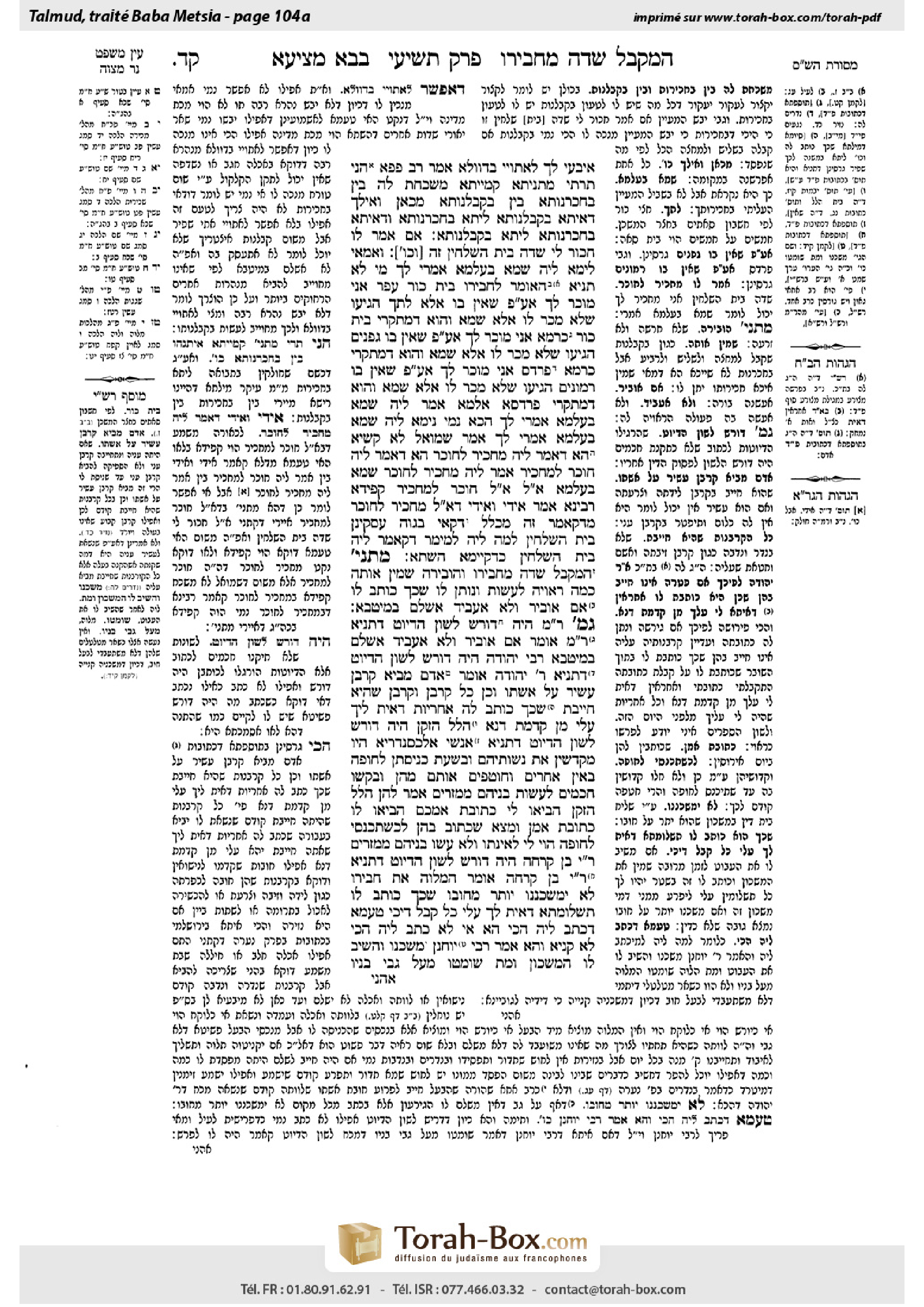
Bava Metzia 104a: Talmud study for Daf Yomi
Study the Talmud for Daf Yomi with scanned pages, Hebrew text, English translations from Sefaria and AI-generated French translations.
Passage selection and English or AI-generated French translation are available where the scan has annotations. Daf Study is independent of Torah-Box and Sefaria.
Browse Bava Metzia · בבא מציעא · All tractatesBava Metzia 104a text and translations
This page of Bava Metzia includes the Aramaic text, an English translation and an AI-generated French translation, alongside the scan above.
בבא מציעא ק״ד א · Aramaic and Hebrew text
אִיבְּעִי לָךְ לְאֵתוֹיֵי בְּדַוְולָא.
אָמַר רַב פָּפָּא: הָנֵי תַּרְתֵּי מַתְנְיָתָא קַמָּיָיתָא – מַשְׁכַּחַתְּ לַהּ בֵּין בְּחַכְרָנוּתָא בֵּין בְּקַבְּלָנוּתָא. מִכָּאן וְאֵילָךְ: דְּאִיתַהּ בְּקַבְּלָנוּתָא – לֵיתַהּ בְּחַכְרָנוּתָא, וּדְאִיתַהּ בְּחַכְרָנוּתָא – לֵיתַהּ בְּקַבְּלָנוּתָא.
אִם אָמַר לוֹ חֲכוֹר לִי שְׂדֵה בֵּית הַשְּׁלָחִין זֶה [וְכוּ׳]. וְאַמַּאי? לֵימָא לֵיהּ: שְׁמָא בְּעָלְמָא אֲמַרִי לָךְ, מִי לָא תַּנְיָא: הָאוֹמֵר לַחֲבֵירוֹ ״בֵּית כּוֹר עָפָר אֲנִי מוֹכֵר לָךְ״, אַף עַל פִּי שֶׁאֵין בּוֹ אֶלָּא לֶתֶךְ – הִגִּיעוֹ שֶׁלֹּא מָכַר לוֹ אֶלָּא שְׁמָא, וְהוּא דְּמִתְקְרֵי ״בֵּית כּוֹר״.
״כַּרְמָא אֲנִי מוֹכֵר לָךְ״, אַף עַל פִּי שֶׁאֵין בּוֹ גְּפָנִים – הִגִּיעוֹ, שֶׁלֹּא מָכַר לוֹ אֶלָּא שְׁמָא, וְהוּא דְּמִתְקְרֵי ״כַּרְמָא״. ״פַּרְדֵּס אֲנִי מוֹכֵר לָךְ״, אַף עַל פִּי שֶׁאֵין בּוֹ רִמּוֹנִים – הִגִּיעוֹ, שֶׁלֹּא מָכַר לוֹ אֶלָּא שְׁמָא, וְהוּא דְּמִתְקְרֵי ״פַּרְדֵּסָא״. אַלְמָא אָמַר לֵיהּ: שְׁמָא בְּעָלְמָא אֲמַרִי לָךְ. הָכִי נָמֵי נֵימָא לֵיהּ: שְׁמָא בְּעָלְמָא אֲמַרִי לָךְ!
אָמַר שְׁמוּאֵל, לָא קַשְׁיָא: הָא דַּאֲמַר לֵיהּ מַחְכִּיר לְחוֹכֵר, הָא דַּאֲמַר לֵיהּ חוֹכֵר לְמַחְכִּיר. אֲמַר לֵיהּ מַחְכִּיר לְחוֹכֵר – שְׁמָא בְּעָלְמָא אֲמַר לֵיהּ. אֲמַר לֵיהּ חוֹכֵר לְמַחְכִּיר – קְפֵידָא.
רָבִינָא אָמַר: אִידֵּי וְאִידִי, דַּאֲמַר לֵיהּ מַחְכִּיר לְחוֹכֵר. מִדְּקָאָמַר ״זֶה״, מִכְּלַל דְּקָאֵי בְּגַוַּהּ עָסְקִינַן. בֵּית הַשְּׁלָחִין לְמָה לֵיהּ לְמֵימַר? דְּקָאָמַר לֵיהּ: בֵּית הַשְּׁלָחִין כִּדְקָיְימָא הַשְׁתָּא.
מַתְנִי׳ הַמְקַבֵּל שָׂדֶה מֵחֲבֵירוֹ וְהוֹבִירָהּ – שָׁמִין אוֹתָהּ כַּמָּה רְאוּיָה לַעֲשׂוֹת, וְנוֹתֵן לוֹ. שֶׁכָּךְ כּוֹתֵב לוֹ: ״אִם אוֹבִיר וְלָא אֶעֱבֵיד אֲשַׁלֵּם בְּמֵיטְבָא״.
גְּמָ׳ רַבִּי מֵאִיר הָיָה דּוֹרֵשׁ לְשׁוֹן הֶדְיוֹט. דְּתַנְיָא, רַבִּי מֵאִיר אוֹמֵר: ״אִם אוֹבִיר וְלָא אֶעֱבֵיד אֲשַׁלֵּם בְּמֵיטְבָא״.
רַבִּי יְהוּדָה הָיָה דּוֹרֵשׁ לְשׁוֹן הֶדְיוֹט. דְּתַנְיָא, רַבִּי יְהוּדָה אוֹמֵר: אָדָם מֵבִיא קׇרְבַּן עָשִׁיר עַל אִשְׁתּוֹ, וְכֵן כׇּל קׇרְבָּן וְקׇרְבָּן שֶׁהִיא חַיֶּיבֶת, שֶׁכָּךְ כּוֹתֵב לָהּ אַחְרָיוּת: דְּאִית לִיךְ עֲלַי מִן קַדְמַת דְּנָא.
הִלֵּל הַזָּקֵן הָיָה דּוֹרֵשׁ לְשׁוֹן הֶדְיוֹט, דְּתַנְיָא: אַנְשֵׁי אֲלֶכְּסַנְדְּרִיָּא הָיוּ מְקַדְּשִׁין אֶת נְשׁוֹתֵיהֶם, וּבִשְׁעַת כְּנִיסָתָן לַחוּפָּה בָּאִין אֲחֵרִים וְחוֹטְפִים אוֹתָם מֵהֶן, וּבִקְּשׁוּ חֲכָמִים לַעֲשׂוֹת בְּנֵיהֶם מַמְזֵרִים.
אָמַר לָהֶן הִלֵּל הַזָּקֵן: הָבִיאוּ לִי כְּתוּבַּת אִמְּכֶם. הֵבִיאוּ לוֹ כְּתוּבַּת אִמָּן, וּמָצָא שֶׁכָּתוּב בָּהֶן: לִכְשֶׁתִּכָּנְסִי לַחוּפָּה הֱוַי לִי לְאִינְתּוּ. וְלֹא עָשׂוּ בְּנֵיהֶם מַמְזֵרִים.
רַבִּי יְהוֹשֻׁעַ בֶּן קׇרְחָה הָיָה דּוֹרֵשׁ לְשׁוֹן הֶדְיוֹט. דְּתַנְיָא, רַבִּי יְהוֹשֻׁעַ בֶּן קׇרְחָה אוֹמֵר: הַמַּלְוֶה אֶת חֲבֵירוֹ לֹא יְמַשְׁכְּנֶנּוּ יוֹתֵר מֵחוֹבוֹ, שֶׁכָּךְ כּוֹתֵב לוֹ תַּשְׁלוּמְתָּא דְּאִית לְךָ עָלַי כֹּל קֳבֵל דֵּיכִי.
טַעְמָא דִּכְתַב לֵיהּ הָכִי, הָא אִי לָא כְּתַב לֵיהּ הָכִי – לָא קַנְיֵהּ. וְהָא אָמַר רַבִּי יוֹחָנָן: מִשְׁכְּנוֹ וְהֵשִׁיב לוֹ הַמַּשְׁכּוֹן, וָמֵת – שׁוֹמְטוֹ מֵעַל גַּבֵּי בָּנָיו.
Bava Metzia 104a · English translation
You should have brought water in a bucket.
Rav Pappa said: With regard to these first two mishnayot, you find that they are correct, concerning both tenancy, where the tenant farmer gives a certain amount of produce to the owner and keeps the rest, as well as the case of a contractor, who gives a set proportion, e.g., one-quarter or one-third, of the yield to the owner, and keeps the rest. From this point forward, i.e., from the third mishna of the chapter until its end, that which is relevant to the case of a contractor is not applicable to tenancy, and that which is relevant to tenancy is not applicable to the case of a contractor.
§ The mishna teaches: If the cultivator said to the landowner explicitly: Lease me this irrigated field, or he said: Lease me this field with trees, and the spring dried up or the trees were cut down, he may subtract from the produce he owes as part of his tenancy. The Gemara asks: But why is this so? Let the owner say to him: I told you only the name, i.e., the type, of the field, but this does not mean it would actually be irrigated during the time you are cultivating it. Isn’t it taught in a baraita: In the case of one who says to another: I am selling you a beit kor field of dirt, although the field contains only a half-kor, once the buyer purchases the dirt it has come to him, i.e., he may not retract from the transaction, as the seller sold him the dirt only by the name, and he did not mean that its size was precisely a beit kor. The baraita adds: And this is the halakha only where that field is called by people a beit kor.
The baraita continues: Similarly, if he said: I am selling you a vineyard, then although it does not have vines, once he purchases the land it has come to him, as the seller sold him the field only by the name; and this is the halakha only where it is called a vineyard. Likewise, if he said: I am selling you an orchard, then even though it does not have pomegranates, once he purchases the land it has come to him, as he sold him only by the name; and again this is the case only where it is called an orchard. Apparently, the seller can say to him: I told you only the name. So too here, let the seller say to him: I told you only the name.
Shmuel said: It is not difficult; this baraita is comparable to a case where the owner of the land said to the tenant farmer what he was leasing him, while in that mishna the tenant farmer said to the owner of the land what he was leasing from him. The reason for the difference is that if the owner of the land said the terms to the tenant farmer, then he can claim that he told him only the name, and the tenant farmer cannot object. But if the tenant farmer said the terms to the owner of the land, then he was clearly particular to receive a field that would be irrigated when he cultivated it.
Ravina said: Both this baraita and that mishna are referring to a case where the owner of the land told the tenant farmer what he was leasing him, as implied by the mishna, but since the owner said: This irrigated field, by inference we are dealing with one who is standing inside it. Why, then, does the owner need to state the fact that it is an irrigated field? It is obvious simply from looking at it that it is irrigated. Rather, the owner must have said to him by way of emphasis that he is providing an irrigated field as it currently stands.
MISHNA: With regard to one who receives a field from another as a contractor and then lets it lie fallow and does not work the land at all, the court appraises it by evaluating how much it was able to produce if cultivated, and he gives his share of this amount to the owner. The reason is that this is what a cultivator writes to the owner in a standard contract: If I let the field lie fallow and do not cultivate it, I will pay with best-quality produce.
GEMARA: Rabbi Meir would expound common language used in legal documents written by ordinary Jews to deduce halakhic conclusions. Although these formulations were not prescribed by the Sages, one can nevertheless infer halakhot from them if they are used in legal documents. As it is taught in a baraita that presents a similar case to the mishna: Rabbi Meir says he is liable to pay, as the document states: If I let the field lie fallow and do not cultivate it, I will pay with best-quality produce.
Likewise, Rabbi Yehuda would also expound common language, as it is taught in a baraita: Rabbi Yehuda says: In a case where a woman who has given birth is commanded to bring the offering of a childbearing woman and her husband is sufficiently wealthy, a person brings the offering of the rich on behalf of his wife. This is so even if his wife does not possess money of her own and perhaps should have been considered poor. Similarly, he may bring every offering that she is obligated to bring, such as a sin offering or guilt offering. He pays for all these offerings because this is what he writes to her in her marriage contract: I accept upon myself to repay you for all obligations that you have, even those from beforehand. Consequently, he must fund all of her offerings.
Similarly, Hillel the Elder would expound common language as well, as it is taught in a baraita: The inhabitants of Alexandria would betroth their wives a significant amount of time before the wedding, as was customary in those days, and at the time of their entry to the wedding canopy, others would come and snatch the women from their husbands. The Sages consequently sought to establish the children of these women as mamzerim. This is because with regard to sexual intercourse with other men, a betrothed woman has the status of a married woman. Consequently, if she is taken by another man, her children fathered by that man are mamzerim, just like children of a married woman who were fathered by a man other than her husband.
Hillel the Elder said to the children who came before him for a ruling on their status: Bring me your mother’s marriage contract for examination. They brought him their mother’s marriage contract, and he found that the following formulation was written in it: When you will enter the wedding canopy, be for me a wife. This shows that the marriage would not take effect at the time of her betrothal, but only after she would enter the wedding canopy. Consequently, the marriage did not occur at all, as she never entered the wedding canopy, and therefore these women did not cause their children to be mamzerim by engaging in intercourse with the other man.
The Gemara adds: Rabbi Yehoshua ben Korḥa would also expound common language. As it is taught in a baraita: Rabbi Yehoshua ben Korḥa says: One who lends money to another may not take more collateral from him than the value of his debt, as this is what the debtor writes to the creditor if the creditor temporarily returns a deposit for the debtor’s use: The payment to which you have a right, which it is upon me to pay, corresponds to the entire value of this item, indicating that the item cannot be greater in value than the debt itself.
The Gemara infers: The reason the creditor acquires the collateral is that he wrote this to him. But if the creditor did not write this to the debtor, would the creditor not acquire the collateral? But doesn’t Rabbi Yoḥanan say: If a creditor took collateral from the debtor and returned the collateral to him and then the debtor died, the creditor removes the collateral from the debtor’s children. The reason for this is that although movable property of orphans is not acquired by their father’s creditor, the collateral is considered to belong to the creditor, and he can collect the debt from it.
Bava Metzia 104a · Traduction française (IA)
Vous devriez avoir apporté de l'eau dans un seau.
Rav Pappa a dit : Concernant ces deux premières mitsnayot, vous trouvez qu'elles sont correctes, concernant à la fois le contrat de location, où le fermier donne une certaine quantité de récolte à l'propriétaire et garde le reste, ainsi que le cas du contracteur, qui donne une proportion déterminée, par exemple un quart ou un tiers, de la récolte à l'propriétaire et garde le reste. À partir de ce point, c'est-à-dire à partir de la troisième mitsna du chapitre jusqu'à la fin, ce qui est pertinent pour le cas du contracteur n'est pas applicable au contrat de location, et ce qui est pertinent pour le contrat de location n'est pas applicable au cas du contracteur.
§ La mitsna enseigne : Si le cultivateur a dit à l'propriétaire : Louez-moi ce champ arrosé, ou s'il a dit : Louez-moi ce champ avec des arbres, et que la source s'est tarie ou les arbres ont été abattus, il peut déduire de la récolte qu'il doit comme partie de son contrat de location. La Guemara pose la question : Mais pourquoi est-ce ainsi ? Laissez l'propriétaire dire au cultivateur : J'ai dit seulement le nom, c'est-à-dire le type, du champ, mais cela ne signifie pas qu'il serait effectivement arrosé pendant la période de culture. N'est-ce pas enseigné dans une baraïta : Dans le cas où l'on dit à un autre : Je vends à toi un champ de beit kor de terre, bien que le champ ne contienne que la moitié d'un kor, une fois que l'acheteur achète la terre, elle lui appartient, c'est-à-dire qu'il ne peut pas rétracter la transaction, car le vendeur a vendu la terre seulement par le nom, et il n'avait pas l'intention que sa taille fût exactement un beit kor. La baraïta ajoute : Et c'est ainsi la halakha seulement là où ce champ est appelé par les gens un beit kor.
La baraïta continue : De même, si l'on dit : Je vends à toi un vignoble, alors que celui-ci n'a pas de vignes, une fois que l'acheteur achète la terre, elle lui appartient, car le vendeur a vendu la terre seulement par le nom ; et c'est ainsi la halakha seulement là où elle est appelée un vignoble. De même, si l'on dit : Je vends à toi un verger, alors que celui-ci n'a pas de pommiers, une fois que l'acheteur achète la terre, elle lui appartient, car le vendeur a vendu la terre seulement par le nom ; et à nouveau c'est le cas seulement là où elle est appelée un verger. Apparemment, le vendeur peut dire à l'acheteur : J'ai dit seulement le nom. De même, ici, le vendeur peut dire à l'acheteur : J'ai dit seulement le nom.
Shmuel a dit : Ce n'est pas difficile ; cette baraïta est comparable à un cas où l'propriétaire du terrain a dit au fermier ce qu'il lui louait, tandis que dans cette mitsva le fermier a dit à l'propriétaire du terrain ce qu'il lui louait. La raison de la différence est que si l'propriétaire du terrain a dit les termes au fermier, alors il peut affirmer qu'il a dit seulement le nom, et le fermier ne peut pas protester. Mais si le fermier a dit les termes à l'propriétaire du terrain, alors il était clairement spécifique pour recevoir un champ qui serait arrosé lorsqu'il le cultivait.
Ravina a dit : À la fois cette baraïta et cette mitsva se réfèrent à un cas où l'propriétaire du terrain a dit au fermier ce qu'il lui louait, comme suggéré par la mitsva, mais puisque l'propriétaire a dit : Ce champ arrosé, par l'inférence nous sommes en présence d'une personne qui est debout dedans. Pourquoi, alors, l'propriétaire a-t-il besoin de préciser que c'est un champ arrosé ? C'est évident simplement en le regardant que c'est arrosé. Plutôt, l'propriétaire doit avoir dit au fermier par manière d'accentuation qu'il lui fournit un champ arrosé tel qu'il est actuellement.
MICHNA: Concernant celui qui reçoit un champ d'un autre comme contracteur et ensuite le laisse en friche sans le cultiver du tout, le tribunal évalue le champ en évaluant combien il aurait pu produire s'il avait été cultivé, et il lui donne sa part de cette quantité à l'propriétaire. La raison est que c'est ce que le cultivateur écrit à l'propriétaire dans un contrat standard : Si je laisse le champ en friche et ne le cultive pas, je paierai avec des produits de qualité supérieure.
GUEMARA: Rabbi Meir interpréterait le langage courant utilisé dans les documents juridiques rédigés par les Juifs ordinaires pour déduire des conclusions halakhiques. Bien que ces formulations ne fussent pas prescrites par les Sages, on peut néanmoins en déduire des halakhot si elles sont utilisées dans des documents juridiques. Comme il est enseigné dans une baraïta qui présente un cas similaire à la mitsna : Rabbi Meir dit qu'il est tenu de payer, car le document stipule : Si je laisse le champ en friche et ne le cultive pas, je paierai avec des produits de qualité supérieure.
De même, Rabbi Yéhouda interpréterait également le langage courant, comme il est enseigné dans une baraïta : Rabbi Yéhouda dit : Dans le cas où une femme qui a donné naissance est commandée à apporter l'offrande de la femme enceinte et son mari est suffisamment riche, une personne apporte l'offrande du riche à la place de sa femme. C'est ainsi même si sa femme ne possède pas d'argent personnel et pourrait être considérée comme pauvre. De même, il peut apporter toute offrande qu'elle est tenue d'apporter, comme une offrande expiatoire ou une offrande de culpabilité. Il paie pour toutes ces offrandes car c'est ce que l'on écrit à sa femme dans son contrat de mariage : Je m'engage à vous rétribuer pour toutes les obligations que vous avez, même celles d'avant. Par conséquent, il doit financer toutes ses offrandes.
De même, Hillel le Vieil expliquait également le langage courant, comme il est enseigné dans une baraïta : Les habitants d'Alexandrie se fiançaient un temps considérablement long avant le mariage, comme c'était coutume à cette époque, et à l'époque de leur entrée sous le dais nuptial, d'autres venaient et enlevaient les femmes de leurs maris. Les Sages cherchaient donc à établir les enfants de ces femmes comme mamzerim. C'est parce que, concernant l'acte sexuel avec d'autres hommes, une femme fiancée a le statut d'une femme mariée. Par conséquent, si elle est enlevée par un autre homme, ses enfants conçus par cet homme sont mamzerim, tout comme les enfants d'une femme mariée conçus par un homme autre que son mari.
Hillel le'Chacham aîné dit aux enfants qui venaient le consulter concernant leur statut : Apportez-moi le contrat de mariage de votre mère pour l'examiner. Ils lui apportèrent le contrat de mariage de leur mère, et il découvrit que la formulation suivante était inscrite : Lorsque tu entreras sous le dais nuptial, sois pour moi une épouse. Cela montre que le mariage ne prendrait effet qu'au moment où elle entrerait sous le dais nuptial, et non lors de son engagement. Par conséquent, le mariage n'avait pas eu lieu du tout, car elle n'avait jamais entré sous le dais nuptial, et par conséquent ces femmes n'avaient pas rendu leurs enfants mamzerim en ayant des relations sexuelles avec l'autre homme.
La Guemara ajoute : Rabbi Yéhoshua ben Korkha expliquait également la langue courante. Comme il est enseigné dans une baraïta : Rabbi Yéhoshua ben Korkha dit : Celui qui prête de l'argent à un autre ne peut pas prendre plus de garantie que la valeur de sa dette, car c'est ce que l'emprunteur écrit au créancier si le créancier rend temporairement un dépôt à l'emprunteur : La rétribution à laquelle tu as droit, qui m'est due, correspond à la valeur totale de cet objet, indiquant que cet objet ne peut pas être plus précieux que la dette elle-même.
La Guemara déduit : La raison pour laquelle le créancier acquiert la garantie est qu'il a écrit cela à l'emprunteur. Mais si le créancier n'avait pas écrit cela à l'emprunteur, le créancier n'aurait-il pas acquis la garantie ? Mais ne dit-on pas que Rabbi Yochanan : Si un créancier avait pris une garantie de l'emprunteur et avait rendu la garantie à l'emprunteur, et que ensuite l'emprunteur est mort, le créancier retire la garantie des enfants de l'emprunteur. La raison de cela est que bien que la propriété mobile des orphelins ne soit pas acquise par le créancier du père, la garantie est considérée comme appartenant au créancier, et il peut récupérer la dette à partir d'elle.
Traduction française générée par IA à partir de l’édition anglaise de Sefaria. Vérifie toujours un passage avec le texte source.
Text from Sefaria: William Davidson Edition - Vocalized Aramaic (CC BY NC); William Davidson Edition - English (CC BY NC).