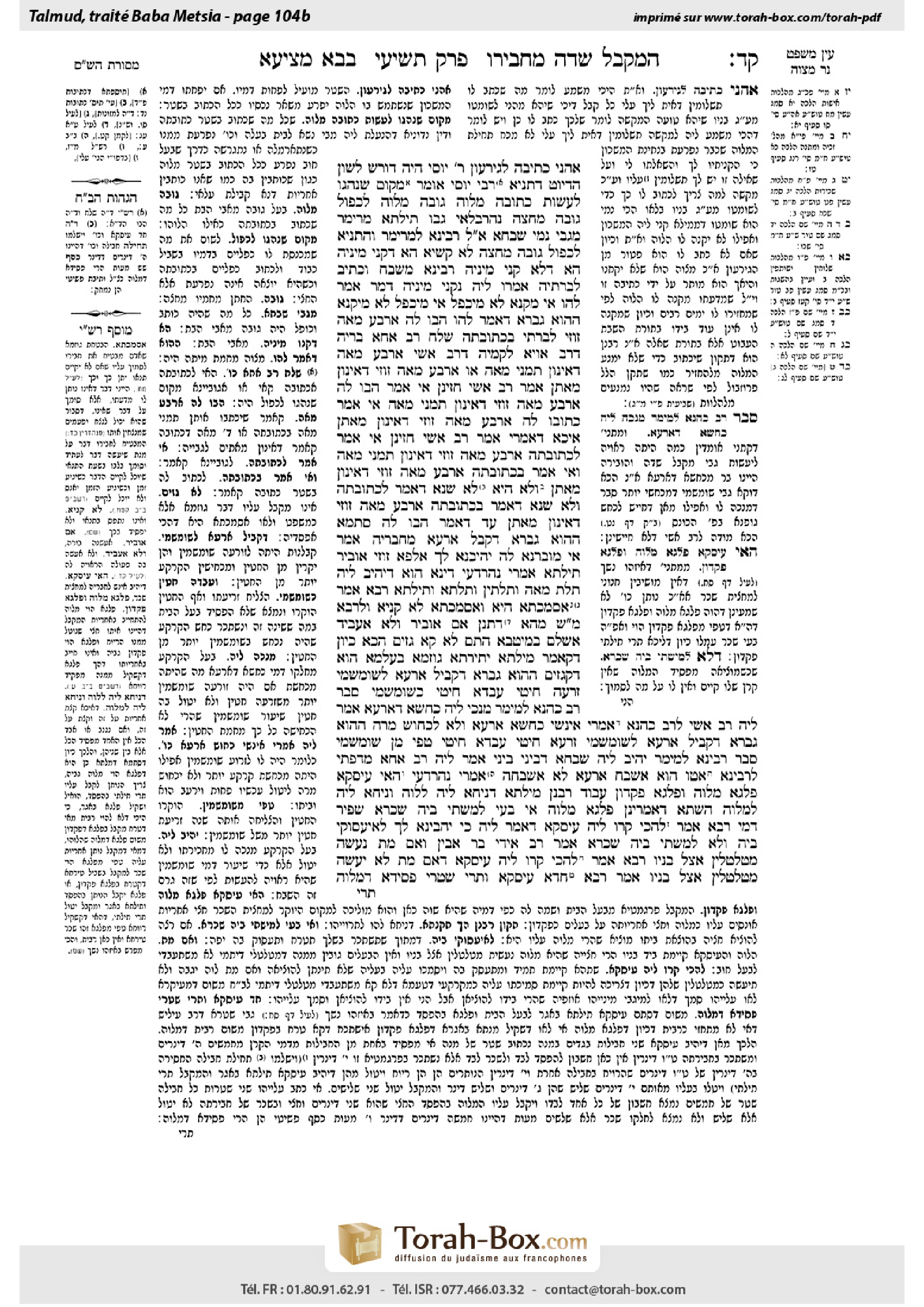
Bava Metzia 104b: Talmud study for Daf Yomi
Study the Talmud for Daf Yomi with scanned pages, Hebrew text, English translations from Sefaria and AI-generated French translations.
Passage selection and English or AI-generated French translation are available where the scan has annotations. Daf Study is independent of Torah-Box and Sefaria.
Browse Bava Metzia · בבא מציעא · All tractatesBava Metzia 104b text and translations
This page of Bava Metzia includes the Aramaic text, an English translation and an AI-generated French translation, alongside the scan above.
בבא מציעא ק״ד ב · Aramaic and Hebrew text
אַהֲנַי כְּתִיבָה לְגֵירָעוֹן.
רַבִּי יוֹסֵי הָיָה דּוֹרֵשׁ לְשׁוֹן הֶדְיוֹט. דְּתַנְיָא, רַבִּי יוֹסֵי אוֹמֵר: מָקוֹם שֶׁנָּהֲגוּ לַעֲשׂוֹת כְּתוּבָּה מִלְוָה – גּוֹבֶה מִלְוָה. לִכְפּוֹל – גּוֹבֶה מֶחֱצָה.
נְהַרְבְּלָאֵי גָּבוּ תִּילְתָּא, מָרִימָר מַגְבֵּי נָמֵי שְׁבָחָא.
אֲמַר לֵיהּ רָבִינָא לְמָרִימָר, וְהָתַנְיָא: לִכְפּוֹל גּוֹבֶה מֶחֱצָה! לָא קַשְׁיָא: הָא (דִּקְנֵי) [דִּקְנוֹ] מִינֵּיהּ, הָא דְּלָא (קָנֵי) [קְנוֹ] מִינֵּיהּ.
רָבִינָא מַשְׁבַּח וְכָתֵיב לִבְרַתֵּיהּ. אֲמַרוּ לֵיהּ: נִקְנֵי מִינֵּיהּ דְּמָר. אֲמַר לְהוּ: אִי מִקְנֵא – לָא מִיכְפַּל, אִי מִיכְפַּל – לָא מִיקְנֵא.
הָהוּא גַּבְרָא דַּאֲמַר לְהוּ: הַבוּ לָהּ אַרְבַּע מְאָה זוּזֵי לִבְרַתִּי בִּכְתוּבְּתַהּ. שְׁלַח רַב אַחָא בְּרֵיהּ דְּרַב אַוְיָא לְקַמֵּיהּ דְּרַב אָשֵׁי: אַרְבַּע מְאָה דְּאִינּוּן תַּמְנֵי מְאָה, אוֹ אַרְבַּע מְאָה זוּזֵי דְּאִינּוּן מָאתַן? אָמַר רַב אָשֵׁי: חָזֵינַן, אִי אֲמַר ״הַבוּ לַהּ״ – אַרְבַּע מְאָה זוּזֵי דְּאִינּוּן תַּמְנֵי מְאָה, אִי אֲמַר ״כְּתוֹבוּ לַהּ״ – אַרְבַּע מְאָה זוּזֵי דְּאִינּוּן מָאתַן.
אִיכָּא דְּאָמְרִי, אָמַר רַב אָשֵׁי: חָזֵינַן אִי אֲמַר ״לִכְתוּבְּתַהּ״ – אַרְבַּע מְאָה זוּזֵי דְּאִינּוּן תַּמְנֵי מְאָה, וְאִי אֲמַר ״בִּכְתוּבְּתַהּ״ – אַרְבַּע מְאָה זוּזֵי דְּאִינּוּן מָאתַן.
וְלָא הִיא, לָא שְׁנָא דְּאָמַר ״לִכְתוּבְּתַהּ״ וְלָא שְׁנָא דְּאָמַר ״בִּכְתוּבְּתַהּ״ – אַרְבַּע מְאָה זוּזֵי דְּאִינּוּן מָאתַן, עַד דְּאָמַר ״הַבוּ לַהּ״ סְתָמָא.
הָהוּא גַּבְרָא דְּקַבֵּל אַרְעָא מֵחַבְרֵיהּ, אֲמַר: אִי מוֹבַרְנָא לַהּ – יָהֵיבְנָא לָךְ אַלְפָּא זוּזֵי. אוֹבַיר תִּילְתָּא. אָמְרִי נְהַרְדָּעֵי: דִּינָא הוּא דְּיָהֵיב לֵיהּ תְּלָת מְאָה וּתְלָתִין וּתְלָתָא וְתִילְתָּא. רָבָא אָמַר: אַסְמַכְתָּא הִיא, וְאַסְמַכְתָּא לָא קָנְיָא.
וּלְרָבָא, מַאי שְׁנָא מֵהָא דִּתְנַן: ״אִם אוֹבִיר וְלָא אֶעֱבֵיד אֲשַׁלֵּם בְּמֵיטְבָא״? הָתָם לָא קָא גָזֵים, הָכָא כֵּיוָן דְּקָאָמַר מִילְּתָא יַתִּירְתָּא – גּוּזְמָא בְּעָלְמָא הוּא דְּקָגָזֵים.
הָהוּא גַּבְרָא דְּקַבֵּיל אַרְעָא לְשׁוּמְשְׁמֵי, זַרְעַהּ חִיטֵּי. עֲבַדָא חִיטֵּי כְּשׁוּמְשְׁמֵי. סְבַר רַב כָּהֲנָא לְמֵימַר מְנַכֵּי לֵיהּ כַּחְשָׁא דְאַרְעָא.
אֲמַר לֵיהּ רַב אָשֵׁי לְרַב כָּהֲנָא, אָמְרִי אִינָשֵׁי: (כָּחֲשָׁא) [תִּכְחוֹשׁ] אַרְעָא, וְלָא לִכְחוֹשׁ מָרַהּ.
הָהוּא גַּבְרָא דְּקַבֵּיל אַרְעָא לְשׁוּמְשְׁמֵי, זַרְעָא חִיטֵּי, עֲבַדָא חִיטֵּי טְפֵי מִן שׁוּמְשְׁמֵי. סְבַר רָבִינָא לְמֵימַר יָהֵיב לֵיהּ שְׁבָחָא דְּבֵינֵי בֵּינֵי. אֲמַר לֵיהּ רַב אַחָא מִדִּפְתִּי לְרָבִינָא: אַטּוּ הוּא אַשְׁבַּח, אַרְעָא לָא אַשְׁבַּחָה?!
אָמְרִי נְהַרְדָּעֵי: הַאי עִיסְקָא פַּלְגָא מִלְוָה וּפַלְגָא פִּקָּדוֹן, עֲבוּד רַבָּנַן מִילְּתָא דְּנִיחָא לֵיהּ לְלֹוֶה וְנִיחָא לֵיהּ לְמַלְוֶה.
הַשְׁתָּא דְּאָמְרִינַן פַּלְגָא מִלְוָה, אִי בָּעֵי לְמִשְׁתֵּי בֵּיהּ שִׁכְרָא – שַׁפִּיר דָּמֵי. רָבָא אָמַר: לְהָכִי קָרוּ לֵיהּ ״עִיסְקָא״, דַּאֲמַר לֵיהּ: כִּי יָהֲבִינָא לָךְ לְאִיעֲסוֹקֵי בֵּיהּ, וְלָא לְמִשְׁתֵּי בֵּיהּ שִׁכְרָא.
אָמַר רַב אִידִי בַּר אָבִין: וְאִם מֵת – נַעֲשֶׂה מִטַּלְטְלִין אֵצֶל בָּנָיו. רָבָא אָמַר: לְהָכִי קָרוּ לֵיהּ עִיסְקָא, דְּאִם מֵת לֹא יֵעָשֶׂה מִטַּלְטְלִין אֵצֶל בָּנָיו.
אָמַר רָבָא: חֲדָא עִיסְקָא וּתְרֵי שְׁטָרֵי – פְּסֵידָא דְמַלְוֶה.
Bava Metzia 104b · English translation
The Gemara answers: The writing of this statement in the document is effective for depreciation. If the collateral depreciates in value, the creditor may claim the remainder of the debt from the debtor’s property.
§ The Gemara continues: Rabbi Yosei would also expound common language, as it is taught in a baraita that Rabbi Yosei says: In a location where they were accustomed to formulate the terms of a marriage contract as one would formulate the terms of a loan, i.e., the precise value of her dowry is written in the marriage contract, then upon the termination of the marriage due to divorce or the husband’s death, the wife collects the sum of her dowry as a creditor would collect payment of a loan. In other words, she receives the entire sum recorded as her dowry. Conversely, in a place where the custom is to double the written sum of the dowry in the marriage contract to honor the bride, so that it should appear as though her father is providing her husband with a considerable dowry, she collects only half of the sum written in the marriage contract.
The Gemara relates: The Sages of Neharbela collected, i.e., allowed the wife to collect, one-third of the stated sum, as the custom in their location was to write three times the actual amount of the dowry in the marriage contract. Mareimar would allow the wife to collect even the added value of those sums that the father of the bride had written in the marriage contract in honor of his daughter.
Ravina said to Mareimar: But isn’t it taught in the baraita that in a location where the custom is to record double the amount, she collects only half? The Gemara answers: This is not difficult; in this case, where Mareimar allowed the wife to collect the full sum, the husband performed an act of acquisition for the entire written amount with the father of the bride; whereas in that case, where the baraita rules that she collects only a portion of the sum written for the dowry, the husband did not perform an act of acquisition for the entire written amount with the father of the bride. Therefore, the wife would collect the sum of her dowry only in accordance with the regular custom.
The Gemara relates: Ravina wrote an enhancement of the value of the dowry for his daughter in her marriage contract, in keeping with the accepted custom. The groom’s family said to Ravina: Let us perform an act of acquisition with the Master, so that he would be required to give that entire sum as the dowry. Ravina said to them: If you wish to perform an act of acquisition, I will not double the sum of the dowry, but will record the actual sum I intend to provide; if you prefer that I record double the sum of the dowry in the marriage contract, I will not allow you to perform an act of acquisition.
The Gemara cites a related incident: There was a certain man who said to his inheritors before his death: Give four hundred dinars to my daughter in her marriage contract. Rav Aḥa, son of Rav Avya, sent the following question to be asked before Rav Ashi: What was that man’s intention? Did he mean an actual dowry of four hundred dinars, which are written as eight hundred, or four hundred dinars written in the marriage contract, which are actually a dowry of two hundred dinars? Rav Ashi said: We examine the matter. If he said: Give her, then he meant to give her four hundred dinars, which are written as eight hundred. But if he said: Write for her, then he meant to write four hundred dinars, which are two hundred in practice.
There are those who say a different version of Rav Ashi’s ruling. Rav Ashi said: We examine the matter. If he said: For her marriage contract [likhtubatah], he meant four hundred dinars, which are written as eight hundred, because he indicated that this is the sum he wants to give for her dowry. But if he said: In her marriage contract [bikhtubatah], he was clearly referring to the written amount, and it is assumed that he meant to write four hundred dinars, which are two hundred in practice.
The Gemara comments: And that is not so. There is no difference whether he said: For her marriage contract, and there is no difference whether he said: In her marriage contract. In either case her dowry is written as four hundred dinars, which are two hundred in practice, unless he simply said: Give her, without specification, i.e., without mentioning the marriage contract. In that case the full sum is given as a dowry.
§ The Gemara relates another incident: There was a certain man who received land from another to cultivate. He said: If I fail to work the land and instead let it lie fallow, I will give you one thousand dinars. He let one-third of it lie fallow. The Sages of Neharde’a said: The halakha is that he gives him 333⅓ dinars, one-third of the stipulated amount, as compensation for neglecting one-third of the field. Rava said: This kind of agreement is a transaction with inconclusive consent [asmakhta]. And since an asmakhta does not effect acquisition, he need not pay.
The Gemara asks: And according to Rava, in what way is it different from that which we learned in the mishna concerning one who wrote: If I let the field lie fallow and do not cultivate it, I will pay with best-quality produce? The Gemara answers: There he did not exaggerate, but simply said he will pay for the owner’s losses from best-quality produce; whereas here, since he said something extra, i.e., he promised to give an excessively large sum of money, he is merely exaggerating. It is therefore not viewed as an actual monetary obligation but an asmakhta.
§ The Gemara relates: There was a certain man acting as a sharecropper who received land for planting sesame, which typically weakens the land but yields larger short-term profits, but he planted it with wheat instead. That year, the field produced wheat at a value similar to that of sesame. Rav Kahana thought to say that the owner must deduct the usual amount of the deterioration of the land from planting sesame from his own share, since by planting wheat the sharecropper had spared the owner the damage to his field, while the owner had received the same profit.
Rav Ashi said to Rav Kahana: People say the following proverb: Let the land be weakened, but do not weaken its owner. People prefer a quick profit and discount the damage to their land. Therefore, the sharecropper is not entitled to a larger share of the yield for having spared the owner from the weakening of his field.
The Gemara relates another incident: There was a certain man who received land for planting sesame and he planted it with wheat. Ultimately, it produced more wheat than the usual value of sesame. Ravina thought to say that the owner must give the cultivator the added value that is the difference between this, the actual value of the wheat, and that, the expected value of the sesame. Rav Aḥa of Difti said to Ravina: Is that to say that the cultivator alone enhanced its value, but the land did not help to enhance it? Rather, they should divide the extra sum between them.
§ A common type of business venture was one where the capital or merchandise was supplied by one person and managed by another, who would receive a share, commonly half of the profits, for his efforts. This arrangement can also be viewed as one where the investor is lending half of the invested capital or merchandise to the manager, with the manager agreeing to supervise the venture in exchange for receiving the loan. In order to avoid violating the prohibition of interest, the investor agrees to accept a greater share of the possible loss, e.g., two-thirds, than of the profits, e.g., one-half. The Sages of Neharde’a said: With regard to its halakhic status, this joint venture is considered a half-loan and half-deposit, as the Sages formulated an enactment that would be satisfactory for the borrower, i.e., the manager, and equally satisfactory for the lender, i.e., the investor.
Now that we have said that half of the capital is viewed as a loan, it would appear that the manager may use the money in any way he chooses: If he wants to drink alcohol with it, he may well do so, regardless of any objection on the part of the investor. Rava disagreed and said: It is for this reason that it is called a joint venture, as the investor can say to the manager: When I gave the money to you it was to use it for business and not to drink alcohol with it.
Rav Idi bar Avin said: And according to this reasoning, if the manager died, it becomes movable property in the possession of his children. Therefore, it may not be taken from them, as movable property inherited by orphans is liened for the payment of their father’s debts. Rava disagreed and said: It is for this reason that it is called a joint venture, so that if he died it does not become movable property in the possession of his children, as it is considered a partnership, not a loan.
Rava says: If two people conducted one joint venture and drafted it as separate ventures of equal value in two separate documents, and they suffered a heavy loss from the venture recorded in one of the documents and had a slight gain from the other, the halakha is as follows: The two documents are treated as two separate agreements, and one does not calculate the profits and losses from the two ventures together. Therefore, this will be to the detriment of the lender. According to the common arrangement, he will gain half of the profits from one venture and suffer two-thirds of the loss of the other.
Bava Metzia 104b · Traduction française (IA)
Le Guemara répond : L'écriture de cette déclaration dans le document est efficace pour la dépréciation. Si la garantie se déprécie en valeur, le créancier peut réclamer le reste de la dette auprès des biens du débiteur.
§ Le Guemara continue : Rabbi Yosei expliquerait également la langue commune, comme il est enseigné dans une baraïta que Rabbi Yosei dit : Dans un lieu où ils étaient habitués à formuler les termes d'un contrat de mariage comme on formule les termes d'un prêt, c'est-à-dire que la valeur précise de sa dot est écrite dans le contrat de mariage, alors, à la fin du mariage en raison du divorce ou de la mort du mari, la femme récupère la somme de sa dot comme un créancier récupère le paiement d'un prêt. En d'autres termes, elle reçoit la totalité de la somme indiquée comme sa dot. À l'inverse, dans un lieu où la coutume est d'écrire double la somme de la dot dans le contrat de mariage pour honorer la mariée, de sorte qu'elle semble donner à son mari une dot considérable, elle récupère seulement la moitié de la somme écrite dans le contrat de mariage.
Le Guemara rapporte : Les Sages de Neharbela ont permis à la femme de récupérer un tiers de la somme indiquée, car la coutume de leur lieu était d'écrire trois fois la valeur réelle de la dot dans le contrat de mariage. Mareimar permettait à la femme de récupérer même la valeur ajoutée de ces sommes que le père de la mariée avait écrites dans le contrat de mariage en l'honneur de sa fille.
Ravina dit à Mareimar : Mais n'est-ce pas enseigné dans la baraïta que dans un lieu où la coutume est d'inscrire double la somme, elle récupère seulement la moitié ? Le Guemara répond : Ce n'est pas difficile ; dans ce cas, où Mareimar permettait à la femme de récupérer la totalité de la somme, le mari a accompli un acte d'acquisition pour l'intégralité de la somme écrite avec le père de la mariée ; tandis que dans ce cas, où la baraïta déclare qu'elle récupère seulement une partie de la somme écrite pour la dot, le mari n'a pas accompli un acte d'acquisition pour l'intégralité de la somme écrite avec le père de la mariée. Par conséquent, la femme récupère la somme de sa dot uniquement conformément à la coutume habituelle.
Le Guemara rapporte : Ravina a écrit une augmentation de la valeur de la dot pour sa fille dans son contrat de mariage, conformément à la coutume acceptée. La famille du mari a dit à Ravina : Faisons un acte d'acquisition avec le Maître, afin qu'il doive lui donner cette somme totale comme dot. Ravina a dit à eux : Si vous souhaitez faire un acte d'acquisition, je ne doublerai pas la somme de la dot, mais je noterai la somme réelle que je souhaite fournir ; si vous préférez que je note double la somme de la dot dans le contrat de mariage, je ne permettrai pas que vous fassiez un acte d'acquisition.
Le Guemara cite un incident lié : Il y avait un certain homme qui a dit à ses héritiers avant sa mort : Donnez quatre cents dinars à ma fille dans son contrat de mariage. Rav Aḥa, fils de Rav Avya, a envoyé la question suivante à être posée devant Rav Ashi : Quel était l'intention de cet homme ? Voulait-il une dot réelle de quatre cents dinars, qui sont écrites comme huit cents, ou quatre cents dinars écrites dans le contrat de mariage, qui sont en réalité une dot de deux cents dinars ? Rav Ashi a dit : Nous examinons la question. S'il a dit : Donne-lui, alors il voulait donner quatre cents dinars, qui sont écrites comme huit cents. Mais s'il a dit : Écris pour elle, alors il voulait écrire quatre cents dinars, qui sont deux cents en pratique.
Certains disent une version différente de la décision de Rav Ashi. Rav Ashi a dit : Nous examinons la question. S'il a dit : Pour son contrat de mariage [likhtubatah], il voulait quatre cents dinars, qui sont écrites comme huit cents, car il indiquait que c'était la somme qu'il voulait donner pour sa dot. Mais s'il a dit : Dans son contrat de mariage [bikhtubatah], il faisait clairement référence à la somme écrite, et on suppose qu'il voulait écrire quatre cents dinars, qui sont deux cents en pratique.
Le Guemara commente : Et cela n'est pas ainsi. Il n'y a pas de différence si il a dit : Pour son contrat de mariage, et il n'y a pas de différence si il a dit : Dans son contrat de mariage. Dans les deux cas, sa dot est écrite comme quatre cents dinars, qui sont deux cents en pratique, sauf s'il a simplement dit : Donne-lui, sans précision, c'est-à-dire sans mentionner le contrat de mariage. Dans ce cas, la somme totale est donnée comme dot.
§ Le Guemara rapporte un autre incident : Il y avait un certain homme qui avait reçu une terre d'un autre pour la cultiver. Il a dit : Si je ne travaille pas la terre et que je la laisse en friche, je te donnerai mille dinars. Il a laissé un tiers de la terre en friche. Les Sages de Neharde’a ont dit : La halakha est que il doive lui donner 333⅓ dinars, un tiers de la somme stipulée, comme compensation pour avoir négligé un tiers du champ. Rava a dit : Ce genre d'accord est un accord avec consentement indéterminé [asmakhta]. Et puisque un asmakhta ne produit pas un acquisition, il n'a pas besoin de payer.
Le Guemara pose la question : Et selon Rava, dans quelle mesure est-ce différent de ce que nous avons appris dans la mishna concernant celui qui a écrit : Si je laisse le champ en friche et que je ne le cultive pas, je paierai avec des produits de meilleure qualité ? Le Guemara répond : Là, il n'a pas exagéré, mais simplement dit qu'il paierait pour les pertes du propriétaire avec des produits de meilleure qualité ; tandis que ici, puisqu'il a dit quelque chose d'extra, c'est-à-dire qu'il a promis une somme excessive, il exagère simplement. Il est donc considéré comme une simple exagération et non comme une obligation monétaire réelle, mais un asmakhta.
§ Le Guemara rapporte : Il y avait un certain homme agissant en tant que fermier en partage qui avait reçu un terrain pour cultiver le sésame, qui affaiblit généralement le terrain mais donne des profits plus importants à court terme, mais il avait planté du blé à la place. Cet année-là, le champ avait produit du blé dont la valeur était comparable à celle du sésame. Rav Kahana avait l'intention de dire que le propriétaire devait déduire la quantité habituelle d'affaiblissement du terrain causé par la culture du sésame de sa part, car en plantant du blé, le fermier en partage avait préservé au propriétaire l'affaiblissement de son terrain, tout en recevant la même rente.
Rav Ashi a dit à Rav Kahana : Les gens disent le proverbe suivant : Laissez le terrain s'affaiblir, mais ne faites pas souffrir son propriétaire. Ils préfèrent un profit rapide et négligent les dommages subis par leur terrain. Par conséquent, le fermier en partage n'a pas le droit à une part plus importante des récoltes pour avoir préservé au propriétaire l'affaiblissement de son terrain.
Le Guemara rapporte un autre incident : Il y avait un certain homme qui avait reçu un terrain pour cultiver le sésame et il avait planté du blé à la place. Finalement, il avait produit plus de blé que la valeur habituelle du sésame. Ravina avait l'intention de dire que le propriétaire devait donner au cultivateur la valeur supplémentaire correspondant à la différence entre cette valeur réelle du blé et celle attendue du sésame. Rav Aḥa de Difti a dit à Ravina : Est-ce que cela signifie que c'est le cultivateur seul qui a augmenté la valeur, mais pas le terrain ? Plutôt, ils devraient partager la somme supplémentaire entre eux.
§ Un type courant de projet d'entreprise était celui où le capital ou les marchandises étaient fournis par une personne et gérés par une autre, qui recevait une part, généralement la moitié des profits, pour ses efforts. Ce type d'arrangement peut également être vu comme un prêt où l'investisseur prête la moitié de son capital ou de ses marchandises au gestionnaire, en échange de la supervision du projet. Afin d'éviter de violer l'interdiction d'intérêt, l'investisseur accepte de supporter une part plus importante des pertes, par exemple les deux tiers, que des profits, par exemple la moitié. Les Sages de Neharde’a ont dit : En termes de statut halakhique, ce projet conjoint est considéré comme un demi-prêt et un demi-dépôt, car les Sages ont institué une mesure qui serait satisfaisante pour le prêteur, c'est-à-dire le gestionnaire, et également pour le prêt, c'est-à-dire l'investisseur.
Maintenant que nous avons dit que la moitié du capital est vue comme un prêt, il semble que le gestionnaire puisse utiliser l'argent comme il l'entend : s'il veut boire de l'alcool avec, il peut le faire, indépendamment de toute objection de la part de l'investisseur. Rava a désaccordé et a dit : C'est pour cette raison qu'on l'appelle un projet conjoint, car l'investisseur peut dire au gestionnaire : Quand j'ai donné l'argent à toi, c'était pour le mettre en affaire et non pour boire de l'alcool avec.
Rav Idi bar Avin a dit : Et selon cette raisonnement, si le gestionnaire est mort, cela devient une propriété mobile entre ses enfants. Par conséquent, cela ne peut pas être emprunté, car la propriété mobile héritée par des orphelins est liée pour le paiement des dettes de leur père. Rava a désaccordé et a dit : C'est pour cette raison qu'on l'appelle un projet conjoint, afin que si il est mort, cela ne devienne pas une propriété mobile entre ses enfants, car on le considère comme une part, pas un prêt.
Rava dit : Si deux personnes ont conduit un projet conjoint et l'ont rédigé comme des projets séparés de valeur égale dans deux documents séparés, et s'ils ont subi une perte importante du projet enregistré dans l'un des documents et une petite gain du autre, la halakha est la suivante : Les deux documents sont traités comme deux accords séparés, et l'on ne calcule pas les profits et pertes des deux projets ensemble. Par conséquent, cela sera préjudiciable au prêteur. Selon l'arrangement commun, il gagnera la moitié des profits d'un projet et subira les deux tiers de la perte de l'autre.
Traduction française générée par IA à partir de l’édition anglaise de Sefaria. Vérifie toujours un passage avec le texte source.
Text from Sefaria: William Davidson Edition - Vocalized Aramaic (CC BY NC); William Davidson Edition - English (CC BY NC).