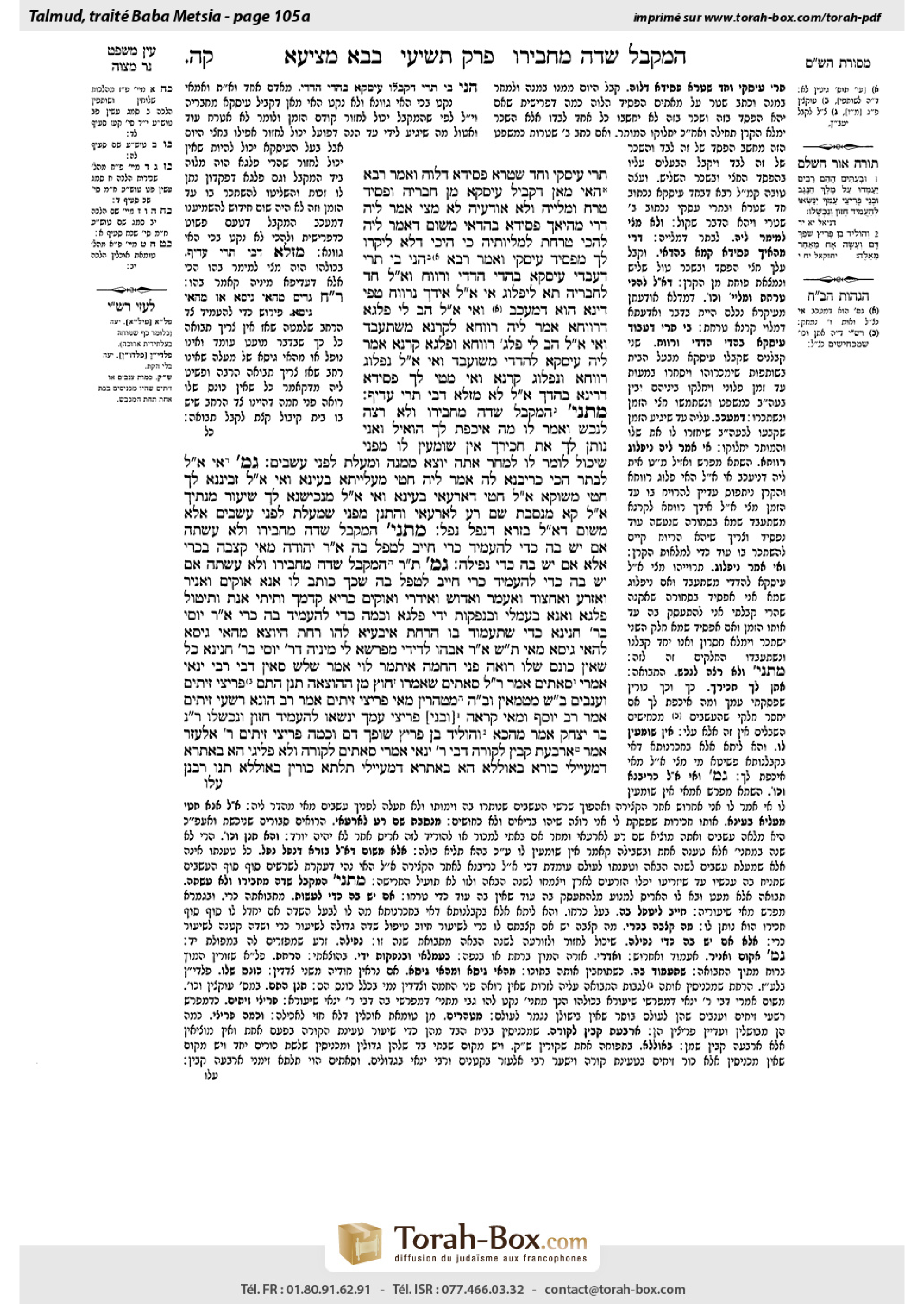
Bava Metzia 105a: Talmud study for Daf Yomi
Study the Talmud for Daf Yomi with scanned pages, Hebrew text, English translations from Sefaria and AI-generated French translations.
Passage selection and English or AI-generated French translation are available where the scan has annotations. Daf Study is independent of Torah-Box and Sefaria.
Browse Bava Metzia · בבא מציעא · All tractatesBava Metzia 105a text and translations
This page of Bava Metzia includes the Aramaic text, an English translation and an AI-generated French translation, alongside the scan above.
בבא מציעא ק״ה א · Aramaic and Hebrew text
תְּרֵי עִיסְקֵי וְחַד שְׁטָרָא – פְּסֵידָא דְּלֹוֶה.
וְאָמַר רָבָא: הַאי מַאן דְּקַבֵּיל עִיסְקָא מִן חַבְרֵיהּ וּפְסֵיד, טְרַח וּמַלְּיֵיהּ וְלָא אוֹדְעֵיהּ, לָא מָצֵי אֲמַר לֵיהּ: דְּרִי מֵהַיְאךְ פְּסֵידָא בַּהֲדַאי. מִשּׁוּם דַּאֲמַר לֵיהּ: לְהָכִי טְרַחְתְּ (לְמַלָּיוֹתֵיהּ) [וּמַלֵּיתֵיהּ] – כִּי הֵיכִי דְּלָא לִיקְרוֹ לָךְ ״מַפְסֵיד עִיסְקֵי״.
וְאָמַר רָבָא: הָנֵי בֵּי תְרֵי דְּעָבְדִי עִיסְקָא בַּהֲדֵי הֲדָדֵי וּרְוַוח, וַאֲמַר לֵיהּ חַד לְחַבְרֵיהּ: תָּא לִיפְלוֹג, אִי אֲמַר לֵיהּ אִידַּךְ: נַרְוַוח טְפֵי – דִּינָא הוּא דִּמְעַכֵּב. וְאִי אָמַר לֵיהּ: הַב לִי פַּלְגָא דְּרַוְוחָא – אָמַר לֵיהּ: רַוְוחָא – לְקַרְנָא מִשְׁתַּעְבֵּד.
וְאִי אָמַר לֵיהּ: הַב לִי פַּלְגָא רַוְוחָא וּפַלְגָא קַרְנָא – אָמַר לֵיהּ: עִיסְקָא לַהֲדָדֵי מְשׁוּעְבַּד. וְאִי אָמַר לֵיהּ: נִפְלוֹג רַוְוחָא וְנִפְלוֹג קַרְנָא, וְאִי מָטֵי לָךְ פְּסֵידָא דָּרֵינָא בַּהֲדָךְ – אָמַר לֵיהּ: לָא מַזָּלָא דְּבֵי תְרֵי עָדִיף.
מַתְנִי׳ הַמְקַבֵּל שָׂדֶה מֵחֲבֵירוֹ וְלֹא רָצָה לְנַכֵּשׁ, וְאָמַר לוֹ: מָה אִיכְפַּת לְךָ? הוֹאִיל וַאֲנִי נוֹתֵן לְךָ אֶת חֲכִירָךְ – אֵין שׁוֹמְעִין לוֹ. מִפְּנֵי שֶׁיָּכוֹל לוֹמַר לוֹ: לְמָחָר אַתָּה יוֹצֵא מִמֶּנָּה וּמַעֲלֵת לְפָנַי עֲשָׂבִים.
גְּמָ׳ אִי אָמַר לֵיהּ: לְבָתַר הָכִי כָּרֵיבְנָא לַהּ – אָמַר לֵיהּ: חִטֵּי מְעַלְּיָיתָא בָּעֵינָא. וְאִי אָמַר לֵיהּ: זָבֵינְנָא לָךְ חִטֵּי מִשּׁוּקָא – אָמַר לֵיהּ: חִטֵּי דְּאַרְעַאי בָּעֵינָא. וְאִי אָמַר לֵיהּ מְנַכֵּישְׁנָא לָךְ שִׁיעוּר מְנָתָיךְ – אָמַר לֵיהּ: קָא מַנְסְבַתְּ שֵׁם רַע לְאַרְעַאי.
וְהָתְנַן: מִפְּנֵי שֶׁמַּעֲלֵת לְפָנַי עֲשָׂבִים! אֶלָּא מִשּׁוּם דְּאָמַר לֵיהּ: בִּזְרָא דִּנְפַל – נְפַל.
מַתְנִי׳ הַמְקַבֵּל שָׂדֶה מֵחֲבֵירוֹ וְלֹא עָשְׂתָה, אִם יֵשׁ בָּהּ כְּדֵי לְהַעֲמִיד כְּרִי – חַיָּיב לִטַּפֵּל בָּהּ. אָמַר רַבִּי יְהוּדָה: מַאי קִצְבָה בִּכְרִי? אֶלָּא אִם יֵשׁ בָּהּ כְּדֵי נְפִילָה.
גְּמָ׳ תָּנוּ רַבָּנַן: הַמְקַבֵּל שָׂדֶה מֵחֲבֵירוֹ וְלֹא עָשְׂתָה, אִם יֵשׁ בָּהּ כְּדֵי לְהַעֲמִיד כְּרִי – חַיָּיב לִטַּפֵּל בָּהּ. שֶׁכָּךְ כּוֹתֵב לוֹ: אֲנָא אֵוקֹים וְאֵנוּר וְאֶזְרַע וְאֶחְצוֹד וַאֲעַמַּר וְאֵדוּשׁ וְאֶידְרֵי וְאוֹקֵים כַּרְיָא קׇדָמָךְ, וְתֵיתֵי אַנְתְּ וְתִיטּוֹל פַּלְגָא, וַאֲנָא בְּעַמְלִי וּבְנַפְקוּת יְדַי פַּלְגָא.
וְכַמָּה כְּדֵי לְהַעֲמִיד בָּהּ כְּרִי? אָמַר רַבִּי יוֹסֵי בְּרַבִּי חֲנִינָא: כְּדֵי שֶׁתַּעֲמוֹד בּוֹ הָרַחַת. אִיבַּעְיָא לְהוּ: רַחַת הַיּוֹצֵא מֵהַאי גִּיסָא לְהַאי גִּיסָא, מַאי?
תָּא שְׁמַע: אָמַר רַבִּי אֲבָהוּ, לְדִידִי מִפָּרְשָׁא לִי מִינֵּיהּ דְּרַבִּי יוֹסֵי בְּרַבִּי חֲנִינָא: כֹּל שֶׁאֵין כּוֹנֵס שֶׁלּוֹ רוֹאֶה פְּנֵי הַחַמָּה. אִיתְּמַר: לֵוִי אָמַר שָׁלֹשׁ סְאִין, דְּבֵי רַבִּי יַנַּאי אָמְרִי סָאתַיִם. אָמַר רֵישׁ לָקִישׁ: סָאתַיִם שֶׁאָמְרוּ חוּץ מִן הַהוֹצָאָה.
תְּנַן הָתָם: פָּרִיצֵי זֵיתִים וַעֲנָבִים, בֵּית שַׁמַּאי מְטַמְּאִין, וּבֵית הִלֵּל מְטַהֲרִין.
מַאי פָּרִיצֵי זֵיתִים? אָמַר רַב הוּנָא: רִשְׁעֵי זֵיתִים. אָמַר רַב יוֹסֵף: וּמַאי קְרָאָה – ״[וּבְנֵי] פָּרִיצֵי עַמְּךָ יִנַּשְּׂאוּ לְהַעֲמִיד חֲזוֹן וְנִכְשָׁלוּ״. רַב נַחְמָן בַּר יִצְחָק אָמַר: מֵהָכָא – ״וְהוֹלִיד בֵּן פָּרִיץ שֹׁפֵךְ דָּם״.
וְכַמָּה פָּרִיצֵי זֵיתִים? רַבִּי אֶלְעָזָר אָמַר: אַרְבַּעַת קַבִּין לַקּוֹרָה. דְּבֵי רַבִּי יַנַּאי אָמְרִי: סָאתַיִם לַקּוֹרָה.
וְלָא פְּלִיגִי: הָא בְּאַתְרָא דִּמְעַיְּילִי כּוֹרָא בְּאוֹלָלָא, הָא בְּאַתְרָא דִּמְעַיְּילִי תְּלָתָא כּוֹרִין בְּאוֹלָלָא.
תָּנוּ רַבָּנַן:
Bava Metzia 105a · English translation
Conversely, if two people engaged in two joint ventures and recorded both in one document, this will be to the detriment of the borrower. They calculate the profits and losses of the two transactions together, and therefore as long as the profits of one joint venture are greater than the losses of the other, the investor will not have to suffer a loss.
And Rava says: This one, who receives merchandise for a joint venture from another, and lost money in the process, and then made the effort to replace the loss but did not inform the investor that he had done so, he may not later say to the investor: Bear this original loss together with me. This is because the investor can say to him: It is for this reason that you made the effort to replace the loss, so that you should not be called a loser of ventures. You wanted to preserve your reputation in order to improve your future business prospects but did not intend to be reimbursed.
And Rava said: With regard to these two managers who engaged in a joint venture together, i.e., they both received merchandise together from an investor, and profited from it, and one of them said to the other: Come, let us divide the profits and terminate the venture, the halakha is as follows: If the other said to him: Let us wait and profit more, the halakha is that the second manager indeed prevents the first from executing his request. And if, instead of requesting the final division of the profits and the termination of the venture, one said to the other: At least give me half the profits, the latter can say to him: The profit is liened to the principal, meaning that the profits and the principal are considered a single unit, and we can earn much more if we do not set aside the profits.
Rava continues: And if one says to the other: Give me half the profits and half the principal, the latter can say to him: The merchandise for the joint venture is liened to both of us. As we are equal partners in this venture, you cannot force me to divide it. And if one says to the other: Let us divide the profits and divide the principal, and if you suffer a loss as a result, I will bear the loss with you, his partner can say to him: No, I do not desire to do that, since the luck of two people is better. Consequently, I want to continue working together. In all these cases, the claims of the second manager are accepted.
MISHNA: With regard to one who received a field from another to cultivate and did not want to weed it, and he then said to the owner: What do you care if I neglect the land? You will not suffer a loss since I will give you the amount of produce I owe you for your granting me tenancy, regardless of the state of the field. Nevertheless, they do not listen to him. The reason is because the owner of the land can say to him: Tomorrow you will depart from the field, and it will grow weeds for me, which will remain there and disrupt the yield of the field for years to come.
GEMARA: If the cultivator said to the owner: Afterward, when I have reaped the field, I will plow it and remove the weeds, the owner can say to him: I want superior wheat, not wheat that sprouted among weeds. And if he says to the owner: I will buy good wheat for you from the market, the owner can say to him: I want wheat from my land. And if he says to the owner: I will weed for you according to the measure of your portion, but no more, the owner can say to him: You are giving a bad name to my land, as everyone will see that it is full of weeds.
The Gemara asks: But didn’t we learn in the mishna that the reason they do not listen to him is: Because it will grow weeds for me, indicating that these other claims are not accepted? Rather, the explanation must be because the owner can say to him: The seed that fell has fallen. In other words, even if the cultivator later plows the land and uproots all of the weeds, their seeds remain in the ground and will sprout in the following years.
MISHNA: With regard to one who receives a field from another to cultivate and it did not produce a sufficient crop to cover the expenses of its upkeep, if it has enough produce to form a pile he is obligated to take care of it and give the owner his share. Rabbi Yehuda says: What fixed measure is a pile? There is no inherent measure of produce that is considered significant, as it all depends on the size of the plot of land in question. Rather, the relevant issue is whether it has a crop equivalent to the measure of seeds for dropping in a field in order to sow it.
GEMARA: The Sages taught: With regard to one who receives a field from another to cultivate and it did not produce a sufficient crop, if it has enough produce to form a pile he is obligated to take care of it and provide the owner with his share. This is because this is what he writes to him in the cultivator’s contract: I will stand and plow and plant and reap and bind and thresh and winnow and establish a pile before you, and you will come and take half, and I, for my work and expenses, will take the other half. Based on this contract, if there is sufficient produce to form a pile, the cultivator must fulfill the terms of the agreement.
The Gemara asks: And how much is the amount of: Enough to form a pile? How large must the pile be? Rabbi Yosei, son of Rabbi Ḥanina, said: Enough for the winnowing shovel to stand in it. If the pile is big enough that the shovel can be placed there and stand independently without falling, it is considered a sufficiently large pile. A dilemma was raised before the Sages: With regard to a winnowing shovel that protrudes from this side to that side, i.e., whose edges extend beyond the pile, what is the halakha? Is this considered a pile in which a winnowing shovel can stand or not?
The Gemara suggests: Come and hear a proof from that which Rabbi Abbahu said: This was explained to me by Rabbi Yosei, son of Rabbi Ḥanina: Any pile in which the blade of the winnowing shovel cannot see the face of the sun because it is covered by the pile is considered a significant one. It was stated that the amora’im engaged in a dispute concerning this issue: Levi says: This pile must be three se’a in size, while the Sages of the school of Rabbi Yannai say: Two se’a. Reish Lakish says: The two se’a of which they spoke is without deducting the expenses. Consequently, if he has paid the expenses and a profit of two se’a remains, in that case alone it is considered worthwhile to work the field. But if it cannot produce this amount, the cultivator may neglect the land if he so chooses.
The Gemara cites a dispute from a different area of halakha that discusses a similar measurement: We learned in a mishna there (Okatzin 3:6) concerning the halakhot of food impurities: With regard to unruly olives and grapes, Beit Shammai hold that they become susceptible to ritual impurity, as they are considered food, and Beit Hillel hold that they do not become susceptible to ritual impurity because they are of inferior quality and are unfit for consumption.
The Gemara asks: What is the meaning of unruly [peritzei] olives? Rav Huna said: Wicked olives, i.e., olives that barely produce any oil. Rav Yosef said: And what is the verse from which it is derived? “Also the children of the wicked [peritzei] among your people shall raise themselves up to establish the vision but they shall stumble” (Daniel 11:14). This verse indicates that the word peritzei means wicked. Rav Naḥman bar Yitzḥak said that the meaning of this word can be derived from here: “If he beget a son that is a robber [paritz], a shedder of blood” (Ezekiel 18:10).
The Gemara asks: And how much is the amount of unruly olives? When are olives classified as unruly? Rabbi Elazar says: They are classified as such if it is possible to extract only four kav of oil from one press of the beam when the fruits are brought in together to the olive press. The Sages of the school of Rabbi Yannai say: They are classified as such if it is possible to extract only two se’a of oil from one press of the beam.
The Gemara comments: And these Sages do not disagree with regard to the halakha itself, as the difference between their rulings stems from divergent local practices. This statement of Rabbi Elazar is referring to a place where one kor is brought into the press, from which he must be able to extract four kav, whereas that halakha of the school of Rabbi Yannai is referring to a place where three kor are brought into the baskets of the oil press. Since they bring in three times the amount of fruit, it must produce exactly three times as much oil.
The Sages taught:
Bava Metzia 105a · Traduction française (IA)
Inversement, si deux personnes ont participé à deux entreprises conjointes et ont enregistré les deux dans un seul document, cela sera préjudiciable au prêteur. Ils calculent les profits et les pertes des deux transactions ensemble, et donc tant que les profits d'une entreprise conjointe sont supérieurs aux pertes de l'autre, l'investisseur ne subira pas de perte.
Et Rava dit : Celui qui reçoit des marchandises pour une entreprise conjointe d'un autre, et a perdu de l'argent en cours de route, et a ensuite fait l'effort de remplacer la perte sans informer l'investisseur de ce qu'il avait fait, ne peut pas plus tard affirmer à l'investisseur : Supporte cette perte initiale avec moi. Cela est dû au fait que l'investisseur peut lui répondre : C'est pour cette raison que tu as fait l'effort de remplacer la perte, afin que tu ne sois pas considéré comme un perdant. Tu voulais préserver ta réputation pour améliorer tes perspectives d'affaires à l'avenir, mais tu n'avais pas l'intention d'être rétribué.
Et Rava dit : Concernant ces deux gestionnaires qui ont participé à une entreprise conjointe, c'est-à-dire qu'ils ont tous deux reçu des marchandises d'un investisseur et ont profité de celle-ci, et l'un d'eux a dit à l'autre : Viens, partageons les profits et terminons l'entreprise, la halakha est la suivante : Si l'autre a dit à lui : Attendons et profitons davantage, la halakha est que le second gestionnaire empêche effectivement le premier d'exécuter sa demande. Et si, au lieu de demander la division finale des profits et la fin de l'entreprise, l'un a dit à l'autre : Donne-moi au moins la moitié des profits, l'autre peut lui répondre : Les profits sont liés au principal, c'est-à-dire que les profits et le principal sont considérés comme une seule unité, et nous pouvons gagner beaucoup plus si nous ne séparons pas les profits.
Rava continue : Et si l'un dit à l'autre : Donne-moi la moitié des profits et la moitié du principal, l'autre peut lui répondre : Les marchandises de l'entreprise conjointe sont liées à tous les deux. Comme nous sommes partenaires égaux dans ce projet, tu ne peux pas me forcer à les diviser. Et si l'un dit à l'autre : Divisons les profits et divisons le principal, et si tu subis une perte en conséquence, je t'assumerai la perte avec toi, son partenaire peut lui répondre : Non, je n'ai pas envie de le faire, car la chance de deux personnes est meilleure. Par conséquent, je veux continuer à travailler ensemble. Dans tous ces cas, les revendications du second gestionnaire sont acceptées.
MICHNA : Concernant celui qui a reçu un champ d'un autre pour le cultiver et ne voulait pas le désherber, et qui a ensuite dit à l'propriétaire : Qu'est-ce que tu en as à faire si je néglige le champ ? Tu ne subiras pas de perte, car je te donnerai la quantité de récolte que je dois pour ton prêt de terrain, indépendamment de l'état du champ. Cependant, ils ne l'écoutent pas. La raison est que l'propriétaire du terrain peut lui dire : Demain tu quitteras le champ, et il poussera des mauvaises herbes pour moi, qui resteront là et perturberont la récolte du champ pendant des années.
GUEMARA : Si le cultivateur a dit à l'propriétaire : Après avoir récolté le champ, je le labourerai et enlèverai les mauvaises herbes, l'propriétaire peut lui dire : Je veux du blé supérieur, pas du blé qui a poussé parmi les mauvaises herbes. Et si il dit à l'propriétaire : Je t'achèterai du bon blé du marché, l'propriétaire peut lui dire : Je veux du blé de mon terrain. Et si il dit à l'propriétaire : Je désherberai selon la mesure de ta part, mais pas plus, l'propriétaire peut lui dire : Tu donnes une mauvaise réputation à mon terrain, car tout le monde verra qu'il est plein de mauvaises herbes.
La Guemara pose la question : Mais n'avons-nous pas appris dans la Michna que la raison pour laquelle ils ne l'écoutent pas est : Parce qu'il poussera des mauvaises herbes pour moi, indiquant que ces autres revendications ne sont pas acceptées ? Plutôt, l'explication doit être que l'owner peut lui dire : Les graines qui sont tombées sont tombées. En d'autres termes, même si le cultivateur plante plus tard le champ et retire toutes les mauvaises herbes, leurs graines restent dans le sol et germeront les années suivantes.
MICHNA : Concernant celui qui reçoit un champ d'un autre pour le cultiver et qui n'a pas produit une récolte suffisante pour couvrir les dépenses de son entretien, si la récolte est suffisante pour former un tas, il est tenu de s'en occuper et de donner à l'owner sa part. Rabbi Yehuda dit : Quelle est la mesure fixe d'un tas ? Il n'y a pas de mesure intrinsèque de récolte considérée comme importante, car cela dépend de la taille du terrain en question. Plutôt, l'élément important est de savoir si la récolte est équivalente à la mesure de graines nécessaires pour semer un champ.
GUEMARA : Les Sages ont enseigné : Concernant celui qui reçoit un champ d'un autre pour le cultiver et qui n'a pas produit une récolte suffisante, si la récolte est suffisante pour former un tas, il est tenu de s'en occuper et de fournir à l'owner sa part. Cela est dû au fait que c'est ce que l'on écrit dans le contrat de cultivateur : Je me tiendrai et labourerai et semerai et récolterai et lierai et meunierai et séparerai et établirai un tas devant toi, et tu viendras et prendras la moitié, et moi, pour mon travail et mes dépenses, je prendrai l'autre moitié. Selon ce contrat, si la récolte est suffisante pour former un tas, le cultivateur doit respecter les termes de l'accord.
La Guemara pose la question : Et combien est la quantité de : Suffisante pour former un tas ? Quelle taille doit avoir le tas ? Rabbi Yosei, fils de Rabbi Ḥanina, a dit : Suffisante pour que la faux de séparation puisse y être placée. Si le tas est suffisamment grand pour que la faux puisse y être placée et rester debout sans tomber, il est considéré comme un tas suffisamment grand. Un dilemme a été soulevé devant les Sages : Concernant une faux de séparation qui dépasse de ce côté à cet autre, c'est-à-dire dont les bords dépassent le tas, quelle est la halakha ? Est-ce que cela est considéré comme un tas dans lequel une faux de séparation peut être placée ou non ?
La Guemara suggère : Viens écouter une preuve tirée de ce que Rabbi Abbahu a dit : Cela m’a été expliqué par Rabbi Yosei, fils de Rabbi Ḥanina : Toute pile dans laquelle la lame de la pelle ne peut pas voir le visage du soleil, car elle est recouverte par la pile, est considérée comme une pile importante. Il a été dit que les amora’im ont eu une dispute concernant cette question : Levi dit : Cette pile doit avoir trois se’ah de volume, tandis que les Sages de la maison de Rabbi Yannai disent : Deux se’ah. Reish Lakish dit : Les deux se’ah dont ils parlaient ne tiennent pas compte des dépenses. Ainsi, si l’on a payé les dépenses et qu’il reste un bénéfice de deux se’ah, dans ce cas seul il est considéré comme utile de cultiver le champ. Mais si elle ne peut pas produire cette quantité, le cultivateur peut négliger la terre s’il le souhaite.
La Guemara cite une dispute provenant d’un autre domaine de halakha qui discute d’une mesure similaire : Nous avons appris dans une mitsva là (Okatzin 3:6) concernant les halakhot des impuretés alimentaires : En ce qui concerne les olives et les raisins récalcitrants, Beit Shammai considère qu’ils sont sujets à l’impureté rituelle, car ils sont considérés comme de la nourriture, tandis que Beit Hillel considère qu’ils ne sont pas sujets à l’impureté rituelle, car ils sont de mauvaise qualité et ne sont pas comestibles.
La Guemara demande : Quelle est la signification d’olives récalcitrantes [peritzei] ? Rav Huna dit : Olives malveillantes, c’est-à-dire des olives qui produisent très peu d’huile. Rav Yosef dit : Et quelle est la source de cette expression ? « Aussi les enfants des malveillants [peritzei] parmi votre peuple se dresseront-ils pour établir la vision, mais ils trébucheront » (Daniel 11:14). Cette verset indique que le mot peritzei signifie malveillant. Rav Naḥman bar Yitzḥak dit que la signification de ce mot peut être tirée de là : « S’il engendre un fils qui est un voleur [paritz], un meurtrier » (Ezechiel 18:10).
La Guemara demande : Et quelle quantité d’olives récalcitrantes est-ce ? À quel moment les olives sont-elles considérées comme récalcitrantes ? Rabbi Elazar dit : Elles sont considérées comme telles si l’on peut extraire seulement quatre kav d’huile d’une seule presse de la poutre lorsque les fruits sont amenés ensemble à la presse à huile. Les Sages de la maison de Rabbi Yannai disent : Elles sont considérées comme telles si l’on peut extraire seulement deux se’ah d’huile d’une seule presse de la poutre.
La Guemara commente : Et ces Sages ne divergent pas quant à la halakha elle-même, car la différence entre leurs décisions provient de pratiques locales divergentes. Cette déclaration de Rabbi Elazar fait référence à un lieu où un kor est amené à la presse, d’où il faut pouvoir extraire quatre kav, tandis que cette halakha de la maison de Rabbi Yannai fait référence à un lieu où trois kor sont amenés dans les paniers de la presse à huile. Puisqu’ils apportent trois fois plus de fruits, il faut qu’ils produisent exactement trois fois plus d’huile.
Les Sages ont enseigné :
Traduction française générée par IA à partir de l’édition anglaise de Sefaria. Vérifie toujours un passage avec le texte source.
Text from Sefaria: William Davidson Edition - Vocalized Aramaic (CC BY NC); William Davidson Edition - English (CC BY NC).