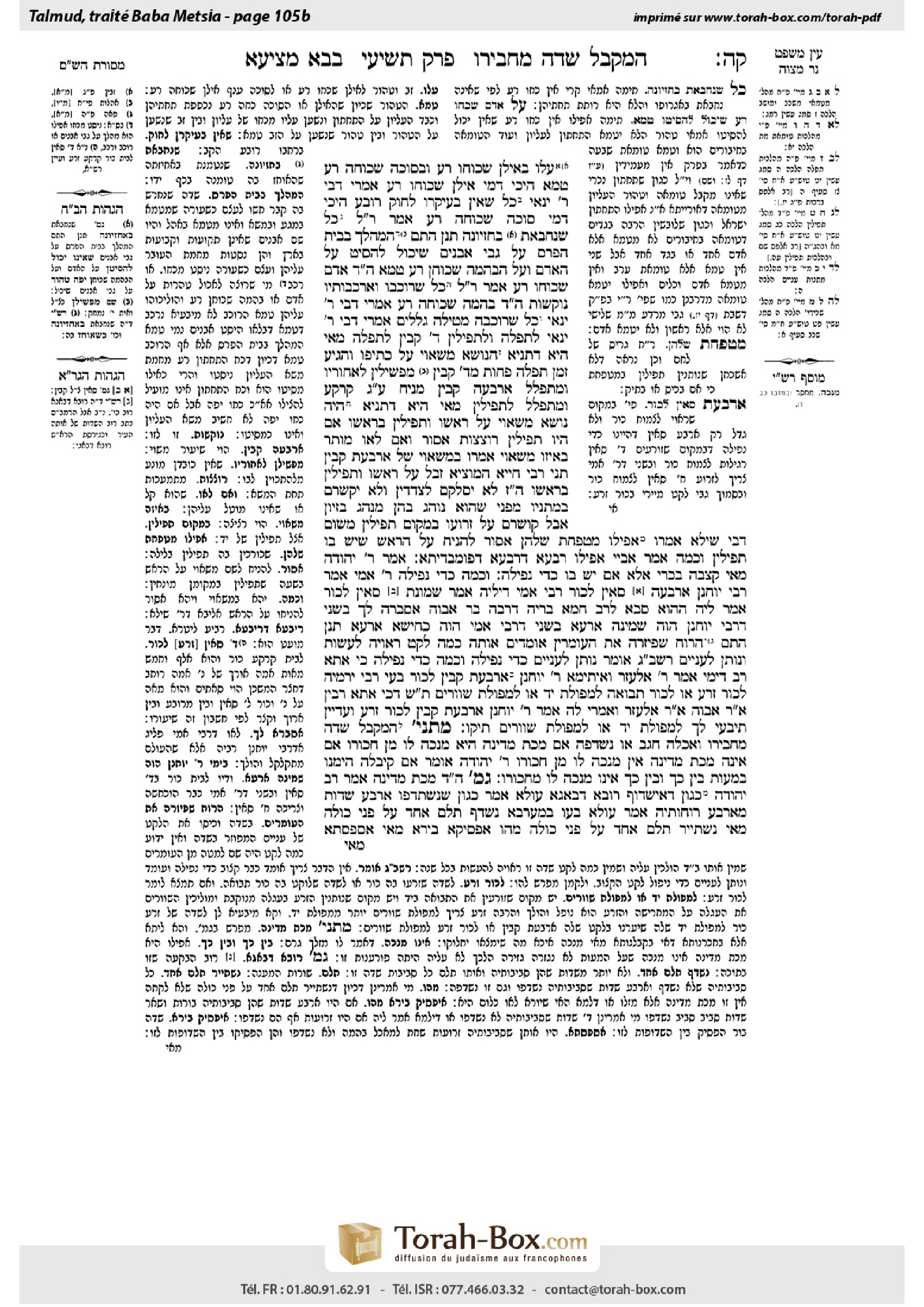
Bava Metzia 105b: Talmud study for Daf Yomi
Study the Talmud for Daf Yomi with scanned pages, Hebrew text, English translations from Sefaria and AI-generated French translations.
Passage selection and English or AI-generated French translation are available where the scan has annotations. Daf Study is independent of Torah-Box and Sefaria.
Browse Bava Metzia · בבא מציעא · All tractatesBava Metzia 105b text and translations
This page of Bava Metzia includes the Aramaic text, an English translation and an AI-generated French translation, alongside the scan above.
בבא מציעא ק״ה ב · Aramaic and Hebrew text
עָלוּ בְּאִילָן שֶׁכּוֹחוֹ רַע, וּבְסוֹכָה שֶׁכּוֹחָהּ רַע – טָמֵא.
הֵיכִי דָּמֵי אִילָן שֶׁכּוֹחוֹ רַע? אָמְרִי דְּבֵי רַבִּי יַנַּאי: כֹּל שֶׁאֵין בְּעִיקָּרוֹ לָחוֹק רוֹבַע. הֵיכִי דָּמֵי סוֹכָה שֶׁכּוֹחָהּ רַע? אָמַר רֵישׁ לָקִישׁ: כֹּל שֶׁנֶּחְבֵּאת בְּחֶזְיוֹנָהּ.
תְּנַן הָתָם: הַמְהַלֵּךְ בְּבֵית הַפְּרָס, עַל גַּבֵּי אֲבָנִים שֶׁיָּכוֹל לְהָסִיט, עַל הָאָדָם וְעַל הַבְּהֵמָה שֶׁכּוֹחָן רַע – טָמֵא.
הֵיכִי דָּמֵי אָדָם שֶׁכּוֹחוֹ רַע? אָמַר רֵישׁ לָקִישׁ: כֹּל שֶׁרוֹכְבוֹ וְאַרְכֻבּוֹתָיו נוֹקְשׁוֹת. הֵיכִי דָּמֵי בְּהֵמָה שֶׁכּוֹחָהּ רַע? אָמְרִי דְּבֵי רַבִּי יַנַּאי: כֹּל שֶׁרוֹכְבָהּ [וּ]מְטִילָה גְּלָלִים.
אָמְרִי דְּבֵי רַבִּי יַנַּאי: לִתְפִלָּה וְלִתְפִילִּין אַרְבָּעָה קַבִּין.
לִתְפִלָּה מַאי הִיא? דְּתַנְיָא: הַנּוֹשֵׂא מַשּׂאוֹי עַל כְּתֵיפוֹ וְהִגִּיעַ זְמַן תְּפִלָּה, פָּחוֹת מֵאַרְבָּעָה קַבִּין – מַפְשִׁילָין לַאֲחוֹרָיו וּמִתְפַּלֵּל. אַרְבָּעָה קַבִּין – מַנִּיחַ עַל גַּבֵּי קַרְקַע וּמִתְפַּלֵּל.
לִתְפִילִּין מַאי – הִיא דְּתַנְיָא: הָיָה נוֹשֵׂא מַשּׂאוֹי עַל רֹאשׁוֹ וּתְפִילִּין בְּרֹאשׁוֹ, אִם הָיוּ תְּפִילִּין רוֹצְצוֹת – אָסוּר, וְאִם לָאו – מוּתָּר. בְּאֵיזוֹ מַשּׂאוֹי אָמְרוּ – בְּמַשּׂאוֹי שֶׁל אַרְבַּעַת קַבִּין.
תָּנֵי רַבִּי חִיָּיא: הַמּוֹצִיא זֶבֶל עַל רֹאשׁוֹ וּתְפִילִּין בְּרֹאשׁוֹ – הֲרֵי זֶה לֹא יְסַלְּקֵם לִצְדָדִין, וְלֹא יִקְשְׁרֵם בְּמׇתְנָיו, מִפְּנֵי שֶׁהוּא נוֹהֵג בָּהֶן מִנְהַג בִּזָּיוֹן. אֲבָל קוֹשְׁרָם עַל זְרוֹעוֹ בִּמְקוֹם תְּפִילִּין.
מִשּׁוּם רַבִּי שֵׁילָא אָמְרוּ: אֲפִילּוּ מִטְפַּחַת שֶׁלָּהֶן אָסוּר לְהַנִּיחַ עַל הָרֹאשׁ שֶׁיֵּשׁ בּוֹ תְּפִילִּין. וְכַמָּה? אָמַר אַבָּיֵי: אֲפִילּוּ רִבְעָא דְּרִבְעָא דְּפוּמְבְּדִיתָא.
אָמַר רַבִּי יְהוּדָה: מַאי קִצְבָה בִּכְרִי? אֶלָּא: אִם יֵשׁ בּוֹ כְּדֵי נְפִילָה. וְכַמָּה כְּדֵי נְפִילָה? רַבִּי אַמֵּי אָמַר רַבִּי יוֹחָנָן: אַרְבַּעה סְאִין לְכוֹר. רַבִּי אַמֵּי דִּילֵיהּ אָמַר: שְׁמוֹנַת סְאִין לְכוֹר. אֲמַר לֵיהּ הָהוּא סָבָא לְרַב חָמָא בְּרֵיהּ דְּרַבָּה בַּר אֲבוּהּ: אַסְבְּרַהּ לָךְ, בִּשְׁנֵי דְּרַבִּי יוֹחָנָן הֲוָה שַׁמִּינָא אַרְעָא, בִּשְׁנֵי דְּרַבִּי אַמֵּי הֲוָה כְּחִישָׁא אַרְעָא.
תְּנַן הָתָם: הָרוּחַ שֶׁפִּיזְּרָה אֶת הָעוֹמָרִין, אוֹמְדִים אוֹתָהּ כַּמָּה לֶקֶט רְאוּיָה לַעֲשׂוֹת וְנוֹתֵן לַעֲנִיִּים. רַבָּן שִׁמְעוֹן בֶּן גַּמְלִיאֵל אוֹמֵר: נוֹתֵן לַעֲנִיִּים כְּדֵי נְפִילָה.
וְכַמָּה כְּדֵי נְפִילָה? כִּי אֲתָא רַב דִּימִי, אָמַר רַבִּי אֶלְעָזָר וְאִיתֵּימָא רַבִּי יוֹחָנָן: אַרְבַּעַת קַבִּין לְכוֹר. בָּעֵי רַבִּי יִרְמְיָה: לְכוֹר זֶרַע, אוֹ לְכוֹר תְּבוּאָה? לְמַפּוֹלֶת יָד, אוֹ לְמַפּוֹלֶת שְׁווֹרִים?
תָּא שְׁמַע, דְּכִי אֲתָא רָבִין, אָמַר רַבִּי אֲבוּהּ אָמַר רַבִּי אֶלְעָזָר, וְאָמְרִי לָהּ אָמַר רַבִּי יוֹחָנָן: אַרְבַּעַת קַבִּין לְכוֹר זֶרַע. וַעֲדַיִין תִּבְּעֵי לָךְ: לְמַפּוֹלֶת יָד אוֹ לְמַפּוֹלֶת שְׁווֹרִים? תֵּיקוּ.
מַתְנִי׳ הַמְקַבֵּל שָׂדֶה מֵחֲבֵירוֹ וַאֲכָלָהּ חָגָב, אוֹ נִשְׁדְּפָה. אִם מַכַּת מְדִינָה הִיא – מְנַכֶּה לוֹ מִן חֲכוֹרוֹ. אִם אֵינָהּ מַכַּת מְדִינָה – אֵין מְנַכֶּה לוֹ מִן חֲכוֹרוֹ. רַבִּי יְהוּדָה אוֹמֵר: אִם קִיבְּלָהּ הֵימֶנּוּ בְּמָעוֹת, בֵּין כָּךְ וּבֵין כָּךְ אֵינוֹ מְנַכֶּה לוֹ מֵחֲכוֹרוֹ.
גְּמָ׳ הֵיכִי דָמֵי מַכַּת מְדִינָה? אָמַר רַב יְהוּדָה: כְּגוֹן דְּאִישְׁתְּדוּף רוּבָּא דְבָאגָא. עוּלָּא אָמַר: כְּגוֹן שֶׁנִּשְׁתַּדְּפוּ אַרְבַּע שָׂדוֹת מֵאַרְבַּע רוּחוֹתֶיהָ.
אָמַר עוּלָּא, בָּעוּ בְּמַעְרְבָא: נִשְׁדַּף תֶּלֶם אֶחָד עַל פְּנֵי כּוּלָּהּ, מַאי? נִשְׁתַּיֵּיר תֶּלֶם אֶחָד עַל פְּנֵי כּוּלָּהּ, מַהוּ? אִפְּסִיקא בְּיָרָא, מַאי? אַסְפַּסְתָּא,
Bava Metzia 105b · English translation
If a zav and a ritually pure person climbed a tree that has little strength, which shook as they climbed it, or if they climbed onto a branch that has little strength, the ritually pure person is rendered ritually impure. One of the ways a zav imparts impurity is by movement, and here the zav is viewed as having moved the pure person.
The Gemara asks: What are the circumstances of this tree that has little strength, i.e., how is a tree with little strength defined? The Sages of the school of Rabbi Yannai say: It is any tree whose trunk is not broad enough that one can hollow out a vessel of a quarter-kav from it. What are the circumstances of a branch that has little strength? Reish Lakish said: It is any branch concerning which its circumference can be hidden, i.e., inserted, in a person’s fist. A branch of this size is generally not strong enough to hold two people without shaking.
We learned in a mishna elsewhere (Oholot 18:6): With regard to one who walks in an area in which uncertainty exists concerning the location of a grave or corpse [beit haperas], if he treads over stones that he can move as he walks, raising concerns that he might have moved a bone of a corpse and thereby rendered himself impure, or if he was in that location, on the back of a person or riding on an animal that had little strength, he is impure, as he is considered to have moved the impurity himself.
The Gemara asks: What are the circumstances of a person that has little strength? Reish Lakish said: Any person whose knees knock against each other when someone rides upon him. What are the circumstances of an animal that has little strength? The Sages of the school of Rabbi Yannai say: Any animal that releases excrement due to strain when a person rides upon it.
§ As the Gemara has cited the rulings of the school of Rabbi Yannai with regard to measurements, it now cites similar halakhot that the Sages of the school of Rabbi Yannai state: With regard to prayer and with regard to phylacteries, the measure is four kav.
The Gemara inquires: What is the relevance of this measure with regard to prayer? This is as it is taught in a baraita: With regard to one who carries a load on his shoulder and the time for prayer arrives, if the load is less than four kav, he lowers it behind him while still holding it and prays, as a light load of this size does not interfere with prayer. If the load is four kav, he places it on the ground and prays.
What is the relevance of this amount with regard to phylacteries? This is as it is taught in a baraita: If a man was carrying a load on his head and he had phylacteries on his head, if the phylacteries were being crushed under the load it is forbidden to leave them on his head, but if they were not being crushed, it is permitted. With regard to which load did the Sages state this halakha? They stated it with regard to a load of four kav.
Rabbi Ḥiyya teaches: With regard to one who removes garbage by carrying it on his head and has phylacteries on his head, he may not move the phylacteries to the side to prevent them from being crushed, and likewise he may not tie the phylacteries of the head to his loins because he thereby treats them in a manner of degradation. But he may tie them on his arm in the location where the phylacteries of the hand are placed.
The Sages said in the name of the school of Sheila: It is forbidden to place on the head of one that has phylacteries on it even the scarf in which they are wrapped. The Gemara asks: And how much does Rabbi Sheila permit one to place on his head while wearing phylacteries? Abaye said: Even as little as one-quarter of one-quarter of the smallest measurement of Pumbedita is still forbidden from being placed on one’s head.
§ The mishna teaches: Rabbi Yehuda says: What fixed measure is a pile? Rather, the relevant issue is whether it has a crop equivalent to the measure of seeds for dropping in a field in order to sow it. The Gemara asks: And how much is equivalent to the measure of seeds for dropping in a field in order to sow it? Rabbi Ami says that Rabbi Yoḥanan says: Four se’a for the amount of land sufficient to grow a kor. Rabbi Ami himself, though, says eight se’a for the amount of land sufficient to grow a kor. A certain elder said to Rav Ḥama, son of Rabba bar Avuh: I will explain it to you: In the years of Rabbi Yoḥanan the land was fat, while in the years of Rabbi Ami the land was lean, and it was therefore necessary to double the amount of seed for each unit of land.
We learned in a mishna elsewhere (Pe’a 5:1): If the wind scattered the standing sheaves so that it is no longer known which gleanings fell from the sheaves during the harvest and belong to the poor, one evaluates how many gleanings it was fit to produce, and he gives these to the poor. Rabban Shimon ben Gamliel says: He gives to the poor the amount equivalent to the measure of seeds dropping in the course of harvesting.
The Gemara asks: And how much is the amount equivalent to the measure of seeds dropping in the course of harvesting? When Rav Dimi came from Eretz Yisrael he said that Rabbi Elazar said, and some say it was Rabbi Yoḥanan: Four kav for a kor. Rabbi Yirmeya raised a dilemma: Does this mean for a field that requires a kor of seed to plant it, or for a kor of produce? And if it is the former, does it refer to sowing by hand or to sowing by oxen?
The Gemara answers: Come and hear, as when Ravin came from Eretz Yisrael he said that Rabbi Avuh said that Rabbi Elazar said, and some say that Rabbi Yoḥanan said: Four kav for a field sown with a kor of seed. The Gemara comments: And the other question should still raise a dilemma for you: Does this refer to sowing by hand or to sowing by oxen? No answer was found for this question, and the dilemma shall stand unresolved.
MISHNA: In the case of one who receives a field from another to cultivate and grasshoppers consumed it or it was wind blasted, if it is a regional disaster which affected all the fields in the area, the cultivator subtracts from the produce he owes as part of his tenancy. If it is not a regional disaster, the cultivator does not subtract from the produce he owes as part of his tenancy. Rabbi Yehuda says: If the cultivator received it from the owner for a fixed sum of money, whether this way, i.e., there is a regional disaster, or whether that way, i.e., there was no regional disaster, he does not subtract the produce he owes as part of his tenancy.
GEMARA: The Gemara asks: What are the circumstances of a regional disaster? Rav Yehuda said: If, for example, most of that valley in which the field was located was wind blasted, it is considered a regional disaster. Ulla said: If, for example, four fields were wind blasted on its four sides, it is considered a regional disaster.
Ulla also said: They raise the following dilemma in the West, Eretz Yisrael: If one furrow was wind blasted along its entire length, adjacent to other fields that were wind blasted, what is the halakha? Is this considered to be part of the regional disaster? Conversely, if one furrow remained undamaged along its entire length, what is the halakha? Does the remaining furrow mean that the entire field is not considered to be part of the regional disaster? If a fallow field divided between the cultivated fields and the fields that were wind blasted, what is the halakha? Alternatively, if there was a field of fodder between this field and the others that were wind blasted,
Bava Metzia 105b · Traduction française (IA)
Si un zav et une personne pure montent un arbre qui a peu de force, qui tremble lorsqu'ils montent dessus, ou si ils montent sur une branche qui a peu de force, la personne pure devient impure. L'une des manières dont un zav transmet l'impureté est par mouvement, et ici le zav est considéré comme ayant fait bouger la personne pure.
Le Guemara pose la question : Quelles sont les circonstances de cet arbre qui a peu de force, c'est-à-dire comment définir un arbre qui a peu de force ? Les Sages de l'école de Rabbi Yannai disent : C'est tout arbre dont le tronc n'est pas suffisamment épais pour qu'on puisse en faire un récipient d'un quart de kav. Quelles sont les circonstances d'une branche qui a peu de force ? Reish Lakish dit : C'est toute branche dont la circonférence peut être cachée, c'est-à-dire insérée, dans la main d'une personne. Une branche de cette taille n'est généralement pas assez solide pour supporter deux personnes sans trembler.
Nous avons appris dans une mitsna ailleurs (Oholot 18:6) : Concernant celui qui marche dans un lieu où il y a incertitude sur la localisation d'un tombeau ou d'un cadavre [beit haperas], si il marche sur des pierres qu'il peut déplacer alors qu'il marche, ce qui suscite des inquiétudes qu'il pourrait avoir déplacé un os de cadavre et ainsi devenir impur, ou s'il était dans ce lieu, sur le dos d'une personne ou monté sur un animal qui a peu de force, il est impur, car il est considéré comme ayant fait bouger lui-même l'impureté.
Le Guemara pose la question : Quelles sont les circonstances d'une personne qui a peu de force ? Reish Lakish dit : Toute personne dont les genoux se heurtent l'un contre l'autre lorsqu'on monte dessus. Quelles sont les circonstances d'un animal qui a peu de force ? Les Sages de l'école de Rabbi Yannai disent : Toute bête qui excreta du fumier en raison de l'effort lorsqu'on monte dessus.
§ Comme le Guemara a cité les décisions de l'école de Rabbi Yannai concernant les mesures, il cite maintenant des halakhot similaires que les Sages de l'école de Rabbi Yannai affirment : Concernant la prière et concernant les phylactères, la mesure est de quatre kav.
Le Guemara interroge : Quel est le rapport de cette mesure concernant la prière ? C'est comme il est enseigné dans une baraïta : Concernant celui qui porte un fardeau sur ses épaules et que l'heure de la prière arrive, si le fardeau est inférieur à quatre kav, il le place derrière lui tout en le tenant et prie, car un fardeau léger de cette taille ne gêne pas la prière. Si le fardeau est de quatre kav, il le pose au sol et prie.
Quel est le rapport de cette quantité concernant les phylactères ? C'est comme il est enseigné dans une baraïta : Si un homme portait un fardeau sur sa tête et avait des phylactères sur sa tête, si les phylactères étaient écrasés sous le fardeau, il est interdit de les laisser sur sa tête, mais si ils ne l'étaient pas, il est permis. Concernant quel fardeau les Sages ont-ils énoncé cette halakha ? Ils l'ont énoncé concernant un fardeau de quatre kav.
Rabbi Ḥiyya enseigne : Concernant celui qui transporte des déchets en les portant sur sa tête et qui a des phylactères sur sa tête, il ne doit pas déplacer les phylactères vers le côté pour les protéger de l'écrasement, et de même il ne doit pas attacher les phylactères de la tête à ses hanches car il les traiterait ainsi de manière dégradante. Mais il peut les attacher sur son bras au lieu où les phylactères de la main sont placés.
Les Sages ont dit en nom de l'école de Sheila : Il est interdit de placer sur la tête d'une personne qui porte des phylactères même le foulard dans lequel ils sont enveloppés. Le Guemara pose la question : Et combien permet Rabbi Sheila de placer sur la tête lorsqu'on porte des phylactères ? Abaye a dit : Même une quantité aussi petite que un quart d'un quart de la plus petite mesure de Pumbedita est encore interdite de placer sur sa tête.
§ La mitsna enseigne : Rabbi Yehuda dit : Quelle mesure fixe est un tas ? Plutôt, l'important est de savoir si la récolte est équivalente à la mesure de grain destiné à être semé dans un champ pour le semer. Le Guemara pose la question : Et combien est équivalent à la mesure de grain destiné à être semé dans un champ pour le semer ? Rabbi Ami dit que Rabbi Yoḥanan dit : Quatre se'a pour la quantité de terre suffisante pour produire un kor. Rabbi Ami lui-même, cependant, dit huit se'a pour la quantité de terre suffisante pour produire un kor. Un certain vieillard a dit à Rav Ḥama, fils de Rabba bar Avuh : Je vais vous expliquer : Dans les années de Rabbi Yoḥanan la terre était fertile, tandis que dans les années de Rabbi Ami la terre était aride, et il a donc fallu doubler la quantité de grain pour chaque unité de terre.
Nous avons appris dans une mitsna ailleurs (Pe’a 5:1) : Si le vent avait dispersé les épis debout de sorte qu'il n'était plus possible de savoir quels grains de blé avaient été tombés des épis lors de la récolte et appartenaient aux pauvres, on évalue combien de grains il était convenable de produire, et on donne ces grains aux pauvres. Rabban Shimon ben Gamliel dit : Il donne aux pauvres la quantité équivalente à la mesure de grain destiné à être semé dans le cours de la récolte.
Le Guemara pose la question : Et combien est la quantité équivalente à la mesure de grain destiné à être semé dans le cours de la récolte ? Quand Rav Dimi est venu de la Terre d'Israël, il a dit que Rabbi Elazar a dit, et certains disent que c'était Rabbi Yoḥanan : Quatre kav pour un kor. Rabbi Yirmeya a soulevé un dilemme : Cela signifie-t-il pour un champ qui nécessite un kor de grain pour le semer, ou pour un kor de produit ? Et si c'est le premier cas, cela fait-il référence à la semence manuelle ou à la semence par bœufs ?
Le Guemara répond : Viens écouter, car quand Ravin est venu d'Israël, il a dit que Rabbi Avuh a dit que Rabbi Elazar a dit, et certains disent que Rabbi Yoḥanan a dit : Quatre kav pour un champ semé avec un kor de grain. Le Guemara commente : Et la question autrement devrait encore poser un dilemme pour toi : Cela fait-il référence à la semence manuelle ou à la semence par bœufs ? Aucune réponse n'a été trouvée à cette question, et le dilemme restera sans solution.
MICHNA : Dans le cas d'une personne qui reçoit un champ d'un autre pour le cultiver et que des criquets l'ont dévasté ou qu'il a été ravagé par le vent, si c'est un désastre régional qui a affecté tous les champs de la région, le cultivateur réduit la récolte qu'il doit produire en tant que locataire. Si ce n'est pas un désastre régional, le cultivateur ne réduit pas la récolte qu'il doit produire en tant que locataire. Rabbi Yehuda dit : Si le cultivateur l'a reçu de l'owner pour une somme fixe d'argent, qu'importe que ce soit ainsi, c'est-à-dire qu'il y ait eu un désastre régional, ou qu'il n'y ait pas eu de désastre régional, il ne réduit pas la récolte qu'il doit produire en tant que locataire.
GUEMARA : La Guemara pose la question : Quelles sont les circonstances d'un désastre régional ? Rav Yehuda a dit : Par exemple, si la plupart de cette vallée où se trouvait le champ a été ravagée par le vent, cela est considéré comme un désastre régional. Ulla a dit : Par exemple, si quatre champs ont été ravagés par le vent sur les quatre côtés, cela est considéré comme un désastre régional.
Ulla a aussi dit : Ils posent le suivant dilemme dans l'Ouest, Eretz Yisrael : Si un sillage a été ravagé par le vent tout au long de sa longueur, adjacent à d'autres champs qui ont été ravagés par le vent, quelle est la halakha ? Est-ce considéré comme faisant partie du désastre régional ? À l'inverse, si un sillage a resté intact tout au long de sa longueur, quelle est la halakha ? Le sillage intact signifie-t-il que l'ensemble du champ n'est pas considéré comme faisant partie du désastre régional ? Si un champ de repos divisé entre les champs cultivés et les champs ravagés par le vent, quelle est la halakha ? À l'alternative, si il y avait un champ de fourrage entre ce champ et les autres qui ont été ravagés par le vent,
Traduction française générée par IA à partir de l’édition anglaise de Sefaria. Vérifie toujours un passage avec le texte source.
Text from Sefaria: William Davidson Edition - Vocalized Aramaic (CC BY NC); William Davidson Edition - English (CC BY NC).