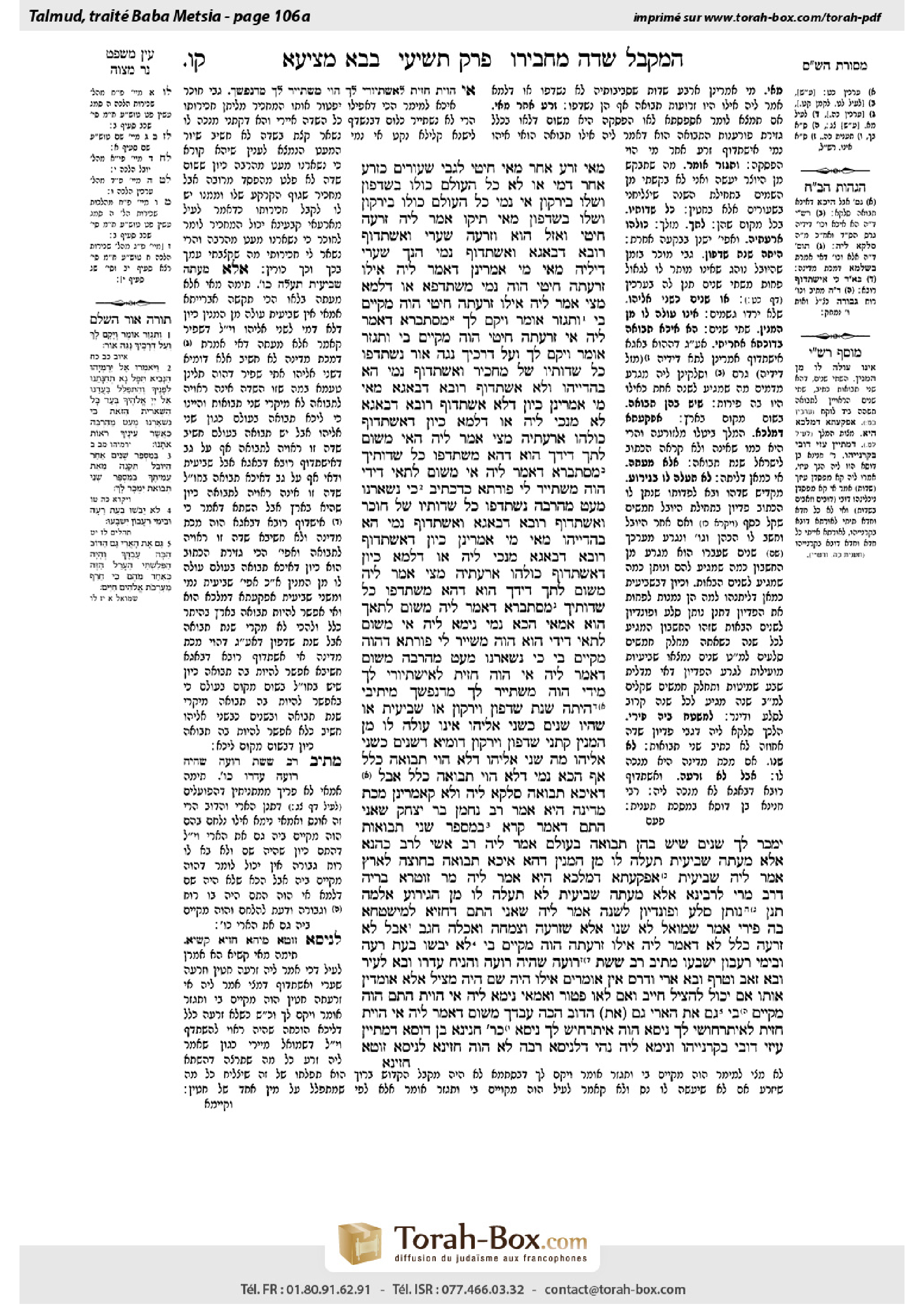
Bava Metzia 106a: Talmud study for Daf Yomi
Study the Talmud for Daf Yomi with scanned pages, Hebrew text, English translations from Sefaria and AI-generated French translations.
Passage selection and English or AI-generated French translation are available where the scan has annotations. Daf Study is independent of Torah-Box and Sefaria.
Browse Bava Metzia · בבא מציעא · All tractatesBava Metzia 106a text and translations
This page of Bava Metzia includes the Aramaic text, an English translation and an AI-generated French translation, alongside the scan above.
בבא מציעא ק״ו א · Aramaic and Hebrew text
מַאי? זֶרַע אַחֵר, מַאי? חִיטֵּי לְגַבֵּי (שְׂעוֹרִים) [שְׂעָרֵי] כְּזֶרַע אַחֵר דָּמֵי, אוֹ לָא? כָּל הָעוֹלָם כּוּלּוֹ בְּשִׁדָּפוֹן, וְשֶׁלּוֹ בְּיֵרָקוֹן, אִי נָמֵי: כָּל הָעוֹלָם כּוּלּוֹ בְּיֵרָקוֹן, וְשֶׁלּוֹ בְּשִׁדָּפוֹן, מַאי? תֵּיקוּ.
אֲמַר לֵיהּ: זִרְעַהּ חִיטֵּי, וַאֲזַל הוּא וְזַרְעַהּ שְׂעָרֵי, וְאִשְׁתְּדוּף רוּבָּא דְבָאגָא, וְאִשְׁתְּדוּף נָמֵי הָנָךְ שְׂעָרֵי דִּילֵיהּ, מַאי? מִי אָמְרִינַן דְּאָמַר לֵיהּ: אִילּוּ זְרַעְתַּהּ חִיטֵּי הֲוָה נָמֵי מִשְׁתַּדְפָא, אוֹ דִלְמָא מָצֵי אֲמַר לֵיהּ: אִילּוּ זְרַעְתַּהּ חִיטֵּי הֲוָה מִקַּיַּים בִּי ״וְתִגְזַר אֹמֶר וְיָקׇם לָךְ״?
מִסְתַּבְּרָא דְּאָמַר לֵיהּ: אִי זְרַעְתַּהּ חִיטֵּי הֲוָה מִקַּיַּים בִּי ״וְתִגְזַר אֹמֶר וְיָקׇם לָךְ וְעַל דְּרָכֶיךָ נָגַהּ אוֹר״.
נִשְׁתַּדְפוּ כׇּל שְׂדוֹתָיו שֶׁל מַחְכִּיר, וְאִשְׁתְּדוּף נָמֵי הָא בַּהֲדַיְיהוּ, וְלָא אִשְׁתְּדוּף רוּבָּא דְבָאגָא, מַאי? מִי אָמְרִינַן כֵּיוָן דְּלָא אִשְׁתְּדוּף רוּבָּא דְבָאגָא – לָא מְנַכֵּי לֵיהּ, אוֹ דִלְמָא כֵּיוָן דְּאִשְׁתְּדוּף כּוּלְּהוּ אַרְעָתֵיהּ, מָצֵי אֲמַר לֵיהּ: הַאי מִשּׁוּם לַתָּךְ דִּידָךְ הוּא, דְּהָא (מִשְׁתַּדְפוּ) [נִשְׁתַּדְפוּ] כָּל שְׂדוֹתֶיךָ.
מִסְתַּבְּרָא דְּאָמַר לֵיהּ: אִי מִשּׁוּם לַתַּאי דִּידִי – הֲוָה מִשְׁתַּיַּיר לִי פּוּרְתָּא, כְּדִכְתִיב: ״כִּי נִשְׁאַרְנוּ מְעַט מֵהַרְבֵּה״.
נִשְׁתַּדְפוּ כׇּל שְׂדוֹתָיו שֶׁל חוֹכֵר וְאִשְׁתְּדוּף רוּבָּא דְבָאגָא, וְאִשְׁתְּדוּף נָמֵי הָא בַּהֲדַיְיהוּ, מַאי? מִי אָמְרִינַן כֵּיוָן דְּאִשְׁתְּדוּף רוּבָּא דְבָאגָא מְנַכֵּי לֵיהּ, אוֹ דִלְמָא כֵּיוָן דְּאִשְׁתְּדוּף כּוּלְּהוּ אַרְעָתֵיהּ, מָצֵי אֲמַר לֵיהּ: מִשּׁוּם לַתָּךְ דִּידָךְ הוּא, דְּהָא (מִשְׁתַּדְפוּ) [נִשְׁתַּדְפוּ] כָּל שְׂדוֹתֶיךָ. מִסְתַּבְּרָא דְּאָמַר לֵיהּ: מִשּׁוּם לַתָּאךְ הוּא.
אַמַּאי? הָכָא נָמֵי נֵימָא לֵיהּ: אִי מִשּׁוּם לַתַּאי דִּידִי הוּא – הֲוָה מִשְׁ[תַּ]יַּיר לִי פּוּרְתָּא, דַּהֲוָה מִקַּיַּים בִּי ״כִּי נִשְׁאַרְנוּ מְעַט מֵהַרְבֵּה״. מִשּׁוּם דַּאֲמַר לֵיהּ: אִי הֲוָה חֲזֵית לְאִישְׁתַּיּוֹרֵי לָךְ מִידֵּי – הֲוָה מִשְׁתַּיַּיר לָךְ מִדְּנַפְשָׁךְ.
מֵיתִיבִי: הָיְתָה שְׁנַת שִׁדָּפוֹן וְיֵרָקוֹן, אוֹ שְׁבִיעִית, אוֹ שֶׁהָיוּ שָׁנִים כִּשְׁנֵי אֵלִיָּהוּ – אֵינוֹ עוֹלֶה לוֹ מִן הַמִּנְיָן.
קָתָנֵי: שִׁדָּפוֹן וְיֵרָקוֹן דּוּמְיָא דְּשָׁנִים כִּשְׁנֵי אֵלִיָּהוּ, מָה שְׁנֵי אֵלִיָּהוּ – דְּלָא הֲוַי תְּבוּאָה כְּלָל, אַף הָכָא נָמֵי – דְּלָא הֲוַי תְּבוּאָה כְּלָל. אֲבָל דְּאִיכָּא תְּבוּאָה – סָלְקָא לֵיהּ, וְלָא קָאָמְרִינַן מַכַּת מְדִינָה הִיא!
אָמַר רַב נַחְמָן בַּר יִצְחָק: שָׁאנֵי הָתָם, דְּאָמַר קְרָא: ״בְּמִסְפַּר שְׁנֵי תְבוּאֹת יִמְכׇּר לָךְ״, שָׁנִים שֶׁיֵּשׁ בָּהֶן תְּבוּאָה בָּעוֹלָם.
אֲמַר לֵיהּ רַב אָשֵׁי לְרַב כָּהֲנָא: אֶלָּא מֵעַתָּה שְׁבִיעִית תַּעֲלֶה לוֹ מִן הַמִּנְיָן, דְּהָא אִיכָּא תְּבוּאָה בְּחוּצָה לָאָרֶץ! אֲמַר לֵיהּ: שְׁבִיעִית אַפְקַעְתָּא דְמַלְכָּא הִיא.
אֲמַר לֵיהּ מָר זוּטְרָא בְּרֵיהּ דְּרַב מָרִי לְרָבִינָא: אֶלָּא מֵעַתָּה, שְׁבִיעִית לֹא תַּעֲלֶה לוֹ מִן הַגֵּירוּעַ! אַלְּמָה תְּנַן: נוֹתֵן סֶלַע וּפוּנְדְּיוֹן לְשָׁנָה! אֲמַר לֵיהּ: שָׁאנֵי הָתָם דְּחַזְיָא לְמִישְׁטַחא בַּהּ פֵּירֵי.
אָמַר שְׁמוּאֵל: לֹא שָׁנוּ, אֶלָּא שֶׁזְּרָעָהּ וְצִמְּחָה וַאֲכָלָהּ חָגָב. אֲבָל לֹא זְרָעָהּ כְּלָל – לָא, דְּאָמַר לֵיהּ: אִילּוּ זְרַעְתַּהּ הֲוָה מִקַּיַּים בִּי ״לֹא יֵבֹשׁוּ בְּעֵת רָעָה וּבִימֵי רְעָבוֹן יִשְׂבָּעוּ״.
מֵתִיב רַב שֵׁשֶׁת: רוֹעֶה שֶׁהָיָה רוֹעֶה וְהִנִּיחַ עֶדְרוֹ וּבָא לָעִיר, וּבָא זְאֵב וְטָרַף, וּבָא אֲרִי וְדָרַס – אֵין אוֹמְרִים: אִילּוּ הָיָה שָׁם הָיָה מַצִּיל, אֶלָּא אוֹמְדִין אוֹתוֹ אִם יָכוֹל לְהַצִּיל – חַיָּיב, וְאִם לָאו – פָּטוּר. וְאַמַּאי? נֵימָא לֵיהּ: אִי הֲוֵית הָתָם הֲוָה מִקַּיַּים בִּי ״גַּם אֶת הָאֲרִי גַּם הַדּוֹב הִכָּה עַבְדֶּךָ״!
מִשּׁוּם דַּאֲמַר לֵיהּ: אִי הֲוֵית חֲזֵית לְאִיתְרְחוֹשֵׁי לָךְ נִיסָּא, הֲוָה (אִיתְרְחִישׁ) [מִיתְרְחִישׁ] לָךְ נִיסָּא כְּרַבִּי חֲנִינָא בֶּן דּוֹסָא דְּמֵתְיָין עִיזֵּי דּוּבֵּי בְּקַרְנַיְיהוּ. וְנֵימָא לֵיהּ: נְהִי דִּלְנִיסָּא רַבָּה לָא הֲוָה חֲזֵינָא – לְנִיסָּא זוּטָא
Bava Metzia 106a · English translation
what is the halakha? If the surrounding fields were planted with a different type of seed, what is the halakha? Likewise, is wheat, in relation to barley, considered like a different type of seed or not? Furthermore, if the entire world, i.e., all the surrounding fields, were blighted by windblasts and his was affected by mildew; or alternatively, if the fields of the entire world were struck by mildew, and his were blighted with windblasts, what is the halakha? The Gemara responds: No resolution is found to any of these dilemmas, and the dilemmas shall stand unresolved.
The Gemara poses another question: If the owner said to the tenant farmer: Plant the field with wheat, and he went and planted it with barley, and most of the valley was wind blasted, and these fields with barley of his were also wind blasted, what is the halakha? Do we say that the tenant farmer can say to him: Even if I had planted it with wheat it would likewise have been wind blasted, as all the surrounding fields suffered the same fate, or perhaps the owner can say to him: Had you planted it with wheat, the following verse would have been fulfilled for me: “And you shall decree a matter and it will be established for you, and the light shall shine upon your ways” (Job 22:28), since you might have merited greater success by following my wishes.
The Gemara responds: It stands to reason that the owner can say to him: Had you planted it with wheat it would have fulfilled for me: “And you shall decree a matter and it will be established for you, and the light shall shine upon your ways.”
The Gemara presents another question: If all the fields of the owner of the land were wind blasted and this one was also wind blasted with them, but the majority of the valley was not wind blasted, what is the halakha? Do we say that since the majority of the valley was not wind blasted the tenant farmer does not subtract for the owner the amount owed for his tenancy, as this is not a regional disaster, or perhaps could one claim that since all the lands of the owner were wind blasted the tenant can say to the owner: This happened due to your bad fortune, as all your fields were wind blasted?
The Gemara responds: It stands to reason that the owner can say to the tenant: If it was due to my bad fortune, a little would have been left for me, as it is written: “For we are left but a few from many” (Jeremiah 42:2), which indicates that even one suffering from misfortune does not lose all he has.
The Gemara discusses a similar case: If all the fields of the tenant farmer were wind blasted and most of the valley was wind blasted and this field was also wind blasted with them, what is the halakha? Do we say that since most of the valley was wind blasted the tenant farmer subtracts for the owner the amount owed for his tenancy and does not pay, or perhaps, since all the tenant’s lands were wind blasted, the owner can say to the tenant: The damage is due to your bad fortune, as all your fields were wind blasted. The Gemara responds: It stands to reason that the owner can say to him: It occurred due to your bad fortune.
The Gemara asks: Why should this be so? Here too, let us say to the owner: If it was due to my bad fortune, a little would have been left for me, as the following verse would have been fulfilled for me: “For we are left but a few from many.” The Gemara answers: This is not a valid claim because the owner can say to the tenant: Had you been worthy of something being left for you, it would have been left from your own private land, not the field you paid to cultivate.
The Gemara raises an objection from a mishna to the ruling that if there is a regional disaster the cultivator subtracts from the produce he owes as part of his tenancy. The halakha is that if one sells his field in Eretz Yisrael in a time when the halakhot of the Jubilee Year are in effect, he does not have the right to purchase it from the buyer until two years have passed. The mishna teaches (Arakhin 29b): If it was a year of wind-blasted crops or mildew or it was the Sabbatical Year, or if those years were like the years of Elijah in which no rain fell (see I Kings 17:1, 18:1–2), they do not count as part of his tally of years before he may repurchase his land.
The Gemara analyzes the mishna: This tanna teaches that the cases of windblasts and mildew are similar to the case where the years were like the years of Elijah. Just as the years of Elijah is referring to a time when there was no produce at all, so too, here, windblasts and mildew are referring to cases when there was no produce at all. But by inference, one can learn that if there was some produce, it counts toward his tally of years before he may repurchase his land, and we do not say that it is a regional disaster.
The Gemara answers: Rav Naḥman bar Yitzḥak said: There, the case with regard to the sold field is different, as the verse states with regard to the sale and leasing of fields: “According to the numbers of years of the crops he shall sell to you” (Leviticus 25:15), which is referring to years in which there is produce harvested in the world.
Rav Ashi said to Rav Kahana: If that is so, the Sabbatical Year should count for him as part of his tally of years, as at least there is produce outside of Eretz Yisrael. Rav Kahana said to him: The Sabbatical Year is an abrogation of the King, i.e., God. Therefore, it should not be included in the number of the years before land is repurchased.
Mar Zutra, son of Rav Mari, said to Ravina: If that is so, that the Sabbatical Year is entirely disregarded, then in the case of one who consecrates his field and wants to redeem it, the Sabbatical Year should not count for him for the deduction of the price of the field when it is redeemed. Why did we learn in a mishna (Arakhin 25a) that the one who consecrated his field gives a sela and a pundeyon coin, which is worth 16 perutot, to the Temple treasury for each year remaining until the Jubilee Year, including the Sabbatical Year, in accordance with the payment prescribed by the Torah (see Leviticus 27:16–19)? The amount to be paid per year, which is fifty shekels divided by the years remaining until the Jubilee Year, should not take the upcoming Sabbatical Years into account. Ravina said to him: There it is different, as it is suitable for laying out produce on it. Although one may not plant the field during the Sabbatical Year, one may use it for other purposes.
Shmuel said: They taught the halakha that if there is a regional disaster the cultivator subtracts from the produce he owes as part of his tenancy only if the tenant planted the field and it sprouted and then grasshoppers consumed it, or if he planted it with a different seed, but if he did not plant it at all, the tenant is not entitled to subtract from the amount he owes even if there was a regional disaster. This is because the owner can say to him: Had you planted it, perhaps my merit would have prevented the field from being affected by the epidemic, and the following verse would have been fulfilled for me: “They will not be shamed in the time of evil, and in the days of famine they shall be satisfied” (Psalms 37:19).
Rav Sheshet raises an objection from a baraita: In the case of a shepherd who was herding the animals of others, and he left his flock and came to the town, and in the meantime a wolf came and tore an animal to pieces, or a lion came and trampled one of the flock, we do not say definitively that had he been there he would have rescued them and therefore he is liable due to his absence. Rather, the court estimates with regard to him: If he could have rescued his animal by chasing a beast of this kind away, he is liable, as his departure from the scene was certainly a contributing factor to the damage. If not, he is exempt from liability. According to Shmuel’s opinion, why is the shepherd exempt from liability? Let the owner say to him: Had you been there, the following verse would have been fulfilled for me: “Your servant smote both the lion and the bear” (I Samuel 17:36).
The Gemara answers: This is because the shepherd could say to the owner: If you were worthy of a miracle occurring to you, a miracle would have indeed occurred to you as it did to Rabbi Ḥanina ben Dosa, when his goats brought bears impaled on their horns without any assistance on the part of a shepherd (see Ta’anit 25a). The Gemara asks: And let the owner say to him: Granted that I was not worthy of a great miracle, but of a small miracle
Bava Metzia 106a · Traduction française (IA)
quelle est la halakha ? Si les champs environnants avaient été semés avec un autre type de grain, quelle est la halakha ? De même, le blé, par rapport au froment, est-il considéré comme un autre type de grain ou non ? De plus, si l'ensemble du monde, c'est-à-dire tous les champs environnants, avait été touché par des tempêtes de vent et le sien avait été affecté par la moisissure ; ou, à l'inverse, si les champs du monde entier avaient été touchés par la moisissure et le sien par des tempêtes de vent, quelle est la halakha ? La Guemara répond : Aucune solution n'est trouvée à aucun de ces dilemmes, et ces dilemmes resteront sans solution.
La Guemara pose une autre question : Si l'owner a dit au fermier : Semez le champ avec du blé, et il a semé avec du froment, et la plupart de la vallée a été touchée par des tempêtes de vent, et ces champs de froment à lui ont aussi été touchés par des tempêtes de vent, quelle est la halakha ? Disons-nous que le fermier peut dire à l'owner : Même si j'avais semé avec du blé, cela aurait également été touché par des tempêtes de vent, car tous les champs environnants ont subi le même sort, ou peut-être l'owner peut-il dire au fermier : Si tu avais semé avec du blé, la suivante verset serait accompli pour moi : « Et tu jugeras une affaire, et elle sera établie pour toi, et la lumière brillera sur tes chemins » (Job 22:28), car tu aurais pu mériter un plus grand succès en suivant mes désirs.
La Guemara répond : Il est raisonnable que l'owner puisse dire au fermier : Si tu avais semé avec du blé, cela aurait accompli pour moi : « Et tu jugeras une affaire, et elle sera établie pour toi, et la lumière brillera sur tes chemins. »
La Guemara présente une autre question : Si tous les champs de l'propriétaire de la terre avaient été touchés par des tempêtes de vent et ce champ aussi avait été touché avec eux, mais la majorité de la vallée n'avait pas été touchée par des tempêtes de vent, quelle est la halakha ? Disons-nous que puisque la majorité de la vallée n'a pas été touchée par des tempêtes de vent, le fermier ne retranche pas pour l'propriétaire la somme due pour son bail, car ce n'est pas un désastre régional, ou peut-on affirmer que puisque tous les terres de l'propriétaire ont été touchées par des tempêtes de vent, le fermier peut dire à l'propriétaire : Cela s'est produit à cause de votre malheur, car tous vos champs ont été touchés par des tempêtes de vent ?
La Guemara répond : Il est raisonnable que l'propriétaire puisse dire au fermier : Si c'était à cause de mon malheur, un peu aurait été laissé pour moi, car il est écrit : « Car nous sommes restés mais quelques-uns de beaucoup » (Jérémie 42:2), ce qui indique que même celui qui souffre d'un malheur ne perd pas tout ce qu'il possède.
La Guemara discute d'un cas similaire : Si tous les champs du fermier avaient été touchés par des tempêtes de vent et la majorité de la vallée avait été touchée par des tempêtes de vent et ce champ avait aussi été touché avec eux, quelle est la halakha ? Disons-nous que puisque la majorité de la vallée a été touchée par des tempêtes de vent, le fermier retranche pour l'propriétaire la somme due pour son bail et ne paie pas, ou peut-on affirmer que puisque tous les terres du fermier ont été touchées par des tempêtes de vent, l'propriétaire peut dire au fermier : Le dommage est dû à votre malheur, car tous vos champs ont été touchés par des tempêtes de vent ? La Guemara répond : Il est raisonnable que l'propriétaire puisse dire au fermier : Cela s'est produit à cause de votre malheur.
La Guemara pose une question : Pourquoi devrait-ce être ainsi ? Ici aussi, disons à l'propriétaire : Si c'était à cause de mon malheur, un peu aurait été laissé pour moi, car la parole suivante serait accomplie pour moi : « Car nous sommes restés mais quelques-uns de beaucoup. » La Guemara répond : Ce n'est pas une revendication valide, car l'propriétaire peut dire au fermier : Si tu avais été digne de quelque chose être laissé pour toi, cela aurait été laissé de ton propre terrain, pas du champ que tu as payé pour cultiver.
La Guemara soulève un objet d'une Michna sur la décision selon laquelle si un désastre régional survient, le cultivateur retranche de la récolte qu'il doit comme partie de son bail. La halakha est que si l'on vend son champ en Eretz Yisrael pendant une époque où les halakhot de l'année de Jubilé sont en effet, il n'a pas le droit d'acheter ce champ du acheteur jusqu'à ce que deux ans aient passé. La Michna enseigne (Arakhin 29b) : Si c'était une année de tempêtes de vent ou de moisissure ou si c'était l'année sabbatique, ou si ces années étaient comme les années d'Elie où il n'y avait pas de pluie (voir I Rois 17:1, 18:1–2), elles ne comptent pas comme partie de son compte des années avant qu'il ne puisse racheter son terrain.
La Guemara analyse la Michna : Ce tanna enseigne que les cas de tempêtes de vent et de moisissure sont semblables au cas où les années étaient comme les années d'Elie. Tout comme les années d'Elie font référence à une époque où il n'y avait pas de récolte du tout, de même ici, les tempêtes de vent et la moisissure font référence à des cas où il n'y avait pas de récolte du tout. Mais par déduction, on peut apprendre que si une récolte existait, cela compte comme partie de son compte des années avant qu'il ne puisse racheter son terrain, et nous ne disons pas que c'est un désastre régional.
La Guemara répond : Rav Naḥman bar Yitzḥak a dit : Là, le cas concernant le champ vendu est différent, car la verset dit concernant la vente et le bail des champs : « Selon le nombre d'années des récoltes qu'il te vend » (Lévitique 25:15), ce qui fait référence aux années où il y a une récolte dans le monde.
Rav Ashi a dit à Rav Kahana : Si c'est ainsi, l'année sabbatique devrait compter pour lui comme partie de son compte des années, car au moins il y a une récolte en dehors d'Eretz Yisrael. Rav Kahana a dit à lui : L'année sabbatique est une abrogation du Roi, c'est-à-dire Dieu. Par conséquent, elle ne devrait pas être incluse dans le nombre des années avant la reprise du terrain.
Mar Zutra, fils de Rav Mari, dit à Ravina : Si c'est ainsi, que l'année sabbatique est entièrement négligée, alors dans le cas d'une personne qui consacre son champ et veut le racheter, l'année sabbatique ne devrait pas compter pour lui lors du calcul du prix du champ lors de son rachat. Pourquoi avons-nous appris dans une mitsva (Arakhin 25a) que celui qui a consacré son champ verse un sela et un pundeyon, c'est-à-dire 16 perutot, au trésor du Temple pour chaque année restante jusqu'à l'année sabbatique, y compris l'année sabbatique, conformément au paiement prescrit par la Torah (voir Lévitique 27:16–19) ? La somme à payer par année, qui est cinquante sicles divisés par le nombre d'années restantes jusqu'à l'année sabbatique, ne devrait pas prendre en compte les années sabbatiques à venir. Ravina répondit à lui : C'est différent là, car c'est approprié pour l'exploitation des récoltes. Bien qu'on ne puisse pas planter le champ pendant l'année sabbatique, on peut l'utiliser à d'autres fins.
Shmuel dit : Ils ont appris la halakha selon laquelle, en cas de catastrophe régionale, le cultivateur ne peut déduire de la récolte qu'il doit comme locataire que si le locataire a planté le champ et qu'il a germé, puis que des criquets l'ont dévoré, ou s'il l'a planté avec une autre semence, mais si il n'a pas planté du tout, le locataire n'a pas le droit de déduire de la somme qu'il doit même s'il y a eu une catastrophe régionale. Cela est dû au fait que le propriétaire peut dire au locataire : Si tu avais planté, peut-être ma mérite aurait empêché le champ d'être affecté par l'épidémie, et la suivante versette serait accomplie pour moi : « Ils ne seront pas honteux en temps de malheur, et dans les jours de famine ils seront rassasiés » (Psaumes 37:19).
Rav Sheshet émet un objection à partir d'une baraïta : Dans le cas d'un berger qui faisait paître les animaux d'autrui, et qui a laissé son troupeau et est allé en ville, et pendant ce temps un loup est venu et a déchiré un animal, ou un lion est venu et a écrasé l'un des animaux du troupeau, nous ne disons pas définitivement qu'il aurait sauvé les animaux s'il était resté, et donc il est responsable à cause de son absence. Plutôt, la cour estime envers lui : Si il aurait pu sauver son animal en chassant un animal de ce genre, il est responsable, car son départ du lieu de l'incident a certainement été un facteur contributif à la dégradation. Si non, il est exempt de responsabilité. Selon l'opinion de Shmuel, pourquoi le berger est-il exempt de responsabilité ? Que le propriétaire dise à lui : Si tu étais là, la suivante versette serait accomplie pour moi : « Ton serviteur a tué à la fois le lion et l'ours » (I Samuel 17:36).
La Guemara répond : Cela est dû au fait que le berger pouvait dire au propriétaire : Si tu étais digne d'un miracle, un miracle aurait effectivement eu lieu pour toi comme celui de Rabbi Ḥanina ben Dosa, lorsque ses brebis ont ramené des ours impales sur leurs cornes sans aucune assistance du berger (voir Ta'anit 25a). La Guemara demande : Et que le propriétaire dise au berger : Admettons que je ne suis pas digne d'un grand miracle, mais d'un petit miracle.
Traduction française générée par IA à partir de l’édition anglaise de Sefaria. Vérifie toujours un passage avec le texte source.
Text from Sefaria: William Davidson Edition - Vocalized Aramaic (CC BY NC); William Davidson Edition - English (CC BY NC).