Bava Metzia 106b: Talmud study for Daf Yomi
Study the Talmud for Daf Yomi with scanned pages, Hebrew text, English translations from Sefaria and AI-generated French translations.
Passage selection and English or AI-generated French translation are available where the scan has annotations. Daf Study is independent of Torah-Box and Sefaria.
Browse Bava Metzia · בבא מציעא · All tractatesBava Metzia 106b text and translations
This page of Bava Metzia includes the Aramaic text, an English translation and an AI-generated French translation, alongside the scan above.
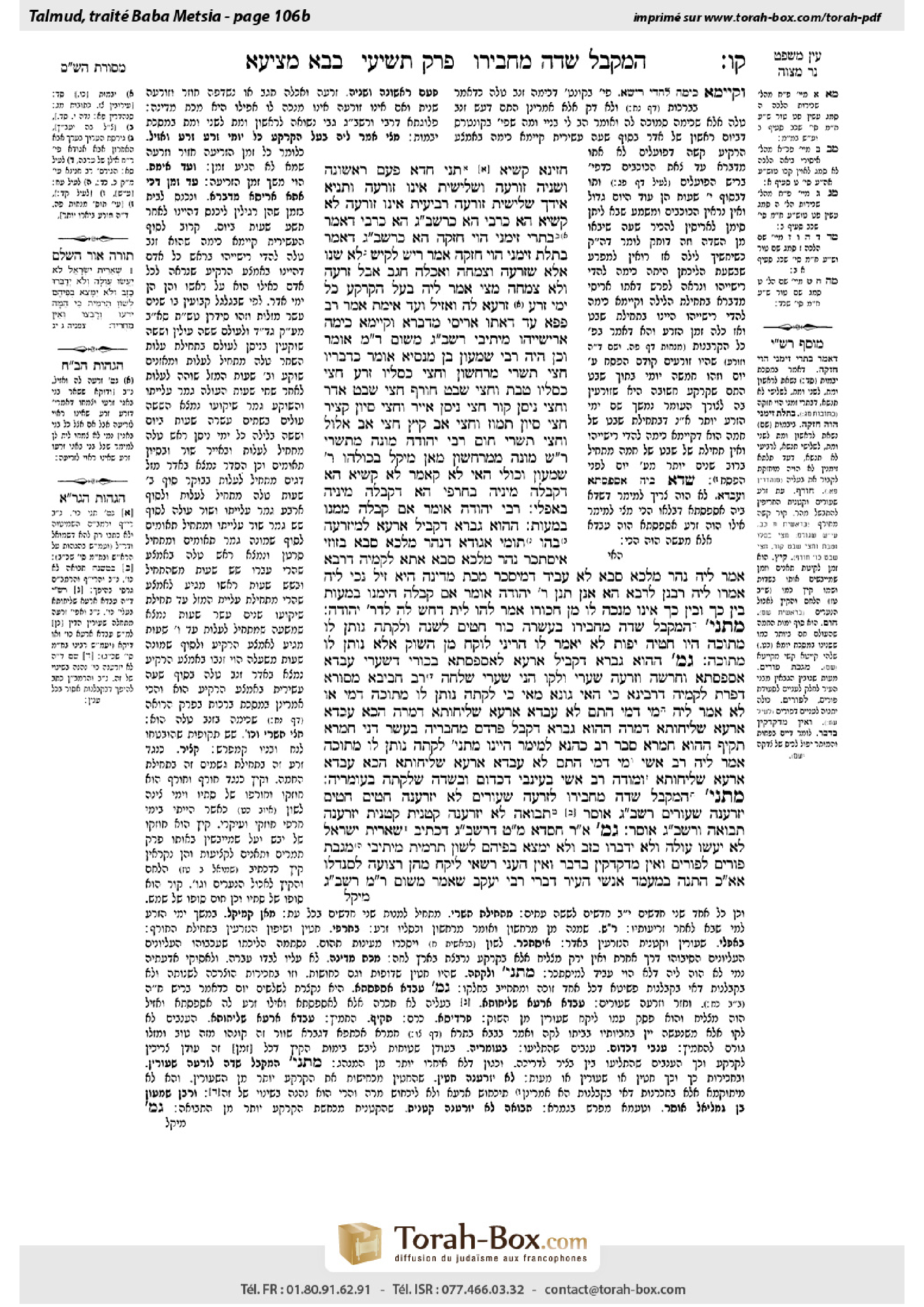
בבא מציעא ק״ו ב · Aramaic and Hebrew text
חֲזֵינָא? קַשְׁיָא.
תָּנֵי חֲדָא: פַּעַם רִאשׁוֹנָה וּשְׁנִיָּה זוֹרְעָהּ, וּשְׁלִישִׁית אֵינוֹ זוֹרְעָהּ. וְתַנְיָא אִידַּךְ: שְׁלִישִׁית זוֹרְעָהּ, רְבִיעִית אֵינוֹ זוֹרְעָהּ. לָא קַשְׁיָא: הָא כְּרַבִּי, הָא כְּרַבָּן שִׁמְעוֹן בֶּן גַּמְלִיאֵל.
הָא כְּרַבִּי, דְּאָמַר: בִּתְרֵי זִימְנֵי הָוְיָ[א] חֲזָקָה. הָא כְּרַבָּן שִׁמְעוֹן בֶּן גַּמְלִיאֵל, דְּאָמַר: בִּתְלָת זִימְנֵי הָוְיָ[א] חֲזָקָה.
אָמַר רֵישׁ לָקִישׁ: לֹא שָׁנוּ אֶלָּא שֶׁזְּרָעָהּ וְצִמְּחָה וַאֲכָלָהּ חָגָב. אֲבָל זְרָעָהּ וְלֹא צִמְּחָה – מָצֵי אֲמַר לֵיהּ בַּעַל הַקַּרְקַע: כׇּל יְמֵי זֶרַע זְרַעא לַהּ וֶאֱזִיל. וְעַד אֵימַת? אָמַר רַב פָּפָּא: עַד דְּאָתוּ אֲרִיסֵי מִדַּבְרָא וְקָיְימָא כִּימָה אַרֵישַׁיְיהוּ.
מֵיתִיבִי: רַבָּן שִׁמְעוֹן בֶּן גַּמְלִיאֵל מִשּׁוּם רַבִּי מֵאִיר אוֹמֵר, וְכֵן הָיָה רַבִּי שִׁמְעוֹן בֶּן מְנַסְיָא אוֹמֵר כִּדְבָרָיו: חֲצִי תִשְׁרֵי, מְרַחְשְׁוָן, וַחֲצִי כִסְלֵיו – זֶרַע.
חֲצִי כִסְלֵיו, טֵבֵת, וַחֲצִי שְׁבָט – חוֹרֶף. חֲצִי שְׁבָט, אֲדָר, וַחֲצִי נִיסָן – קוֹר. חֲצִי נִיסָן, אִיָּיר, וַחֲצִי סִיוָן – קָצִיר. חֲצִי סִיוָן, תַּמּוּז, וַחֲצִי אָב – קַיִץ. חֲצִי אָב, אֱלוּל, וַחֲצִי תִּשְׁרֵי – חוֹם.
רַבִּי יְהוּדָה מוֹנֶה מִתִּשְׁרִי, רַבִּי שִׁמְעוֹן מוֹנֶה מִמְּרַחְשְׁוָן.
מַאן מֵיקֵל בְּכוּלְּהוּ – רַבִּי שִׁמְעוֹן, וְכוּלֵּי הַאי לָא קָאָמַר! לָא קַשְׁיָא: הָא דְּקַבְּלַהּ מִינֵּיהּ בְּחָרְפֵי, הָא דְּקַבְּלֵהּ מִינֵּיהּ בְּאַפְלֵי.
רַבִּי יְהוּדָה אוֹמֵר: אִם קִבְּלָה מִמֶּנּוּ בְּמָעוֹת. הָהוּא גַּבְרָא דְּקַבֵּיל אַרְעָא לְמִיזְרַעה בַּהּו תּוּמֵי אַגּוּדָּא דִּנְהַר מַלְכָּא סָבָא בְּזוּזֵי. אִיסְתְּכַר נְהַר מַלְכָּא סָבָא. אֲתָא לְקַמֵּיהּ דְּרָבָא, אֲמַר לֵיהּ: נְהַר מַלְכָּא סָבָא לָא עֲבִיד דְּמִיסְתְּכַר, מַכַּת מְדִינָה הִיא, זִיל נַכֵּי לֵיהּ.
אֲמַרוּ לֵיהּ רַבָּנַן לְרָבָא: הָא אֲנַן תְּנַן, רַבִּי יְהוּדָה אוֹמֵר: אִם קִבְּלָה הֵימֶנּוּ בְּמָעוֹת – בֵּין כָּךְ וּבֵין כָּךְ אֵינוֹ מְנַכָּה לוֹ מִן חֲכוֹרוֹ! אֲמַר לְהוּ: לֵית דְּחָשׁ לַהּ לִדְרַבִּי יְהוּדָה.
מַתְנִי׳ הַמְקַבֵּל שָׂדֶה מֵחֲבֵירוֹ בַּעֲשָׂרָה כּוֹר חִטִּים לְשָׁנָה וְלָקְתָה – נוֹתֵן לוֹ מִתּוֹכָהּ. הָיוּ חִטֶּיהָ יָפוֹת, לֹא יֹאמַר לוֹ: הֲרֵינִי לוֹקֵחַ מִן הַשּׁוּק, אֶלָּא נוֹתֵן לוֹ מִתּוֹכָהּ.
גְּמָ׳ הָהוּא גַּבְרָא דְּקַבֵּיל אַרְעָא לְאַסְפַּסְתָּא בְּכוֹרֵי דִשְׂעָרֵי, עֲבַדָא אַסְפַּסְתָּא, וְחַרְשַׁהּ וְזַרְעַהּ שְׂעָרֵי, וּלְקוֹ הָנֵי שְׂעָרֵי. שַׁלְחַהּ רַב חֲבִיבָא מִסּוּרָא דִפְרָת לְקַמֵּיהּ דְּרָבִינָא, כִּי הַאי גַּוְנָא מַאי: כִּי ״לָקְתָה נוֹתֵן לוֹ מִתּוֹכָהּ״ דָּמֵי, אוֹ לָא?
אֲמַר לֵיהּ: מִי דָּמֵי? הָתָם לָא עֲבַדָא אַרְעָא שְׁלִיחוּתָא דְּמָרַהּ, הָכָא עֲבַדָא אַרְעָא שְׁלִיחוּתָא דְּמָרַהּ.
הָהוּא גַּבְרָא דְּקַבֵּל פַּרְדֵּס מֵחַבְרֵיהּ בַּעֲשַׂר דַּנֵּי חַמְרָא, תְּקֵיף הָהוּא חַמְרָא. סְבַר רַב כָּהֲנָא לְמֵימַר: הַיְינוּ מַתְנִיתִין – לָקְתָה נוֹתֵן לוֹ מִתּוֹכָהּ. אָמַר לֵיהּ רַב אָשֵׁי: מִי דָּמֵי? הָתָם לָא עֲבַדָא אַרְעָא שְׁלִיחוּתָא, הָכָא עֲבַדָא אַרְעָא שְׁלִיחוּתָא.
וּמוֹדֶה רַב אָשֵׁי בְּעִינְּבֵי דִּכְדוּם וּבְשָׂדֶה שֶׁלָּקְתָה בָּעוֹמָרֶיהָ.
מַתְנִי׳ הַמְקַבֵּל שָׂדֶה מֵחֲבֵירוֹ לְזׇרְעָהּ שְׂעוֹרִים – לֹא יִזְרָעֶנָּה חִטִּים. חִטִּים – יִזְרָעֶנָּה שְׂעוֹרִים, רַבָּן שִׁמְעוֹן בֶּן גַּמְלִיאֵל אוֹסֵר. תְּבוּאָה – לֹא יִזְרָעֶנָּה קִטְנִית. קִטְנִית – יִזְרָעֶנָּה תְּבוּאָה, וְרַבָּן שִׁמְעוֹן בֶּן גַּמְלִיאֵל אוֹסֵר.
גְּמָ׳ אָמַר רַב חִסְדָּא: מַאי טַעְמָא דְּרַבָּן שִׁמְעוֹן בֶּן גַּמְלִיאֵל, דִּכְתִיב: ״שְׁאֵרִית יִשְׂרָאֵל לֹא יַעֲשׂוּ עַוְלָה וְלֹא יְדַבְּרוּ כָזָב וְלֹא יִמָּצֵא בְּפִיהֶם לְשׁוֹן תַּרְמִית״.
מֵיתִיבִי: מִגְבַּת פּוּרִים לְפוּרִים, וְאֵין מְדַקְדְּקִין בַּדָּבָר. וְאֵין הֶעָנִי רַשַּׁאי לִיקַּח מֵהֶן רְצוּעָה לְסַנְדָּלוֹ, אֶלָּא אִם כֵּן הִתְנָה בְּמַעֲמַד אַנְשֵׁי הָעִיר, דִּבְרֵי רַבִּי יַעֲקֹב שֶׁאָמַר מִשּׁוּם רַבִּי מֵאִיר. רַבָּן שִׁמְעוֹן בֶּן גַּמְלִיאֵל
Bava Metzia 106b · English translation
I was worthy. The Gemara concludes: Indeed, this is difficult.
§ It is taught in one baraita: With regard to one who cultivates a field, the first and second time he plants the field again if the crops were destroyed by some mishap, but the third time he is not required to plant it again. And it is taught in another baraita that on the third occasion, he must plant it the field again, but after the fourth time the crops are destroyed, he is not required to plant it again. These two baraitot appear to contradict one another. The Gemara explains: That is not difficult, as this baraita is in accordance with the opinion of Rabbi Yehuda HaNasi, whereas that baraita is in accordance with the opinion of Rabban Shimon ben Gamliel.
The Gemara clarifies: This baraita is in accordance with the opinion of Rabbi Yehuda HaNasi who says that presumptive status is established by two occasions, while that baraita is in accordance with the opinion of Rabban Shimon ben Gamliel, who says that presumptive status is established by three occasions.
Reish Lakish said: They taught that a cultivator plants a limited number of times only if he planted the field and it sprouted and locusts consumed the crops, but if he planted it and the crops did not sprout at all, the landowner can say to him: You should continue planting it on all the days that are fit for planting. The Gemara asks: And until when does the period of planting last? The Gemara answers: Rav Pappa said: Until such time that the sharecroppers come in from the field and the stars of Pleiades are stationed over their heads, which occurs roughly during the month of Shevat.
The Gemara raises an objection to this from a baraita that discusses the verse: “While the earth remains, planting and harvest, and cold and heat, and summer and winter, and day and night shall not cease” (Genesis 8:22). The baraita interprets this verse as referring to six seasons of the year: Rabban Shimon ben Gamliel says in the name of Rabbi Meir, and similarly, Rabbi Shimon ben Menasya would say in accordance with his statement: The second half of Tishrei, all of Marḥeshvan, and the first half of Kislev are the days of planting.
The second half of Kislev, all of Tevet, and the first half of Shevat are the winter days. The second half of Shevat, all of Adar, and the first half of Nisan are the period of cold; the second half of Nisan, all of Iyar, and the first half of Sivan are the harvest period. The second half of Sivan, all of Tammuz, and half of Av are the summer season, while the second half of Av, all of Elul, and the first half of Tishrei are the season of heat.
The baraita adds: Rabbi Yehuda also would divide the year into these six seasons, but he counts from the beginning of Tishrei rather than from the middle. Rabbi Shimon counts from Marḥeshvan, so that Marḥeshvan and Kislev constitute the season of planting, and so on.
The Gemara states its objection: Who is the most lenient of all of them in that the period of planting occurs at the latest time of the year? It is Rabbi Shimon, and even he did not say that the planting season extends that far to the time when Pleiades is above their heads. The Gemara responds: That is not difficult, as this is referring to a cultivator who accepted from the owner the planting of early crops, while that case involves a cultivator who accepted from the owner the planting of late crops, performed at a much later date.
§ The mishna teaches: Rabbi Yehuda says: If the cultivator received it from the owner for a fixed sum of money, whether a regional disaster occurred or not, he does not subtract the produce he owes as part of his tenancy. The Gemara relates: There was a certain man who received land to plant garlic on it on the bank of the river Malka Sava in exchange for a specified sum of money. The bank of the river Malka Sava became dammed up. The case came before Rava, who said to the cultivator: The river Malka Sava does not usually dam up. Therefore, it is classified as a regional disaster; go subtract this loss from the payment you owe to the owner.
The Gemara continues the story: The Rabbis said to Rava: Didn’t we learn in the mishna here: If the cultivator received it from the owner for a fixed sum of money, whether this way or whether that way, i.e., whether a regional disaster occurred or not, he does not subtract the produce he owes as part of his tenancy. Rava said to them: There is no one who is concerned for the ruling of Rabbi Yehuda since it is a minority opinion that is rejected.
MISHNA: In the case of one who receives a field from another to cultivate in return for the payment of ten kor of wheat per year, and its produce was blighted by a crop disease or the like, the cultivator gives the owner the ten kor of wheat from it but does not have to provide him with high quality wheat. If the wheat stalks produced by the field were particularly good stalks of wheat, the cultivator may not say to the owner: I will buy regular wheat from the market; rather, he gives him from inside the field itself.
GEMARA: The Gemara relates: There was a certain man who received land to grow hay in exchange for paying the owner several kor of barley. After the field produced hay, the recipient plowed and sowed it with barley, and that barley was blighted. The worker sought to pay the owner from the damaged barley he had cultivated. Rav Ḥaviva from Sura in the Euphrates sent the following question before Ravina: What is the halakha with regard to a case of this kind? Is it considered similar to an instance of: If it was blighted, he gives him from inside the field, or not?
Ravina said to him: Is it comparable? There, in the mishna, the land did not perform its owner’s mission, and the cultivator also received blighted produce, whereas here, the land did perform its owner’s mission, as the cultivator took the land for the purpose of growing hay, which it produced. His additional crop of barley was not part of their agreement and therefore he cannot pay his debt with blighted barley.
The Gemara relates: There was a certain man who received an orchard from another to cultivate in exchange for paying the owner ten barrels of wine, but that wine produced from the orchard’s grapes turned sour. Rav Kahana thought to say that this is an example of the ruling of the mishna that if it was blighted he may give him from inside the field. Rav Ashi said to him: Is it comparable? There, in the mishna, the land did not perform its owner’s mission, as the crop was blighted, whereas here, the land did perform its owner’s mission, as there was nothing wrong with the grapes themselves, and the wine turned sour in the cultivator’s possession.
The Gemara comments: And Rav Ashi concedes with regard to grapes that shrunk over the course of their growth and with regard to a field whose sheaves were blighted that since the damage occurred to the crop itself, the cultivator can pay his debt from the produce of the field.
MISHNA: With regard to one who receives a field from another in order to plant it with barley, he may not plant it with wheat, as wheat weakens the field more than barley does. But if he receives it in order to plant wheat, he may plant it with barley if he wishes, but Rabban Shimon ben Gamliel forbids it. Similarly, if he receives it to plant it with grain he may not plant it with legumes, as they weaken the field more than grains do, but if he receives it in order to plant legumes he may plant it with grain, but Rabban Shimon ben Gamliel forbids it.
GEMARA: Rav Ḥisda said: What is the reason of the ruling of Rabban Shimon ben Gamliel? The landowner has apparently suffered no loss from the cultivator’s actions. His reasoning is as it is written: “The remnant of Israel shall not do iniquity, nor speak lies, neither shall a deceitful tongue be found in their mouth” (Zephaniah 3:13). In other words, one may not retract from an obligation accepted upon oneself, even if no one suffers as a result.
The Gemara raises an objection to this from a baraita: The Purim collection is only for the Purim feast, but one does not scrutinize the matter by limiting the allocation for the poor to the exact costs of the meal and no more. And it is not permitted for a poor person to purchase even a strap for his sandal from it unless he stipulated in the presence of the people of the city that he may do as he wishes with the money he receives. This is the statement of Rabbi Ya’akov, who said it in the name of Rabbi Meir. Rabban Shimon ben Gamliel
Bava Metzia 106b · Traduction française (IA)
Je suis digne. La Guemara conclut : En effet, cela est difficile.
§ Il est enseigné dans une baraïta : Concernant celui qui cultive un champ, la première et la deuxième fois qu'il replante le champ si les récoltes ont été détruites par un malheur, mais la troisième fois il n'est pas tenu de le replanter. Et il est enseigné dans une autre baraïta que lors de la troisième occasion, il doit replanter le champ, mais après la quatrième fois que les récoltes sont détruites, il n'est pas tenu de le replanter. Ces deux baraitot semblent s'opposer l'une à l'autre. La Guemara explique : Ce n'est pas difficile, car cette baraïta est selon l'opinion de Rabbi Yéhuda Hanassi, tandis que celle-ci est selon l'opinion de Rabban Shimon ben Gamliel.
La Guemara clarifie : Cette baraïta est selon l'opinion de Rabbi Yéhuda Hanassi qui dit que le statut présumé est établi par deux occasions, tandis que celle-ci est selon l'opinion de Rabban Shimon ben Gamliel, qui dit que le statut présumé est établi par trois occasions.
Reish Lakish a dit : Ils enseignent que le cultivateur plante un nombre limité de fois seulement s'il a planté le champ et que les plants ont germé et que des locustes ont dévoré les récoltes, mais s'il a planté le champ et que les récoltes n'ont pas germé du tout, le propriétaire du champ peut lui dire : Tu dois continuer à planter le champ tous les jours propices à la plantation. La Guemara pose une question : Et jusqu'à quand la période de plantation dure-t-elle ? La Guemara répond : Rav Pappa a dit : Jusqu'au moment où les cultivateurs reviennent du champ et les étoiles de la Pléiade sont stationnées au-dessus de leurs têtes, ce qui arrive approximativement pendant le mois de Shevat.
La Guemara soulève une objection contre cela à partir d'une baraïta qui discute du verset : « Tant que la terre subsistera, la culture et la récolte, et le froid et la chaleur, et l'été et l'hiver, et le jour et la nuit ne cesseront pas » (Genèse 8:22). La baraïta interprète ce verset comme faisant référence à six saisons de l'année : Rabban Shimon ben Gamliel dit en nom de Rabbi Meir, et de même, Rabbi Shimon ben Menasya le dit selon son enseignement : La seconde moitié de Tishri, tout le mois de Marḥeshvan, et la première moitié de Kislev sont les jours de plantation.
La seconde moitié de Kislev, tout le mois de Tévet, et la première moitié de Shevat sont les jours d'hiver. La seconde moitié de Shevat, tout le mois d'Adar, et la première moitié de Nisan sont la période de froid ; la seconde moitié de Nisan, tout le mois d'Iyar, et la première moitié de Sivan sont la période de récolte. La seconde moitié de Sivan, tout le mois de Tammuz, et la moitié de Av sont la saison d'été, tandis que la seconde moitié d'Av, tout le mois d'Elul, et la première moitié de Tishri sont la saison de chaleur.
La baraïta ajoute : Rabbi Yéhuda divise également l'année en ces six saisons, mais il compte à partir du début de Tishri plutôt que du milieu. Rabbi Shimon compte à partir de Marḥeshvan, de sorte que Marḥeshvan et Kislev constituent la saison de plantation, et ainsi de suite.
La Guemara énonce son objection : Qui est le plus indulgent parmi tous ceux-ci en ce qui concerne la période de plantation qui a lieu à la fin de l'année ? C'est Rabbi Shimon, et même lui n'a pas dit que la saison de plantation s'étend jusqu'au moment où les étoiles de la Pléiade sont au-dessus de leurs têtes. La Guemara répond : Ce n'est pas difficile, car cela fait référence à un cultivateur qui a accepté de l'owner la plantation des cultures précoces, tandis que ce cas concerne un cultivateur qui a accepté de l'owner la plantation des cultures tardives, effectuée à une date beaucoup plus tardive.
§ La mésorah enseigne : Rabbi Yéhuda dit : Si le cultivateur a reçu le champ de l'owner pour une somme fixe d'argent, qu'il y ait eu un désastre régional ou non, il ne déduit pas la récolte qu'il doit lui donner en tant que locataire. La Guemara rapporte : Il y avait un certain homme qui avait reçu un champ pour y planter de l'ail sur la rive du fleuve Malka Sava en échange d'une somme d'argent déterminée. La rive du fleuve Malka Sava s'est asséchée. Le cas est venu devant Rava, qui a dit au cultivateur : Le fleuve Malka Sava ne s'assèche généralement pas. Par conséquent, cela est classé comme un désastre régional ; va déduire cette perte du paiement que tu dois à l'owner.
La Guemara continue l'histoire : Les Rabbins dirent à Rava : N'avons-nous pas appris dans la mésorah ici : Si le cultivateur a reçu le champ de l'owner pour une somme fixe d'argent, qu'il y ait eu un désastre régional ou non, il ne déduit pas la récolte qu'il doit lui donner en tant que locataire. Rava répondit à eux : Il n'y a personne qui s'occupe de la décision de Rabbi Yéhuda puisque c'est une opinion minoritaire qui est rejetée.
MÉSORAH : Dans le cas d'une personne qui reçoit un champ d'une autre personne pour le cultiver en échange du paiement de dix kor de blé par an, et que sa récolte a été ravagée par une maladie des plantes ou une chose semblable, le cultivateur donne à l'owner les dix kor de blé, mais il n'a pas à lui fournir du blé de qualité supérieure. Si les tiges de blé produites par le champ étaient particulièrement bonnes, le cultivateur ne peut pas dire à l'owner : Je vais acheter du blé ordinaire du marché ; plutôt, il lui donne du blé directement du champ.
GUEMARA : La Guemara rapporte : Il y avait un certain homme qui avait reçu un champ pour y cultiver du foin en échange du paiement à l'owner de plusieurs kor de blé. Après que le champ ait produit du foin, le receveur a labouré et semé du blé, et ce blé a été ravagé. Le travailleur a voulu payer l'owner à partir du blé détruit qu'il avait cultivé. Rav Ḥaviva de Sura sur le Tigris envoya la question suivante à Ravina : Quel est le halakha concernant un cas de ce genre ? Est-ce considéré comme semblable à un cas de : Si c'était ravagé, il lui donne du blé directement du champ, ou non ?
Ravina lui dit : Est-ce comparable ? Là, dans la mitsna, la terre n’a pas accompli la mission de son propriétaire, et le cultivateur a également récolté des produits pourris, tandis que ici, la terre a accompli la mission de son propriétaire, car le cultivateur a pris la terre pour y faire pâture, qu’elle a produite. Son surplus de blé n’était pas dans leur accord et donc il ne peut pas payer sa dette avec du blé pourri.
Le Guemara rapporte : Il y avait un homme qui avait reçu un verger d’un autre pour le cultiver en échange de dix barils de vin à lui payer, mais que le vin produit à partir des raisins du verger était devenu aigre. Rav Kahana avait l’intention de dire que cela est un exemple de la décision de la mitsna qui stipule que s’il était pourri, il peut lui donner de l’intérieur du champ. Rav Ashi lui dit : Est-ce comparable ? Là, dans la mitsna, la terre n’a pas accompli la mission de son propriétaire, car la récolte était pourrie, tandis que ici, la terre a accompli la mission de son propriétaire, car les raisins eux-mêmes n’étaient pas défectueux, et le vin est devenu aigre dans la possession du cultivateur.
Le Guemara commente : Et Rav Ashi reconnaît concernant les raisins qui ont diminué durant leur croissance et concernant un champ dont les gerbes étaient pourries, que puisque le dommage s’est produit sur la récolte elle-même, le cultivateur peut payer sa dette à partir de la production du champ.
MICHNA : Concernant celui qui reçoit un champ d'un autre pour le semer à l'orge, il ne doit pas le semer au blé, car le blé affaiblit le champ plus que l'orge. Cependant, si l'on reçoit le champ pour le semer au blé, on peut le semer à l'orge si l'on veut, mais Rabban Shimon ben Gamliel l'interdit. De même, si l'on reçoit le champ pour le semer à grains, on ne doit pas le semer avec des légumineuses, car celles-ci affaiblissent le champ plus que les grains, mais si l'on reçoit le champ pour le semer à légumineuses, on peut le semer à grains, mais Rabban Shimon ben Gamliel l'interdit.
GUEMARA : Rav Ḥisda a dit : Quelle est la raison du jugement de Rabban Shimon ben Gamliel ? Le propriétaire du champ n'a visiblement subi aucun préjudice à cause des actions du cultivateur. Son raisonnement est tel que cela est écrit : « Le reste d'Israël ne commetra pas d'iniquité, ne parlera pas de mensonges, ni ne trouvera-t-on une langue perfide dans leur bouche » (Zéphanie 3:13). En d'autres termes, on ne peut pas revenir sur une obligation acceptée par soi-même, même si personne ne souffre en conséquence.
La Guemara soulève une objection contre cela à partir d'une baraïta : La collecte de Purim est uniquement pour la fête de Purim, mais on ne limite pas la répartition pour les pauvres aux coûts exacts du repas et pas plus. Il n'est pas permis à un pauvre d'acheter même une bride pour ses sandales à partir de cela, sauf s'il a stipulé devant les habitants de la ville qu'il peut faire ce qu'il veut avec l'argent qu'il reçoit. C'est la déclaration de Rabbi Ya'akov, qui l'a dit au nom de Rabbi Meir. Rabban Shimon ben Gamliel
Traduction française générée par IA à partir de l’édition anglaise de Sefaria. Vérifie toujours un passage avec le texte source.
Text from Sefaria: William Davidson Edition - Vocalized Aramaic (CC BY NC); William Davidson Edition - English (CC BY NC).