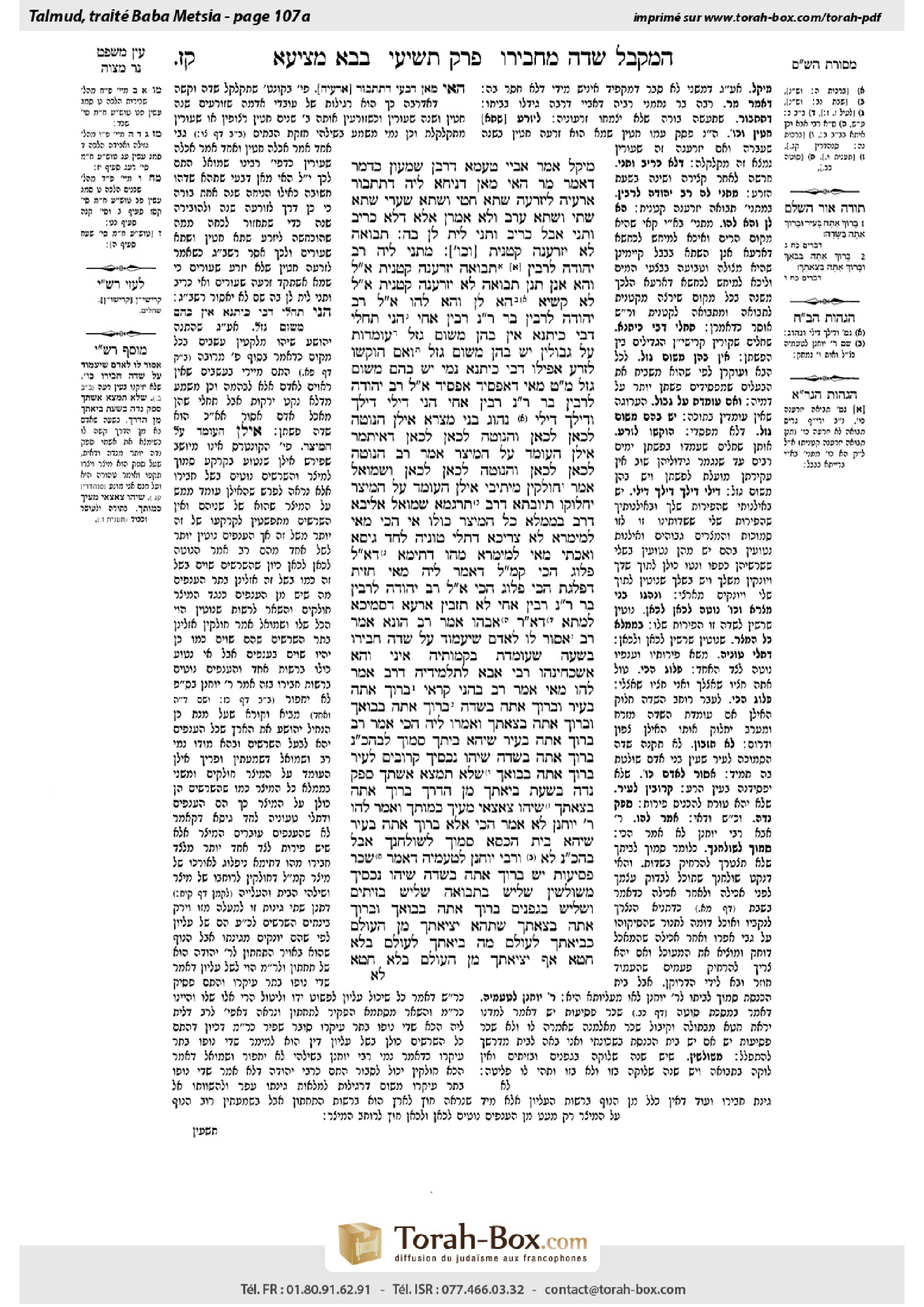
Bava Metzia 107a: Talmud study for Daf Yomi
Study the Talmud for Daf Yomi with scanned pages, Hebrew text, English translations from Sefaria and AI-generated French translations.
Passage selection and English or AI-generated French translation are available where the scan has annotations. Daf Study is independent of Torah-Box and Sefaria.
Browse Bava Metzia · בבא מציעא · All tractatesBava Metzia 107a text and translations
This page of Bava Metzia includes the Aramaic text, an English translation and an AI-generated French translation, alongside the scan above.
בבא מציעא ק״ז א · Aramaic and Hebrew text
מֵיקֵל,
אָמַר אַבָּיֵי, טַעְמָא דְּרַבָּן שִׁמְעוֹן כִּדְמָר. דְּאָמַר מָר: הַאי מַאן דְּנִיחָא לֵיהּ דְּתִתְבַּיַּר אַרְעֵיהּ – לִיזְרְעַהּ שַׁתָּא חִטֵּי וְשַׁתָּא שְׂעָרֵי, שַׁתָּא שְׁתִי וְשַׁתָּא עֵרֶב.
וְלָא אֲמַרַן אֶלָּא דְּלָא כָּרֵיב וְתָנֵי, אֲבָל כָּרֵיב וְתָנֵי – לֵית לַן בַּהּ.
תְּבוּאָה לֹא יִזְרָעֶנָּה קִטְנִית [וְכוּ׳]. מַתְנֵי לֵיהּ רַב יְהוּדָה לְרָבִין: תְּבוּאָה – יִזְרָעֶנָּה קִטְנִית. אֲמַר לֵיהּ: וְהָא אֲנַן תְּנַן: תְּבוּאָה – לֹא יִזְרָעֶנָּה קִטְנִית! אֲמַר לֵיהּ: לָא קַשְׁיָא, הָא לַן וְהָא לְהוּ.
אֲמַר לֵיהּ רַב יְהוּדָה לְרָבִין בַּר רַב נַחְמָן: רָבִין אֲחִי, הָנֵי תַּחְלֵי דְּבֵי כִתָּנָא אֵין בָּהֶן מִשּׁוּם גָּזֵל. עוֹמְדוֹת עַל גְּבוּלִין – יֵשׁ בָּהֶן מִשּׁוּם גָּזֵל.
וְאִם הוּקְשׁוּ לְזֶרַע – אֲפִילּוּ דְּבֵי כִתָּנָא נָמֵי יֵשׁ בָּהֶם מִשּׁוּם גָּזֵל. מַאי טַעְמָא? מַאי דְּאַפְסֵיד – אַפְסֵיד.
אֲמַר לֵיהּ רַב יְהוּדָה לְרָבִין בַּר רַב נַחְמָן: רָבִין אַחִי, הָנֵי דִּילִי – דִּילָךְ, וְדִילָךְ – דִּילִי. נְהוּג בְּנֵי מִצְרָא: אִילָן הַנּוֹטֶה לְכָאן – לְכָאן, וְהַנּוֹטֶה לְכָאן – לְכָאן.
דְּאִיתְּמַר: אִילָן הָעוֹמֵד עַל הַמֶּיצֶר, אָמַר רַב: הַנּוֹטֶה לְכָאן – לְכָאן. וְהַנּוֹטֶה לְכָאן – לְכָאן, וּשְׁמוּאֵל אָמַר: חוֹלְקִין.
מֵיתִיבִי: אִילָן הָעוֹמֵד עַל הַמֶּיצֶר – יַחְלוֹקוּ. תְּיוּבְתָּא דְּרַב! תַּרְגְּמָא שְׁמוּאֵל אַלִּיבָּא דְּרַב, בִּמְמַלֵּא כָּל הַמֶּיצֶר כּוּלּוֹ.
אִי הָכִי, מַאי לְמֵימְרָא? לָא צְרִיכָא דִּתְלֵי טוּנֵיהּ לְחַד גִּיסָא. וְאַכַּתִּי מַאי לְמֵימְרָא? מַהוּ דְּתֵימָא: דְּאָמַר לֵיהּ פְּלוֹג הָכִי, קָא מַשְׁמַע לַן דְּאָמַר לֵיהּ: מַאי חָזֵית דְּפָלְגַתְּ הָכִי – פְּלוֹג הָכִי.
אֲמַר לֵיהּ רַב יְהוּדָה לְרָבִין בַּר רַב נַחְמָן: רָבִין אֲחִי, לָא תִּזְבֹּין אַרְעָא דִּסְמִיכָא לְמָתָא, דְּאָמַר רַבִּי אֲבָהוּ אָמַר רַב הוּנָא אָמַר רַב: אָסוּר לוֹ לְאָדָם שֶׁיַּעֲמוֹד עַל שְׂדֵה חֲבֵירוֹ בְּשָׁעָה שֶׁעוֹמֶדֶת בְּקָמוֹתֶיהָ.
אִינִי? וְהָא אַשְׁכְּחִינְהוּ רַבִּי אַבָּא לְתַלְמִידֵיהּ דְּרַב, אֲמַר לְהוּ: מַאי אָמַר רַב בְּהָנֵי קְרָאֵי ״בָּרוּךְ אַתָּה בָּעִיר וּבָרוּךְ אַתָּה בַּשָּׂדֶה״, ״בָּרוּךְ אַתָּה בְּבֹאֶךָ וּבָרוּךְ אַתָּה בְּצֵאתֶךָ״?
וַאֲמַרוּ לֵיהּ, הָכִי אָמַר רַב: ״בָּרוּךְ אַתָּה בָּעִיר״ – שֶׁיְּהֵא בֵּיתְךָ סָמוּךְ לְבֵית הַכְּנֶסֶת. ״בָּרוּךְ אַתָּה בַּשָּׂדֶה״ – שֶׁיְּהוּ נְכָסֶיךָ קְרוֹבִים לָעִיר. ״בָּרוּךְ אַתָּה בְּבֹאֶךָ״ – שֶׁלֹּא תִּמְצָא אִשְׁתְּךָ סְפֵק נִדָּה בִּשְׁעַת בִּיאָתְךָ מִן הַדֶּרֶךְ. ״בָּרוּךְ אַתָּה בְּצֵאתֶךָ״ – שֶׁיְּהוּ צֶאֱצָאֵי מֵעֶיךָ כְּמוֹתְךָ.
וַאֲמַר לְהוּ: רַבִּי יוֹחָנָן לָא אָמַר הָכִי, אֶלָּא: ״בָּרוּךְ אַתָּה בָּעִיר״ – שֶׁיְּהֵא בֵּית הַכִּסֵּא סָמוּךְ לְשׁוּלְחָנְךָ, אֲבָל בֵּית הַכְּנֶסֶת לָא. וְרַבִּי יוֹחָנָן לְטַעְמֵיהּ, דְּאָמַר: שְׂכַר פְּסִיעוֹת יֵשׁ.
״בָּרוּךְ אַתָּה בַּשָּׂדֶה״ – שֶׁיְּהוּ נְכָסֶיךָ מְשׁוּלָּשִׁין: שְׁלִישׁ בִּתְבוּאָה, שְׁלִישׁ בְּזֵיתִים, וּשְׁלִישׁ בִּגְפָנִים. ״בָּרוּךְ אַתָּה בְּבֹאֶךָ וּבָרוּךְ אַתָּה בְּצֵאתֶךָ״ – שֶׁתְּהֵא יְצִיאָתְךָ מִן הָעוֹלָם כְּבִיאָתְךָ לְעוֹלָם. מָה בִּיאָתְךָ לְעוֹלָם בְּלֹא חֵטְא, אַף יְצִיאָתְךָ מִן הָעוֹלָם בְּלֹא חֵטְא.
Bava Metzia 107a · English translation
is lenient, as he maintains that donors are not particular in this regard. This shows that Rabban Shimon ben Gamliel is not bothered by a change of mind if no harm results.
Abaye said: Rabban Shimon ben Gamliel’s reason is as explained by the Master, Abaye’s teacher Rabba, as the Master says: One for whom it is preferable to grow crops and yet have his land remain as fertile as if it lay fallow should plant wheat one year and barley the next year. In addition, he should plant one year lengthwise and the following year crosswise. In this manner, he will prevent the field from being weakened.
The Gemara comments: And we said that his use of the land with-out following these dictates would weaken it only where he does not plow and repeat his plowing, i.e., plow the field twice before reseeding it, but if he plows and repeats his plowing, we have no problem with it. Consequently, the reasoning of Rabban Shimon ben Gamliel is that a change of crops at the wrong time can weaken the field.
§ The mishna states that one who receives a field to plant it with grain may not plant it with legumes. Rav Yehuda taught Ravin that the halakha is that one who receives a field to plant it with grain may plant it with legumes. Ravin said to him: But didn’t we learn in the mishna that one who receives a field to plant it with grain may not plant it with legumes? Rav Yehuda said to him: This is not difficult, as this halakha is for us, the residents of Babylonia, and that halakha is for them, the residents of Eretz Yisrael. Since what type of seed to plant depends on the quality of the land, in Eretz Yisrael, where the land is weak, there is concern that the land will be weakened. This concern does not apply to Babylonian fields.
Rav Yehuda said to Ravin bar Rav Naḥman: Ravin my brother, those cress plants that grow among flax are not subject to the prohibition of robbery, as the one taking them is effectively weeding the field, and the owner prefers that the cress not grow so as to not affect the growing flax. But if the plants stand on the boundary of where the flax is growing, so that their remaining there would not have a negative impact on the growing flax, they are subject to the prohibition of robbery, as it is assumed that the owner grew the plants there intentionally.
And if the cress plants were sufficiently grown to the point that they were hardened with seed growing inside, i.e., they were fully grown, then even if they were among the flax, they are subject to the prohibition of robbery. What is the reason? Concerning that flax to which they have already caused a loss, they have already caused the loss. Since the flax has already been damaged, by removing the cress now he does nothing to improve the crop and merely takes something from the owner.
Ravin bar Rav Naḥman and Rav Yehuda owned adjacent fields, and their trees leaned over the boundaries. Rav Yehuda said to Ravin bar Rav Naḥman: Ravin my brother, these that are mine are yours, and those that are yours are mine. This is because it is customary with regard to those whose fields border on the field of their neighbors that with regard to a tree that tilts to here, i.e., to the property of one of them, its fruit belongs to the owner of the field here, to where it is tilting, and with regard to one that tilts to there, i.e., to the other side, its fruit belongs to the owner of the field there, as neighbors are not particular which portion of the land actually grew the fruit.
As a dispute was stated about this issue between amora’im: With regard to a tree that stands on the border between fields, Rav says: That which tilts to here, i.e., to this field, its fruit belongs to the owner of the field here, and that which tilts to there belongs to the owner of the field there. And Shmuel says: The owners of the two fields divide all the fruit.
The Gemara raises an objection from a baraita: With regard to a tree that stands on the border between fields, they divide its fruit. This is apparently a conclusive refutation of Rav. The Gemara responds: Shmuel interpreted the baraita so that it should be in accordance with the opinion of Rav as referring to a case where the tree fills the entire boundary, and consequently it belongs to both of them.
The Gemara asks: If so, this is obvious; what is the purpose of the baraita stating its ruling? The Gemara answers: No, it is necessary in a situation where its boughs hang more to one side. The Gemara asks: But still, what is the purpose of stating it? The novelty of this halakha remains unclear. The Gemara explains: It is necessary, lest you say that the owner of the field above which the boughs hang can say to the owner of the other field: Let us divide the fruit in this manner, where each of us receives the fruit that grows over his land. The tanna therefore teaches us that the owner of the other field may say to him: What did you see to make you prefer to divide the fruit in this manner, based on bisecting the tree in one direction; divide the fruit instead in that manner, i.e., based on bisecting the tree in the other direction, so that we each receive an equal share.
§ Rav Yehuda said to Ravin bar Rav Naḥman: Ravin my brother, do not buy land that is near a town, as Rabbi Abbahu says that Rav Huna says that Rav says: It is prohibited for a person to stand by another’s field when its ripe grain is standing, i.e., when its produce is ready for harvest, as he might harm the produce with the evil eye. Similarly, land near a town may be harmed by the people of the town watching it.
The Gemara asks: Is that so? But when Rabbi Abba encountered Rav’s students he said to them: What does Rav say with regard to the meaning of these verses of blessing: “Blessed shall you be in the city, and blessed shall you be in the field” (Deuteronomy 28:3), and: “Blessed shall you be when you enter, and blessed shall you be when you exit” (Deuteronomy 28:6)?
And they said to him: This is what Rav said: “Blessed shall you be in the city” means that your house should be adjacent to a synagogue, and the phrase: “Blessed shall you be in the field” means that your property should be near the city. “Blessed shall you be when you enter” means that you will not find your wife in a state where it is uncertain whether she has the halakhic status of a menstruating woman when you come in from a journey, which would render her forbidden to you. “Blessed shall you be when you go out” means that those who emerge from you, i.e., your descendants, should be like you.
And Rabbi Abba said to them: Rabbi Yoḥanan did not say this, but he interpreted the verse as follows: “Blessed shall you be in the city,” means that there should be a bathroom near your table, but he did not refer to a synagogue. The Gemara adds: And Rabbi Yoḥanan conforms to his line of reasoning in this regard, as he says: There is a reward for the steps one takes to reach the location of a mitzva, and one who lives adjacent to a synagogue will not have the opportunity to earn this reward.
The Gemara returns to Rabbi Yoḥanan’s exposition of the verses: “Blessed shall you be in the field” means that your property should be divided into thirds: One-third should be invested in grain, one-third in olives, and one-third in grapevines. “Blessed shall you be when you enter and blessed shall you be when you exit” means that your exit from the world should be like your entry into the world: Just as your entry into the world was without sin, so too your exit from the world should be without sin.
Bava Metzia 107a · Traduction française (IA)
il est indulgent, car il considère que les donateurs ne sont pas exigeants à cet égard. Cela montre que Rabban Shimon ben Gamliel n'est pas troublé par un changement d'avis si cela ne cause aucun préjudice.
Abaye a dit : la raison de Rabban Shimon ben Gamliel est celle expliquée par le Maître, l'enseignant d'Abaye, Rabba, comme le Maître dit : celui qui préfère cultiver des céréales et dont le terrain reste aussi fertile qu'un terrain en friche devrait planter du blé une année et du seigle l'année suivante. De plus, il devrait planter une année en long et l'année suivante en travers. Ainsi, il empêchera le champ de se détériorer.
Le Guemara commente : Et nous avons dit que son utilisation du terrain sans suivre ces règles le détériorerait uniquement là où il ne laboure pas et ne répète pas son labour, c'est-à-dire qu'il laboure le champ deux fois avant de le resemencer, mais si il laboure et répète son labour, nous n'avons pas de problème. Ainsi, la raison de Rabban Shimon ben Gamliel est que changer de culture à mauvais moment peut détériorer le champ.
La mishna stipule que celui qui reçoit un champ à cultiver ne peut le semer avec des légumineuses. Rav Yehuda enseigna à Ravin que la halakha est que celui qui reçoit un champ à cultiver peut le semer avec des légumineuses. Ravin lui dit : Mais n'avons-nous pas appris dans la mishna que celui qui reçoit un champ à cultiver ne peut pas le semer avec des légumineuses ? Rav Yehuda lui répondit : Ce n'est pas difficile, car cette halakha s'applique à nous, les habitants de Babylone, et celle-ci s'applique à eux, les habitants de la Terre d'Israël. Puisque le type de grain à semer dépend de la qualité du sol, en Terre d'Israël, où le sol est faible, il y a une crainte que le sol se détériore. Cette crainte ne s'applique pas aux champs babyloniens.
Rav Yehuda dit à Ravin bar Rav Naḥman : Mon frère Ravin, ces plantes de chénopodie qui poussent parmi le lin ne sont pas soumises à l'interdiction de vol, car celui qui les prend est effectivement en train de débarrasser le champ, et l'propriétaire préfère que la chénopodie ne pousse pas afin de ne pas affecter le lin en croissance. Mais si les plantes sont situées sur la limite du lieu où le lin pousse, de sorte que leur présence n'ait pas d'impact négatif sur le lin en croissance, elles sont soumises à l'interdiction de vol, car on suppose que l'propriétaire a planté les plantes là intentionnellement.
Et si les plantes de chénopodie étaient suffisamment développées pour être durcies avec des graines à l'intérieur, c'est-à-dire qu'elles étaient pleinement développées, alors même qu'elles étaient parmi le lin, elles étaient soumises à l'interdiction de vol. Quelle est la raison ? Concernant ce lin auquel ils ont déjà causé un préjudice, ils ont déjà causé le préjudice. Puisque le lin a déjà été endommagé, en enlevant la chénopodie maintenant, il ne fait rien pour améliorer la récolte et il ne fait qu'arracher quelque chose à l'propriétaire.
Ravin bar Rav Naḥman et Rav Yehuda possédaient des champs adjacents, et leurs arbres penchaient sur les limites. Rav Yehuda dit à Ravin bar Rav Naḥman : Mon frère Ravin, ceux qui sont à moi sont à toi, et ceux qui sont à toi sont à moi. Cela est dû au fait que c'est la coutume concernant ceux dont les champs sont limitrophes de ceux de leurs voisins, que concernant un arbre qui penche ici, c'est-à-dire vers la propriété de l'un d'eux, ses fruits appartiennent à l'propriétaire du champ ici, vers lequel il penche, et concernant un arbre qui penche là, c'est-à-dire vers l'autre côté, ses fruits appartiennent à l'propriétaire du champ là, car les voisins ne sont pas exigeants quant à la portion exacte du terrain où les fruits ont vraiment poussé.
Un débat a été établi sur ce sujet entre des amoraïm : Concernant un arbre qui se trouve sur la limite entre des champs, Rav dit : celui qui penche ici, c'est-à-dire vers ce champ, ses fruits appartiennent à l'propriétaire de ce champ, et celui qui penche là appartient à l'propriétaire du champ là. Et Shmuel dit : les propriétaires des deux champs divisent tous les fruits.
Le Guemara soulève un objet à partir d'une baraïta : Concernant un arbre qui se trouve sur la limite entre des champs, ils divisent ses fruits. Cela semble être une réfutation concluante de Rav. Le Guemara répond : Shmuel a interprété la baraïta de sorte qu'elle s'applique à l'opinion de Rav, en référence à un cas où l'arbre remplit toute la limite, et par conséquent, il appartient aux deux.
Le Guemara pose une question : Si c'est ainsi, cela est évident ; à quoi bon la baraïta énonce sa décision ? Le Guemara répond : Non, il est nécessaire dans un cas où ses branches penchent plus d'un côté. Le Guemara pose une question : Mais encore, à quoi bon énoncer cela ? L'originalité de cette halakha reste obscure. Le Guemara explique : Il est nécessaire, afin que vous ne disiez pas que l'propriétaire du champ au-dessus duquel les branches penchent puisse dire à l'propriétaire du autre champ : Divisons les fruits ainsi, où chacun reçoit les fruits qui poussent sur son terrain. Le tanna enseigne donc que l'propriétaire du autre champ peut dire à lui : Qu'est-ce qui t'a fait préférer de diviser les fruits ainsi, en se basant sur la division de l'arbre dans une direction ; divise les fruits plutôt ainsi, c'est-à-dire en se basant sur la division de l'arbre dans l'autre direction, afin que nous recevions chacun une part égale.
§ Rav Yehuda dit à Ravin bar Rav Naḥman : Mon frère Ravin, ne achète pas de terrain proche d'une ville, car Rabbi Abbahu dit que Rav Huna dit que Rav dit : Il est interdit à une personne de se tenir près du champ d'un autre lorsque ses céréales mûres sont debout, c'est-à-dire lorsque sa récolte est prête, car il pourrait nuire à la récolte avec le regard mauvais. De même, un terrain proche d'une ville peut être nuire par les habitants de la ville qui le regardent.
Le Guemara pose une question : Est-ce ainsi ? Mais lorsque Rabbi Abba a rencontré les élèves de Rav, il a dit à eux : Quel est le sens de ces versets de bénédiction : « Béni seras-tu en la ville, et béni seras-tu en le champ » (Deutéronome 28:3), et : « Béni seras-tu quand tu entreras, et béni seras-tu quand tu sortiras » (Deutéronome 28:6) ?
Et ils lui dirent : C’est ce que dit Rava : « Heureux seras-tu dans la ville » signifie que ta maison devrait être adjacente à une synagogue, et la phrase : « Heureux seras-tu dans le champ » signifie que ta propriété devrait être proche de la ville. « Heureux seras-tu lorsqu’il te viendra » signifie que tu ne trouveras pas ta femme dans un état où il est incertain qu’elle ait le statut halakhique de femme en période de ménstruation lorsqu’il te viendra d’un voyage, ce qui la rendrait interdite à toi. « Heureux seras-tu lorsqu’il te partiras » signifie que ceux qui sortent de toi, c’est-à-dire tes descendants, devraient être comme toi.
Et Rabbi Abba leur dit : Rabbi Yoḥanan n’a pas dit cela, mais il a interprété la parole ainsi : « Heureux seras-tu dans la ville », signifie qu’il devrait y avoir une salle de toilette près de ta table, mais il n’a pas mentionné une synagogue. La Guemara ajoute : Et Rabbi Yoḥanan suit cette ligne de raisonnement dans ce sens, car il dit : Il y a une récompense pour les pas que l’on fait pour atteindre l’emplacement d’une mitsva, et celui qui vit à proximité d’une synagogue n’aura pas l’occasion d’acquérir cette récompense.
La Guemara revient à l’explication de Rabbi Yoḥanan des versets : « Heureux seras-tu dans le champ » signifie que ta propriété devrait être divisée en tiers : un tiers doit être investi en céréales, un tiers en olives, et un tiers en vigne. « Heureux seras-tu lorsqu’il te viendra et heureux seras-tu lorsqu’il te partiras » signifie que ton départ du monde devrait être comme ton entrée dans le monde : tout comme ton entrée dans le monde était sans péché, ainsi ton départ du monde devrait être sans péché.
Traduction française générée par IA à partir de l’édition anglaise de Sefaria. Vérifie toujours un passage avec le texte source.
Text from Sefaria: William Davidson Edition - Vocalized Aramaic (CC BY NC); William Davidson Edition - English (CC BY NC).