Bava Metzia 107b: Talmud study for Daf Yomi
Study the Talmud for Daf Yomi with scanned pages, Hebrew text, English translations from Sefaria and AI-generated French translations.
Passage selection and English or AI-generated French translation are available where the scan has annotations. Daf Study is independent of Torah-Box and Sefaria.
Browse Bava Metzia · בבא מציעא · All tractatesBava Metzia 107b text and translations
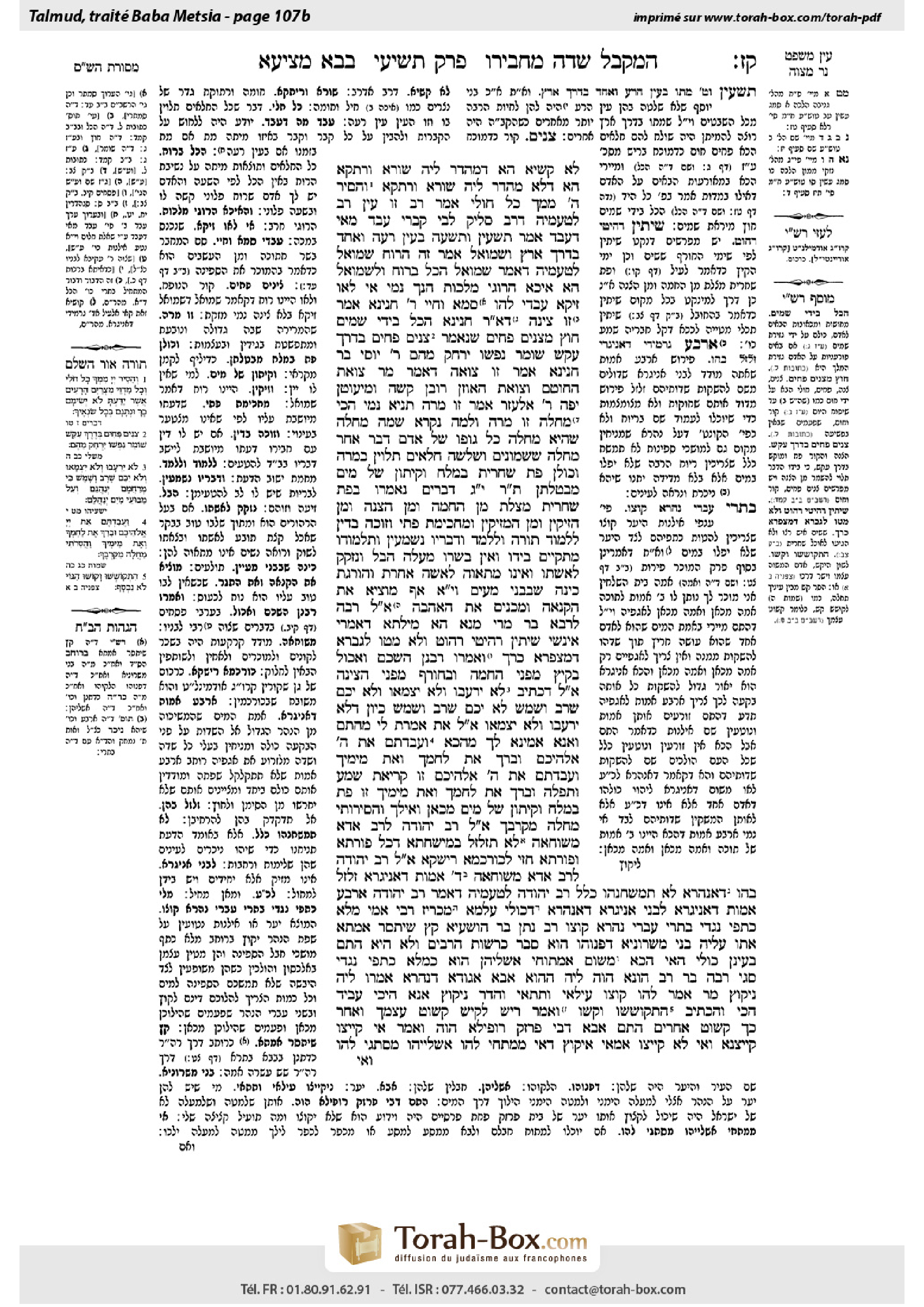
This page of Bava Metzia includes the Aramaic text, an English translation and an AI-generated French translation, alongside the scan above.
בבא מציעא ק״ז ב · Aramaic and Hebrew text
לָא קַשְׁיָא: הָא דִּמְהַדַּר לֵיהּ שׁוּרָא וְרִתְקָא, הָא דְּלָא מְהַדַּר לֵיהּ שׁוּרָא וְרִתְקָא.
״וְהֵסִיר ה׳ מִמְּךָ כׇּל חֹלִי״, אָמַר רַב: זוֹ [הָ]עַיִן. רַב לְטַעְמֵיהּ. דְּרַב סָלֵיק לְבֵי קִבְרֵי, עֲבַד מַאי דַּעֲבַד, אֲמַר: תִּשְׁעִין וְתִשְׁעָה בְּעַיִן רָעָה, וְאֶחָד בְּדֶרֶךְ אֶרֶץ.
וּשְׁמוּאֵל אָמַר: זֶה הָרוּחַ. שְׁמוּאֵל לְטַעְמֵיהּ, דְּאָמַר שְׁמוּאֵל: הַכֹּל בָּרוּחַ. וְלִשְׁמוּאֵל: הָא אִיכָּא הֲרוּגֵי מַלְכוּת! הָנָךְ נָמֵי, אִי לָאו זִיקָא, עָבְדִי לְהוּ סַמָּא וְחָיֵי.
רַבִּי חֲנִינָא אָמַר: זוֹ צִינָּה, דְּאָמַר רַבִּי חֲנִינָא: הַכֹּל בִּידֵי שָׁמַיִם, חוּץ מִצִּנִּים פַּחִים. שֶׁנֶּאֱמַר: ״צִנִּים פַּחִים בְּדֶרֶךְ עִקֵּשׁ שׁוֹמֵר נַפְשׁוֹ יִרְחַק מֵהֶם״.
רַבִּי יוֹסֵי בַּר חֲנִינָא אָמַר: זוֹ צוֹאָה. דְּאָמַר מָר: צוֹאַת הַחוֹטֶם, וְצוֹאַת הָאוֹזֶן – רוּבָּן קָשֶׁה, וּמִיעוּטָן יָפֶה.
רַבִּי אֶלְעָזָר אָמַר: זוֹ מָרָה. תַּנְיָא נָמֵי הָכִי: ״מַחֲלָה״ – זוֹ מָרָה, וְלָמָּה נִקְרָא שְׁמָהּ ״מַחֲלָה״ – שֶׁהִיא מַחֲלָה כׇּל גּוּפוֹ שֶׁל אָדָם. דָּבָר אַחֵר: ״מַחֲלָה״, שֶׁשְּׁמוֹנִים וּשְׁלֹשָׁה חֳלָאִים תְּלוּיִן בַּמָּרָה. וְכוּלָּן, פַּת שַׁחֲרִית בְּמֶלַח וְקִיתוֹן שֶׁל מַיִם מְבַטַּלְתָּן.
תָּנוּ רַבָּנַן: שְׁלֹשָׁה עָשָׂר דְּבָרִים נֶאֶמְרוּ בְּפַת שַׁחֲרִית: מַצֶּלֶת מִן הַחַמָּה, וּמִן הַצִּנָּה, וּמִן הַזִּיקִין, וּמִן הַמַּזִּיקִין, וּמַחְכִּימַת פֶּתִי, וְזוֹכֶה בַּדִּין, לִלְמוֹד תּוֹרָה וּלְלַמֵּד, וּדְבָרָיו נִשְׁמָעִין, וְתַלְמוּדוֹ מִתְקַיֵּים בְּיָדוֹ,
וְאֵין בְּשָׂרוֹ מַעֲלֶה הֶבֶל, וְנִזְקָק לְאִשְׁתּוֹ, וְאֵינוֹ מִתְאַוֶּה לְאִשָּׁה אַחֶרֶת, וְהוֹרֶגֶת כִּינָּה שֶׁבִּבְנֵי מֵעַיִם. וְיֵשׁ אוֹמְרִים: אַף מוֹצִיאָ[ה] אֶת הַקִּנְאָה וּמַכְנֶיסֶ[ת] אֶת הָאַהֲבָה.
אֲמַר לֵיהּ רַבָּה לְרָבָא בַּר מָרִי: מְנָא הָא מִילְּתָא דְאָמְרִי אִינָשֵׁי: שִׁיתִּין רָהֹיטֵי רְהוּט וְלָא מְטוֹ לְגַבְרָא דְּמִצַּפְרָא כְּרַךְ. וַאֲמַרוּ רַבָּנַן: הַשְׁכֵּם וֶאֱכוֹל, בְּקַיִץ מִפְּנֵי הַחַמָּה וּבַחוֹרֶף מִפְּנֵי הַצִּינָּה.
אֲמַר לֵיהּ, דִּכְתִיב: ״לֹא יִרְעָבוּ וְלֹא יִצְמָאוּ וְלֹא יַכֵּם שָׁרָב וָשָׁמֶשׁ״, לֹא יַכֵּם שָׁרָב וָשָׁמֶשׁ – כֵּיוָן דְּלָא יִרְעָבוּ וְלֹא יִצְמָאוּ.
אֲמַר לֵיהּ: אַתְּ אָמְרַתְּ לִי מֵהָתָם, וַאֲנָא אָמֵינָא לָךְ מֵהָכָא: ״וַעֲבַדְתֶּם אֵת ה׳ אֱלֹהֵיכֶם וּבֵרַךְ אֶת לַחְמְךָ וְאֶת מֵימֶיךָ״. ״וַעֲבַדְתֶּם אֵת ה׳ אֱלֹהֵיכֶם״ – זוֹ קְרִיאַת שְׁמַע וּתְפִלָּה. ״וּבֵרַךְ אֶת לַחְמְךָ וְאֶת מֵימֶיךָ״ – זוֹ פַּת בַּמֶּלַח וְקִיתוֹן שֶׁל מַיִם, מִכָּאן וְאֵילָךְ: ״וַהֲסִרֹתִי מַחֲלָה מִקִּרְבֶּךָ״.
אֲמַר לֵיהּ רַב יְהוּדָה לְרַב אַדָּא מָשׁוֹחָאָה: לָא תְּזַלְזֵל בְּמִשְׁחֲתָא, דְּכֹל פּוּרְתָּא וּפוּרְתָּא חֲזִי לְכוּרְכְּמָא רִישְׁקָא. אֲמַר לֵיהּ רַב יְהוּדָה לְרַב אַדָּא מָשׁוֹחָאָה: אַרְבַּע אַמּוֹת דְּאַנִּיגְרָא – זַלְזֵל בְּהוּ. דְּאַנַּהֲרָא לָא תִּמְשְׁחִנְהוּ כְּלָל.
רַב יְהוּדָה לְטַעְמֵיהּ, דְּאָמַר רַב יְהוּדָה: אַרְבַּע אַמּוֹת דְּאַנִּיגְרָא – לִבְנֵי אנִיגְרָא. דְּאַנַּהֲרָא – דְּכוּלֵּי עָלְמָא.
מַכְרִיז רַבִּי אַמֵּי: מְלֵא כַּתְפֵי נַגָּדֵי בִּתְרֵי עֶבְרֵי נַהֲרָא – קוּצוּ. רַב נָתָן בַּר הוֹשַׁעְיָא קַץ שִׁיתְּסַר אַמְּתָא. אֲתוֹ עֲלֵיהּ בְּנֵי מַשְׁרוֹנְיָא, דַּפְנוּהּ. הוּא סָבַר כִּרְשׁוּת הָרַבִּים, וְלָא הִיא: הָתָם בָּעֵינַן כּוּלֵּי הַאי, הָכָא מִשּׁוּם אַמְתּוֹחֵי (אַשְׁלֵיהֶן) [אַשְׁלַיְהוּ] הוּא, כִּמְלֵא כַּתְפֵי נַגָּדֵי סַגִּי.
רַבָּה בַּר רַב הוּנָא הֲוָה לֵיהּ הָהוּא אִבָּא אַגּוּדָּא דְנַהֲרָא, אֲמַרוּ לֵיהּ: נִיקּוֹץ מָר! אֲמַר לְהוּ: קוּצוּ עִילָּאֵי וְתַתָּאֵי, וַהֲדַר נִיקּוֹץ אֲנָא. הֵיכִי עָבֵיד הָכִי? וְהָכְתִיב: ״הִתְקוֹשְׁשׁוּ וָקוֹשּׁוּ״, וְאָמַר רֵישׁ לָקִישׁ: קְשׁוֹט עַצְמְךָ וְאַחַר כָּךְ קְשׁוֹט אֲחֵרִים!
הָתָם אִבָּא דְּבֵי פַרְזַק רוּפִילָא הֲוָה, וְאָמַר: אִי קָיְיצוּ – קָיֵיצְנָא, וְאִי לָא קָיְיצוּ – אַמַּאי אִיקּוֹץ. דְּאִי מִמַּתְחִי לְהוּ – אַשְׁלַיְיהוּ מִסְתַּגִּי לְהוּ,
Bava Metzia 107b · English translation
In any case, it is evident that Rav approves of one whose property is located near a city. How does this accord with his statement that there is concern for the evil eye when one’s field is viewed by people? The Gemara answers: This is not difficult. This statement is referring to a wall and an additional partition [ritka] that surround the plot and prevent it from being harmed by the evil eye. That statement is referring to a case where a wall and an additional partition do not surround it.
§ The Gemara returns to expounding the themes of blessings and the evil eye. The Torah states: “And the Lord will take away from you all sickness” (Deuteronomy 7:15). In interpreting this verse, Rav says: This verse is speaking about the evil eye. The Gemara comments: Rav conforms to his line of reasoning, as Rav went to a graveyard, and did what he did, i.e., he used an incantation to find out how those buried there died, and he said: Ninety-nine of these died by the evil eye, and only one died by entirely natural means.
And Shmuel says: This term: “All sickness,” refers to the wind. The Gemara comments: Shmuel conforms to his line of reasoning, as Shmuel says: Every injury suffered by people is due to the wind that enters wounds and bodily cavities. The Gemara asks: But according to Shmuel, aren’t there those executed by the monarchy and others killed by traumatic injury and not the wind? The Gemara responds: With regard to these too, were it not for the wind, they would prepare a medicine for those injured people and they would be healed and live, but the wind prevents this from happening.
Rabbi Ḥanina says: This phrase: “All sickness,” refers to the cold, as Rabbi Ḥanina says: All occurrences that befall man are at the hands of Heaven, except for excess cold and heat, as it is stated: “Cold and heat are on the path of the perverse; he who guards his soul shall keep far from them” (Proverbs 22:5). This indicates that cold and heat are forms of harm caused by man, from which one can protect himself.
Rabbi Yosei bar Ḥanina says: This phrase: “All sickness,” refers to excrement, as the Master says: With regard to excrement of the nose, i.e., mucous, and excrement of the ear, i.e., earwax, if a large amount is emitted, having much of it is harmful, but having a bit of it is beneficial.
Rabbi Elazar says: This term: “All sickness,” refers to the gall bladder. The Gemara adds: This is also taught in a baraita: With regard to the term: “Sickness,” this refers to the gall bladder. And why is the gall bladder called sickness? It is because it makes a person’s entire body ill. Alternatively, it is called sickness because eighty-three diseases, the numerical value of maḥala, sickness, are dependent on the gall bladder. The Gemara comments: And with regard to all of them, consuming bread in the morning with salt and drinking a large jug of water negates their ill effects, as a simple morning meal is beneficial to the body.
§ The Gemara cites a related baraita: The Sages taught that thirteen matters of praise were stated with regard to a meal of bread eaten in the morning: It protects the diner from the heat, and from the cold, and from the winds, and from the harmful spirits; and it makes the simple wise, and one who consumes it will be victorious in judgment, he will merit to learn Torah and to teach it, and his statements are heard, and his study will remain in his possession.
In addition, his flesh does not generate excess sweat, and he engages in intercourse with his wife at the proper time, and he does not lust for another woman, and this meal is so advantageous that it even kills any louse in his intestines. And some say it even removes jealousy and brings in love. Since he is completely healthy, he is not inclined to be angered by others.
In relation to the above baraita, Rabba said to Rava bar Mari: From where is this matter that people say derived: Sixty runners ran but could not catch the man who ate in the morning, and the Sages likewise said: Arise early and eat, in the summer due to the sun and in the winter due to the cold, so that one’s body should have the strength to withstand the climate.
Rava bar Mari said to him: It is derived from a verse, as it is written: “They shall not hunger nor thirst, neither shall the heat nor sun smite them” (Isaiah 49:10). Why will the heat and the sun not smite them? Since they shall not hunger nor thirst, as they rose early to eat.
Rava said to him: You said to me that it is derived from there, but I say to you that it is derived from here, a different verse: “And you shall serve the Lord your God, and He will bless your bread and your water” (Exodus 23:25), which he interprets as follows: “And you shall serve the Lord your God,” this refers to the recitation of Shema and the Amida prayer, both of which constitute daily service of God. “And He will bless your bread and your water,” this refers to bread with salt and a large jug of water consumed after morning prayers. From that point onward, the rest of the verse: “And I will take sickness away from your midst,” will be fulfilled.
§ Rav Yehuda said to Rav Adda the surveyor: Do not treat measuring lightly even for small areas of land, as each little bit is suitable for growing the cultivated [rishka] saffron, a very expensive product. Rav Yehuda further said to Rav Adda the surveyor: With regard to the four cubits measured adjacent to an irrigation channel, you may treat them lightly, and it is not necessary to provide an exact measurement of them when calculating the areas of fields. And as for the four cubits adjacent to a river, do not measure them at all, but simply estimate the size and include them in the larger measurement.
The Gemara comments: In this regard, Rav Yehuda conforms to his line of reasoning, as Rav Yehuda says: The four cubits adjacent to a channel belong to the residents of the houses alongside the channel, while the four cubits adjacent to a river belong to everyone.
Rabbi Ami would announce: Cut down the trees along the width of the full shoulders of the pullers of the boat on both sides of the river so that the trees should not interfere with the pulling of the boats. The Gemara relates: Rav Natan bar Hoshaya instructed people to cut down sixteen cubits on each side of the river, and the residents of Mashronya came upon him and beat him for issuing this directive. The Gemara explains: He holds that any pathway must be made as wide as like a public domain, which is sixteen cubits wide. But that is not so, as there, in the case of a public domain, we do require that much space; here, however, the space is necessary needs to be only enough to enable the stretching of the ropes to pull the boats. Therefore, the width of the full shoulders of the pullers is the sufficient measure of space needed in order not to interfere with the pulling of the boats.
The Gemara relates another incident: Rabba bar Rav Huna had a certain forest on the bank of a river. They said to him: Let the Master cut down the trees on the riverbank in accordance with the above statement. Rabba bar Rav Huna said to them: Let those above and below me along the river cut down their trees first, and then I will cut down my trees. I will achieve nothing by cutting down my trees on my own. The Gemara asks: How can he do so, i.e., wait for others to act? But isn’t it written: “Gather yourselves together, and gather [hitkosheshu vakoshu]” (Zephaniah 2:1), and Reish Lakish says concerning this: Adorn [keshot] yourself and afterward adorn others. Therefore, one must first perform the required action himself before offering advice to others.
The Gemara responds: There it was the forest of the house of Parzak, the general, and it was obvious that they would pay no attention to a Jewish scholar. Rabba bar Rav Huna therefore said: If the workers of the Persian officer cut down, I will cut down as well, and if they do not cut down, why should I cut down for no purpose? Since if the pullers can stretch their ropes they can go along this side of the river,
Bava Metzia 107b · Traduction française (IA)
Dans tous les cas, il est évident que Rav approuve celui dont la propriété est située près d'une ville. Comment cela s'aligne-t-il avec son affirmation selon laquelle il y a une préoccupation pour l'œil mauvais lorsqu'un champ est vu par les gens ? La Guemara répond : Ce n'est pas difficile. Cette déclaration fait référence à un mur et une partition supplémentaire qui entourent la parcelle et l'empêchent d'être affectée par l'œil mauvais. Cette déclaration fait référence à un cas où un mur et une partition supplémentaire ne l'entourent pas.
§ La Guemara reprend les thèmes des bénédictions et de l'œil mauvais. La Torah dit : « Et l'Éternel enlèvera de toi toute maladie » (Deutéronome 7:15). En interprétant cette versette, Rav dit : Cette versette parle de l'œil mauvais. La Guemara commente : Rav suit sa ligne de raisonnement, car Rav est allé au cimetière et a fait ce qu'il a fait, c'est-à-dire qu'il a utilisé une incantation pour découvrir comment ces personnes enterrées étaient mortes, et il a dit : Quatre-vingt-dix-neuf d'entre elles sont mortes par l'œil mauvais, et seule une est morte de manière entièrement naturelle.
Et Shmuel dit : Ce terme : « Toute maladie », fait référence au vent. La Guemara commente : Shmuel suit sa ligne de raisonnement, car Shmuel dit : Toute blessure subie par les gens est due au vent qui entre dans les plaies et les cavités du corps. La Guemara pose la question : Mais selon Shmuel, ne sont-il pas ceux exécutés par la monarchie et d'autres tués par des blessures traumatiques et non par le vent ? La Guemara répond : Concernant ceux-ci aussi, sans le vent, on préparerait un remède pour ces personnes blessées et elles seraient guéries et vivraient, mais le vent empêche cela de se produire.
Rabbi Ḥanina dit : Ce terme : « Toute maladie », fait référence au froid, car Rabbi Ḥanina dit : Toutes les choses qui affectent l'homme sont entre les mains de l'Éternel, sauf le froid et la chaleur excessifs, car il est dit : « Le froid et la chaleur sont sur le chemin du pervers ; celui qui garde son âme restera éloigné d'eux » (Proverbes 22:5). Cela indique que le froid et la chaleur sont des formes de préjudice causés par l'homme, d'où l'on peut se protéger.
Rabbi Yosei bar Ḥanina dit : Ce terme : « Toute maladie », fait référence aux déjections, car le Maître dit : Concernant les déjections du nez, c'est-à-dire la muqueuse, et les déjections de l'oreille, c'est-à-dire la cire, si une grande quantité est émise, avoir beaucoup de cela est nuisible, mais avoir un peu est bénéfique.
Rabbi Elazar dit : Ce terme : « Toute maladie », fait référence à la vésicule biliaire. La Guemara ajoute : Cela est également enseigné dans une baraïta : Concernant le terme : « Maladie », cela fait référence à la vésicule biliaire. Et pourquoi la vésicule biliaire est-elle appelée maladie ? C'est parce qu'elle rend tout le corps de la personne malade. Alternativement, elle est appelée maladie car soixante-treize maladies, dont la valeur numérique est maḥala, maladie, dépendent de la vésicule biliaire. La Guemara commente : Et concernant toutes ces maladies, consommer du pain le matin avec du sel et boire une grande jarre d'eau annule leurs effets néfastes, car un petit déjeuner simple est bénéfique pour le corps.
§ La Guemara cite une baraïta liée : Les Sages enseignèrent que treize choses de louange furent dites concernant un repas de pain mangé le matin : Il protège le mangeur du chaud, du froid, des vents et des esprits nuisibles ; il rend le simple sage, celui qui le consomme sera victorieux devant le juge, il méritera d'apprendre la Torah et de la transmettre, et ses paroles seront entendues, et son étude restera en son possession.
En outre, sa chair ne produit pas de sueur en excès, et il engage en relations conjugales avec sa femme à l'heure appropriée, et il ne convoite pas une autre femme, et ce repas est si avantageux qu'il élimine même les poux dans son intestin. Et certains disent qu'il élimine même la jalousie et apporte l'amour. Puisqu'il est complètement sain, il n'est pas enclin à être irrité par les autres.
En rapport avec la baraïta ci-dessus, Rabba dit à Rava bar Mari : D'où provient cette matière que les gens disent : Soixante coureurs coururent mais ne purent attraper l'homme qui mangea le matin, et les Sages dirent également : Lève-toi tôt et mange, en été à cause du soleil et en hiver à cause du froid, afin que ton corps ait la force de résister au climat.
Rava bar Mari dit à lui : C'est tiré d'une versette, car il est écrit : « Ils ne mourront ni de faim ni de soif, ni le chaud ni le soleil ne les frapperont » (Isaïe 49:10). Pourquoi le chaud et le soleil ne les frapperont-ils pas ? Parce qu'ils ne mourront ni de faim ni de soif, car ils se sont levés tôt pour manger.
Rava dit à lui : Tu as dit à moi qu'il est tiré d'ici, mais je dis à toi qu'il est tiré d'ici, une autre versette : « Et tu serviras l'Éternel ton Dieu, et Il bénira ton pain et ton eau » (Exode 23:25), qu'il interprète ainsi : « Et tu serviras l'Éternel ton Dieu », cela fait référence à la récitation du Chéma et de la prière de l'Amida, qui constituent un service quotidien de Dieu. « Et Il bénira ton pain et ton eau », cela fait référence au pain avec du sel et à une grande jarre d'eau consommés après les prières matinales. À partir de ce point, la suite de la versette : « Et je retirerai la maladie de parmi vous », sera accomplie.
§ Rav Yehuda dit à Rav Adda le géomètre : Ne traite pas la mesure à la légère même pour de petites zones de terre, car chaque petit morceau est adapté à la culture de la safran cultivé [rishka], un produit très cher. Rav Yehuda dit également à Rav Adda le géomètre : Concernant les quatre coudées mesurées adjacentes à un canal d'irrigation, tu peux les traiter à la légère, et il n'est pas nécessaire de fournir une mesure exacte lors du calcul des surfaces des champs. Et concernant les quatre coudées adjacentes à un fleuve, ne les mesure pas du tout, mais estime simplement la taille et inclut-les dans la mesure plus grande.
Le Guemara commente : En ce qui concerne cela, Rav Yehuda suit la logique de sa propre école, car Rav Yehuda dit : Les quatre coudées adjacentes à un cours d'eau appartiennent aux habitants des maisons situées aux côtés du cours d'eau, tandis que les quatre coudées adjacentes à un fleuve appartiennent à tous.
Rabbi Ami disait : Découpez les arbres sur la largeur des épaules des hommes qui tireront les bateaux, des deux côtés du fleuve, afin que les arbres ne gênent pas le tirage des bateaux. Le Guemara rapporte : Rav Natan bar Hoshaya a ordonné à la population de couper seize coudées sur chaque côté du fleuve, et les habitants de Mashronya l'ont trouvé et l'ont battu pour avoir donné cet ordre. Le Guemara explique : Il considère que toute piste doit être faite aussi large qu'un domaine public, qui est large de seize coudées. Cependant, cela n'est pas le cas, car dans le cas d'un domaine public, nous exigeons effectivement cette largeur ; ici, en revanche, la largeur nécessaire est seulement suffisante pour permettre l'étirement des cordes afin de tirer les bateaux. Ainsi, la largeur des épaules des hommes qui tirent les bateaux est la mesure suffisante de largeur nécessaire afin de ne pas gêner le tirage des bateaux.
Le Guemara rapporte un autre incident : Rabba bar Rav Huna avait un certain bois sur la rive d'un fleuve. On lui dit : Que le Maître coupe les arbres sur la rive du fleuve conformément à l'affirmation ci-dessus. Rabba bar Rav Huna répondit à ceux-ci : Que ceux qui sont au-dessus et en dessous de moi le long du fleuve coupent d'abord leurs arbres, et ensuite je couperai les miens. Je ne gagnerai rien en coupant mes arbres seul. Le Guemara demande : Comment peut-il faire cela, c'est-à-dire attendre que les autres agissent ? Mais n'est-il pas écrit : « Rassemblez-vous, et rassemblez [hitkosheshu vakoshu] » (Zéphanie 2:1), et Reish Lakish dit à ce sujet : Adonnez-vous [keshot] et ensuite adonnez les autres. Ainsi, on doit d'abord accomplir l'action requise soi-même avant de conseiller aux autres.
Le Guemara répond : Il s'agissait là du bois de la maison de Parzak, le général, et il était évident qu'ils ne prêteraient aucune attention à un savant juif. Rabba bar Rav Huna dit donc : Si les ouvriers de l'officier perse coupent, je couperai aussi, et s'ils ne coupent pas, pourquoi devrais-je couper pour rien ? Car si les tireurs peuvent étirer leurs cordes, ils peuvent aller le long de ce côté du fleuve,
Traduction française générée par IA à partir de l’édition anglaise de Sefaria. Vérifie toujours un passage avec le texte source.
Text from Sefaria: William Davidson Edition - Vocalized Aramaic (CC BY NC); William Davidson Edition - English (CC BY NC).