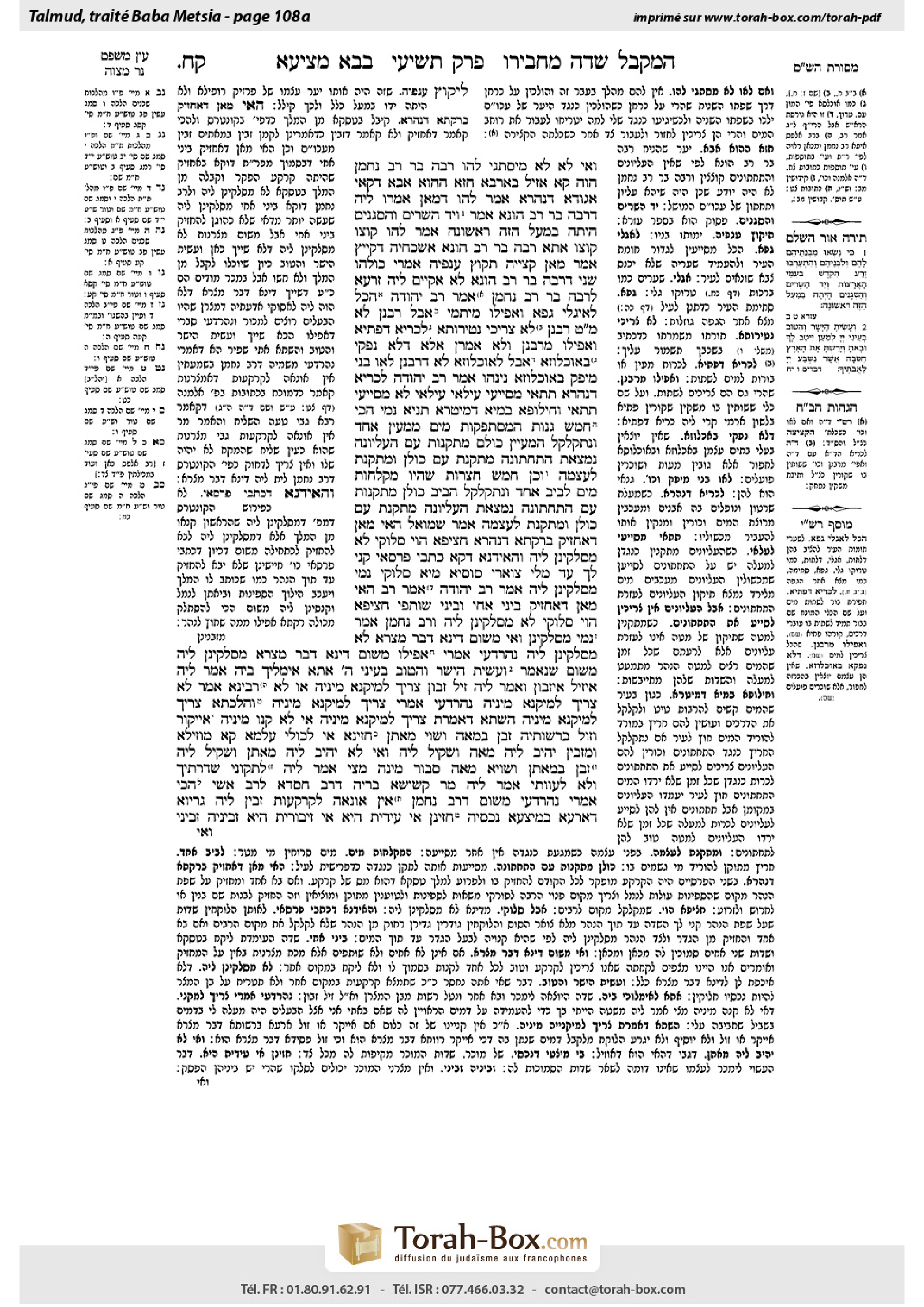
Bava Metzia 108a: Talmud study for Daf Yomi
Study the Talmud for Daf Yomi with scanned pages, Hebrew text, English translations from Sefaria and AI-generated French translations.
Passage selection and English or AI-generated French translation are available where the scan has annotations. Daf Study is independent of Torah-Box and Sefaria.
Browse Bava Metzia · בבא מציעא · All tractatesBava Metzia 108a text and translations
This page of Bava Metzia includes the Aramaic text, an English translation and an AI-generated French translation, alongside the scan above.
בבא מציעא ק״ח א · Aramaic and Hebrew text
וְאִי לָא – לָא מִיסְתַּגֵּי לְהוּ.
רַבָּה בַּר רַב נַחְמָן הֲוָה קָא אָזֵיל בְּאַרְבָּא, חֲזָא הָהוּא אִבָּא דְּקָאֵי אַגּוּדָּא דְנַהְרָא. אֲמַר לְהוּ: דְּמַאן? אֲמַרוּ לֵיהּ: דְּרַבָּה בַּר רַב הוּנָא. אָמַר: ״וְיַד הַשָּׂרִים וְהַסְּגָנִים הָיְתָה בַּמַּעַל הַזֶּה רִאשׁוֹנָה״. אֲמַר לְהוּ: קוּצוּ. קַצּוּ.
אֲתָא רַבָּה בַּר רַב הוּנָא אַשְׁכְּחֵיהּ דְּקַיִיץ, אֲמַר: מַאן קַצְיֵיהּ – תִּקּוֹץ עַנְפֵיהּ. אָמְרִי כּוּלְּהוּ שְׁנֵי דְּרַבָּה בַּר רַב הוּנָא, לָא אִקַּיַּים לֵיהּ זַרְעָא לְרַבָּה בַּר רַב נַחְמָן.
אָמַר רַב יְהוּדָה: הַכֹּל לְאִיגְלֵי גַפָּא, וַאֲפִילּוּ מִיַּתְמֵי – אֲבָל רַבָּנַן לָא. מַאי טַעְמָא? רַבָּנַן לָא צְרִיכִי נְטִירוּתָא. לְכַרְיָא דְפַתְיָא – וַאֲפִילּוּ מֵרַבָּנַן.
וְלָא אֲמַרַן אֶלָּא דְּלָא נָפְקִי בְּכָלוֹזָא. אֲבָל לְכָלוֹזָא – לָא, דְּרַבָּנַן לָאו בְּנֵי מִיפַּק בְּכָלוֹזָא נִינְהוּ.
אָמַר רַב יְהוּדָה: לְכַרְיָא דְנַהְרָא – תַּתָּאֵי מְסַיְּיעִי עִילָּאֵי, עִילָּאֵי לָא מְסַיְּיעִי תַּתָּאֵי. וְחִילּוּפָא בְּמַיָּא דְמִיטְרָא.
תַּנְיָא נָמֵי הָכִי: חָמֵשׁ גַּנּוֹת הַמִּסְתַּפְּקוֹת מַיִם מִמַּעְיָן אֶחָד, וְנִתְקַלְקֵל הַמַּעְיָין – כּוּלָּם מְתַקְּנוֹת עִם הָעֶלְיוֹנָה. נִמְצֵאת הַתַּחְתּוֹנָה מְתַקֶּנֶת עִם כּוּלָּן וּמְתַקֶּנֶת לְעַצְמָהּ. וְכֵן חָמֵשׁ חֲצֵרוֹת שֶׁהָיוּ מְקַלְּחוֹת מַיִם לְבִיב אֶחָד, וְנִתְקַלְקֵל הַבִּיב – כּוּלָּן מְתַקְּנוֹת עִם הַתַּחְתּוֹנָה, נִמְצֵאת הָעֶלְיוֹנָה מְתַקֶּנֶת עִם כּוּלָּן וּמְתַקֶּנֶת לְעַצְמָהּ.
אָמַר שְׁמוּאֵל: הַאי מַאן דְּאַחְזֵיק בְּרַקְתָּא דְנַהְרָא – חֲצִיפָא הָוֵי, סַלּוֹקֵי לָא מְסַלְּקִינַן לֵיהּ. וְהָאִידָּנָא דְּקָא כָּתְבִי פָּרְסָאֵי: קְנֵי לָךְ עַד מְלֵי צַוְּארֵי סוּסְיָא מַיָּא – סַלּוֹקֵי נָמֵי מְסַלְּקִינַן לֵיהּ.
אָמַר רַב יְהוּדָה אָמַר רַב: הַאי מַאן דְּאַחְזֵיק בֵּינֵי אַחֵי וּבֵינֵי שׁוּתָּפֵי, חֲצִיפָא הָוֵי. סַלּוֹקֵי לָא מְסַלְּקִינַן לֵיהּ. וְרַב נַחְמָן אָמַר: נָמֵי מְסַלְּקִינַן. וְאִי מִשּׁוּם דִּינָא דְּבַר מִצְרָא – לָא מְסַלְּקִינַן לֵיהּ.
נְהַרְדָּעֵי אָמְרִי: אֲפִילּוּ מִשּׁוּם דִּינָא דְּבַר מִצְרָא – מְסַלְּקִינַן לֵיהּ, מִשּׁוּם שֶׁנֶּאֱמַר: ״וְעָשִׂיתָ הַיָּשָׁר וְהַטּוֹב בְּעֵינֵי ה׳״.
אֲתָא אִימְּלִיךְ בֵּיהּ, אֲמַר לֵיהּ: אֵיזִיל אֶיזְבּוֹן? וַאֲמַר לֵיהּ: זִיל זְבוֹן. צְרִיךְ לְמִיקְנֵא מִינֵּיהּ, אוֹ לָא? רָבִינָא אָמַר: לָא צְרִיךְ לְמִיקְנֵא מִינֵּיהּ, נְהַרְדָּעֵי אָמְרִי: צְרִיךְ לְמִיקְנֵא מִינֵּיהּ. וְהִלְכְתָא: צְרִיךְ לְמִיקְנֵא מִינֵּיהּ.
הַשְׁתָּא דְּאָמְרַתְּ צְרִיךְ לְמִיקְנֵא מִינֵּיהּ, אִי לָא קְנוֹ מִינֵּיהּ – אִיַּיקּוּר וְזוּל בִּרְשׁוּתֵיהּ.
זְבַן בִּמְאָה וְשָׁוֵי מָאתַן, (חָזֵינָא) [חָזֵינַן]: אִי לְכוּלֵּי עָלְמָא קָא מוֹזֵילא וּמְזַבֵּין – יָהֵיב לֵיהּ מְאָה וְשָׁקֵיל לֵיהּ. וְאִי לָא – יָהֵיב לֵיהּ מָאתַן וְשָׁקֵיל לֵיהּ.
זְבַן בְּמָאתַן וְשָׁוְיָא מְאָה, סְבוּר מִינָּה, מָצֵי אָמַר לֵיהּ: לְתַקּוֹנֵי שַׁדַּרְתָּיךָ וְלָא לְעַוּוֹתֵי. אֲמַר לֵיהּ מָר קַשִּׁישָׁא בְּרֵיהּ דְּרַב חִסְדָּא לְרַב אָשֵׁי: הָכִי אָמְרִי נְהַרְדָּעֵי מִשּׁוּם דְּרַב נַחְמָן: אֵין אוֹנָאָה לְקַרְקָעוֹת.
זַבֵּין לֵיהּ גְּרִיוָא דְּאַרְעָא בְּמִיצְעָא נִכְסֵיהּ, חָזֵינַן אִי עִידִּית הִיא, אִי זִיבּוּרִית הִיא – זְבִינֵיהּ זְבִינֵי.
Bava Metzia 108a · English translation
and if not, they will be unable to walk, but will have to cross over to the other side of the river. Therefore, no advantage exists to cutting down the trees that block part of the river.
The Gemara cites a related incident: Rabba bar Rav Naḥman was going on a boat and saw a certain forest that was located right on the riverbank, as its trees had not been cut down to make room for the pullers. He said to those who were with him: To whom does this forest belong? They said to him: It belongs to Rabba bar Rav Huna. Rabba bar Rav Naḥman said: This is reminiscent of the verse: “And the hand of the princes and the rulers has been first in this faithlessness” (Ezra 9:2), because a renowned scholar is acting improperly. Rabba bar Rav Naḥman said to them: Cut down, cut down to clear a path.
Rabba bar Rav Huna arrived and found that his forest had been cut down. Since he was within his rights not to cut down his trees, as explained above, he grew angry and pronounced a curse: He who cut down this forest should have his branches cut down. The Sages said: Although he was unaware of the identity of the perpetrator, the Sage’s curse was nevertheless fulfilled, and consequently all the remaining years that Rabba bar Rav Huna was alive, the seed of Rabba bar Rav Naḥman did not last, as his children, his branches, died in his lifetime.
Rav Yehuda says: All participate in the payment for the construction of the city wall, and this sum is collected even from orphans, but not from the Torah scholars. What is the reason for this? The Torah scholars do not require protection, as the merit of their Torah study protects them from harm. By contrast, money is collected for the digging of a river or a well for drinking water, even from the Torah scholars.
The Gemara adds: And we said this halakha only if the town inhabitants do not go out in a crowd to perform the work themselves but pay workers to act on their behalf. But if they go out in a crowd, Torah scholars do not have to join them, as Torah scholars are not among those who go out in a crowd to perform work in public view.
Rav Yehuda says: With regard to the digging of a river, i.e., the periodic deepening of a riverbed to prevent it from blocking up, the lower ones, i.e., those who live by the bottom of the river, must assist the upper ones in digging it and fixing it, as those located at the bottom of the river stand to gain from any work performed down to their houses. But the upper ones do not need to assist the lower ones, as the reverse is not the case. And the opposite is true with regard to the digging of a ditch to remove rainwater. In that case, those who live higher up are interested in the operation and therefore must help the lower ones, but the latter need not aid the higher ones in doing so in the upper area.
The Gemara comments: This is also taught in a baraita: If there were five gardens that draw their water requirements from one spring and the spring became damaged, all must help fix it with the owner of the upper garden, near whose garden the damage occurred. As a result of this ruling, the owner of the lower garden fixes it with all of them in the above case, and fixes it for himself if the damage occurred in the lower area. And similarly, if there were five courtyards that would run off water into a single sewer and the sewer became damaged, all must help fix it with the owner of the lower courtyard, near whose courtyard the damage occurred. The result is that the owner of the upper courtyard fixes the sewer with all of them and fixes it for himself if the damage affected his courtyard alone. This is in accordance with Rav Yehuda’s ruling.
Shmuel says: One who takes possession of an open space left along a riverbank for the purpose of loading and unloading in order to plow and plant there during the time that it is temporarily unused is impudent. As for removing him, we do not remove him, as this piece of land is considered ownerless. And nowadays, when the Persians write to one who acquires land alongside a river: Acquire for yourself the field up to the portion of the river itself where the water reaches a horse’s neck, we even go as far as to remove him from the plot of land, as it belongs to the owner of the field.
Rav Yehuda says that Rav says: One who takes possession of land that is located between the land of brothers or between the land of partners and causes them trouble is impudent. As for removing him, we do not remove him, as they have no real claim against him. And Rav Naḥman said: We even go as far as to remove him, as one should not do anything that harms another. And if the complaint against him is due to the halakha of one whose field borders the field of his neighbor, as they owned fields bordering on this one, we do not remove him.
The Sages of Neharde’a say: Even if his claim was due to the halakha of one whose field borders the field of his neighbor, we still remove him, as it is stated: “And you shall do that which is right and good in the eyes of the Lord” (Deuteronomy 6:18). One should not perform an action that is not right and good, even if he is legally entitled to do so.
With the above halakhot in mind, the Gemara asks: If the stranger came to consult with one of the owners of the fields, and said to him: Shall I go and acquire the field, and the latter said to him, go and acquire it, as I will raise no objection, is it necessary to perform an act of acquisition with him to solidify the agreement? Or perhaps his mere promise is sufficient and it is not necessary? Ravina said: It is not necessary to perform an act of acquisition with him, while the Sages of Neharde’a say: It is necessary to perform an act of acquisition with him. The Gemara concludes: And the halakha is that it is necessary to perform an act of acquisition with him.
The Gemara adds: Now that you have said that it is necessary to perform an act of acquisition with the neighbor for the right to purchase the field, if he did not perform an act of acquisition with him and purchased the field, and the field increased or decreased in value, the price fluctuation occurs in the domain of the owner of the bordering field. The buyer’s purchase is considered a purchase on behalf of the neighbor, who then reimburses the buyer.
Accordingly, if this buyer bought it for one hundred dinars and the field was worth two hundred dinars, in order to determine how much money the neighbor must give him, we determine why the owner sold the field to the buyer at this price: If he sells to everyone at that cheap price, the neighbor gives the buyer one hundred dinars and takes it, as the neighbor could have bought it for this sum himself. But if the owner does not sell to everyone at this price and this buyer was given a discount, the neighbor gives the buyer two hundred dinars, the market value of the field, and takes it.
In the converse case, if he bought it for two hundred dinars and the field was worth one hundred dinars, the Sages understood that the neighbor can say to the buyer: I sent you to act for my benefit, but not to act to my detriment. Since the field will not remain in your possession, you are effectively my agent, and I am not prepared to pay more than its market value due to your mistake. Mar the Elder, son of Rav Ḥisda, said to Rav Ashi: This is what the Sages of Neharde’a say in the name of Rav Naḥman: There is no exploitation with regard to real estate, as land has no fixed value, and therefore it cannot be said that the buyer overpaid, and he is given whatever sum he spent.
The Gemara discusses a related case: If one sold to another a beit se’a of land in the middle of his property so that the buyer is surrounded on all sides by the seller’s fields, we see what type of land it is: Whether the land is superior-quality land or whether it is inferior-quality land, his sale is a valid sale, as it is a distinctive piece of land. In that case, the seller’s neighbors cannot object, as their fields do not actually border on this plot.
Bava Metzia 108a · Traduction française (IA)
et s'ils ne le font pas, ils ne pourront pas marcher, mais devront traverser à l'autre côté du fleuve. Ainsi, il n'y a aucun avantage à couper les arbres qui bloquent partiellement le fleuve.
La Guemara cite un incident similaire : Rabba bar Rav Naḥman était en bateau et a vu un certain bois situé directement sur la rive, car ses arbres n'avaient pas été coupés pour faire place aux remorqueurs. Il a dit à ceux qui étaient avec lui : À qui appartient ce bois ? Ils lui ont répondu : Il appartient à Rabba bar Rav Huna. Rabba bar Rav Naḥman a dit : Cela rappelle la parole : « Et la main des princes et des chefs a été première dans cette infidélité » (Ezra 9:2), car un savant célèbre agit de manière inappropriée. Rabba bar Rav Naḥman a dit à ceux qui étaient avec lui : Coupez, coupez pour dégager un passage.
Rabba bar Rav Huna est arrivé et a découvert que son bois avait été coupé. Puisqu'il avait le droit de ne pas couper ses arbres, comme expliqué ci-dessus, il s'est mis en colère et a prononcé une malédiction : Celui qui a coupé ce bois devrait voir ses branches coupées. Les Sages ont dit : Bien qu'il ne connaisse pas l'identité du coupable, la malédiction du Sage a été accomplie, et par conséquent, pendant les années restantes que Rabba bar Rav Huna a vécu, la descendance de Rabba bar Rav Naḥman n'a pas persisté, car ses enfants, ses branches, sont morts durant sa vie.
Rav Yehuda dit : Tous participent au paiement pour la construction du mur de la ville, et cette somme est recueillie même auprès des orphelins, mais pas auprès des savants de la Torah. Quelle est la raison de cela ? Les savants de la Torah n'ont pas besoin de protection, car la mérite de leur étude de la Torah les protège contre les dangers. En revanche, des fonds sont recueillis pour creuser un fleuve ou un puits pour l'eau potable, même auprès des savants de la Torah.
La Guemara ajoute : Et nous avons dit cette halakha seulement si les habitants de la ville ne sortent pas en groupe pour effectuer eux-mêmes le travail, mais paient des ouvriers pour agir à leur place. Mais si ils sortent en groupe, les savants de la Torah n'ont pas besoin de les rejoindre, car les savants de la Torah ne sont pas parmi ceux qui sortent en groupe pour travailler en public.
Rav Yehuda dit : En ce qui concerne le creusement d'un fleuve, c'est-à-dire le dégagement périodique du lit du fleuve pour éviter qu'il ne s'obstrue, les bas, c'est-à-dire ceux qui habitent en bas du fleuve, doivent aider les hauts à le creuser et à le réparer, car ceux qui habitent en bas du fleuve en tirent profit de toute l'œuvre effectuée jusqu'à leurs maisons. Les hauts n'ont pas besoin d'aider les bas, car c'est l'inverse. Et l'inverse est vrai en ce qui concerne le creusement d'un canal pour éliminer l'eau de pluie. Dans ce cas, ceux qui habitent plus haut sont intéressés par l'opération et doivent donc aider les bas, mais les bas n'ont pas besoin d'aider les hauts dans la zone supérieure.
La Guemara commente : Cela est également enseigné dans une baraïta : Si cinq jardins puisaient leur eau d'une même source et que la source ait été endommagée, tous doivent aider à la réparer avec l'propriétaire du jardin supérieur, près duquel l'endommagement s'est produit. En conséquence de cette décision, l'propriétaire du jardin inférieur répare avec tous ceux-ci dans le cas ci-dessus, et répare lui-même si l'endommagement s'est produit dans la zone inférieure. De même, si cinq cours intérieures s'écoulaient dans un seul égout et que l'égout ait été endommagé, tous doivent aider à la réparer avec l'propriétaire de la cour inférieure, près de laquelle l'endommagement s'est produit. Le résultat est que l'propriétaire de la cour supérieure répare l'égout avec tous ceux-ci et répare lui-même si l'endommagement affectait uniquement sa cour. Cela est conforme à la décision de Rav Yehuda.
Shmuel dit : Celui qui s'empare d'un espace ouvert laissé le long d'une rive pour le chargement et le déchargement afin de labourer et planter pendant la période où il est temporairement inutilisé est impoli. En ce qui concerne l'éloignement de cette personne, nous ne l'éloignons pas, car cette parcelle de terre est considérée comme sans propriétaire. Et maintenant, lorsque les Perses écrivent à celui qui acquiert une terre le long d'un fleuve : Acquière pour toi la terre jusqu'à la portion du fleuve lui-même où l'eau atteint le cou d'un cheval, nous allons même jusqu'à éloigner cette personne du terrain, car il appartient à l'propriétaire de la terre.
Rav Yehuda dit que Rav dit : Celui qui s'empare d'une terre située entre les terres de frères ou entre les terres de partenaires et qui cause des problèmes est impoli. En ce qui concerne l'éloignement de cette personne, nous ne l'éloignons pas, car ils n'ont pas de revendication réelle contre lui. Et Rav Naḥman a dit : Nous allons même jusqu'à éloigner cette personne, car on ne devrait pas faire quelque chose qui nuise à un autre. Et si la plainte contre lui est due à la halakha d'une personne dont le champ limite le champ de son voisin, car ils possédaient des champs limitant celui-ci, nous ne l'éloignons pas.
Les Sages de Neharde’a disent : Même si sa revendication était due à la halakha d'une personne dont le champ limite le champ de son voisin, nous éloignons quand même cette personne, car il est dit : « Et tu feras ce qui est droit et bon aux yeux du Seigneur » (Deutéronome 6:18). On ne doit pas accomplir une action qui n'est pas juste et bonne, même si l'on est légalement autorisé à le faire.
Avec les halakhot ci-dessus en tête, la Guemara pose la question : Si un étranger est venu consulter l'un des propriétaires des champs et a dit à celui-ci : Devrais-je aller et acquérir le champ, et que le dernier ait dit à lui : Va et acquiers-le, car je ne m'opposerai pas, est-il nécessaire d'accomplir une action d'acquisition avec lui pour solidifier l'accord ? Ou peut-être que sa simple promesse suffit et qu'il n'est pas nécessaire ? Ravina a dit : Il n'est pas nécessaire d'accomplir une action d'acquisition avec lui, tandis que les Sages de Neharde’a disent : Il est nécessaire d'accomplir une action d'acquisition avec lui. La Guemara conclut : Et la halakha est que l'accomplissement d'une action d'acquisition avec lui est nécessaire.
La Guemara ajoute : Maintenant que vous avez dit qu'il est nécessaire d'accomplir un acte d'acquisition avec le voisin pour acquérir le droit d'acheter le champ, si l'on n'a pas accompli un acte d'acquisition avec lui et qu'on a acheté le champ, et que le champ a augmenté ou diminué en valeur, la fluctuation du prix se produit dans le domaine du propriétaire du champ adjacent. L'achat de l'acheteur est considéré comme un achat au nom du voisin, qui rétribue ensuite l'acheteur.
Ainsi, si cet acheteur l'a acheté pour cent dinars et que le champ valait deux cents dinars, afin de déterminer combien d'argent le voisin doit lui donner, on examine pourquoi le propriétaire a vendu le champ à l'acheteur à ce prix : Si il vend à tout le monde à ce prix bas, le voisin donne à l'acheteur cent dinars et le reprend, car le voisin aurait pu l'acheter lui-même pour cette somme. Mais si le propriétaire ne vend pas à tout le monde à ce prix et que cet acheteur a bénéficié d'une réduction, le voisin donne à l'acheteur deux cents dinars, la valeur du champ sur le marché, et le reprend.
Dans le cas contraire, si l'on l'a acheté pour deux cents dinars et que le champ valait cent dinars, les Sages ont compris que le voisin peut dire à l'acheteur : J'ai envoyé vous agir en mon nom, mais pas pour votre préjudice. Puisque le champ ne restera pas en votre possession, vous êtes effectivement mon agent, et je ne suis pas prêt à payer plus que sa valeur marchande à cause de votre erreur. Mar le Vieil, fils de Rav Ḥisda, a dit à Rav Ashi : C'est ce que disent les Sages de Neharde’a en nom de Rav Naḥman : Il n'y a pas d'exploitation concernant les biens immobiliers, car la terre n'a pas de valeur fixe, et donc on ne peut pas dire que l'acheteur a payé trop cher, et on lui donne la somme qu'il a dépensée.
La Guemara discute d’un cas similaire : Si l’on a vendu à un autre un beit se’a de terre au milieu de sa propriété de sorte que l’acheteur est entouré de tous côtés par les champs du vendeur, on examine de quel type de terre il s’agit : s’il s’agit de terre de qualité supérieure ou de terre de qualité inférieure, la vente est une vente valide, car il s’agit d’une parcelle distincte. Dans ce cas, les voisins du vendeur ne peuvent pas s’opposer, car leurs champs ne bordent pas réellement cette parcelle.
Traduction française générée par IA à partir de l’édition anglaise de Sefaria. Vérifie toujours un passage avec le texte source.
Text from Sefaria: William Davidson Edition - Vocalized Aramaic (CC BY NC); William Davidson Edition - English (CC BY NC).