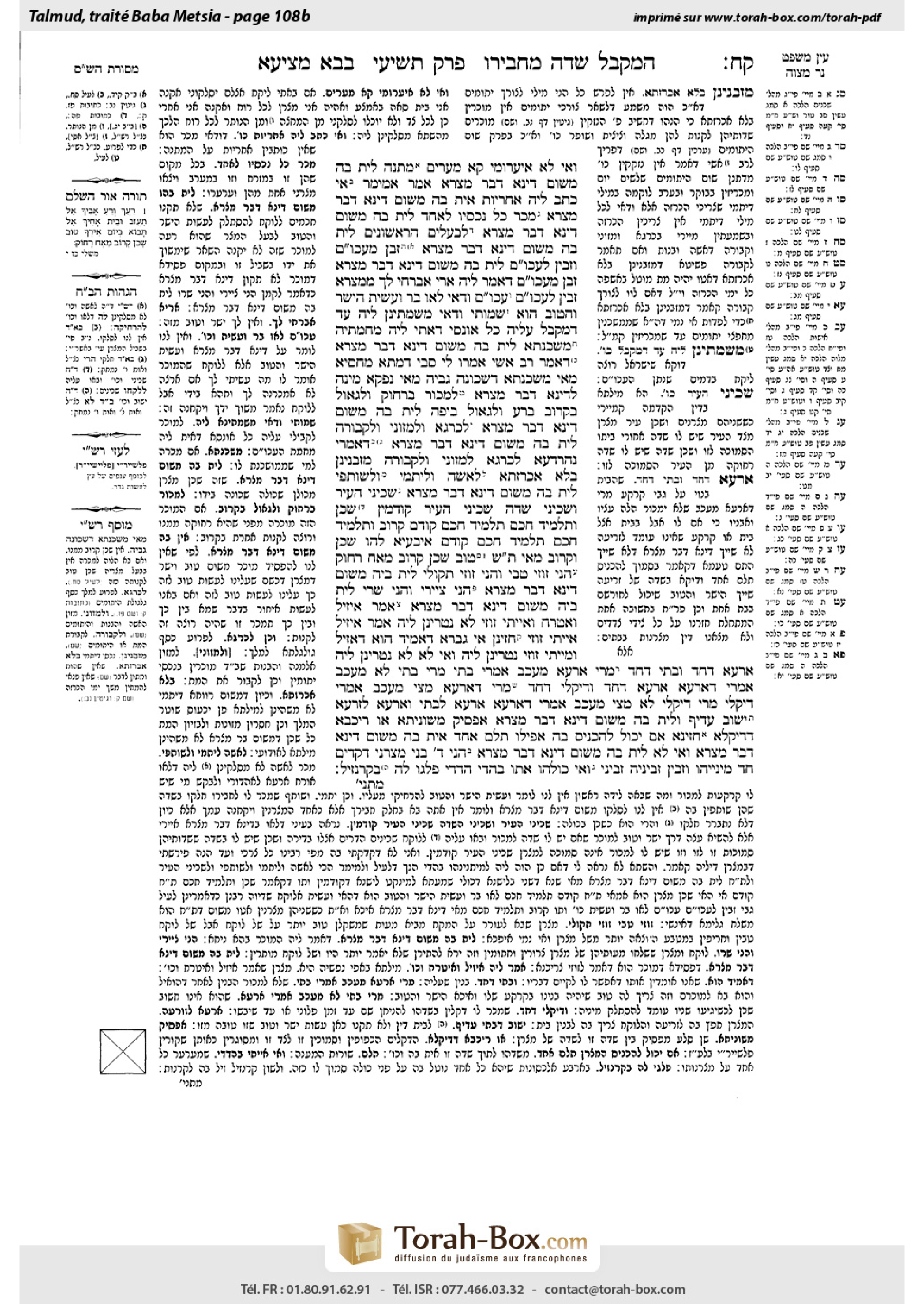
Bava Metzia 108b: Talmud study for Daf Yomi
Study the Talmud for Daf Yomi with scanned pages, Hebrew text, English translations from Sefaria and AI-generated French translations.
Passage selection and English or AI-generated French translation are available where the scan has annotations. Daf Study is independent of Torah-Box and Sefaria.
Browse Bava Metzia · בבא מציעא · All tractatesBava Metzia 108b text and translations
This page of Bava Metzia includes the Aramaic text, an English translation and an AI-generated French translation, alongside the scan above.
בבא מציעא ק״ח ב · Aramaic and Hebrew text
וְאִי לָא, אִיעָרוֹמֵי קָא מַעֲרֵים.
מַתָּנָה לֵית בָּהּ מִשּׁוּם דִּינָא דְּבַר מִצְרָא. אָמַר אַמֵּימָר: אִי כְּתַב לֵיהּ אַחְרָיוּת – אִית בָּהּ מִשּׁוּם דִּינָא דְּבַר מִצְרָא.
מָכַר כׇּל נְכָסָיו לְאֶחָד – לֵית בַּהּ מִשּׁוּם דִּינָא דְּבַר מִצְרָא. לִבְעָלִים הָרִאשׁוֹנִים – לֵית בַּהּ מִשּׁוּם דִּינָא דְּבַר מִצְרָא. זְבַן מִגּוֹי וְזַבֵּין לְגוֹי – לֵית בַּהּ מִשּׁוּם דִּינָא דְּבַר מִצְרָא.
זְבַן מִגּוֹי – דַּאֲמַר לֵיהּ: אֲרִי אַבְרַחִי לָךְ מִמִּצְרָךְ. זַבֵּין לְגוֹי – גּוֹי וַדַּאי לָאו בַּר ״וְעָשִׂיתָ הַיָּשָׁר וְהַטּוֹב״ הוּא. שַׁמּוֹתֵי וַדַּאי מְשַׁמְּתִינַן לֵיהּ, עַד דִּמְקַבֵּל עֲלֵיהּ כֹּל אוּנְסֵי דְּאָתֵי לֵיהּ מֵחֲמָתֵיהּ.
מַשְׁכַּנְתָּא לֵית בַּהּ מִשּׁוּם דִּינָא דְּבַר מִצְרָא. דְּאָמַר רַב אָשֵׁי: אֲמַרוּ לִי סָבֵי דְּמָתָא מַחְסֵיָא: מַאי ״מַשְׁכַּנְתָּא״ – דִּשְׁכוּנָה גַּבֵּיהּ. מַאי נָפְקָא מִינַּהּ – לְדִינָא דְּבַר מִצְרָא.
לִמְכּוֹר בְּרָחוֹק וְלִגְאוֹל בְּקָרוֹב, בְּרַע וְלִגְאוֹל בְּיָפֶה – לֵית בַּהּ מִשּׁוּם דִּינָא דְּבַר מִצְרָא.
לִכְרָגָא וְלִמְזוֹנֵי וְלִקְבוּרָה – לֵית בַּהּ מִשּׁוּם דִּינָא דְּבַר מִצְרָא. דְּאָמְרִי נְהַרְדְּעָאֵי: לִכְרָגָא, לִמְזוֹנֵי וְלִקְבוּרָה מְזַבְּנִינַן בְּלָא אַכְרַזְתָּא. לְאִשָּׁה וּלְיַתְמֵי וּלְשׁוּתָּפֵי – לֵית בַּהּ מִשּׁוּם דִּינָא דְּבַר מִצְרָא.
שְׁכֵינֵי הָעִיר וּשְׁכֵינֵי שָׂדֶה – שְׁכֵינֵי הָעִיר קוֹדְמִין.
שָׁכֵן וְתַלְמִיד חָכָם – תַּלְמִיד חָכָם קוֹדֵם. קָרוֹב וְתַלְמִיד חָכָם – תַּלְמִיד חָכָם קוֹדֵם. אִיבַּעְיָא לְהוּ: שָׁכֵן וְקָרוֹב מַאי? תָּא שְׁמַע: ״טוֹב שָׁכֵן קָרוֹב מֵאָח רָחוֹק״.
הָנֵי זוּזֵי טָבֵי וְהָנֵי זוּזֵי תְּקוּלֵי – לֵית בֵּיהּ מִשּׁוּם דִּינָא דְּבַר מִצְרָא. הָנֵי צַיְירִי וְהָנֵי שְׁרוּ – לֵית בֵּיהּ מִשּׁוּם דִּינָא דְּבַר מִצְרָא.
אָמַר: אֵיזִיל וְאֶטְרַח וְאַיְיתֵי זוּזֵי – לָא נָטְרִינַן לֵיהּ. אָמַר: אֵיזִיל אַיְיתֵי זוּזֵי, חָזֵינַן: אִי גַּבְרָא דַּאֲמִיד הוּא דְּאָזֵיל וּמַיְיתֵי זוּזֵי – נָטְרִינַן לֵיהּ, וְאִי לָא – לָא נָטְרִינַן לֵיהּ.
אַרְעָא דְּחַד וּבָתֵּי דְּחַד – מָרֵי אַרְעָא מְעַכֵּב אַמָּרֵי בָּתֵּי, מָרֵי בָּתֵּי לָא מְעַכֵּב אַמָּרֵי דְּאַרְעָא. אַרְעָא דְּחַד וְדִיקְלֵי דְּחַד – מָרֵי דְּאַרְעָא מָצֵי מְעַכֵּב אַמָּרֵי דִּקְלֵי, מָרֵי דִּיקְלֵי לָא מָצֵי מְעַכֵּב אַמָּרֵי דְּאַרְעָא.
אַרְעָא לְבָתֵּי וְאַרְעָא לְזַרְעָא – יִשּׁוּב עֲדִיף, וְלֵית בַּהּ מִשּׁוּם דִּינָא דְּבַר מִצְרָא.
אַפְסֵיק מְשׁוּנִּיתָא אוֹ רִיכְבָּא דְּדִיקְלָא, (חָזֵינָא) [חָזֵינַן]: אִם יָכוֹל לְהַכְנִיס בָּהּ אֲפִילּוּ תֶּלֶם אֶחָד – אִית בַּהּ מִשּׁוּם דִּינָא דְּבַר מִצְרָא, וְאִי לָא – לֵית בַּהּ מִשּׁוּם דִּינָא דְּבַר מִצְרָא.
הָנֵי אַרְבָּעָה בְּנֵי מִצְרָנֵי, דְּקָדֵים חַד מִינַּיְיהוּ וְזָבֵין – זְבִינֵיהּ זְבִינֵי. וְאִי כּוּלְּהוּ אָתוּ בַּהֲדֵי הֲדָדֵי – פָּלְגוּ לַהּ בְּקַרְנְזִיל.
Bava Metzia 108b · English translation
But if this field is not of any distinct quality, he is certainly trying to employ an artifice. His plan is to then purchase another plot of land from this owner, one that does border on the field of a neighbor. By first buying the plot in the middle, he is trying to establish himself as a neighbor so that the other neighbors will not have the first right of purchase relative to him. Therefore, the neighbors may prevent him from buying the second plot of land.
The Gemara continues to discuss the halakha of one whose field borders that of his neighbor. With regard to a gift, it is not subject to the halakha of one whose field borders the field of his neighbor, as one can give a gift to whomever he chooses. Ameimar said: If he wrote a property guarantee to the recipient of the gift that if the field is seized for payment of a debt of the giver the giver of the gift will compensate the recipient for his loss, it is subject to the halakha of one whose field borders of the field of his neighbor. In that case the supposed gift has the appearance of a sale, so the neighbor can force the recipient to sell the plot to him.
If a seller sold all his property to a single person, this sale is not subject to the halakha of one whose field borders the field of his neighbor, as the seller is not required to leave out one particular field if the buyer is acquiring all his property. Similarly, if the seller sold it back to the previous owners, this sale is not subject to the halakha of one whose field borders the field of his neighbor. If a buyer bought a field from a gentile or a seller sold a field to a gentile, this purchase or sale is not subject to the halakha of one whose field borders the field of his neighbor.
The Gemara clarifies this ruling: If a buyer bought the field from a gentile it does not apply, as he can say to the neighbor: It is better for you that I bought the field, as I have chased away a lion for you from the border; since the neighbor certainly prefers having a Jewish neighbor to having a gentile neighbor. If a seller sold a field to a gentile, the gentile is certainly not bound by the command of: “And you shall do that which is right and good in the eyes of the Lord” (Deuteronomy 6:18). The gentile is therefore under no obligation to refrain from purchasing this land. Nevertheless, we certainly excommunicate the one who sold it to the gentile until he accepts upon himself responsibility for all damage resulting from accidents that might befall the neighbor on the gentile’s account.
The Gemara continues: If he sold a field previously given as a mortgage to the one to whom it was mortgaged, this sale is not subject to the halakha of one whose field borders the field of his neighbor, as Rav Ashi said: The elders of the town of Mata Meḥasya said to me: What is the meaning of the word mortgage [mashkanta]? It means that it resides [shekhuna] with the one to whom it was mortgaged. The Gemara asks: What difference does it make what the word means? The Gemara answers: It is relevant with regard to the halakha of one whose field borders the field of his neighbor in that the person to whom the field is mortgaged has more rights than bordering neighbors, as he lays claim to a measure of ownership over the land.
If one sought to sell a distant field and to redeem, i.e., purchase for himself, a close one, or if he sold a bad one to redeem a good one, this sale is not subject to the halakha of one whose field borders the field of his neighbor. Rather, he may sell his field whenever he has the opportunity.
Likewise, if he sells his field to pay for necessities, such as for taxes, for his wife and daughters’ sustenance, or for the burial of one of his family members, this sale is not subject to the halakha of one whose field borders the field of his neighbor. This is because the Sages of Neharde’a said: For taxes, for sustenance, and for burial we sell a field without a proclamation, as such matters are pressing and urgent and should not be delayed out of consideration for the rights of a bordering neighbor. Similarly, if he sold the field to a woman, who does not usually chase after vendors, or to orphans, or to his partners, this sale is not subject to the halakha of one whose field borders the field of his neighbor.
If various individuals have equal rights to the field, such as both are bordering neighbors, but some of them are neighbors whose fields are adjacent to his on the side of the city, i.e., their fields are between the city and the field being sold; and others are neighbors whose fields are adjacent to his on the side of the field, i.e., their fields are between the field being sold and the area further from the city, the neighbors whose fields are adjacent to his on the side of the city receive precedence.
If one is a regular neighbor and the other is a Torah scholar, the Torah scholar receives precedence. If one is a relative and the other is a Torah scholar, here too, the Torah scholar receives precedence. A dilemma was raised before the Sages: With regard to a neighbor and a relative, what is the halakha? Which of them takes precedence? The Gemara suggests: Come and hear an answer from the following verse: “Better a neighbor who is near than a brother who is far” (Proverbs 27:10).
If two people sought to acquire a field, and these coins that the first produces for payment are good dinars, and those coins that the second uses are weighed dinars, which are preferable to the good dinars, this sale is not subject to the halakha of one whose field borders the field of his neighbor, as the owner can say he prefers the superior quality coins. If these coins were wrapped up and those were loose, this sale is not subject to the halakha of one whose field borders on the field his neighbor, as he may sell his field to the one whose money is ready to be counted.
If the neighbor said: I will go and expend effort and bring money, we do not wait for him, despite his status as a bordering neighbor, if someone else is available who is prepared to pay immediately. If he said: I will go bring money, we see what his financial status is: If he is a person who is assessed as one who can go and bring money without delay, we wait for him, but if not, we do not wait for him.
If the land belonged to one person and the houses on the land belonged to another one, the owner of the land prevents the owner of the houses from selling his houses to someone else, as he has the first right of purchase. By contrast, the owner of the houses does not prevent the owner of the land from selling his land, as one can change his place of residence with relative ease, so he is not considered tied to the land. Similarly, if the land belonged to one and its palm trees to another one, the owner of the land can prevent the owner of the palm trees from selling the trees to another, but the owner of the palm trees cannot prevent the owner of the land from selling his land to another.
If two people wanted to purchase the land, but one desired the land for building houses and the other wished to purchase the land for planting, the settling of the land through construction of houses is preferable, and this sale is not subject to the halakha of one whose field borders the field of his neighbor. Therefore, he may sell to the one who wants to build a house there, even if he is not a bordering neighbor and the other potential buyer is.
If a jagged edge of rock or a row of palm trees served as a barrier between two bordering fields, we see whether any open space exists. If the owner of the adjacent field can insert even a single furrow there that comes into contact with the other field, this sale is subject to the halakha of one whose field borders the field of his neighbor. But if sufficient space for a furrow does not exist, this sale is not subject to the halakha of one whose field borders the field of his neighbor.
In a case of those four bordering neighbors who surround a field that is for sale from all four sides, if one of them preceded the others and purchased it, his purchase is a valid purchase and the others cannot object. And if they all came simultaneously to purchase it, then they divide the plot of land, with two bisecting diagonal lines so that each receives a portion near his field.
Bava Metzia 108b · Traduction française (IA)
Mais si ce champ n'a pas de qualité distincte, il tente certainement d'user d'un artifice. Son plan est d'acheter ensuite une autre parcelle de terre à cet propriétaire, celle qui touche le champ d'un voisin. En achetant d'abord la parcelle au milieu, il tente de se faire passer pour un voisin afin que les autres voisins n'aient pas le droit de préférence d'achat par rapport à lui. Ainsi, les voisins peuvent empêcher son achat de la deuxième parcelle de terre.
La Guemara continue à discuter de la halakha concernant un propriétaire dont le champ touche celui de son voisin. En ce qui concerne un don, il n'est pas soumis à la halakha d'un propriétaire dont le champ touche celui de son voisin, car on peut donner un don à qui on veut. Ameimar a dit : Si l'on a écrit une garantie de propriété au bénéficiaire du don, stipulant que si le champ est confisqué pour le paiement d'une dette du donneur, le donneur compensera le bénéficiaire pour sa perte, il est soumis à la halakha d'un propriétaire dont le champ touche celui de son voisin. Dans ce cas, le don semble être une vente, donc le voisin peut obliger le bénéficiaire à vendre la parcelle à lui.
Si un vendeur vend toute sa propriété à une seule personne, cette vente n'est pas soumise à la halakha d'un propriétaire dont le champ touche celui de son voisin, car le vendeur n'est pas tenu de laisser de côté un champ particulier si l'acheteur acquiert toute sa propriété. De même, si le vendeur revend la propriété aux anciens propriétaires, cette vente n'est pas soumise à la halakha d'un propriétaire dont le champ touche celui de son voisin. Si un acheteur achète un champ à un non-Juif ou si un vendeur vend un champ à un non-Juif, cette vente ou ce achèvement n'est pas soumis à la halakha d'un propriétaire dont le champ touche celui de son voisin.
La Guemara clarifie cette décision : Si un acheteur achète le champ à un non-Juif, cela ne s'applique pas, car il peut dire au voisin : C'est mieux pour toi que j'ai acheté le champ, car j'ai chassé un lion pour toi de la frontière ; le voisin préfère certainement avoir un voisin juif plutôt qu'un non-Juif. Si un vendeur vend un champ à un non-Juif, ce dernier n'est certainement pas tenu de respecter la commande : « Et tu feras ce qui est droit et bon aux yeux du Seigneur » (Deutéronome 6:18). Le non-Juif n'est donc pas tenu de se refréner d'acheter cette terre. Cependant, nous excommunions certainement celui qui l'a vendu à un non-Juif jusqu'à ce qu'il accepte de s'engager à assumer la responsabilité de tous les dommages pouvant résulter d'accidents sur le compte du non-Juif.
La Guemara continue : Si l'on a vendu un champ précédemment donné en hypothèque à celui à qui il avait été hypothéqué, cette vente n'est pas soumise à la halakha d'un propriétaire dont le champ touche celui de son voisin, car Rav Ashi a dit : Les anciens de la ville de Mata Meḥasya m'ont dit : Quelle est la signification du mot hypothèque [mashkanta] ? Cela signifie qu'il réside [shekhuna] avec celui à qui il avait été hypothéqué. La Guemara demande : Quelle différence cela fait-il ? La Guemara répond : Cela est pertinent concernant la halakha d'un propriétaire dont le champ touche celui de son voisin, car la personne à qui le champ a été hypothéqué a plus de droits que les voisins, car il revendique une mesure de propriété sur la terre.
Si l'on cherchait à vendre un champ éloigné et à racheter, c'est-à-dire à acheter pour soi-même un champ proche, ou si l'on avait vendu un mauvais champ pour racheter un bon champ, cette vente n'est pas soumise à la halakha d'un propriétaire dont le champ touche celui de son voisin. Plutôt, il peut vendre son champ à tout moment qu'il a l'occasion.
De même, si l'on vend son champ pour payer des besoins tels que des impôts, la subsistance de sa femme et de ses filles, ou l'enterrement d'un membre de sa famille, cette vente n'est pas soumise à la halakha d'un propriétaire dont le champ touche celui de son voisin. Cela est dû au fait que les Sages de Neharde’a ont dit : Pour les impôts, la subsistance et l'enterrement, on vend un champ sans proclamation, car ces affaires sont pressantes et urgentes et ne devraient pas être retardées en raison des droits d'un voisin. De même, si l'on a vendu le champ à une femme, qui ne suit généralement pas les vendeurs, ou aux orphelins, ou à ses partenaires, cette vente n'est pas soumise à la halakha d'un propriétaire dont le champ touche celui de son voisin.
Si plusieurs personnes ont des droits égaux sur le champ, tels que les deux sont des voisins, mais certains sont des voisins dont les champs sont adjacents à son côté de la ville, c'est-à-dire que leurs champs sont entre la ville et le champ vendu ; et d'autres sont des voisins dont les champs sont adjacents à son côté du champ, c'est-à-dire que leurs champs sont entre le champ vendu et la zone plus éloignée de la ville, les voisins dont les champs sont adjacents à son côté de la ville ont la priorité.
Si l'un est un voisin régulier et l'autre un savant de la Torah, le savant de la Torah a la priorité. Si l'un est un parent et l'autre un savant de la Torah, ici aussi, le savant de la Torah a la priorité. Un dilemme a été soulevé devant les Sages : En ce qui concerne un voisin et un parent, quelle est la halakha ? Qui a la priorité ? La Guemara suggère : Venez et entendez une réponse à partir du verset suivant : « Mieux vaut un voisin proche qu'un frère éloigné » (Proverbes 27:10).
Si deux personnes cherchaient à acquérir un champ, et que les pièces que le premier produit pour le paiement sont des dinars de bonne qualité, et que celles que l'autre utilise sont des dinars pesés, qui sont préférables aux dinars de bonne qualité, cette vente n'est pas soumise à la halakha d'un propriétaire dont le champ touche celui de son voisin, car le propriétaire peut dire qu'il préfère les pièces de meilleure qualité. Si ces pièces étaient emballées et celles-ci étaient des pièces non emballées, cette vente n'est pas soumise à la halakha d'un propriétaire dont le champ touche celui de son voisin, car il peut vendre son champ à celui dont l'argent est prêt à être compté.
Si le voisin dit : Je vais partir et dépenser mes efforts et apporter de l'argent, nous ne l'attendons pas, malgré son statut de voisin adjacent, si quelqu'un d'autre est disponible et prêt à payer immédiatement. Si il dit : Je vais partir apporter de l'argent, nous examinons son statut financier : Si c'est une personne évaluée comme celle qui peut partir et apporter de l'argent sans délai, nous attendons pour lui, mais si ce n'est pas le cas, nous ne l'attendons pas.
Si la terre appartenait à une seule personne et les maisons sur la terre appartenaient à une autre, l'propriétaire de la terre empêche l'propriétaire des maisons de vendre ses maisons à quelqu'un d'autre, car il a le droit de préférence d'achat. À l'inverse, l'propriétaire des maisons n'empêche pas l'propriétaire de la terre de vendre sa terre à quelqu'un d'autre, car on peut changer de lieu de résidence relativement facilement, donc il n'est pas considéré comme lié à la terre. De même, si la terre appartenait à une seule personne et ses palmiers à une autre, l'propriétaire de la terre peut empêcher l'propriétaire des palmiers de vendre les arbres à un autre, mais l'propriétaire des palmiers ne peut pas empêcher l'propriétaire de la terre de vendre sa terre à un autre.
Si deux personnes souhaitaient acheter la terre, mais l'une voulait la terre pour construire des maisons et l'autre souhaitait l'acheter pour planter, la mise en valeur de la terre par la construction des maisons est préférable, et cette vente n'est pas soumise à la halakha de celui dont le champ est adjacent au champ de son voisin. Par conséquent, il peut vendre à celui qui veut construire une maison là, même s'il n'est pas un voisin adjacent et que l'autre acheteur potentiel est présent.
Si un bord irrégulier de rocher ou une rangée de palmiers servait de barrière entre deux champs adjacents, nous examinons s'il existe un espace ouvert. Si l'propriétaire du champ adjacent peut insérer même une seule sillage là où il entre en contact avec le champ, cette vente est soumise à la halakha de celui dont le champ est adjacent au champ de son voisin. Mais si il n'y a pas suffisamment d'espace pour un sillage, cette vente n'est pas soumise à la halakha de celui dont le champ est adjacent au champ de son voisin.
Dans le cas de ces quatre voisins adjacents qui entourent un champ à vendre de tous les côtés, si l'un d'eux a précédé les autres et l'a acheté, son achat est une vente valide et les autres ne peuvent pas s'opposer. Et si tous sont arrivés simultanément pour l'acheter, alors ils divisent la parcelle de terre, avec deux lignes diagonales qui la coupent en deux, de sorte que chacun reçoit une part près de son champ.
Traduction française générée par IA à partir de l’édition anglaise de Sefaria. Vérifie toujours un passage avec le texte source.
Text from Sefaria: William Davidson Edition - Vocalized Aramaic (CC BY NC); William Davidson Edition - English (CC BY NC).