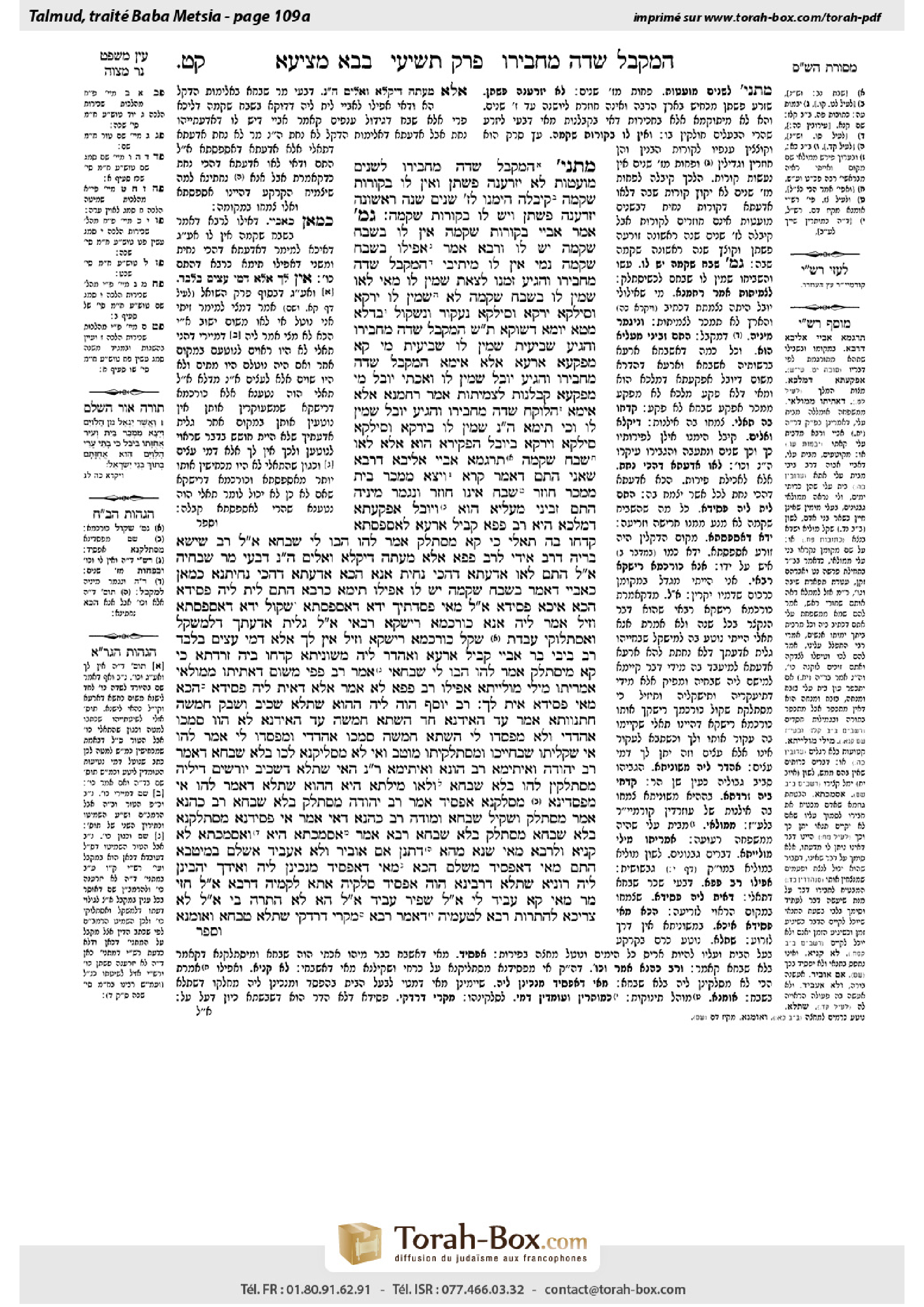
Bava Metzia 109a: Talmud study for Daf Yomi
Study the Talmud for Daf Yomi with scanned pages, Hebrew text, English translations from Sefaria and AI-generated French translations.
Passage selection and English or AI-generated French translation are available where the scan has annotations. Daf Study is independent of Torah-Box and Sefaria.
Browse Bava Metzia · בבא מציעא · All tractatesBava Metzia 109a text and translations
This page of Bava Metzia includes the Aramaic text, an English translation and an AI-generated French translation, alongside the scan above.
בבא מציעא ק״ט א · Aramaic and Hebrew text
מַתְנִי׳ הַמְקַבֵּל שָׂדֶה מֵחֲבֵירוֹ לְשָׁנִים מוּעָטוֹת – לֹא יִזְרָעֶנָּה פִּשְׁתָּן, וְאֵין לוֹ בְּקוֹרוֹת שִׁקְמָה. קִיבְּלָהּ הֵימֶנּוּ לְשֶׁבַע שָׁנִים – שָׁנָה רִאשׁוֹנָה יִזְרָעֶנָּה פִּשְׁתָּן, וְיֵשׁ לוֹ בְּקוֹרוֹת שִׁקְמָה.
גְּמָ׳ אָמַר אַבָּיֵי: בְּקוֹרוֹת שִׁקְמָה – אֵין לוֹ, בִּשְׁבַח שִׁקְמָה – יֵשׁ לוֹ. וְרָבָא אָמַר: אֲפִילּוּ בִּשְׁבַח שִׁקְמָה נָמֵי אֵין לוֹ.
מֵיתִיבִי: הַמְקַבֵּל שָׂדֶה מֵחֲבֵירוֹ וְהִגִּיעַ זְמַנּוֹ לָצֵאת – שָׁמִין לוֹ. מַאי לָאו: שָׁמִין לוֹ בִּשְׁבַח שִׁקְמָה? לָא, שָׁמִין לוֹ יַרְקָא וְסִילְקָא.
יַרְקָא וְסִילְקָא – נַעֲקוֹר וְנִשְׁקוֹל! בִּדְלָא מְטָא יוֹמָא דְשׁוּקָא.
תָּא שְׁמַע: הַמְקַבֵּל שָׂדֶה מֵחֲבֵירוֹ וְהִגִּיעַ שְׁבִיעִית, שָׁמִין לוֹ. שְׁבִיעִית מִי קָא מַפְקְעָא אַרְעָא? אֶלָּא אֵימָא: הַמְקַבֵּל שָׂדֶה מֵחֲבֵירוֹ וְהִגִּיעַ יוֹבֵל, שָׁמִין לוֹ.
וְאַכַּתִּי, יוֹבֵל מִי מַפְקְעָא קַבְּלָנוּת? ״לִצְמִיתֻת״ אָמַר רַחֲמָנָא! אֶלָּא אֵימָא: הַלּוֹקֵחַ שָׂדֶה מֵחֲבֵירוֹ וְהִגִּיעַ יוֹבֵל – שָׁמִין לוֹ.
וְכִי תֵּימָא הָכִי נָמֵי, שָׁמִין לוֹ בְּיַרְקָא וְסִילְקָא? סִילְקָא וְיַרְקָא בְּיוֹבֵל הֶפְקֵירָא הוּא! אֶלָּא לָאו, שְׁבַח שִׁקְמָה!
תַּרְגְּמַהּ אַבָּיֵי אַלִּיבָּא דְּרָבָא: שָׁאנֵי הָתָם, דְּאָמַר קְרָא: ״וְיָצָא מִמְכַּר בַּיִת״. מִמְכָּר – חוֹזֵר, שֶׁבַח – אֵינוֹ חוֹזֵר. וְנִגְמַר מִינֵּיהּ? הָתָם זְבִינֵי מְעַלְּיָא הוּא, וְיוֹבֵל אַפְקַעְתָּא דְּמַלְכָּא הִיא.
רַב פָּפָּא קַבֵּיל אַרְעָא לְאַסְפַּסְתָּא. קְדַחוּ בַּהּ תָּאלֵי. כִּי קָא מִסְתַּלַּק, אֲמַר לְהוּ: הַבוּ לִי שְׁבָחָא. אֲמַר לֵיהּ רַב שִׁישָׁא בְּרֵיהּ דְּרַב אִידִי לְרַב פָּפָּא: אֶלָּא מֵעַתָּה, דִּיקְלָא וַאֲלֵים, הָכִי נָמֵי דְּבָעֵי מָר שְׁבָחֵיהּ? אֲמַר לֵיהּ: הָתָם לָאו אַדַּעְתָּא דְּהָכִי נָחֵית, אֲנָא הָכָא אַדַּעְתָּא דְּהָכִי נְחֵיתְנָא.
כְּמַאן? כְּאַבַּיֵּי, דְּאָמַר: בִּשְׁבַח שִׁקְמָה יֵשׁ לוֹ. אֲפִילּוּ תֵּימָא כְּרָבָא, הָתָם לֵית לֵיהּ פְּסֵידָא. הָכָא אִיכָּא פְּסֵידָא.
אָמַר לֵיהּ: מַאי פְּסֵדָיךְ יְדָא דְּאַסְפַּסְתָּא, שְׁקוֹל יְדָא דְאַסְפַּסְתָּא וְזִיל! אָמַר לֵיהּ: אֲנָא כּוּרְכְּמָא רִישְׁקָא רַבַּאי. אָמַר לֵיהּ: גַּלֵּית אַדַּעְתָּךְ דִּלְמִשְׁקַל וְאִסְתַּלּוֹקֵי עֲבַדְתְּ – שְׁקֹל כּוּרְכְּמָא רִישְׁקָא וְזִיל, אֵין לְךָ אֶלָּא דְּמֵי עֵצִים בִּלְבַד.
רַב בִּיבִי בַּר אַבָּיֵי קַבֵּיל אַרְעָא וְאַהְדַּר לֵיהּ מְשׁוּנִּיתָא, קְדַחוּ בֵּיהּ זַרְדָּתָא. כִּי קָא מִיסְתַּלַּק אֲמַר לְהוּ: הַבוּ לִי שְׁבָחַאי. אָמַר רַב פַּפֵּי: מִשּׁוּם דְּאָתֵיתוּ מִמּוּלָאֵי אָמְרִיתוּ מִילֵּי מוּלְיָיתָא?! אֲפִילּוּ רַב פָּפָּא לָא אֲמַר אֶלָּא דְּאִית לֵיהּ פְּסֵידָא, הָכָא מַאי פְּסֵידָא אִית לָךְ.
רַב יוֹסֵף הֲוָה לֵיהּ הָהוּא שַׁתָּלָא, שְׁכֵיב וּשְׁבַק חַמְשָׁה חַתְנָווֹתָא. אֲמַר עַד הָאִידָּנָא חַד, הַשְׁתָּא חַמְשָׁה. עַד הָאִידָּנָא לָא הֲווֹ סָמְכוּ אַהֲדָדֵי וְלָא מַפְסְדוּ לִי, הַשְׁתָּא חַמְשָׁה סָמְכוּ אַהֲדָדֵי וּמַפְסְדוּ לִי. אֲמַר לְהוּ: אִי שָׁקְלִיתוּ שְׁבָחַיְיכוּ וּמִסְתַּלְּקִיתוּ – מוּטָב, וְאִי לָא – מְסַלֵּיקְנָא לְכוּ בְּלָא שְׁבָחָא.
דְּאָמַר רַב יְהוּדָה, וְאִיתֵּימָא רַב הוּנָא, וְאִיתֵּימָא רַב נַחְמָן: הַאי שַׁתָּלָא דִּשְׁכֵיב – יוֹרְשִׁין דִּילֵיהּ (מִסְתַּלְּקִין) [מְסַלְּקִינַן] לְהוּ בְּלָא שְׁבָחָא. וְלָאו מִילְּתָא הִיא.
הָהוּא שַׁתָּלָא דַּאֲמַר לְהוּ: אִי מַפְסֵדְינָא מִסְתַּלַּקְנָא. אַפְסֵיד. אָמַר רַב יְהוּדָה: מִסְתַּלַּק בְּלָא שְׁבָחָא. רַב כָּהֲנָא אָמַר: מִסְתַּלַּק וְשָׁקֵיל שְׁבָחָא. וּמוֹדֶה רַב כָּהֲנָא דְּאִי אָמַר אִי [מַ]פְסֵידְנָא מִסְתַּלַּקְנָא בְּלָא שְׁבָחָא, מִסְתַּלַּק בְּלָא שְׁבָחָא. רָבָא אָמַר: אַסְמַכְתָּא הִיא, וְאַסְמַכְתָּא לָא קָנְיָא.
וּלְרָבָא מַאי שְׁנָא מֵהָא דִּתְנַן: אִם אוֹבִיר וְלָא אַעֲבֵיד אֲשַׁלֵּם בְּמֵיטְבָא! הָתָם מַאי דְּאַפְסֵיד – מְשַׁלֵּם, הָכָא מַאי דְּאַפְסֵיד – מְנַכֵּינַן לֵיהּ וְאִידַּךְ יָהֲבִינַן לֵיהּ.
רוּנְיָא שַׁתָּלָא דְרָבִינָא הֲוָה אַפְסֵיד. סַלְּקֵיהּ אֲתָא לְקַמֵּיהּ דְּרָבָא. אֲמַר לֵיהּ חֲזִי מָר מַאי קָא עָבֵיד לִי! אֲמַר לֵיהּ: שַׁפִּיר עֲבַיד. אֲמַר לֵיהּ: הָא לֹא הִתְרָה בִּי! אֲמַר לֵיהּ: לָא (צְרִיכָא לְהַתְרוֹת) [צְרִיכַתְּ לְאַתְרוֹיֵי]. רָבָא לְטַעְמֵיהּ, דְּאָמַר רָבָא: מַקְרֵי דַרְדְּקֵי שַׁתָּלָא טַבָּחָא וְאוּמָּנָא
Bava Metzia 109a · English translation
MISHNA: One who receives a field from another to cultivate for a few years, i.e., fewer than seven, may not plant flax in it, as flax greatly weakens the soil, and if a sycamore tree was growing in the field, he does not have rights to the beams fashioned from the branches of the sycamore tree. Therefore, he may not cut down its branches for his own use, as it takes many years for new ones to grow. If he received the field from him for seven years, in the first year he may plant flax in it, and he does have rights to the beams fashioned from the branches of the sycamore tree.
GEMARA: Abaye says: Although he does not have rights to the beams fashioned from the branches of the sycamore tree, he does have rights to the value of the enhancement of the sycamore tree, i.e., the value of its growth that occurred while he was cultivating the field. And Rava says: He does not even have rights to the value of the enhancement of the sycamore tree.
The Gemara raises an objection to Rava’s opinion from a baraita: With regard to one who receives a field from another to cultivate and his time to leave arrives, the court appraises its value for him. What, is it not that the court appraises for him the value of the enhancement of the sycamore or other trees? The Gemara responds: No, the court appraises for him the value of the vegetables and beets left in the field.
The Gemara challenges: If it is referring to vegetables and beets, let him uproot and take them. The Gemara explains: It is referring to a case where the market day has not yet arrived, so that if he uproots them now he will not be able to sell them. He therefore leaves them for the owner of the land and receives money instead.
The Gemara suggests: Come and hear another proof from a baraita: In the case of one who receives a field from another to cultivate and the Sabbatical Year arrived, the court appraises it for him. The Gemara first expresses puzzlement over the baraita itself: Does the Sabbatical Year release land from the one who contracted to cultivate it? The arrangement is in effect it during this time, so why is there a need for an appraisal? The Gemara responds: Rather, say that the baraita reads as follows: In the case of one who receives a field from another to cultivate and the Jubilee Year arrived, the court appraises it for him.
The Gemara asks: But still, this is difficult; does the Jubilee Year release the term of a contractor? The Merciful One states: “Permanently” (Leviticus 25:23), which indicates that only land that was permanently sold returns to its owner, whereas land that was rented does not revert to the owner at the Jubilee Year. Rather, say that the baraita reads as follows: In the case of one who purchases a field from another and the Jubilee Year arrives, the court appraises it for him.
And if you would say that so too here it means that the court appraises it for him with regard to vegetables and beets, this cannot be, as vegetables and beets in the Jubilee Year are ownerless. This is because the Jubilee is like the Sabbatical Year in that any produce that grows is ownerless and may be taken by anyone. Rather, is the baraita not referring to the enhancement of the value of the sycamore that occurred during the time he had owned the field? It must be referring to this, and therefore presents a difficulty to Rava.
Abaye interpreted the baraita so that it is in accordance with the opinion of his disputant Rava: There it is different, as the verse states: “Then the house that was sold shall go out…in the Jubilee” (Leviticus 25:33), which teaches that the house or field that was sold returns to its owner, but the value of its enhancement does not return, but remains with the buyer. The Gemara asks: If so, let us derive from it a general halakha that the value of enhancement need not be returned. The Gemara answers: The two cases are dissimilar, as there, in the baraita, it is a full-fledged sale, and the Jubilee released it, as it is a release of the King, a Divine decree. Since the buyer had been in full ownership of the field, he keeps the value of the enhancement that occurred while it was his. By contrast, one who receives a field to cultivate is not an owner.
The Gemara relates: Rav Pappa received land as a contractor for growing hay. During the time he was cultivating it, palm trees sprouted in the ground. When he left the land he said to the owners of the field: Give me the value of the enhancement to the field from the palm trees. Rav Sheisha, son of Rav Idi, said to Rav Pappa: If that is so, i.e., if your claim is justified, then in a situation where there was a palm tree and it grew thick, so too would the Master, i.e., Rav Pappa, want to be paid for the value of the tree’s enhancement? Rav Pappa said to him: There, in that theoretical case, the cultivator did not descend to the field with that possibility in mind, as the cultivator considered only the consumption of the date palm’s fruit, not its growth. Here, in my case, I did indeed descend to the field with this in mind, as I anticipated receiving compensation for any growth of the field.
The Gemara asks: In accordance with whose opinion did he make this statement? Is it not in accordance with the opinion of Abaye, who says that he does have rights to the value of the enhancement of the sycamore? The Gemara refutes this claim: You may even say that he holds in accordance with the opinion of Rava, as there the cultivator suffers no loss when the sycamore grows in the field, so he is not entitled to the value of the enhancement as compensation. By contrast, here there is a loss, as the palm trees that sprouted occupied space designated for hay.
Rav Sheisha said to Rav Pappa: But here too, the owner of the field can say: What loss have I caused you? I have caused you to lose a handful of hay. Take a handful of hay and go. Rav Pappa said to him: I claim that I grew garden saffron there. He claimed that he lost land that he could have used for the cultivation of expensive produce, not only hay. Rav Sheisha said to him: Even so, you admit that you wanted the land for other plantings, not to plant palm trees, and you have thereby revealed your intention that you acted so as to take the produce and leave. Take your garden saffron and leave, as you have rights only to the value of wood alone. Since you did not mean to grow these trees, you are entitled only to the price you could have received for the palm trees had you had uprooted them and sold them as wood during the time you cultivated the field.
The Gemara relates another incident: Rav Beivai bar Abaye received land to cultivate and he surrounded it with a fence made of earth. In the meantime, trees sprouted in it. When he left the field he said to the owners: Give me my value of the enhancement of the trees that sprouted. Rav Pappi said: Is it because you come from unfortunate people that you say unfortunate and unsound words? Abaye’s family came from the family of Eli, whose descendants were sentenced to die at a young age. Rav Pappi explains: Even Rav Pappa said only that he is entitled to the value of the enhancement of the palm trees when he has suffered a loss, as they take up part of the field. Here, by contrast, what loss do you have? As the trees sprouted in a place that would have been left unplanted, you have not lost anything and you are not entitled to compensation.
§ The Gemara relates: Rav Yosef had a certain planter whose job it was to plant trees, similar to a sharecropper. He died and left behind five sons-in-law. Rav Yosef said: Until now I had to deal with only one person; now there are five. Until now they did not rely on each other to plant the trees and did not cause me a loss, as the responsibility was their father-in-law’s, but now that they are five they will rely on each other to plant the trees and cause me a loss. In light of these considerations, he decided to discontinue the agreement with them. Rav Yosef said to them: If you take the value of your enhancement that you brought to the field and remove yourselves, all is well, but if not, I will remove you without giving you the value of the enhancement.
Rav Yosef explains his statement: As Rav Yehuda says, and some say it was Rav Huna, and some say it was Rav Naḥman: With regard to this planter who died, his heirs may be removed without receiving the value of the enhancement. The Gemara comments: But this is not correct, as the halakha is not in accordance with this opinion.
The Gemara relates another incident. There was a certain planter who said to the owner: If I cause a loss to the vineyard by ruining its plants I will leave the field. Ultimately, he indeed caused a loss to the plants, but some enhancement from the time he began did still exist. Rav Yehuda said: He leaves without receiving payment for the enhancement, while Rav Kahana said: He leaves and takes the payment for the enhancement resulting from his work. And Rav Kahana concedes that if he said: If I cause a loss I will leave without receiving payment for the enhancement, he indeed leaves without receiving payment for the enhancement. Conversely, Rava said: A promise of this kind, which he does not expect to have to fulfill, is a transaction with inconclusive intent [asmakhta], and the halakha is that an asmakhta does not effect acquisition and is therefore not legally binding.
The Gemara asks: And according to Rava, in what way is it different from that which we learned in a mishna (104a) that the recipient of the field stipulates: If I let the field lie fallow and do not cultivate it I will pay with the best-quality produce, in which case he is obligated to fulfill his promise? The Gemara answers: There, he pays for the loss he caused, while here, we deduct from him the loss that he caused, and we give him the other portion of the money. He does not forfeit all that was due to him just because some of his plantings were unsuccessful.
The Gemara relates that Runya was the planter of Ravina. He caused a loss, and Ravina removed him from his field. Runya came before Rava and said to him: Let the Master see what Ravina has done to me. Rava said to him: Ravina did well, as you caused him a loss. Runya said to him: But Ravina did not warn me beforehand. How can he force me to leave without prior warning? Rava said to him: In this case it is not necessary to provide a warning. The Gemara comments: Rava conforms to his line of reasoning, as Rava said: With regard to a teacher of children, a planter, a ritual slaughterer, and a bloodletter,
Bava Metzia 109a · Traduction française (IA)
MICHNA: Celui qui reçoit un champ d'un autre pour le cultiver pendant quelques années, c'est-à-dire moins de sept, ne peut pas planter du lin dedans, car le lin affaiblit considérablement le sol. Et si un saule pleureur était planté dans le champ, il n'a pas le droit aux madriers faits des branches du saule pleureur. Par conséquent, il ne peut pas couper ses branches pour son propre usage, car il faut beaucoup d'années pour que de nouvelles poussent. Si il a reçu le champ pendant sept ans, en premier lieu il peut planter du lin dedans, et il a le droit aux madriers faits des branches du saule pleureur.
GUEMARA: Abaye dit : Bien que ce ne soit pas son droit aux madriers faits des branches du saule pleureur, il a le droit à la valeur de l'amélioration du saule pleureur, c'est-à-dire la valeur de sa croissance qui s'est produite pendant qu'il cultivait le champ. Et Rava dit : Il n'a même pas le droit à la valeur de l'amélioration du saule pleureur.
La Guemara soulève une objection contre l'opinion de Rava à partir d'une baraïta : Concernant celui qui reçoit un champ d'un autre pour le cultiver et son temps de départ arrive, la cour évalue sa valeur pour lui. Qu'est-ce que cela ne signifie pas que la cour évalue pour lui la valeur de l'amélioration du saule pleureur ou d'autres arbres ? La Guemara répond : Non, la cour évalue pour lui la valeur des légumes et des betteraves restants dans le champ.
La Guemara questionne : Si cela concerne des légumes et des betteraves, qu'il les arrache et les emporte. La Guemara explique : Il s'agit d'un cas où la journée de marché n'est pas encore arrivée, de sorte que s'il les arrache maintenant, il ne pourra pas les vendre. Il les laisse donc à l'propriétaire du champ et reçoit de l'argent à la place.
La Guemara suggère : Viens écouter une autre preuve tirée d'une baraïta : Dans le cas où l'on reçoit un champ d'un autre pour le cultiver et l'année sabbatique arrive, la cour évalue le champ pour lui. La Guemara exprime d'abord une perplexité concernant la baraïta elle-même : L'année sabbatique libère-t-elle le champ de celui qui a contracté de le cultiver ? L'arrangement est en vigueur pendant cette période, donc pourquoi y a-t-il besoin d'une évaluation ? La Guemara répond : Plutôt, disons que la baraïta dit ceci : Dans le cas où l'on reçoit un champ d'un autre pour le cultiver et l'année jubilaire arrive, la cour évalue le champ pour lui.
La Guemara pose une question : Mais cela reste difficile ; l'année jubilaire libère-t-elle le contrat du cultivateur ? L'Éternel dit : « Perpétuellement » (Lévitique 25:23), ce qui indique que seule la terre vendue de manière permanente retourne à son propriétaire, tandis que la terre louée ne revient pas au propriétaire à l'année jubilaire. Plutôt, disons que la baraïta dit ceci : Dans le cas où l'on achète un champ d'un autre et l'année jubilaire arrive, la cour évalue le champ pour lui.
Et si l'on disait que c'est pareil ici, c'est-à-dire que la cour évalue le champ pour lui concernant les légumes et les betteraves, cela ne peut pas être, car les légumes et les betteraves dans l'année jubilaire sont sans propriétaire. Cela est dû au fait que l'année jubilaire est comme l'année sabbatique dans le sens où toute production qui pousse est sans propriétaire et peut être prise par n'importe qui. Plutôt, la baraïta ne fait-elle pas référence à l'amélioration de la valeur du saule pleureur qui s'est produite pendant la période où il possédait le champ ? Il doit faire référence à cela, et donc il présente une difficulté pour Rava.
Abaye interprète la baraïta de sorte qu'elle s'aligne sur l'opinion de son disputant Rava : Il est différent, car la Parole divine dit : « Alors la maison vendue sortira… à l'année jubilaire » (Lévitique 25:33), ce qui enseigne que la maison ou le champ vendu retourne à son propriétaire, mais la valeur de son amélioration ne retourne pas, mais reste avec l'acheteur. La Guemara pose une question : Si c'est ainsi, laissons-nous en tirer une halakha générale que la valeur de l'amélioration n'a pas besoin de retourner. La Guemara répond : Les deux cas sont différents, car là, dans la baraïta, il s'agit d'une vente complète, et l'année jubilaire a libéré le champ, car c'est une libération du Roi, un décret divin. Puisque l'acheteur avait été pleinement propriétaire du champ, il garde la valeur de l'amélioration qui s'est produite pendant qu'il était propriétaire. À l'inverse, celui qui reçoit un champ pour le cultiver n'est pas propriétaire.
La Guemara rapporte : Rav Pappa a reçu un champ en tant que cultivateur pour cultiver du foin. Pendant la période où il le cultivait, des palmiers ont germé dans le sol. Lorsqu'il a quitté le champ, il a dit aux propriétaires du champ : Donnez-moi la valeur de l'amélioration du champ provenant des palmiers. Rav Sheisha, fils de Rav Idi, a dit à Rav Pappa : Si c'est ainsi, c'est-à-dire si votre revendication est justifiée, alors dans un cas où il y avait un palmier et il s'est épaissi, voudriez-vous aussi être payé pour la valeur de l'amélioration de l'arbre ? Rav Pappa a répondu à lui : Là, dans ce cas théorique, le cultivateur n'avait pas l'intention de cette possibilité, car le cultivateur considérait seulement la consommation des fruits du palmier, pas sa croissance. Ici, dans mon cas, j'ai effectivement descendu dans le champ avec cette intention, car j'anticipais de recevoir une compensation pour toute croissance du champ.
La Guemara pose une question : Selon l'opinion de qui a-t-il fait cette déclaration ? N'est-ce pas selon l'opinion d'Abaye, qui dit qu'il a le droit à la valeur de l'amélioration du saule pleureur ? La Guemara réfute cette affirmation : Tu peux même dire qu'il tient l'opinion de Rava, car là, le cultivateur ne subit pas de perte lorsque le saule pleureur pousse dans le champ, donc il n'est pas dû une compensation pour la valeur de l'amélioration. À l'inverse, ici il y a une perte, car les palmiers qui ont germé occupaient l'espace destiné au foin.
Rav Sheisha dit à Rav Pappa : Mais ici aussi, l'propriétaire du champ peut dire : Quel préjudice ai-je causé ? J'ai causé la perte d'une poignée de foin. Prends une poignée de foin et va. Rav Pappa dit à lui : Je réclame que j'ai cultivé du safran de jardin là. Il réclamait qu'il avait perdu un terrain qu'il aurait pu utiliser pour la culture de produits coûteux, pas seulement du foin. Rav Sheisha dit à lui : Même ainsi, tu admettras que tu voulais ce terrain pour d'autres plantations, pas pour planter des palmiers, et tu as ainsi révélé ton intention que tu agissais afin de prendre les produits et de laisser. Prends ton safran de jardin et va, car tu n'as de droits qu'à la valeur du bois seul. Comme tu n'avais pas l'intention de cultiver ces arbres, tu es autorisé uniquement à la valeur que tu aurais pu recevoir pour les palmiers si tu avais arraché et vendu ces arbres comme bois pendant la période où tu cultivais le champ.
La Guemara rapporte un autre incident : Rav Beivai bar Abaye reçut un champ à cultiver et il l'entoura d'un mur fait de terre. Pendant ce temps, des arbres poussèrent dans ce champ. Quand il quitta le champ, il dit aux propriétaires : Donnez-moi la valeur de l'amélioration des arbres qui sont poussés. Rav Pappi dit : Est-ce parce que tu viens de gens malheureux que tu dis des paroles malheureuses et incohérentes ? La famille d'Abaye vient de la famille d'Eli, dont les descendants furent condamnés à mourir jeune. Rav Pappi explique : Même Rav Pappa dit seulement qu'il est autorisé à la valeur de l'amélioration des palmiers quand il a subi un préjudice, car ils occupent une partie du champ. Ici, par contre, quel préjudice as-tu ? Comme les arbres sont poussés dans un endroit qui aurait été laissé inoccupé, tu n'as perdu rien et tu n'as pas droit à une compensation.
§ La Guemara rapporte : Rav Yosef avait un certain planter dont le travail consistait à planter des arbres, semblable à un fermier. Il mourut et laissa derrière lui cinq gendres. Rav Yosef dit : Jusqu'à présent j'avais à faire avec une seule personne ; maintenant il y a cinq. Jusqu'à présent ils ne s'appuyaient pas les uns sur les autres pour planter les arbres et ne m'avaient pas causé de préjudice, car la responsabilité était celle de leur beau-père, mais maintenant qu'ils sont cinq, ils s'appuieront les uns sur les autres pour planter les arbres et causeront un préjudice. En lumière de ces considérations, il décida de mettre fin à l'accord avec eux. Rav Yosef dit à eux : Si vous prenez la valeur de votre amélioration que vous avez apportée au champ et vous vous éloignez, tout ira bien, mais si ce n'est pas le cas, je vous éloignerai sans vous donner la valeur de l'amélioration.
Rav Yosef explique sa déclaration : Comme Rav Yehuda dit, et certains disent que c'était Rav Huna, et d'autres disent que c'était Rav Naḥman : Concernant ce planter qui est mort, ses héritiers peuvent être éloignés sans recevoir la valeur de l'amélioration. La Guemara commente : Mais cela n'est pas correct, car la halakha n'est pas en accord avec cet avis.
La Guemara rapporte un autre incident. Il y avait un certain cultivateur qui dit à l'propriétaire : Si je cause un préjudice au domaine en ruinant ses plantes, je quitterai le champ. Finalement, il causa effectivement un préjudice aux plantes, mais une amélioration subsistait encore depuis le moment où il avait commencé. Rav Yehuda dit : Il quitte sans recevoir la rémunération pour l'amélioration, tandis que Rav Kahana dit : Il quitte et prend la rémunération pour l'amélioration résultant de son travail. Et Rav Kahana reconnaît que si il dit : Si je cause un préjudice, je quitterai sans recevoir la rémunération pour l'amélioration, il quitte effectivement sans recevoir la rémunération pour l'amélioration. À l'inverse, Rava dit : Une promesse de ce genre, qu'il ne s'attend pas à devoir remplir, est une transaction avec une intention indéterminée [asmakhta], et la halakha est que l'asmakhta ne produit pas l'acquisition et n'est donc pas juridiquement contraignante.
La Guemara pose la question : Et selon Rava, dans quel sens est-ce différent de ce que nous avons appris dans une michna (104a) où le receveur du champ stipule : Si je laisse le champ en friche et ne le cultive pas, je paierai avec les produits de meilleure qualité, dans lequel cas il est tenu de remplir sa promesse ? La Guemara répond : Là, il paie pour le préjudice qu'il a causé, tandis que ici, nous déduisons du préjudice qu'il a causé et nous lui donnons l'autre partie de l'argent. Il ne perd pas tout ce qui lui était dû juste parce que certaines de ses plantations ont été infructueuses.
La Guemara relate que Runya était le planter de Ravina. Il causa un préjudice, et Ravina l'éloigna de son champ. Runya vint devant Rava et dit : Laisse le Maître voir ce que Ravina a fait à moi. Rava répondit : Ravina a bien fait, car tu as causé un préjudice. Runya dit : Mais Ravina ne m'avait pas averti auparavant. Comment peut-il m'imposer de partir sans avertissement préalable ? Rava répondit : Dans ce cas, il n'est pas nécessaire d'offrir un avertissement. La Guemara commente : Rava suit sa ligne de raisonnement, car Rava dit : Concernant un maître d'enfants, un planter, un boucher rituel et un saigneur de sang,
Traduction française générée par IA à partir de l’édition anglaise de Sefaria. Vérifie toujours un passage avec le texte source.
Text from Sefaria: William Davidson Edition - Vocalized Aramaic (CC BY NC); William Davidson Edition - English (CC BY NC).