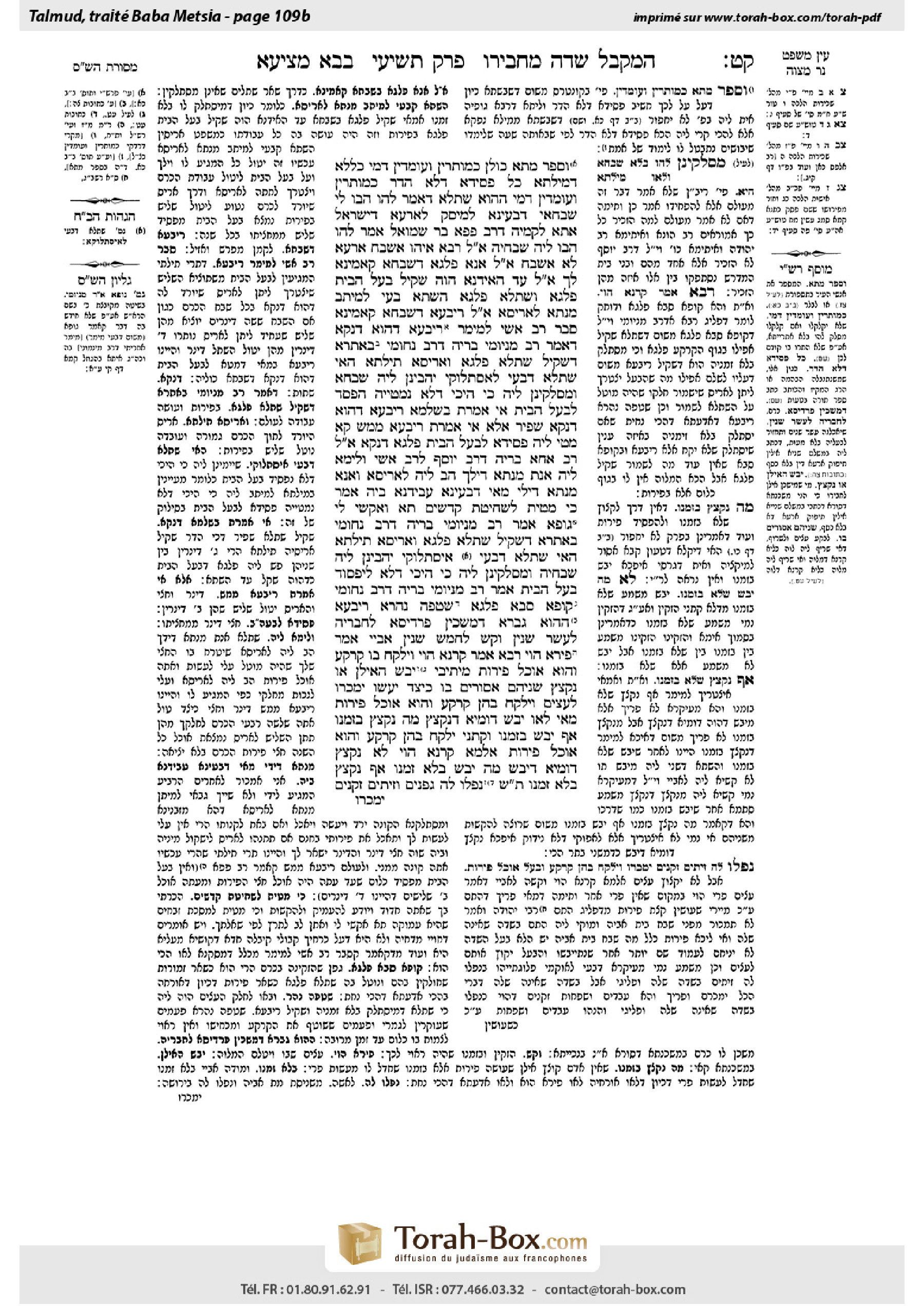
Bava Metzia 109b: Talmud study for Daf Yomi
Study the Talmud for Daf Yomi with scanned pages, Hebrew text, English translations from Sefaria and AI-generated French translations.
Passage selection and English or AI-generated French translation are available where the scan has annotations. Daf Study is independent of Torah-Box and Sefaria.
Browse Bava Metzia · בבא מציעא · All tractatesBava Metzia 109b text and translations
This page of Bava Metzia includes the Aramaic text, an English translation and an AI-generated French translation, alongside the scan above.
בבא מציעא ק״ט ב · Aramaic and Hebrew text
וְסָפַר מָתָא – כּוּלָּן כְּמוּתְרִין וְעוֹמְדִין דָּמֵי. כְּלָלָא דְּמִילְּתָא: כֹּל פְּסֵידָא דְּלָא הָדַר – כְּמוּתְרִין וְעוֹמְדִין דָּמֵי.
הָהוּא שַׁתָּלָא, דַּאֲמַר לְהוּ: הַבוּ לִי שְׁבָחַאי דְּבָעֵינָא לְמִיסַּק לְאַרְעָא דְיִשְׂרָאֵל. אֲתָא לְקַמֵּיהּ דְּרַב פָּפָּא בַּר שְׁמוּאֵל. אֲמַר לְהוּ: הַבוּ לֵיהּ שְׁבָחֵיהּ. אֲמַר לֵיהּ רָבָא: אִיהוּ אַשְׁבַּח, אַרְעָא לָא אַשְׁבַּח! אֲמַר לֵיהּ: אֲנָא פַּלְגָא דִּשְׁבָחָא קָאָמֵינָא לָךְ. אֲמַר לֵיהּ: עַד הָאִידָּנָא הֲוָה שָׁקֵיל בַּעַל הַבַּיִת פַּלְגָא וְשַׁתָּלָא פַּלְגָא. הַשְׁתָּא בָּעֵי לְמִיתַּב מְנָתָא לַאֲרִיסָא! אֲמַר לֵיהּ: רִיבְעָא דִשְׁבָחָא קָאָמֵינָא.
סְבַר רַב אָשֵׁי לְמֵימַר ״רִיבְעָא״ דְּהוּא דַּנְקָא. דְּאָמַר רַב מִנְיוֹמֵי בְּרֵיהּ דְּרַב נְחוּמִי: בְּאַתְרָא דְּשָׁקֵיל שַׁתָּלָא פַּלְגָא וַאֲרִיסָא תִּילְתָּא, הַאי שַׁתָּלָא דְּבָעֵי לְאִסְתַּלּוֹקֵי – יָהֲבִינַן לֵיהּ שְׁבָחָא וּמְסַלְּקִינַן לֵיהּ כִּי הֵיכִי דְּלָא נִמְטְיֵיהּ הֶפְסֵד לְבַעַל הַבַּיִת.
אִי אָמְרַתְּ בִּשְׁלָמָא רִיבְעָא דְּהוּא דַּנְקָא – שַׁפִּיר, אֶלָּא אִי אָמְרַתְּ רִיבְעָא מַמָּשׁ, קָא מָטֵי לֵיהּ פְּסֵידָא לְבַעַל הַבַּיִת פַּלְגָא דַּנְקָא!
אֲמַר לֵיהּ רַב אַחָא בְּרֵיהּ דְּרַב יוֹסֵף לְרַב אָשֵׁי, וְלֵימָא לֵיהּ: אַנְתְּ מְנָתָא דִּילָךְ – הַב לֵיהּ לַאֲרִיסָא, וַאֲנָא מְנָתָא דִּילִי מַאי דְּבָעֵינָא עָבֵידְנָא בֵּיהּ. אָמַר: כִּי מָטֵית לִשְׁחִיטַת קֳדָשִׁים, תָּא וְאַקְשִׁי לִי.
גּוּפָא, אָמַר רַב מִנְיוֹמֵי בְּרֵיהּ דְּרַב נְחוּמִי: בְּאַתְרָא דְּשָׁקֵיל שַׁתָּלָא פַּלְגָא וַאֲרִיסָא תִּילְתָּא, הַאי שַׁתָּלָא דְּבָעֵי אִיסְתַּלּוֹקֵי – יָהֲבִינַן לֵיהּ שְׁבָחֵיהּ וּמְסַלְּקִינַן לֵיהּ כִּי הֵיכִי דְּלָא לִיפְסוֹד בַּעַל הַבַּיִת. אָמַר רַב מִנְיוֹמֵי בְּרֵיהּ דְּרַב נְחוּמִי: קוֹפָא סָבָא – פַּלְגָא. שַׁטְפַהּ נַהֲרָא – רִיבְעָא.
הָהוּא גַּבְרָא דְּמַשְׁכֵּין פַּרְדֵּיסָא לְחַבְרֵיהּ לַעֲשַׂר שְׁנִין, וְקַשׁ לַחֲמֵשׁ שְׁנִין. אַבָּיֵי אָמַר: פֵּירָא הָוֵי. רָבָא אָמַר: קַרְנָא הָוֵי, וְיִלָּקַח בּוֹ קַרְקַע, וְהוּא אוֹכֵל פֵּירוֹת.
מֵיתִיבִי: יָבַשׁ הָאִילָן אוֹ נִקְצַץ, שְׁנֵיהֶם אֲסוּרִים בּוֹ. כֵּיצַד יַעֲשׂוּ? יִמָּכְרוּ לְעֵצִים, וְיִלָּקַח בָּהֶן קַרְקַע, וְהוּא אוֹכֵל פֵּירוֹת. מַאי לָאו, יָבַשׁ דּוּמְיָא דְּנִקְצַץ: מָה נִקְצַץ בִּזְמַנּוֹ, אַף יָבַשׁ בִּזְמַנּוֹ, וְקָתָנֵי: יִלָּקַח בָּהֶן קַרְקַע וְהוּא אוֹכֵל פֵּירוֹת. אַלְמָא קַרְנָא הָוֵי!
לָא: נִקְצַץ דּוּמְיָא דְּיָבַשׁ, מָה יָבַשׁ בְּלֹא זְמַנּוֹ – אַף נִקְצַץ בְּלֹא זְמַנּוֹ.
תָּא שְׁמַע: נָפְלוּ לָהּ גְּפָנִים וְזֵיתִים זְקֵנִים –
Bava Metzia 109b · English translation
and a town scribe who drafts documents on behalf on the local residents, all of these are considered forewarned. Therefore, any loss incurred due to them is deducted from their wages, and they are fined without the need for prior warning. The principle of this matter is: With regard to any loss that is not recoverable they are considered forewarned.
§ The Gemara relates: There was a certain planter who said to the owner of the field: Give me the value of my enhancement because I wish to ascend to Eretz Yisrael. The owner came for a ruling before Rav Pappa bar Shmuel, who said to him: Give the planter the value of his enhancement. Rava said to Rav Pappa bar Shmuel: Did he alone enhance the field, while the land did not enhance it? He cannot be credited with all the improvement. Rav Pappa bar Shmuel said to Rava: I am telling you that he is entitled to half the value of the enhancement. Rava said to him: Until now the owner of the land would take half and the planter would take half, while the planter would work the field. Now the owner also needs to give a portion to the sharecropper, so that the sharecropper will continue working the field. Rav Pappa bar Shmuel said to him: I am telling you to give him one-quarter of the value of the enhancement, half of the sum to which he is entitled.
Rav Ashi thought to say that when he referred to one-quarter he meant one-quarter that is one-sixth, i.e., one-quarter of the sum due to the owner, as the sum due to the owner is two-thirds of the entire yield. This payment would therefore amount to one-sixth of the total. As Rav Minyumi, son of Rav Naḥumi, said: In a location where the planter takes half the fruit and the sharecropper takes one-third, with regard to a planter who wants to leave, we give him his share of the value of the enhancement and remove him in such a manner so that the homeowner should suffer no loss.
Granted, if you say that he meant one-quarter that is one-sixth, this is well and the calculations are in order, but if you say he referred to an actual quarter, the homeowner suffers the loss of half of one-sixth. This is because if the owner had paid the planter initially he would have given him only one-half, whereas now he must give the planter one-quarter and the sharecropper one-third. He thereby pays an extra twelfth.
Rav Aḥa, son of Rav Yosef, said to Rav Ashi: Let the planter say to the owner: You give your portion to the sharecropper, and I will do what I wish with my portion. I performed my half of the work properly, so why should I suffer a loss because you want to pay the sharecropper? Rav Ashi said to him: When you reach the tractate of: The slaughter of sacrificial animals, i.e., tractate Zevaḥim, come and ask this difficulty to me. In other words, your question is a good one, worthy of a difficult tractate full of complex reasoning such as Zevaḥim.
With regard to the matter itself, Rav Minyumi, son of Rav Naḥumi, said: In a location where the planter takes half the fruit and the sharecropper one-third, with regard to a planter who wants to leave, we give him his share of the value of the enhancement and remove him in such a manner so that the homeowner should suffer no loss. Rav Minyumi, son of Rav Naḥumi, further said: With regard to an old vine in a vineyard, the planter receives half. Although he did not plant the vine, since he was placed in charge of the entire vineyard, he receives a portion of that which was there before. If a river flooded the vineyard and the owner and the planter come to divide the trees that fell down, the planter receives one-quarter.
§ The Gemara relates: There was a certain man who mortgaged an orchard to another, i.e., the creditor, for ten years in order that the latter should use the profits gained from the orchard as repayment of the debt. But the orchard aged after five years and no longer produced quality fruit. Consequently, the only way to proceed was to cut down its trees and sell them as wood. Abaye said: This wood is considered as produce of the orchard, and therefore the creditor is entitled to cut them down and sell them. Rava said: The wood is classified as principal and is therefore viewed as part of the orchard itself. Consequently, the creditor has no rights to the wood itself, but other land is purchased with the profits from the sale of the wood and the creditor consumes the produce of that land until the debt is repaid.
The Gemara raises an objection against this from a baraita that discusses the halakhot of a mortgage: If the tree dried up or was chopped down, it is forbidden for both the creditor and the debtor to take it for themselves. How should they proceed? It is sold for wood, and land should be purchased with the proceeds, and he, i.e., the creditor, consumes the produce from that land. The Gemara clarifies: What, is it not referring to a dry tree that is similar to one that was chopped down, in that just as the tree was chopped down at its proper time, so too, the tree dried at its proper time? And yet the tanna teaches that land should be purchased with the money and the creditor consumes the produce. Apparently, the wood is considered part of the principal, not the profits. This supports Rava’s opinion and presents a difficulty to Abaye.
The Gemara rejects this argument: No, the chopped-down tree mentioned in the baraita is similar to the dry one: Just as that tree dried up before its time, so too, this one was chopped down before its time. Since this did not occur naturally, the wood is classified as produce; had the orchard dried up at the expected time, its trees would be considered as part of the land.
The Gemara suggests: Come and hear a proof to Rava’s opinion from a mishna (Ketubot 79b): If a woman after her marriage had old vines and olive trees that were bequeathed to her by means of inheritance,
Bava Metzia 109b · Traduction française (IA)
et un scribe de ville qui rédige des documents au nom des habitants locaux, tous ces individus sont considérés comme avertis. Par conséquent, toute perte subie en raison d'eux est déduite de leurs salaires, et ils sont amendés sans nécessiter un avertissement préalable. Le principe de cette affaire est : concernant toute perte non récupérable, ils sont considérés comme avertis.
§ La Guemara rapporte : Il y avait un certain cultivateur qui dit à l'propriétaire du champ : Donnez-moi la valeur de mon amélioration, car je désire monter en Terre d'Israël. L'propriétaire vint demander un avis devant Rav Pappa bar Shmuel, qui lui dit : Donnez au cultivateur la valeur de son amélioration. Rava dit à Rav Pappa bar Shmuel : A-t-il seul amélioré le champ, tandis que la terre n'a pas amélioré ? Il ne peut être crédité pour toute l'amélioration. Rav Pappa bar Shmuel dit à Rava : Je te dis que lui est dû la moitié de la valeur de l'amélioration. Rava dit à lui : Jusqu'à présent, l'propriétaire prenait la moitié et le cultivateur la moitié, tandis que le cultivateur travaillait le champ. Maintenant, l'propriétaire doit aussi donner une part au cultivateur de partage, afin que le cultivateur de partage continue de travailler le champ. Rav Pappa bar Shmuel dit à lui : Je te dis de lui donner un quart de la valeur de l'amélioration, la moitié de la somme à laquelle il est dû.
Rav Ashi pensait dire que lorsqu'il faisait référence à un quart, il entendait un quart qui est un sixième, c'est-à-dire un quart de la somme due à l'propriétaire, car la somme due à l'propriétaire est les deux tiers de la récolte totale. Ce paiement serait donc équivalent à un sixième du total. Comme Rav Minyumi, fils de Rav Naḥumi, a dit : Dans un lieu où le cultivateur prend la moitié des fruits et le cultivateur de partage un tiers, concernant un cultivateur qui veut partir, nous lui donnons sa part de la valeur de l'amélioration et le retirons de telle sorte que l'propriétaire ne subisse pas de perte.
Admettons que vous disiez qu'il entendait un quart qui est un sixième, cela est bien et les calculs sont corrects, mais si vous disiez qu'il faisait référence à un quart réel, l'propriétaire subit la perte de la moitié d'un sixième. Cela est dû au fait que si l'propriétaire avait payé le cultivateur initialement, il lui aurait donné seulement la moitié, tandis que maintenant il doit donner au cultivateur un quart et au cultivateur de partage un tiers. Il paie ainsi un douzième supplémentaire.
Rav Aḥa, fils de Rav Yosef, dit à Rav Ashi : Que le cultivateur dise à l'propriétaire : Vous donnez votre part au cultivateur de partage, et je ferai ce que je veux avec ma part. J'ai bien effectué ma moitié du travail, donc pourquoi dois-je subir une perte parce que vous voulez payer le cultivateur de partage ? Rav Ashi dit à lui : Quand vous arriverez au tractat : La boucherie des animaux sacrés, c'est-à-dire le tractat Zevaḥim, venez me poser cette difficulté. En d'autres termes, votre question est bonne, méritant un tractat difficile plein de raisonnements complexes comme Zevaḥim.
Concernant l'affaire elle-même, Rav Minyumi, fils de Rav Naḥumi, dit : Dans un lieu où le cultivateur prend la moitié des fruits et le cultivateur de partage un tiers, concernant un cultivateur qui veut partir, nous lui donnons sa part de la valeur de l'amélioration et le retirons de telle sorte que l'propriétaire ne subisse pas de perte. Rav Minyumi, fils de Rav Naḥumi, a également dit : Concernant un vieil vignoble dans un domaine, le cultivateur reçoit la moitié. Bien qu'il n'ait pas planté le vignoble, puisqu'il était chargé de la totalité du domaine, il reçoit une part de ce qui était là avant. Si un fleuve inondait le domaine et l'propriétaire et le cultivateur viennent diviser les arbres tombés, le cultivateur reçoit un quart.
§ La Guemara rapporte : Il y avait un certain homme qui avait hypothéqué un verger à un autre, c'est-à-dire au créancier, pendant dix ans afin que ce dernier puisse utiliser les profits issus du verger comme remboursement de la dette. Mais le verger s'était vieilli après cinq ans et ne produisait plus de fruits de qualité. Il ne restait donc qu'à couper ses arbres et à les vendre comme bois. Abaye dit : Ce bois est considéré comme la production du verger, et par conséquent, le créancier a le droit de le couper et de le vendre. Rava dit : Le bois est classé comme principal et est donc considéré comme faisant partie du verger lui-même. Par conséquent, le créancier n'a aucun droit sur le bois lui-même, mais d'autres terres sont achetées avec les profits de la vente du bois et le créancier consomme la production de ces terres jusqu'à ce que la dette soit remboursée.
La Guemara soulève une objection contre cela à partir d'une baraïta qui discute des halakhot d'une hypothèque : Si l'arbre s'est desséché ou a été coupé, il est interdit à la fois au créancier et au débiteur de s'en emparer. Comment doivent-ils procéder ? Il est vendu comme bois, et des terres sont achetées avec les recettes, et il, c'est-à-dire le créancier, consomme la production de ces terres. La Guemara clarifie : Qu'est-ce que cela ne signifie pas, qu'il ne s'agit pas d'un arbre sec semblable à un arbre coupé, en ce sens que justement l'arbre a été coupé à son moment approprié, de même l'arbre s'est desséché à son moment approprié ? Et pourtant, le tanna enseigne que des terres doivent être achetées avec l'argent et que le créancier consomme la production. Apparemment, le bois est considéré comme faisant partie du principal, pas des profits. Cela soutient l'opinion de Rava et présente une difficulté pour Abaye.
La Guemara rejette cet argument : Non, l'arbre abattu mentionné dans la baraïta est semblable à l'arbre sec : Comme cet arbre s'est desséché avant son temps, de même cet arbre a été abattu avant son temps. Puisque cela n'est pas arrivé naturellement, le bois est considéré comme produit ; si le verger s'était desséché à l'époque prévue, ses arbres auraient été considérés comme faisant partie du sol.
La Guemara suggère : Venez écouter une preuve en faveur de l'opinion de Rava, tirée d'une mitsva (Ketubot 79b) : Si une femme, après son mariage, possédait des vignes et des oliviers anciens hérités d'elle par l'héritage,
Traduction française générée par IA à partir de l’édition anglaise de Sefaria. Vérifie toujours un passage avec le texte source.
Text from Sefaria: William Davidson Edition - Vocalized Aramaic (CC BY NC); William Davidson Edition - English (CC BY NC).