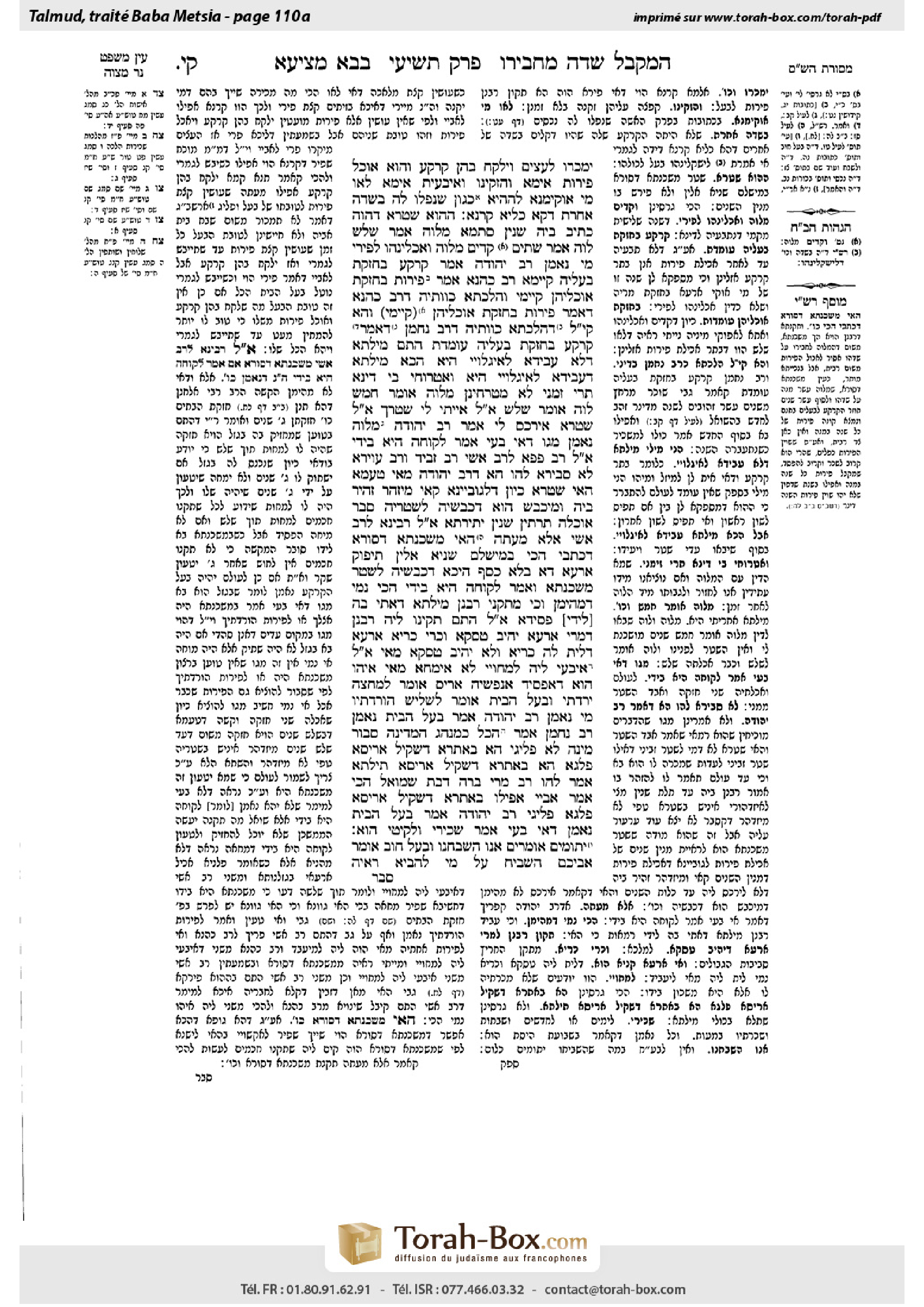
Bava Metzia 110a: Talmud study for Daf Yomi
Study the Talmud for Daf Yomi with scanned pages, Hebrew text, English translations from Sefaria and AI-generated French translations.
Passage selection and English or AI-generated French translation are available where the scan has annotations. Daf Study is independent of Torah-Box and Sefaria.
Browse Bava Metzia · בבא מציעא · All tractatesBava Metzia 110a text and translations
This page of Bava Metzia includes the Aramaic text, an English translation and an AI-generated French translation, alongside the scan above.
בבא מציעא ק״י א · Aramaic and Hebrew text
יִמָּכְרוּ לְעֵצִים, וְיִלָּקַח בָּהֶן קַרְקַע, וְהוּא אוֹכֵל פֵּירוֹת. אֵימָא: וְהִזְקִינוּ.
וְאִיבָּעֵית אֵימָא: לָאו מִי אוֹקֵימְנָא לְהַהִיא כְּגוֹן שֶׁנָּפְלוּ לָהּ בְּשָׂדֶה אַחֶרֶת, דְּקָא כָלְיָא קַרְנָא.
הָהוּא שְׁטָרָא דַּהֲוָה כְּתִיב בֵּיהּ שְׁנִין סְתָמָא. מַלְוֶה אָמַר: שָׁלֹשׁ. לֹוֶה אָמַר: שְׁתַּיִם. קְדֵים מַלְוֶה וְאַכְלִינְהוּ לְפֵירֵי. מִי נֶאֱמָן? רַב יְהוּדָה אָמַר: קַרְקַע בְּחֶזְקַת בְּעָלֶיהָ קָיְימָא. רַב כָּהֲנָא אָמַר: פֵּירוֹת בְּחֶזְקַת אוֹכְלֵיהֶן קָיְימִי.
וְהִלְכְתָא כְּווֹתֵיהּ דְּרַב כָּהֲנָא, דְּאָמַר: פֵּירוֹת בְּחֶזְקַת אוֹכְלֵיהֶן קָיְימִי. וְהָא קַיְימָא לַן דְּהִלְכְתָא כְּווֹתֵיהּ דְּרַב נַחְמָן, דְּאָמַר: קַרְקַע בְּחֶזְקַת בְּעָלֶיהָ עוֹמֶדֶת!
הָתָם – מִילְּתָא דְּלָא עֲבִידָא לְאִיגַּלּוֹיֵי הִיא. הָכָא – מִילְּתָא דַּעֲבִידָא לְאִיגַּלּוֹיֵי הִיא, וְאַטְרוֹחֵי בֵּי דִינָא תְּרֵי זִמְנֵי לָא מַטְרְחִינַן.
מַלְוֶה אוֹמֵר חָמֵשׁ, לֹוֶה אוֹמֵר שָׁלֹשׁ. אָמַר לֵיהּ: אַיְיתִי לִי שְׁטָרָךְ! אָמַר לֵיהּ: שְׁטָרָא אִירְכַס לִי. אָמַר רַב יְהוּדָה: מַלְוֶה נֶאֱמָן, מִגּוֹ דְּאִי בָּעֵי אָמַר לְקוּחָה הִיא בְּיָדִי.
אֲמַר לֵיהּ רַב פָּפָּא לְרַב אָשֵׁי: רַב זְבִיד וְרַב עַוִּירָא לָא סְבִירָא לְהוּ הָא דְּרַב יְהוּדָה. מַאי טַעְמָא: הַאי שְׁטָרָא כֵּיוָן דִּלְגוּבְיָינָא קָאֵי – מִיזְהָר זְהִיר בֵּיהּ, וּמִיכְבָּשׁ הוּא דְּכַבְשֵׁיהּ לִשְׁטָרֵיהּ, סָבַר: אוֹכְלַהּ תַּרְתֵּין שְׁנִין יַתִּירְתָּא.
אֲמַר לֵיהּ רָבִינָא לְרַב אָשֵׁי: אֶלָּא מֵעַתָּה, הַאי מַשְׁכַּנְתָּא דְסוּרָא דְּכָתְבִי הָכִי: ״בְּמִישְׁלַם שְׁנַיָּא אִלֵּין תִּיפּוֹק אַרְעָא דָּא בְּלָא כְּסַף״. הֵיכָא דְּכַבְשֵׁיהּ לִשְׁטַר מַשְׁכַּנְתָּא וְאָמַר: לְקוּחָה הִיא בְּיָדִי, הָכִי נָמֵי דִּמְהֵימַן? וְכִי מְתַקְּנִי רַבָּנַן מִילְּתָא דְּאָתֵי בַּהּ [לִידֵי] פְּסֵידָא? אֲמַר לֵיהּ: הָתָם תַּקִּינוּ לֵיה רַבָּנַן דְּמָרֵי אַרְעָא יָהֵיב טַסְקָא וְכָרֵי כַּרְיָא.
אַרְעָא דְּלֵית לַהּ כַּרְיָא וְלָא יָהֵיב טַסְקָא, מַאי? אֲמַר לֵיהּ: אִיבְּעִי לֵיהּ לְמַחוֹיֵי! לָא (אִימְּחָא) [מַחִי], מַאי? אִיהוּ הוּא דְּאַפְסֵיד אַנַּפְשֵׁיהּ.
אָרִיס אוֹמֵר: לְמֶחֱצָה יָרַדְתִּי, וּבַעַל הַבַּיִת אוֹמֵר: לִשְׁלִישׁ הוֹרַדְתִּיו, מִי נֶאֱמָן? רַב יְהוּדָה אָמַר: בַּעַל הַבַּיִת נֶאֱמָן. רַב נַחְמָן אָמַר: הַכֹּל כְּמִנְהַג הַמְּדִינָה.
סְבוּר מִינַּהּ לָא פְּלִיגִי: הָא בְּאַתְרָא דְּשָׁקֵיל אֲרִיסָא פַּלְגָא, הָא בְּאַתְרָא דְּשָׁקֵיל אֲרִיסָא תִּילְתָּא.
אֲמַר לְהוּ רַב מָרִי בְּרַהּ דְּבַת שְׁמוּאֵל: הָכִי אָמַר אַבָּיֵי: אֲפִילּוּ בְּאַתְרָא דְּשָׁקֵיל אֲרִיסָא פַּלְגָא פְּלִיגִי, רַב יְהוּדָה אָמַר: בַּעַל הַבַּיִת נֶאֱמָן, דְּאִי בָּעֵי אָמַר: שְׂכִירִי וּלְקִיטִי הוּא.
יְתוֹמִים אוֹמְרִים: אָנוּ הִשְׁבַּחְנוּ, וּבַעַל חוֹב אוֹמֵר: אֲבִיכֶם הִשְׁבִּיחַ, עַל מִי לְהָבִיא רְאָיָה?
Bava Metzia 110a · English translation
such trees are sold as wood and land is acquired with them, and her husband consumes the produce, while the land itself belongs to the wife. The Gemara answers that the text should be emended to say: And they grew old, meaning that the trees were not old when she inherited them but they aged with the passage of time.
And if you wish, say: Did we not already establish that mishna as referring to a case where the vines or olive trees were bequeathed to her in a different field that did not belong to her? Since in that case she inherited only the trees but not the land itself, they are considered the principal. Consequently, the husband taking all of it would consume the principal entirely. Therefore, they must be sold as wood, with the proceeds used for the purchase of land.
§ The Gemara relates: There was a certain mortgage document in which it was written that the land was granted to the creditor for an unspecified number of years. The creditor said it was for three years, whereas the debtor said it was for two years. While the issue was being adjudicated, the creditor arose and consumed the produce of the field in the third year. Which of them is deemed credible and accepted? Rav Yehuda said: The halakha is that land remains in its owner’s possession. Therefore, the debtor has the presumptive right to the land, while the creditor, who owns the document, must provide proof for his claim. Rav Kahana said: The produce remains in the possession of the one who consumed it, and therefore the creditor’s claim is accepted.
The Gemara states: And the halakha is in accordance with the opinion of Rav Kahana, who said that the produce remains in the possession of the one who consumed it. The Gemara asks: But don’t we maintain that the halakha is in accordance with the opinion of Rav Naḥman, who said with regard to uncertainty concerning a rental during the extra month of a leap year that land remains in its owner’s possession, and he has the rights to that month? These two rulings appear to contradict each other.
The Gemara answers: There it is a matter that will not be revealed because it is impossible to clarify the uncertainty concerning whether the extra month is included. By contrast, here it is a matter that will be revealed, as the witnesses who signed the document may eventually reveal what it stated, and we do not trouble the court to convene twice. Therefore, the produce should remain in the possession of the one who consumed it until the matter is resolved.
The Gemara analyzes another case involving mortgaged land. The creditor says the mortgage was for five years while the debtor who owned the land says it was for three. The debtor said to the creditor: Give me your document so that we can see what is written there. The creditor said to him: I lost the document. Rav Yehuda said: The creditor is deemed credible and accepted in this case since he could have made a more advantageous claim [miggo]. As the mortgage document is missing and even according to the claim of the debtor he could be in control of the land for the three years required for presumptive ownership, if he wants to lie he could say: The land was purchased by me. Since he did not submit this superior claim, his claim should be accepted.
Rav Pappa said to Rav Ashi: Rav Zevid and Rav Avira do not hold of this opinion of Rav Yehuda. What is the reason for this? Since this document stands ready for collecting the debt, the creditor would certainly have been careful with regard to it. Since he wants to ensure his money is returned it is unlikely he actually lost it. Rather, he is merely hiding his document, as he thinks: I will consume the produce of the field for two extra years.
The Gemara analyzes Rav Yehuda’s opinion. Ravina said to Rav Ashi: If that is so, that Rav Yehuda is correct, then with regard to this mortgage according to the custom practiced in Sura, a city in Babylonia, in which they write this: Upon the completion of these years of the mortgage this land shall leave the creditor’s possession and return to its owner without the debtor paying any money (see 67b), in a case where the creditor hid the mortgage document and said that the land was purchased by me, so too is it possible that he is deemed credible? Would the Sages institute a matter that might cause a loss? Rav Ashi said to him: There, in the mortgage of Sura, the Sages instituted for the landowner, i.e., the debtor, that the landowner, i.e., the debtor, pays the land taxes and digs the trenches for the irrigation of the field. In this manner, his ownership is preserved and established.
Ravina asks further: With regard to land that has no need for trenches and for which he does not pay taxes, what could he have done? Rav Ashi said to him: He should have protested before the three years needed for presumptive status had passed by announcing that the land was his. Ravina again inquires: If he did not protest, what is the halakha? Rav Ashi replied: In that case, he caused his own loss by failing to take the necessary precautions.
§ The Gemara discusses another case. If a sharecropper says: I descended to the field for half the produce, as this was the agreement that we made, and the homeowner says: I sent him down for only one-third of the produce, who is deemed credible and his claim consequently accepted? Rav Yehuda says: The homeowner is deemed credible and his claim is consequently accepted, while Rav Naḥman says: All matters are in accordance with the regional custom. As the terms of their agreement are unknown, this sharecropper should have the same status as other sharecroppers in that location.
They understood from the above discussion that these two Sages do not disagree, but were referring to different cases: This one, Rav Naḥman, stated his ruling with regard to a location where the sharecropper takes half, in which case the sharecropper is believed, while that one, Rav Yehuda, stated his ruling with regard to a location where the sharecropper takes one-third, in which case the homeowner is believed.
Rav Mari, son of the daughter of Shmuel, said to them: This is what Abaye said: They even disagree with regard to a location where the sharecropper usually takes half. In that case, Rav Yehuda said that here too the homeowner is deemed credible and his claim is consequently accepted, as if he wants to lie he could say: The other is not a sharecropper at all but merely my hired worker, who received a stipulated wage, or my gleaner, who performs occasional work for me but has no prearranged share of the crop at all.
The Gemara addresses another issue: If a field was on lien for a loan and the debtor died, and the orphans who inherited the field say: We enhanced the land after we inherited it, and therefore the creditor does not have a right to the value of that enhancement, and the creditor says: Your father enhanced it, and I am entitled to the land as it is, upon whom does the burden to bring proof fall?
Bava Metzia 110a · Traduction française (IA)
De tels arbres sont vendus comme du bois et la terre est acquise avec eux, et son mari consomme les produits, tandis que la terre elle-même appartient à la femme. La Guemara répond que le texte devrait être corrigé pour dire : Et ils vieillirent, c'est-à-dire que les arbres n'étaient pas vieux lorsqu'elle les a hérités, mais ils ont vieilli avec le passage du temps.
Et si l'on veut, disons : N'avons-nous pas déjà établi que cette Michna fait référence à un cas où les vignes ou les oliviers ont été légués à elle dans un autre champ qui n'appartenait pas à elle ? Puisque dans ce cas elle héritait seulement des arbres mais pas de la terre elle-même, ils sont considérés comme le principal. Ainsi, le mari prenant tout cela consommerait entièrement le principal. Par conséquent, ils doivent être vendus comme du bois, avec les recettes utilisées pour l'achat de la terre.
§ La Guemara rapporte : Il y avait un certain document de garantie dans lequel il était écrit que la terre était donnée au créancier pour un nombre indéterminé d'années. Le créancier disait que c'était pour trois ans, tandis que le débiteur disait que c'était pour deux ans. Alors que l'affaire était en cours d'expertise, le créancier s'est levé et a consommé les produits du champ en troisième année. Qui est considéré comme crédible et accepté ? Rav Yehuda a dit : La halakha est que la terre reste dans la possession de son propriétaire. Ainsi, le débiteur a le droit présumé à la terre, tandis que le créancier, qui possède le document, doit fournir une preuve pour sa revendication. Rav Kahana a dit : Les produits restent dans la possession de celui qui les a consommés, et par conséquent la revendication du créancier est acceptée.
La Guemara affirme : Et la halakha suit l'opinion de Rav Kahana, qui a dit que les produits restent dans la possession de celui qui les a consommés. La Guemara pose la question : Mais ne maintenons-nous pas que la halakha suit l'opinion de Rav Naḥman, qui a dit concernant l'incertitude concernant un loyer durant le mois supplémentaire d'une année bissextile que la terre reste dans la possession de son propriétaire, et il a le droit à ce mois ? Ces deux décisions semblent s'opposer l'une à l'autre.
La Guemara répond : Là, il s'agit d'une affaire qui ne sera pas révélée car il est impossible de clarifier l'incertitude concernant si le mois supplémentaire est inclus. En revanche, ici il s'agit d'une affaire qui sera révélée, car les témoins qui ont signé le document pourraient finir par révéler ce qu'il contenait, et nous ne troublons pas le tribunal pour convoquer deux fois. Par conséquent, les produits devraient rester dans la possession de celui qui les a consommés jusqu'à ce que l'affaire soit résolue.
La Guemara analyse un autre cas concernant une terre hypothéquée. Le créancier dit que l'hypothèque était pour cinq ans, tandis que le débiteur, propriétaire de la terre, dit qu'elle était pour trois ans. Le débiteur dit au créancier : Donnez-moi votre document afin que nous puissions voir ce qui est écrit là-dedans. Le créancier dit au débiteur : J'ai perdu le document. Rav Yehuda a dit : Le créancier est considéré comme crédible et accepté dans ce cas, car il pouvait présenter une revendication plus avantageuse [miggo]. Comme le document hypothécaire est perdu, et même selon la revendication du débiteur il pourrait être en contrôle de la terre pendant les trois ans nécessaires pour le droit présumé, s'il veut mentir il pourrait dire : La terre a été achetée par moi. Puisqu'il n'a pas soumis cette revendication supérieure, sa revendication devrait être acceptée.
Rav Pappa a dit à Rav Ashi : Rav Zevid et Rav Avira ne partagent pas cet avis de Rav Yehuda. Quelle est la raison de cela ? Puisque ce document est prêt à être utilisé pour recouvrer la dette, le créancier aurait certainement été prudent envers lui. Puisque il veut s'assurer que son argent est récupéré, il est peu probable qu'il ait vraiment perdu le document. Plutôt, il le cache, car il pense : Je vais consommer les produits du champ pendant deux ans supplémentaires.
La Guemara examine l'opinion de Rav Yehuda. Ravina dit à Rav Ashi : Si c'est ainsi, c'est-à-dire si Rav Yehuda a raison, alors concernant cette hypothèque selon la coutume pratiquée à Sura, une ville en Babylone, dans laquelle ils écrivent cela : À la fin de ces années d'hypothèque, cette terre quittera la possession du créancier et retournera à son propriétaire sans que le débiteur ne paie aucune somme d'argent (voir 67b), dans un cas où le créancier a caché le document d'hypothèque et a dit que la terre a été achetée par moi, est-il possible qu'il soit considéré comme crédible ? Aurait-on institué une affaire qui pourrait causer une perte ? Rav Ashi répond à lui : Là, dans l'hypothèque de Sura, les Sages ont institué pour le propriétaire de la terre, c'est-à-dire le débiteur, qu'il paie les impôts fonciers et creuse les canaux d'irrigation du champ. Ainsi, son droit de propriété est préservé et établi.
Ravina pose une autre question : Concernant une terre qui n'a pas besoin de canaux et pour laquelle il ne paie pas d'impôts, qu'est-ce qu'il aurait pu faire ? Rav Ashi répond à lui : Il aurait dû protester avant que les trois ans nécessaires pour le statut présumé ne soient pas passés, en annonçant que la terre était sienne. Ravina pose à nouveau la question : Si il n'a pas protesté, quelle est la halakha ? Rav Ashi répond : Dans ce cas, il a causé sa propre perte en n'ayant pas pris les précautions nécessaires.
§ La Guemara discute d'un autre cas. Si un cultivateur partageant la récolte dit : J'ai descendu dans le champ pour la moitié des produits, car c'était le pacte que nous avons fait, et le propriétaire dit : J'ai envoyé lui descendre pour seulement un tiers des produits, qui est considéré comme crédible et sa revendication est donc acceptée ? Rav Yehuda dit : Le propriétaire est considéré comme crédible et sa revendication est donc acceptée, tandis que Rav Naḥman dit : Tous les cas suivent la coutume de la région. Puisque les termes de leur pacte sont inconnus, ce cultivateur devrait avoir le même statut que les autres cultivateurs de cette localité.
Ils ont compris de la discussion ci-dessus que ces deux Sages ne s'opposent pas, mais qu'ils faisaient référence à des cas différents : Celui-ci, Rav Naḥman, a formulé son jugement concernant une localité où le cultivateur prend la moitié, dans le cas où le cultivateur est cru, tandis que celui-ci, Rav Yehuda, a formulé son jugement concernant une localité où le cultivateur prend un tiers, dans le cas où le propriétaire est cru.
Rav Mari, fils de la fille de Shmuel, leur dit : C'est ce que Abaye a dit : Ils ne s'entendent même pas sur un lieu où le cultivateur en partage prend la moitié. Dans ce cas, Rav Yehuda dit que là encore le propriétaire est considéré comme crédible et sa revendication est donc acceptée, comme si voulait mentir il pourrait dire : L'autre n'est pas un cultivateur en partage du tout mais simplement mon ouvrier engagé, qui a reçu une rémunération stipulée, ou mon récolteur, qui effectue des travaux occasionnels pour moi mais n'a pas de part préarrangée dans la récolte du tout.
La Guemara aborde une autre question : Si un champ était sous caution pour un prêt et que le débiteur est mort, et que les orphelins qui ont hérité du champ disent : Nous avons amélioré la terre après avoir hérité, et par conséquent le créancier n'a pas le droit à la valeur de cette amélioration, et le créancier dit : Votre père a amélioré la terre, et je suis dû à la terre telle qu'elle est, à qui incombe la charge de prouver ?
Traduction française générée par IA à partir de l’édition anglaise de Sefaria. Vérifie toujours un passage avec le texte source.
Text from Sefaria: William Davidson Edition - Vocalized Aramaic (CC BY NC); William Davidson Edition - English (CC BY NC).