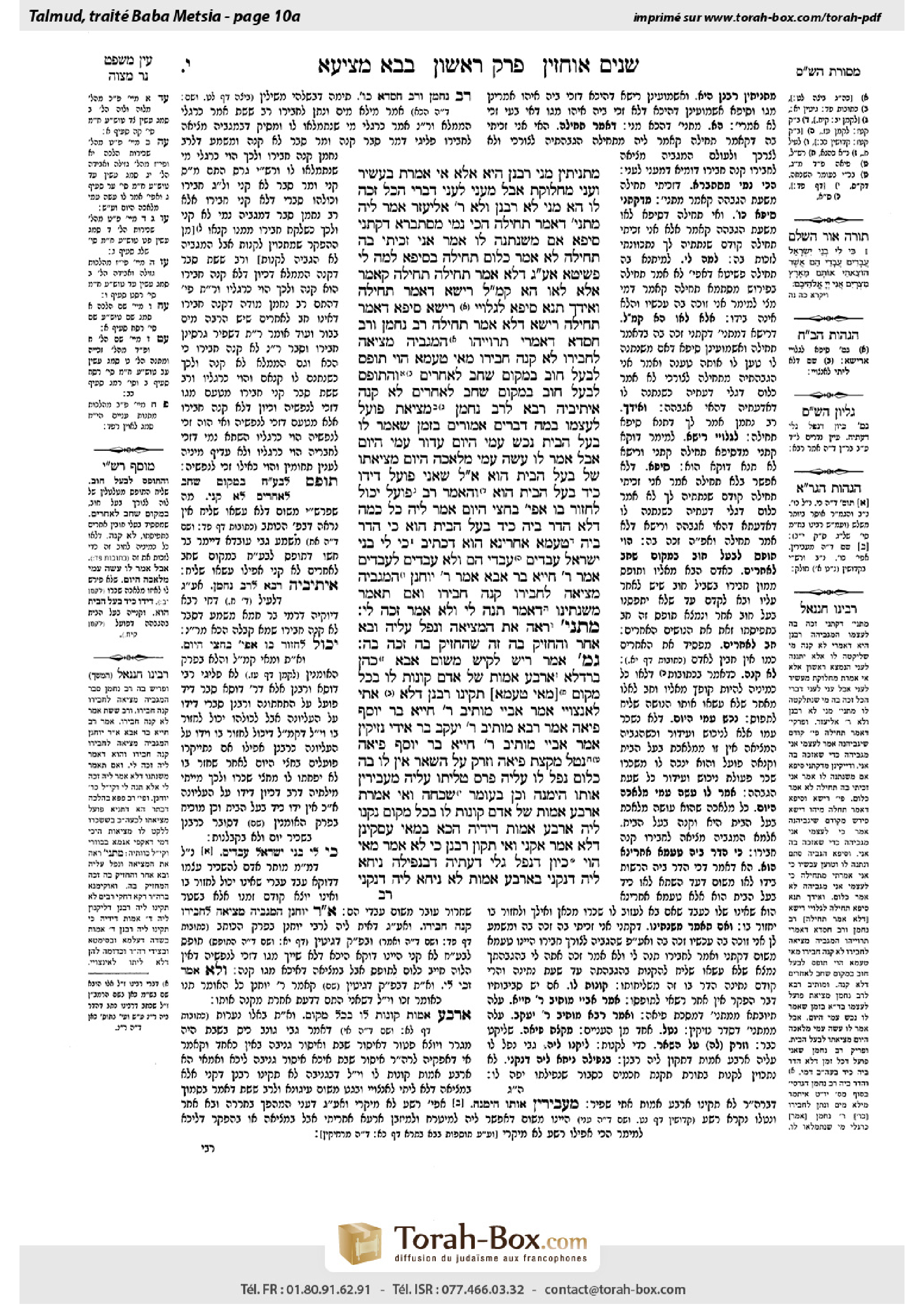
Bava Metzia 10a: Talmud study for Daf Yomi
Study the Talmud for Daf Yomi with scanned pages, Hebrew text, English translations from Sefaria and AI-generated French translations.
Passage selection and English or AI-generated French translation are available where the scan has annotations. Daf Study is independent of Torah-Box and Sefaria.
Browse Bava Metzia · בבא מציעא · All tractatesBava Metzia 10a text and translations
This page of Bava Metzia includes the Aramaic text, an English translation and an AI-generated French translation, alongside the scan above.
בבא מציעא י׳ א · Aramaic and Hebrew text
מַתְנִיתִין מַנִּי – רַבָּנַן הִיא. אֶלָּא אִי אָמְרַתְּ בְּעָשִׁיר וְעָנִי מַחְלוֹקֶת, אֲבָל מֵעָנִי לְעָנִי דִּבְרֵי הַכֹּל זָכָה לוֹ, הָא מַנִּי? לָא רַבָּנַן וְלָא רַבִּי אֱלִיעֶזֶר!
אֲמַר לֵיהּ, מַתְנִיתִין דְּאָמַר תְּחִילָּה.
הָכִי נָמֵי מִסְתַּבְּרָא, דְּקָתָנֵי סֵיפָא: אִם מִשֶּׁנְּתָנָהּ לוֹ אָמַר אֲנִי זָכִיתִי בָּהּ תְּחִילָּה – לֹא אָמַר כְּלוּם. תְּחִילָּה בְּסֵיפָא לְמָה לִי? פְּשִׁיטָא, אַף עַל גַּב דְּלָא אָמַר תְּחִילָּה, תְּחִילָּה קָאָמַר. אֶלָּא לָאו הָא קָא מַשְׁמַע לַן, רֵישָׁא דְּאָמַר ״תְּחִילָּה״.
וְאִידַּךְ: תְּנָא סֵיפָא לְגַלּוֹיֵי רֵישָׁא. סֵיפָא, דְּאָמַר תְּחִילָּה. רֵישָׁא, דְּלָא אָמַר תְּחִילָּה.
רַב נַחְמָן וְרַב חִסְדָּא דְּאָמְרִי תַּרְוַיְיהוּ: הַמַּגְבִּיהַּ מְצִיאָה לַחֲבֵירוֹ – לֹא קָנָה חֲבֵירוֹ.
מַאי טַעְמָא – הָוֵי תּוֹפֵס לְבַעַל חוֹב בִּמְקוֹם שֶׁחָב לַאֲחֵרִים, וְהַתּוֹפֵס לְבַעַל חוֹב בִּמְקוֹם שֶׁחָב לַאֲחֵרִים – לֹא קָנָה.
אֵיתִיבֵיהּ רָבָא לְרַב נַחְמָן: מְצִיאַת פּוֹעֵל לְעַצְמוֹ.
בַּמֶּה דְּבָרִים אֲמוּרִים – בִּזְמַן שֶׁאָמַר לוֹ בַּעַל הַבַּיִת ״נַכֵּשׁ עִמִּי הַיּוֹם״, ״עֲדוֹר עִמִּי הַיּוֹם״. אֲבָל אָמַר לוֹ ״עֲשֵׂה עִמִּי מְלָאכָה הַיּוֹם״ – מְצִיאָתוֹ שֶׁל בַּעַל הַבַּיִת הוּא!
אֲמַר לֵיהּ: שָׁאנֵי פּוֹעֵל, דְּיָדוֹ כְּיַד בַּעַל הַבַּיִת הוּא.
וְהָאָמַר רַב: פּוֹעֵל יָכוֹל לַחֲזוֹר בּוֹ אֲפִילּוּ בַּחֲצִי הַיּוֹם!
אֲמַר לֵיהּ: כֹּל כַּמָּה דְּלָא הָדַר בֵּיהּ, כְּיַד בַּעַל הַבַּיִת הוּא. כִּי הֲדַר בֵּיהּ, טַעְמָא אַחֲרִינָא הוּא, דִּכְתִיב: ״כִּי לִי בְנֵי יִשְׂרָאֵל עֲבָדִים, עֲבָדַי הֵם״ – וְלֹא עֲבָדִים לַעֲבָדִים.
אָמַר רַבִּי חִיָּיא בַּר אַבָּא אָמַר רַבִּי יוֹחָנָן: הַמַּגְבִּיהַּ מְצִיאָה לַחֲבֵירוֹ – קָנָה חֲבֵירוֹ. וְאִם תֹּאמַר מִשְׁנָתֵינוּ, דְּאָמַר ״תְּנָהּ לִי״, וְלָא אָמַר ״זְכָהּ לִי״.
מַתְנִי׳ רָאָה אֶת הַמְּצִיאָה וְנָפַל עָלֶיהָ, וּבָא אַחֵר וְהֶחְזִיק בָּהּ – זֶה שֶׁהֶחְזִיק בָּהּ זָכָה בָּהּ.
גְּמָ׳ אָמַר רֵישׁ לָקִישׁ מִשּׁוּם אַבָּא כֹּהֵן בַּרְדְּלָא: אַרְבַּע אַמּוֹת שֶׁל אָדָם קוֹנוֹת לוֹ בְּכׇל מָקוֹם. [מַאי טַעְמָא] תַּקִּינוּ רַבָּנַן, דְּלָא (אָתֵי) [לֵיתוֹ] לְאִנְּצוֹיֵי. אָמַר אַבָּיֵי: מוֹתֵיב רַבִּי חִיָּיא בַּר יוֹסֵף פֵּיאָה. אָמַר רָבָא: מוֹתֵיב רַבִּי יַעֲקֹב בַּר אִידִי נְזִיקִין.
אָמַר אַבָּיֵי, מוֹתֵיב רַבִּי חִיָּיא בַּר יוֹסֵף פֵּיאָה: נָטַל מִקְצָת פֵּיאָה וְזָרַק עַל הַשְּׁאָר – אֵין לוֹ בָּהּ כְּלוּם. נָפַל לוֹ עָלֶיהָ, פֵּרַס טַלִּיתוֹ עָלֶיהָ – מַעֲבִירִין אוֹתוֹ הֵימֶנָּה. וְכֵן בְּעוֹמֶר שִׁכְחָה.
וְאִי אָמְרַתְּ אַרְבַּע אַמּוֹת שֶׁל אָדָם קוֹנוֹת לוֹ בְּכׇל מָקוֹם, נִקְנוֹ לֵיהּ אַרְבַּע אַמּוֹת דִּידֵיהּ!
הָכָא בְּמַאי עָסְקִינַן – דְּלָא אֲמַר ״אֶקְנֵי״.
וְאִי תַּקּוּן רַבָּנַן, כִּי לָא אֲמַר מַאי הָוֵי?!
כֵּיוָן דִּנְפַל, גַּלִּי דַּעְתֵּיהּ דְּבִנְפִילָה נִיחָא לֵיהּ דְּנִקְנֵי, בְּאַרְבַּע אַמּוֹת לָא נִיחָא לֵיהּ דְּנִקְנֵי.
Bava Metzia 10a · English translation
whose opinion is expressed in the mishna? It is the opinion of the Rabbis, who hold that one cannot acquire an item for another in this manner. But if you say that the dispute is specifically in a case of a rich person and a poor person but in a case where the pe’a was gleaned by a poor person on behalf of a poor person everyone agrees that he acquired it on the latter’s behalf, in accordance with whose opinion is this mishna? It is neither in accordance with the opinion of the Rabbis nor in accordance with the opinion of Rabbi Eliezer.
Ulla said to Rav Naḥman: The mishna is referring to a case where the one lifting the item said: I intended to acquire the item for myself at the outset; I never had intention to acquire it on behalf of the rider.
The Gemara adds: So too, it is reasonable to explain the mishna in this manner, as it teaches in the last clause: But if, after giving it to the one riding the animal he said: I acquired it for myself at the outset, he has said nothing and the rider keeps the item. Why do I need the phrase: At the outset, to be mentioned in the last clause? It is obvious that even if he did not explicitly say: At the outset, he meant that he acquired it at the outset, before he gave it to the rider. Rather, isn’t this phrase mentioned to teach us this: The first clause of the mishna is also referring a case where he said: I intended to acquire it for myself at the outset?
And the other Sage, Rav Naḥman, is of the opinion that the mishna taught this phrase in the last clause of the mishna in order to shed light on the first clause. The last clause is referring to a case where he said that he acquired the item at the outset in order to indicate that in the first clause, the one who lifts the item acquires it even in a case where he did not say that he acquired it for himself at the outset. In Rav Naḥman’s opinion, the rider does not acquire the item until it is given to him.
§ The Gemara discusses the opinion of Rav Naḥman and Rav Ḥisda, who both say: In a case of one who performs an act of acquisition by lifting a found item on behalf of another, the other person, i.e., the latter, does not acquire ownership of the item.
What is the reason for this? The reason is that it is a case of one who seizes assets for a creditor in a situation that will result in a disadvantage for others, as the debtor owes money to other creditors as well; and one who seizes assets for a creditor in a situation that will result in a disadvantage for others does not acquire the assets for him. Although a creditor can himself seize the assets as payment for the debt, no one else can take action that will benefit one person at the expense of others. Similarly, since everyone has equal rights to an ownerless item that is found, one person cannot deprive all others of that right on behalf of another person.
Rava raised an objection to the opinion of Rav Naḥman from a baraita: The found item of a laborer, i.e., something that he found, belongs to him and not to the employer for whom he is working at that time.
In what case is this statement, that the item belongs to the laborer, said? It is said when the employer told the laborer to perform a specific task, e.g., he said to him: Weed for me today, or: Till for me today. Since the employer specified the task that he hired the laborer to perform, the laborer has rights to the item that the laborer found. But if the employer said to the laborer: Work for me today, without specifying the nature of the work, the found item is the employer’s, as finding ownerless items is included within the general category of work. This indicates that a laborer can acquire an item for someone else, which contradicts Rav Naḥman’s principle.
Rav Naḥman said to him: A laborer is different, as his hand is like the hand of the employer. He is considered his agent while he is working for him.
Rava responded: But doesn’t Rav say that a laborer may reconsider and quit his job, even at midday? Evidently, the relationship between the employer and the laborer is structured to the benefit of the laborer.
Rav Naḥman said to him: As long as he does not retract his commitment, his hand is like the employer’s hand. When he does retract his commitment, he is able to do so. But this is not because matters are structured to the benefit of the laborer, but for a different reason, as it is written: “For to Me the children of Israel are slaves; they are My slaves whom I brought forth out of the land of Egypt” (Leviticus 25:55), which indicates: They are My slaves, and not slaves of slaves, i.e., of other Jews. Consequently, a Jew can never be enslaved to another Jew with a contract from which he cannot release himself whenever he wishes. Nevertheless, as long as the laborer does not quit the job, he is considered his employer’s agent.
Contrary to the opinion of Rav Naḥman and Rav Ḥisda, Rabbi Ḥiyya bar Abba says that Rabbi Yoḥanan says: In a case of one who performs an act of acquisition by lifting a found item on behalf of another, the other person acquires ownership of the item. And if you say that our mishna seems to suggest otherwise, it is referring to a case where the rider says to the pedestrian: Give it to me, but does not say: Acquire it for me. If he says give it to me, the rider acquires the item only when it reaches his possession. If he says acquire it for me, the rider acquires the item as soon as the pedestrian lifts it.
MISHNA: If one saw a found item and fell upon it, intending to thereby acquire it, but did not employ one of the formal modes of acquisition, and then another came and seized it, the one who seized it acquired it because he employed one of the formal modes of acquisition.
GEMARA: Reish Lakish says in the name of Abba Kohen Bardela: The area of four square cubits surrounding a person has the legal status of his courtyard, and it effects acquisition of every ownerless item located there for him, everywhere. What is the reason for this? The Sages instituted this ordinance so that people would not come to quarrel over an item. Abaye said that Rabbi Ḥiyya bar Yosef raises an objection to this from a mishna in tractate Pe’a. Rava said that Rabbi Ya’akov bar Idi raises an objection to this from a mishna in Nezikin.
The Gemara elaborates: Abaye said that Rabbi Ḥiyya bar Yosef raises an objection to this from a mishna in tractate Pe’a (4:3), which states: If a poor person took some of the pe’a in the field and threw it on the rest of the pe’a in order to acquire it, he has nothing of it. The same is true if he fell upon the pe’a, or if he spread his garment over it; others may remove him or his garment from the pe’a in order to take it for themselves, as he did not acquire it. And the same is true in the case of a forgotten sheaf left for the poor; a poor person cannot acquire it in any of these manners.
Rabbi Ḥiyya bar Yosef continues: And if you say that a person’s area of four square cubits effects acquisition of property for him everywhere, let his area of four square cubits effect acquisition of the pe’a or the forgotten sheaf for him.
The Gemara responds: With what are we dealing here? We are dealing with a case where he did not say: I will acquire the pe’a through this action. He performed the action without revealing his intention; therefore, his acquisition is ineffective.
The Gemara asks: But if the Sages instituted an ordinance that the area of four cubits surrounding a person acquires property for him, then even in a case where he did not say: I will acquire the produce, what of it? Shouldn’t he have acquired it even without expressing his intent to do so?
The Gemara answers: This case is different. Since he fell upon it he thereby revealed his intention: That it is satisfactory for him to acquire the produce by falling on it and it is not satisfactory for him to acquire the produce through the ordinance concerning his four square cubits. Since he decided to forgo the mode of acquisition that the Sages instituted, and falling on the produce is not a valid mode of acquisition, he did not acquire the produce.
Bava Metzia 10a · Traduction française (IA)
Quel est l'avis exprimé dans la Michna ? C'est l'avis des Rabbins, qui affirment qu'on ne peut pas acquérir un objet pour un autre de cette manière. Mais si vous dites que le débat porte spécifiquement sur le cas d'une personne riche et d'une personne pauvre, mais dans un cas où la pe'a a été récoltée par une personne pauve au nom d'une autre personne pauve, tout le monde convient qu'il l'a acquise au nom de celle-ci. Selon quel avis est-ce que la Michna ? C'est ni selon l'avis des Rabbins ni selon l'avis de Rabbi Eliezer.
Ulla dit à Rav Naḥman : La mitsva fait référence à un cas où la personne qui soulève l'objet dit : J'avais l'intention d'acquérir l'objet pour moi-même dès le début ; je n'avais pas l'intention d'acquérir l'objet au nom du cavalier.
La Guemara ajoute : De même, il est raisonnable d'expliquer la mitsva ainsi, car elle enseigne dans la dernière phrase : Mais si, après avoir donné l'objet au cavalier, il dit : J'ai acquis l'objet pour moi-même dès le début, il n'a rien dit et le cavalier garde l'objet. Pourquoi a-t-on besoin de mentionner la phrase : Dès le début, dans la dernière clause ? C'est évident que même s'il n'a pas explicitement dit : Dès le début, il voulait dire qu'il l'avait acquis dès le début, avant de le donner au cavalier. Plutôt, n'est-ce pas cette phrase qui est mentionnée pour nous enseigner cela : La première clause de la mitsva fait référence également à un cas où il dit : J'avais l'intention d'acquérir l'objet pour moi-même dès le début ?
Et l'autre Sage, Rav Naḥman, est d'avis que la mitsna a enseigné cette phrase dans la dernière clause de la mitsna afin d'éclairer la première clause. La dernière clause fait référence à un cas où il dit qu'il a acquis l'objet dès le début afin d'indiquer que dans la première clause, la personne qui soulève l'objet l'acquiert même dans un cas où il n'a pas dit qu'il l'avait acquis pour lui-même dès le début. Selon l'avis de Rav Naḥman, le cavalier ne possède l'objet qu'une fois qu'il le reçoit.
§ La Guemara discute de l'avis de Rav Naḥman et de Rav Ḥisda, qui disent tous les deux : Dans un cas où une personne effectue un acte d'acquisition en soulevant un objet trouvé au nom d'une autre, la personne, c'est-à-dire celle-ci, ne possède pas l'objet.
Quelle est la raison de cela ? La raison est que c'est un cas où l'on saisit des biens pour un créancier dans une situation qui entraîne un préjudice pour d'autres, car le débiteur doit de l'argent à d'autres créanciers également ; et celui qui saisit des biens pour un créancier dans une situation qui entraîne un préjudice pour d'autres ne possède pas les biens pour lui. Bien qu'un créancier puisse lui-même saisir les biens comme paiement de la dette, personne d'autre ne peut agir de manière à bénéficier à une personne au détriment d'autres. De même, puisque tout le monde a des droits égaux à un objet trouvé, une personne ne peut pas dérober à tous les autres ce droit au nom d'une autre personne.
Rava souleva une objection contre l'opinion de Rav Naḥman, à partir d'une baraïta : L'objet trouvé par un ouvrier, c'est-à-dire quelque chose qu'il a trouvé, appartient à lui et non à l'employeur pour qui il travaille à ce moment-là.
Dans quel cas cette déclaration, selon laquelle l'objet appartient à l'ouvrier, est-elle faite ? C'est lorsque l'employeur a dit à l'ouvrier d'accomplir une tâche spécifique, par exemple, il a dit à lui : Désherbe-moi aujourd'hui, ou : Laboure-moi aujourd'hui. Puisque l'employeur a spécifié la tâche qu'il avait engagé l'ouvrier à accomplir, l'ouvrier a des droits sur l'objet qu'il a trouvé. Mais si l'employeur a dit à l'ouvrier : Travaille-moi aujourd'hui, sans spécifier la nature du travail, l'objet trouvé appartient à l'employeur, car trouver des objets abandonnés est inclus dans la catégorie générale du travail. Cela montre que l'ouvrier peut acquérir un objet pour quelqu'un d'autre, ce qui contredit le principe de Rav Naḥman.
Rav Naḥman répondit à Rava : L'ouvrier est différent, car sa main est comme la main de l'employeur. Il est considéré comme son agent pendant qu'il travaille pour lui.
Rava a répondu : Mais ne dit-on pas que Rav affirme qu'un ouvrier peut revenir sur sa décision et quitter son travail, même au milieu de la journée ? Évidemment, la relation entre l'employeur et l'ouvrier est structurée au bénéfice de l'ouvrier.
Rav Naḥman a dit à lui : Tant qu'il ne rétracte pas son engagement, sa main est comme la main de l'employeur. Lorsqu'il rétracte son engagement, il peut le faire. Mais cela n'est pas parce que les choses sont structurées au bénéfice de l'ouvrier, mais pour une autre raison, car il est écrit : « Car pour Moi les enfants d'Israël sont des esclaves ; ils sont mes esclaves que J'ai tirés du pays d'Égypte » (Lévitique 25:55), ce qui indique : Ils sont mes esclaves, et non des esclaves des esclaves, c'est-à-dire d'autres Juifs. Ainsi, un Juif ne peut jamais être esclave d'un autre Juif avec un contrat duquel il ne peut se libérer à tout moment qu'il le souhaite. Cependant, tant que l'ouvrier ne quitte pas le travail, il est considéré comme l'agent de son employeur.
Contrairement à l'avis de Rav Naḥman et de Rav Ḥisda, Rabbi Ḥiyya bar Abba dit que Rabbi Yoḥanan dit : Dans un cas où une personne effectue un acte d'acquisition en soulevant un objet trouvé au nom d'une autre, la personne acquiert l'objet. Et si vous dites que notre mitsna semble suggérer le contraire, elle fait référence à un cas où le cavalier dit au marcheur : Donne-le-moi, mais ne dit pas : Acquière-le pour moi. Si il dit donne-le-moi, le cavalier acquiert l'objet seulement lorsque l'objet arrive en son possession. Si il dit acquière-le pour moi, le cavalier acquiert l'objet dès que le marcheur le soulève.
MICHNA : Si l'on a vu un objet trouvé et s'est précipité dessus, avec l'intention d'acquérir l'objet, mais n'a pas utilisé l'un des modes formels d'acquisition, et que quelqu'un d'autre est venu et l'a emporté, celui qui l'a emporté l'a acquis car il a utilisé l'un des modes formels d'acquisition.
GUEMARA : Reish Lakish dit, au nom d’Abba Kohen Bardela : L’espace de quatre cubits carrés autour d’une personne a le statut juridique d’un jardin, et il permet l’acquisition de tout objet abandonné situé là, pour lui, partout. Pourquoi cela ? Les Sages ont institué cette ordonnance afin que les gens ne viennent pas à se disputer sur un objet. Abaye dit que Rabbi Ḥiyya bar Yosef soulève une objection contre cela à partir d’une mitsva dans le traité Pe’a. Rava dit que Rabbi Ya’akov bar Idi soulève une objection contre cela à partir d’une mitsva dans le traité Nezikin.
La Guemara développe : Abaye dit que Rabbi Ḥiyya bar Yosef soulève une objection contre cela à partir d’une mitsva dans le traité Pe’a (4:3), qui stipule : Si un pauvre prend une partie de la pe’a du champ et la jette sur le reste de la pe’a afin d’en acquérir la propriété, il n’a rien de cela. C’est pareil si il tombe sur la pe’a, ou si il étend sa robe sur elle ; d’autres peuvent le retirer ou sa robe de la pe’a afin de s’en emparer, car il n’a pas acquis cela. Et c’est pareil dans le cas d’un épis oublié laissé aux pauvres ; un pauvre ne peut acquérir cela par aucun de ces moyens.
Rabbi Ḥiyya bar Yosef continue : Et si vous dites que l’espace de quatre cubits carrés autour d’une personne permet l’acquisition de la propriété pour lui partout, que cet espace de quatre cubits carrés permette l’acquisition de la pe’a ou de l’épis oublié pour lui.
La Guemara répond : Avec quoi sommes-nous en train de nous occuper ici ? Nous sommes en train de nous occuper d’un cas où il n’a pas dit : Je vais acquérir la pe’a par cet acte. Il a accompli l’acte sans révéler son intention ; par conséquent, son acquisition est inefficace.
La Guemara pose la question : Mais si les Sages ont institué une ordonnance selon laquelle l’espace de quatre cubits autour d’une personne permet l’acquisition de la propriété pour lui, alors même dans un cas où il n’a pas dit : Je vais acquérir la production, qu’en est-il ? Ne devrait-il pas avoir acquis cela même sans exprimer son intention d’y parvenir ?
La Guemara répond : Ce cas est différent. Puisqu’il est tombé sur cela, il a ainsi révélé son intention : Que cela lui convienne d’acquérir la production en tombant sur elle et que cela ne lui convienne pas d’acquérir la production par l’ordonnance concernant ses quatre cubits carrés. Puisqu’il a décidé de renoncer au mode d’acquisition que les Sages ont institué, et que tomber sur la production n’est pas un mode d’acquisition valide, il n’a pas acquis la production.
Traduction française générée par IA à partir de l’édition anglaise de Sefaria. Vérifie toujours un passage avec le texte source.
Text from Sefaria: William Davidson Edition - Vocalized Aramaic (CC BY NC); William Davidson Edition - English (CC BY NC).