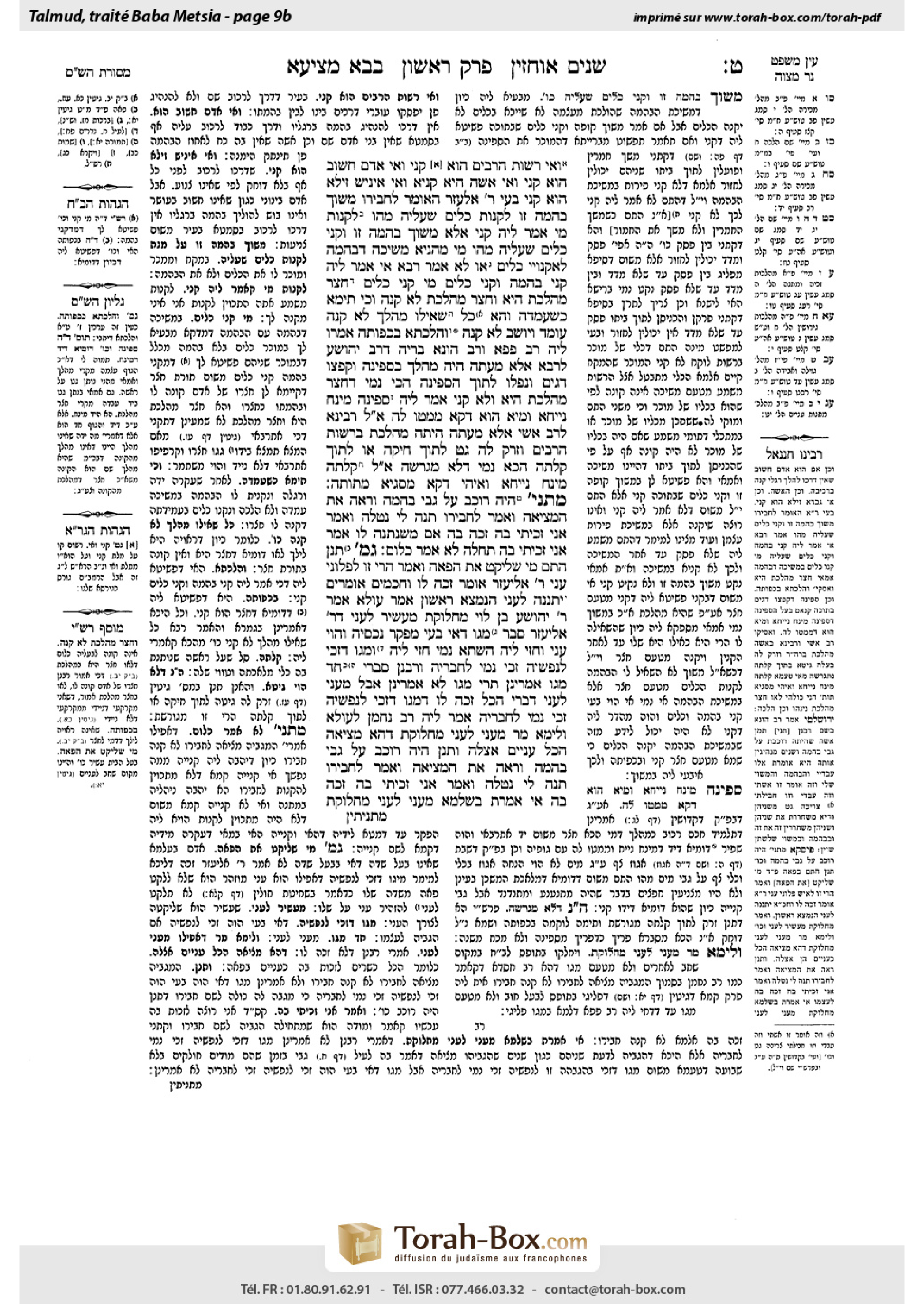
Bava Metzia 9b: Talmud study for Daf Yomi
Study the Talmud for Daf Yomi with scanned pages, Hebrew text, English translations from Sefaria and AI-generated French translations.
Passage selection and English or AI-generated French translation are available where the scan has annotations. Daf Study is independent of Torah-Box and Sefaria.
Browse Bava Metzia · בבא מציעא · All tractatesBava Metzia 9b text and translations
This page of Bava Metzia includes the Aramaic text, an English translation and an AI-generated French translation, alongside the scan above.
בבא מציעא ט׳ ב · Aramaic and Hebrew text
וְאִי רְשׁוּת הָרַבִּים הוּא – קָנֵי, וְאִי אָדָם חָשׁוּב הוּא – קָנֵי, וְאִי אִשָּׁה הִיא – קָנְיָא, וְאִי אִינִישׁ זִילָא הוּא – קָנֵי.
בָּעֵי רַבִּי אֶלְעָזָר: הָאוֹמֵר לַחֲבֵירוֹ ״מְשׁוֹךְ בְּהֵמָה זוֹ לִקְנוֹת כֵּלִים שֶׁעָלֶיהָ״, מַהוּ?
לִקְנוֹת: מִי אֲמַר לֵיהּ קְנֵי! אֶלָּא: ״מְשׁוֹךְ בְּהֵמָה זוֹ וּקְנֵי כֵּלִים שֶׁעָלֶיהָ״, מַהוּ? מִי מַהְנְיָא מְשִׁיכָה דִּבְהֵמָה לְאַקְנוֹיֵי כֵּלִים, אוֹ לָא?
אָמַר רָבָא: אִי אֲמַר לֵיהּ קְנֵי בְּהֵמָה וּקְנֵי כֵּלִים – מִי קָנֵי כֵּלִים? חָצֵר מְהַלֶּכֶת הִיא, וְחָצֵר מְהַלֶּכֶת לֹא קָנָה.
וְכִי תֵּימָא כְּשֶׁעָמְדָה, וְהָא כֹּל שֶׁאִילּוּ מְהַלֵּךְ לֹא קָנָה – עוֹמֵד וְיוֹשֵׁב לֹא קָנָה!
וְהִלְכְתָא בִּכְפוּתָהּ.
אֲמַרוּ לֵיהּ רַב פָּפָּא וְרַב הוּנָא בְּרֵיהּ דְּרַב יְהוֹשֻׁעַ לְרָבָא: אֶלָּא מֵעַתָּה, הָיָה מְהַלֵּךְ בִּסְפִינָה, וְקָפְצוּ דָּגִים וְנָפְלוּ לְתוֹךְ הַסְּפִינָה, הָכִי נָמֵי דְּחָצֵר מְהַלֶּכֶת הִיא וְלָא קָנֵי?! אֲמַר לֵיהּ: סְפִינָה מֵינָח נָיְיחָא, וּמַיָּא הוּא דְּקָא מַמְטוּ לַהּ.
אֲמַר לֵיהּ רָבִינָא לְרַב אָשֵׁי: אֶלָּא מֵעַתָּה הָיְתָה מְהַלֶּכֶת בִּרְשׁוּת הָרַבִּים וְזָרַק לָהּ גֵּט לְתוֹךְ חֵיקָהּ אוֹ לְתוֹךְ קַלְתָּהּ, הָכָא נָמֵי דְּלָא מִגָּרְשָׁה?! אֲמַר לֵיהּ: קַלְתָּהּ מֵינָח נָיְיחָא, וְאִיהִי דְּקָא מְסַגְּיָא מִתּוּתַהּ.
מַתְנִי׳ הָיָה רוֹכֵב עַל גַּבֵּי בְּהֵמָה וְרָאָה אֶת הַמְּצִיאָה וְאָמַר לַחֲבֵירוֹ ״תְּנָהּ לִי״. נְטָלָהּ וְאָמַר: ״אֲנִי זָכִיתִי בָּהּ״ – זָכָה בָּהּ. אִם מִשֶּׁנְּתָנָהּ לוֹ, אָמַר: ״אֲנִי זָכִיתִי בָּהּ תְּחִלָּה״ – לֹא אָמַר כְּלוּם.
גְּמָ׳ תְּנַן הָתָם: מִי שֶׁלִּיקֵּט אֶת הַפֵּאָה, וְאָמַר: ״הֲרֵי זוֹ לִפְלוֹנִי עָנִי״, רַבִּי אֱלִיעֶזֶר אוֹמֵר: זָכָה לוֹ. וַחֲכָמִים אוֹמְרִים: יִתְּנֶנָּה לֶעָנִי הַנִּמְצָא רִאשׁוֹן.
אָמַר עוּלָּא אָמַר רַבִּי יְהוֹשֻׁעַ בֶּן לֵוִי: מַחְלוֹקֶת מֵעָשִׁיר לְעָנִי,
דְּרַבִּי אֱלִיעֶזֶר סָבַר: מִגּוֹ דְּאִי בָּעֵי מַפְקַר נִכְסֵיהּ וְהָוֵי עָנִי וַחֲזֵי לֵיהּ – הַשְׁתָּא נָמֵי חֲזֵי לֵיהּ. וּמִגּוֹ דְּזָכֵי לְנַפְשֵׁיהּ, זָכֵי נָמֵי לְחַבְרֵיהּ. וְרַבָּנַן סָבְרִי חַד מִגּוֹ אָמְרִינַן, תְּרֵי מִגּוֹ לָא אָמְרִינַן.
אֲבָל מֵעָנִי לְעָנִי, דִּבְרֵי הַכֹּל זָכָה לוֹ – דְּמִגּוֹ דְּזָכֵי לְנַפְשֵׁיהּ זָכֵי נָמֵי לְחַבְרֵיהּ.
אֲמַר לֵיהּ רַב נַחְמָן לְעוּלָּא: וְלֵימָא מָר, מֵעָנִי לְעָנִי מַחְלוֹקֶת, דְּהָא מְצִיאָה הַכֹּל עֲנִיִּים אֶצְלָהּ, וּתְנַן: הָיָה רוֹכֵב עַל גַּבֵּי בְּהֵמָה וְרָאָה אֶת הַמְּצִיאָה וְאָמַר לַחֲבֵירוֹ ״תְּנָהּ לִי״, נְטָלָהּ וְאָמַר ״אֲנִי זָכִיתִי בָּהּ״ – זָכָה בָּהּ.
אִי אָמְרַתְּ בִּשְׁלָמָא: מֵעָנִי לְעָנִי מַחְלוֹקֶת,
Bava Metzia 9b · English translation
And if he rides it in the public domain, he acquires it, as people commonly ride animals in the city’s public domain. And if he is an important person, who always rides his animal rather than leading it, he acquires it even in an alleyway. And if the buyer is a woman, she acquires the animal, as women do not normally lead animals. And if the buyer is a detestable person, who rides even where other people do not, he too acquires the animal.
§ Rabbi Elazar raises a dilemma: With regard to one who says to another, to whom he wishes to sell vessels: Pull this animal in order to acquire the vessels that are upon it, what is the halakha? Can the buyer acquire the vessels by pulling the animal?
Before discussing the dilemma, the Gemara clarifies the issue. If the vendor merely says: In order that you will acquire the vessels, how can the buyer acquire them? Did he say to him in the imperative: Acquire the vessels? Without the seller’s explicitly instructing the buyer to acquire the vessels, the buyer cannot acquire them. Rather, Rabbi Elazar’s dilemma is with regard to a case where the seller says to the buyer: Pull this animal and thereby acquire the vessels that are upon it. What is the halakha? Is pulling the animal effective in order to acquire the vessels upon it, or not?
Rava said: It is clearly not effective, as even if he said to him: Acquire the animal and acquire the vessels, does the buyer acquire the vessels? Although one can acquire an item by having it placed in his courtyard, and one’s animal is the equivalent of his courtyard, it is considered a mobile courtyard, and a mobile courtyard does not effect acquisition of items that are placed in it.
And if you would say that the animal can function as a courtyard when it is standing still, not walking, while being pulled, isn’t there a principle which states that anything that does not effect acquisition when moving also does not effect acquisition when it is standing or sitting?
The Gemara concludes: And the halakha is that the buyer can acquire vessels by having them placed on the animal’s back only when the animal is bound. In that circumstance, when the buyer acquires the animal it assumes the legal status of his courtyard, and he also acquires the items that are placed upon the animal.
Rav Pappa and Rav Huna, son of Rav Yehoshua, said to Rava: If that is so, in a case where one was sailing on a boat and fish jumped and fell into the boat, is the boat also considered a mobile courtyard, and therefore he does not acquire the fish? Rava said to them: A boat is not considered a mobile courtyard, as the boat itself sits idle, and it is the water that moves it.
Ravina said to Rav Ashi: If that is so, that one does not acquire items that are placed in his mobile courtyard, then if a woman was walking in the public domain and her husband threw a bill of divorce into her lap, i.e., onto her person, or into her basket that she was carrying on her head, here too, is she not divorced because the basket was moving? Rav Ashi said to him: Her basket is not considered a mobile courtyard, as it sits idle, and it is she who walks beneath it.
MISHNA: If one was riding on an animal and saw a found item, and said to another person who was walking beside him: Give it to me, if the pedestrian took it and said: I have acquired it for myself, he has acquired it by means of lifting it, even though he did not see it first. But if, after giving it to the one riding the animal, he said: I acquired it for myself at the outset, he has said nothing and the rider keeps the item.
GEMARA: We learned in a mishna there (Pe’a 4:9): With regard to one who gleaned the produce in the corner of the field, which is given to the poor [pe’a], and said: This produce is for so-and-so, a poor person, Rabbi Eliezer says: He thereby acquired it on the poor person’s behalf. And the Rabbis say: He did not acquire it for the poor person; rather, he should give it to the first poor person that he encounters.
Ulla said that Rabbi Yehoshua ben Levi said: This dispute is in a case where the pe’a was gleaned by a rich person, who is not entitled to take the pe’a for himself, on behalf of a poor person.
As Rabbi Eliezer holds that since [miggo], if he so desires, he can renounce ownership of his property and he would then be poor, and the pe’a would then be suitable for him, now too, it is considered potentially suitable for him even though he is wealthy. And since [miggo] he can acquire it for himself, he can acquire it on behalf of another poor person as well. And the Rabbis hold that we say miggo once, but we do not say miggo twice. Therefore, a wealthy person cannot acquire pe’a for a poor person.
But in a case where the pe’a was gleaned by a poor person on behalf of another poor person, everyone agrees that he acquires it on behalf of the other person, as since [miggo] he can acquire it for himself, he can acquire it on behalf of another person as well.
Rav Naḥman said to Ulla: But shouldn’t the Master say that the dispute is even in a case where the pe’a was gleaned by a poor person on behalf of another poor person? This can be proven from the mishna, as everyone is considered like poor people with regard to a found item, i.e., everyone has the right to acquire a found item just as a poor person is entitled to glean pe’a, and we learned in the mishna: If one was riding on an animal and saw a found item, and said to another person: Give it to me, if the pedestrian took it and said: I have acquired it for myself, he has acquired it.
Granted, if you say the dispute pertains to a case where the pe’a was gleaned by a poor person on behalf of a poor person,
Bava Metzia 9b · Traduction française (IA)
Et s'il monte en public, il l'acquiert, car les gens montent habituellement des animaux dans le domaine public de la ville. Et s'il s'agit d'une personne importante, qui monte toujours son animal plutôt que de le conduire, il l'acquiert même dans une allée. Et si l'acheteur est une femme, elle acquiert l'animal, car les femmes ne conduisent généralement pas les animaux. Et si l'acheteur est une personne répugnante, qui monte même là où d'autres ne le font pas, il acquiert l'animal également.
§ Rabbi Elazar pose un dilemme : Concernant celui qui dit à un autre, à qui il veut vendre des objets : Tire cet animal afin d'acquérir les objets qui sont sur lui, quelle est la halakha ? L'acheteur peut-il acquérir les objets en tirant l'animal ?
Avant d'aborder ce dilemme, le Guemara clarifie la question. Si le vendeur dit simplement : Afin que tu acquierres les objets, comment l'acheteur peut-il les acquérir ? A-t-il dit à l'acheteur à l'impératif : Acquiers les objets ? Sans que le vendeur ne lui instruise explicitement d'acquérir les objets, l'acheteur ne peut pas les acquérir. Le dilemme de Rabbi Elazar est donc concernant un cas où le vendeur dit à l'acheteur : Tire cet animal et ainsi acquiers les objets qui sont sur lui. Quelle est la halakha ? L'acte de tirer l'animal est-il efficace pour acquérir les objets qui sont sur lui, ou non ?
Rava dit : Cela n'est clairement pas efficace, car même si l'on disait à l'acheteur : Acquiers l'animal et acquiers les objets, l'acheteur ne peut pas acquérir les objets. Bien qu'on puisse acquérir un objet en le plaçant dans son cour, et que l'animal soit équivalent à son cour, il s'agit d'un cour mobile, et un cour mobile ne permet pas d'acquérir les objets placés dedans.
Et si l'on disait que l'animal peut fonctionner comme un cour lorsqu'il est immobile, sans marcher, alors que l'on tire, n'y a-t-il pas un principe qui stipule que tout ce qui ne permet pas l'acquisition lorsqu'il est en mouvement ne permet pas non plus l'acquisition lorsqu'il est immobile ou assis ?
Le Guemara conclut : Et la halakha est que l'acheteur peut acquérir des objets en les plaçant sur le dos de l'animal uniquement lorsque l'animal est lié. Dans ce cas, lorsque l'acheteur acquiert l'animal, il acquiert le statut juridique de son cour, et il acquiert également les objets placés sur l'animal.
Rav Pappa et Rav Huna, fils de Rav Yéhoshua, dirent à Rava : Si c'est ainsi, dans un cas où l'on naviguait sur un bateau et des poissons sautèrent et tombèrent dans le bateau, le bateau est-il également considéré comme un cour mobile, et donc l'acheteur ne peut-il pas acquérir les poissons ? Rava répondit à eux : Le bateau n'est pas considéré comme un cour mobile, car le bateau lui-même est immobile, et c'est l'eau qui le fait bouger.
Ravina dit à Rav Ashi : Si c'est ainsi, que l'on ne peut pas acquérir des objets placés dans son cour mobile, alors si une femme marchait dans le domaine public et son mari jeta un divorce dans ses bras, c'est-à-dire sur sa personne, ou dans son panier qu'elle portait sur la tête, n'est-ce pas qu'elle est divorcée, car le panier était en mouvement ? Rav Ashi répondit à lui : Son panier n'est pas considéré comme un cour mobile, car il est immobile, et c'est elle qui marche sous lui.
MICHNA : Si l'on montait sur un animal et voyait un objet trouvé, et disait à une autre personne qui marchait à côté de lui : Donne-le-moi, si le marcheur le prenait et disait : J'ai acquis cela pour moi-même, il l'acquiert en le soulevant, même s'il n'avait pas vu l'objet d'abord. Mais si, après avoir donné l'objet à celui qui montait l'animal, il disait : J'ai acquis cela pour moi-même dès le début, il a dit rien et le monteur garde l'objet.
GUEMARA : Nous avons appris dans une mishna là (Pe’a 4:9) : Concernant celui qui a récolté les produits du coin du champ, qui est donné aux pauvres [pe’a], et qui dit : Cet objet est pour tel ou tel, un pauvre, Rabbi Eliezer dit : Il l'a ainsi acquis au nom du pauvre. Et les Rabbins disent : Il ne l'a pas acquis pour le pauvre ; plutôt, il devrait le donner au premier pauvre qu'il rencontre.
Ulla dit que Rabbi Yéhoshua ben Levi dit : Ce débat est dans un cas où le pe’a a été récolté par une personne riche, qui n'a pas le droit de prendre le pe’a pour lui-même, au nom d'une personne pauvre.
Car Rabbi Eliezer considère que [miggo], s'il le désire, il peut renoncer à la propriété de ses biens et deviendra alors pauvre, et le pe’a serait alors adapté à lui, maintenant aussi, il est considéré comme potentiellement adapté à lui même s'il est riche. Et puisque [miggo] il peut l'acquérir pour lui-même, il peut l'acquérir au nom d'une autre personne pauvre. Et les Rabbins considèrent que nous disons miggo une fois, mais nous ne disons pas miggo deux fois. Ainsi, une personne riche ne peut pas acquérir le pe’a pour un pauvre.
Mais dans un cas où le pe’a a été récolté par une personne pauvre au nom d'une autre personne pauve, tout le monde convient qu'il l'acquiert au nom de la personne autre, car puisque [miggo] il peut l'acquérir pour lui-même, il peut l'acquérir au nom d'une autre personne également.
Rav Naḥman dit à Ulla : Mais ne devrait pas le Maître dire que le débat est même dans un cas où le pe’a a été récolté par une personne pauve au nom d'une autre personne pauve ? Cela peut être prouvé à partir de la mishna, car tout le monde est considéré comme des pauvres concernant un objet trouvé, c'est-à-dire que tout le monde a le droit d'acquérir un objet trouvé, tout comme un pauvre a le droit de récolter le pe’a, et nous avons appris dans la mishna : Si l'on montait sur un animal et voyait un objet trouvé, et disait à une autre personne : Donne-le-moi, si le marcheur le prenait et disait : J'ai acquis cela pour moi-même, il l'acquiert.
Admettons que vous disiez que le débat concerne un cas où le pe’a a été récolté par une personne pauve au nom d'une autre personne pauve,
Traduction française générée par IA à partir de l’édition anglaise de Sefaria. Vérifie toujours un passage avec le texte source.
Text from Sefaria: William Davidson Edition - Vocalized Aramaic (CC BY NC); William Davidson Edition - English (CC BY NC).