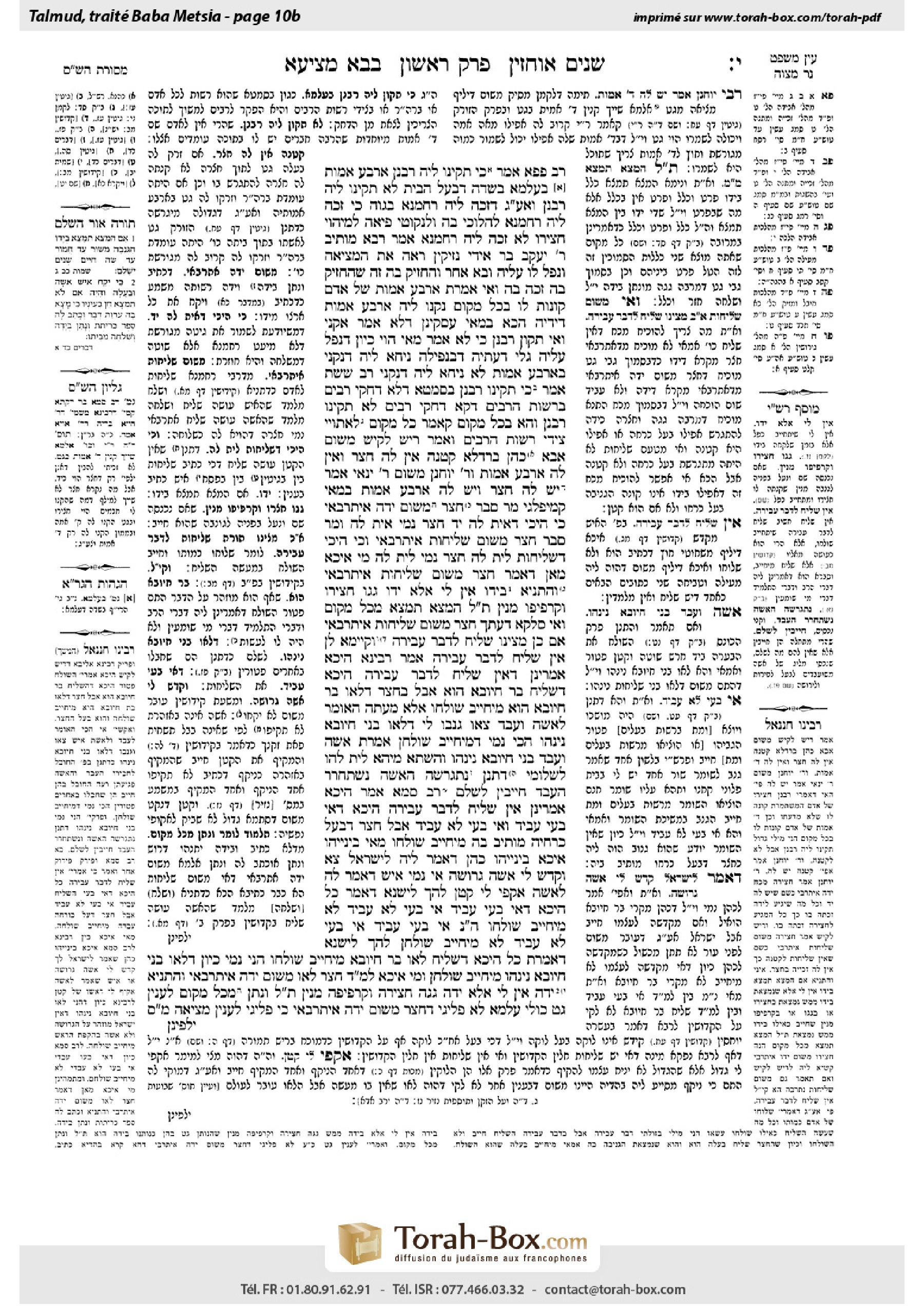
Bava Metzia 10b: Talmud study for Daf Yomi
Study the Talmud for Daf Yomi with scanned pages, Hebrew text, English translations from Sefaria and AI-generated French translations.
Passage selection and English or AI-generated French translation are available where the scan has annotations. Daf Study is independent of Torah-Box and Sefaria.
Browse Bava Metzia · בבא מציעא · All tractatesBava Metzia 10b text and translations
This page of Bava Metzia includes the Aramaic text, an English translation and an AI-generated French translation, alongside the scan above.
בבא מציעא י׳ ב · Aramaic and Hebrew text
רַב פָּפָּא אָמַר: כִּי תַּקִּינוּ לֵיה רַבָּנַן אַרְבַּע אַמּוֹת – בְּעָלְמָא, בְּשָׂדֶה דְּבַעַל הַבַּיִת לָא תַּקִּינוּ לֵיה רַבָּנַן. וְאַף עַל גַּב דִּזְכָה לֵיהּ רַחֲמָנָא בְּגַוַּהּ, כִּי זְכָה לֵיהּ רַחֲמָנָא – לְהַלּוֹכֵי בַּהּ וּלְנַקּוֹטֵי פֵּיאָה, לְמִיהְוֵי חֲצֵירוֹ לָא זְכָה לֵיהּ רַחֲמָנָא.
אָמַר רָבָא, מוֹתֵיב רַבִּי יַעֲקֹב בַּר אִידִי נְזִיקִין: רָאָה אֶת הַמְּצִיאָה וְנָפַל לוֹ עָלֶיהָ וּבָא אַחֵר וְהֶחְזִיק בָּהּ, זֶה שֶׁהֶחְזִיק בָּהּ זָכָה בַּהּ. וְאִי אָמְרַתְּ אַרְבַּע אַמּוֹת שֶׁל אָדָם קוֹנוֹת לוֹ בְּכׇל מָקוֹם – נִקְנוֹ לֵיהּ אַרְבַּע אַמּוֹת דִּידֵיהּ!
הָכָא בְּמַאי עָסְקִינַן, דְּלָא אֲמַר ״אֶקְנֵי״. וְאִי תַּקּוּן רַבָּנַן, כִּי לָא אֲמַר מַאי הָוֵי! כֵּיוָן דְּנָפַל עָלֶיהָ, גַּלִּי דַּעְתֵּיהּ דְּבִנְפִילָה נִיחָא לֵיהּ דְּנִקְנֵי, בְּאַרְבַּע אַמּוֹת לָא נִיחָא לֵיהּ דְּנִקְנֵי.
רַב שֵׁשֶׁת אָמַר: כִּי תַּקִּינוּ רַבָּנַן, בְּסִמְטָא דְּלָא דָּחֲקִי רַבִּים. בִּרְשׁוּת הָרַבִּים דְּקָא דָחֲקִי רַבִּים, לָא תַּקִּינוּ רַבָּנַן.
וְהָא בְּכׇל מָקוֹם קָאָמַר!
כׇּל מָקוֹם – לְאֵתוֹיֵי צִידֵּי רְשׁוּת הָרַבִּים.
וְאָמַר רֵישׁ לָקִישׁ מִשּׁוּם אַבָּא כֹּהֵן בַּרְדְּלָא: קְטַנָּה אֵין לָהּ חָצֵר, וְאֵין לָהּ אַרְבַּע אַמּוֹת. וְרַבִּי יוֹחָנָן מִשּׁוּם רַבִּי יַנַּאי אָמַר: יֵשׁ לָהּ חָצֵר, וְיֵשׁ לָהּ אַרְבַּע אַמּוֹת.
בְּמַאי קָמִיפַּלְגִי? מָר סָבַר חָצֵר מִשּׁוּם יָדָהּ אִיתְרַבַּאי, כִּי הֵיכִי דְּאִית לַהּ יָד – חָצֵר נָמֵי אִית לַהּ. וּמָר סָבַר חָצֵר מִשּׁוּם שְׁלִיחוּת אִיתְרַבַּאי, וְכִי הֵיכִי דִּשְׁלִיחוּת לֵית לַהּ – חָצֵר נָמֵי לֵית לַהּ.
מִי אִיכָּא מַאן דְּאָמַר חָצֵר מִשּׁוּם שְׁלִיחוּת אִיתְרַבַּאי? וְהָתַנְיָא: ״בְּיָדוֹ״ – אֵין לִי אֶלָּא יָדוֹ. גַּגּוֹ, חֲצֵירוֹ וְקַרְפֵּיפוֹ מִנַּיִן – תַּלְמוּד לוֹמַר: ״הִמָּצֵא תִמָּצֵא״, מִכׇּל מָקוֹם.
וְאִי סָלְקָא דַעְתָּךְ חָצֵר מִשּׁוּם שְׁלִיחוּת אִיתְרַבַּאי, אִם כֵּן מָצִינוּ שָׁלִיחַ לִדְבַר עֲבֵירָה, וְקַיְימָא לַן אֵין שָׁלִיחַ לִדְבַר עֲבֵירָה!
אָמַר רָבִינָא: הֵיכָא אָמְרִינַן דְּאֵין שָׁלִיחַ לִדְבַר עֲבֵירָה – הֵיכָא דְּשָׁלִיחַ בַּר חִיּוּבָא הוּא, אֲבָל בְּחָצֵר דְּלָאו בַּר חִיּוּבָא הוּא – מִיחַיַּיב שׁוֹלְחוֹ.
אֶלָּא מֵעַתָּה, הָאוֹמֵר לְאִשָּׁה וְעֶבֶד: ״צְאוּ גִּנְבוּ לִי״ – דְּלָאו בְּנֵי חִיּוּבָא נִינְהוּ, הָכִי נָמֵי דְּמִיחַיַּיב שׁוֹלְחָן?!
אָמְרַתְּ אִשָּׁה וְעֶבֶד – בְּנֵי חִיּוּבָא נִינְהוּ, וְהַשְׁתָּא מִיהָא לֵית לְהוּ לְשַׁלּוֹמֵי. דִּתְנַן: נִתְגָּרְשָׁה הָאִשָּׁה, נִשְׁתַּחְרֵר הָעֶבֶד – חַיָּיבִין לְשַׁלֵּם.
רַב סַמָּא אָמַר: הֵיכָא אָמְרִינַן אֵין שָׁלִיחַ לִדְבַר עֲבֵירָה – הֵיכָא דְּאִי בָּעֵי עָבֵיד וְאִי בָּעֵי לָא עָבֵיד, אֲבָל חָצֵר דִּבְעַל כֻּרְחֵיהּ מוֹתֵיב בַּהּ, מִיחַיַּיב שׁוֹלְחוֹ.
מַאי בֵּינַיְיהוּ? אִיכָּא בֵּינַיְיהוּ כֹּהֵן דְּאָמַר לֵיהּ לְיִשְׂרָאֵל: צֵא וְקַדֵּשׁ לִי אִשָּׁה גְּרוּשָׁה, אִי נָמֵי אִישׁ דְּאָמַר לַהּ לְאִשָּׁה: אַקִּפִי לִי קָטָן.
לְהָךְ לִישָּׁנָא דְּאָמַר כֹּל הֵיכָא דְּאִי בָּעֵי עָבֵיד אִי בָּעֵי לָא עָבֵיד – לָא מִיחַיַּיב שׁוֹלְחוֹ. הָנֵי נָמֵי אִי בָּעֵי עָבֵיד, אִי בָּעֵי לָא עָבֵיד – לָא מִיחַיַּיב שׁוֹלְחָן. לְהָךְ לִישָּׁנָא דְּאָמְרַתְּ כֹּל הֵיכָא דְּשָׁלִיחַ לָאו בַּר חִיּוּבָא מִיחַיַּיב שׁוֹלְחוֹ, הָנֵי נָמֵי כֵּיוָן דְּלָאו בְּנֵי חִיּוּבָא נִינְהוּ – מִיחַיַּיב שׁוּלְחָן.
וּמִי אִיכָּא לְמַאן דְּאָמַר חָצֵר לָאו מִשּׁוּם יָדָהּ אִיתְרַבַּאי? וְהָתַנְיָא: ״יָדָהּ״, אֵין לִי אֶלָּא יָדָהּ. גַּגָּהּ, חֲצֵירָהּ וְקַרְפֵּיפָהּ מִנַּיִן? תַּלְמוּד לוֹמַר: ״וְנָתַן״ מִכׇּל מָקוֹם!
לְעִנְיַן גֵּט כּוּלֵּי עָלְמָא לָא פְּלִיגִי דְּחָצֵר מִשּׁוּם יָדָהּ אִיתְרַבַּאי, כִּי פְּלִיגִי לְעִנְיַן מְצִיאָה. מָר סָבַר:
Bava Metzia 10b · English translation
Rav Pappa said a different answer: When the Sages instituted an ordinance that one’s four square cubits effect acquisition of property for him, that was in the world, i.e., on public land. But the Sages did not institute this mode of acquisition for him in a field belonging to an owner. And even though the Merciful One accorded a poor person certain rights in a landowner’s field during the distribution of pe’a, this mode of acquisition is not included in those rights; when the Merciful One accorded him rights it was specifically to walk in the field and to collect pe’a, but the Merciful One did not accord him the right that the field be considered his courtyard with regard to acquiring pe’a. Therefore, the mishna in tractate Pe’a does not contradict the statement of Reish Lakish.
As mentioned previously, Rava said that Rabbi Ya’akov bar Idi raises an objection to this from a mishna in Nezikin. The Gemara elaborates: The mishna here states that if one saw a found item and fell upon it, and another came and seized it, the one who seized it acquired it. And if you say that a person’s four square cubits effect acquisition of property for him everywhere, let his four square cubits effect acquisition of the found item for him.
The Gemara answers: Here we are dealing with a case where he did not say: I will acquire it. The Gemara asks: But if the Sages instituted an ordinance that one’s four square cubits effect acquisition of property for him, then even in a case when he did not say: I will acquire the item, what of it? The item should still be his. The Gemara answers: Since he fell upon it, he revealed his intention that it is satisfactory for him to acquire the item by falling on it, and it is not satisfactory for him to acquire the item through the ordinance concerning his four square cubits. Since he decided to forgo the mode of acquisition instituted by the Sages, he does not acquire the found item.
Rav Sheshet said a different answer: When the Sages instituted that one’s four square cubits effect acquisition of property for him, that was in a place like an alleyway, where the multitudes do not crowd, so the four square cubits surrounding a person can temporarily be considered his property and enable him to acquire an item; but the Sages did not institute this mode of acquisition in the public domain, where the multitudes crowd.
The Gemara asks: But doesn’t the wording of Reish Lakish’s statement indicate that there is no such limitation, as he says that the area of four square cubits surrounding a person effects acquisition of property for him everywhere? The indication is that this is true even in the public domain.
The Gemara answers: The word everywhere is not to be taken literally; it was stated to include even the sides of the public domain, areas that are adjacent to the public domain but not actually part of it. Since the multitudes do not crowd there, one who is standing there acquires an item that is in his four square cubits.
§ And Reish Lakish says another halakha in the name of Abba Kohen Bardela: A minor girl does not have the ability to acquire property by means of her courtyard, and she does not have the ability to acquire property by means of her four square cubits. And Rabbi Yoḥanan says in the name of Rabbi Yannai that she has the ability to acquire property by means of her courtyard, and she has the ability to acquire property by means of her four square cubits.
The Gemara asks: With regard to what do they disagree? The Gemara explains: One Sage, Rabbi Yannai, holds that placing an item in a courtyard is included as a valid means of acquisition due to the fact that it acts as her hand. Just as a minor girl has the ability to acquire property with her hand, she also has the ability to acquire property by means of her courtyard. And one Sage, Abba Kohen Bardela, holds that placing an item in a courtyard is included as a valid means of acquisition due to the option of acquiring property via agency; and just as a minor girl has no power of agency, as a minor cannot appoint an agent, she does not have the ability to acquire property by means of her courtyard either.
The Gemara asks: Is there anyone who says that a courtyard is included as a valid means of acquisition due to the option of acquiring property via agency? But isn’t it taught in a baraita: The verse states: “If the theft shall be found in his possession alive, whether it is an ox, or a donkey, or a sheep, he shall pay double” (Exodus 22:3)” From the term “in his possession [beyado],” I have derived only a case where the stolen item is found in his hand [yado]. From where do I derive that the same halakha applies if it is found on his roof, in his yard, or in his enclosure? The verse states the repetitive phrase “if the theft shall be found [himmatze timmatze],” to indicate that the same halakha applies in any case, i.e., in any location that the stolen item is found.
The Gemara explains: And if it enters your mind that a courtyard is included as a valid means of acquisition due to agency, if so, we have found a case where there is agency for a transgression, i.e., theft. But we maintain that there is no agency for transgression. If one sends an agent to violate a transgression on his behalf, the agent is liable for the transgression and is not considered to be acting on behalf of the one who sent him.
Ravina said: That baraita poses no problem, as where do we say that there is no agency for transgression? It is where the agent himself is subject to liability for transgression. Consequently, the agent is liable, not the one who sent him. But in the case of a courtyard, which is not subject to liability, its sender, i.e., its owner, is liable.
The Gemara asks: If that is so, then in a case of one who says to a woman or a slave: Go out and steal for me, is the one who sent them indeed liable, since they are not subject to liability? Married women and slaves have no property of their own from which one could collect payment.
The Gemara answers: You can say in response: A woman and a slave are not comparable to a courtyard, as they are subject to liability if they steal; and only now, in any event, they do not have the means to pay. This is as we learned in a mishna (Bava Kamma 87a) concerning a married woman or Canaanite slave who injured another person: If the woman becomes divorced or the slave becomes emancipated, and they then have their own money, they are liable to pay for the damage they inflicted. Evidently, although it is not possible to collect payment from them, they are liable for their actions.
Rav Samma stated a different resolution to the difficulty based on the baraita: Where do we say that there is no agency for transgression? It is specifically in a case where if the agent wants to execute his assignment he can do so, and if he wants to refrain from executing it he can also opt to not do it. But in the case of a courtyard, where one places items without its consent, its sender, i.e., its owner, is liable.
The Gemara asks: What is the practical difference between the answers of Ravina and Rav Samma? The practical difference between them is in the case of a priest who said to an Israelite: Go out and betroth a divorced woman for me. It is prohibited for a priest to betroth a divorcée, while it is permitted for an Israelite to do so. Alternatively, the difference is in the case of a man who said to a woman: Round the corners of the head of a minor boy for me. Rounding the corners of a man’s head, and a man having the corners of his head rounded, are prohibited in the verse: “You shall not round the corners of your head” (Leviticus 19:27), but they are prohibited only for men and not for women.
The Gemara explains: According to the formulation in which it was said that anywhere that if the agent wants to execute his assignment he can do so and if he wants to refrain from executing it he can opt to not do it the one who sent him is not liable for the transgression but rather the agent is liable, in these cases too, since if the agent wants to execute his assignment he can do so, and if he wants to refrain from executing it he can opt to not do it, the one who sent them is not liable. But according to the formulation in which it was said that wherever an agent is not subject to liability the one who sent him is liable, in these cases too, since the agents are not subject to liability, the one who sent them is liable.
The Gemara asks about the explanation of the opinion of Abba Kohen Bardela: But is there anyone who says that placing an item in a courtyard is not included as a valid means of acquisition due to the fact that it acts as her hand? But isn’t it taught in a baraita: From the verse: “And he writes her a scroll of severance, and he gives it in her hand” (Deuteronomy 24:1), I have derived only that a woman is divorced if her husband places the bill of divorce in her hand. From where is it derived that even if he places it on her roof, in her courtyard, or in her enclosure, she is divorced? The verse states: “And he gives,” indicating that she is divorced in any case. Apparently one’s courtyard is considered an extension of his hand with regard to acquiring property, in this case, the bill of divorce.
The Gemara answers: With regard to a bill of divorce everyone agrees that placing an item in a courtyard is included as a valid means of acquisition due to the fact that it acts as her hand. When they disagree, it is with regard to acquiring a found item that was discovered in her courtyard. One Sage, Rabbi Yannai, holds that
Bava Metzia 10b · Traduction française (IA)
Rav Pappa a dit une autre réponse : Lorsque les Sages ont institué un décret selon lequel les quatre cubits carrés d'une personne permettent l'acquisition de propriété pour lui, cela était dans le monde, c'est-à-dire sur un terrain public. Mais les Sages n'ont pas institué ce mode d'acquisition pour lui dans un champ appartenant à un propriétaire. Et même si le Bienveillant a accordé certains droits aux pauvres dans un champ d'un propriétaire lors de la distribution de la pe'a, ce mode d'acquisition n'est pas inclus dans ces droits ; lorsque le Bienveillant a accordé des droits, c'était spécifiquement pour marcher dans le champ et récolter la pe'a, mais le Bienveillant n'a pas accordé le droit que le champ soit considéré comme son courtil en ce qui concerne l'acquisition de la pe'a. Ainsi, la mitsva du traité Pe'a ne contredit pas la déclaration de Reish Lakish.
Comme mentionné précédemment, Rava a dit que Rabbi Ya'akov bar Idi émet un objet d'argumentation contre cela à partir d'une mitsva dans Nezikin. La Guemara développe : La mitsva ici stipule que si l'on voit un objet trouvé et s'y jette, et que quelqu'un d'autre vient et le prend, celui qui l'a pris l'acquiert. Et si l'on dit qu'un homme's quatre cubits carrés permettent l'acquisition de propriété partout, alors ses quatre cubits carrés permettent l'acquisition de l'objet trouvé pour lui.
La Guemara répond : Ici, nous sommes en présence d'un cas où il n'a pas dit : Je vais l'acquérir. La Guemara demande : Mais si les Sages ont institué un décret selon lequel les quatre cubits carrés d'une personne permettent l'acquisition de propriété pour lui, alors même dans un cas où il n'a pas dit : Je vais acquérir l'objet, qu'est-ce que cela change ? L'objet devrait lui appartenir. La Guemara répond : Puisqu'il s'est jeté dessus, il a révélé son intention que cela lui convienne d'acquérir l'objet en s'y jetant, et cela ne lui convient pas d'acquérir l'objet via le décret concernant ses quatre cubits. Puisqu'il a décidé de renoncer au mode d'acquisition institué par les Sages, il ne peut pas acquérir l'objet trouvé.
Rav Sheshet a dit une autre réponse : Lorsque les Sages ont institué que les quatre cubits carrés d'une personne permettent l'acquisition de propriété pour lui, cela était dans un lieu comme un passage, où les foules ne se pressent pas, de sorte que les quatre cubits carrés autour d'une personne peuvent temporairement être considérés comme sa propriété et permettent l'acquisition d'un objet ; mais les Sages n'ont pas institué ce mode d'acquisition dans le domaine public, où les foules se pressent.
La Guemara demande : Mais ne montre-t-il pas la formulation de la déclaration de Reish Lakish qu'il n'y a pas de telle limitation, puisqu'il dit que les quatre cubits carrés autour d'une personne permettent l'acquisition de propriété partout ? L'indication est que cela est vrai même dans le domaine public.
La Guemara répond : Le mot « partout » ne doit pas être pris littéralement ; il a été utilisé pour inclure même les côtés du domaine public, des zones adjacentes au domaine public mais ne faisant pas partie de celui-ci. Puisque les foules ne se pressent pas là, celui qui est debout là acquiert un objet qui est dans ses quatre cubits carrés.
§ Reish Lakish dit une autre halakha en nom d'Abba Kohen Bardela : Une petite fille n'a pas la capacité d'acquérir une propriété par le biais de son courtil, et elle n'a pas la capacité d'acquérir une propriété par le biais de ses quatre cubits carrés. Et Rabbi Yoḥanan dit en nom de Rabbi Yannai qu'elle a la capacité d'acquérir une propriété par le biais de son courtil, et elle a la capacité d'acquérir une propriété par le biais de ses quatre cubits carrés.
La Guemara demande : Sur quel point s'opposent-ils ? La Guemara explique : Un Sage, Rabbi Yannai, considère que placer un objet dans un courtil est inclus comme un moyen valide d'acquisition en raison du fait qu'il agit comme sa main. Tout comme une petite fille a la capacité d'acquérir une propriété avec sa main, elle a aussi la capacité d'acquérir une propriété par le biais de son courtil. Et un autre Sage, Abba Kohen Bardela, considère que placer un objet dans un courtil est inclus comme un moyen valide d'acquisition en raison de l'option d'acquisition via l'agence ; et tout comme une petite fille n'a pas de pouvoir d'agence, puisqu'elle ne peut pas désigner un agent, elle n'a pas non plus la capacité d'acquérir une propriété par le biais de son courtil.
La Guemara demande : Y a-t-il quelqu'un qui dit que le courtil est inclus comme un moyen valide d'acquisition en raison de l'option d'acquisition via l'agence ? Mais n'est-il pas enseigné dans une baraïta : La Torah écrite dit : « Si la chose volée est trouvée en son possession vivante, qu'il s'agisse d'un bœuf, d'un âne, ou d'une brebis, il devra payer double » (Exode 22:3). De la term « en son possession [beyado] », j'ai déduit un cas où l'objet volé est trouvé dans sa main [yado]. D'où déduis-je que la même halakha s'applique si l'objet est trouvé sur son toit, dans son courtil, ou dans son enclos ? La Torah écrite répète le mot « si la chose volée est trouvée [himmatze timmatze] », pour indiquer que la même halakha s'applique dans tout cas, c'est-à-dire dans n'importe quel lieu où l'objet volé est trouvé.
La Guemara explique : Et si cela entre dans votre tête que le courtil est inclus comme un moyen valide d'acquisition en raison de l'agence, si tel est le cas, nous avons trouvé un cas où il y a de l'agence pour une transgression, c'est-à-dire le vol. Mais nous maintenons qu'il n'y a pas d'agence pour une transgression. Si l'on envoie un agent pour violer une transgression à sa place, l'agent est responsable de la transgression et n'est pas considéré comme agissant au nom de celui qui l'a envoyé.
Ravina a dit : Cette baraïta ne pose aucun problème, car où dit-on qu'il n'y a pas d'agence pour une transgression ? C'est là où l'agent lui-même est sujet à la responsabilité pour une transgression. Ainsi, l'agent est responsable, pas celui qui l'a envoyé. Mais dans le cas du courtil, qui n'est pas sujet à la responsabilité, son propriétaire, c'est-à-dire l'homme qui l'a construit, est responsable.
La Guemara demande : Si c'est ainsi, alors dans un cas où l'on dit à une femme ou à un esclave : Sortez et volez pour moi, est-ce que celui qui les a envoyés est effectivement responsable, puisqu'ils ne sont pas sujets à la responsabilité ? Les femmes mariées et les esclaves n'ont pas de propriété propre d'où l'on pourrait réclamer un paiement.
La Guemara répond : On peut répondre : Une femme et un esclave ne sont pas comparables à un courtil, car ils sont soumis à la responsabilité en cas de vol ; et en tout cas, ils n'ont pas les moyens de payer. C'est ce que nous avons appris dans une mitsva (Bava Kamma 87a) concernant une femme mariée ou un esclave cananéen qui a blessé une autre personne : Si la femme devient veuve ou l'esclave est libéré, et qu'ils disposent alors de leur propre argent, ils sont responsables de payer le préjudice qu'ils ont causé. Évidemment, bien qu'il ne soit pas possible de récupérer le paiement d'eux, ils sont responsables de leurs actions.
Rav Samma a proposé une autre résolution à la difficulté, fondée sur la baraïta : Où dit-on qu'il n'y a pas d'agent pour un péché ? C'est précisément dans le cas où l'agent veut exécuter sa tâche, il peut le faire, et s'il veut s'en abstenir, il peut aussi choisir de ne pas le faire. Mais dans le cas d'un courtil, où l'on place des objets sans son consentement, son expéditeur, c'est-à-dire son propriétaire, est responsable.
La Guemara pose la question : Quelle est la différence pratique entre les réponses de Ravina et de Rav Samma ? La différence pratique entre eux est dans le cas d'un prêtre qui dit à un Israélite : Sortez et épousez une femme divorcée pour moi. Il est interdit à un prêtre d'épouser une divorcée, tandis qu'il est permis à un Israélite de le faire. Alternativement, la différence est dans le cas d'un homme qui dit à une femme : Arrondissez les coins de la tête d'un petit garçon pour moi. Arrondir les coins de la tête d'un homme et un homme ayant les coins de sa tête arrondis sont interdits dans la parole : « Vous ne devriez pas arrondir les coins de votre tête » (Lévitique 19:27), mais ils sont interdits uniquement aux hommes et non aux femmes.
La Guemara explique : Selon la formulation dans laquelle on dit que partout où l'agent veut exécuter sa tâche il peut le faire et où s'il veut s'en abstenir il peut aussi choisir de ne pas le faire, l'expéditeur n'est pas responsable du péché, mais l'agent est responsable. Dans ces cas également, puisque l'agent veut exécuter sa tâche il peut le faire, et s'il veut s'en abstenir il peut aussi choisir de ne pas le faire, l'expéditeur n'est pas responsable. Mais selon la formulation dans laquelle on dit que partout où l'agent n'est pas responsable, l'expéditeur est responsable, dans ces cas également, puisque les agents ne sont pas responsables, l'expéditeur est responsable.
La Guemara pose la question concernant l'explication de l'opinion d'Abba Kohen Bardela : Mais est-ce que quelqu'un dit que placer un objet dans un courtil n'est pas considéré comme un moyen valide d'acquisition en raison du fait qu'il agit comme sa main ? Mais n'est-il pas enseigné dans une baraïta : « Et il écrit à elle un rouleau de séparation, et il le donne en sa main » (Deutéronome 24:1), d'où on déduit seulement que la femme est divorcée si son mari place le livre de divorce en sa main. D'où est-il déduit que même s'il le place sur son toit, dans son courtil ou dans son enclos, elle est divorcée ? La parole dit : « Et il donne », ce qui indique qu'elle est divorcée dans tous les cas. Apparemment, le courtil d'une personne est considéré comme une extension de sa main en ce qui concerne l'acquisition de biens, dans ce cas précis, le livre de divorce.
La Guemara répond : Concernant un livre de divorce, tout le monde convient que placer un objet dans un courtil est considéré comme un moyen valide d'acquisition en raison du fait qu'il agit comme sa main. Lorsqu'ils divergent, c'est concernant l'acquisition d'un objet trouvé dans son courtil. Un sage, Rabbi Yannai, affirme que
Traduction française générée par IA à partir de l’édition anglaise de Sefaria. Vérifie toujours un passage avec le texte source.
Text from Sefaria: William Davidson Edition - Vocalized Aramaic (CC BY NC); William Davidson Edition - English (CC BY NC).