Bava Metzia 11a: Talmud study for Daf Yomi
Study the Talmud for Daf Yomi with scanned pages, Hebrew text, English translations from Sefaria and AI-generated French translations.
Passage selection and English or AI-generated French translation are available where the scan has annotations. Daf Study is independent of Torah-Box and Sefaria.
Browse Bava Metzia · בבא מציעא · All tractatesBava Metzia 11a text and translations
This page of Bava Metzia includes the Aramaic text, an English translation and an AI-generated French translation, alongside the scan above.
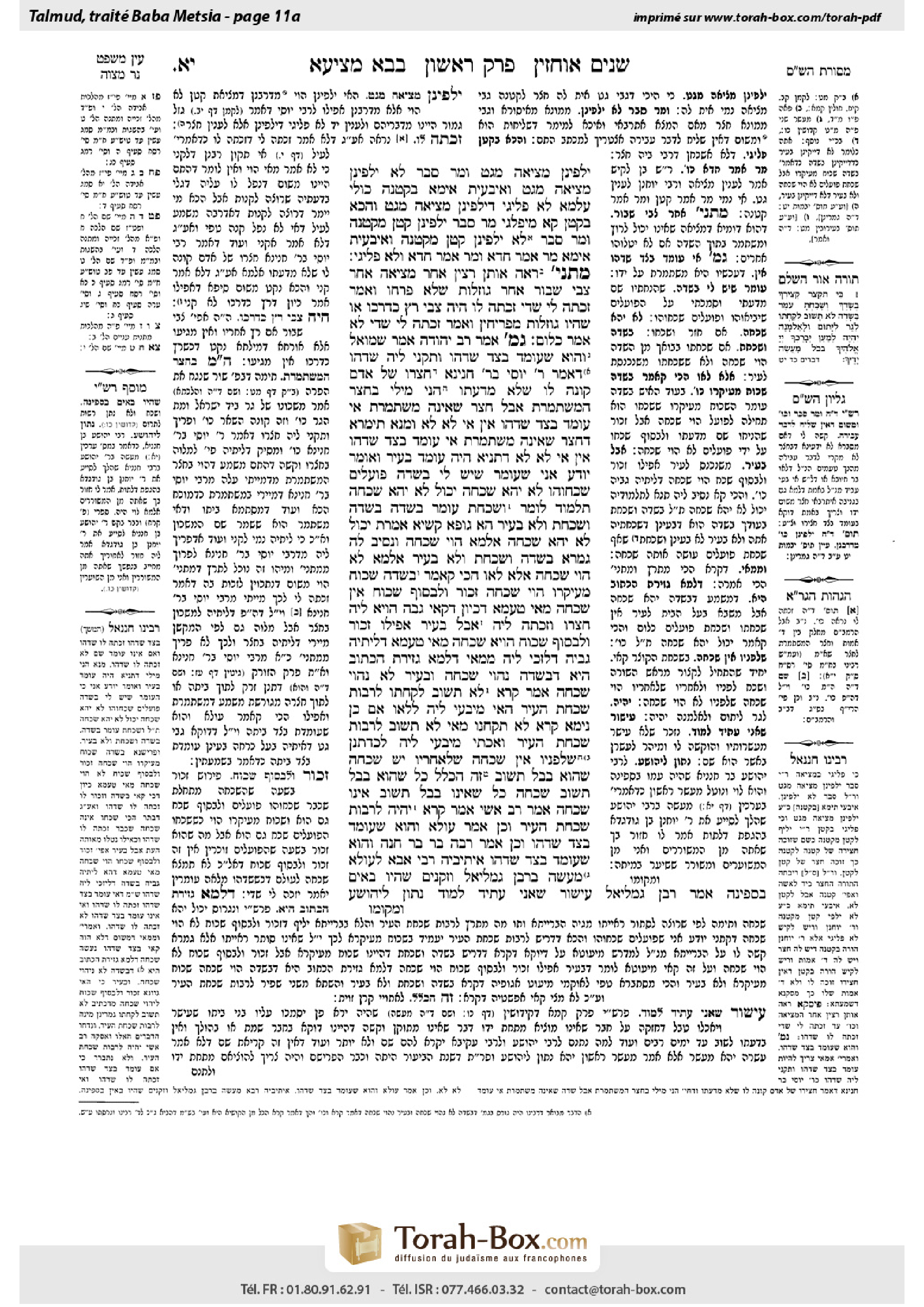
בבא מציעא י״א א · Aramaic and Hebrew text
יָלְפִינַן מְצִיאָה מִגֵּט, וּמָר סָבַר: לָא יָלְפִינַן מְצִיאָה מִגֵּט.
וְאִיבָּעֵית אֵימָא: בִּקְטַנָּה כּוּלֵּי עָלְמָא לָא פְּלִיגִי דְּיָלְפִינַן מְצִיאָה מִגֵּט. וְהָכָא בְּקָטָן קָא מִיפַּלְגִי,
מָר סָבַר: יָלְפִינַן קָטָן מִקְּטַנָּה. וּמָר סָבַר: לָא יָלְפִינַן קָטָן מִקְּטַנָּה.
וְאִיבָּעֵית אֵימָא: מָר אֲמַר חֲדָא, וּמָר אֲמַר חֲדָא וְלָא פְּלִיגִי.
מַתְנִי׳ רָאָה אוֹתָן רָצִין אַחַר מְצִיאָה, אַחַר צְבִי שָׁבוּר, אַחַר גּוֹזָלוֹת שֶׁלֹּא פֵּרְחוּ, וְאָמַר: ״זָכְתָה לִי שָׂדִי״ – זָכְתָה לוֹ. הָיָה צְבִי רָץ כְּדַרְכּוֹ, אוֹ שֶׁהָיוּ גּוֹזָלוֹת מַפְרִיחִין, וְאָמַר: ״זָכְתָה לִי שָׂדִי״ – לֹא אָמַר כְּלוּם.
גְּמָ׳ אָמַר רַב יְהוּדָה אָמַר שְׁמוּאֵל: וְהוּא שֶׁעוֹמֵד בְּצַד שָׂדֵהוּ.
וְתִקְנֵי לֵיהּ שָׂדֵהוּ, דְּאָמַר רַבִּי יוֹסֵי בְּרַבִּי חֲנִינָא: חֲצֵרוֹ שֶׁל אָדָם קוֹנָה לוֹ שֶׁלֹּא מִדַּעְתּוֹ!
הָנֵי מִילֵּי בְּחָצֵר הַמִּשְׁתַּמֶּרֶת, אֲבָל חָצֵר שֶׁאֵינָהּ מִשְׁתַּמֶּרֶת, אִי עוֹמֵד בְּצַד שָׂדֵהוּ – אִין, אִי לָא – לָא.
וּמְנָא תֵּימְרָא דְּחָצֵר שֶׁאֵינָהּ מִשְׁתַּמֶּרֶת, אִי עוֹמֵד בְּצַד שָׂדֵהוּ – אִין, אִי לָא – לָא?
דְּתַנְיָא: הָיָה עוֹמֵד בָּעִיר וְאוֹמֵר, ״יוֹדֵעַ אֲנִי שֶׁעוֹמֶר שֶׁיֵּשׁ לִי בַּשָּׂדֶה פּוֹעֲלִים שְׁכֵחוּהוּ – לֹא יְהֵא שִׁכְחָה״, יָכוֹל לֹא יְהֵא שִׁכְחָה – תַּלְמוּד לוֹמַר: ״וְשָׁכַחְתָּ עֹמֶר בַּשָּׂדֶה״, ״בַּשָּׂדֶה וְשָׁכַחְתָּ״ – וְלֹא בָּעִיר.
הָא גּוּפַהּ קַשְׁיָא: אָמְרַתְּ יָכוֹל לֹא יְהֵא שִׁכְחָה – אַלְמָא הָוֵי שִׁכְחָה, וְנָסֵיב לַהּ תַּלְמוּדָא ״בַּשָּׂדֶה וְשָׁכַחְתָּ״ וְלֹא בָּעִיר, אַלְמָא לָא הָוֵי שִׁכְחָה!
אֶלָּא לָאו הָכִי קָאָמַר: בַּשָּׂדֶה – שָׁכוּחַ מֵעִיקָּרוֹ הָוֵי שִׁכְחָה, זָכוּר וּלְבַסּוֹף שָׁכוּחַ אֵין שִׁכְחָה, מַאי טַעְמָא – דְּכֵיוָן דְּקָאֵי גַּבַּהּ, הָוְיָא לַיהּ חֲצֵרוֹ וְזָכְתָה לֵיהּ.
אֲבָל בָּעִיר, אֲפִילּוּ זָכוּר וּלְבַסּוֹף שָׁכוּחַ – הָוְיָא שִׁכְחָה. מַאי טַעְמָא – דְּלֵיתֵיהּ גַּבֵּיהּ דְּלִזְכֵּי לֵיהּ.
מִמַּאי? דִּלְמָא גְּזֵירַת הַכָּתוּב הִיא, דְּבַשָּׂדֶה נֶהֱוֵי שִׁכְחָה וּבָעִיר לָא נֶהֱוֵי שִׁכְחָה!
אָמַר קְרָא: ״לֹא תָּשׁוּב לְקַחְתּוֹ״, לְרַבּוֹת שִׁכְחַת הָעִיר.
הַאי מִיבְּעֵי לֵיהּ לְלָאו!
אִם כֵּן נֵימָא קְרָא ״לֹא תִּקָּחֶנּוּ״, מַאי ״לֹא תָּשׁוּב״ – לְרַבּוֹת שִׁכְחַת הָעִיר.
וְאַכַּתִּי מִיבְּעֵי לֵיהּ, לִכְדִתְנַן: שֶׁלְּפָנָיו – אֵין שִׁכְחָה, שֶׁלְּאַחֲרָיו – יֵשׁ שִׁכְחָה, שֶׁהוּא בְּבַל תָּשׁוּב.
זֶה הַכְּלָל: כֹּל שֶׁהוּא בְּבַל תָּשׁוּב – שִׁכְחָה, כֹּל שֶׁאֵינוֹ בְּבַל תָּשׁוּב – אֵינוֹ שִׁכְחָה!
אָמַר רַב אָשֵׁי, אָמַר קְרָא ״יִהְיֶה״ – לְרַבּוֹת שִׁכְחַת הָעִיר.
וְכֵן אָמַר עוּלָּא: וְהוּא שֶׁעוֹמֵד בְּצַד שָׂדֵהוּ. וְכֵן אָמַר רַבָּה בַּר בַּר חָנָה: וְהוּא שֶׁעוֹמֵד בְּצַד שָׂדֵהוּ.
אֵיתִיבֵיהּ רַבִּי אַבָּא לְעוּלָּא: מַעֲשֶׂה בְּרַבָּן גַּמְלִיאֵל וּזְקֵנִים שֶׁהָיוּ בָּאִים בִּסְפִינָה. אָמַר רַבָּן גַּמְלִיאֵל: עִישּׂוּר שֶׁאֲנִי עָתִיד לָמוֹד נָתוּן לִיהוֹשֻׁעַ,
Bava Metzia 11a · English translation
we derive the halakha with regard to acquiring a found item from the halakha with regard to a bill of divorce, and one Sage, Abba Kohen Bardela, holds that we do not derive the halakha with regard to a found item from the halakha with regard to a bill of divorce.
And if you wish, say instead that with regard to a minor girl, everyone agrees that we derive the halakha with regard to a found item from the halakha with regard to a bill of divorce, and she acquires an ownerless item that is found in her courtyard. And here they disagree with regard to whether a minor boy acquires an item that is placed in his courtyard.
One Sage, Rabbi Yannai, holds that we derive the halakha with regard to a minor boy from the halakha with regard to a minor girl, as there should be no difference between them with regard to the halakhot of acquisition. And one Sage, Abba Kohen Bardela, holds that we do not derive the halakha with regard to a minor boy from the halakha with regard to a minor girl; only a minor girl acquires items by means of her courtyard, as the Torah includes this mode of acquisition with regard to acquiring a bill of divorce.
And if you wish, say instead that there is no dispute here at all. Rather, one Sage, Abba Kohen Bardela, said one statement, that a minor girl is divorced by her husband placing a bill of divorce in her courtyard, and one Sage, Rabbi Yannai, said another statement, that a minor boy or girl does not acquire an item that is found in his or her courtyard; and they do not disagree.
MISHNA: If one saw people running after a found ownerless animal, e.g., after a deer crippled by a broken leg, or after young pigeons that have not yet learned to fly, which can be caught easily, and he said: My field has effected acquisition of this animal for me, it has effected acquisition of it for him. If the deer were running in its usual manner, or the young pigeons were flying, and he said: My field has effected acquisition of this animal for me, he has said nothing, as one’s courtyard cannot effect acquisition of an item that does not remain there on its own.
GEMARA: Rav Yehuda says that Shmuel says: And this acquisition mentioned in the mishna is effective specifically in a case where the owner is standing next to his field at the time of the acquisition, so that it has the halakhic status of a secured courtyard.
The Gemara raises a difficulty: But shouldn’t his field effect acquisition of the animal for him even without him standing next to it? As Rabbi Yosei, son of Rabbi Ḥanina, says: A person’s courtyard effects acquisition of property for him even without his knowledge.
The Gemara answers: This statement applies only to a secured courtyard, where items remain in the courtyard without supervision. But with regard to an unsecured courtyard, if the owner is standing next to his field, yes, it effects acquisition of ownerless items on his behalf, but if he is not, it does not effect acquisition of items on his behalf.
The Gemara asks: And from where do you say that in the case of an unsecured courtyard, if the owner is standing next to his field, yes, it effects acquisition of ownerless items on his behalf, but if he is not, it does not effect acquisition of items on his behalf?
As it is taught in a baraita: There is a case where a landowner was standing in the town and saying: I know that my laborers forgot a sheaf that I have in the field, which I had intended for the laborers to bring in, but since I remember it, it shall not be considered a forgotten sheaf, which must be left for the poor. Then, the landowner himself forgot about the sheaf. In this case, one might have thought that it is not considered a forgotten sheaf. To counter this, the verse states: “When you reap your harvest in your field, and have forgotten a sheaf in the field, you shall not go back to fetch it; it shall be for the stranger, for the fatherless, and for the widow” (Deuteronomy 24:19). It is derived from here that the phrase: “And have forgotten” applies “in the field,” but not in the town.
The Gemara clarifies: This baraita itself is difficult. First you said that one might have thought that it is not considered a forgotten sheaf, so apparently the tanna seeks to prove that it is considered a forgotten sheaf. And then the baraita adduces the derivation that the phrase “and have forgotten” applies only “in the field,” but not in the town, which apparently means that a sheaf forgotten by the owner while he is in the town is not considered a forgotten sheaf.
Rather, isn’t this what the tanna is saying: In a case where the owner is in the field, if the sheaf was forgotten at the outset, it is considered a forgotten sheaf; but if it was remembered at first and was ultimately forgotten, it does not assume the status of a forgotten sheaf? What is the reason for this distinction? The reason is that since he is standing in the field, beside the sheaf, his field is tantamount to his courtyard, and his courtyard effects acquisition of the sheaf for him once he remembers it.
But in a case where the owner is in the town, even if the sheaf was remembered and ultimately forgotten, it is considered a forgotten sheaf and must be left for the poor. What is the reason for this? It is because the owner is not beside it, which is necessary for his courtyard to effect acquisition of the sheaf for him. Evidently, an item that is in a person’s courtyard is acquired by him only if he is standing next to the courtyard.
The Gemara rejects this proof: From where can it be proven that this is the reason? Perhaps the baraita should be understood in a different manner: It is a Torah edict that if the owner is in the field, it is considered a forgotten sheaf, but if the owner is in the town, it is not considered a forgotten sheaf and does not need to be left for the poor. Accordingly, the distinction would not be derived from the halakhot of acquisition.
The Gemara responds that the verse states: “You shall not go back to take it” (Deuteronomy 24:19), which is interpreted to include sheaves forgotten while the owner is in the town. Evidently, there is no fundamental difference between a town and the field with regard to the halakhot of forgotten sheaves; rather, the distinction is due to the fact that one cannot acquire a sheaf by means of his courtyard if he is not standing next to the courtyard.
The Gemara challenges: This phrase is necessary to impose a prohibition upon one who takes his sheaf after he forgot it, instead of leaving it for the poor. It is therefore not superfluous and cannot be interpreted as including an additional case.
The Gemara answers: If so, if the verse serves only that purpose, let the verse say: You shall not take it. What is added by the phrase: “You shall not go back to take it”? It is written to include sheaves forgotten while the owner is in the town.
The Gemara challenges: But the phrase “you shall not go back” is still necessary for that which we learned in a mishna (Pe’a 7:4): While a landowner collects the sheaves from his field, any sheaf that remains before him, as he has not reached it yet, does not assume the status of a forgotten sheaf, even if he has forgotten about its existence. Any sheaf that is already behind him has the status of a forgotten sheaf, as the prohibition of: You shall not go back, applies.
This is the principle: Any sheaf to which the prohibition of: You shall not go back, applies, as one would need to retrace his steps in order to retrieve the sheaf, assumes the status of a forgotten sheaf; and any sheaf to which the prohibition of: You shall not go back, does not apply, i.e., a sheaf that one has yet to reach, does not assume the status of a forgotten sheaf. The phrase “You shall not go back” is apparently necessary to teach this halakha, and it cannot be interpreted as including a case where the owner is in the town.
Rav Ashi said that the inclusion of this case is derived from another phrase in the verse. The verse states: “It shall be” (Deuteronomy 24:19), which is interpreted to include sheaves forgotten while the owner is in the town. Therefore, the Gemara’s initial interpretation of the baraita is accepted, leading to the conclusion that the distinction between a case where the owner is in the field and a case where he is in the town is due to the halakha that one’s courtyard can effect acquisition of property for him only if he is next to the courtyard, as Rav Yehuda said in the name of Shmuel.
And Ulla also says that the acquisition mentioned in the mishna is effective specifically in a case where the owner is standing next to his field. And Rabba bar bar Ḥana also says that the acquisition is effective specifically in a case where he is standing next to his field.
Rabbi Abba raised an objection to Ulla from that which is taught in a mishna (Ma’aser Sheni 5:9): There was an incident involving Rabban Gamliel and other Elders, who were traveling on a ship. Since he remembered that he had not tithed the produce of his fields, Rabban Gamliel said to the others: One-tenth of my produce, which I will measure out in the future and separate from my produce, is given to Yehoshua ben Ḥananya, who is a Levite and is entitled to receive the first tithe,
Bava Metzia 11a · Traduction française (IA)
On déduit la halakha concernant l'acquisition d'un objet trouvé à partir de la halakha concernant un acte de divorce, et un Sage, Abba Kohen Bardela, affirme que l'on ne déduit la halakha concernant un objet trouvé à partir de la halakha concernant un acte de divorce.
Et si l'on veut, on peut dire plutôt que concernant une jeune fille, tout le monde convient que l'on déduit la halakha concernant un objet trouvé à partir de la halakha concernant un acte de divorce, et elle acquiert un objet trouvé dans son jardin. Et ici, ils divergent sur le fait qu'un jeune garçon acquiert un objet placé dans son jardin.
Un Sage, Rabbi Yannai, affirme que l'on déduit la halakha concernant un jeune garçon à partir de la halakha concernant une jeune fille, car il ne devrait pas y avoir de différence entre eux concernant les halakhot de l'acquisition. Et un Sage, Abba Kohen Bardela, affirme que l'on ne déduit la halakha concernant un jeune garçon à partir de la halakha concernant une jeune fille ; seule la jeune fille acquiert des objets par le biais de son jardin, car la Torah inclut ce mode d'acquisition concernant l'acquisition d'un acte de divorce.
Et si l'on veut, on peut dire plutôt qu'il n'y a pas de désaccord ici du tout. Plutôt, un Sage, Abba Kohen Bardela, a dit une déclaration, savoir qu'une jeune fille est divorcée par son mari en plaçant un acte de divorce dans son jardin, et un Sage, Rabbi Yannai, a dit une autre déclaration, savoir qu'un jeune garçon ou une jeune fille ne peut pas acquérir un objet trouvé dans leur jardin ; et ils ne divergent pas.
MICHNA : Si l'on voit des gens courir après un animal trouvé et sans propriétaire, par exemple, après un cerf avec une jambe cassée, ou après des moineaux jeunes qui n'ont pas encore appris à voler et qui peuvent être facilement attrapés, et qu'il dit : Mon champ a accompli l'acquisition de cet animal pour moi, il l'a accomplie pour lui. Si le cerf courait normalement, ou les moineaux volaient, et qu'il dit : Mon champ a accompli l'acquisition de cet animal pour moi, il a dit rien, car le jardin ne peut accomplir l'acquisition d'un objet qui ne reste pas là tout seul.
GUEMARA : Rav Yehuda dit que Shmuel dit : Et cette acquisition mentionnée dans la mishna est efficace spécifiquement dans le cas où l'propriétaire est debout à côté de son champ au moment de l'acquisition, de sorte qu'elle a le statut halakhique d'un jardin sécurisé.
La Guemara soulève une difficulté : Ne devrait pas son champ accomplir l'acquisition de l'animal pour lui-même sans qu'il ne soit debout à côté ? Comme Rabbi Yosei, fils de Rabbi Ḥanina, dit : Le jardin d'une personne accompli l'acquisition des biens pour lui-même sans qu'il ne le sache.
La Guemara répond : Cette déclaration s'applique uniquement à un jardin sécurisé, où les objets restent dans le jardin sans surveillance. Mais concernant un jardin non sécurisé, si l'propriétaire est debout à côté de son champ, oui, il accomplit l'acquisition des objets sans propriétaire à sa place, mais si il n'est pas là, il ne l'accompli pas.
La Guemara pose la question : Et d'où dis-tu que dans le cas d'un jardin non sécurisé, si l'propriétaire est debout à côté de son champ, oui, il accomplit l'acquisition des objets sans propriétaire à sa place, mais si il n'est pas là, il ne l'accompli pas ?
Comme il est enseigné dans une baraïta : Il y a un cas où un propriétaire de terrain était debout dans la ville et disait : Je sais que mes ouvriers ont oublié un épi que j'ai dans le champ, que j'avais l'intention qu'ils amènent, mais puisque je me souviens de lui, il ne sera pas considéré comme un épi oublié, qui doit être laissé aux pauvres. Puis, le propriétaire lui-même a oublié l'épi. Dans ce cas, on pourrait penser qu'il n'est pas considéré comme un épi oublié. Pour contrecarrer cela, la parabole dit : « Quand tu moissonnes ton champ et que tu as oublié un épi dans le champ, ne reviens pas pour le ramasser ; il sera pour l'étranger, pour l'orphelin et pour la veuve » (Deutéronome 24:19). On en déduit ici que la phrase « et tu as oublié » s'applique « dans le champ », mais pas dans la ville.
La Guemara clarifie : Cette baraïta elle-même est difficile. D'abord tu as dit que l'on pourrait penser qu'il n'est pas considéré comme un épi oublié, donc apparemment le tanna cherche à prouver qu'il est considéré comme un épi oublié. Et puis la baraïta déduit la dérivation que la phrase « et tu as oublié » s'applique uniquement « dans le champ », mais pas dans la ville, ce qui semble signifier qu'un épi oublié par l'propriétaire pendant qu'il est dans la ville n'est pas considéré comme un épi oublié.
Plutôt, n'est-ce pas ce que le tanna dit : Dans le cas où l'propriétaire est dans le champ, si l'épi a été oublié dès le départ, il est considéré comme un épi oublié ; mais si l'épi a été d'abord souvenu et finalement oublié, il ne prend pas le statut d'un épi oublié ? Quelle est la raison de cette distinction ? La raison est que puisque il est debout dans le champ, à côté de l'épi, son champ est équivalent à son jardin, et son jardin accompli l'acquisition de l'épi pour lui une fois qu'il le souvient.
Mais dans le cas où l'propriétaire est dans la ville, même si l'épi a été d'abord souvenu et finalement oublié, il est considéré comme un épi oublié et doit être laissé aux pauvres. Quelle est la raison de cela ? C'est parce que l'propriétaire n'est pas à côté de l'épi, ce qui est nécessaire pour que son jardin accomplisse l'acquisition de l'épi pour lui. Apparemment, un objet qui est dans le jardin d'une personne est acquis par lui uniquement s'il est debout à côté du jardin.
La Guemara rejette cette preuve : D'où peut-on prouver que c'est la raison ? Peut-être la baraïta doit-elle être comprise d'une autre manière : Il s'agit d'un décret de la Torah selon lequel si l'owner est dans le champ, il est considéré comme un épis oublié, mais si l'owner est en ville, il n'est pas considéré comme un épis oublié et n'a pas besoin d'être laissé aux pauvres. Ainsi, la distinction ne serait pas tirée des halakhot de l'acquisition.
La Guemara répond que le verset dit : « Tu ne reviendras pas le prendre » (Deutéronome 24:19), qui est interprété pour inclure les épis oubliés pendant que l'owner est en ville. Évidemment, il n'y a pas de différence fondamentale entre une ville et le champ en ce qui concerne les halakhot des épis oubliés ; plutôt, la distinction provient du fait qu'on ne peut acquérir un épis par le biais de son courtil si l'on n'est pas à côté du courtil.
La Guemara soulève un défi : Cette expression est nécessaire pour imposer une interdiction à celui qui prend son épis après l'avoir oublié, au lieu de le laisser aux pauvres. Il s'agit donc d'une expression essentielle et ne peut pas être interprétée comme incluant un cas supplémentaire.
La Guemara répond : Si tel est le cas, si le verset sert uniquement à cela, que le verset dise : « Tu ne le prendras pas ». Quel est l'ajout de l'expression : « Tu ne reviendras pas le prendre » ? Il est écrit pour inclure les épis oubliés pendant que l'owner est en ville.
La Guemara soulève un défi : Mais l'expression « tu ne reviendras pas » est encore nécessaire pour ce que nous avons appris dans une mitsva (Pe’a 7:4) : Tandis qu'un propriétaire collecte les épis de son champ, tout épis qui reste devant lui, avant qu'il ne l'atteigne, ne prend pas le statut d'épis oublié, même s'il a oublié son existence. Tout épis déjà derrière lui prend le statut d'épis oublié, car l'interdiction de : « Tu ne reviendras pas » s'applique.
C'est le principe : Tout épis auquel s'applique l'interdiction de : « Tu ne reviendras pas », c'est-à-dire qu'on a besoin de faire marche arrière pour récupérer l'épis, prend le statut d'épis oublié ; et tout épis auquel l'interdiction de : « Tu ne reviendras pas » ne s'applique pas, c'est-à-dire un épis que l'on n'a pas encore atteint, ne prend pas le statut d'épis oublié. L'expression « Tu ne reviendras pas » est visiblement nécessaire pour enseigner cette halakha, et ne peut pas être interprétée comme incluant un cas où l'owner est en ville.
Rav Ashi a dit que l'inclusion de ce cas est tirée d'une autre expression du verset. Le verset dit : « Il sera » (Deutéronome 24:19), qui est interprété pour inclure les épis oubliés pendant que l'propriétaire est en ville. Ainsi, l'interprétation initiale de la baraïta par la Guemara est acceptée, menant à la conclusion que la distinction entre le cas où l'propriétaire est dans le champ et celui où il est en ville provient de la halakha selon laquelle le courtil d'une personne peut effectuer l'acquisition de propriété pour lui uniquement s'il est à côté du courtil, comme Rav Yehuda a dit au nom de Shmuel.
Et Ulla dit aussi que l'acquisition mentionnée dans la mitsna est efficace spécifiquement dans le cas où l'propriétaire est debout à côté de son champ. Et Rabba bar bar Ḥana dit aussi que l'acquisition est efficace spécifiquement dans le cas où il est debout à côté de son champ.
Rabbi Abba a soulevé un objet contre Ulla à partir de ce qui est enseigné dans une mitsna (Ma’aser Sheni 5:9) : Il y avait un incident impliquant Rabban Gamliel et d'autres Anciens, qui voyageaient sur un bateau. Puisqu'il se rappelait qu'il n'avait pas titré les produits de ses champs, Rabban Gamliel a dit aux autres : Un dixième de mes produits, que je mesurerai ultérieurement et séparerai de mes produits, est donné à Yehoshua ben Ḥananya, qui est un Lévite et est dû à recevoir la première tithe,
Traduction française générée par IA à partir de l’édition anglaise de Sefaria. Vérifie toujours un passage avec le texte source.
Text from Sefaria: William Davidson Edition - Vocalized Aramaic (CC BY NC); William Davidson Edition - English (CC BY NC).