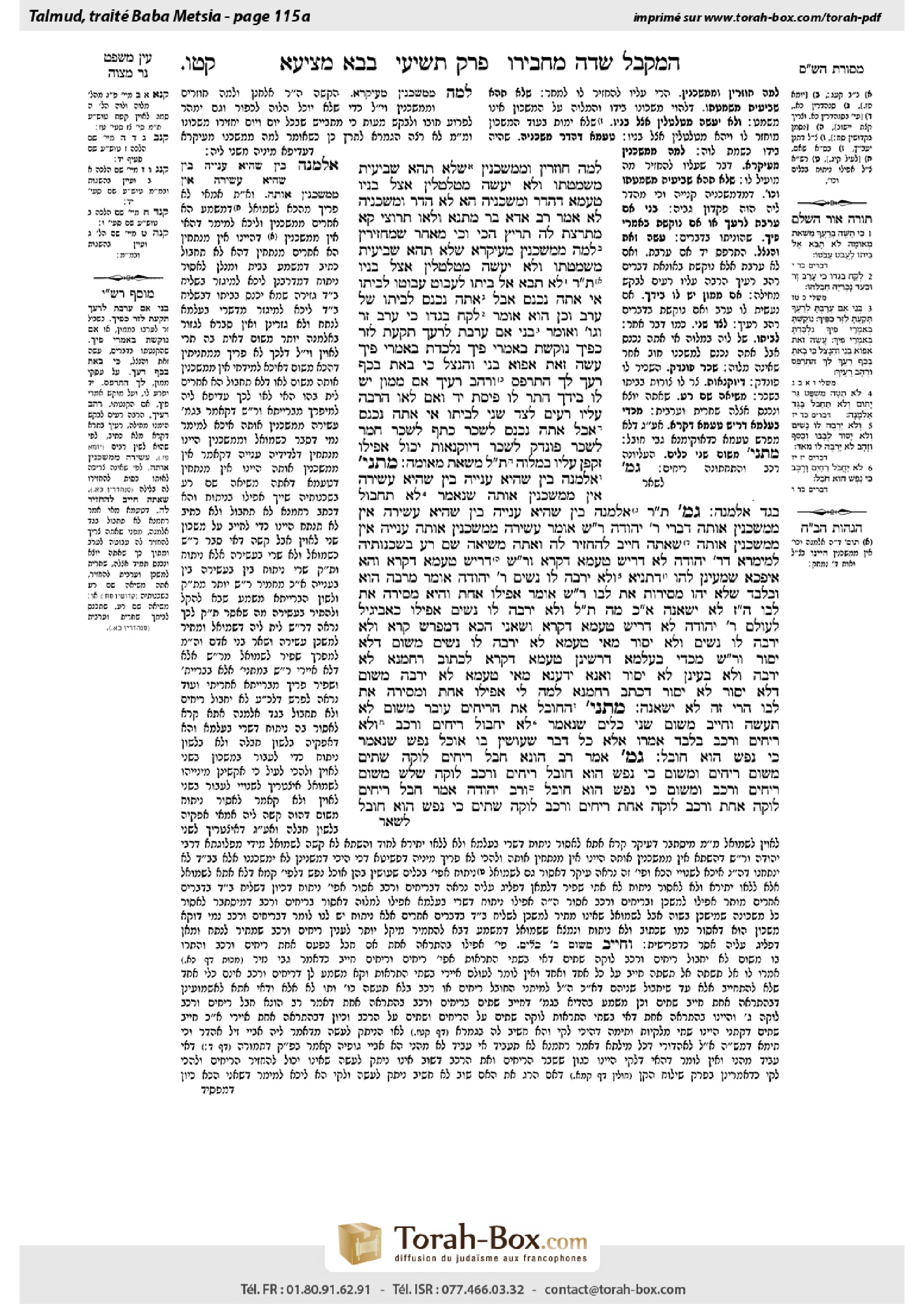
Bava Metzia 115a: Talmud study for Daf Yomi
Study the Talmud for Daf Yomi with scanned pages, Hebrew text, English translations from Sefaria and AI-generated French translations.
Passage selection and English or AI-generated French translation are available where the scan has annotations. Daf Study is independent of Torah-Box and Sefaria.
Browse Bava Metzia · בבא מציעא · All tractatesBava Metzia 115a text and translations
This page of Bava Metzia includes the Aramaic text, an English translation and an AI-generated French translation, alongside the scan above.
בבא מציעא קי״ה א · Aramaic and Hebrew text
לָמָּה חוֹזְרִין וּמְמַשְׁכְּנִין? שֶׁלֹּא תְּהֵא שְׁבִיעִית מְשַׁמַּטְתּוֹ, וְלֹא יֵעָשֶׂה מִטַּלְטְלִין אֵצֶל בָּנָיו.
טַעְמָא דַּהֲדַר וּמַשְׁכְּנֵיהּ, הָא לָא הֲדַר וּמַשְׁכְּנֵיהּ – לָא!
אָמַר רַב אַדָּא בַּר מַתְנָא: וְלָאו תָּרוֹצֵי קָא מְתָרְצַתְּ לַהּ? תָּרֵיץ הָכִי: וְכִי מֵאַחַר שֶׁמַּחְזִירִין לָמָּה מְמַשְׁכְּנִין מֵעִיקָּרָא – שֶׁלֹּא תְּהֵא שְׁבִיעִית מְשַׁמַּטְתּוֹ, וְלֹא יֵעָשֶׂה מִטַּלְטְלִין אֵצֶל בָּנָיו.
תָּנוּ רַבָּנַן: ״לֹא תָבֹא אֶל בֵּיתוֹ לַעֲבֹט עֲבֹטוֹ״. לְבֵיתוֹ אִי אַתָּה נִכְנָס, אֲבָל אַתָּה נִכְנָס לְבֵיתוֹ שֶׁל עָרֵב. וְכֵן הוּא אוֹמֵר: ״לְקַח בִּגְדוֹ כִּי עָרַב זָר וְגוֹ׳״.
וְאוֹמֵר: ״בְּנִי אִם עָרַבְתָּ לְרֵעֶךָ תָּקַעְתָּ לַזָּר כַּפֶּיךָ. נוֹקַשְׁתָּ בְאִמְרֵי פִיךָ נִלְכַּדְתָּ בְּאִמְרֵי פִיךָ. עֲשֵׂה זֹאת אֵפוֹא בְּנִי וְהִנָּצֵל כִּי בָאתָ בְכַף רֵעֶךָ לֵךְ הִתְרַפֵּס וּרְהַב רֵעֶיךָ״.
אִם מָמוֹן יֵשׁ לוֹ בְּיָדֶךָ – הַתֵּר לוֹ פִּיסַּת יָד, וְאִם לָאו – הַרְבֵּה עָלָיו רֵעִים.
לְצַד שֵׁנִי – לְבֵיתוֹ אִי אַתָּה נִכְנָס, אֲבָל אַתָּה נִכְנָס לִשְׂכַר כַּתָּף, לִשְׂכַר חַמָּר, לִשְׂכַר פּוּנְדָּק, לִשְׂכַר דְּיוֹקְנָאוֹת. יָכוֹל אֲפִילּוּ זְקָפָן עָלָיו בְּמִלְוֶה? תַּלְמוּד לוֹמַר: ״מַשַּׁאת מְאוּמָה״.
מַתְנִי׳ אַלְמָנָה, בֵּין שֶׁהִיא עֲנִיָּיה בֵּין שֶׁהִיא עֲשִׁירָה – אֵין מְמַשְׁכְּנִין אוֹתָהּ, שֶׁנֶּאֱמַר: ״וְלֹא תַחֲבֹל בֶּגֶד אַלְמָנָה״.
גְּמָ׳ תָּנוּ רַבָּנַן: אַלְמָנָה, בֵּין שֶׁהִיא עֲנִיָּיה בֵּין שֶׁהִיא עֲשִׁירָה – אֵין מְמַשְׁכְּנִין אוֹתָהּ, דִּבְרֵי רַבִּי יְהוּדָה.
רַבִּי שִׁמְעוֹן אוֹמֵר: עֲשִׁירָה – מְמַשְׁכְּנִין אוֹתָהּ, עֲנִיָּיה – אֵין מְמַשְׁכְּנִין אוֹתָהּ. שֶׁאַתָּה חַיָּיב לְהַחֲזִיר לַהּ, וְאַתָּה מַשִּׂיאָהּ שֵׁם רַע בִּשְׁכֵנוֹתֶיהָ.
לְמֵימְרָא דְּרַבִּי יְהוּדָה לָא דָּרֵישׁ טַעְמָא דִקְרָא, וְרַבִּי שִׁמְעוֹן דָּרֵישׁ טַעְמָא דִקְרָא? וְהָא אִיפְּכָא שָׁמְעִינַן לְהוּ.
דְּתַנְיָא: ״וְלֹא יַרְבֶּה לּוֹ נָשִׁים״, רַבִּי יְהוּדָה אוֹמֵר: מַרְבֶּה הוּא, וּבִלְבַד שֶׁלֹּא יְהוּ מְסִירוֹת אֶת לִבּוֹ. רַבִּי שִׁמְעוֹן אוֹמֵר: אֲפִילּוּ אַחַת וְהִיא מְסִירָה אֶת לִבּוֹ, הֲרֵי זֶה לֹא יִשָּׂאֶנָּה. אִם כֵּן, מָה תַּלְמוּד לוֹמַר ״וְלֹא יַרְבֶּה לּוֹ נָשִׁים״ – אֲפִילּוּ כַּאֲבִיגַיִל!
לְעוֹלָם רַבִּי יְהוּדָה לָא דָּרֵישׁ טַעְמָא דִקְרָא, וְשָׁאנֵי הָכָא, דִּמְפָרֵשׁ קְרָא ״וְלֹא יַרְבֶּה לּוֹ נָשִׁים וְלֹא יָסוּר״. מַאי טַעְמָא ״לֹא יַרְבֶּה לוֹ נָשִׁים״ – מִשּׁוּם דְּ״לֹא יָסוּר״.
וְרַבִּי שִׁמְעוֹן מִכְּדֵי בְּעָלְמָא דָּרְשִׁינַן טַעְמָא דִקְרָא, לִכְתּוֹב רַחֲמָנָא ״לֹא יַרְבֶּה״, וְלָא בָּעֵינַן ״לֹא יָסוּר״! וַאֲנָא יָדַעְנָא: מַאי טַעְמָא ״לֹא יַרְבֶּה״ – מִשּׁוּם דְּ״לֹא יָסוּר״. ״לֹא יָסוּר״ דִּכְתַב רַחֲמָנָא לְמָה לִי? אֲפִילּוּ אַחַת וּמְסִירָה אֶת לִבּוֹ – הֲרֵי זֶה לֹא יִשָּׂאֶנָּה.
מַתְנִי׳ הַחוֹבֵל אֶת הָרֵיחַיִם – עוֹבֵר מִשּׁוּם לֹא תַעֲשֶׂה, וְחַיָּיב מִשּׁוּם שְׁנֵי כֵּלִים, שֶׁנֶּאֱמַר: ״לֹא יַחֲבֹל רֵיחַיִם וָרָכֶב״. וְלֹא רֵיחַיִם וָרֶכֶב בִּלְבַד אָמְרוּ, אֶלָּא כׇּל דָּבָר שֶׁעוֹשִׂין בּוֹ אוֹכֶל נֶפֶשׁ, שֶׁנֶּאֱמַר: ״כִּי נֶפֶשׁ הוּא חֹבֵל״.
גְּמָ׳ אָמַר רַב הוּנָא: חָבַל רֵיחַיִם – לוֹקֶה שְׁתַּיִם: מִשּׁוּם ״רֵיחַיִם״, וּמִשּׁוּם ״כִּי נֶפֶשׁ הוּא חֹבֵל״. רֵיחַיִם וָרֶכֶב – לוֹקֶה שָׁלֹשׁ: מִשּׁוּם ״רֵיחַיִם״, ״וָרֶכֶב״, וּמִשּׁוּם ״כִּי נֶפֶשׁ הוּא חֹבֵל״.
וְרַב יְהוּדָה אָמַר: חָבַל רֵיחַיִם – לוֹקֶה אַחַת, וְרֶכֶב – לוֹקֶה אַחַת, רֵיחַיִם וָרֶכֶב – לוֹקֶה שְׁתַּיִם. ״כִּי נֶפֶשׁ הוּא חֹבֵל״ –
Bava Metzia 115a · English translation
why does one go back and take the collateral again, as the creditor must anyway restore it to the debtor the following day? The Gemara replies: Any loan that is secured by collateral is not canceled by the Sabbatical Year, in contrast to other debts, which are canceled. Therefore, this ensures that the Sabbatical Year should not cancel it. And an additional reason is so that the collateral should not become movable property in the possession of his children, as one generally cannot claim such items from orphans to pay for their father’s debt.
The Gemara infers: The reason these exceptions apply is that he goes back and takes it as collateral; but if he did not go back and take it as collateral, these exceptions do not apply. This baraita therefore contradicts the opinion of Rabbi Yoḥanan, who held that the initial seizing of collateral is sufficient to grant the creditor full rights to it.
Rav Adda bar Mattana said: And did you not resolve this baraita once already by adjusting its wording slightly? Answer it by changing its formulation again in this manner: And since one must return the collateral, why does one take collateral at the outset? It is done so that the Sabbatical Year should not cancel the debt, and so that it should not become movable property in the possession of his children. This version is in accordance with the opinion of Rabbi Yoḥanan, as it teaches that one who has taken collateral even on a single occasion may confiscate it from the debtor’s heirs.
§ The Sages taught: The verse states: “When you lend your neighbor any manner of loan, you shall not go into his house to take his collateral” (Deuteronomy 24:10). This verse indicates that you may not enter his house, but you may enter the house of a guarantor to take collateral from him. And similarly it states: “Take his garment that is a surety for a stranger” (Proverbs 20:16).
And it further states with regard to the same issue: “My son, if you are a guarantor for your neighbor, if you have struck your hands for a stranger, you are ensnared by the words of your mouth; you are caught by the words of your mouth. Do this, now, my son, and deliver yourself, when you have come into the hand of your friend; go humble yourself and strengthen your friend” (Proverbs 6:1–3).
This passage in Proverbs is interpreted as follows: The phrase “You are snared by the words of your mouth” is referring to a guarantor who obligated himself to pay or one who upset his friend with his comments. In such a case, one should do the following: If he has money in your hand, “go humble yourself [hitrapes],” which is expounded as: Release for him the palm of your hand [hatter lo pissat yad] to give him his money. And if it is not money that you owe him, but rather you have “become ensnared by the words of your mouth” and owe him an apology for a personal slight, gather together many neighbors through which to seek his forgiveness.
The verse “When you lend your neighbor any manner of loan, you shall not go into his house to take his collateral” can be interpreted in a different direction, i.e., in another manner: You may not enter his house to take collateral for the loan, but if he owes wages, you may enter and take collateral for a porter’s wages, for a donkey driver’s wages, for an innkeeper’s payment, or for the wages for one who made drawings [diyokanaot] for him. One might have thought that this applies even if the one owed the money establishes it as a loan for the one who owes the money after he was already liable for such payment. Therefore, the verse states: “Any manner of loan” (Deuteronomy 24:10), which demonstrates that once the debt has been converted into a loan, it is like any other loan, and therefore one may not take collateral against the debtor’s will.
MISHNA: With regard to a widow, whether she is poor or whether she is wealthy, one may not take collateral from her, as it is stated: “And you may not take the garment of a widow as collateral” (Deuteronomy 24:17).
GEMARA: The Sages taught: With regard to a widow, whether she is poor or whether she is wealthy, one may not take collateral from her. This is the statement of Rabbi Yehuda.
Rabbi Shimon says: With regard to a wealthy widow, one may take collateral from her. But with regard to a poor widow, one may not take collateral from her, because you are obligated to return it to her, in accordance with the halakha that the collateral of a poor person must be returned to him whenever he needs it. And since you will be entering every day to return the collateral to her, you will thereby give her a bad name among her neighbors, as they will suspect her of developing an inappropriate relationship with you. By contrast, in the case of a wealthy widow, since there is no obligation to return her collateral, it is permitted to take collateral from her.
The Gemara asks: Is this to say that Rabbi Yehuda does not interpret the rationale behind the mitzva in the verse and draw halakhic conclusions based on that interpretation, and Rabbi Shimon does interpret the rationale behind the mitzva in the verse? But haven’t we heard them holding the reverse opinions elsewhere?
As it is taught in a mishna (Sanhedrin 21a) concerning the mitzvot of a king: “And he should not multiply wives for himself, that his heart not turn away” (Deuteronomy 17:17). Rabbi Yehuda says: He may accumulate many wives for himself, provided that they are not like those who turn his heart from reverence for God. Rabbi Shimon says: Even one who turns his heart away, he should not marry her. If so, why is it stated: “He shall not multiply wives for himself”? This teaches that even with regard to wives like Abigail, who was righteous and prevented David from sin (see I Samuel chapter 25), he is forbidden to have many. In this case, Rabbi Shimon does not interpret the rationale of the verse, while Rabbi Yehuda does interpret its rationale.
The Gemara answers: Actually, Rabbi Yehuda does not generally interpret the rationale of the verse, and it is different here, with regard to a king, as the verse itself specifies the reason: “And he should not multiply wives for himself, that his heart not turn away.” What is the reason that he may not multiply wives for himself? It is because he must ensure that his heart will not turn away.
And Rabbi Shimon maintains: Since we generally interpret the rationale in the verse, there is no need for the verse itself to supply the rationale for the prohibition. Let the Merciful One state: “He may not multiply,” and we do not need the Torah to add “that his heart not turn away,” and I would already know the answer to the question: What is the reason that he may not accumulate many wives? It is because of the concern that his heart not turn away. If so, why do I need the phrase “His heart not turn away” that the Merciful One writes? It must certainly be necessary in order to increase the scope of the prohibition: Even if there is one woman who turns his heart away, he may not marry her. Therefore, the verse includes two halakhot: A general stricture against a king’s marrying too many women, and a further halakha that a king may not marry even one woman who will lead him astray.
MISHNA: One who takes a millstone as collateral violates a prohibition, and he is liable for taking two vessels, i.e., both millstones in the pair, as it is stated: “He shall not take the lower or upper millstone as collateral” (Deuteronomy 24:6). The tanna adds: Not only did the Sages say that it is prohibited to take the lower or upper millstone as collateral, but they also said that one may not take anything that people use in the preparation of food [okhel nefesh], as it is stated: “For he takes a man’s life [nefesh] as collateral” (Deuteronomy 24:6).
GEMARA: Rav Huna says: One who took a lower millstone as collateral is flogged with two sets of lashes: One set is due to violating the prohibition of taking the lower millstone as collateral, and the second is due to: “For he takes a man’s life as collateral,” since he took an item used in the preparation of food. If he took the lower and upper millstone, he is flogged with three sets of lashes: Two sets are due to violating the prohibitions of taking a lower millstone and an upper millstone as collateral, and the third is due to violating the prohibition: “For he takes a man’s life as collateral.”
And Rav Yehuda says: If he took a lower millstone as collateral he is flogged with one set of lashes, if he took an upper millstone he is flogged with one set of lashes, and if he took both the lower and upper millstones together as collateral he is flogged with two sets of lashes. With regard to the verse: “For he takes a man’s life as collateral,”
Bava Metzia 115a · Traduction française (IA)
Pourquoi doit-on revenir et récupérer le cautionnement à nouveau, puisque le créancier doit tout de même le rendre au débiteur le lendemain ? La Guemara répond : Tout prêt garanti par un cautionnement n'est pas annulé par l'année sabbatique, contrairement aux autres dettes, qui sont annulées. Ainsi, cela assure que l'année sabbatique ne puisse l'annuler. Une autre raison est que le cautionnement ne devrait pas devenir une propriété mobile entre les mains de ses enfants, car on ne peut généralement pas réclamer de tels biens aux orphelins pour payer la dette de leur père.
La Guemara conclut : La raison pour laquelle ces exceptions s'appliquent est qu'il revient et le récupère comme cautionnement ; mais si on ne revenait pas et ne le récupérait pas comme cautionnement, ces exceptions ne s'appliqueraient pas. Cette baraïta contredit donc l'opinion de Rabbi Yoḥanan, qui considère que la saisie initiale du cautionnement suffit à accorder au créancier des droits complets sur celui-ci.
Rav Adda bar Mattana dit : Et ne l'avez-vous pas déjà résolu une fois, en modifiant légèrement la formulation de cette baraïta ? Répondez-y en modifiant à nouveau sa formulation ainsi : Et puisque l'on doit rendre le cautionnement, pourquoi prendre un cautionnement dès le départ ? C'est pour que l'année sabbatique ne l'annule pas, et pour qu'il ne devienne pas une propriété mobile entre les mains de ses enfants. Cette version s'accorde avec l'opinion de Rabbi Yoḥanan, car elle enseigne qu'une personne qui a pris un cautionnement même une seule fois peut confisquer ce dernier aux héritiers du débiteur.
§ Les Sages enseignent : La Parabible dit : « Quand tu prêtes à ton voisin toute sorte de prêt, tu ne pénétreras pas dans sa maison pour prendre son cautionnement » (Deutéronome 24:10). Cette Parabible indique que vous ne pouvez pas entrer dans sa maison, mais vous pouvez entrer dans la maison d'un garant pour prendre le cautionnement de celui-ci. De même, elle dit : « Prends son vêtement qui est un cautionnement pour un étranger » (Proverbes 20:16).
Et elle dit encore sur la même question : « Mon fils, si tu es un garant pour ton voisin, si tu as frappé tes mains pour un étranger, tu es enserré par les paroles de ta bouche ; tu es capturé par les paroles de ta bouche. Fais cela, maintenant, mon fils, et délivre-toi, quand tu as été mis entre les mains de ton ami ; humilie-toi et renforce ton ami » (Proverbes 6:1–3).
Ce passage des Proverbes est interprété ainsi : La phrase « Tu es enserré par les paroles de ta bouche » fait référence à un garant qui s'est engagé à payer ou à une personne qui a déplacé son ami avec ses commentaires. Dans ce cas, on doit faire ce qui suit : Si l'on a de l'argent en main, « humilie-toi [hitrapes] », ce qui signifie : Libère-lui la main [hatter lo pissat yad] pour lui donner son argent. Et si ce n'est pas de l'argent que l'on doit, mais plutôt que l'on ait « été enserré par les paroles de sa bouche » et qu'on doive lui présenter des excuses pour une offense personnelle, rassemble plusieurs voisins pour demander son pardon.
La parabible « Quand tu prêtes à ton voisin toute sorte de prêt, tu ne pénétreras pas dans sa maison pour prendre son cautionnement » peut être interprétée d'une autre manière, c'est-à-dire d'une autre façon : Tu ne dois pas entrer dans sa maison pour prendre le cautionnement pour le prêt, mais si il doit des salaires, tu peux entrer et prendre le cautionnement pour les salaires d'un porteur, d'un conducteur de bête de somme, d'un hôte ou pour les salaires d'une personne qui a dessiné [diyokanaot] pour lui. On pouvait penser que cela s'applique même si la personne qui devait l'argent l'a établi comme un prêt après qu'il était déjà responsable de ce paiement. Ainsi, la parabible dit : « toute sorte de prêt » (Deutéronome 24:10), ce qui montre que dès que la dette est convertie en prêt, elle est comme tout autre prêt, et donc on ne peut pas prendre le cautionnement contre la volonté du débiteur.
MICHNA : Concernant une veuve, qu'elle soit pauvre ou riche, on ne peut pas prendre de cautionnement d'elle, car il est dit : « Et tu ne prendras pas le vêtement d'une veuve comme cautionnement » (Deutéronome 24:17).
GUEMARA : Les Sages enseignent : Concernant une veuve, qu'elle soit pauvre ou riche, on ne peut pas prendre de cautionnement d'elle. C'est la déclaration de Rabbi Yehuda.
Rabbi Shimon dit : Concernant une veuve riche, on peut prendre un cautionnement d'elle. Mais concernant une veuve pauvre, on ne peut pas prendre un cautionnement d'elle, car on est tenu de le lui rendre, conformément à la halakha selon laquelle le cautionnement d'une personne pauvre doit être rendu à lui chaque fois qu'il en a besoin. Et puisque vous entrerez quotidiennement pour lui rendre le cautionnement, cela vous donnera une mauvaise réputation auprès de ses voisins, car ils soupçonneront qu'elle ait un lien inapproprié avec vous. En revanche, dans le cas d'une veuve riche, puisque la restitution du cautionnement n'est pas obligatoire, il est permis de prendre un cautionnement d'elle.
La Guemara pose la question : Est-ce que cela signifie que Rabbi Yehuda ne considère pas l'interprétation de la raison de la mitsva dans la parabible et ne tire pas des conclusions halakhiques à partir de cette interprétation, tandis que Rabbi Shimon l'interprète ? Mais n'avons-nous pas entendu qu'ils avaient des opinions opposées ailleurs ?
Comme il est enseigné dans une mishna (Sanhédrin 21a) concernant les mitsvot du roi : « Et il ne multipliera pas de femmes pour lui-même, afin que son cœur ne se détache pas » (Deutéronome 17:17). Rabbi Yehuda dit : Il peut accumuler beaucoup de femmes pour lui-même, à condition qu'elles ne soient pas comme celles qui détournent son cœur de la révérence envers Dieu. Rabbi Shimon dit : Même une femme qui détoure son cœur, il ne doit pas l'épouser. Si c'est ainsi, pourquoi est-il dit : « Il ne multipliera pas de femmes pour lui-même » ? Cela enseigne que même concernant des femmes comme Abigail, qui était juste et qui a empêché David de pécher (voir I Samuel chapitre 25), il est interdit d'avoir beaucoup. Dans ce cas, Rabbi Shimon ne considère pas l'interprétation de la raison de la parabible, tandis que Rabbi Yehuda l'interprète.
La Guemara répond : En réalité, le Rabbi Yéhuda ne commente généralement pas la raison du verset, et c’est différent ici, concernant un roi, car le verset lui-même indique la raison : « Et il ne doit pas multiplier de femmes, afin que son cœur ne se détourne pas. » Quelle est la raison pour laquelle il ne doit pas multiplier de femmes ? C’est parce qu’il doit s’assurer que son cœur ne se détourne pas.
Et le Rabbi Shimon affirme : Puisque nous généralement commentons la raison du verset, il n’est pas nécessaire que le verset lui-même fournisse la raison de l’interdiction. Que l’Éternel dit : « Il ne doit pas multiplier », et nous n’avons pas besoin de la Torah pour ajouter « afin que son cœur ne se détourne pas », et je connaîtrais déjà la réponse à la question : Quelle est la raison pour laquelle il ne doit pas accumuler beaucoup de femmes ? C’est à cause de la crainte que son cœur ne se détourne pas. Si c’est ainsi, pourquoi avons-nous besoin de la phrase « afin que son cœur ne se détourne pas » que l’Éternel a écrite ? Il doit certainement être nécessaire afin d’élargir la portée de l’interdiction : Même si une seule femme détourne son cœur, il ne doit pas l’épouser. Ainsi, le verset inclut deux halakhot : une restriction générale contre le mariage de trop de femmes par un roi, et une autre halakha selon laquelle un roi ne doit pas épouser même une seule femme qui le détournerait.
MICHNA : Celui qui prend une meule de moulin comme caution enfreint une interdiction, et il est puni pour avoir pris deux objets, c’est-à-dire les deux meules du couple, comme il est dit : « Il ne doit pas prendre la meule inférieure ou supérieure comme caution » (Deutéronome 24:6). Le tanna ajoute : Non seulement les Sages ont dit qu’il est interdit de prendre la meule inférieure ou supérieure comme caution, mais ils ont aussi dit qu’on ne doit pas prendre tout ce qui est utilisé dans la préparation des aliments [okhel nefesh], comme il est dit : « Car il prend la vie d’un homme comme caution » (Deutéronome 24:6).
GUEMARA : Rav Huna dit : Celui qui a pris une meule inférieure comme caution est frappé de deux séries de coups de fouet : une série est due à l’enfreinte de l’interdiction de prendre la meule inférieure comme caution, et la seconde est due à : « Car il prend la vie d’un homme comme caution », car il a pris un objet utilisé dans la préparation des aliments. Si l’on a pris à la fois la meule inférieure et supérieure, il est frappé de trois séries de coups de fouet : deux séries sont dues à l’enfreinte des interdits de prendre la meule inférieure et supérieure comme caution, et la troisième est due à l’enfreinte de l’interdiction : « Car il prend la vie d’un homme comme caution. »
Et Rav Yéhuda dit : Si l’on a pris une meule inférieure comme caution, on frappe une seule série de coups de fouet, si l’on a pris une meule supérieure, on frappe une seule série de coups de fouet, et si l’on a pris à la fois la meule inférieure et supérieure comme caution, on frappe deux séries de coups de fouet. Concernant le verset : « Car il prend la vie d’un homme comme caution »,
Traduction française générée par IA à partir de l’édition anglaise de Sefaria. Vérifie toujours un passage avec le texte source.
Text from Sefaria: William Davidson Edition - Vocalized Aramaic (CC BY NC); William Davidson Edition - English (CC BY NC).