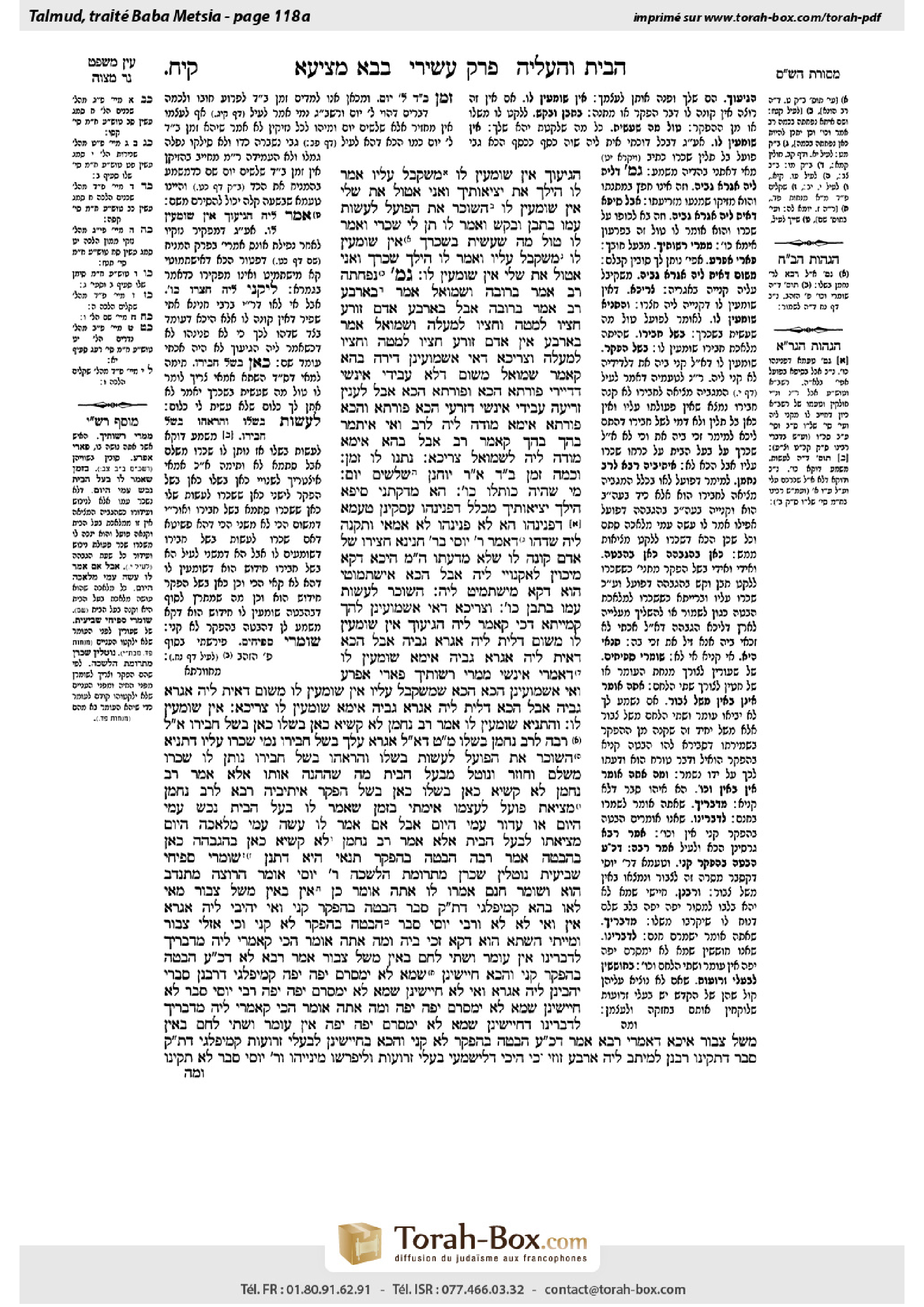
Bava Metzia 118a: Talmud study for Daf Yomi
Study the Talmud for Daf Yomi with scanned pages, Hebrew text, English translations from Sefaria and AI-generated French translations.
Passage selection and English or AI-generated French translation are available where the scan has annotations. Daf Study is independent of Torah-Box and Sefaria.
Browse Bava Metzia · בבא מציעא · All tractatesBava Metzia 118a text and translations
This page of Bava Metzia includes the Aramaic text, an English translation and an AI-generated French translation, alongside the scan above.
בבא מציעא קי״ח א · Aramaic and Hebrew text
הִגִּיעוּךָ – אֵין שׁוֹמְעִין לוֹ. מִשֶּׁקִּבֵּל עָלָיו אָמַר לוֹ: הֵילָךְ אֶת יְצִיאוֹתֶיךָ, וַאֲנִי אֶטּוֹל אֶת שֶׁלִּי – אֵין שׁוֹמְעִין לוֹ.
הַשּׂוֹכֵר אֶת הַפּוֹעֵל לַעֲשׂוֹת עִמּוֹ בַּתֶּבֶן וּבַקַּשׁ, וְאָמַר לוֹ: תֵּן לִי שְׂכָרִי. וְאָמַר לוֹ: טוֹל מַה שֶּׁעָשִׂית בִּשְׂכָרְךָ – אֵין שׁוֹמְעִין לוֹ. מִשֶּׁקִּבֵּל עָלָיו וְאָמַר לוֹ: הֵילָךְ שְׂכָרְךָ וַאֲנִי אֶטּוֹל אֶת שֶׁלִּי – אֵין שׁוֹמְעִין לוֹ.
גְּמָ׳ נִפְחֲתָה, רַב אָמַר בְּרוּבָּהּ, וּשְׁמוּאֵל אָמַר בְּאַרְבַּע. רַב אָמַר: בְּרוּבָּהּ, אֲבָל בְּאַרְבַּע – אָדָם זוֹרֵעַ חֶצְיוֹ לְמַטָּה וְחֶצְיוֹ לְמַעְלָה. וּשְׁמוּאֵל אָמַר: בְּאַרְבַּע – אֵין אָדָם זוֹרֵעַ חֶצְיוֹ לְמַטָּה וְחֶצְיוֹ לְמַעְלָה.
וּצְרִיכָא: דְּאִי אַשְׁמוֹעִינַן דִּירָה, בְּהָא קָאָמַר שְׁמוּאֵל מִשּׁוּם דְּלָא עֲבִידִי אִינָשֵׁי דְּדָיְירִי פּוּרְתָּא הָכָא וּפוּרְתָּא הָכָא, אֲבָל לְעִנְיַן זְרִיעָה – עֲבִידִי אִינָשֵׁי דְּזָרְעִי הָכָא פּוּרְתָּא וְהָכָא פּוּרְתָּא, אֵימָא מוֹדֶה לֵיהּ לְרַב. וְאִי אִיתְּמַר בְּהָךְ, בְּהָךְ קָאָמַר רַב, אֲבָל בְּהָא – אֵימָא מוֹדֶה לֵיהּ לִשְׁמוּאֵל, צְרִיכָא.
נָתְנוּ לוֹ זְמַן. וְכַמָּה זְמַן בֵּית דִּין? אָמַר רַבִּי יוֹחָנָן: שְׁלֹשִׁים יוֹם.
מִי שֶׁהָיָה כּוֹתְלוֹ כּוּ׳. הָא מִדְּקָתָנֵי סֵיפָא: ״הֵילָךְ יְצִיאוֹתֶיךָ״, מִכְּלָל דְּפַנִּינְהוּ עָסְקִינַן. טַעְמָא דְּפַנִּינְהוּ, הָא לָא פַּנִּינְהוּ – לָא.
אַמַּאי: וְתִקְנֶה לֵיהּ שָׂדֵהוּ, דְּאָמַר רַבִּי יוֹסֵי בְּרַבִּי חֲנִינָא: חֲצֵירוֹ שֶׁל אָדָם קוֹנָה לוֹ שֶׁלֹּא מִדַּעְתּוֹ!
הָנֵי מִילֵּי הֵיכָא דְּקָא מִיכַּוֵּין לְאַקְנוֹיֵי לֵיהּ. אֲבָל הָכָא – אִישְׁתְּמוֹטֵי הוּא דְּקָא מִישְׁתְּמִיט לֵיהּ.
הַשּׂוֹכֵר לַעֲשׂוֹת עִמּוֹ בְּתֶבֶן כּוּ׳. וּצְרִיכָא,
דְּאִי אַשְׁמוֹעִינַן לְהָךְ קַמַּיְיתָא, דְּכִי קָאָמַר לֵיהּ ״הִגִּיעוּךְ״ – אֵין שׁוֹמְעִין לוֹ, מִשּׁוּם דְּלֵית לֵיהּ אַגְרָא גַּבֵּיהּ. אֲבָל הָכָא, דְּאִית לֵיהּ אַגְרָא גַּבֵּיהּ – אֵימָא שׁוֹמְעִין לוֹ, דְּאָמְרִי אִינָשֵׁי: ״מִמָּרֵי רַשְׁוָתָיךְ פָּארֵי אִפְּרַע״.
וְאִי אַשְׁמוֹעִינַן הָכָא – הָכָא שֶׁמִּשֶּׁקִּבֵּל עָלָיו אֵין שׁוֹמְעִין לוֹ, מִשּׁוּם דְּאִית לֵיהּ אַגְרָא גַּבֵּיהּ. אֲבָל הָכָא, דְּלֵית לֵיהּ אַגְרָא גַּבֵּיהּ – אֵימָא שׁוֹמְעִין לוֹ, צְרִיכָא.
אֵין שׁוֹמְעִין לוֹ. וְהָתַנְיָא: שׁוֹמְעִין לוֹ! אָמַר רַב נַחְמָן: לָא קַשְׁיָא. כָּאן בְּשֶׁלּוֹ, כָּאן בְּשֶׁל חֲבֵירוֹ.
אֲמַר לֵיהּ רָבָא לְרַב נַחְמָן: בְּשֶׁלּוֹ מַאי טַעְמָא – דַּאֲמַר לֵיהּ: אַגְרָא עֲלָךְ, בְּשֶׁל חֲבֵירוֹ נָמֵי שְׂכָרוֹ עָלָיו. דְּתַנְיָא: הַשּׂוֹכֵר אֶת הַפּוֹעֵל לַעֲשׂוֹת בְּשֶׁלּוֹ, וְהֶרְאָהוּ בְּשֶׁל חֲבֵירוֹ – נוֹתֵן לוֹ שְׂכָרוֹ מִשָּׁלֵם, וְחוֹזֵר וְנוֹטֵל מִבַּעַל הַבַּיִת מַה שֶּׁהֶהֱנָה אוֹתוֹ!
אֶלָּא אָמַר רַב נַחְמָן, לָא קַשְׁיָא: כָּאן בְּשֶׁלּוֹ, כָּאן בְּשֶׁל הֶפְקֵר.
אֵיתִיבֵיהּ רָבָא לְרַב נַחְמָן: מְצִיאַת פּוֹעֵל לְעַצְמוֹ, אֵימָתַי? בִּזְמַן שֶׁאָמַר לוֹ בַּעַל הַבַּיִת נַכֵּשׁ עִמִּי הַיּוֹם, אוֹ עֲדוֹר עִמִּי הַיּוֹם. אֲבָל אִם אָמַר לוֹ: עֲשֵׂה עִמִּי מְלָאכָה הַיּוֹם – מְצִיאָתוֹ לְבַעַל הַבַּיִת!
אֶלָּא אָמַר רַב נַחְמָן, לָא קַשְׁיָא: כָּאן – בְּהַגְבָּהָה, כָּאן – בְּהַבָּטָה.
אָמַר רַבָּה: הַבָּטָה בְּהֶפְקֵר – תַּנָּאֵי הִיא. דִּתְנַן: שׁוֹמְרֵי סְפִיחֵי שְׁבִיעִית נוֹטְלִין שְׂכָרָן מִתְּרוּמַת הַלִּשְׁכָּה. רַבִּי יוֹסֵי אוֹמֵר: הָרוֹצֶה מִתְנַדֵּב הוּא וְשׁוֹמֵר חִנָּם. אָמְרוּ לוֹ: אַתָּה אוֹמֵר כֵּן? אֵין בָּאִין מִשֶּׁל צִבּוּר.
מַאי לָאו בְּהָא קָמִיפַּלְגִי: דְּתַנָּא קַמָּא סָבַר הַבָּטָה בְּהֶפְקֵר קָנֵי, וְאִי יָהֲיבִי לֵיהּ אַגְרָא – אִין, וְאִי לָא – לָא. וְרַבִּי יוֹסֵי סָבַר הַבָּטָה בְּהֶפְקֵר לָא קָנֵי, וְכִי אָזְלִי צִבּוּר וּמַיְיתִי – הַשְׁתָּא הוּא דְּקָא זָכֵי בֵּיהּ.
וּמָה ״אַתָּה אוֹמֵר״? הָכִי קָאָמְרִי לֵיהּ: מִדְּבָרֶיךָ לִדְבָרֵינוּ – אֵין עוֹמֶר וּשְׁתֵּי לֶחֶם בָּאִין מִשֶּׁל צִבּוּר.
אָמַר רָבָא: לָא, דְּכוּלֵּי עָלְמָא הַבָּטָה בְּהֶפְקֵר קָנֵי, וְהָכָא חָיְישִׁינַן שֶׁמָּא לֹא יִמְסְרֵם יָפֶה יָפֶה קָמִיפַּלְגִי. דְּרַבָּנַן סָבְרִי: יָהֲבִינַן לֵיהּ אַגְרָא, וְאִי לָא, חָיְישִׁינַן שֶׁמָּא לֹא יִמְסְרֵם יָפֶה יָפֶה.
רַבִּי יוֹסֵי סָבַר לָא חָיְישִׁינַן שֶׁמָּא לֹא יִמְסְרֵם יָפֶה יָפֶה, וּמָה ״אַתָּה אוֹמֵר״? הָכִי קָאָמְרִי לֵיהּ: מִדְּבָרֶיךָ לִדְבָרֵינוּ, דְּחָיְישִׁינַן שֶׁמָּא לֹא יִמְסְרֵם יָפֶה יָפֶה: אֵין עוֹמֶר וּשְׁתֵּי [הַ]לֶּחֶם בָּאִין מִשֶּׁל צִבּוּר.
אִיכָּא דְאָמְרִי, רָבָא אָמַר: דְּכוּלֵּי עָלְמָא הַבָּטָה בְּהֶפְקֵר לָא קָנֵי, וְהָכָא בְּחָיְישִׁינַן לְבַעֲלֵי זְרוֹעוֹת קָמִיפַּלְגִי. דְּתַנָּא קַמָּא סָבַר דְּתַקִּינוּ רַבָּנַן לְמִיתַּב לֵיהּ אַרְבַּע זוּזֵי, כִּי הֵיכִי דְּלִישְׁמְעוּ בַּעֲלֵי זְרוֹעוֹת וְלִיפְרְשׁוּ מִינַּיְיהוּ. וְרַבִּי יוֹסֵי סָבַר: לָא תַּקִּינוּ.
Bava Metzia 118a · English translation
They are yours, as I hereby declare them ownerless, and you can take them for yourself; the court does not listen to him, since he cannot force the other to acquire the stones. If after the owner of the garden voluntarily accepted ownership of the stones upon himself, the owner of the wall said to him: Here you are, take your expenditures for the removal of the stones, and I will take the stones that are mine; the court does not listen to him, as they had already been acquired by the owner of the garden.
The mishna continues: In the case of one who hires a laborer to do work with him with hay or with straw, and after he finished the task, the laborer said to the employer: Give me my wages, and the employer said to him: Take what you have worked with as your wages, i.e., take some of the hay or straw as payment, the court does not listen to him. Although debts can be paid with any item of value, even hay or straw, the wages of a laborer must be paid in accordance with the initial agreement between the laborer and the employer. But if after the laborer accepted upon himself to keep the hay or straw as payment, the employer changed his mind and said to him: Here you are, take your wages and I will take what is mine; the court does not listen to him, since the laborer had already acquired the hay.
GEMARA: With regard to the case of the roof of the olive press that was broken, the Gemara cites a dispute with regard to the amount that collapsed: Rav says: Most of it must have collapsed, and Shmuel says: Even a hole of four handbreadths is sufficient for the ruling of the mishna to apply. Rav says: Most of it must have collapsed, but if it is only a hole of four handbreadths, there is no basis for a claim, since a person can sow partially on a level below, and partially on a level above. And Shmuel says: It is enough if it is a hole of four handbreadths, as a person cannot sow partially on a level below, and partially on a level above.
The Gemara comments: And it is necessary for the dispute between Rav and Shmuel to be stated both here and with regard to the case of an upper story of a house that collapsed (116b). As had the Gemara taught us only that they disagree with regard to a residence, one would have said: It is only in this case that Shmuel is saying his ruling, because people do not tend to live a little here and a little there, but with regard to sowing, people do tend to sow a little here and a little there. Therefore, one might say that he concedes to Rav in the case of the olive press. And if this dispute was stated only with regard to this case of the olive press, one would have said that it is only with regard to this case that Rav is saying his opinion, but with regard to that case involving the house, one might say that he concedes to Shmuel. Therefore, it is necessary to state that their dispute applies to both cases.
§ The mishna teaches: If the court saw that the wall was shaky, or that the tree was tilting, and they gave him time to cut down the tree or to dismantle the wall, and then they fell down, if this occurred during the allotted time, he is exempt, but if they collapsed after the time given to him had elapsed, he is liable to pay. The Gemara asks: And how much time will a court usually allot for this purpose? Rabbi Yoḥanan says: The standard period is thirty days.
§ The mishna teaches: In the case of one whose wall was located next to his friend’s garden and it fell, if the owner of the wall told the owner of the garden to keep the stones, he cannot retract. The Gemara comments: But from the fact that the last clause of the mishna teaches that if the owner of the fallen wall says: Here you are, take your expenditures, the court does not listen to him, it can be understood by inference that we are dealing with a case where the owner of the garden cleared away the stones. It can therefore be deduced that the reason the owner of the fallen wall cannot retract his offer is that the owner of the garden cleared them away, but if he did not clear them away, the stones are not considered his, and they remain in the possession of the owner of the wall.
The Gemara asks: Why do they remain in the possession of the owner of the wall? But shouldn’t the owner of the garden’s field effect acquisition of the stones on his behalf? As Rabbi Yosei, son of Rabbi Ḥanina, says: The courtyard of a person effects acquisition for him of those items that enter it, even without his knowledge.
The Gemara answers: This statement applies only in a case where the giver intends to transfer them to him, in which case the field can effect acquisition of the stones for the receiver without an additional act of acquisition, but here, the owner of the fallen wall is seeking only to evade the owner of the garden. He wants the owner of the garden to take care of the stones, at which point he can collect them from him without much effort on his part, and he does not intend to give the stones to him.
§ The mishna teaches: In the case of one who hires a laborer to do work with him with hay, the employer cannot force him to accept his wages in the form of some of the hay. The Gemara comments: And it is necessary to mention this halakha with regard to both cases.
As had it taught us only with regard to this first case of the stones that fell that when the owner of the fallen wall says to the owner of the garden: They are yours, the court does not listen to him, one would have said that this is the halakha because he does not have a wage owed by him, as they had no prior business dealings together, and the owner of the stones does not owe the owner of the garden anything. But here, in the case of a laborer working with hay, in which the laborer does have a wage owed by the employer, one might say that the court listens to him, as people say the following proverb: When collecting a debt from your debtor, allow yourself to be repaid even in bran [parei], i.e., take whatever you can as payment of a loan.
And had it taught us only over here with regard to the hay, one would have said that it is only here that after the laborer has already accepted ownership upon himself, the court does not listen to the employer who desires to retract, because the laborer has a wage owed by him, and therefore there is reason to say that he receives the hay. But here, with regard to the stones, where the owner of the garden does not have a wage owed by the owner of the fallen wall, one might say that the court listens to him and he can retract. It is therefore necessary for the mishna to teach both cases.
§ The mishna teaches that if an employer seeks to pay his laborer with straw, the court does not listen to him. The Gemara asks: But isn’t it taught in a baraita that the court does listen to him? The Gemara answers: Rav Naḥman said: This is not difficult. The ruling of the mishna here, that the court does not listen to him, is stated with regard to a case of work done with the employer’s own property. And the ruling of the baraita there, that the court does listen to him, is stated with regard to work done with the property of another, and there the employer’s request is accepted.
Rava said to Rav Naḥman: In a case where he is working with his own property, what is the reason that the court does not listen to him? As the laborer can say to the employer: The responsibility of paying my wage is on you. But if he was working with the property of his friend, the responsibility of paying his earnings is also on the employer, as it is taught in a baraita: With regard to one who hires a laborer to perform work in his own field, and the employer inadvertently showed the laborer the field belonging to another in which he should work, the employer must give the laborer his full wages, and in addition, the employer goes back and takes from the owner of the field in which he worked the value of the benefit that owner received from the laborer. The payment of the wages is incumbent upon the employer, not the owner of the field.
Rather, Rav Naḥman said a different explanation: It is not difficult. The ruling of the mishna here, that the court does not listen to him, is stated with regard to work done with the employer’s own property. And the ruling of the baraita there, that the court does listen to him, is stated with regard to work done with ownerless property, e.g., the employer hired him to gather ownerless hay, and later told him to keep some of the hay as his wages. In that case, he can force the laborer to accept the hay as payment.
Rava raised an objection to Rav Naḥman: It was taught in a baraita: The found item of a salaried laborer belongs to himself. When is this so? When the employer told him to perform a specific task, for example if he said: Weed with me today, or if he said: Hoe with me today. If the laborer finds lost property while performing that task, then the item belongs to him. But if the employer says to the laborer: Work with me today, without specifying what labor he wants him to perform, his found item belongs to the employer, as acquiring found items can be considered part of his terms of employment. In the case of Rav Naḥman, since the employer instructed the laborer to gather ownerless hay, the acquisition of the hay is certainly part of the terms of his employment, and belongs to the employer. Since it is the employer’s property, he is not able to force the laborer to accept the hay as payment.
Rather, Rav Naḥman said: Both the ruling of the mishna and the ruling of the baraita are stated with regard to a laborer hired to work with ownerless property, but it is not difficult. The ruling of the mishna here, that the court does not listen to him, is stated with regard to a case where the laborer’s task was to lift up the hay and gather it, and he is therefore considered the employer’s agent and acquires the hay for him. Since the hay then belongs to the employer, he cannot force the laborer to accept it as payment. And the ruling of the baraita there, that the court does listen to him, is stated with regard to a case where his work merely consisted of viewing, e.g., he hired him to make sure that no one takes the ownerless hay. In that case, even the employer does not acquire the straw, and it remains ownerless. Consequently, the employer can tell the laborer to take some hay as payment.
Rabba says: The issue of whether, in the case of ownerless property, viewing effects acquisition of it is a dispute between tanna’im. As we learned in a mishna (Shekalim 9b): The watchmen of the sefiḥim, grain that grew without being purposely planted, of the Sabbatical Year ensured that people did not take this ownerless grain, so that it remained available to be used for the omer offering and the two loaves, i.e., the public offering on Shavuot of two loaves from the new wheat. These watchmen take their wages from the collection of the Temple treasury chamber, as they are employed by the Temple treasury. Rabbi Yosei says: One who so desires can volunteer his services and safeguard the grain, and he has the status of an unpaid bailee. The Rabbis said to him: Do you say so? But according to your view, the omer and the two loaves do not come from communal funds as required, since in reality they come from a private individual, i.e., the bailee.
The Gemara suggests: What, is it not with regard to this that they disagree: The first tanna holds that in the case of ownerless property, viewing effects acquisition of it, and so the watchman, although he did not lift up the grain, acquires the grain by viewing it. And therefore, if he is given a wage from communal funds, then yes, he is safeguarding it on behalf of the community, and he acquires it for them. But if he is not paid, he has not acquired it for the community, but for himself. And, conversely, Rabbi Yosei holds that in the case of ownerless property, viewing does not effect acquisition of it, and when the community goes and brings the grain for the omer offering and the two loaves, it is only now, at this stage, that they acquire it.
And what, according to this explanation, is the meaning of the phrase: Do you say so? This is what they were saying to him: If the opinion from your statement that one may volunteer as an unpaid bailee is applied to our statement that in the case of ownerless property, viewing effects acquisition, the result is that the omer offering and the two loaves do not come from communal funds as required.
Rava said: No; the dispute can be explained differently. It can be explained that everyone agrees that in the case of ownerless property, viewing effects acquisition, and here they disagree with regard to the question of whether we are concerned that perhaps he will not give the grain over wholeheartedly to the community. As the Rabbis hold that we give the watchman a wage, and if we do not pay him, but allow him to act as a volunteer, we are concerned that perhaps he will not give the grain over wholeheartedly to the community, as deep down he might feel that the grain really belongs to him and that he is offering it from his own pocket, which means that the omer offering and two loaves are not properly offered by the community.
Conversely, Rabbi Yosei holds that we are not concerned that perhaps he will not hand the grain over wholeheartedly to the community. And what is the meaning of the phrase: Do you say so? This is what they were saying to him: If the opinion from your statement that one may volunteer as an unpaid bailee is applied to our statement that we are concerned that perhaps he will not give the grain over wholeheartedly, the result is that the omer offering and the two loaves do not come from communal funds as required.
There are those who say that there is a different version of this discussion: Rava said: It can be explained that everyone agrees that in the case of ownerless property, viewing does not effect acquisition of it, and here, concerning the omer offering, they disagree with regard to the question of whether we are concerned about violent people that may come and seize the grain for themselves. As the first tanna holds that the Sages instituted a directive to give him four dinars, or whatever payment is appropriate for his services as a watchman, so that violent people should hear of this and keep away from the grain, since when they hear that the Temple is paying the watchmen, they will certainly not take the grain. And Rabbi Yosei holds that the Sages did not institute this directive, since there is no concern about violent people.
Bava Metzia 118a · Traduction française (IA)
Ce sont à vous, déclare-t-il, les biens sont désormais sans propriétaire, et vous pouvez les prendre ; la cour ne l'écoute pas, car il ne peut contraindre l'autre à acquérir les pierres. Si l'propriétaire du jardin a volontairement accepté d'acquérir les pierres, l'propriétaire du mur lui a dit : Voici, prenez vos dépenses pour l'élimination des pierres, et je prendrai les pierres qui sont à moi ; la cour ne l'écoute pas, car elles avaient déjà été acquises par l'propriétaire du jardin.
La mitsna continue : Dans le cas d'une personne qui embauche un ouvrier pour travailler avec lui avec du foin ou de la paille, et après avoir terminé la tâche, l'ouvrier a dit à l'employeur : Donnez-moi mes salaires, et l'employeur a répondu : Prenez ce que vous avez travaillé avec comme salaire, c'est-à-dire prenez une partie du foin ou de la paille comme paiement ; la cour ne l'écoute pas. Bien que les dettes puissent être payées par n'importe quel objet de valeur, même du foin ou de la paille, les salaires d'un ouvrier doivent être payés conformément à l'accord initial entre l'ouvrier et l'employeur. Mais si l'ouvrier a accepté de garder le foin ou la paille comme paiement, et que l'employeur a changé d'avis et a dit à l'ouvrier : Voici, prenez vos salaires et je prendrai ce qui est à moi ; la cour ne l'écoute pas, car l'ouvrier avait déjà acquis le foin.
GUEMARA : En ce qui concerne le cas du toit de la presse à olives qui était brisé, la Guemara cite un désaccord concernant la quantité qui s'est effondrée : Rav dit : La plupart d'entre eux doivent avoir effondré, et Shmuel dit : Même un trou de quatre paumes est suffisant pour que la décision de la mitsna s'applique. Rav dit : La plupart d'entre eux doivent avoir effondré, mais si c'est seulement un trou de quatre paumes, il n'y a pas de fondement pour une réclamation, car une personne peut semer partiellement sur un niveau inférieur et partiellement sur un niveau supérieur. Et Shmuel dit : Il suffit qu'il s'agisse d'un trou de quatre paumes, car une personne ne peut pas semer partiellement sur un niveau inférieur et partiellement sur un niveau supérieur.
La Guemara commente : Il est nécessaire que le désaccord entre Rav et Shmuel soit évoqué ici et concernant le cas d'un étage supérieur d'une maison qui s'est effondré (116b). Si la Guemara n'avait enseigné que cela, on aurait dit : C'est seulement dans ce cas que Shmuel exprime son avis, car les gens ne tendent pas à habiter un peu ici et un peu là, mais concernant la culture, les gens tendent à cultiver un peu ici et un peu là. Par conséquent, on pourrait dire qu'il reconnaît Rav dans le cas de la presse à olives. Et si ce désaccord avait été évoqué uniquement concernant ce cas de la presse à olives, on aurait dit que c'est seulement dans ce cas que Rav exprime son opinion, mais concernant ce cas de la maison, on pourrait dire qu'il reconnaît Shmuel. Par conséquent, il est nécessaire d'évoquer ce désaccord dans les deux cas.
§ La mitsna enseigne : Si la cour a constaté que le mur était instable, ou que l'arbre penchait, et qu'ils lui ont donné un délai pour couper l'arbre ou démonter le mur, et qu'ils sont tombés, si cela s'est produit pendant le délai accordé, il est exempt, mais si ils sont tombés après que le délai avait expiré, il est tenu responsable de payer. La Guemara pose la question : Et combien de temps la cour accorde-t-elle généralement pour cela ? Rabbi Yoḥanan dit : La période standard est de trente jours.
§ La mitsna enseigne : Dans le cas d'une personne dont le mur était situé à côté de son jardin et qu'il s'est effondré, si l'propriétaire du mur a dit à l'propriétaire du jardin de garder les pierres, il ne peut pas revenir sur sa déclaration. La Guemara commente : Mais à partir du fait que la dernière clause de la mitsna enseigne que si l'propriétaire du mur effondré dit : Voici, prenez vos dépenses, la cour ne l'écoute pas, on peut en déduire par l'inférence que nous sommes en présence d'un cas où l'propriétaire du jardin a nettoyé les pierres. On peut donc en déduire que la raison pour laquelle l'propriétaire du mur effondré ne peut pas revenir sur son offre est que l'propriétaire du jardin a nettoyé les pierres, mais s'il n'avait pas nettoyé les pierres, les pierres ne sont pas considérées comme étant à lui, et elles restent en possession de l'propriétaire du mur.
La Guemara pose la question : Pourquoi restent-elles en possession de l'propriétaire du mur ? Mais ne devrait pas l'propriétaire du champ de l'propriétaire du jardin acquérir les pierres à sa place ? Comme dit Rabbi Yosei, fils de Rabbi Ḥanina : Le courtil d'une personne acquiert à sa place les objets qui y pénètrent, même sans sa connaissance.
La Guemara répond : Cette déclaration s'applique uniquement dans un cas où le donneur a l'intention de transférer les pierres à lui, dans ce cas le champ peut acquérir les pierres pour le receveur sans un acte supplémentaire d'acquisition, mais ici, l'propriétaire du mur effondré cherche uniquement à éviter l'propriétaire du jardin. Il veut que l'propriétaire du jardin prenne soin des pierres, à ce moment-là il peut les récupérer sans beaucoup d'effort de sa part, et il n'a pas l'intention de lui donner les pierres.
§ La mitsna enseigne : Dans le cas d'une personne qui embauche un ouvrier pour travailler avec lui avec du foin, l'employeur ne peut pas le contraindre à accepter ses salaires sous la forme de partie du foin. La Guemara commente : Et il est nécessaire de mentionner cette halakha concernant les deux cas.
Comme si elle avait été enseignée uniquement concernant ce premier cas des pierres qui s'étaient effondrées, et que lorsque l'propriétaire du mur effondré disait à l'propriétaire du jardin : Ce sont à vous, la cour ne l'écoute pas, on aurait dit que c'est la halakha parce qu'il n'avait pas de salaire dû par lui, car ils n'avaient pas de relations commerciales antérieures, et l'propriétaire des pierres ne devait rien à l'propriétaire du jardin. Mais ici, dans le cas d'un ouvrier travaillant avec du foin, où l'ouvrier a un salaire dû par l'employeur, on pourrait dire que la cour l'écoute, car les gens disent la suivante : Lors de la collecte d'une dette de votre débiteur, permettez-vous d'être récompensé même en bran [parei], c'est-à-dire prenez ce que vous pouvez comme paiement d'un prêt.
Et si elle nous avait enseigné seulement ici concernant le foin, on aurait dit qu'il est seulement ici que, après que le travailleur ait déjà accepté la propriété sur lui-même, la cour ne prête pas attention au patron qui désire rétracter, car le travailleur a un salaire dû par lui, et donc il y a une raison de dire qu'il reçoit le foin. Mais ici, concernant les pierres, où le propriétaire du jardin n'a pas un salaire dû par le propriétaire du mur tombé, on pourrait dire que la cour prête attention à lui et qu'il peut rétracter. Il est donc nécessaire que la mitsna enseigne les deux cas.
§ La mitsna enseigne que si un patron cherche à payer son travailleur avec du foin, la cour ne prête pas attention à lui. La Guemara demande : Mais n'est-ce pas enseigné dans une baraïta que la cour prête attention à lui ? La Guemara répond : Rav Naḥman a dit : Ce n'est pas difficile. Le jugement de la mitsna ici, que la cour ne prête pas attention à lui, est énoncé concernant un cas de travail effectué avec la propriété du patron. Et le jugement de la baraïta là-bas, que la cour prête attention à lui, est énoncé concernant un travail effectué avec la propriété d'autrui, et là-bas, la demande du patron est acceptée.
Rava dit à Rav Naḥman : Dans un cas où il travaille avec sa propre propriété, quelle est la raison pour laquelle la cour ne l'écoute pas ? Comme le travailleur peut dire au patron : La responsabilité de payer mon salaire incombe à toi. Mais s'il travaillait avec la propriété de son ami, la responsabilité de payer ses gains incombe également au patron, comme il est enseigné dans une baraïta : Concernant celui qui embauche un travailleur pour effectuer un travail dans son propre champ, et le patron a inadvertamment montré au travailleur le champ appartenant à un autre où il devait travailler, le patron doit donner au travailleur ses salaires complets, et en plus, le patron retourne et récupère de l'propriétaire du champ où il a travaillé la valeur du bénéfice que l'propriétaire a reçu du travailleur. Le paiement des salaires incombe au patron, pas à l'propriétaire du champ.
Plutôt, Rav Naḥman a dit une autre explication : Ce n'est pas difficile. Le jugement de la mitsna ici, que la cour ne l'écoute pas, est énoncé concernant un travail effectué avec la propriété du patron. Et le jugement de la baraïta là-bas, que la cour l'écoute, est énoncé concernant un travail effectué avec une propriété sans propriétaire, c'est-à-dire que le patron a embauché lui pour ramasser du foin sans propriétaire, et plus tard lui a dit de garder une partie du foin comme salaire. Dans ce cas, il peut forcer le travailleur à accepter le foin comme paiement.
Rava souleva une objection contre Rav Naḥman : Il a été enseigné dans une baraïta : L'objet trouvé d'un travailleur salarial appartient à lui-même. Quand cela est-il ainsi ? Quand le patron lui a dit d'effectuer une tâche spécifique, par exemple s'il a dit : Désherbe-moi aujourd'hui, ou s'il a dit : Laboure-moi aujourd'hui. Si le travailleur trouve un objet perdu en effectuant cette tâche, alors l'objet appartient à lui. Mais si le patron dit au travailleur : Travaille-moi aujourd'hui, sans spécifier quelle tâche il veut qu'il effectue, son objet trouvé appartient au patron, car l'acquisition d'objets trouvés peut être considérée comme faisant partie de ses conditions de travail. Dans le cas de Rav Naḥman, puisque le patron a instruit le travailleur à ramasser du foin sans propriétaire, l'acquisition du foin est certainement faisant partie des conditions de son travail, et appartient au patron. Puisque c'est la propriété du patron, il ne peut pas forcer le travailleur à accepter le foin comme paiement.
Plutôt, Rav Naḥman dit : Les jugements de la mitsva et de la baraïta sont énoncés concernant un travailleur embauché pour travailler avec une propriété sans propriétaire, mais ce n'est pas difficile. Le jugement de la mitsva ici, que la cour ne prête pas attention à lui, est énoncé concernant un cas où la tâche du travailleur était de soulever le foin et de le ramasser, et il est donc considéré comme l'agent du patron et acquiert le foin pour lui. Puisque le foin appartient alors au patron, il ne peut pas forcer le travailleur à l'accepter comme paiement. Et le jugement de la baraïta là-bas, que la cour prête attention à lui, est énoncé concernant un cas où son travail consistait simplement à surveiller, par exemple s'il l'a embauché pour veiller à ce que personne ne prenne le foin sans propriétaire. Dans ce cas, même le patron ne récupère pas le foin, et il reste sans propriétaire. Par conséquent, le patron peut dire au travailleur de prendre une partie de foin comme paiement.
Rabba dit : La question de savoir si, dans le cas d'une propriété sans propriétaire, la surveillance a pour effet d'acquérir cette propriété est un débat entre les tannaïm. Comme nous avons appris dans une mitsva (Shekalim 9b) : Les gardiens des sefiḥim, céréales qui ont poussé sans être plantées intentionnellement, de l'année sabbatique ont veillé à ce que les gens ne prennent pas ces céréales sans propriétaire, afin qu'elles restent disponibles pour être utilisées pour l'offrande de l'omer et les deux pains, c'est-à-dire l'offrande publique de Shavuot de deux pains de blé nouveau. Ces gardiens prennent leur salaire de la collecte de la chambre du trésor du Temple, car ils sont employés par le trésor du Temple. Rabbi Yosei dit : Celui qui le désire peut volontairement se porter volontaire pour surveiller les céréales, et il a le statut d'un gardien non rémunéré. Les Rabbins lui ont dit : Est-ce que tu dis cela ? Mais selon ton avis, l'omer et les deux pains ne viennent pas des fonds communaux comme requis, puisque dans la réalité ils viennent d'un individu privé, c'est-à-dire le gardien.
La Guemara suggère : Qu'est-ce que cela signifie, n'est-ce pas à propos de cela qu'ils discutent : Le premier tanna maintient que dans le cas d'une propriété sans propriétaire, la surveillance a pour effet d'acquérir cette propriété, et donc le gardien, même s'il n'a pas soulevé les céréales, les acquiert par la surveillance. Et donc, si on lui donne un salaire des fonds communaux, alors oui, il les surveille au nom de la communauté, et les acquiert pour eux. Mais si on ne lui donne pas de salaire, il n'a pas acquis pour la communauté, mais pour lui-même. Et inversement, Rabbi Yosei maintient que dans le cas d'une propriété sans propriétaire, la surveillance n'a pas pour effet d'acquérir cette propriété, et quand la communauté va et apporte les céréales pour l'offrande de l'omer et les deux pains, c'est seulement à ce stade qu'ils les acquièrent.
Et que signifie, selon cette explication, la phrase : « Et tu dis cela ? » C’est ce qu’ils lui disaient : si l’opinion tirée de votre déclaration selon laquelle on peut volontairement accepter la charge d’un dépositaire non rémunéré est appliquée à notre déclaration selon laquelle, dans le cas d’une propriété sans propriétaire, la vue des effets constitue une acquisition, le résultat est que l’offrande d’omer et les deux pains ne proviennent pas des fonds communautaires comme requis.
Rava dit : Non ; ce débat peut être expliqué différemment. On peut expliquer que tout le monde est d’accord sur le fait que, dans le cas d’une propriété sans propriétaire, la vue des effets constitue une acquisition, et ici ils s’opposent sur la question de savoir si nous craignons que l’homme ne livre pas volontiers le grain à la communauté. Comme les Sages pensent que l’on doit rémunérer le gardien, et si on ne le rémunère pas, mais qu’on le laisse agir comme volontaire, on craint que l’homme ne livre pas volontiers le grain à la communauté, car en profondeur il pourrait penser que le grain lui appartient vraiment et qu’il l’offre de sa propre poche, ce qui signifie que l’offrande d’omer et les deux pains ne sont pas offertes correctement par la communauté.
À l’inverse, Rabbi Yosei pense que nous ne craignons pas que l’homme ne livre pas volontiers le grain à la communauté. Et que signifie la phrase : « Et tu dis cela ? » C’est ce qu’ils lui disaient : si l’opinion tirée de votre déclaration selon laquelle on peut volontairement accepter la charge d’un dépositaire non rémunéré est appliquée à notre déclaration selon laquelle nous craignons que l’homme ne livre pas volontiers le grain, le résultat est que l’offrande d’omer et les deux pains ne proviennent pas des fonds communautaires comme requis.
Certains disent qu’il existe une autre version de ce débat : Rava dit : on peut expliquer que tout le monde est d'accord sur le fait que, dans le cas d'une propriété sans propriétaire, la vue des effets ne constitue pas une acquisition, et ici, concernant l'offrande d'omer, ils s'opposent sur la question de savoir si nous craignons que des gens violents viennent et s'approprient le grain. Comme le premier tanna pense que les Sages ont institué une directive pour lui donner quatre drachmes, ou tout paiement approprié pour ses services de gardien, afin que les gens violents sachent de cela et s'éloignent du grain, car quand ils entendent que le Temple rémunère les gardien, ils ne prendront certainement pas le grain. Et Rabbi Yosei pense que les Sages n'ont pas institué cette directive, car il n'y a pas de crainte concernant les gens violents.
Traduction française générée par IA à partir de l’édition anglaise de Sefaria. Vérifie toujours un passage avec le texte source.
Text from Sefaria: William Davidson Edition - Vocalized Aramaic (CC BY NC); William Davidson Edition - English (CC BY NC).