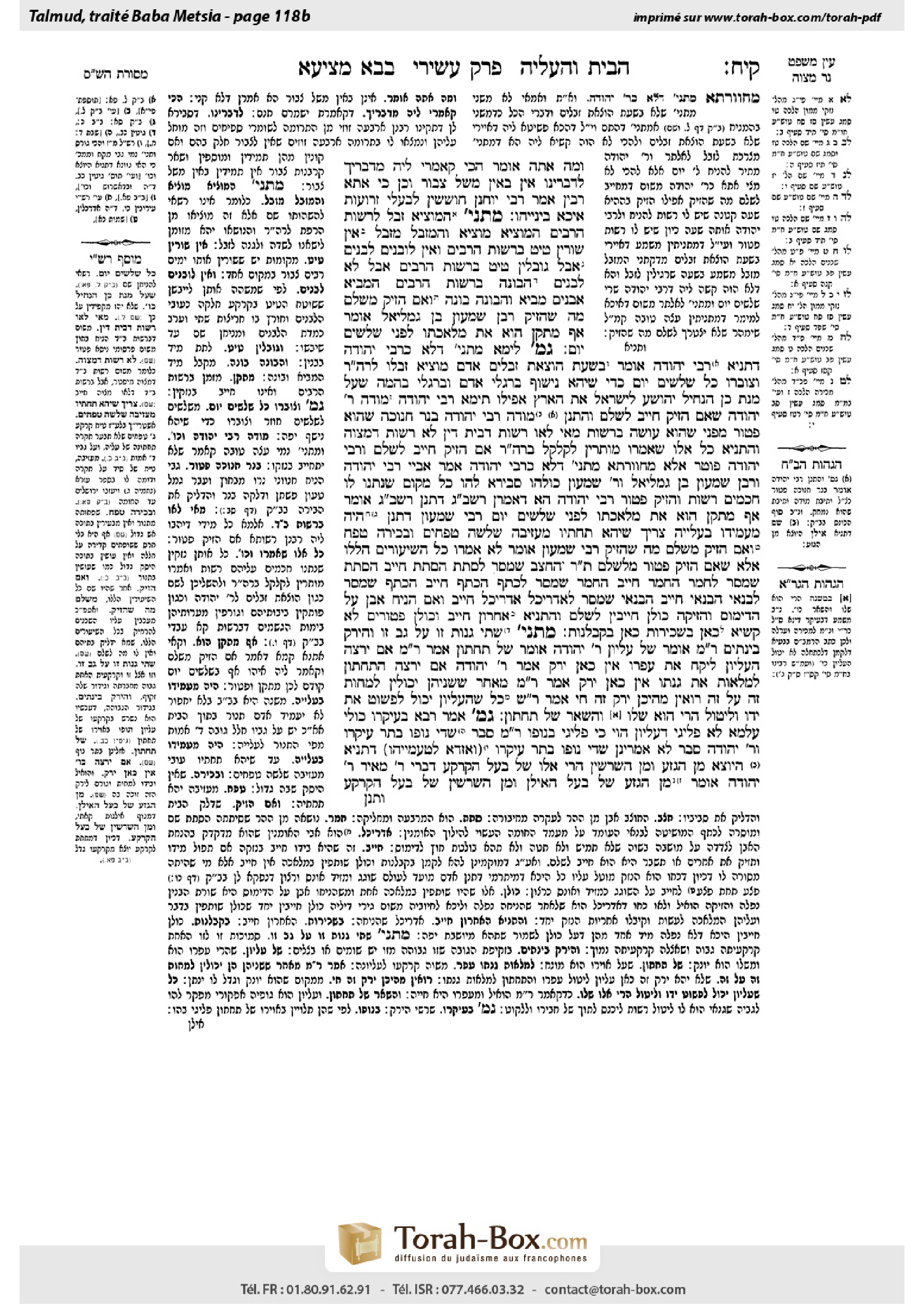
Bava Metzia 118b: Talmud study for Daf Yomi
Study the Talmud for Daf Yomi with scanned pages, Hebrew text, English translations from Sefaria and AI-generated French translations.
Passage selection and English or AI-generated French translation are available where the scan has annotations. Daf Study is independent of Torah-Box and Sefaria.
Browse Bava Metzia · בבא מציעא · All tractatesBava Metzia 118b text and translations
This page of Bava Metzia includes the Aramaic text, an English translation and an AI-generated French translation, alongside the scan above.
בבא מציעא קי״ח ב · Aramaic and Hebrew text
וּמָה ״אַתָּה אוֹמֵר״? הָכִי קָאָמְרִי לֵיהּ: מִדְּבָרֶיךָ לִדְבָרֵינוּ, אֵין [תְּמִידִין וּמוּסָפִין] בָּאִין מִשֶּׁל צִבּוּר. וְכֵן כִּי אֲתָא רָבִין, אָמַר רַבִּי יוֹחָנָן: חוֹשְׁשִׁין לְבַעֲלֵי זְרוֹעוֹת אִיכָּא בֵּינַיְיהוּ.
מַתְנִי׳ הַמּוֹצִיא זֶבֶל לִרְשׁוּת הָרַבִּים, הַמּוֹצִיא – מוֹצִיא, וְהַמְזַבֵּל – מְזַבֵּל. אֵין שׁוֹרִין טִיט בִּרְשׁוּת הָרַבִּים, וְאֵין לוֹבְנִים לְבֵנִים. אֲבָל גּוֹבְלִין טִיט בִּרְשׁוּת הָרַבִּים, אֲבָל לֹא לְבֵנִים.
הַבּוֹנֶה בִּרְשׁוּת הָרַבִּים, הַמֵּבִיא אֲבָנִים – מֵבִיא, וְהַבּוֹנֶה – בּוֹנֶה. וְאִם הִזִּיק – מְשַׁלֵּם מַה שֶּׁהִזִּיק. רַבָּן שִׁמְעוֹן בֶּן גַּמְלִיאֵל אוֹמֵר: אַף מְתַקֵּן הוּא אֶת מְלַאכְתּוֹ לִפְנֵי שְׁלֹשִׁים יוֹם.
גְּמָ׳ לֵימָא מַתְנִיתִין דְּלָא כְּרַבִּי יְהוּדָה. דְּתַנְיָא, רַבִּי יְהוּדָה אוֹמֵר: בִּשְׁעַת הוֹצָאַת זְבָלִים אָדָם מוֹצִיא זִבְלוֹ לִרְשׁוּת הָרַבִּים וְצוֹבְרוֹ כׇּל שְׁלֹשִׁים יוֹם, כְּדֵי שֶׁיְּהֵא נִישּׁוֹף בְּרַגְלֵי אָדָם וּבְרַגְלֵי בְּהֵמָה, שֶׁעַל מְנָת כֵּן הִנְחִיל יְהוֹשֻׁעַ לְיִשְׂרָאֵל אֶת הָאָרֶץ.
אֲפִילּוּ תֵּימָא רַבִּי יְהוּדָה, מוֹדֶה רַבִּי יְהוּדָה שֶׁאִם הִזִּיק – חַיָּיב לְשַׁלֵּם. וְהָתְנַן: מוֹדֶה רַבִּי יְהוּדָה בְּנֵר חֲנוּכָּה שֶׁהוּא פָּטוּר, מִפְּנֵי שֶׁהוּא עוֹשֶׂה בִּרְשׁוּת. מַאי לָאו: רְשׁוּת דְּבֵית דִּין? לָא, רְשׁוּת דְּמִצְוָה.
וְהָתַנְיָא: כׇּל אֵלּוּ שֶׁאָמְרוּ מוּתָּרִין לְקַלְקֵל בִּרְשׁוּת הָרַבִּים, אִם הִזִּיק – חַיָּיב לְשַׁלֵּם, וְרַבִּי יְהוּדָה פּוֹטֵר. אֶלָּא מְחַוַּורְתָּא מַתְנִיתִין דְּלָא כְּרַבִּי יְהוּדָה.
אָמַר אַבָּיֵי: רַבִּי יְהוּדָה, וְרַבָּן שִׁמְעוֹן בֶּן גַּמְלִיאֵל, וְרַבִּי שִׁמְעוֹן – כּוּלְּהוּ סְבִירָא לְהוּ: כׇּל מָקוֹם שֶׁנָּתְנוּ לוֹ חֲכָמִים רְשׁוּת וְהִזִּיק – פָּטוּר. רַבִּי יְהוּדָה – הָא דַּאֲמַרַן. רַבָּן שִׁמְעוֹן בֶּן גַּמְלִיאֵל, דִּתְנַן: רַבָּן שִׁמְעוֹן בֶּן גַּמְלִיאֵל אוֹמֵר: אַף מְתַקֵּן הוּא אֶת מְלַאכְתּוֹ לִפְנֵי שְׁלֹשִׁים יוֹם.
רַבִּי שִׁמְעוֹן, דִּתְנַן: הָיָה מַעֲמִידוֹ בַּעֲלִיָּיה – צָרִיךְ שֶׁיְּהֵא תַּחְתָּיו מַעֲזִיבָה שְׁלֹשָׁה טְפָחִים, וּבַכִּירָה – טֶפַח. וְאִם הִזִּיק – מְשַׁלֵּם מַה שֶּׁהִזִּיק. רַבִּי שִׁמְעוֹן אוֹמֵר: לֹא אָמְרוּ כׇּל הַשִּׁעוּרִים הַלָּלוּ אֶלָּא שֶׁאִם הִזִּיק פָּטוּר מִלְּשַׁלֵּם.
תָּנוּ רַבָּנַן: הַחַצָּב שֶׁמָּסַר לַסַּתָּת – הַסַּתָּת חַיָּיב. הַסַּתָּת שֶׁמָּסַר לַחַמָּר – הַחַמָּר חַיָּיב. הַחַמָּר שֶׁמָּסַר לַכַּתָּף – הַכַּתָּף חַיָּיב. הַכַּתָּף שֶׁמָּסַר לַבַּנַּאי – הַבַּנַּאי חַיָּיב. הַבַּנַּאי שֶׁמָּסַר לָאַדְרִיכָל – אַדְרִיכָל חַיָּיב. וְאִם הִנִּיחַ אֶבֶן עַל הַדִּימוֹס וְהִזִּיקָה – כּוּלָּן חַיָּיבִין לְשַׁלֵּם.
וְהָתַנְיָא: אַחֲרוֹן חַיָּיב וְכוּלָּן פְּטוּרִים! לָא קַשְׁיָא: כָּאן בִּשְׂכִירוּת, כָּאן בְּקַבְּלָנוּת.
מַתְנִי׳ שְׁתֵּי גַּנּוֹת זוֹ עַל גַּב זוֹ, וְהַיָּרָק בֵּינְתַיִם. רַבִּי מֵאִיר אוֹמֵר: שֶׁל עֶלְיוֹן. רַבִּי יְהוּדָה אוֹמֵר: שֶׁל תַּחְתּוֹן. אָמַר רַבִּי מֵאִיר: אִם יִרְצֶה הָעֶלְיוֹן לִיקַּח אֶת עֲפָרוֹ, אֵין כָּאן יָרָק. אָמַר רַבִּי יְהוּדָה: אִם יִרְצֶה הַתַּחְתּוֹן לְמַלֹּאות אֶת גִּנָּתוֹ, אֵין כָּאן יָרָק.
אָמַר רַבִּי מֵאִיר: מֵאַחַר שֶׁשְּׁנֵיהֶן יְכוֹלִין לְמַחוֹת זֶה עַל זֶה, רוֹאִין מֵהֵיכָן יָרָק זֶה חַי. אָמַר רַבִּי שִׁמְעוֹן: כׇּל שֶׁהָעֶלְיוֹן יָכוֹל לִפְשׁוֹט אֶת יָדוֹ וְלִיטּוֹל – הֲרֵי הוּא שֶׁלּוֹ, וְהַשְּׁאָר שֶׁל תַּחְתּוֹן.
גְּמָ׳ אָמַר רָבָא: בְּעִיקָּרוֹ, כּוּלֵּי עָלְמָא לָא פְּלִיגִי דְּעֶלְיוֹן הָוֵי. כִּי פְּלִיגִי בְּנוֹפוֹ. רַבִּי מֵאִיר סָבַר: שְׁדִי נוֹפוֹ בָּתַר עִיקָּרוֹ. וְרַבִּי יְהוּדָה סָבַר: לָא אָמְרִינַן שְׁדִי נוֹפוֹ בָּתַר עִיקָּרוֹ.
וְאַזְדָּא לְטַעְמַיְיהוּ, דְּתַנְיָא: הַיּוֹצֵא מִן הַגֶּזַע וּמִן הַשׇּׁרָשִׁין – הֲרֵי אֵלּוּ שֶׁל בַּעַל הַקַּרְקַע, דִּבְרֵי רַבִּי מֵאִיר. רַבִּי יְהוּדָה אוֹמֵר: מִן הַגֶּזַע – שֶׁל בַּעַל הָאִילָן, וּמִן הַשׇּׁרָשִׁין – שֶׁל בַּעַל הַקַּרְקַע.
Bava Metzia 118b · English translation
And what is the meaning of the phrase: Do you say so? This is what they were saying to him: If we apply the opinion from your statement that one may volunteer as an unpaid bailee, to our statement that the Sages instituted a directive to give him four dinars, the result is that communal offerings do not come from communal funds as required. And likewise, when Ravin came from Eretz Yisrael to Babylonia, he said that Rabbi Yoḥanan says: The question of whether or not we are concerned about violent people is the difference between the opinions of the Rabbis and Rabbi Yosei, i.e., that is the crux of their dispute.
MISHNA: In the case of one who takes manure out to the public domain, in order for it to be transported to fertilize a field, he who takes it out from his property takes it out, and immediately, he who takes it to fertilize the field takes it to fertilize the field. They must relocate the manure immediately without allowing it to sit around in the public domain. Similarly, one may not soak clay in the public domain before it is kneaded, and one may not mold bricks in the public domain since this takes a long time and inhibits use of the public domain by others. But one may knead clay in the public domain, as this process does not take long, but not bricks.
With regard to one who builds a structure, keeping the building materials in the public domain, he who brings the stones brings them, and immediately, he who builds the structure builds with them, and may not leave them there. And if the stones cause damage before he had a chance to build them into the structure, he must pay for what he damaged. Rabban Shimon ben Gamliel says: One may even prepare his work thirty days beforehand; he may keep the building materials in the public domain for that duration.
GEMARA: The Gemara suggests: Let us say that the mishna is not in accordance with the opinion of Rabbi Yehuda? As it is taught in a baraita (Tosefta 11:8): Rabbi Yehuda says: When it is the time for the manure to be taken out, a person may take his manure out into the public domain and may pile it up for all thirty days, so that it will be trodden on by the feet of people and by the feet of animals, to prepare it for use as fertilizer, since it was on this condition that Joshua bequeathed Eretz Yisrael to the Jewish people. In other words, it is universally accepted that some will relinquish certain rights for the sake of others, and although it may be a nuisance for certain people, this practice is allowed.
The Gemara responds: You may even say that the mishna is in accordance with the opinion of Rabbi Yehuda, since Rabbi Yehuda concedes that although he acted within his rights, if the manure caused damage, the one who placed it there is liable to pay. The Gemara asks: But didn’t we learn in a mishna (Bava Kamma 62b): Rabbi Yehuda concedes with regard to a Hanukkah lamp placed in the public domain that ignited a fire and caused damage that he is exempt, because he acts with permission? What, is the reason he is exempt not that he acted with the permission of the court to use the public domain in this manner, which indicates that one who acts with court permission is exempt from liability for damage? The Gemara rejects this suggestion: No, it means that he has the permission of a mitzva. Since it is a mitzva to place the Hanukkah lamp outside, he is exempt from paying for the damage it caused. The mere right to place the item in the public domain does not exempt the owner from liability.
The Gemara asks: But isn’t it taught in a baraita: With regard to all these cases in which the Sages said that it is permitted for people to place obstacles in the public domain, if they caused damage, these people are liable to pay, and Rabbi Yehuda exempts them? Evidently, according to Rabbi Yehuda, if one has the permission of the court to put an item in the public domain, he is exempt from paying damages. Rather, it is clear that the mishna is not in accordance with the opinion of Rabbi Yehuda.
Abaye said: Rabbi Yehuda and Rabban Shimon ben Gamliel and Rabbi Shimon all hold that wherever the Sages gave someone permission to perform an action, and in performing this action he causes damage, he is exempt from payment. The Gemara cites the sources for this assertion: It is clear that Rabbi Yehuda is of that opinion based on that which we just said. It is clear that Rabban Shimon ben Gamliel is of that opinion, as we learned in the mishna: Rabban Shimon ben Gamliel says: One may even prepare his work thirty days beforehand.
It is clear that Rabbi Shimon is of that opinion, as we learned in a mishna (Bava Batra 20b): If one was setting up an oven in the upper story, there must be a plaster floor beneath it, which serves as the ceiling of the lower story, at least three handbreadths thick, so that the ceiling below does not burn. And in the case of a stove the plaster floor must be at least one handbreadth thick. And if he causes damage after having taken the necessary precautions, he pays compensation for that which he damaged. Rabbi Shimon says: The Sages said all of these measurements to teach only that if he causes damage he is exempt from paying, as he took all reasonable precautions.
§ The Sages taught: Once the stonecutter has delivered the stones to the chiseler, from that point on, the chiseler is liable for any damage caused by them. Once the chiseler has delivered the stones to the donkey driver to transport them, the donkey driver is liable. Once the donkey driver has delivered the stones to a porter to carry them to the building site, the porter is liable. Once the porter has delivered the stones to the builder, the builder is liable. Once the builder has delivered them to the master builder [adrikhal], who places and straightens the stones on the structure, the master builder is liable. And if he placed a stone upon the row [dimos] of stones and the stone fell off and caused damage, then they are all liable to pay.
The Gemara asks: But isn’t it taught in a baraita, that only the last one, the master builder, is liable, and all of them are exempt? The Gemara answers: This is not difficult, as the ruling here, in this baraita, is stated with regard to a case of hiring, and therefore only the last one is liable, whereas the ruling there, in that baraita, is stated with regard to a case of contracting, in which they all agreed to perform the work together, and therefore they are all liable to pay.
MISHNA: In the case of two gardens that were located one above the other, i.e., a garden on a plateau that borders another garden below, and vegetables grew in-between, out of the wall of soil resulting from the difference in height between the two gardens, Rabbi Meir says: These vegetables belong to the owner of the upper garden. Rabbi Yehuda says: They belong to the owner of the lower one. Rabbi Meir said in explanation of his ruling: If the owner of the upper garden would want to dig and take his dirt and does so, no vegetables would grow here, as that wall made of soil would not exist. The vegetables therefore belong to him. In response, Rabbi Yehuda said: If the owner of the lower garden would want to fill his garden with dirt and does so, thereby raising its level, no vegetables would grow here, as that wall made of soil would not exist. The vegetables therefore belong to him.
Rabbi Meir said: Since the two of them can object to each other, as they each have the ability to prevent the vegetable growth, nothing can be decided based on such considerations. Instead, the court considers from where this vegetable lives and derives nourishment, whether from above or from below. Rabbi Shimon said: Any vegetables that the owner of the upper garden can stretch out his hand and take, those vegetables are his, and the rest belong to the owner of the lower garden.
GEMARA: Rava says: With regard to the root of the vegetable growing out of the wall of soil, everyone agrees that it is the property of the owner of the upper garden, since the ground belongs to him. When they disagree, it is with regard to its leaves, which grow above the airspace of the lower garden. Rabbi Meir holds: Cast its leaves after its root, and consider that they too belong to the owner of the upper garden. And Rabbi Yehuda holds: We do not say: Cast its leaves after its root.
The Gemara comments: And they follow their line of reasoning, as it is taught in a baraita with regard to a tree belonging to one individual that grew on land owned by another: That which sprouts from the trunk and from the roots, these belong to the owner of the land. This is the statement of Rabbi Meir. Rabbi Yehuda says: That which sprouts from the trunk belongs to the owner of the tree, and anything that grows from the roots belongs to the owner of the land. This statement demonstrates that according to Rabbi Yehuda, ownership of the sprouts is not determined exclusively based on the ownership of the roots.
Bava Metzia 118b · Traduction française (IA)
Et quelle est la signification de la phrase : « Et tu dis cela ? » C’est ce qu’ils lui disaient : Si nous appliquons l’opinion tirée de votre déclaration selon laquelle on peut volontairement devenir un dépositaire non rémunéré, à notre déclaration selon laquelle les Sages ont institué une directive pour lui donner quatre drachmes, le résultat est que les offrandes communales ne proviennent pas des fonds communaux comme requis. De même, lorsque Ravin est venu de la Terre d’Israël vers Babylone, il a dit que Rabbi Yoḥanan dit : La question de savoir si nous sommes préoccupés par les gens violents est la différence d’opinion entre les Rabbins et Rabbi Yosei, c’est-à-dire que c’est le point crucial de leur débat.
MICHNA : Dans le cas d’une personne qui sort des déjections vers le domaine public afin de les transporter pour fertiliser un champ, celui qui les sort de sa propriété les sort, et immédiatement, celui qui les transporte pour fertiliser le champ les transporte pour fertiliser le champ. Ils doivent déplacer les déjections immédiatement sans les laisser traîner dans le domaine public. De même, on ne peut pas tremper de la boue dans le domaine public avant qu’elle ne soit pétrie, et on ne peut pas modeler des briques dans le domaine public, car cela prend du temps et entrave l’utilisation du domaine public par les autres. Mais on peut pétrir de la boue dans le domaine public, car ce processus ne prend pas longtemps, mais pas des briques.
Concernant celui qui construit une structure, en laissant les matériaux de construction dans le domaine public, celui qui apporte les pierres les apporte, et immédiatement, celui qui construit la structure la construit avec elles, et ne peut pas les laisser là. Et si les pierres causent des dommages avant qu’il n’ait eu le temps de les intégrer dans la structure, il doit payer pour ce qu’il a endommagé. Rabban Shimon ben Gamliel dit : On peut même préparer son travail trente jours à l’avance ; on peut laisser les matériaux de construction dans le domaine public pendant cette durée.
GUEMARA : La Guemara suggère : Disons que la Michna ne suit pas l’opinion de Rabbi Yehuda ? Comme il est enseigné dans une baraïta (Tosefta 11:8) : Rabbi Yehuda dit : Lorsque vient le moment de sortir les déjections, une personne peut sortir ses déjections dans le domaine public et les stocker pendant trente jours, afin qu’elles soient foulées par les pieds des gens et des animaux, pour les préparer à l’usage comme engrais, car c’est ainsi que Josué a légué la Terre d’Israël au peuple juif. En d’autres termes, il est universellement accepté que certains renoncent à certains droits au bénéfice d’autrui, et bien qu’il puisse être gênant pour certains, cette pratique est autorisée.
La Guemara répond : On peut même dire que la Michna suit l’opinion de Rabbi Yehuda, car Rabbi Yehuda reconnaît que bien qu’il ait agi dans ses droits, si les déjections causaient des dommages, celui qui les a placées là est tenu de payer. La Guemara demande : Mais n’avons-nous pas appris dans une Michna (Bava Kamma 62b) : Rabbi Yehuda reconnaît, concernant une lampe de Hanouka placée dans le domaine public qui a pris feu et causé des dommages, qu’il est exempt, car il agit avec l’autorisation ? Qu’est-ce que cela signifie, que la raison pour laquelle il est exempt n’est pas que l’il a agi avec l’autorisation du tribunal à utiliser le domaine public ainsi, ce qui indiquerait que celui qui agit avec l’autorisation du tribunal est exempt de responsabilité en cas de dommages ? La Guemara rejette cette suggestion : Non, cela signifie qu’il a l’autorisation d’un mitsva. Puisque c’est un mitsva de placer la lampe de Hanouka à l’extérieur, il est exempt de payer les dommages qu’elle a causés. Le simple droit de placer l’objet dans le domaine public ne dispense pas le propriétaire de la responsabilité.
La Guemara demande : Mais n’est-ce pas enseigné dans une baraïta : Concernant tous ces cas où les Sages ont dit que c’est permis aux gens de placer des obstacles dans le domaine public, si ils causent des dommages, ces gens sont tenus de payer, et Rabbi Yehuda exempt les personnes ? Évidemment, selon Rabbi Yehuda, si l’on a l’autorisation du tribunal de placer un objet dans le domaine public, on est exempt de payer les dommages. Plutôt, il est clair que la Michna ne suit pas l’opinion de Rabbi Yehuda.
Abaye dit : Rabbi Yehuda et Rabban Shimon ben Gamliel et Rabbi Shimon tous deux pensent que partout où les Sages ont donné à quelqu’un l’autorisation d’agir, et qu’en agissant ainsi il cause des dommages, il est exempt de paiement. La Guemara cite les sources de cette affirmation : Il est clair que Rabbi Yehuda pense ainsi en raison de ce que nous venons de dire. Il est clair que Rabban Shimon ben Gamliel pense ainsi, comme nous l’avons appris dans la Michna : Rabban Shimon ben Gamliel dit : On peut même préparer son travail trente jours à l’avance.
Il est clair que Rabbi Shimon pense ainsi, comme nous l’avons appris dans une Michna (Bava Batra 20b) : Si l’on installait une cheminée au premier étage, il fallait avoir un plancher en plâtre sous elle, servant de toit au rez-de-chaussée, d’au moins trois tefachim d’épaisseur, afin que le toit en dessous ne brûle pas. Et dans le cas d’une cheminée, le plancher en plâtre devait être d’au moins un tefachim d’épaisseur. Et si l’on causait des dommages après avoir pris les précautions nécessaires, on payait la compensation pour ce qu’on avait endommagé. Rabbi Shimon dit : Les Sages ont dit toutes ces mesures pour enseigner seulement que s’il cause des dommages, il est exempt de paiement, car il a pris toutes les précautions raisonnables.
§ Les Sages ont enseigné : Dès que le pierreux a livré les pierres au tailleur, à partir de ce moment, le tailleur est tenu responsable de tout dommage causé par elles. Dès que le tailleur a livré les pierres au conducteur de bête de trait pour les transporter, le conducteur de bête de trait est tenu responsable. Dès que le conducteur de bête de trait a livré les pierres à un porteur pour les emmener au chantier, le porteur est tenu responsable. Dès que le porteur a livré les pierres au constructeur, le constructeur est tenu responsable. Dès que le constructeur a livré les pierres au maître constructeur [adrikhal], qui les place et les aligne sur la structure, le maître constructeur est tenu responsable. Et si, après avoir placé une pierre sur la rangée [dimos] de pierres, la pierre est tombée et a causé des dommages, alors tous sont tenus de payer.
La Guemara pose la question : Mais n’est-il pas enseigné dans une baraïta que seul celui qui a construit en dernier, le maître bâtisseur, est responsable, et tous les autres sont exemptés ? La Guemara répond : Ce n’est pas difficile, car la décision énoncée ici, dans cette baraïta, concerne un cas de contrat de travail, et donc seul celui qui a construit en dernier est responsable, tandis que la décision énoncée là, dans cette baraïta, concerne un cas de contrat de construction, où tous ont convenu de réaliser le travail ensemble, et donc tous sont responsables de payer.
MICHNA : Dans le cas de deux jardins situés l’un au-dessus de l’autre, c’est-à-dire un jardin sur une colline qui borde un autre jardin en dessous, et des légumes poussent entre les deux, issus du mur de terre résultant de la différence de niveau entre les deux jardins, Rabbi Meir dit : Ces légumes appartiennent à l’propriétaire du jardin supérieur. Rabbi Yéhuda dit : Ils appartiennent à l’propriétaire du jardin inférieur. Rabbi Meir explique sa décision en disant : Si l’propriétaire du jardin supérieur veut creuser et prendre sa terre et le fait, alors aucun légume ne poussera ici, car ce mur de terre n’existerait plus. Les légumes appartiennent donc à lui. En réponse, Rabbi Yéhuda dit : Si l’propriétaire du jardin inférieur veut remplir son jardin de terre et le fait, en le maintenant au même niveau, aucun légume ne poussera ici, car ce mur de terre n’existerait plus. Les légumes appartiennent donc à lui.
Rabbi Meir dit : Puisque les deux peuvent s’opposer l’un à l’autre, car chacun a la capacité d’empêcher la croissance des légumes, rien ne peut être décidé sur la base de tels considérations. Au contraire, la cour considère d’où ces légumes vivent et tirent leur nourriture, qu’il s’agisse d’en haut ou d’en bas. Rabbi Shimon dit : Tout légume que l’propriétaire du jardin supérieur peut tendre la main pour prendre, ceux-là sont à lui, et le reste appartient à l’propriétaire du jardin inférieur.
Rava dit : En ce qui concerne la racine du légume poussant dans le mur de terre, tout le monde convient qu’il appartient à l’propriétaire du jardin supérieur, car la terre appartient à lui. Lorsqu’ils divergent, c’est en ce qui concerne ses feuilles, qui poussent au-dessus de l’espace aérien du jardin inférieur. Rabbi Meir affirme : Éliminez ses feuilles après sa racine, et considérez qu’elles aussi appartiennent à l’propriétaire du jardin supérieur. Et Rabbi Yéhuda affirme : Nous ne disons pas : Éliminez ses feuilles après sa racine.
La Guemara commente : Et ils suivent leur raisonnement, comme il est enseigné dans une baraïta concernant un arbre appartenant à une personne qui a poussé sur une terre appartenant à une autre : Ce qui pousse du tronc et des racines, ceux-ci appartiennent à l’propriétaire de la terre. C’est la déclaration de Rabbi Meir. Rabbi Yéhuda dit : Ce qui pousse du tronc appartient à l’propriétaire de l’arbre, et tout ce qui pousse des racines appartient à l’propriétaire de la terre. Cette déclaration montre que selon Rabbi Yéhuda, la propriété des pousses n’est pas déterminée exclusivement en fonction de la propriété des racines.
Traduction française générée par IA à partir de l’édition anglaise de Sefaria. Vérifie toujours un passage avec le texte source.
Text from Sefaria: William Davidson Edition - Vocalized Aramaic (CC BY NC); William Davidson Edition - English (CC BY NC).