Bava Metzia 11b: Talmud study for Daf Yomi
Study the Talmud for Daf Yomi with scanned pages, Hebrew text, English translations from Sefaria and AI-generated French translations.
Passage selection and English or AI-generated French translation are available where the scan has annotations. Daf Study is independent of Torah-Box and Sefaria.
Browse Bava Metzia · בבא מציעא · All tractatesBava Metzia 11b text and translations
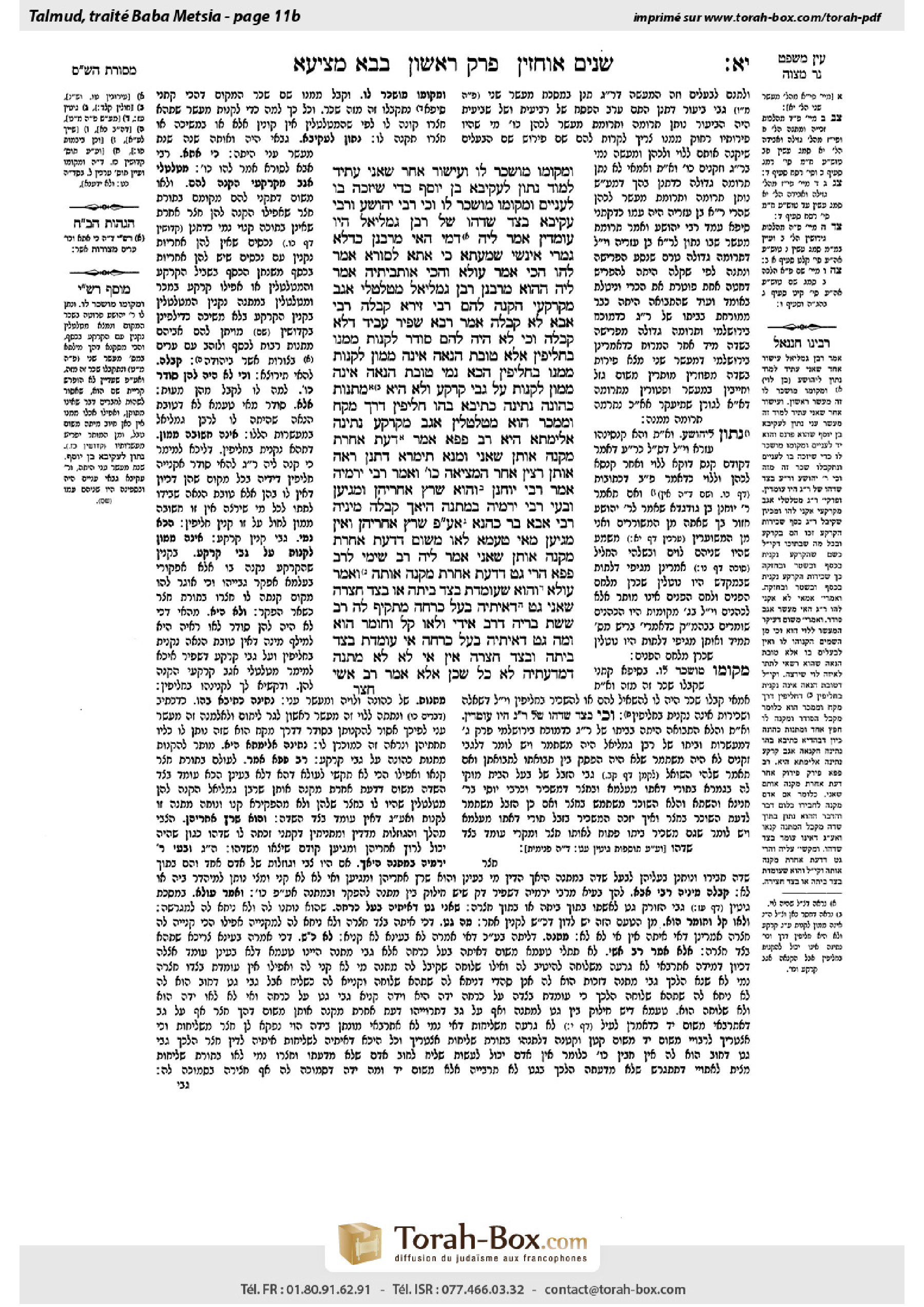
This page of Bava Metzia includes the Aramaic text, an English translation and an AI-generated French translation, alongside the scan above.
בבא מציעא י״א ב · Aramaic and Hebrew text
וּמְקוֹמוֹ מוּשְׂכָּר לוֹ. וְעִישּׂוּר אַחֵר שֶׁאֲנִי עָתִיד לָמוֹד, נָתוּן לַעֲקִיבָא בֶּן יוֹסֵף, כְּדֵי שֶׁיִּזְכֶּה בּוֹ לַעֲנִיִּים, וּמְקוֹמוֹ מוּשְׂכָּר לוֹ.
וְכִי רַבִּי יְהוֹשֻׁעַ וְרַבִּי עֲקִיבָא בְּצַד שָׂדֵהוּ שֶׁל רַבָּן גַּמְלִיאֵל הָיוּ עוֹמְדִין?
אֲמַר לֵיהּ: דָּמֵי הַאי מֵרַבָּנַן כִּדְלָא גָּמְרִי אִינָשֵׁי שְׁמַעְתָּא.
כִּי אֲתָא לְסוּרָא אֲמַר לְהוּ: הָכִי אָמַר עוּלָּא וְהָכִי אוֹתְבִיתֵיהּ. אֲמַר לֵיהּ הָהוּא מֵרַבָּנַן: רַבָּן גַּמְלִיאֵל מִטַּלְטְלֵי אַגַּב מְקַרְקְעֵי הִקְנָה לָהֶם. רַבִּי זֵירָא קַבְּלַהּ, רַבִּי אַבָּא לָא קַבְּלַהּ.
אָמַר רָבָא: שַׁפִּיר עֲבַיד דְּלָא קַבְּלַהּ, וְכִי לֹא הָיָה לָהֶם סוּדָר לִקְנוֹת מִמֶּנּוּ בַּחֲלִיפִין? אֶלָּא טוֹבַת הֲנָאָה אֵינָהּ מָמוֹן לִקְנוֹת מִמֶּנּוּ בַּחֲלִיפִין. הָכָא נָמֵי טוֹבַת הֲנָאָה אֵינָהּ מָמוֹן לִקְנוֹת עַל גַּבֵּי קַרְקַע.
וְלָא הִיא, מַתְּנוֹת כְּהוּנָּה נְתִינָה כְּתִיבָא בְּהוּ. חֲלִיפִין, דֶּרֶךְ מִקָּח וּמִמְכָּר הוּא. מִטַּלְטְלִין אַגַּב מִקַּרְקַע, נְתִינָה אַלִּימְתָּא הִיא.
רַב פָּפָּא אָמַר: דַּעַת אַחֶרֶת מַקְנָה אוֹתָן שָׁאנֵי.
וּמְנָא תֵּימְרַאּ – דִּתְנַן: רָאָה אוֹתָן רָצִין אַחַר הַמְּצִיאָה כּוּ׳, וְאָמַר רַבִּי יִרְמְיָה אָמַר רַבִּי יוֹחָנָן: וְהוּא שֶׁרָץ אַחֲרֵיהֶן וּמַגִּיעָן. וּבָעֵי רַבִּי יִרְמְיָה, בְּמַתָּנָה הֵיאַךְ? קַבְּלַהּ מִינֵּיהּ רַבִּי אַבָּא בַּר כָּהֲנָא אַף עַל פִּי שֶׁרָץ אַחֲרֵיהֶן וְאֵין מַגִּיעָן. מַאי טַעְמָא – לָאו מִשּׁוּם דְּדַעַת אַחֶרֶת מַקְנָה אוֹתָן שָׁאנֵי?!
אֲמַר לֵיהּ רַב שִׁימִי לְרַב פָּפָּא: הֲרֵי גֵּט, דְּדַעַת אַחֶרֶת – מַקְנָה אוֹתָהּ, וְאָמַר עוּלָּא: וְהוּא שֶׁעוֹמֶדֶת בְּצַד בֵּיתָהּ אוֹ בְּצַד חֲצֵרָהּ. שָׁאנֵי גֵּט דְּאִיתֵיהּ בְּעַל כׇּרְחָהּ.
מַתְקֵיף לַהּ רַב שֵׁשֶׁת בְּרֵיהּ דְּרַב אִידִי: וְלָאו קַל וָחוֹמֶר הוּא – וּמָה גֵּט דְּאִיתֵיהּ בְּעַל כׇּרְחָהּ, אִי עוֹמֶדֶת בְּצַד בֵּיתָהּ וּבְצַד חֲצֵרָהּ – אִין, אִי לָא – לָא. מַתָּנָה דְּמִדַּעְתֵּיהּ לֹא כׇּל שֶׁכֵּן!
אֶלָּא אָמַר רַב אָשֵׁי:
Bava Metzia 11b · English translation
and the place of the tithe is rented to him. Rabbi Yehoshua paid him a token sum to rent the field, which presumably became the equivalent of his courtyard, and thereby acquired the tithe. And another one-tenth that I will measure out in the future and separate from my produce as the poor man’s tithe is given to Akiva ben Yosef so that he will acquire it for the poor, and its place is rented to him.
Rabbi Abba continued: But were Rabbi Yehoshua and Rabbi Akiva standing next to Rabban Gamliel’s field then? All of them were on the ship. Apparently, one’s courtyard effects acquisition for him even when he is not standing next to it.
Ulla said to him: This one of the Sages seems like one who has not studied halakha. Ulla dismissed the question entirely, as he deemed it unworthy of consideration.
When Rabbi Abba came to Sura, he related the discussion to the local scholars, saying to them: This is what Ulla said, and this is how I challenged him. One of the Sages said to him: Rabban Gamliel transferred ownership of the movable property, the tithes, to them by means of renting them the land. The transaction concerning the tithes was effected not by causing the location of the produce to become the equivalent of a courtyard belonging to Rabbi Yehoshua and Rabbi Akiva, but rather by employing the principle that movable property can be acquired together with the acquisition of land. The Gemara comments: Rabbi Zeira accepted this response to Rabbi Abba’s objection, but Rabbi Abba did not accept it.
Rava said: Rabbi Abba did well by not accepting this response, because if Rabban Gamliel had intended to transfer his ownership of the tithes to Rabbi Yehoshua and Rabbi Akiva, did they not have a cloth with which to acquire the tithes from him by means of a symbolic exchange? They could have acquired the tithes through symbolic exchange without renting the land. Rather, clearly the tithes were not considered the property of Rabban Gamliel, as he owned only the benefit of discretion, i.e., the benefit accrued from the option of giving the tithes to whichever Levite or poor person that he chose, and such benefit is not considered property that can be acquired by means of a symbolic exchange. Here, too, the transaction was clearly effected by means of a courtyard, as benefit of discretion is not property that can be acquired by means of acquiring land. Therefore, Rabbi Abba’s explanation must be correct, and one’s courtyard effects acquisition for him even when he is not standing next to it.
The Gemara rejects Rava’s reasoning: But that is not so. With regard to gifts to which members of the priesthood are entitled, and similarly with regard to tithes that are given to Levites and to the poor, the concept of giving is written in the Torah: “And have given it to the Levite, to the stranger, to the fatherless, and to the widow” (Deuteronomy 26:12). These gifts must be given and not sold or bartered. Therefore, since exchange is a form of buying and selling, it is an inappropriate mode of acquisition with regard to tithes. By contrast, transferring ownership of movable property by means of transferring ownership of land is a powerful form of giving. Consequently, Rabban Gamliel could not give them the tithes by means of a symbolic exchange using a cloth, but instead had to give it to them along with land. Therefore, since the transaction was not effected by means of a courtyard, it poses no difficulty to Ulla’s opinion.
Rav Pappa said: Even if Rabbi Yehoshua and Rabbi Akiva acquired the tithes by means of a courtyard, this poses no difficulty to Ulla’s opinion. Since the tithes were not ownerless items, but rather another mind, i.e., Rabban Gamliel, transferred their ownership to Rabbi Yehoshua and Rabbi Akiva, it is different, and the recipients did not need to stand next to the courtyard.
And from where do you state this distinction? As we learned in the mishna: If one saw people running after a found ownerless animal, and said: My field has effected acquisition of this animal for me, it has effected acquisition of it for him. And Rabbi Yirmeya says that Rabbi Yoḥanan says that this halakha is true only in a case where he would be able to run after them and catch them. And Rabbi Yirmeya raises a dilemma: Does one acquire animals that are given to him as a gift in such a scenario? Rabbi Abba bar Kahana accepted the premise of the dilemma of Rabbi Yirmeya, and ruled that in the case of a gift one acquires the animals even if he would not be able to run after them and catch them. What is the reason for this distinction? Is it not because when another mind transfers their ownership, the halakha is different, in that the courtyard effects acquisition of the items with fewer limitations? This supports Rav Pappa’s explanation.
Rav Shimi said to Rav Pappa: But what about the case of a bill of divorce, where another mind, the husband, transfers its ownership to the wife, and nevertheless Ulla says with regard to one who threw a bill of divorce into his wife’s house or courtyard: But it is a valid divorce only if she is standing next to her house or next to her courtyard? Rav Pappa responded: A bill of divorce is different, as it is possible to give it to one’s wife even against her will.
Rav Sheshet, son of Rav Idi, objects to this response: But is it not an a fortiori inference? If in the case of a bill of divorce, which is valid even if it is given to the wife against her will, nevertheless if she is standing next to her house or next to her courtyard she does acquire the bill of divorce, and if not she does not acquire it, then in the case of a gift, which one can receive only willingly, is it not all the more so correct that the recipient must be next to his courtyard for the transaction to take effect?
Rather, Rav Ashi said that the distinction between the cases of a gift and a bill of divorce should be explained as follows:
Bava Metzia 11b · Traduction française (IA)
et la place de la dîme est louée à lui. Rabbi Yéhoshua lui a payé une somme symbolique pour louer le champ, ce qui a probablement équivalu à son courtil, et ainsi a acquis la dîme. Et une autre dîme que je mesurerai ultérieurement et séparerai de mes produits, comme dîme du pauvre, est donnée à Akiva ben Yosef afin qu'il l'acquière pour les pauvres, et sa place est louée à lui.
Rabbi Abba continua : Mais Rabbi Yéhoshua et Rabbi Akiva étaient-ils alors à côté du champ de Rabban Gamliel ? Tous étaient sur le bateau. Apparemment, le courtil d'une personne acquiert pour lui même quand il n'est pas à côté de celui-ci.
Ulla dit à lui : Ce Sage semble être celui qui n'a pas étudié la halakha. Ulla a rejeté entièrement la question, car il la jugeait inadéquate.
Quand Rabbi Abba est arrivé à Sura, il a rapporté la discussion aux savants locaux, en disant : C'est ce que dit Ulla, et c'est ainsi que j'ai contesté. Un des Sages lui a dit : Rabban Gamliel a transféré la propriété des biens mobiliers, des dîmes, à eux par le biais de la location du terrain. La transaction concernant les dîmes a été effectuée non pas en rendant la localisation des produits équivalente à un courtil appartenant à Rabbi Yéhoshua et Rabbi Akiva, mais plutôt en utilisant le principe selon lequel les biens mobiliers peuvent être acquis ensemble avec l'acquisition du terrain. La Guemara commente : Rabbi Zéira a accepté cette réponse à l'objection de Rabbi Abba, mais Rabbi Abba n'a pas accepté cette réponse.
Rava dit : Rabbi Abba a bien fait de ne pas accepter cette réponse, car si Rabban Gamliel avait voulu transférer sa propriété des dîmes à Rabbi Yéhoshua et Rabbi Akiva, n'avaient-ils pas un tissu avec lequel ils pouvaient acquérir les dîmes de lui par échange symbolique ? Ils auraient pu acquérir les dîmes par échange symbolique sans louer le terrain. En revanche, clairement les dîmes n'étaient pas considérées comme la propriété de Rabban Gamliel, car il possédait seulement le bénéfice de la discrétion, c'est-à-dire le bénéfice issu de l'option de donner les dîmes à n'importe quel Lévi ou pauvre qu'il choisirait, et ce bénéfice n'est pas considéré comme une propriété pouvant être acquise par échange symbolique. Ici aussi, la transaction a été clairement effectuée par le biais d'un courtil, car le bénéfice de la discrétion n'est pas une propriété pouvant être acquise par l'acquisition du terrain. Ainsi, l'explication de Rabbi Abba doit être correcte, et le courtil d'une personne acquiert pour lui même quand il n'est pas à côté de celui-ci.
La Guemara rejette la raison de Rava : Mais cela n'est pas ainsi. En ce qui concerne les dons auxquels les membres du clergé ont droit, ainsi qu'en ce qui concerne les dîmes données aux Lévites et aux pauvres, la notion de don est écrite dans la Torah : « Et tu as donné cela au Lévi, à l'étranger, au veuf et à l'orphelin » (Deutéronome 26 : 12). Ces dons doivent être donnés et non vendus ou échangés. Ainsi, puisque l'échange est une forme d'achat et de vente, il est inadapté comme mode d'acquisition concernant les dîmes. En revanche, le transfert de propriété des biens mobiliers par le biais du transfert de propriété du terrain est un mode puissant de don. Par conséquent, Rabban Gamliel ne pouvait pas donner les dîmes à l'aide d'un échange symbolique avec un tissu, mais devait les donner avec le terrain. Ainsi, puisque la transaction n'a pas été effectuée par le biais d'un courtil, cela ne pose pas de difficulté pour l'opinion d'Ulla.
Rav Pappa dit : Même si Rabbi Yéhoshua et Rabbi Akiva ont acquis les dîmes par le biais d'un courtil, cela ne pose pas de difficulté pour l'opinion d'Ulla. Puisque les dîmes n'étaient pas des objets sans propriétaire, mais plutôt un autre individu, c'est-à-dire Rabban Gamliel, qui a transféré leur propriété à Rabbi Yéhoshua et Rabbi Akiva, c'est différent, et les bénéficiaires n'avaient pas besoin d'être à côté du courtil.
Et d'où tire-t-on cette distinction ? Comme nous l'avons appris dans la michna : Si l'on voyait des gens courir après un animal trouvé sans propriétaire, et qu'on disait : Mon champ a acquis cet animal pour moi, il a acquis pour lui aussi. Et Rabbi Yirméya dit que Rabbi Yochanan dit que cette halakha est vraie uniquement dans un cas où il pourrait courir après eux et les attraper. Et Rabbi Yirméya soulève un dilemme : Acquiert-on des animaux donnés en cadeau dans ce cas ? Rabbi Abba bar Kahana a accepté la prémisses du dilemme de Rabbi Yirméya, et a rendu un jugement selon lequel, dans le cas d'un cadeau, on acquiert les animaux même si l'on ne peut pas courir après eux et les attraper. Quelle est la raison de cette distinction ? N'est-ce pas parce que lorsque l'autre esprit transfère sa propriété, la halakha est différente, en ce sens que le courtil acquiert les objets avec moins de restrictions ? Cela soutient l'explication de Rav Pappa.
Rav Shimé dit à Rav Pappa : Mais que dire du cas d'un divorce, où l'autre esprit, l'époux, transfère sa propriété à la femme, et pourtant Ulla dit concernant celui qui jette un divorce dans la maison ou le courtil de sa femme : Mais c'est un divorce valide uniquement si elle est à côté de sa maison ou de son courtil ? Rav Pappa répondit : Le divorce est différent, car il est possible de le donner à sa femme même contre sa volonté.
Rav Shéshét, fils de Rav Idi, s'oppose à cette réponse : Mais n'est-ce pas une inférence a fortiori ? Si, dans le cas d'un divorce, qui est valide même s'il est donné à la femme contre sa volonté, néanmoins si elle est à côté de sa maison ou de son courtil elle acquiert le divorce, et si non elle ne l'acquiert pas, alors dans le cas d'un cadeau, qui peut être reçu uniquement volontairement, n'est-ce pas encore plus vrai que le destinataire doit être à côté de son courtil pour que la transaction ait effet ?
Plutôt, Rav Ashi dit que la distinction entre les cas d'un don et d'un divorce doit être expliquée comme suit :
Traduction française générée par IA à partir de l’édition anglaise de Sefaria. Vérifie toujours un passage avec le texte source.
Text from Sefaria: William Davidson Edition - Vocalized Aramaic (CC BY NC); William Davidson Edition - English (CC BY NC).