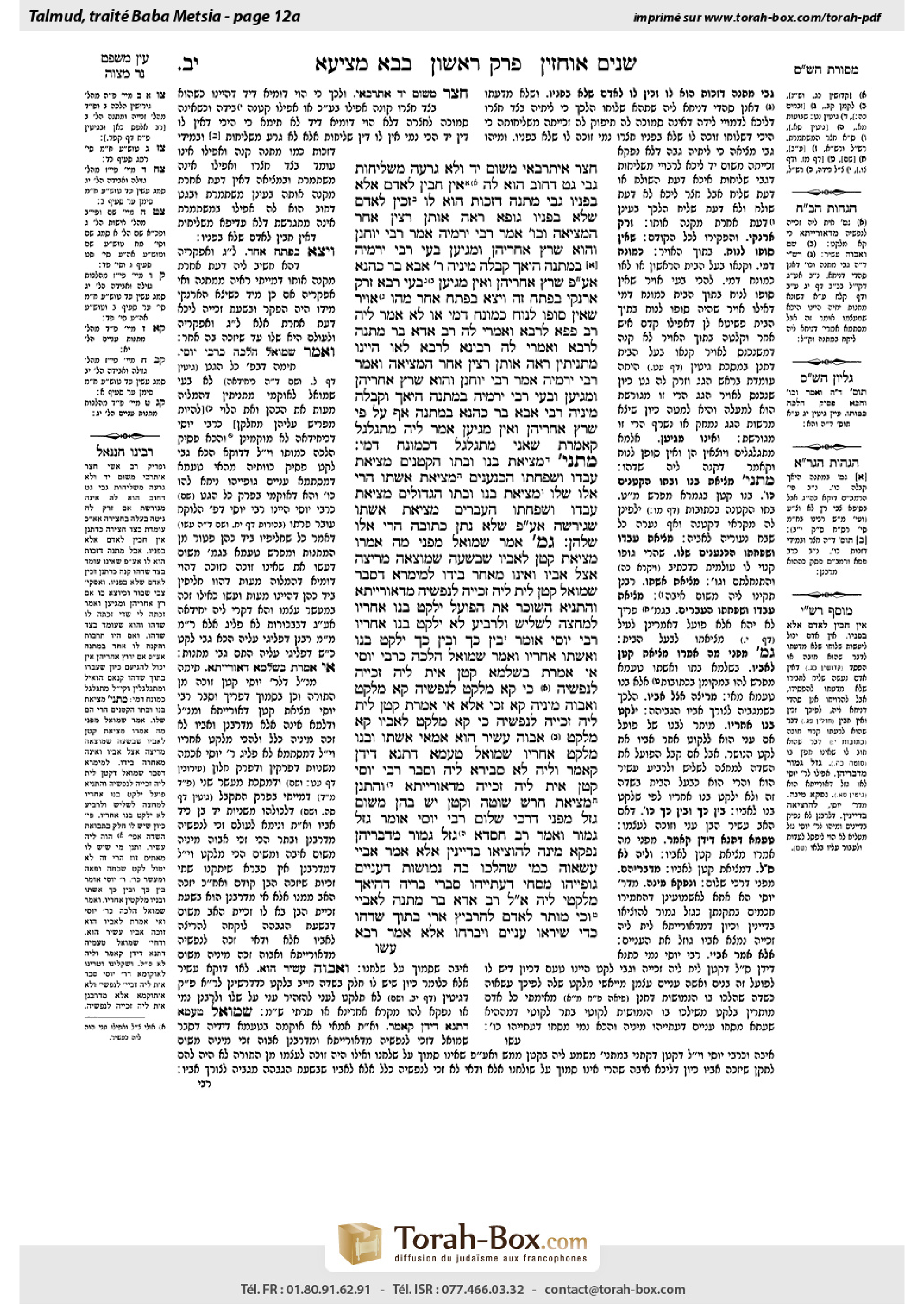
Bava Metzia 12a: Talmud study for Daf Yomi
Study the Talmud for Daf Yomi with scanned pages, Hebrew text, English translations from Sefaria and AI-generated French translations.
Passage selection and English or AI-generated French translation are available where the scan has annotations. Daf Study is independent of Torah-Box and Sefaria.
Browse Bava Metzia · בבא מציעא · All tractatesBava Metzia 12a text and translations
This page of Bava Metzia includes the Aramaic text, an English translation and an AI-generated French translation, alongside the scan above.
בבא מציעא י״ב א · Aramaic and Hebrew text
חָצֵר אִיתְרַבַּאי מִשּׁוּם יָד וְלָא גָּרְעָה מִשְּׁלִיחוּת. גַּבֵּי גֵּט דְּחוֹב הוּא לָהּ: אֵין חָבִין לְאָדָם אֶלָּא בְּפָנָיו. גַּבֵּי מַתָּנָה דִּזְכוּת הוּא לוֹ: זָכִין לְאָדָם שֶׁלֹּא בְּפָנָיו.
גּוּפָא. רָאָה אוֹתָן רָצִין אַחַר הַמְּצִיאָה וְכוּ׳. אָמַר רַבִּי יִרְמְיָה אָמַר רַבִּי יוֹחָנָן: וְהוּא שֶׁרָץ אַחֲרֵיהֶן וּמַגִּיעָן. בָּעֵי רַבִּי יִרְמְיָה: בְּמַתָּנָה הֵיאַךְ? קַבְּלַהּ מִינֵּיהּ רַבִּי אַבָּא בַּר כָּהֲנָא: אַף עַל פִּי שֶׁרָץ אַחֲרֵיהֶן וְאֵין מַגִּיעָן.
בָּעֵי רָבָא: זָרַק אַרְנָקִי בְּפֶתַח זֶה וְיָצָא בְּפֶתַח אַחֵר, מַהוּ? אֲוִיר שֶׁאֵין סוֹפוֹ לָנוּחַ כְּמוּנָּח דָּמֵי, אוֹ לָא?
אֲמַר לֵיהּ רַב פָּפָּא לְרָבָא, וְאָמְרִי לַהּ רַב אַדָּא בַּר מַתְנָה לְרָבָא, וְאָמְרִי לַהּ רָבִינָא לְרָבָא: לָאו הַיְינוּ מַתְנִיתִין. רָאָה אוֹתָן רָצִין אַחַר הַמְּצִיאָה, וְאָמַר רַבִּי יִרְמְיָה אָמַר רַבִּי יוֹחָנָן: וְהוּא שֶׁרָץ אַחֲרֵיהֶן וּמַגִּיעָן, וּבָעֵי רַבִּי יִרְמְיָה: בְּמַתָּנָה הֵיאַךְ? וְקַבְּלַהּ מִינֵּיהּ רַבִּי אַבָּא בַּר כָּהֲנָא: בְּמַתָּנָה אַף עַל פִּי שֶׁרָץ אַחֲרֵיהֶן וְאֵין מַגִּיעָן.
אֲמַר לֵיהּ, מִתְגַּלְגֵּל קָאָמְרַתְּ? שָׁאנֵי מִתְגַּלְגֵּל דִּכְמוּנָּח דָּמֵי.
מַתְנִי׳ מְצִיאַת בְּנוֹ וּבִתּוֹ הַקְּטַנִּים, מְצִיאַת עַבְדּוֹ וְשִׁפְחָתוֹ הַכְּנַעֲנִים, מְצִיאַת אִשְׁתּוֹ – הֲרֵי אֵלּוּ שֶׁלּוֹ. מְצִיאַת בְּנוֹ וּבִתּוֹ הַגְּדוֹלִים, מְצִיאַת עַבְדּוֹ וְשִׁפְחָתוֹ הָעִבְרִים, מְצִיאַת אִשְׁתּוֹ שֶׁגֵּירְשָׁהּ, אַף עַל פִּי שֶׁלֹּא נָתַן כְּתוּבָּה – הֲרֵי אֵלּוּ שֶׁלָּהֶן.
גְּמָ׳ אָמַר שְׁמוּאֵל: מִפְּנֵי מָה אָמְרוּ מְצִיאַת קָטָן לְאָבִיו – שֶׁבְּשָׁעָה שֶׁמּוֹצְאָהּ מְרִיצָהּ אֵצֶל אָבִיו, וְאֵינוֹ מְאַחֵר בְּיָדוֹ.
לְמֵימְרָא דְּסָבַר שְׁמוּאֵל קָטָן לֵית לֵיהּ זְכִיָּיה לְנַפְשֵׁיהּ מִדְּאוֹרָיְיתָא? וְהָתַנְיָא: הַשּׂוֹכֵר אֶת הַפּוֹעֵל – יְלַקֵּט בְּנוֹ אַחֲרָיו. לְמֶחֱצָה, לִשְׁלִישׁ וְלִרְבִיעַ – לֹא יְלַקֵּט בְּנוֹ אַחֲרָיו. רַבִּי יוֹסִי אוֹמֵר: בֵּין כָּךְ וּבֵין כָּךְ יְלַקֵּט בְּנוֹ וְאִשְׁתּוֹ אַחֲרָיו. וְאָמַר שְׁמוּאֵל: הֲלָכָה כְּרַבִּי יוֹסֵי.
אִי אָמְרַתְּ בִּשְׁלָמָא קָטָן אִית לֵיהּ זְכִיָּיה לְנַפְשֵׁיהּ, כִּי קָא מְלַקֵּט – לְנַפְשֵׁיהּ קָא מְלַקֵּט, וַאֲבוּהּ מִינֵּיהּ קָא זָכֵי. אֶלָּא אִי אָמְרַתְּ קָטָן לֵית לֵיהּ זְכִיָּיה לְנַפְשֵׁיהּ, כִּי קָא מְלַקֵּט – לְאָבִיו קָא מְלַקֵּט, אֲבוּהּ עָשִׁיר הוּא, אַמַּאי אִשְׁתּוֹ וּבְנוֹ מְלַקֵּט אַחֲרָיו?
שְׁמוּאֵל, טַעְמָא דְּתַנָּא דִּידַן קָאָמַר, וְלֵיהּ לָא סְבִירָא לֵיהּ.
וְסָבַר רַבִּי יוֹסֵי קָטָן אִית לֵיהּ זְכִיָּיה מִדְּאוֹרָיְיתָא? וְהָתְנַן: מְצִיאַת חֵרֵשׁ, שׁוֹטֶה וְקָטָן יֵשׁ בָּהֶן מִשּׁוּם גָּזֵל מִפְּנֵי דַּרְכֵי שָׁלוֹם. רַבִּי יוֹסֵי אוֹמֵר: גָּזֵל גָּמוּר.
וְאָמַר רַב חִסְדָּא: גָּזֵל גָּמוּר מִדִּבְרֵיהֶן. נָפְקָא מִינַּהּ לְהוֹצִיאָהּ בְּדַיָּינִין.
אֶלָּא אָמַר אַבָּיֵי: עֲשָׂאוּהָ כְּמִי שֶׁהָלְכוּ בָּהּ נָמוֹשׁוֹת. דַּעֲנִיִּים גּוּפַיְיהוּ מַסְּחִי דַּעְתַּיְיהוּ. סָבְרִי: בְּרֵיהּ דְּהַיְאךְ מְלַקֵּטי לֵיהּ.
אֲמַר לֵיהּ רַב אַדָּא בַּר מַתְנָה לְאַבָּיֵי: וְכִי מוּתָּר לָאָדָם לְהַרְבִּיץ אֲרִי בְּתוֹךְ שָׂדֵהוּ כְּדֵי שֶׁיִּרְאוּ עֲנִיִּים וְיִבְרְחוּ?
אֶלָּא אָמַר רָבָא:
Bava Metzia 12a · English translation
One’s courtyard is included as a valid means of acquisition due to the fact that it acts as his hand; but it is no less effective than agency. Therefore, with regard to a bill of divorce, which is considered detrimental to the wife, one cannot transfer it to her by placing it in her courtyard in her absence, as one cannot act against the interests of a person unless it is in his presence. By contrast, with regard to a gift, which is beneficial for the recipient, one can give it to him by placing it in his courtyard in the recipient’s absence, as one can act in a person’s interest in his absence.
§ The Gemara returns to discuss the matter itself. The mishna teaches: If one saw people running after a found ownerless animal, and said: My field has effected acquisition of this animal for me, it has effected acquisition of it for him. Rabbi Yirmeya says that Rabbi Yoḥanan says: And this halakha is true only in a case where he would be able to run after them and catch them. Rabbi Yirmeya raises a dilemma: Does one acquire animals that are given to him as a gift in such a scenario? Rabbi Abba bar Kahana accepted the premise of the dilemma of Rabbi Yirmeya, and ruled that in the case of a gift one acquires the animals even if he would not be able to run after them and catch them.
Rava raises a dilemma: If one threw a purse through this entrance of a house and it went through the house and exited through another entrance, what is the halakha? Does the owner of the house acquire the purse during the course of its flight? The dilemma is: Is an item in the airspace [avir] of a courtyard that will not eventually come to rest in the courtyard itself regarded as though it has come to rest, or is it not regarded as though it has come to rest?
Rav Pappa said to Rava, and some say that it was Rav Adda bar Mattana who said this to Rava, and some say that it was Ravina who said this to Rava: Isn’t this the same as the halakha in the mishna? As it is stated: If one saw people running after a found ownerless animal, and said: My field has effected acquisition of this animal for me, it has effected acquisition of it for him. And Rabbi Yirmeya says that Rabbi Yoḥanan says: And this halakha is true only in a case where he would be able to run after them and catch them. Rabbi Yirmeya raises a dilemma: Does one acquire animals that are given to him as a gift in such a scenario? Rabbi Abba bar Kahana accepted the premise of the dilemma of Rabbi Yirmeya, and ruled that in the case of a gift one acquires the animals even if he would not be able to run after them and catch them.
Rava said to him: Are you saying that a purse flying through the air is comparable to an item that is rolling, i.e., moving on the ground? A rolling item is different, as it is regarded as though it has come to rest. At any given instant throughout its movement, the item rests on the ground. Therefore, the dilemma cannot be resolved from the mishna.
MISHNA: With regard to the found item of one’s minor son or daughter, i.e., an ownerless item that they found; the found item of his Canaanite slave or maidservant; and the found item of his wife, they are his. By contrast, with regard to the found item of one’s adult son or daughter; the found item of his Hebrew slave or maidservant; and the found item of his ex-wife, whom he divorced, even if he has not yet given her payment of the marriage contract that he owes her, they are theirs.
GEMARA: Shmuel says: For what reason did the Sages say that the found item of one’s minor son or daughter belongs to his father? It is because the minor does not intend to acquire it for himself, as when he finds it, he runs with it to his father and does not retain it in his possession.
The Gemara asks: Is this to say that Shmuel holds that a minor does not have the capability of acquiring property for himself by Torah law? But isn’t it taught in a baraita: With regard to one who hires a salaried laborer to harvest his field, the son of the laborer may glean fallen stalks from behind the laborer like all poor people who have a right to the stalks left in the field. But if one hires a laborer as a sharecropper, whether the laborer receives one-half, one-third, or one-quarter of the produce, his son may not glean stalks after him, as the laborer himself is considered a partial owner of the field and is consequently not considered poor. Rabbi Yosei says: In both this case and that case the laborer’s son and wife may glean after him. And Shmuel says that the halakha is in accordance with the opinion of Rabbi Yosei.
Granted, if you say that a minor has the capability of acquiring property for himself, Shmuel’s opinion is understood, as when the son gleans stalks, he gleans them for himself and acquires them, and his father subsequently acquires them from him as a gift. Since the minor has no property of his own, his status is that of a poor person and it is permitted for him to glean stalks. But if you say that a minor does not have the capability of acquiring property for himself, then when he gleans the stalks, he gleans them for his father. Since his father is considered wealthy and is not entitled to the gleanings because he owns a portion of the produce, why may his wife and son glean stalks after him?
The Gemara answers: In Shmuel’s explanation, Shmuel is stating the reason of the tanna of our mishna, but he himself does not hold accordingly. Rather, Shmuel holds in accordance with the opinion of Rabbi Yosei that a minor can acquire property for himself.
The Gemara asks: And does Rabbi Yosei hold that a minor has the capability of acquiring property by Torah law? But didn’t we learn in a mishna (Gittin 59b): With regard to the found items of a deaf-mute, an imbecile, or a minor, i.e., lost items that they found, although they are not considered to be halakhically competent and are unable to acquire found items by Torah law, taking such items from them is considered robbery, by rabbinic law, for the sake of the ways of peace. Rabbi Yosei says: This is full-fledged robbery.
And Rav Ḥisda says that Rabbi Yosei means that it is full-fledged robbery by rabbinic law. And the practical difference between the opinion of the first tanna and Rabbi Yosei’s opinion is that according to Rabbi Yosei, if the robber refuses to return the stolen item, it is appropriated by the judges and returned to its owner. In any event, it is evident from here that Rabbi Yosei also holds that a minor cannot acquire property for himself by Torah law.
Rather, Abaye rejected the above explanation of Rabbi Yosei’s opinion in the baraita with regard to gleaning, and said: The reason that according to Rabbi Yosei a sharecropper’s son may glean after him despite the fact that he does not acquire property by Torah law is that in such a case the Sages rendered the field like one through which the last gleaners have walked. Once the poor people have finished gleaning stalks from a field, even wealthy people are permitted to collect whatever remains. In this case, since the sharecropper’s son is walking behind him, the poor people themselves dismiss the notion of gleaning in this field from their minds; they assume that the son of this sharecropper is gleaning for him and that they will therefore not find any gleanings in this field. Since the poor people themselves have finished taking stalks from the field, the sharecropper’s son can glean for his father.
Rav Adda bar Mattana said to Abaye: But how is it permitted for one to allow his son to follow him in the field, thereby causing all the poor people to leave? Is a person permitted to have a lion crouch in his field so that the poor people will see it and flee?
Rather, Rava stated an alternative explanation:
Bava Metzia 12a · Traduction française (IA)
Le jardin d'une personne est considéré comme un moyen valide d'acquisition, car il agit comme sa main ; cependant, il n'est pas moins efficace que l'agent. Ainsi, concernant un acte de divorce, qui est considéré comme nuisible pour la femme, on ne peut pas le transférer à elle en la laissant seule en laissant le document dans son jardin, car on ne peut pas agir contre les intérêts d'une personne sans qu'elle ne soit présente. En revanche, concernant un cadeau, qui est bénéfique pour le destinataire, on peut lui donner le cadeau en le laissant dans son jardin en l'absence du destinataire, car on peut agir en son intérêt même en son absence.
§ Le Guemara reprend la discussion sur le sujet. La mitsna enseigne : Si l'on voit des gens courir après un animal trouvé sans propriétaire, et qu'on dit : Mon champ a acquis cet animal pour moi, il a acquis cet animal pour lui. Rabbi Yirmeya dit que Rabbi Yoḥanan dit : Et cette halakha est vraie uniquement dans le cas où il pourrait courir après eux et les attraper. Rabbi Yirmeya soulève un dilemme : Acquiert-on des animaux donnés en cadeau dans ce cas ? Rabbi Abba bar Kahana a accepté la prémisses du dilemme de Rabbi Yirmeya, et a rendu un jugement selon lequel, dans le cas d'un cadeau, on acquiert les animaux même si l'on ne pourrait pas courir après eux et les attraper.
Rava soulève un dilemme : Si l'on jette un sac par cette entrée d'une maison et qu'il traverse la maison et sort par une autre entrée, quelle est la halakha ? L'acquiert-on durant son vol ? Le dilemme est : Un objet dans l'espace aérien [avir] d'un jardin, qui ne finira pas par se poser dans le jardin lui-même, est-il considéré comme s'il avait déjà pris position, ou non ?
Rav Pappa a dit à Rava, et certains disent que c'était Rav Adda bar Mattana qui a dit cela à Rava, et d'autres disent que c'était Ravina qui a dit cela à Rava : N'est-ce pas la même chose que la halakha de la mitsna ? Comme il est dit : Si l'on voit des gens courir après un animal trouvé sans propriétaire, et qu'on dit : Mon champ a acquis cet animal pour moi, il a acquis cet animal pour lui. Et Rabbi Yirmeya dit que Rabbi Yoḥanan dit : Et cette halakha est vraie uniquement dans le cas où il pourrait courir après eux et les attraper. Rabbi Yirmeya soulève un dilemme : Acquiert-on des animaux donnés en cadeau dans ce cas ? Rabbi Abba bar Kahana a accepté la prémisses du dilemme de Rabbi Yirmeya, et a rendu un jugement selon lequel, dans le cas d'un cadeau, on acquiert les animaux même si l'on ne pourrait pas courir après eux et les attraper.
Rava a dit à lui : Vous dites donc que le sac volant à travers l'air est comparable à un objet roulant, c'est-à-dire en mouvement sur le sol ? Un objet roulant est différent, car il est considéré comme s'il avait déjà pris position. À chaque instant de son mouvement, l'objet repose sur le sol. Ainsi, le dilemme ne peut pas être résolu à partir de la mitsna.
MITSNA : Concernant l'objet trouvé par son fils ou sa fille mineure, c'est-à-dire un objet sans propriétaire qu'ils ont trouvé ; l'objet trouvé par son serviteur cananéen ou sa servante ; et l'objet trouvé par sa femme, ils sont à lui. En revanche, concernant l'objet trouvé par son fils ou sa fille adulte ; l'objet trouvé par son serviteur hébreu ou sa servante ; et l'objet trouvé par sa femme exilée, qu'il a divorcée, même s'il n'a pas encore versé le paiement du contrat de mariage qu'il lui doit, ils sont à eux.
GUEMARA : Shmuel dit : Pour quelle raison les Sages ont-ils dit que l'objet trouvé par son fils ou sa fille mineure appartient à son père ? C'est parce que le mineur ne souhaite pas acquérir cet objet pour lui-même, car lorsqu'il le trouve, il court avec lui vers son père et ne le garde pas en possession.
La Guemara pose la question : Est-ce que cela signifie que Shmuel considère que le mineur n'a pas la capacité d'acquérir des biens pour lui-même selon la loi juive ? Mais n'est-il pas enseigné dans une baraïta : Concernant celui qui engage un ouvrier salarial pour récolter son champ, le fils de l'ouvrier peut ramasser les épis tombés derrière l'ouvrier comme tous les pauvres qui ont le droit aux épis restants dans le champ. Mais si l'on engage un ouvrier comme partageant, que l'ouvrier reçoive un tiers, un tiers ou un quart des récoltes, son fils ne peut pas ramasser les épis après lui, car l'ouvrier lui-même est considéré comme partiellement propriétaire du champ et n'est donc pas considéré comme pauvre. Rabbi Yosei dit : Dans les deux cas, le fils et la femme de l'ouvrier peuvent ramasser les épis après lui. Et Shmuel dit que la halakha suit l'opinion de Rabbi Yosei.
Admettons que vous disiez que le mineur a la capacité d'acquérir des biens pour lui-même, l'opinion de Shmuel est compréhensible, car lorsque le fils ramasse les épis, il les ramasse pour lui-même et les acquiert, et son père les acquiert ensuite de lui en tant que cadeau. Puisque le mineur n'a pas de propriété personnelle, son statut est celui d'un pauvre et il est permis de ramasser les épis. Mais si vous disiez que le mineur n'a pas la capacité d'acquérir des biens pour lui-même, alors lorsque le mineur ramasse les épis, il les ramasse pour son père. Puisque son père est considéré comme riche et n'a pas le droit aux récoltes car il possède une part des récoltes, pourquoi son épouse et son fils peuvent-ils ramasser les épis après lui ?
La Guemara répond : Dans l'explication de Shmuel, Shmuel expose la raison donnée par le tanna de notre mitsna, mais il ne suit pas cette opinion. En réalité, Shmuel suit l'opinion de Rabbi Yosei selon laquelle un mineur peut acquérir des biens pour lui-même.
La Guemara pose la question : Et Rabbi Yosei considère-t-il que le mineur a la capacité d'acquérir des biens selon la loi juive ? Mais n'avons-nous pas appris dans une mitsna (Gittin 59b) : Concernant les objets trouvés par un sourd-muet, un imbécile ou un mineur, c'est-à-dire des objets perdus qu'ils ont trouvés, bien qu'ils ne soient pas considérés comme compétents halakhiquement et ne puissent pas acquérir des objets trouvés selon la loi juive, prendre tels objets chez eux est considéré comme vol, selon la loi rabbinique, pour le bien des relations pacifiques. Rabbi Yosei dit : C'est un vol complet.
Et Rav Ḥisda dit que Rabbi Yosei entend par là un vol complet selon la loi rabbinique. La différence pratique entre l'opinion du premier tanna et celle de Rabbi Yosei réside dans le fait que selon Rabbi Yosei, si le voleur refuse de rendre l'objet volé, les juges le prennent en possession et le restituent à son propriétaire. En tout cas, il est évident d'ici que Rabbi Yosei considère également que selon la loi orale, un mineur ne peut pas acquérir de propriété pour lui-même.
Plutôt, Abaye rejeta l'explication ci-dessus de l'opinion de Rabbi Yosei dans la baraïta concernant la récolte des épis, et dit : La raison pour laquelle selon Rabbi Yosei, le fils d'un fermier peut récolter après lui, malgré le fait qu'il ne puisse pas acquérir de propriété selon la loi divine, est que dans ce cas les Sages ont rendu le champ comme s'il était celui par lequel les derniers récolteurs sont passés. Une fois que les pauvres ont fini de récolter les épis d'un champ, même les gens riches sont autorisés à ramasser ce qui reste. Dans ce cas, puisque le fils du fermier marche derrière lui, les pauvres eux-mêmes abandonnent l'idée de récolter dans ce champ ; ils supposent que le fils du fermier récolte pour lui et qu'ils ne trouveront donc plus d'épis dans ce champ. Puisque les pauvres ont eux-mêmes fini de récolter les épis du champ, le fils du fermier peut récolter pour son père.
Rav Adda bar Mattana dit à Abaye : Mais comment est-il permis à quelqu'un de permettre à son fils de le suivre dans le champ, causant ainsi que tous les pauvres fuient ? Est-ce que l'on peut autoriser un lion à se coucher dans son champ pour que les pauvres le voient et s'enfuient ?
Plutôt, Rava proposa une autre explication :
Traduction française générée par IA à partir de l’édition anglaise de Sefaria. Vérifie toujours un passage avec le texte source.
Text from Sefaria: William Davidson Edition - Vocalized Aramaic (CC BY NC); William Davidson Edition - English (CC BY NC).