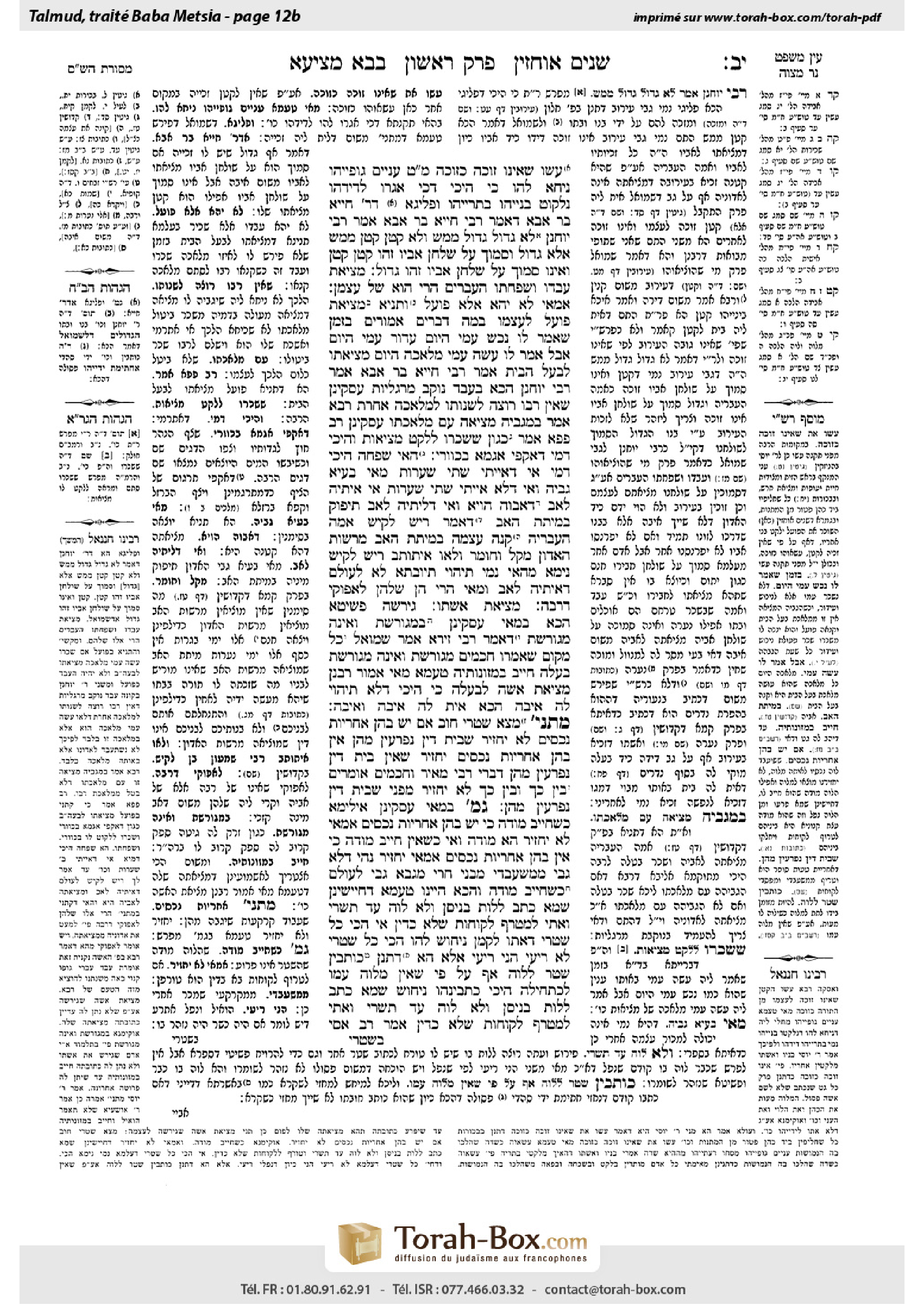
Bava Metzia 12b: Talmud study for Daf Yomi
Study the Talmud for Daf Yomi with scanned pages, Hebrew text, English translations from Sefaria and AI-generated French translations.
Passage selection and English or AI-generated French translation are available where the scan has annotations. Daf Study is independent of Torah-Box and Sefaria.
Browse Bava Metzia · בבא מציעא · All tractatesBava Metzia 12b text and translations
This page of Bava Metzia includes the Aramaic text, an English translation and an AI-generated French translation, alongside the scan above.
בבא מציעא י״ב ב · Aramaic and Hebrew text
עָשׂוּ שֶׁאֵינוֹ זוֹכֶה כְּזוֹכֶה, מַאי טַעְמָא – עֲנִיִּים גּוּפַיְיהוּ נִיחָא לְהוּ, כִּי הֵיכִי דְּכִי אָגְרוּ לְדִידְהוּ נִלְקוֹט בְּנַיְיהוּ בָּתְרַיְיהוּ.
וּפְלִיגָא דְּרַבִּי חִיָּיא בַּר אַבָּא. דְּאָמַר רַבִּי חִיָּיא בַּר אַבָּא אָמַר רַבִּי יוֹחָנָן: לֹא גָּדוֹל – גָּדוֹל מַמָּשׁ, וְלֹא קָטָן – קָטָן מַמָּשׁ, אֶלָּא גָּדוֹל וְסָמוּךְ עַל שֻׁלְחָן אָבִיו – זֶהוּ קָטָן. קָטָן וְאֵינוֹ סָמוּךְ עַל שֻׁלְחָן אָבִיו – זֶהוּ גָּדוֹל.
מְצִיאַת עַבְדּוֹ וְשִׁפְחָתוֹ הָעִבְרִים הֲרֵי הוּא שֶׁל עַצְמָן. אַמַּאי לֹא יְהֵא אֶלָּא פּוֹעֵל? וְתַנְיָא: מְצִיאַת פּוֹעֵל לְעַצְמוֹ. בַּמֶּה דְּבָרִים אֲמוּרִים – בִּזְמַן שֶׁאָמַר לוֹ: ״נַכֵּשׁ עִמִּי הַיּוֹם״, ״עֲדוֹר עַמִּי הַיּוֹם״.
אֲבָל אָמַר לוֹ ״עֲשֵׂה עִמִּי מְלָאכָה הַיּוֹם״ – מְצִיאָתוֹ לְבַעַל הַבַּיִת.
אָמַר רַבִּי חִיָּיא בַּר אַבָּא אָמַר רַבִּי יוֹחָנָן: הָכָא בְּעֶבֶד נוֹקֵב מַרְגָּלִיּוֹת עָסְקִינַן, שֶׁאֵין רַבּוֹ רוֹצֶה לְשַׁנּוֹתוֹ לִמְלָאכָה אַחֶרֶת.
רָבָא אָמַר: בְּמַגְבִּיהַּ מְצִיאָה עִם מְלַאכְתּוֹ עָסְקִינַן.
רַב פָּפָּא אָמַר: כְּגוֹן שֶׁשְּׂכָרוֹ לְלַקֵּט מְצִיאוֹת. וְהֵיכִי דָּמֵי? דְּאַקְּפַי אַגְמָא בִּכְווֹרֵי.
הַאי שִׁפְחָה הֵיכִי דָמֵי? אִי דְּאַיְיתַי שְׁתֵּי שְׂעָרוֹת, מַאי בָּעֲיָא גַּבֵּיהּ?
וְאִי דְּלָא אַיְיתַי שְׁתֵּי שְׂעָרוֹת, אִי אִיתֵיהּ לְאָב – דַּאֲבוּהּ הָוְיָא! וְאִי דְּלֵיתֵיהּ לָאָב – תִּיפּוֹק בְּמִיתַת הָאָב.
דְּאָמַר רֵישׁ לָקִישׁ: אָמָה הָעִבְרִיָּה קֹנָה עַצְמָהּ בְּמִיתַת הָאָב מֵרְשׁוּת הָאָדוֹן מִקַּל וָחוֹמֶר. וְלָאו אִיתּוֹתַב רֵישׁ לָקִישׁ?
נֵימָא מֵהַאי נָמֵי תֶּיהְוֵי תְּיוּבְתָּא!
לָא, לְעוֹלָם דְּאִיתֵיהּ לְאָב, וּמַאי ״הֲרֵי הֵן שֶׁלָּהֶן״ – לְאַפּוֹקֵי דְּרַבָּה.
מְצִיאַת אִשְׁתּוֹ. גֵּירְשָׁהּ פְּשִׁיטָא!
הָכָא בְּמַאי עָסְקִינַן? בִּמְגוֹרֶשֶׁת וְאֵינָהּ מְגוֹרֶשֶׁת, דְּאָמַר רַבִּי זֵירָא אָמַר שְׁמוּאֵל: כׇּל מָקוֹם שֶׁאָמְרוּ חֲכָמִים ״מְגוֹרֶשֶׁת וְאֵינָהּ מְגוֹרֶשֶׁת״ – בַּעְלָהּ חַיָּיב בִּמְזוֹנוֹתֶיהָ.
טַעְמָא מַאי אֲמוּר רַבָּנַן מְצִיאַת אִשָּׁה לְבַעְלָהּ, כִּי הֵיכִי דְּלָא תֶּיהְוֵי לַהּ אֵיבָה. הָכָא אִית לַהּ אֵיבָה וְאֵיבָה.
מַתְנִי׳ מָצָא שִׁטְרֵי חוֹב, אִם יֵשׁ בָּהֶן אַחְרָיוּת נְכָסִים – לֹא יַחְזִיר, שֶׁבֵּית דִּין נִפְרָעִין מֵהֶן. אֵין בָּהֶן אַחְרָיוּת נְכָסִים – יַחְזִיר, שֶׁאֵין בֵּית דִּין נִפְרָעִין מֵהֶן, דִּבְרֵי רַבִּי מֵאִיר.
וַחֲכָמִים אוֹמְרִים: בֵּין כָּךְ וּבֵין כָּךְ לֹא יַחְזִיר, מִפְּנֵי שֶׁבֵּית דִּין נִפְרָעִין מֵהֶן.
גְּמָ׳ בְּמַאי עָסְקִינַן? אִילֵימָא כְּשֶׁחַיָּיב מוֹדֶה, כִּי יֵשׁ בָּהֶן אַחְרָיוּת נְכָסִים אַמַּאי לֹא יַחְזִיר? הָא מוֹדֶה! וְאִי כְּשֶׁאֵין חַיָּיב מוֹדֶה, כִּי אֵין בָּהֶן אַחְרָיוּת נְכָסִים אַמַּאי יַחְזִיר? נְהִי דְּלָא גָּבֵי מִמְּשַׁעְבְּדֵי – מִבְּנֵי חָרֵי מִגְבָּא גָּבֵי!
לְעוֹלָם כְּשֶׁחַיָּיב מוֹדֶה, וְהָכָא הַיְינוּ טַעְמָא: דְּחָיְישִׁינַן שֶׁמָּא כָּתַב לִלְוֹת בְּנִיסָן וְלֹא לָוָה עַד תִּשְׁרִי, וְאָתֵי לְמִטְרַף לָקוֹחוֹת שֶׁלֹּא כַּדִּין.
אִי הָכִי, כֹּל שְׁטָרֵי דְּאָתוּ לְקַמַּן נֵיחוּשׁ לְהוּ הָכִי!
כֹּל שְׁטָרֵי לָא רִיעֵי, הָנֵי רִיעֵי.
אֶלָּא הָא דִּתְנַן: כּוֹתְבִין שְׁטָר לַלֹּוֶה אַף עַל פִּי שֶׁאֵין מַלְוֶה עִמּוֹ. לְכַתְּחִילָּה הֵיכִי כָּתְבִינַן? נֵיחוּשׁ שֶׁמָּא כָּתַב לִלְוֹת בְּנִיסָן וְלֹא לָוָה עַד תִּשְׁרִי, וְאָתֵי לְמִטְרַף לָקוֹחוֹת שֶׁלֹּא כַּדִּין!
אָמַר רַב אַסִּי:
Bava Metzia 12b · English translation
The Sages instituted an ordinance rendering a son of the sharecropper, who does not have the right to acquire property, like one who has the right to acquire property; i.e., they granted him a special right to acquire the gleanings. What is the reason for this ordinance? This arrangement is satisfactory for the poor people themselves, so that when they are hired under similar terms themselves, their sons will be able to glean the stalks after them.
The Gemara comments: And Shmuel, in his above explanation of the mishna, disagrees with the opinion of Rabbi Ḥiyya bar Abba. As Rabbi Ḥiyya bar Abba says that Rabbi Yoḥanan says: The word adult in the mishna is not referring to an actual adult, and the word minor is not referring to an actual minor. Rather, with regard to an adult son who is dependent on the food of his father’s table for support, this is considered a minor in the context of the mishna. It is appropriate for one who is reliant on his father’s support to give items that he finds to his father. And with regard to a minor son who is not dependent on the food of his father’s table for support, this is considered an adult in this context, and any lost item that he finds is his.
§ The mishna teaches: The found item of his Hebrew slave or maidservant, it is theirs. The Gemara asks: Why does it not belong to the master? Let the slave be considered merely a laborer; and it is taught in a baraita: The found item of a laborer, i.e., a lost item that he found, belongs to him and not to his employer. In what case is this statement, that the item belongs to the laborer, said? It is said when the employer told the laborer to perform a specific task, e.g., he said to him: Weed for me today, or: Till for me today. Since the employer specified the task that he hired the laborer to perform, and that task did not include finding lost items, the laborer has rights to the item that he himself found.
The baraita continues: But if the employer said to the laborer: Work for me today, without specifying the nature of the work, the found item is the employer’s, as finding ownerless items is included within the general category of work. Since a Hebrew slave is duty-bound to perform all types of labor for his master, why doesn’t his master acquire all items that he finds?
Rabbi Ḥiyya bar Abba said that Rabbi Yoḥanan said: Here we are dealing with a slave who pierces pearls [margaliyyot], which is such a profitable activity that his master would not want to transfer him to another line of work even for a moment. Therefore his status is like that of a laborer who is hired to perform a specific task.
Rava said: We are dealing with a case where the slave lifts a found item along with performing his work. Since there is no need for him to interrupt his work in order to take the item, his taking the item costs his master nothing, so it belongs to the slave.
Rav Pappa said: An item found by a laborer belongs to his employer only in a case where he hired him specifically to collect found items. The Gemara asks: But what are the circumstances in which one would hire a person to find ownerless items? The Gemara answers: It is in a case where a lake flooded its shore with fish, and after the water receded, the fish remained on the shore. One would hire laborers to gather those fish.
§ The mishna teaches that an item found by a Hebrew maidservant belongs to her. The Gemara asks: What are the circumstances of this maidservant? If the reference is to a maidservant who has grown two pubic hairs, which is a sign of adulthood, why is she with her master? A Hebrew maidservant who reaches adulthood is emancipated.
And if she is a maidservant who has not yet grown two pubic hairs and is still considered a minor, then if her father is still alive, the found item is her father’s, and if her father is not still alive, she should have gone free with the death of her father.
As Reish Lakish says: A Hebrew maidservant acquires herself from the authority of her master through the death of her father, and this halakha is derived from an a fortiori inference: Signs indicating puberty release her from her master’s authority but do not release her from her father’s authority, as although she shows signs indicating puberty she remains under her father’s authority with regard to certain matters. Therefore, is it not logical that her father’s death, which releases her entirely from the father’s authority, would release her from the authority of her master? Clearly, there is no situation where a Hebrew maidservant can acquire an item that she finds. The Gemara answers: But wasn’t the opinion of Reish Lakish conclusively refuted? It is not accepted as halakha.
The Gemara suggests: Let us say that there is a conclusive refutation of his opinion from this mishna as well. If a Hebrew maidservant is emancipated once her father dies, there is no possible situation in which a Hebrew maidservant who finds an ownerless item acquires it for herself.
The Gemara rejects this suggestion: This mishna is not a refutation of Reish Lakish’s opinion, as perhaps it is actually referring to a case where the father is alive. And what is the meaning of the phrase: They are theirs? It does not mean that the item belongs to the maidservant; rather it is stated in order to exclude the possibility that it belongs to her master. The maidservant acquires the found item, and through her, her father acquires it.
§ The mishna teaches that the found item of his ex-wife, whom he divorced, belongs to her, even if he has not yet given her payment of the marriage contract that he owes her. The Gemara asks: If he divorced her, it is obvious that the item is hers. Why does the mishna specify this?
The Gemara answers: Here we are dealing with a case where there is uncertainty whether she is divorced or whether she is not divorced. As Rabbi Zeira says that Shmuel says: Everywhere that the Sages said that there is uncertainty whether a woman is divorced or whether she is not divorced, her husband remains obligated to provide for her sustenance. Furthermore, the Sages instituted an ordinance that an item found by a wife belongs to her husband, and that this right is reciprocal to his obligation to provide for her sustenance. Therefore, one might reason that here too, since the husband is still obligated to provide for his wife he retains the right to items that she finds.
But this is not the halakha, as what is the reason that the Sages said that an item found by a wife belongs to her husband? It is so that she should not be subject to her husband’s enmity due to the fact that he is supporting her and yet she keeps any item that she finds. Here, however, let her be subject to much enmity. He should resolve the uncertainty and finalize the divorce as soon as possible, and perhaps this enmity will facilitate reaching that goal.
MISHNA: With regard to one who found promissory notes, if they include a property guarantee for the loan he may not return them to the creditor, as, if he were to return them, the court would then use them to collect repayment of the debts from land that belonged to the debtor at the time of the loan, even if that land was subsequently sold to others. If they do not include a property guarantee, he returns them to the creditor, as in this case the court will not use them to collect repayment of the debt from purchasers of the debtor’s land. This is the statement of Rabbi Meir.
And the Rabbis say: In both this case and that case he should not return the promissory notes to the creditor, as, if he were to return them, the court would in any event use them to collect repayment of the loan from purchasers of the debtor’s land.
GEMARA: With what case are we dealing? If we say it is a case when the liable party, i.e., the debtor, admits that he wrote the promissory notes and that the debts have not yet been repaid, then when the promissory notes include a property guarantee, why should the finder not return them to the creditor? Doesn’t the debtor admit to the debts? And if it is in a case when the debtor does not admit to the debts, claiming that he dropped the promissory notes after he repaid his debts, then even when the promissory notes do not include a property guarantee, why should the finder return them to the creditor? Granted, the creditor cannot collect these debts from liened property that has been sold, but he can collect from unsold property. The returning of the promissory note would be disadvantageous to the borrower, who claims that he repaid the loan.
The Gemara answers: Actually, the mishna is referring to a case when the liable party admits to the debts, and here, this is the reason that the finder may not return the promissory notes: It is that we are concerned that perhaps the debtor wrote in the promissory note that he would borrow the money in Nisan but he did not actually borrow the money until Tishrei, and between Nisan and Tishrei he sold land. These lands are not liened to the debt, as the liability to repay the loan took effect only when he actually borrowed the money. And the creditor will come to repossess the land that was sold between Nisan and Tishrei from the purchasers, unlawfully.
The Gemara asks: If so, if the court must be concerned that the date on a promissory note predates the actual loan, we should likewise be concerned that all promissory notes that come before us to the court are perhaps predated.
The Gemara answers: The credibility of all promissory notes in general has not been compromised, as they remain in the creditor’s possession, which is the correct location in the case of an outstanding loan. The credibility of these promissory notes has been compromised by the fact that they were lost.
The Gemara asks: But with regard to that which we learned in a mishna (Bava Batra 167b): One may write a promissory note for a borrower even if the lender is not with him because it is the borrower who assumes liability based on the note, the question arises: How can one write this promissory note ab initio? Let us be concerned that perhaps the borrower wants to write the note as he intends to borrow money in Nisan, but will ultimately not borrow the money until Tishrei, and the lender might then come to repossess the land that the borrower sells between Nisan and Tishrei from the purchasers, unlawfully.
Rav Asi said:
Bava Metzia 12b · Traduction française (IA)
Les Sages ont institué un décret qui considère un fils du fermier à partage, qui n'a pas le droit d'acquérir des biens, comme s'il avait ce droit ; c'est-à-dire qu'ils lui ont octroyé un droit spécial d'acquérir les épis. Quelle est la raison de ce décret ? Cette disposition est satisfaisante pour les pauvres eux-mêmes, afin que lorsqu'ils seront embauchés sous des conditions similaires, leurs fils pourront ramasser les épis après eux.
Le Guemara commente : Et Shmuel, dans son explication ci-dessus de la mitsna, est en désaccord avec l'opinion de Rabbi Ḥiyya bar Abba. Comme Rabbi Ḥiyya bar Abba dit que Rabbi Yoḥanan dit : Le mot « adulte » dans la mitsna ne fait pas référence à un adulte réel, et le mot « mineur » ne fait pas référence à un mineur réel. En réalité, il s'agit d'un fils adulte dépendant de la nourriture de la table de son père, qui est considéré comme un mineur dans le contexte de la mitsna. Il est approprié que celui qui dépend de la nourriture de son père donne les objets qu'il trouve à son père. Et concernant un fils mineur qui n'est pas dépendant de la nourriture de la table de son père, il est considéré comme un adulte dans ce contexte, et tout objet perdu qu'il trouve lui appartient.
§ La mitsna enseigne : L'objet trouvé par son serviteur hébreu ou sa servante, c'est à eux. Le Guemara pose la question : Pourquoi cet objet n'appartient-il pas à son maître ? Faisons de ce serviteur simplement un ouvrier ; et il est enseigné dans une baraïta : L'objet trouvé par un ouvrier, c'est-à-dire un objet perdu qu'il a trouvé, appartient à lui et non à son employeur. Dans quel cas cette déclaration, selon laquelle l'objet appartient à l'ouvrier, est-elle émise ? C'est lorsque l'employeur a dit à l'ouvrier de faire une tâche spécifique, par exemple, il lui a dit : « Débroussaille-moi aujourd'hui » ou « Laboure-moi aujourd'hui ». Puisque l'employeur a spécifié la tâche qu'il avait embauché l'ouvrier pour accomplir, et que cette tâche ne comprenait pas la recherche d'objets perdus, l'ouvrier a des droits sur l'objet qu'il a lui-même trouvé.
La baraïta continue : Mais si l'employeur a dit à l'ouvrier : « Travaille-moi aujourd'hui », sans spécifier la nature du travail, l'objet trouvé est celui de l'employeur, car la recherche d'objets perdus est incluse dans la catégorie générale du travail. Puisque le serviteur hébreu est tenu de faire tous les types de travail pour son maître, pourquoi l'objet trouvé ne lui appartient-il pas ?
Rabbi Ḥiyya bar Abba dit que Rabbi Yoḥanan a dit : Ici, nous parlons d'un serviteur qui perçait des perles [margaliyyot], une activité si rentable que son maître ne voudrait pas le transférer à une autre activité même pendant une minute. Par conséquent, son statut est celui d'un ouvrier embauché pour accomplir une tâche spécifique.
Rava a dit : Nous parlons d'un cas où le serviteur soulève un objet trouvé tout en accomplissant son travail. Puisque cela ne nécessite pas qu'il interrompe son travail pour prendre l'objet, son prise de l'objet ne coûte rien à son maître, donc l'objet appartient au serviteur.
Rav Pappa a dit : Un objet trouvé par un ouvrier appartient à son employeur uniquement dans le cas où il l'a embauché spécifiquement pour collecter des objets perdus. Le Guemara pose la question : Mais quels sont les cas où l'on embauche une personne pour trouver des objets perdus ? Le Guemara répond : C'est dans le cas où un lac a inondé sa rive de poissons, et après que l'eau a reculé, les poissons restent sur la rive. On embauche des ouvriers pour récolter ces poissons.
§ La mitsva enseigne que l'objet trouvé par une servante hébreuse appartient à elle. Le Guemara pose la question : Quelles sont les circonstances de cette servante ? Si la référence est à une servante qui a développé deux poils pubiens, signe de l'âge adulte, pourquoi est-elle avec son maître ? Une servante hébreuse qui atteint l'âge adulte est emancipée.
Et si elle est une servante qui n'a pas encore développé deux poils pubiens et est encore considérée comme mineure, alors si son père est encore vivant, l'objet trouvé est la propriété de son père, et si son père n'est plus vivant, elle devrait être emancipée avec la mort de son père.
Comme Reish Lakish dit : Une servante hébreuse acquiert sa liberté par la mort de son père, et cette halakha est dérivée d'une inférence a fortiori : Les signes d'adultère la libèrent de l'autorité de son maître mais ne la libèrent pas de l'autorité de son père, car bien qu'elle montre des signes d'adultère, elle reste sous l'autorité de son père concernant certains aspects. Par conséquent, n'est-ce pas logique que la mort de son père, qui la libère entièrement de l'autorité de son père, la libère également de l'autorité de son maître ? Évidemment, il n'y a pas de situation où une servante hébreuse puisse acquérir un objet qu'elle a trouvé. Le Guemara répond : Mais n'était-ce pas l'opinion de Reish Lakish qui a été définitivement réfutée ? Elle n'est pas acceptée comme halakha.
Le Guemara suggère : Disons que cette opinion de Reish Lakish a été définitivement réfutée par cette mitsva. Si une servante hébreuse est emancipée une fois que son père est mort, il n'y a pas de situation possible où une servante hébreuse qui trouve un objet perdu puisse l'acquérir pour elle-même.
Le Guemara rejette cette suggestion : Cette mitsva n'est pas une réfutation de l'opinion de Reish Lakish, car peut-être elle fait référence à un cas où le père est encore vivant. Et que signifie la phrase : « Ils sont à eux » ? Ce n'est pas pour dire que l'objet appartient à la servante ; plutôt, cela est dit afin d'exclure la possibilité qu'il appartienne à son maître. La servante acquiert l'objet trouvé, et par elle, son père l'acquiert.
§ La mitsva enseigne que l'objet trouvé appartient à son ex-épouse, qu'il a divorcée, même s'il n'a pas encore versé le paiement du contrat de mariage qu'il lui doit. Le Guemara pose la question : Si elle est divorcée, il est évident que l'objet est à elle. Pourquoi la mitsva précise-t-elle cela ?
La Guemara répond : Nous sommes ici dans un cas où il y a une incertitude quant à savoir si la femme est divorcée ou non. Comme le dit Rabbi Zeira, selon Shmuel : Partout où les Sages ont dit qu'il y a une incertitude quant à savoir si une femme est divorcée ou non, le mari reste tenu de lui fournir sa subsistance. De plus, les Sages ont institué un ordonnance selon laquelle un objet trouvé par une femme appartient à son mari, et que ce droit est réciproque à son obligation de lui fournir sa subsistance. Ainsi, on pourrait raisonner que dans ce cas également, puisque le mari est encore tenu de fournir sa subsistance à sa femme, il conserve le droit aux objets qu'elle trouve.
Mais cela n'est pas la halakha, car pourquoi les Sages ont-ils dit qu'un objet trouvé par une femme appartient à son mari ? C'est afin qu'elle ne soit pas soumise à la colère de son mari, en raison du fait qu'il la soutient et qu'elle garde tout objet qu'elle trouve. Ici cependant, qu'elle soit soumise à une grande colère. Il devrait résoudre l'incertitude et finaliser le divorce aussi rapidement que possible, et peut-être cette colère facilitera l'atteinte de ce but.
MICHNA : Concernant celui qui a trouvé des notes de promesse, si elles incluent une garantie immobilière pour le prêt, il ne peut pas les rendre au créancier, car, s'il les rendait, le tribunal utiliserait alors ces notes pour récupérer le prêt sur les terres appartenant au débiteur au moment du prêt, même si ces terres avaient été ultérieurement vendues à d'autres. Si elles n'incluent pas de garantie immobilière, il les rend au créancier, car dans ce cas le tribunal ne les utiliserait pas pour récupérer le prêt auprès des acheteurs des terres du débiteur. C'est l'opinion de Rabbi Meir.
Et les Rabbins disent : Dans les deux cas mentionnés, il ne doit pas rendre les notes de promesse au créancier, car, s'il les rendait, le tribunal utiliserait en tout cas ces notes pour récupérer le prêt auprès des acheteurs des terres du débiteur.
GUEMARA : De quel cas sommes-nous en train de parler ? Si nous disons qu'il s'agit d'un cas où la partie responsable, c'est-à-dire le débiteur, admet qu'il a écrit les notes de promesse et que les dettes n'ont pas encore été remboursées, alors, lorsque les notes de promesse incluent une garantie immobilière, pourquoi le trouver ne devrait-il pas les rendre au créancier ? Le débiteur n'admet-il pas les dettes ? Et si c'est un cas où le débiteur ne reconnaît pas les dettes, affirmant qu'il a perdu les notes de promesse après avoir remboursé ses dettes, alors, même lorsque les notes de promesse n'incluent pas de garantie immobilière, pourquoi le trouver devrait-il les rendre au créancier ? Bien que le créancier ne puisse pas récupérer ces dettes sur les biens liés qui ont été vendus, il peut le faire sur les biens non vendus. Le rendement des notes de promesse serait préjudiciable au prêteur, qui affirme avoir remboursé le prêt.
La Guemara répond : En réalité, la mishna fait référence à un cas où la partie responsable admet les dettes, et c'est pour cette raison que le trouver ne peut pas rendre les notes de promesse : nous craignons que le débiteur ait écrit dans la note de promesse qu'il emprunterait l'argent en Nisan, mais qu'il n'aurait effectivement emprunté l'argent qu'en Tishrei, et qu'entre Nisan et Tishrei il aurait vendu des terres. Ces terres ne sont pas liées à la dette, car la responsabilité de rembourser le prêt a pris effet uniquement lorsqu'il a effectivement emprunté l'argent. Et le créancier viendrait à récupérer ces terres vendues entre Nisan et Tishrei auprès des acheteurs, de manière illégale.
La Guemara pose la question : Si tel est le cas, si le tribunal doit s'inquiéter que la date d'une note de promesse précède le prêt réel, nous devrions également nous inquiéter que toutes les notes de promesse qui nous sont soumises devant le tribunal soient peut-être antérieures.
La Guemara répond : La crédibilité de toutes les notes de promesse en général n'a pas été compromise, car elles restent en possession du créancier, qui est la bonne place dans le cas d'un prêt impayé. La crédibilité de ces notes de promesse a été compromise par le fait qu'elles ont été perdues.
La Guemara pose la question : Mais concernant ce que nous avons appris dans une Michna (Bava Batra 167b) : On peut écrire une note de promesse pour un emprunteur même si le prêteur n'est pas présent, car c'est l'emprunteur qui assume la responsabilité basée sur la note, la question se pose : Comment peut-on écrire cette note de promesse dès le début ? Nous devons nous inquiéter que peut-être l'emprunteur veut écrire la note car il prévoit d'emprunter de l'argent en Nisan, mais finira par emprunter l'argent en Tishrei, et le prêteur pourrait alors venir récupérer les terres que l'emprunteur vend entre Nisan et Tishrei auprès des acheteurs, de manière illégale.
Rav Asi a dit :
Traduction française générée par IA à partir de l’édition anglaise de Sefaria. Vérifie toujours un passage avec le texte source.
Text from Sefaria: William Davidson Edition - Vocalized Aramaic (CC BY NC); William Davidson Edition - English (CC BY NC).