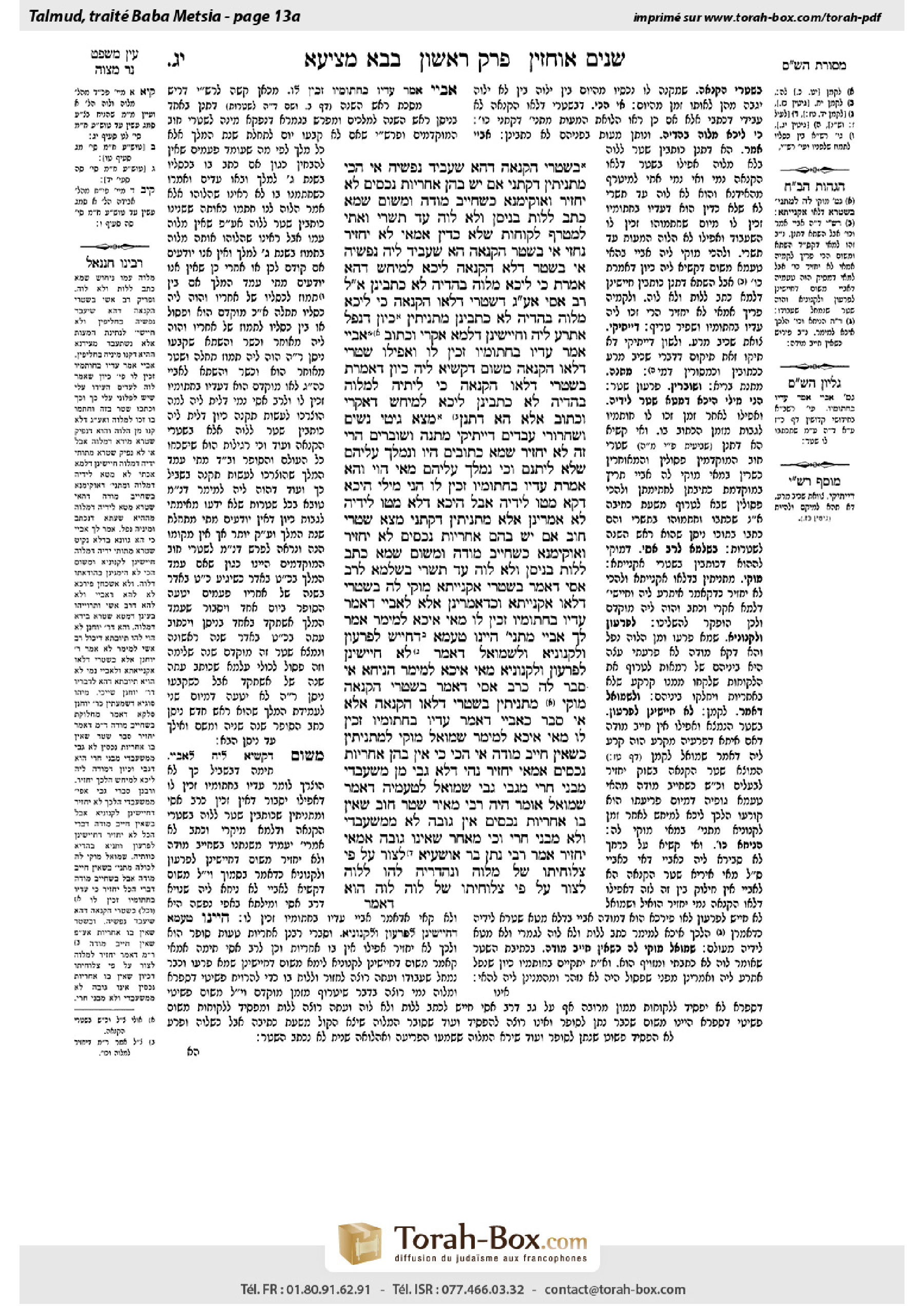
Bava Metzia 13a: Talmud study for Daf Yomi
Study the Talmud for Daf Yomi with scanned pages, Hebrew text, English translations from Sefaria and AI-generated French translations.
Passage selection and English or AI-generated French translation are available where the scan has annotations. Daf Study is independent of Torah-Box and Sefaria.
Browse Bava Metzia · בבא מציעא · All tractatesBava Metzia 13a text and translations
This page of Bava Metzia includes the Aramaic text, an English translation and an AI-generated French translation, alongside the scan above.
בבא מציעא י״ג א · Aramaic and Hebrew text
בִּשְׁטָרֵי הַקְנָאָה, דְּהָא שַׁעְבֵּיד נַפְשֵׁיהּ.
אִי הָכִי, מַתְנִיתִין דְּקָתָנֵי: ״אִם יֵשׁ בָּהֶן אַחְרָיוּת נְכָסִים לֹא יַחֲזִיר״, וְאוֹקֵימְנָא כְּשֶׁחַיָּיב מוֹדֶה, וּמִשּׁוּם שֶׁמָּא כָּתַב לִלְוֹת בְּנִיסָן וְלֹא לָוָה עַד תִּשְׁרֵי, וְאָתֵי לְמִטְרַף לָקוֹחוֹת שֶׁלֹּא כַּדִּין, אַמַּאי לֹא יַחֲזִיר?
נֶחְזֵי אִי בִּשְׁטַר הַקְנָאָה – הָא שַׁעְבֵּיד לֵיהּ נַפְשֵׁיהּ! אִי בִּשְׁטָר דְּלָא הַקְנָאָה – לֵיכָּא לְמֵיחַשׁ, דְּהָא אָמְרַתְּ כִּי לֵיכָּא מַלְוֶה בַּהֲדֵיהּ לָא כָּתְבִינַן.
אָמַר לְךָ רַב אַסִּי: אַף עַל גַּב דִּשְׁטָרֵי דְּלָאו הַקְנָאָה, כִּי לֵיכָּא מַלְוֶה בַּהֲדֵיהּ לָא כָּתְבִינַן, מַתְנִיתִין כֵּיוָן דִּנְפַל אִתְּרַע לֵיהּ, וְחָיְישִׁינַן דִּלְמָא אִקְּרִי וּכְתוּב.
אַבָּיֵי אָמַר: עֵדָיו בַּחֲתוּמָיו זָכִין לוֹ, וַאֲפִילּוּ שְׁטָרֵי דְּלָאו הַקְנָאָה.
מִשּׁוּם דְּקַשְׁיָא לֵיהּ: כֵּיוָן דְּאָמְרַתְּ בִּשְׁטָרֵי דְּלָאו הַקְנָאָה כִּי לֵיתֵיהּ לְמַלְוֶה בַּהֲדֵיהּ לָא כָּתְבִינַן, לֵיכָּא לְמֵיחַשׁ דְּאִקְּרִי וּכְתוּב.
אֶלָּא הָא דִּתְנַן: מָצָא גִּיטֵּי נָשִׁים וְשִׁחְרוּרֵי עֲבָדִים, דְּיָיתֵיקֵי, מַתָּנָה וְשׁוֹבָרִים – הֲרֵי זֶה לֹא יַחְזִיר, שֶׁמָּא כְּתוּבִים הָיוּ וְנִמְלַךְ עֲלֵיהֶם שֶׁלֹּא לִיתְּנָם. וְכִי נִמְלַךְ עֲלֵיהֶם מַאי הָוֵי? וְהָא אָמְרַתְּ: עֵדָיו בַּחֲתוּמָיו זָכִין לוֹ?
הָנֵי מִילֵּי הֵיכָא דְּקָא מָטוּ לִידֵיהּ. אֲבָל הֵיכָא דְּלָא מָטוּ לִידֵיהּ לָא אָמְרִינַן.
אֶלָּא מַתְנִיתִין דְּקָתָנֵי: מָצָא שִׁטְרֵי חוֹב, אִם יֵשׁ בָּהֶם אַחְרָיוּת נְכָסִים – לֹא יַחְזִיר. וְאוֹקִימְנָא כְּשֶׁחַיָּיב מוֹדֶה, וּמִשּׁוּם שֶׁמָּא כָּתַב לִלְוֹת בְּנִיסָן וְלֹא לָוָה עַד תִּשְׁרֵי.
בִּשְׁלָמָא לְרַב אַסִּי דְּאָמַר בִּשְׁטָרֵי אַקְנְיָיתָא – מוֹקֵי לַהּ בִּשְׁטָרֵי דְּלָאו אַקְנְיָיתָא, וְכִדְאָמְרִינַן. אֶלָּא לְאַבָּיֵי, דְּאָמַר: עֵדָיו בַּחֲתוּמָיו זָכִין לוֹ, מַאי אִיכָּא לְמֵימַר?
אָמַר לָךְ אַבָּיֵי, מַתְנִיתִין הַיְינוּ טַעְמָא: דְּחָיְישִׁ[ינַן] לְפֵרָעוֹן וְלִקְנוּנְיָא.
וְלִשְׁמוּאֵל, דְּאָמַר לָא חָיְישִׁינַן לְפֵרָעוֹן וְלִקְנוּנְיָא, מַאי אִיכָּא לְמֵימַר? הָנִיחָא אִי סָבַר לַהּ כְּרַב אַסִּי דְּאָמַר בִּשְׁטָרֵי הַקְנָאָה – מוֹקֵי מַתְנִיתִין בִּשְׁטָרֵי דְּלָאו הַקְנָאָה. אֶלָּא אִי סָבַר כְּאַבָּיֵי דְּאָמַר עֵדָיו בַּחֲתוּמָיו זָכִין לוֹ, מַאי אִיכָּא לְמֵימַר?
שְׁמוּאֵל מוֹקֵי לְמַתְנִיתִין כְּשֶׁאֵין חַיָּיב מוֹדֶה.
אִי הָכִי, כִּי אֵין בָּהֶן אַחְרָיוּת נְכָסִים אַמַּאי יַחְזִיר? נְהִי דְּלָא גָּבֵי מִן מְשַׁעְבְּדֵי, מִבְּנֵי חָרֵי מִגְבֵּי גָּבֵי!
שְׁמוּאֵל לְטַעְמֵיהּ: דְּאָמַר שְׁמוּאֵל, אוֹמֵר הָיָה רַבִּי מֵאִיר: שְׁטַר חוֹב שֶׁאֵין בּוֹ אַחְרָיוּת נְכָסִים – אֵין גּוֹבֶה לָא מִמְּשַׁעְבְּדִי וְלָא מִבְּנֵי חָרֵי.
וְכִי מֵאַחַר שֶׁאֵינוֹ גּוֹבֶה אַמַּאי יַחְזִיר? אָמַר רַבִּי נָתָן בַּר אוֹשַׁעְיָא: לָצוֹר עַל פִּי צְלוֹחִיתוֹ שֶׁל מַלְוֶה.
וְנַהְדְּרֵיהּ (לְהוּ) לְלֹוֶה לָצוֹר עַל פִּי צְלוֹחִיתוֹ שֶׁל לֹוֶה! לֹוֶה הוּא
Bava Metzia 13a · English translation
This mishna is referring not to one who finds an ordinary promissory note but to one who finds deeds of transfer. This refers to a promissory note that establishes a lien on the debtor’s property from the date the note is written, regardless of when he borrows the money. Because the debtor obligated himself from that date, the creditor has the legal right to repossess his land from any subsequent purchasers.
The Gemara asks: If that is so, the following difficulty arises: How will one account for the ruling of the mishna here, which teaches that if the promissory notes include a property guarantee, the finder should not return them to the creditor; and we established that the reference is to a case when the debtor admits that he still owes the debt and that the promissory note should not be returned due to suspicion that perhaps the debtor wrote it with the intention to borrow the money in Nisan but did not actually borrow it until Tishrei, and therefore, if the promissory note is returned to the creditor he will come to repossess the land from the purchasers unlawfully. If Rav Asi’s explanation is correct, why shouldn’t the finder return the document?
The Gemara elaborates: Let us see what the possibilities are. If the reference is to a deed of transfer, didn’t the debtor obligate himself that his property can be collected for payment of the loan from the date that the deed of transfer was written? Conversely, if the reference is to a promissory note that is not a deed of transfer, there is no room for concern, as you said that in such a case, when the lender is not present together with the borrower, we do not write such a document.
The Gemara answers: Rav Asi could have said to you: Although we do not write promissory notes that are not deeds of transfer when the lender is not present together with the borrower, with regard to the case in the mishna it can be explained that since the promissory note was dropped, its credibility was compromised, and consequently we are concerned that perhaps it happened to have been written in the absence of the lender, deviating from the standard procedure.
Abaye stated an alternative explanation of the mishna that allows one to write a promissory note for a borrower in the absence of the lender: The document’s witnesses, with their signatures, acquire the lender’s lien on the borrower’s land on the lender’s behalf, despite the fact that the loan did not occur yet. And this applies even with regard to promissory notes that are not deeds of transfer.
Abaye offered this explanation because Rav Asi’s explanation was difficult for him; since you said with regard to promissory notes that are not deeds of transfer that we do not write them when the lender is not present together with the borrower, there is no reason for concern that perhaps in the case of a found promissory note it happened to be written in the lender’s absence.
The Gemara asks: But how can Abaye’s opinion be reconciled with that which we learned in a mishna (18a): If one found bills of divorce, or bills of manumission of slaves, or wills [deyaitiki], or deeds of gift, or receipts, he may not return them to the people who are presumed to have lost them. The reason is that perhaps they were only written and not delivered, because the one who wrote them subsequently reconsidered about them and decided not to deliver them. The Gemara asks: If he reconsidered and decided not to deliver them, what of it? Didn’t you say that a document’s witnesses, with their signatures, acquire it on behalf of the recipient? If so, why shouldn’t it be returned to him?
The Gemara answers: This statement, that a creditor acquires the lien on the debtor’s land immediately when the witnesses sign the document, applies only in a case where the document came into the creditor’s possession; but in a case where the document did not come into his possession, as it was never given to him, we do not say that.
The Gemara asks: Rather, how can the mishna be reconciled with Abaye’s opinion? As it teaches: With regard to one who found promissory notes, if they include a property guarantee, he may not return them to the creditor. And we established that the mishna is referring to a case when the liable party, i.e., the debtor, admits to the debts, and nevertheless the finder may not return the note due to the suspicion that perhaps he wrote the promissory note with the intention to borrow the money in Nisan but he did not actually borrow it until Tishrei.
The Gemara elaborates: Granted, according to Rav Asi, who says that the halakha that a promissory note may be written for a borrower in the absence of the lender applies only with regard to deeds of transfer, the mishna can be established as referring to promissory notes that are not deeds of transfer, and it is as we stated above. But according to Abaye, who says that a document’s witnesses, with their signatures, acquire the lien on the lender’s behalf, what is there to say? Why shouldn’t one return the promissory notes even if they include a property guarantee for the loan?
The Gemara answers that Abaye could have said to you that this is the reason for the ruling in the mishna: It is that the tanna suspects that there was repayment and collusion. Although the debtor admits his debt, he is suspected to be lying, as after he repaid the debt he might have colluded with the creditor to repossess land that he sold during the period of the loan, and the debtor and creditor would split the money between them.
The Gemara asks: But according to Shmuel, who says that we do not suspect repayment and collusion, what is there to say? How can the mishna be explained? This works out well if Shmuel holds in accordance with the opinion of Rav Asi, who says that only in the case of deeds of transfer is it permitted to write a promissory note for a borrower in the absence of the lender. Accordingly, Shmuel can establish the mishna as referring to promissory notes that are not deeds of transfer. But if Shmuel holds in accordance with the opinion of Abaye, who says that a document’s witnesses, with their signatures, acquire the lien on the creditor’s behalf, what is there to say?
The Gemara answers: Shmuel can establish the mishna as referring to a case when the purported liable party does not admit to the debt, and therefore the finder may not return the promissory notes to the creditor.
The Gemara asks: If so, in a case when the promissory notes do not include a property guarantee, why must the finder return them to the purported creditor? Granted, the creditor cannot collect the debt from liened property that had been sold, but he can collect it from the debtor’s unsold property, even though the debtor claims to be exempt.
The Gemara answers: Shmuel conforms to his standard line of reasoning, as Shmuel says that Rabbi Meir would say: In the case of a promissory note that does not include a property guarantee, the creditor collects neither from liened property that has been sold nor from unsold property. Therefore, there is no harm in the finder returning the promissory note to the creditor.
The Gemara asks: But since the creditor cannot collect the debt, why should the finder return the promissory note? For what purpose can the creditor use it? Rabbi Natan bar Oshaya says: The creditor can use it to cover the opening of his flask. Its only value is as a piece of paper.
The Gemara asks: If the document has only the value of the paper, let the finder return it to the debtor, to cover the opening of the debtor’s flask. The Gemara answers: The debtor is
Bava Metzia 13a · Traduction française (IA)
Cette mésorah ne fait pas référence à celui qui trouve une note de promesse ordinaire, mais à celui qui trouve des actes de transfert. Il s'agit d'une note de promesse qui établit un droit de gage sur la propriété du débiteur à la date où la note est rédigée, indépendamment de la date à laquelle le débiteur a emprunté l'argent. Puisque le débiteur s'est engagé à cette date, le créancier a le droit légal de récupérer sa terre auprès de tout acheteur ultérieur.
Le Guemara pose la question : Si c'est ainsi, un problème se présente : comment expliquer la décision de la mésorah ici, qui enseigne que si les notes de promesse incluent une garantie immobilière, le trouver ne doit pas les rendre au créancier ; et nous avons établi que la référence est à un cas où le débiteur admet qu'il doit encore l'argent et que la note ne doit pas être rendue en raison de l'incertitude qu'il ait rédigé la note avec l'intention de prêter l'argent en Nisan mais n'ait réellement emprunté l'argent qu'en Tishrei, et donc, si la note est rendue au créancier, il viendra légalement récupérer la terre auprès des acheteurs. Si l'explication de Rav Asi est correcte, pourquoi le trouver ne devrait-il pas rendre le document ?
Le Guemara développe : Examinons les possibilités. Si la référence est à un acte de transfert, n'a-t-il pas engagé le débiteur à ce que sa propriété puisse être récupérée pour le paiement du prêt à la date où l'acte de transfert a été rédigé ? À l'inverse, si la référence est à une note de promesse qui n'est pas un acte de transfert, il n'y a pas lieu de s'inquiéter, car vous avez dit que dans ce cas, lorsque le prêteur n'est pas présent avec le prêteur, nous n'écrivons pas de tel document.
Le Guemara répond : Rav Asi aurait pu dire à vous : Bien que nous n'écrivions pas de notes de promesse qui ne sont pas des actes de transfert lorsque le prêteur n'est pas présent avec le prêteur, concernant le cas de la mésorah, on peut expliquer que puisque la note a été perdue, sa crédibilité a été compromise, et par conséquent, nous nous inquiétons qu'elle ait pu être rédigée en l'absence du prêteur, s'écartant de la procédure standard.
Abaye a formulé une autre explication de la mésorah qui permet d'écrire une note de promesse pour un prêteur en l'absence du prêteur : Les témoins du document, avec leurs signatures, acquièrent le droit de gage du prêteur sur la propriété du prêteur à la place du prêteur, même si le prêt n'a pas encore eu lieu. Et cela s'applique même aux notes de promesse qui ne sont pas des actes de transfert.
Abaye a proposé cette explication parce que l'explication de Rav Asi était difficile pour lui ; puisque vous avez dit concernant les notes de promesse qui ne sont pas des actes de transfert que nous n'écrivons pas de tel document lorsque le prêteur n'est pas présent avec le prêteur, il n'y a pas de raison de s'inquiéter que, dans le cas d'une note de promesse trouvée, elle ait pu être rédigée en l'absence du prêteur.
Le Guemara pose la question : Mais comment concilier l'opinion d'Abaye avec ce que nous avons appris dans une mitsva (18a) : Si l'on trouvait des actes de divorce, ou des actes de manumission des esclaves, ou des testaments [deyaitiki], ou des dons, ou des reçus, on ne devait pas les rendre aux personnes qui étaient supposées les avoir perdus. La raison est que peut-être ils ont été seulement rédigés et non livrés, car celui qui les a rédigés a ensuite réfléchi et décidé de ne pas les livrer. Le Guemara pose la question : Si il a réfléchi et décidé de ne pas les livrer, qu'y a-t-il de mal ? N'avez-vous pas dit que les témoins d'un document, avec leurs signatures, acquièrent le document à la place du destinataire ? Si c'est ainsi, pourquoi ne devrait-il pas être rendu à lui ?
Le Guemara répond : Cette déclaration, que le créancier acquiert le droit de gage sur la propriété du débiteur immédiatement lorsque les témoins signent le document, s'applique uniquement dans le cas où le document est en possession du créancier ; mais dans le cas où le document n'est pas en possession du créancier, comme il n'a jamais été donné à lui, nous ne disons pas cela.
Le Guemara pose la question : Plutôt, comment concilier la mitsva avec l'opinion d'Abaye ? Comme il enseigne : Concernant celui qui trouve des notes de promesse, si elles incluent une garantie immobilière, il ne doit pas les rendre au créancier. Et nous avons établi que la mitsva fait référence à un cas où la partie responsable, c'est-à-dire le débiteur, admet ses dettes, et pourtant le trouver ne doit pas rendre la note en raison de l'incertitude qu'il ait rédigé la note de promesse avec l'intention de prêter l'argent en Nisan mais n'ait réellement emprunté l'argent qu'en Tishrei.
Le Guemara développe : Bien sûr, selon Rav Asi, qui affirme que la halakha selon laquelle une note de promesse peut être rédigée pour un prêteur en l'absence du prêteur s'applique uniquement aux actes de transfert, la mésorah peut être établie comme faisant référence à des notes de promesse qui ne sont pas des actes de transfert, et c'est comme nous l'avons dit ci-dessus. Mais selon Abaye, qui affirme que les témoins d'un document, avec leurs signatures, acquièrent le droit de gage à la place du prêteur, qu'est-ce que cela signifie ? Pourquoi ne devrait-on pas rendre les notes de promesse même s'ils incluent une garantie immobilière pour le prêt ?
Le Guemara répond que Abaye pourrait avoir dit à vous que c'est la raison de la décision de la mésorah : c'est que le tanna soupçonne qu'il y a eu un paiement et un complot. Bien que le débiteur admette sa dette, il est soupçonné de mentir, car après avoir remboursé la dette, il pourrait avoir comploté avec le créancier pour récupérer la terre qu'il a vendue pendant la période du prêt, et le débiteur et le créancier partageraient l'argent entre eux.
La Guemara pose la question : Mais selon Shmuel, qui dit qu’on ne soupçonne pas le remboursement ni la complicité, que dire alors ? Comment expliquer la mésiha ? Cela s’explique bien si Shmuel suit l’opinion de Rav Asi, qui dit que seul dans le cas des actes de transfert on peut écrire une note de promesse de paiement pour un emprunteur en l’absence du prêteur. Ainsi, Shmuel peut établir la mésiha comme se rapportant à des notes de promesse de paiement qui ne sont pas des actes de transfert. Mais si Shmuel suit l’opinion d’Abaye, qui dit que les témoins d’un document, avec leurs signatures, acquièrent le droit de gage pour le compte du créancier, que dire alors ?
La Guemara répond : Shmuel peut établir la mésiha comme se rapportant à un cas où la personne prétendument responsable ne reconnaît pas la dette, et par conséquent le trouveur ne peut pas rendre les notes de promesse de paiement au créancier.
La Guemara pose la question : Si c’est ainsi, dans un cas où les notes de promesse de paiement ne comportent pas une garantie immobilière, pourquoi le trouveur doit-il les rendre au créancier prétendument ? Bien que le créancier ne puisse pas récupérer la dette des biens gagnés qui ont été vendus, il peut la récupérer des biens non vendus du débiteur, même si le débiteur affirme être exempt.
La Guemara répond : Shmuel suit sa ligne de raisonnement habituelle, car Shmuel affirme que Rabbi Meir dirait : Dans le cas d'une note de promesse de paiement qui ne comporte pas une garantie immobilière, le créancier ne récupère ni des biens hypothéqués qui ont été vendus ni des biens non vendus. Par conséquent, il n'y a pas de danger à ce que le trouveur rende la note de promesse de paiement au créancier.
La Guemara pose la question : Mais puisque le créancier ne peut pas récupérer la dette, pourquoi le trouveur doit-il rendre la note de promesse de paiement ? À quel usage peut-il l'utiliser ? Rabbi Natan bar Oshaya dit : Le créancier peut l'utiliser pour couvrir l'ouverture de sa bouteille. Sa seule valeur est celle d'un morceau de papier.
La Guemara pose la question : Si le document n'a que la valeur du papier, laissez le trouveur le rendre au débiteur, pour couvrir l'ouverture de la bouteille du débiteur. La Guemara répond : Le débiteur est
Traduction française générée par IA à partir de l’édition anglaise de Sefaria. Vérifie toujours un passage avec le texte source.
Text from Sefaria: William Davidson Edition - Vocalized Aramaic (CC BY NC); William Davidson Edition - English (CC BY NC).