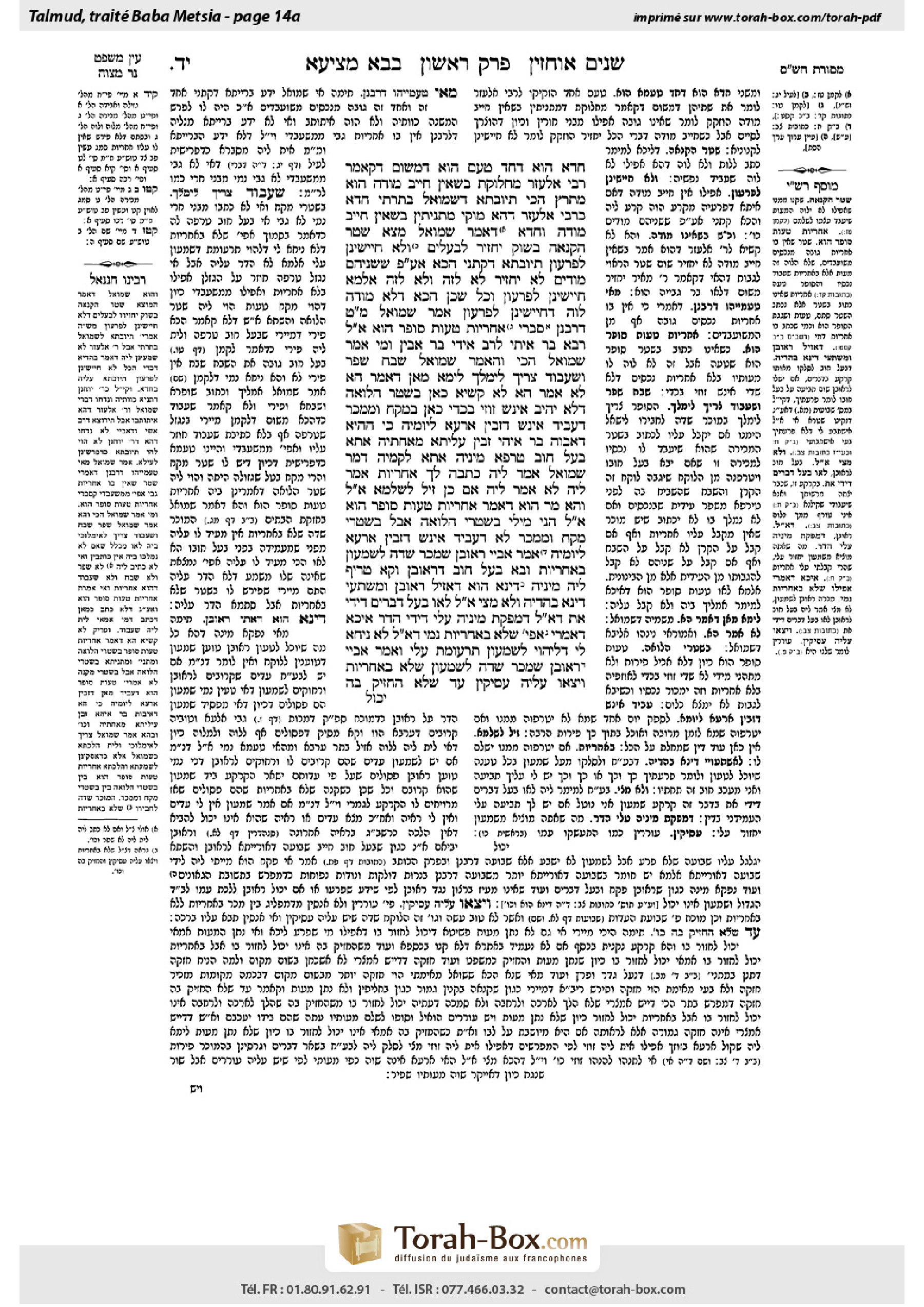
Bava Metzia 14a: Talmud study for Daf Yomi
Study the Talmud for Daf Yomi with scanned pages, Hebrew text, English translations from Sefaria and AI-generated French translations.
Passage selection and English or AI-generated French translation are available where the scan has annotations. Daf Study is independent of Torah-Box and Sefaria.
Browse Bava Metzia · בבא מציעא · All tractatesBava Metzia 14a text and translations
This page of Bava Metzia includes the Aramaic text, an English translation and an AI-generated French translation, alongside the scan above.
בבא מציעא י״ד א · Aramaic and Hebrew text
חֲדָא הוּא, דְּחַד טַעַם הוּא, דְּמִשּׁוּם דְּקָאָמַר רַבִּי אֶלְעָזָר מַחְלוֹקֶת בְּשֶׁאֵין חַיָּיב מוֹדֶה – הוּא מְתָרֵץ הָכִי.
תְּיוּבְתָּא דִשְׁמוּאֵל בְּתַרְתֵּי: חֲדָא כְּרַבִּי אֶלְעָזָר, דְּהָא מוֹקֵי מַתְנִיתִין בְּשֶׁאֵין חַיָּיב מוֹדֶה.
וַחֲדָא דְּאָמַר שְׁמוּאֵל: מָצָא שְׁטַר הַקְנָאָה בַּשּׁוּק – יַחְזִיר לַבְּעָלִים, וְלָא חָיְישִׁינַן לְפֵרָעוֹן.
תְּיוּבְתָּא דְּקָתָנֵי הָכָא: אַף עַל פִּי שֶׁשְּׁנֵיהֶם מוֹדִים לֹא יַחְזִיר לֹא לָזֶה וְלֹא לָזֶה, אַלְמָא חָיְישִׁינַן לְפֵרָעוֹן, וְכׇל שֶׁכֵּן הָכָא דְּלָא מוֹדֵה לֹוֶה – דְּחָיְישִׁינַן לְפֵרָעוֹן.
אָמַר שְׁמוּאֵל: מַאי טַעְמַיְיהוּ דְּרַבָּנַן? סָבְרִי אַחְרָיוּת טָעוּת סוֹפֵר הוּא.
אֲמַר לֵיהּ רָבָא בַּר אִיתַּי לְרַב אִידִי בַּר אָבִין: וּמִי אָמַר שְׁמוּאֵל הָכִי? וְהָאָמַר שְׁמוּאֵל: שֶׁבַח, שֶׁפֶר וְשִׁעְבּוּד – צָרִיךְ לִימָּלֵךְ!
לֵימָא מַאן דְּאָמַר הָא לָא אָמַר הָא?
לָא קַשְׁיָא: כָּאן בִּשְׁטַר הַלְוָאָה, דְּלָא יָהֵיב אִינָשׁ זוּזֵי בִּכְדִי. כָּאן בְּמִקָּח וּמִמְכָּר, דְּעָבֵיד אִינָשׁ דְּזָבֵין אַרְעָא לְיוֹמֵיהּ.
כִּי הָהִיא דַּאֲבוּהּ בַּר אִיהִי זְבַין עִלִּיתָא מֵאֲחָתֵיהּ, אֲתָא בַּעַל חוֹב טַרְפַהּ מִינֵּיהּ. אֲתָא לְקַמֵּיהּ דְּמָר שְׁמוּאֵל, אֲמַר לֵיהּ: כְּתַבָה לָךְ אַחְרָיוּת? אֲמַר לֵיהּ: לָא. אֲמַר לֵיהּ: אִם כֵּן, זִיל לִשְׁלָמָא. אֲמַר לֵיהּ: וְהָא מָר הוּא דְּאָמַר אַחְרָיוּת טָעוּת סוֹפֵר הוּא! אֲמַר לֵיהּ: הָנֵי מִילֵּי בִּשְׁטָרֵי הַלְוָאָה, אֲבָל בִּשְׁטָרֵי מִקָּח וּמִמְכָּר – לָא, דַּעֲבִיד אִינָשׁ דְּזָבֵין אַרְעָא לְיוֹמֵיהּ.
אָמַר אַבָּיֵי: רְאוּבֵן שֶׁמָּכַר שָׂדֶה לְשִׁמְעוֹן בְּאַחְרָיוּת, וּבָא בַּעַל חוֹב דִּרְאוּבֵן וְקָא טָרֵיף לֵיהּ מִינֵּיהּ, דִּינָא הוּא דְּאָזֵיל רְאוּבֵן וּמִשְׁתַּעֵי דִּינָא בַּהֲדֵיהּ, וְלָא מָצֵי אָמַר לֵיהּ: לָאו בַּעַל דְּבָרִים דִּידִי אַתְּ, דְּאָמַר לֵיהּ: דְּמַפְּקַתְּ מִינֵּיהּ, עֲלַי דִּידִי הָדַר.
אִיכָּא דְּאָמְרִי: אֲפִילּוּ שֶׁלֹּא בְּאַחְרָיוּת נָמֵי, דְּאָמַר לֵיהּ: לָא נִיחָא לִי דְּלֶיהְוֵי לְשִׁמְעוֹן תַּרְעוֹמֶת עֲלַי.
וְאָמַר אַבָּיֵי: רְאוּבֵן שֶׁמָּכַר שָׂדֶה לְשִׁמְעוֹן שֶׁלֹּא בְּאַחְרָיוּת, וְיָצְאוּ עָלֶיהָ עֲסִיקִין, עַד שֶׁלֹּא הֶחְזִיק בָּהּ
Bava Metzia 14a · English translation
The Gemara answers: It is actually one element, as both elements have the same one reason; because Rabbi Elazar says that the dispute in the mishna is in a case when the liable party does not admit his debt, he explains Rabbi Meir’s opinion in this manner, i.e., that a promissory note that does not include a property guarantee cannot be used to collect the debt even from unsold property.
The Gemara elaborates on the statement that the baraita serves as a conclusive refutation of two elements of the opinion of Shmuel: One element is like the element of the opinion of Rabbi Elazar that was refuted, as Shmuel also establishes the dispute in the mishna as referring to a case when the liable party does not admit to the debt, and the baraita states that in such a case there is no dispute.
And the other one is that which Shmuel says: If one found a deed of transfer in the marketplace, in which it is stipulated that the debtor transfers the rights to his property from the date that the document was signed, he must return it to its owner, and we do not suspect that there was repayment and that there is collusion between the creditor and the debtor.
There is a conclusive refutation of that statement as well, as the baraita here teaches: Even if they both agree, he should return it neither to this person nor to that person. Apparently, we suspect that there was repayment. And all the more so here, in the case of a deed of transfer, when the liable party does not admit that he owes money, the deed should certainly not be returned, as we suspect that there was repayment.
§ Shmuel said: What is the reason for the opinion of the Rabbis, who say that one can collect a debt from liened property even if the promissory note does not include a property guarantee? They hold that omission of the property guarantee from the promissory note is a scribal error, as one would certainly not lend money without a property guarantee.
Rava bar Ittai said to Rav Idi bar Avin: Did Shmuel actually say this; i.e., that the omission of this clause is considered a scribal error? But doesn’t Shmuel say that enhancement, superior-quality land, and a lien require consultation? When a scribe writes a deed of sale for a field he must ask the seller whether to write explicitly that if there is a lien on the field, and the field is then is repossessed from the buyer, in which case the seller must compensate the buyer for any enhancement of the value of the field that occurred while it was in his possession, that this compensation will be made from superior-quality land, and that he liens all of his land as security for this sale. This indicates that Shmuel holds that a property guarantee is not written in every promissory note.
The Gemara asks: Shall we say that the one who says this statement quoting Shmuel does not say that statement quoting Shmuel? Perhaps it is a dispute between the amora’im who transmitted the statements of Shmuel.
The Gemara answers: This is not difficult. Here, where Shmuel said that the omission of a property guarantee is a scribal error, it was with regard to a promissory note, as a person does not give away his money for nothing. When one lends his money, he requires a property guarantee. There, by contrast, where Shmuel said that a scribe must consult with the seller with regard to writing a property guarantee, it is with regard to a case of buying and selling land, as a person is apt to purchase land for a day. It is conceivable that the buyer is willing to risk that there is a prior lien on the land, thinking that even if he owns the property only for one day he can earn a profit.
As evidence of this distinction, the Gemara gives an example: It is like that incident in which Avuh bar Ihi purchased a loft from his sister. Her creditor came and repossessed the loft from him. He came before Mar Shmuel to file a claim against his sister. Shmuel said to him: Did she write you a guarantee in the deed of sale? He said to Shmuel: No. Shmuel said to him: If so, go to peace (see Berakhot 64a), as there is nothing that can be done. He said to Shmuel: But wasn’t it you, Master, who said that omission of the guarantee of the sale from the document is a scribal error? Shmuel said to him: This statement applies only to promissory notes, but with regard to deeds of buying and selling it does not apply, as a person is apt to purchase land for a day.
§ Abaye said: Consider the case of Reuven, who sold a field to Shimon with a property guarantee, and Reuven’s creditor came and repossessed the field from Shimon, as he had a prior lien on the property. It is the halakha that Reuven can go and litigate with the creditor, and the creditor cannot say to him: I am not legally answerable to you since I am taking the field from Shimon. This is because Reuven can say to his creditor: That which you take from him comes back to me, as I sold the field to Shimon with a guarantee, so you cannot claim that I am not a legal party in this matter.
There are those who say that Abaye said: Even if Reuven sold the field to Shimon without a property guarantee, Reuven can dispute the legal claim in court, as he can say to the creditor: It is not amenable to me that Shimon would have a grievance against me for selling him property that was subsequently repossessed.
And Abaye said: Consider the case of Reuven, who sold a field to Shimon without a property guarantee, and disputants emerged disputing Reuven’s prior ownership of the field. As long as Shimon has not yet taken actual possession of the land,
Bava Metzia 14a · Traduction française (IA)
Le Guemara répond : C’est en réalité un seul élément, car les deux éléments partagent la même raison ; car Rabbi Elazar dit que le désaccord dans la mitsna est dans un cas où la partie responsable ne reconnaît pas sa dette, il explique ainsi l’opinion de Rabbi Meir, à savoir qu’un titre de dette ne comportant pas une garantie immobilière ne peut être utilisé pour récupérer la dette même sur une propriété non vendue.
Le Guemara développe l’affirmation selon laquelle la baraïta sert de réfutation définitive de deux éléments de l’opinion de Shmuel : l’un est comme l’élément de l’opinion de Rabbi Elazar qui a été réfuté, car Shmuel établit également le désaccord dans la mitsna comme se rapportant à un cas où la partie responsable ne reconnaît pas sa dette, et la baraïta affirme que dans ce cas-là il n’y a pas de désaccord.
Et l’autre est ce que Shmuel dit : Si l’on trouve un acte de transfert au marché, stipulant que le débiteur transfère les droits sur sa propriété à partir de la date de signature du document, il doit le rendre à son propriétaire, et nous ne soupçonnons pas qu’il y ait un remboursement et qu’il y ait une complicité entre le créancier et le débiteur.
Il y a également une réfutation définitive de cette affirmation, car la baraïta enseigne ici : Même s’ils sont d’accord, il ne doit pas le rendre à cette personne ni à celle-ci. Apparemment, nous soupçonnons qu’il y a eu un remboursement. Et encore davantage dans le cas d’un acte de transfert, lorsque la partie responsable ne reconnaît pas qu’il doit de l’argent, le document ne devrait certainement pas être rendu, car nous soupçonnons qu’il y a eu un remboursement.
§ Shmuel dit : Quelle est la raison de l’opinion des Rabbins, qui affirment qu’on peut récupérer une dette sur une propriété hypothéquée même si le titre de dette ne comporte pas de garantie immobilière ? Ils pensent que l’omission de la garantie immobilière dans le titre de dette est une erreur d’écriture, car on ne prête pas de l’argent sans garantie immobilière.
Rava bar Ittai dit à Rav Idi bar Avin : A-t-il vraiment dit cela Shmuel, c’est-à-dire que l’omission de cette clause est considérée comme une erreur d’écriture ? Mais ne dit-il pas Shmuel que l’amélioration, les terres de qualité supérieure et l’hypothèque nécessitent une consultation ? Lorsqu’un scribe écrit un acte de vente d’un champ, il doit demander au vendeur s’il veut spécifier explicitement que s’il y a une hypothèque sur le champ, et que le champ est ensuite réclamé par le vendeur, dans ce cas le vendeur doit indemniser l’acheteur pour toute amélioration de valeur du champ pendant qu’il était en sa possession, que cette indemnité sera réclamée à partir de terres de qualité supérieure, et qu’il hypothéque toute sa terre comme garantie pour cette vente. Cela montre que Shmuel considère que la garantie immobilière n’est pas écrite dans chaque titre de dette.
Le Guemara pose la question : Devons-nous dire que celui qui cite cette déclaration de Shmuel ne cite pas cette déclaration de Shmuel ? Peut-être s’agit-il d’un désaccord entre les amoraïm qui transmettaient les déclarations de Shmuel.
Le Guemara répond : Ce n’est pas difficile. Ici, où Shmuel dit que l’omission d’une garantie immobilière est une erreur d’écriture, il s’agissait d’un titre de dette, car une personne ne donne pas son argent sans raison. Lorsqu’on prête de l’argent, on exige une garantie immobilière. Là, par contraste, où Shmuel dit qu’un scribe doit consulter avec le vendeur concernant l’écriture d’une garantie immobilière, il s’agit d’un cas d’achat et de vente de terre, car une personne peut acheter une terre pour une journée. Il est concevable que l’acheteur accepte de prendre le risque qu’il y ait une hypothèque préalable sur la terre, pensant que même s’il possède la propriété seulement une journée, il peut gagner un profit.
Comme preuve de cette distinction, le Guemara donne un exemple : C’est comme l’incident où Avuh bar Ihi a acheté un grenier de sa sœur. Son créancier est venu et a réclamé le grenier de lui. Il est venu devant Mar Shmuel pour présenter une réclamation contre sa sœur. Shmuel lui a dit : A-t-elle écrit une garantie dans l’acte de vente ? Il lui a répondu : Non. Shmuel lui a dit : Si c’est le cas, va en paix (voir Berakhot 64a), car il n’y a rien à faire. Il lui a dit à Shmuel : Mais n’était-ce pas toi, Maître, qui as dit que l’omission de la garantie de la vente dans le document est une erreur d’écriture ? Shmuel lui a répondu : Cette déclaration s’applique uniquement aux titres de dette, mais concernant les actes d’achat et de vente, elle ne s’applique pas, car une personne peut acheter une terre pour une journée.
§ Abaye dit : Considérons le cas de Réouven, qui a vendu un champ à Shimon avec une garantie immobilière, et le créancier de Réouven est venu et a réclamé le champ de Shimon, car il avait une hypothèque préalable sur la propriété. C’est la halakha que Réouven peut aller en justice contre le créancier, et le créancier ne peut pas lui dire : Je ne suis pas légalement responsable envers toi, car je prends le champ de Shimon. C’est parce que Réouven peut dire à son créancier : Ce que tu prends de lui revient à moi, car j’ai vendu le champ à Shimon avec une garantie, donc tu ne peux pas affirmer que je ne suis pas une partie légale dans cette affaire.
Certains disent que Abaye a dit : Même si Réouven a vendu le champ à Shimon sans garantie immobilière, Réouven peut contester la réclamation en justice, car il peut dire au créancier : Ce n’est pas acceptable pour moi que Shimon ait une réclamation contre moi pour avoir vendu une propriété qui a été réclamée ultérieurement.
Et Abaye a dit : Considérons le cas de Réouven, qui a vendu un champ à Shimon sans garantie immobilière, et des contestations sont apparues concernant la propriété antérieure de Réouven du champ. Tant que Shimon n’a pas encore pris possession effective du terrain,
Traduction française générée par IA à partir de l’édition anglaise de Sefaria. Vérifie toujours un passage avec le texte source.
Text from Sefaria: William Davidson Edition - Vocalized Aramaic (CC BY NC); William Davidson Edition - English (CC BY NC).