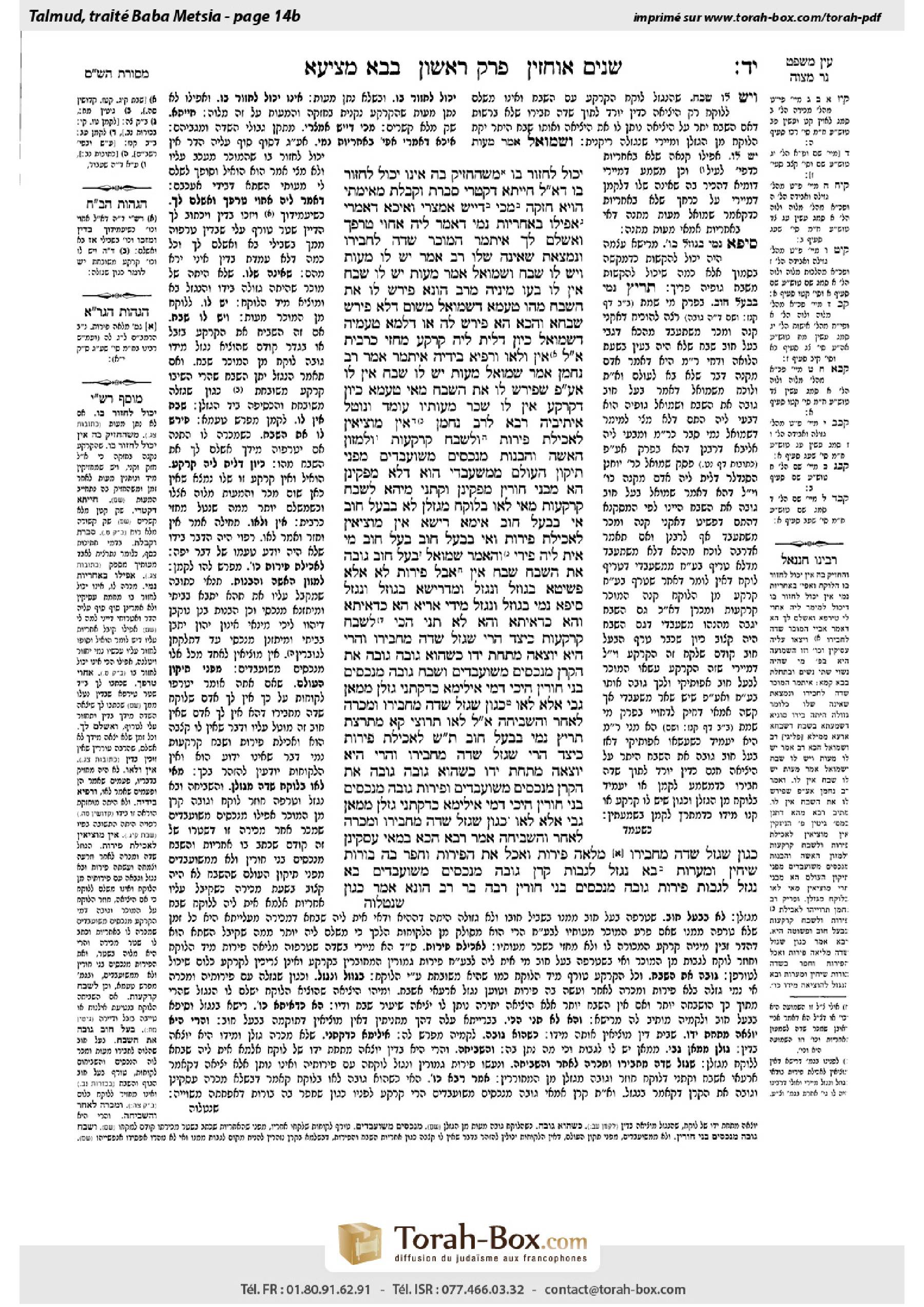
Bava Metzia 14b: Talmud study for Daf Yomi
Study the Talmud for Daf Yomi with scanned pages, Hebrew text, English translations from Sefaria and AI-generated French translations.
Passage selection and English or AI-generated French translation are available where the scan has annotations. Daf Study is independent of Torah-Box and Sefaria.
Browse Bava Metzia · בבא מציעא · All tractatesBava Metzia 14b text and translations
This page of Bava Metzia includes the Aramaic text, an English translation and an AI-generated French translation, alongside the scan above.
בבא מציעא י״ד ב · Aramaic and Hebrew text
יָכוֹל לַחֲזוֹר בּוֹ, מִשֶּׁהֶחְזִיק בָּהּ – אֵינוֹ יָכוֹל לַחֲזוֹר בּוֹ. דְּאָמַר לֵיהּ: חַיְיתָא דְקִטְרֵי סְבַרְתְּ וְקַבֵּלְתְּ. מֵאֵימָתַי הָוְיָא חֲזָקָה? מִכִּי דָיֵישׁ אַמִּצְרֵי.
וְאִיכָּא דְּאָמְרִי, אֲפִילּוּ בְּאַחְרָיוּת נָמֵי, דְּאָמַר לֵיהּ: אַחְוִי טִרְפָךְ וַאֲשַׁלֵּם לָךְ.
אִיתְּמַר: הַמּוֹכֵר שָׂדֶה לַחֲבֵירוֹ וְנִמְצֵאת שֶׁאֵינָהּ שֶׁלּוֹ. רַב אָמַר: יֵשׁ לוֹ מָעוֹת וְיֵשׁ לוֹ שֶׁבַח. וּשְׁמוּאֵל אָמַר: מָעוֹת יֵשׁ לוֹ, שֶׁבַח אֵין לוֹ.
בְּעוֹ מִינֵּיהּ מֵרַב הוּנָא: פֵּירֵשׁ לוֹ אֶת הַשֶּׁבַח מַהוּ? טַעְמָא דִשְׁמוּאֵל מִשּׁוּם דְּלָא פָּירֵשׁ שְׁבָחָא, וְהָכָא הָא פָּירֵשׁ לֵהּ, אוֹ דִלְמָא טַעְמֵיהּ דִשְׁמוּאֵל: כֵּיוָן דְּלֵית לֵיהּ קַרְקַע, מִחֲזֵי כְּרִיבִּית. אֲמַר לְהוּ: אִין וְלָאו, וְרַפְיָא בִּידֵיהּ.
אִיתְּמַר, אָמַר רַב נַחְמָן אָמַר שְׁמוּאֵל: מָעוֹת יֵשׁ לוֹ, שֶׁבַח אֵין לוֹ, אַף עַל פִּי שֶׁפֵּירַשׁ לוֹ אֶת הַשֶּׁבַח. מַאי טַעְמָא? כֵּיוָן דְּקַרְקַע אֵין לוֹ, שְׂכַר מְעוֹתָיו עוֹמֵד וְנוֹטֵל.
אֵיתִיבֵיהּ רָבָא לְרַב נַחְמָן: אֵין מוֹצִיאִין לַאֲכִילַת פֵּירוֹת, וְלִשְׁבַח קַרְקָעוֹת, וְלִמְזוֹן הָאִשָּׁה וְהַבָּנוֹת מִנְּכָסִים מְשׁוּעְבָּדִים, מִפְּנֵי תִּיקּוּן הָעוֹלָם.
מִמְּשַׁעְבְּדִי הוּא דְּלָא מַפְּקִינַן, הָא מִבְּנֵי (חוֹרִין) – [חָרֵי] מַפְּקִינַן, וְקָתָנֵי מִיהָא לִשְׁבַח קַרְקָעוֹת, מַאי לָאו בְּלוֹקֵחַ מִגַּזְלָן!
לָא בְּבַעַל חוֹב.
אִי בְּבַעַל חוֹב, אֵימָא רֵישָׁא: אֵין מוֹצִיאִין לַאֲכִילַת פֵּירוֹת, וְאִי בְּבַעַל חוֹב, בַּעַל חוֹב מִי אִית לֵיהּ פֵּירֵי? וְהָאָמַר שְׁמוּאֵל: בַּעַל חוֹב גּוֹבֶה אֶת הַשֶּׁבַח. שֶׁבַח – אִין, אֲבָל פֵּירוֹת – לָא!
אֶלָּא פְּשִׁיטָא בְּגוֹזֵל וְנִגְזָל. וּמִדְּרֵישָׁא בְּגוֹזֵל וְנִגְזָל, סֵיפָא נָמֵי בְּגוֹזֵל וְנִגְזָל.
מִידֵּי אִרְיָא?! הָא כִּדְאִיתָא וְהָא כִּדְאִיתָא.
וְהָא לָא תָּנֵי הָכִי: לְשֶׁבַח קַרְקָעוֹת כֵּיצַד? הֲרֵי שֶׁגָּזַל שָׂדֶה מֵחֲבֵירוֹ וַהֲרֵי הִיא יוֹצְאָה מִתַּחַת יָדוֹ, כְּשֶׁהוּא גּוֹבֶה – גּוֹבֶה אֶת הַקֶּרֶן מִנְּכָסִים מְשׁוּעְבָּדִים, וְשֶׁבַח – גּוֹבֶה מִנְּכָסִים בְּנֵי חוֹרִין.
הֵיכִי דָמֵי? אִילֵּימָא כִּדְקָתָנֵי, גַּזְלָן מִמַּאן גָּבֵי? אֶלָּא לָאו: כְּגוֹן שֶׁגָּזַל שָׂדֶה מֵחֲבֵירוֹ וּמְכָרָהּ לְאַחֵר וְהִשְׁבִּיחָהּ!
אָמַר לָךְ: לָאו תָּרוֹצֵי קָא מְתָרְצַתְּ? תָּרֵיץ נָמֵי בְּבַעַל חוֹב.
תָּא שְׁמַע: לַאֲכִילַת פֵּירוֹת כֵּיצַד? הֲרֵי שֶׁגָּזַל שָׂדֶה מֵחֲבֵירוֹ וַהֲרֵי הִיא יוֹצְאָה מִתַּחַת יָדוֹ, כְּשֶׁהוּא גּוֹבֶה – גּוֹבֶה אֶת הַקֶּרֶן מִנְּכָסִים מְשׁוּעְבָּדִים, וּפֵירוֹת גּוֹבֶה מִנְּכָסִים בְּנֵי חוֹרִין.
הֵיכִי דָמֵי? אִילֵּימָא כִּדְקָתָנֵי, גַּזְלָן מִמַּאן גָּבֵי? אֶלָּא לָאו: כְּגוֹן שֶׁגָּזַל שָׂדֶה מֵחֲבֵירוֹ וּמְכָרָהּ לְאַחֵר וְהִשְׁבִּיחָהּ!
אָמַר רָבָא: הָכָא בְּמַאי עָסְקִינַן – כְּגוֹן שֶׁגָּזַל שָׂדֶה מֵחֲבֵירוֹ, מְלֵאָה פֵּירוֹת, וְאָכַל אֶת הַפֵּירוֹת, וְחָפַר בָּהּ בּוֹרוֹת, שִׁיחִין וּמְעָרוֹת. בָּא נִגְזָל לִגְבּוֹת קֶרֶן – גּוֹבֶה מִנְּכָסִים מְשׁוּעְבָּדִים, בָּא נִגְזָל לִגְבּוֹת פֵּירוֹת – גּוֹבֶה מִנְּכָסִים בְּנֵי חוֹרִין.
רַבָּה בַּר רַב הוּנָא אָמַר: כְּגוֹן
Bava Metzia 14b · English translation
he can withdraw from the transaction and is not required to pay for the land. Once he has taken possession of the land, he cannot withdraw, as Reuven, the seller, can say to him: The purchase of the land was like purchasing a tied sack whose content is unknown and might not be worth anything. Since you were aware of that and accepted it, as you purchased it without a guarantee, you cannot withdraw your purchase. From when is it that he has taken possession? It is from when he walks along the borders of the field to inspect them.
And there are those who say: Even if he bought the field with a property guarantee, the buyer cannot withdraw from the sale, as the seller can say to him: Show me your document of authorization to repossess, which a court provides to a buyer when the land he purchased is seized from him by a third party who demonstrated that it did not belong to the seller, and then I will pay you. I do not wish to cancel the sale and reimburse you unless it is clear that the field is being taken from you legally.
§ It was stated that with regard to a case of one who sells a field to another and it is found subsequently that it did not belong to the seller, and the rightful owner repossesses the field from the buyer and the buyer then demands reimbursement from the seller, Rav says that the buyer has the right to be repaid the money that he paid for the field, and he also has the right to compensation for the enhancement of the value of the field while it was in his possession. And Shmuel says that he has the right to the money, but he does not have the right to compensation for the enhancement.
The students raised a dilemma before Rav Huna: What is the halakha if the seller specified that the buyer would receive payment for any enhancement in the value of the field in the event that the field is taken by the rightful owners? Is the reason for the opinion of Shmuel because the seller did not specify that the buyer would receive the enhancement when he sold him the field, but here, in this case, he did specify it? Or perhaps Shmuel’s reason is that since the buyer is reimbursed but the seller does not have the right to the land, i.e., he is not given back the land, the transaction appears to have been a loan, and therefore payment for enhancement of the field appears to be interest. Rav Huna said to them: Yes and no, and the matter was unclear to him.
It was stated that Rav Naḥman says that Shmuel says that he has the right to the money, but he does not have the right to the value of the enhancement, even if the seller specified in the deed of sale that he would compensate the buyer for the value of the enhancement in the event that the field was repossessed. What is the reason? Since the seller does not have the right to the land, the buyer appears to be standing and taking payment for the right to use his money, which is interest.
Rava raised an objection to the statement of Rav Naḥman: It is taught in a mishna (Gittin 48b) that one cannot appropriate liened property that has been sold as payment for consuming produce or for enhancement of land, cases that will be explained later, or for the sustenance of a man’s wife and his daughters after his death, to which he committed in his marriage contract. This is despite the fact that each of these financial liabilities or commitments predated the sale of the land. These ordinances were instituted by the Sages for the betterment of the world, as these liabilities are not of a fixed amount, and the purchaser of the liened property cannot assess the risk he is assuming should some other person come to collect compensation from that property.
The mishna indicates that we do not appropriate liened property for these purposes, but we do appropriate unsold property. And in any event, it is taught in the mishna that one of these purposes is for the enhancement of land. What, is it not referring to a case where one purchases a field from a robber, in which case the field did not belong to the seller? And it says that the seller must pay the buyer the value of the field’s enhancement, provided he has unsold property.
The Gemara responds: No, it is referring to a case of a creditor, where one sold a field and his creditor subsequently repossessed it from the buyer due to the seller’s prior debt to him. In that case, the sale of the land was valid, and it does not appear to have been a loan. Therefore, the seller’s payment of the enhancement does not appear to be interest.
The Gemara asks: If this mishna is referring to the case of a creditor, say the first clause of the mishna: One cannot appropriate liened property for consuming produce. This is apparently referring to a case where the field was full of unharvested produce and was appropriated from the buyer along with the produce. The buyer then claims payment for the value of the produce as well. And if the reference is to the case of a creditor, does a creditor have the right to appropriate produce from the buyer? But doesn’t Shmuel say that a creditor collects the value of the enhancement of the field? This indicates that he does collect the value of enhancement, but he does not collect the produce.
Rather, it is obvious that the mishna is referring to the case of a robber, who stole the field and sold it, and a robbery victim, who recovers his field, including the produce, from the buyer. And from the fact that the first clause is referring to a robber and a robbery victim, the latter clause, i.e., the case of the enhancement of land, is also referring to a robber and a robbery victim. Rava’s objection to Shmuel’s opinion remains.
The Gemara rejects the premise: Are the cases comparable? This case, with regard to consuming produce, is as it is, and that case, with regard to the enhancement of land, is as it is. The former case is referring to a case of robbery and the latter case is referring to the case of a creditor.
The Gemara asks: But it is not taught that way in a baraita that elaborates on the mishna, stating: What is the case in which one appropriates property for enhancement of land? It is a case where one robbed another of a field and it is appropriated by the court from his possession. When he collects payment, he collects the principal, i.e., the value of the field itself, from liened property, and he collects the enhancement from unsold property.
The Gemara asks: What are the circumstances of the case? If we say that the case is as it is taught in the baraita, which indicates that it is the robber who collects, from whom does the robber collect? Who owes him money? Rather, is it not referring to a case where one robbed another of a field and sold it to another person, i.e., to a third party, and that third party invested in the field and enhanced it? Accordingly, when the court appropriates the land from the purchaser, he collects the value of the enhancement from the unsold property of the robber who sold it to him. This interpretation poses a difficulty to Shmuel’s opinion.
The Gemara answers: Shmuel could have said to you: Did you not explain the baraita by adding information, i.e., that the robber sold the field to a third party? If so, you could also explain that rather than referring to a robber, it is referring to a creditor. This interpretation would accord with the opinion of Shmuel.
The Gemara suggests: Come and hear another baraita that elaborates on the mishna and poses a difficulty to the opinion of Shmuel: What is the case in which one appropriates property for consuming produce? It is the case of one who robbed another of a field, and it is appropriated from his possession. When he collects payment, he collects the principal from liened property and he collects the produce from unsold property.
The Gemara asks: What are the circumstances? If we say that the case is as it is taught in the baraita, which indicates that it is the robber who collects, from whom does the robber collect? Rather, is it not referring to a case where one robbed another of a field and sold it to yet another person, and that third person enhanced it?
Rava said: With what are we dealing here? It is a case where one stole a field full of produce from another, and he consumed the produce and dug pits, ditches, and caves in the field, damaging it. When the robbery victim comes to collect the principal, the value of the field before it was damaged, he collects it from the robber’s liened property. When the robbery victim comes to collect the value of the produce from the robber, he collects it from unsold property.
Rabba bar Rav Huna said: It is a case where
Bava Metzia 14b · Traduction française (IA)
il peut se retirer de la transaction et n'est pas tenu de payer pour la terre. Une fois qu'il a pris possession de la terre, il ne peut plus se retirer, car Réouven, le vendeur, peut lui dire : L'achat de la terre est comme l'achat d'un sac de farine dont le contenu est inconnu et pourrait ne pas avoir de valeur. Puisque vous étiez conscient de cela et que vous l'avez accepté, comme vous l'avez acheté sans garantie, vous ne pouvez pas annuler votre achat. À partir de quand est-ce qu'il a pris possession ? C'est à partir du moment où il marche le long des limites du champ pour les inspecter.
Et il y a ceux qui disent : Même si l'acheteur a acheté le champ avec une garantie de propriété, l'acheteur ne peut pas se retirer de la vente, car le vendeur peut lui dire : Montre-moi ton document d'autorisation de reprise, que la cour donne à un acheteur lorsqu'il est dépossédé de la terre par un tiers qui a prouvé qu'elle ne lui appartenait pas, et alors je te paierai. Je ne veux pas annuler la vente et te rembourser à moins que ce soit clair que la terre est reprise légalement.
§ Il a été dit que concernant un cas où l'on vend un champ à un autre et qu'on découvre ultérieurement qu'il ne lui appartenait pas, et que l'propriétaire légitime reprend le champ de l'acheteur et que l'acheteur exige ensuite un remboursement auprès du vendeur, Rav dit que l'acheteur a le droit de se faire rembourser l'argent qu'il a payé pour le champ, et il a aussi le droit à une compensation pour l'augmentation de la valeur du champ pendant qu'il était en sa possession. Et Shmuel dit qu'il a le droit à l'argent, mais pas à la compensation pour l'augmentation.
Les étudiants ont soulevé un dilemme devant Rav Huna : Quelle est la halakha si le vendeur spécifie que l'acheteur recevra le paiement pour toute augmentation de valeur du champ en cas de reprise par les propriétaires légitimes ? Est-ce que la raison de l'opinion de Shmuel est que le vendeur n'avait pas spécifié que l'acheteur recevrait l'augmentation lorsqu'il lui avait vendu le champ, mais ici, dans ce cas, il l'avait spécifié ? Ou peut-être que la raison de Shmuel est que puisque l'acheteur est remboursé mais que le vendeur ne récupère pas la terre, c'est-à-dire qu'il n'est pas remis la terre, la transaction semble être un prêt, et par conséquent le paiement pour l'augmentation du champ semble être un intérêt. Rav Huna a dit à eux : Oui et non, et la question était ambiguë pour lui.
Il a été dit que Rav Naḥman dit que Shmuel dit qu'il a le droit à l'argent, mais pas à la valeur de l'augmentation, même si le vendeur a spécifié dans le contrat de vente qu'il compenserait l'acheteur pour la valeur de l'augmentation en cas de reprise du champ. Quelle est la raison ? Puisque le vendeur n'a pas le droit à la terre, l'acheteur semble être en position de prendre le paiement pour le droit d'utiliser son argent, ce qui est un intérêt.
Rava a soulevé une objection contre l'affirmation de Rav Naḥman : Il est enseigné dans une mitsna (Gittin 48b) qu'on ne peut pas approprier une propriété hypothéquée qui a été vendue comme paiement pour la consommation de produits ou pour l'amélioration de la terre, des cas qui seront expliqués plus tard, ou pour la subsistance d'une femme et de ses filles après la mort d'un homme, à quoi il a convenu dans son contrat de mariage. Cela, malgré le fait que chacune de ces obligations financières ou engagements a précédé la vente de la terre. Ces ordonnances ont été instituées par les Sages pour le bien de l'humanité, car ces obligations ne sont pas d'un montant fixe, et l'acheteur de la propriété hypothéquée ne peut pas évaluer le risque qu'il assume si quelqu'un d'autre vient réclamer une compensation de cette propriété.
La mitsna indique que nous ne pouvons pas approprier une propriété hypothéquée pour ces fins, mais nous pouvons approprier une propriété non vendue. Et en tout cas, il est enseigné dans la mitsna que l'une de ces fins est l'amélioration de la terre. Qu'est-ce que cela signifie ? N'est-ce pas un cas où l'on achète un champ d'un voleur, dans lequel cas le champ ne lui appartenait pas ? Et il dit que le vendeur doit payer à l'acheteur la valeur de l'amélioration du champ, à condition qu'il ait une propriété non vendue.
La Guemara répond : Non, il s'agit d'un cas d'un créancier, où l'on a vendu un champ et son créancier a ensuite réclamé le champ de l'acheteur en raison de la dette antérieure du vendeur envers lui. Dans ce cas, la vente du champ était valide, et elle ne semble pas avoir été un prêt. Par conséquent, le paiement de l'amélioration ne semble pas être un intérêt.
La Guemara pose une question : Si cette Michna fait référence au cas du créancier, disons la première clause de la Michna : On ne peut pas approprier une propriété hypothéquée pour la consommation des produits. Cela semble faire référence à un cas où le champ était plein de produits non récoltés et a été approprié de l'acheteur avec les produits. L'acheteur revendique alors le paiement de la valeur des produits. Et si la référence est au cas du créancier, le créancier a-t-il le droit d'approprier les produits de l'acheteur ? Mais ne dit pas Shmuel que le créancier collecte la valeur de l'amélioration du champ ? Cela indique qu'il collecte la valeur de l'amélioration, mais pas les produits.
Plutôt, il est évident que la Michna fait référence au cas du voleur, qui a volé le champ et l'a vendu, et à la victime du vol, qui récupère son champ, y compris les produits, de l'acheteur. Et du fait que la première clause fait référence au voleur et à la victime du vol, la deuxième clause, c'est-à-dire le cas de l'amélioration de la terre, fait également référence au voleur et à la victime du vol. L'objection de Rava contre l'opinion de Shmuel reste.
La Guemara rejette cette hypothèse : Ces cas sont-ils comparables ? Ce cas, concernant la consommation des produits, est tel qu'il est, et celui concernant l'amélioration de la terre est tel qu'il est. Le premier cas fait référence à un vol et le second à un créancier.
La Guemara pose la question : Mais ce n'est pas ainsi que cela est enseigné dans une baraïta qui développe la mitsna, disant : Dans quel cas une personne s'approprie une propriété pour améliorer un terrain ? C'est le cas où l'on a volé un champ à un autre et que le tribunal l'a approprié à son possession. Lorsqu'il récupère le paiement, il récupère le principal, c'est-à-dire la valeur du champ lui-même, à partir d'une propriété hypothéquée, et il récupère l'amélioration à partir d'une propriété non vendue.
La Guemara pose la question : Quelles sont les circonstances du cas ? Si nous disons que le cas est comme celui qui est enseigné dans la baraïta, qui indique que c'est le voleur qui récupère, de qui le voleur récupère-t-il ? Qui lui doit de l'argent ? Plutôt, n'est-ce pas pas en référence à un cas où l'on a volé un champ à un autre et que l'on l'a vendu à une autre personne, c'est-à-dire à un tiers, et que ce tiers a investi dans le champ et l'a amélioré ? Ainsi, lorsque le tribunal s'appropriate le terrain du acheteur, il récupère la valeur de l'amélioration à partir de la propriété non vendue du voleur qui l'a vendu à lui. Cette interprétation pose un problème pour l'opinion de Shmuel.
La Guemara répond : Shmuel aurait pu dire à vous : N'avez-vous pas expliqué la baraïta en ajoutant des informations, c'est-à-dire que le voleur a vendu le champ à un tiers ? Si c'est le cas, vous auriez aussi pu expliquer que plutôt que de parler d'un voleur, il s'agit d'un créancier. Cette interprétation s'accorderait avec l'opinion de Shmuel.
La Guemara suggère : Venez écouter une autre baraïta qui développe la mitsna et qui pose un problème pour l'opinion de Shmuel : Dans quel cas une personne s'approprie une propriété pour consommer les produits ? C'est le cas d'une personne qui a volé un champ à un autre, et que la propriété a été appropriée à sa possession. Lorsqu'il récupère le paiement, il récupère le principal à partir d'une propriété hypothéquée et il récupère les produits à partir d'une propriété non vendue.
La Guemara pose la question : Quelles sont les circonstances ? Si nous disons que le cas est comme celui qui est enseigné dans la baraïta, qui indique que c'est le voleur qui récupère, de qui le voleur récupère-t-il ? Plutôt, n'est-ce pas en référence à un cas où l'on a volé un champ à un autre et que l'on l'a vendu à une autre personne, et que ce tiers a amélioré le champ ?
Rava dit : Avec quel cas nous sommes ici ? C'est le cas où l'on a volé un champ rempli de produits à un autre, et qu'il a consommé les produits et creusé des puits, des fossés et des grottes dans le champ, le dégradant. Lorsque la victime du vol vient récupérer le principal, la valeur du champ avant qu'il ne soit dégradé, il le récupère à partir de la propriété hypothéquée du voleur. Lorsque la victime du vol vient récupérer la valeur des produits du voleur, il le récupère à partir de la propriété non vendue.
Rabba bar Rav Huna dit : C'est le cas où
Traduction française générée par IA à partir de l’édition anglaise de Sefaria. Vérifie toujours un passage avec le texte source.
Text from Sefaria: William Davidson Edition - Vocalized Aramaic (CC BY NC); William Davidson Edition - English (CC BY NC).