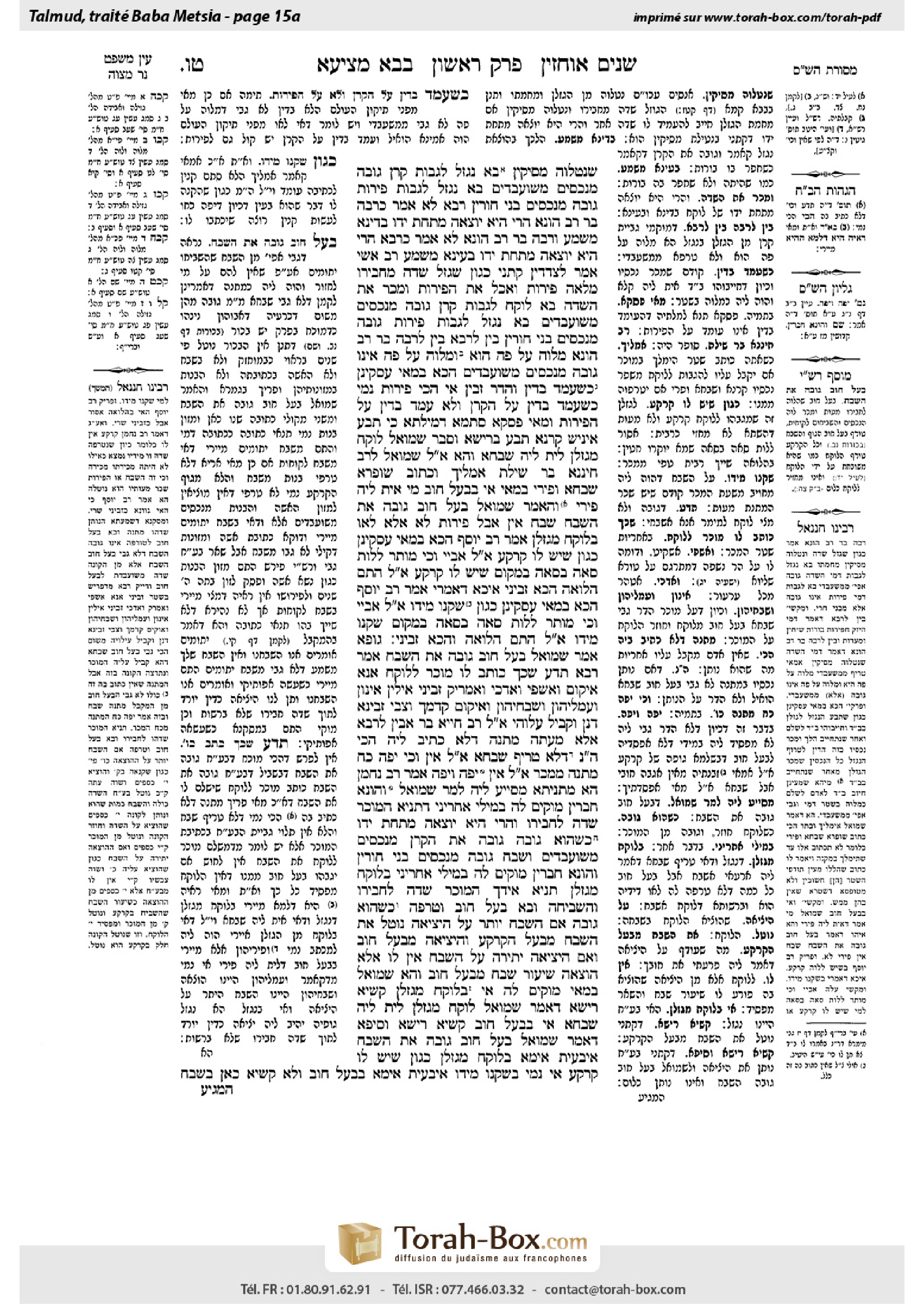
Bava Metzia 15a: Talmud study for Daf Yomi
Study the Talmud for Daf Yomi with scanned pages, Hebrew text, English translations from Sefaria and AI-generated French translations.
Passage selection and English or AI-generated French translation are available where the scan has annotations. Daf Study is independent of Torah-Box and Sefaria.
Browse Bava Metzia · בבא מציעא · All tractatesBava Metzia 15a text and translations
This page of Bava Metzia includes the Aramaic text, an English translation and an AI-generated French translation, alongside the scan above.
בבא מציעא י״ה א · Aramaic and Hebrew text
שֶׁנְּטָלוּהָ מַסִּיקִין, בָּא נִגְזָל לִגְבּוֹת קֶרֶן – גּוֹבֶה מִנְּכָסִים מְשׁוּעְבָּדִים, בָּא נִגְזָל לִגְבּוֹת פֵּירוֹת – גּוֹבֶה מִנְּכָסִים בְּנֵי חוֹרִין.
רָבָא לָא אָמַר כְּרַבָּה בַּר רַב הוּנָא: ״הֲרֵי הִיא יוֹצְאָה מִתַּחַת יָדוֹ״ – בְּדִינָא מַשְׁמַע. וְרַבָּה בַּר רַב הוּנָא לָא אָמַר כְּרָבָא: ״הֲרֵי הִיא יוֹצְאָה מִתַּחַת יָדוֹ״ – בְּעֵינָא מַשְׁמַע.
רַב אָשֵׁי אָמַר: לִצְדָדִין קָתָנֵי, כְּגוֹן שֶׁגָּזַל שָׂדֶה מֵחֲבֵירוֹ מְלֵאָה פֵּירוֹת וְאָכַל אֶת הַפֵּירוֹת וּמָכַר אֶת הַשָּׂדֶה, בָּא לוֹקֵחַ לִגְבּוֹת קֶרֶן – גּוֹבֶה מִנְּכָסִים מְשׁוּעְבָּדִים. בָּא נִגְזָל לִגְבּוֹת פֵּירוֹת – גּוֹבֶה מִנְּכָסִים בְּנֵי חוֹרִין.
בֵּין לְרָבָא בֵּין לְרַבָּה בַּר רַב הוּנָא, מִלְוָה עַל פֶּה הוּא, וּמִלְוָה עַל פֶּה אֵינוֹ גּוֹבֶה מִנְּכָסִים מְשׁוּעְבָּדִים!
הָכָא בְּמַאי עָסְקִינַן – כְּשֶׁעָמַד בַּדִּין וַהֲדַר זַבֵּין.
אִי הָכִי, פֵּירוֹת נָמֵי! כְּשֶׁעָמַד בַּדִּין עַל הַקֶּרֶן, וְלֹא עָמַד בַּדִּין עַל הַפֵּירוֹת. וּמַאי פַּסְקָא? סְתָמָא דְמִילְּתָא כִּי תָּבַע אִינִישׁ – קַרְנָא תָּבַע בְּרֵישָׁא.
וְסָבַר שְׁמוּאֵל לוֹקֵחַ מִגַּזְלָן לֵית לֵיהּ שְׁבָחָא?
וְהָא אֲמַר לֵיהּ שְׁמוּאֵל לְרַב חִינָּנָא בַּר שִׁילַת: אִמְּלֵיךְ, וּכְתוֹב ״שׁוּפְרָא שְׁבָחָא וּפֵירֵי״.
בְּמַאי? אִי בְּבַעַל חוֹב – מִי אִית לֵיהּ פֵּירֵי? וְהָאָמַר שְׁמוּאֵל: בַּעַל חוֹב גּוֹבֶה אֶת הַשֶּׁבַח, שֶׁבַח – אִין, אֲבָל פֵּירוֹת – לָא. אֶלָּא לָאו, בְּלוֹקֵחַ מִגַּזְלָן!
אָמַר רַב יוֹסֵף: הָכָא בְּמַאי עָסְקִינַן – כְּגוֹן שֶׁיֵּשׁ לוֹ קַרְקַע.
אֲמַר לֵיהּ אַבָּיֵי: וְכִי מוּתָּר לִלְוֹת סְאָה בִּסְאָה בִּמְקוֹם שֶׁיֵּשׁ לוֹ קַרְקַע?
אֲמַר לֵיהּ, הָתָם הַלְוָאָה, הָכָא זְבִינֵי.
אִיכָּא דְּאָמְרִי, אָמַר רַב יוֹסֵף: הָכָא בְּמַאי עָסְקִינַן – כְּגוֹן שֶׁקָּנוּ מִיָּדוֹ.
אֲמַר לֵיהּ אַבָּיֵי: וְכִי מוּתָּר לִלְוֹת סְאָה בִּסְאָה בִּמְקוֹם שֶׁקָּנוּ מִיָּדוֹ?
אֲמַר לֵיהּ: הָתָם הַלְוָאָה, וְהָכָא זְבִינֵי.
גּוּפָא, אָמַר שְׁמוּאֵל: בַּעַל חוֹב גּוֹבֶה אֶת הַשֶּׁבַח. אָמַר רָבָא: תֵּדַע, שֶׁכָּךְ כּוֹתֵב לוֹ מוֹכֵר לַלּוֹקֵחַ: ״אֲנָא אֵיקוּם וַאֲשַׁפֵּי וַאֲדַכֵּי וַאֲמָרֵיק זְבִינֵי אִילֵּין, אִינּוּן וְעַמְלֵיהוֹן וּשְׁבָחֵיהוֹן, וְאֵיקוּם קֳדָמָךְ, וּצְבִי זָבֹינָא דְּנַן וְקַבֵּיל עֲלוֹהִי״.
אֲמַר לֵיהּ רַב חִיָּיא בַּר אָבִין לְרָבָא: אֶלָּא מֵעַתָּה מַתָּנָה דְּלָא כָּתֵיב לֵיהּ הָכִי, הָכִי נָמֵי דְּלָא טָרֵיף שְׁבָחָא?! אֲמַר לֵיהּ: אִין.
וְכִי יָפֶה כֹּחַ מַתָּנָה מִמֶּכֶר? אֲמַר לֵיהּ: אִין יָפֶה וְיָפֶה.
אָמַר רַב נַחְמָן: הָא מַתְנִיתָא מְסַיַּיע לֵיהּ לְמָר שְׁמוּאֵל, וְהוּנָא חַבְרִין מוֹקֵים לַהּ בְּמִילֵּי אַחֲרִינֵי. דְּתַנְיָא: הַמּוֹכֵר שָׂדֶה לַחֲבֵירוֹ, וַהֲרֵי הִיא יוֹצְאָה מִתַּחַת יָדוֹ, כְּשֶׁהוּא גּוֹבֶה – גּוֹבֶה אֶת הַקֶּרֶן מִנְּכָסִים מְשׁוּעְבָּדִים, וְשֶׁבַח גּוֹבֶה מִנְּכָסִים בְּנֵי חוֹרִין.
וְהוּנָא חַבְרִין מוֹקֵים לַהּ בְּמִילֵּי אַחֲרִינֵי, בְּלוֹקֵחַ מִגַּזְלָן.
תַּנְיָא אִידַּךְ: הַמּוֹכֵר שָׂדֶה לַחֲבֵירוֹ וְהִשְׁבִּיחָהּ, וּבָא בַּעַל חוֹב וּטְרָפָהּ, כְּשֶׁהוּא גּוֹבֶה, אִם הַשֶּׁבַח יוֹתֵר עַל הַיְּצִיאָה – נוֹטֵל אֶת הַשֶּׁבַח מִבַּעַל הַקַּרְקַע, וְהַיְּצִיאָה מִבַּעַל חוֹב. וְאִם הַיְּצִיאָה יְתֵירָה עַל הַשֶּׁבַח – אֵין לוֹ אֶלָּא הוֹצָאָה שִׁיעוּר שֶׁבַח מִבַּעַל חוֹב.
וְהָא שְׁמוּאֵל בְּמַאי מוֹקֵים לַהּ? אִי בְּלוֹקֵחַ מִגַּזְלָן – קַשְׁיָא רֵישָׁא, דְּאָמַר שְׁמוּאֵל: לוֹקֵחַ מִגַּזְלָן לֵית לֵיהּ שְׁבָחָא. אִי בְּבַעַל חוֹב – קַשְׁיָא רֵישָׁא וְסֵיפָא, דְּאָמַר שְׁמוּאֵל: בַּעַל חוֹב גּוֹבֶה אֶת הַשֶּׁבַח!
אִיבָּעֵית אֵימָא בְּלוֹקֵחַ מִגַּזְלָן, כְּגוֹן שֶׁיֵּשׁ לוֹ קַרְקַע. אִי נָמֵי בְּשֶׁקָּנוּ מִיָּדוֹ.
אִיבָּעֵית אֵימָא בְּבַעַל חוֹב. וְלָא קַשְׁיָא: כָּאן בְּשֶׁבַח
Bava Metzia 15a · English translation
gentile thugs took the field from the robber by force due to previous dealings between them. In that case, when the robbery victim comes to collect the principal, he collects it from liened property, and when the robbery victim comes to collect payment for the produce, he can collect only from unsold property.
The Gemara explains: Rava did not state his explanation of the baraita in accordance with the explanation of Rabba bar Rav Huna, because the phrase: It is appropriated from his possession, indicates that the field was taken from him legally and not by thugs. And Rabba bar Rav Huna did not state his explanation of the baraita in accordance with the explanation of Rava, because the phrase: It is appropriated from his possession, indicates that the field is appropriated in its unadulterated form, and was not damaged.
Rav Ashi stated that the baraita teaches its rulings disjunctively. According to Rav Ashi, the baraita is referring to a case where one robbed another of a field while it was full of produce, and he consumed the produce and sold the field. When, after the true owner recovers the field from purchaser, the purchaser comes to collect the principal from the robber, i.e., the amount that he paid for the field, he collects it from the robber’s liened property. When the robbery victim comes to collect payment for the produce, he collects only from unsold property.
The Gemara raises a difficulty: According to both Rava and Rabba bar Rav Huna, the money that the robber owes the robbery victim has the status of a loan by oral agreement, as it is not accompanied by documentation, and one who is owed a loan by oral agreement cannot collect from liened property.
The Gemara answers: Here we are dealing with a case where the robber stood trial for his robbery and was found guilty, and he subsequently sold the land. Since he sold it after his liability was well known, the debt is equivalent to one that is written in a promissory note, and can be collected from liened property.
The Gemara asks: If so, the owner should collect payment for the produce as well from liened property. The Gemara answers: It is referring to a case when the robber stood trial for the principal, but did not yet stand trial for the produce. The Gemara asks: And why was it stated without qualification? According to this explanation, the distinction is not between the principal and the produce but rather between debts for which the robber stood trial and those for which he did not stand trial. The Gemara answers: The normal way of things is that when a person files a claim, he first claims the principal and only afterward does he file claims with regard to other property, such as produce.
§ The Gemara questions the statement that Rav Naḥman cited in Shmuel’s name: But does Shmuel hold that one who buys land from a robber does not have the right to the value of the enhancement of the land?
But didn’t Shmuel say to Rav Ḥinnana bar Sheilat, who was a scribe: When you write a deed of sale, consult with the parties, and if they agree, write that the seller commits to compensate the buyer, in the event that the land is appropriated from him, with superior-quality land, and for the value of the enhancement of the land and the produce as well? That was the standard formula for deeds of sale.
The Gemara clarifies: To what case is this statement referring? If it is a case where the seller’s creditor repossesses the land, does a creditor have rights to the produce? But doesn’t Shmuel say that a creditor collects the value of the enhancement of the field, indicating that he does collect the value of the enhancement, but he does not collect the produce? Rather, is it not referring to a case of one who buys land from a robber, and the owner subsequently repossesses it? This contradicts Shmuel’s earlier statement that one who buys land from a robber does not have the right to the value of the enhancement.
Rav Yosef said: Here we are dealing with a case where the robber owns land, which he can return to the buyer instead of paying him money. In that case, the transaction appears to be a sale and not payment of interest for a loan.
Abaye said to him: But is it permitted for one to borrow a se’a of grain for return of a se’a in a case where he owns land? The Sages render prohibited executing a loan of produce for return of the same amount of produce, lest the price rise in the interim, causing the debtor to return a higher value than he borrowed, which appears to be interest. This is the halakha even in a case where the borrower owns land. Similarly, in the case where the robber owns land, the payment of the value of the enhancement resembles the payment of interest.
Rav Yosef said to him: The distinction between the two cases is that there, with regard to borrowing a se’a and returning a se’a, the case in question involves a loan, whereas here, it is a case involving a sale. Since the field was bought from the robber, the additional value that the robber pays does not appear to be interest.
There are those who say that this is what Rav Yosef said: Here we are dealing with a case where the buyer performed an act of acquisition at the time he purchased the land from the robber’s possession, thereby formalizing a condition that should the field be appropriated from him, he will be reimbursed for any enhancement in its value. Since he acquired this right at the time of the purchase, it does not appear as though he is receiving interest.
Abaye said to him: But is it permitted for one to borrow a se’a for a se’a in a case where he performed an act of acquisition formalizing such a condition at the time he purchased the land from the lender’s possession? Isn’t it still considered to be interest and therefore prohibited?
Rav Yosef said to him: There, with regard to borrowing a se’a and returning a se’a, it is a case involving a loan, whereas here it is a case involving a sale. Buying at a low price and selling for a higher price is not considered to be interest.
The Gemara returns to discuss Shmuel’s statement itself that was mentioned above. Shmuel says: A creditor collects the value of the enhancement of the land. Rava says: Know that this is true, as this is the standard formulation that the seller writes to the buyer in a deed of sale: I will stand and silence and purify and cleanse this sale, i.e., I accept responsibility if the land is repossessed by my creditor. The text of the document continues: This applies to this property itself, and the labor invested in it, and its enhancement; and I will present its value before you. The witnesses then sign the document and attest: And this seller consented and accepted upon himself all of the commitments enumerated in the document. Evidently, a creditor can collect the value of the enhancement.
Rav Ḥiyya bar Avin said to Rava: If that is so, in the case of a gift, where the owner does not write this formulation to the recipient in the deed of gift, would you indeed say that the creditor does not repossess the value of the enhancement of the land from the recipient of the gift? Rava said to him: Indeed.
Rav Ḥiyya bar Avin said to Rava: But is the legal power of a gift stronger than that of a sale, as in the case of a sale the buyer loses the value of the enhancement if the land is repossessed? Rava said to him: Yes, it is indeed stronger. Since in a case of repossession, the recipient of the gift does not receive the value of the enhancement back from the one who gave him the gift, he is under no obligation to relinquish this value to the creditor.
Rav Naḥman said: This following baraita supports the opinion of Mar Shmuel; but our colleague, Rav Huna, interprets it as referring to other matters, so it does not support Shmuel’s opinion. As it is taught in a baraita: With regard to a case of one who sells a field to another, and it is appropriated from the buyer’s possession, as it was liened to the seller’s debt, when the buyer then collects compensation from the seller, he collects the principal from liened property, and he collects the enhancement from unsold property. Evidently, the value of the enhancement is also repossessed by the creditor.
But our colleague, Rav Huna, interprets it as referring to other matters, i.e., to the case of one who buys a field from a robber. In that case, the robbery victim is certainly entitled to the value of the enhancement of the land.
It is taught in another baraita: In a case of one who sells a field to another, and the buyer enhances it, and then a creditor comes and repossesses the field, in this case when the buyer collects compensation, the halakha is as follows: If the value of the enhancement of the field is greater than the buyer’s expenses in generating that enhancement, he takes the difference in value between the enhancement and the expenses from the owner of the land, i.e., the seller, and he is compensated for the expenses by the creditor. And if the expenses were greater than the enhancement of the field, he receives compensation for his expenses, only up to the value of the enhancement, from the creditor.
The Gemara asks: But how does Shmuel interpret the baraita? If it is referring to one who buys a field from a robber, the first clause in the baraita poses a difficulty to Shmuel’s opinion, as Shmuel says that one who buys a field from a robber does not have the right to compensation for the enhancement of the field, and the baraita states that the buyer is entitled to compensation for the enhancement. If it is referring to a creditor, then both the first clause and the latter clause in the baraita pose a difficulty to Shmuel’s opinion, as Shmuel says that a creditor collects the enhancement of the field and needs to pay nothing.
The Gemara suggests two answers: If you wish, say that the baraita is referring to one who buys a field from a robber, in a case where the robber owns land with which he can compensate the buyer instead of paying him money. In that case, the compensation does not appear to be interest. Alternatively, it is referring to a case where the buyer performed an act of acquisition at the time he purchased the land from the robber’s possession, thereby formalizing a condition that should the field be appropriated from him, he will be reimbursed for any enhancement in its value. Since the buyer acquired the enhancement at the time he paid for the field, it does not appear as if he is receiving interest.
If you wish, say instead that it is referring to a creditor, but nevertheless it is not difficult according to the opinion of Shmuel. Here, in the baraita, the reference is to enhancement
Bava Metzia 15a · Traduction française (IA)
Des bandits païens ont pris le champ du voleur par la force en raison des précédentes relations entre eux. Dans ce cas, lorsque le victime du vol vient récupérer le principal, il le récupère du bien en garantie, et lorsque le victime du vol vient récupérer le paiement pour les produits, il ne peut récupérer que les produits non vendus.
La Guemara explique : Rava n’a pas formulé son explication de la baraïta conformément à celle de Rabba bar Rav Huna, car la phrase : « Il est approprié à son possession », indique que le champ a été pris légalement et non par des bandits. Et Rabba bar Rav Huna n’a pas formulé son explication de la baraïta conformément à celle de Rava, car la phrase : « Il est approprié à son possession », indique que le champ est approprié dans sa forme pure et n’a pas été endommagé.
Rav Ashi a affirmé que la baraïta enseigne ses règles de manière disjunctive. Selon Rav Ashi, la baraïta fait référence à un cas où l’un a volé à un autre un champ qui était plein de produits, et il a consommé les produits et vendu le champ. Lorsque, après que l’propriétaire légitime a récupéré le champ auprès de l’acheteur, l’acheteur vient récupérer le principal auprès du voleur, c’est-à-dire la somme qu’il a payé pour le champ, il le récupère du bien en garantie du voleur. Lorsque le victime du vol vient récupérer le paiement pour les produits, il ne peut récupérer que les produits non vendus.
La Guemara soulève une difficulté : Selon Rava et Rabba bar Rav Huna, l’argent que le voleur doit au victime du vol a le statut d’un prêt par accord oral, car il n’est pas accompagné de documents, et celui qui est dû un prêt par accord oral ne peut récupérer du bien en garantie.
La Guemara répond : Ici, nous sommes en présence d’un cas où le voleur a été jugé pour son vol et a été reconnu coupable, puis il a vendu la terre. Puisque la vente s’est produite après que sa responsabilité était bien connue, la dette est équivalente à celle d’un prêt écrit dans une promesse de paiement, et peut être récupérée du bien en garantie.
La Guemara pose une question : Si c’est ainsi, le propriétaire devrait récupérer le paiement pour les produits également du bien en garantie. La Guemara répond : Il s’agit d’un cas où le voleur a été jugé pour le principal, mais n’a pas encore été jugé pour les produits. La Guemara pose une question : Et pourquoi a-t-il été dit sans qualification ? Selon cette explication, la distinction n’est pas entre le principal et les produits, mais plutôt entre les dettes pour lesquelles le voleur a été jugé et celles pour lesquelles il n’a pas été jugé. La Guemara répond : La manière normale est que lorsque quelqu’un présente une réclamation, il commence par réclamer le principal et ne présente ensuite les réclamations concernant d’autres biens, tels que les produits.
§ La Guemara questionne l'affirmation que Rav Naḥman a citée en nom de Shmuel : Mais Shmuel considère-t-il que celui qui achète une terre à un voleur n'a pas le droit à la valeur de l'amélioration de la terre ?
Mais n'a-t-il pas dit Shmuel à Rav Ḥinnana bar Sheilat, qui était un scribe : Lorsque vous rédigez un acte de vente, consultez les parties et, si elles sont d'accord, écrivez que le vendeur s'engage à compenser l'acheteur, en cas de réappropriation de la terre par lui, avec une terre de meilleure qualité, et pour la valeur de l'amélioration de la terre ainsi que des produits ? C'était la formule standard pour les actes de vente.
La Guemara clarifie : À quel cas cette affirmation fait-elle référence ? Si c'est un cas où le créancier du vendeur réapproprie la terre, le créancier a-t-il le droit aux produits ? Mais n'a-t-il pas dit Shmuel que le créancier récupère la valeur de l'amélioration du champ, indiquant qu'il récupère la valeur de l'amélioration, mais pas les produits ? Plutôt, n'est-ce pas un cas où l'on achète une terre à un voleur, et l'propriétaire réapproprie ensuite la terre ? Cela contredit l'affirmation précédente de Shmuel que celui qui achète une terre à un voleur n'a pas le droit à la valeur de l'amélioration.
Rav Yosef a dit : Ici, nous sommes en présence d’un cas où le voleur possède une terre, qu’il peut restituer à l’acheteur à la place de payer de l’argent. Dans ce cas, la transaction semble être une vente et non un prêt d’intérêt.
Abaye a dit à lui : Mais est-il permis à quelqu’un de prêter un se’a de blé pour un se’a de retour dans un cas où il possède une terre ? Les Sages rendent interdit l’exécution d’un prêt de produits pour le retour de la même quantité de produits, de peur que le prix augmente pendant l’intervalle, causant au débiteur de rendre une valeur supérieure à celle qu’il a emprunté, ce qui semble être un intérêt. C’est la halakha même dans un cas où le prêteur possède une terre. De même, dans le cas où le voleur possède une terre, le paiement de la valeur de l’amélioration ressemble au paiement d’intérêt.
Rav Yosef a dit à lui : La distinction entre les deux cas est que là, concernant le prêt d’un se’a et le retour d’un se’a, le cas en question implique un prêt, tandis que ici, il s’agit d’un cas de vente. Puisque la terre a été achetée du voleur, la valeur supplémentaire que le voleur paie ne semble pas être un intérêt.
Certains disent que c’est ce que Rav Yosef a dit : Nous sommes en présence d’un cas où l’acheteur a accompli un acte d’acquisition au moment où il a acheté la terre du voleur, formalisant une condition selon laquelle, si la terre est réappropriée, il sera indemnisé pour toute amélioration de sa valeur. Puisqu’il a acquis ce droit au moment de l’achat, cela ne semble pas comme s’il recevait d’intérêt.
Abaye a dit à lui : Mais est-il permis à quelqu’un de prêter un se’a pour un se’a dans un cas où il a accompli un acte d’acquisition formalisant une telle condition au moment de l’achat de la terre du prêteur ? N’est-ce pas encore considéré comme un intérêt et donc interdit ?
Rav Yosef dit à lui : Là, concernant l'emprunt d'un sé'ah et le retour d'un sé'ah, il s'agit d'un cas d'emprunt, tandis que ici il s'agit d'un cas de vente. Acheter à bas prix et vendre à un prix plus élevé n'est pas considéré comme un intérêt.
Le Guemara revient sur la déclaration de Shmuel elle-même qui a été mentionnée ci-dessus. Shmuel dit : Le créancier récupère la valeur de l'amélioration du terrain. Rava dit : Sachez que cela est vrai, car c'est la formulation standard que l'acheteur écrit au vendeur dans un acte de vente : Je me tiens, je m'interdis et je purifie et je nettoie cette vente, c'est-à-dire que je m'engage à ce que le terrain soit récupéré par mon créancier. Le texte de l'acte continue : Cela s'applique à ce terrain lui-même, ainsi qu'au travail investi dans ce terrain et à son amélioration ; et je présenterai sa valeur devant vous. Les témoins signent alors l'acte et attestent : Et ce vendeur a consenti et accepté tous les engagements énumérés dans l'acte. Évidemment, un créancier peut récupérer la valeur de l'amélioration.
Rav Ḥiyya bar Avin dit à Rava : Si c'est ainsi, dans le cas d'un don, où l'owner n'écrit pas cette formulation au bénéficiaire dans l'acte de don, diriez-vous que le créancier ne récupère pas la valeur de l'amélioration du terrain auprès du bénéficiaire ? Rava dit à lui : Oui.
Rav Ḥiyya bar Avin dit à Rava : Mais la puissance juridique d'un don est-elle plus forte que celle d'une vente, comme dans le cas d'une vente où l'acheteur perd la valeur de l'amélioration si le terrain est récupéré ? Rava dit à lui : Oui, elle est effectivement plus forte. Puisque, dans le cas de la récupération, le bénéficiaire du don ne reçoit pas la valeur de l'amélioration du terrain du donateur, il n'a pas l'obligation de céder cette valeur au créancier.
Rav Naḥman dit : Cette baraïta suivante soutient l'opinion de Mar Shmuel ; mais notre collègue, Rav Huna, l'interprète comme faisant référence à d'autres cas, donc elle ne soutient pas l'opinion de Shmuel. Comme il est enseigné dans une baraïta : Concernant le cas d'une personne qui vend un champ à un autre, et que ce champ est récupéré par le propriétaire de la dette, lorsque l'acheteur récupère une compensation auprès du vendeur, il récupère le principal du terrain lié à la dette, et il récupère l'amélioration du terrain non vendu. Évidemment, la valeur de l'amélioration est également récupérée par le créancier.
Mais notre collègue, Rav Huna, l'interprète comme faisant référence à d'autres cas, c'est-à-dire au cas d'une personne qui achète un champ à un voleur. Dans ce cas, la victime du vol a certainement le droit à la valeur de l'amélioration du terrain.
Il est enseigné dans une autre baraïta : Dans le cas d'une personne qui vend un champ à un autre, et que l'acheteur améliore ce champ, et que ensuite un créancier vienne récupérer le champ, dans ce cas, lorsque l'acheteur récupère une compensation, la halakha est la suivante : Si la valeur de l'amélioration du champ est supérieure aux dépenses de l'acheteur pour générer cette amélioration, il récupère la différence entre la valeur de l'amélioration et ses dépenses auprès du propriétaire du terrain, c'est-à-dire du vendeur, et il est indemnisé pour ses dépenses par le créancier. Et si les dépenses étaient supérieures à l'amélioration du champ, il reçoit une indeminité pour ses dépenses, uniquement jusqu'à la valeur de l'amélioration, auprès du créancier.
Le Guemara pose une question : Mais comment Shmuel interprète-t-il cette baraïta ? Si elle fait référence à une personne qui achète un champ à un voleur, la première clause de la baraïta pose un problème pour l'opinion de Shmuel, car Shmuel dit qu'une personne qui achète un champ à un voleur n'a pas le droit à une compensation pour l'amélioration du champ, et la baraïta dit que l'acheteur est dû une compensation pour l'amélioration. Si elle fait référence à un créancier, alors à la fois la première clause et la dernière clause de la baraïta posent un problème pour l'opinion de Shmuel, car Shmuel dit qu'un créancier récupère l'amélioration du champ et n'a pas besoin de payer quoi que ce soit.
Le Guemara suggère deux réponses : Si vous le souhaitez, dites que la baraïta fait référence à une personne qui achète un champ à un voleur, dans un cas où le voleur possède un terrain avec lequel il peut indemniser l'acheteur au lieu de lui payer de l'argent. Dans ce cas, la compensation ne semble pas être un intérêt. Alternativement, elle fait référence à un cas où l'acheteur a accompli une acquisition au moment où il a acheté le terrain dans la possession du voleur, formalisant ainsi une condition selon laquelle, si le terrain est récupéré par lui, il sera indemnisé pour toute amélioration de sa valeur. Puisque l'acheteur a acquis l'amélioration au moment où il a payé pour le terrain, cela ne semble pas comme s'il recevait un intérêt.
Si vous le souhaitez, dites plutôt qu'il s'agit d'un créancier, mais néanmoins cela ne pose pas de difficulté selon l'opinion de Shmuel. Ici, dans la baraïta, la référence est à l'amélioration.
Traduction française générée par IA à partir de l’édition anglaise de Sefaria. Vérifie toujours un passage avec le texte source.
Text from Sefaria: William Davidson Edition - Vocalized Aramaic (CC BY NC); William Davidson Edition - English (CC BY NC).