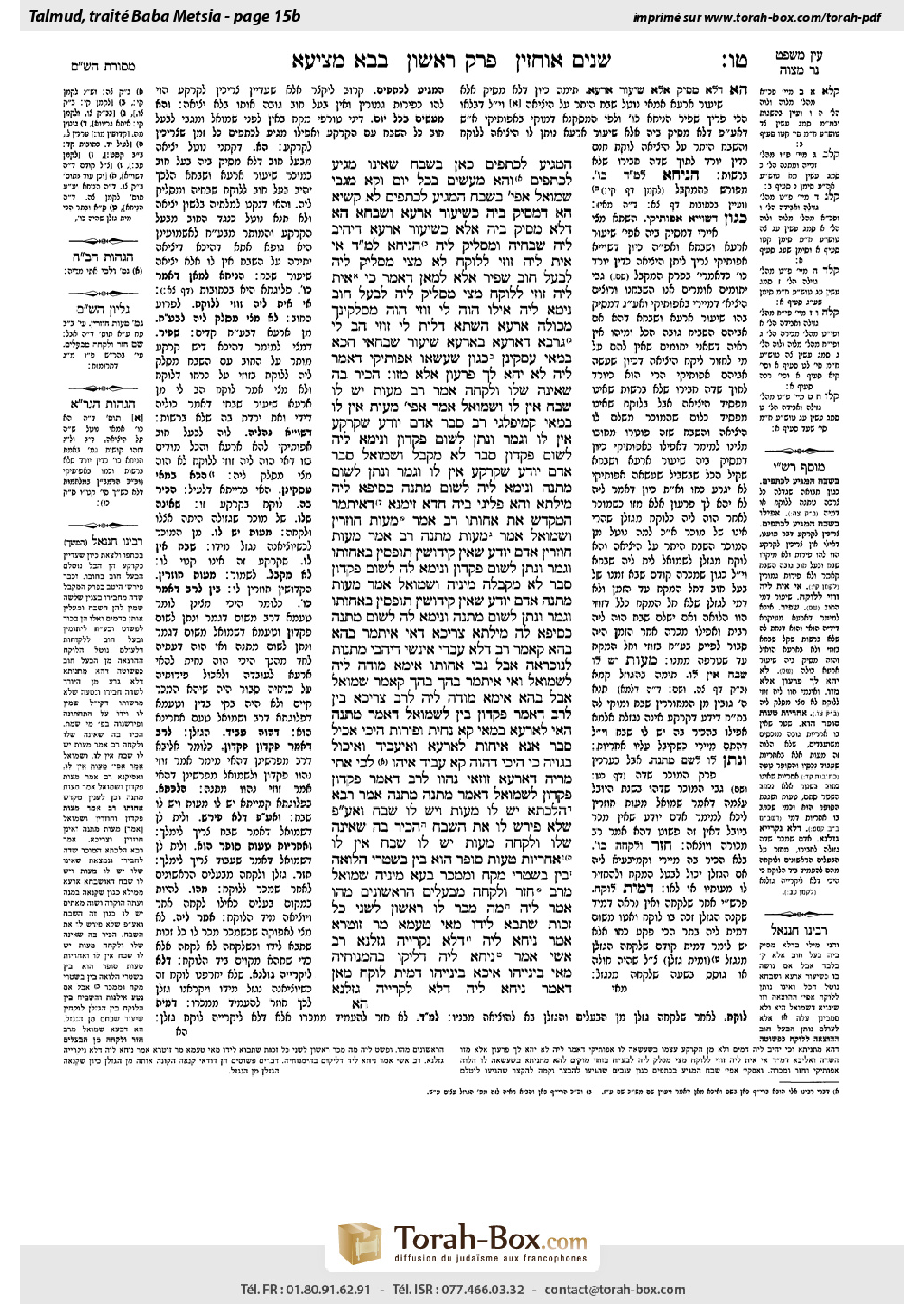
Bava Metzia 15b: Talmud study for Daf Yomi
Study the Talmud for Daf Yomi with scanned pages, Hebrew text, English translations from Sefaria and AI-generated French translations.
Passage selection and English or AI-generated French translation are available where the scan has annotations. Daf Study is independent of Torah-Box and Sefaria.
Browse Bava Metzia · בבא מציעא · All tractatesBava Metzia 15b text and translations
This page of Bava Metzia includes the Aramaic text, an English translation and an AI-generated French translation, alongside the scan above.
בבא מציעא י״ה ב · Aramaic and Hebrew text
הַמַּגִּיעַ לַכְּתֵפַיִם, כָּאן בְּשֶׁבַח שֶׁאֵינוֹ מַגִּיעַ לַכְּתֵפַיִם.
וְהָא מַעֲשִׂים בְּכׇל יוֹם, וְקָא מַגְבֵּי שְׁמוּאֵל אֲפִילּוּ בְּשֶׁבַח הַמַּגִּיעַ לִכְתֵפַיִם!
לָא קַשְׁיָא: הָא דְּמַסֵּיק בֵּיהּ כְּשִׁיעוּר אַרְעָא וּשְׁבָחָא. הָא דְּלָא מַסֵּיק בֵּיהּ אֶלָּא כְּשִׁיעוּר אַרְעָא, דְּיָהֵיב לֵיהּ שְׁבָחֵיהּ וּמְסַלֵּיק לֵיהּ.
הָנִיחָא לְמַאן דְּאָמַר: אִי אִית לֵיהּ זוּזֵי לְלוֹקֵחַ לָא מָצֵי מְסַלֵּיק לֵיהּ לְבַעַל חוֹב, שַׁפִּיר. אֶלָּא לְמַאן דְּאָמַר כִּי אִית לֵיהּ זוּזֵי לְלוֹקֵחַ מָצֵי מְסַלֵּיק לֵיהּ לְבַעַל חוֹב, נֵימָא לֵיהּ: אִילּוּ הֲוָה לִי זוּזֵי, הֲוָה מְסַלְּקִינָּךְ מִכּוּלַּהּ אַרְעָא, הַשְׁתָּא דְּלֵית לִי זוּזֵי, הַב לִי גְּרִבָא דְאַרְעָא (בְּאַרְעָא) [בְּהָא אַרְעָא] שִׁיעוּר שְׁבָחַאי!
הָכָא בְּמַאי עָסְקִינַן – כְּגוֹן שֶׁעֲשָׂאוֹ אַפּוֹתֵיקֵי. דַּאֲמַר לֵיהּ: לֹא יְהֵא לְךָ פֵּרָעוֹן אֶלָּא מִזּוֹ.
הִכִּיר בָּהּ שֶׁאֵינָהּ שֶׁלּוֹ וּלְקָחָהּ, אָמַר רַב: מָעוֹת יֵשׁ לוֹ, שֶׁבַח אֵין לוֹ. וּשְׁמוּאֵל אָמַר: אֲפִילּוּ מָעוֹת אֵין לוֹ.
בְּמַאי קָמִיפַּלְגִי? רַב סָבַר: אָדָם יוֹדֵעַ שֶׁקַּרְקַע אֵין לוֹ, וְגָמַר וְנָתַן לְשׁוּם פִּקָּדוֹן. וְנֵימָא לֵיהּ לְשׁוּם פִּקָּדוֹן! סָבַר לָא מְקַבֵּל.
וּשְׁמוּאֵל סָבַר: אָדָם יוֹדֵעַ שֶׁקַּרְקַע אֵין לוֹ, וְגָמַר וְנָתַן לְשׁוּם מַתָּנָה. וְנֵימָא לֵיהּ לְשׁוּם מַתָּנָה! כְּסִיפָא לֵיהּ מִילְּתָא.
וְהָא פְּלִיגִי בַּיהּ חֲדָא זִימְנָא, דְּאִיתְּמַר: הַמְקַדֵּשׁ אֶת אֲחוֹתוֹ, רַב אָמַר: מָעוֹת חוֹזְרִין, וּשְׁמוּאֵל אָמַר: מָעוֹת מַתָּנָה. רַב אָמַר: מָעוֹת חוֹזְרִין, אָדָם יוֹדֵעַ שֶׁאֵין קִידּוּשִׁין תּוֹפְסִין בַּאֲחוֹתוֹ, וְגָמַר וְנָתַן לְשׁוּם פִּקָּדוֹן. וְנֵימָא לַהּ לְשׁוּם פִּקָּדוֹן! סָבַר לָא מְקַבְּלָה מִינֵּיהּ.
וּשְׁמוּאֵל אָמַר: מָעוֹת מַתָּנָה – אָדָם יוֹדֵעַ שֶׁאֵין קִידּוּשִׁין תּוֹפְסִין בַּאֲחוֹתוֹ, וְגָמַר וְנָתַן לְשׁוּם מַתָּנָה. וְנֵימָא לָהּ לְשׁוּם מַתָּנָה! כְּסִיפָא לַהּ מִילְּתָא
צְרִיכָא: דְּאִי אִיתְּמַר בְּהָא, בְּהָא קָאָמַר רַב, דְּלָא עָבְדִי אִינָשֵׁי דְּיָהֲבִי מַתָּנוֹת לְנוּכְרָאָה. אֲבָל גַּבֵּי אֲחוֹתוֹ אֵימָא מוֹדֵה לֵיהּ לִשְׁמוּאֵל.
וְאִי אִיתְּמַר בְּהָךְ, בְּהָךְ קָאָמַר שְׁמוּאֵל: אֲבָל בְּהָא אֵימָא מוֹדֶה לֵיהּ לְרַב, צְרִיכָא.
בֵּין לְרַב דְּאָמַר פִּקָּדוֹן, בֵּין לִשְׁמוּאֵל דְּאָמַר מַתָּנָה, הַאי לְאַרְעָא בְּמַאי קָא נָחֵית, וּפֵירוֹת הֵיכִי אָכֵיל?
סָבַר: אֲנָא אֵיחוֹת לְאַרְעָא וְאֶיעְבֵּיד וְאֵיכוֹל בְּגַוַּיהּ כִּי הֵיכִי דַּהֲוָה קָא עָבֵיד אִיהוּ, לְכִי אָתֵי מָרֵיהּ דְּאַרְעָא זוּזַאי נֶהְווֹ, לְרַב דְּאָמַר פִּקָּדוֹן – פִּקָּדוֹן, לִשְׁמוּאֵל דְּאָמַר מַתָּנָה – מַתָּנָה.
אָמַר רָבָא, הִלְכְתָא: יֵשׁ לוֹ מָעוֹת וְיֵשׁ לוֹ שֶׁבַח, וְאַף עַל פִּי שֶׁלֹּא פֵּירֵשׁ לוֹ אֶת הַשֶּׁבַח. הִכִּיר בָּהּ שֶׁאֵינָהּ שֶׁלּוֹ וּלְקָחָהּ – מָעוֹת יֵשׁ לוֹ, שֶׁבַח אֵין לוֹ.
אַחְרָיוּת טָעוּת סוֹפֵר הוּא, בֵּין בִּשְׁטָרֵי הַלְוָאָה, בֵּין בִּשְׁטָרֵי מִקָּח וּמִמְכָּר.
בְּעָא מִינֵּיהּ שְׁמוּאֵל מֵרַב: חָזַר וּלְקָחָהּ מִבְּעָלִים הָרִאשׁוֹנִים, מַהוּ? אֲמַר לֵיהּ: מָה מָכַר לוֹ רִאשׁוֹן לַשֵּׁנִי – כׇּל זְכוּת שֶׁתָּבֹא לְיָדוֹ.
מַאי טַעְמָא? מָר זוּטְרָא אָמַר: נִיחָא לֵיהּ דְּלָא נִקְרְיֵיהּ גַּזְלָנָא. רַב אָשֵׁי אָמַר: נִיחָא לֵיהּ דְּלֵיקוּ בְּהֵמָנוּתֵיהּ.
מַאי בֵּינַיְיהוּ? אִיכָּא בֵּינַיְיהוּ דְּמִית לוֹקֵחַ: מַאן דְּאָמַר נִיחָא לֵיהּ דְּלָא לִקְרְיֵיהּ גַּזְלָנָא –
Bava Metzia 15b · English translation
of the field that reaches one’s shoulders, i.e., the produce that grew due to the improvements made by the purchaser is almost fully grown and ripened, and it can soon be harvested and carried upon one’s shoulders. At that point, the produce is considered independent of the land and is therefore not collected by the creditor unless he pays for the expenses. And there, in Shmuel’s statement that the creditor collects the enhancement without paying compensation, the reference is to enhancement that does not reach one’s shoulders, i.e., whose growth is not almost complete. At that point, the produce is considered to be part of the land.
The Gemara asks: But there were daily incidents of this type, and Shmuel would collect payment from buyers even for enhancement that reaches one’s shoulders, without requiring the creditors to compensate them for their expenses.
The Gemara answers that this is not difficult; these instances when Shmuel did not require the creditor to compensate the purchaser were cases where the creditor was owed by the debtor the same amount of money as the value of the land and the enhancement. That baraita, which states that the creditor must compensate the purchaser for the enhancement, is referring to a case where he was owed by the debtor only the same amount of money as the value of the land, without the enhancement, as in this case the creditor gives the buyer the value of his enhancement to the land and thereby dismisses from the buyer any claim to the land.
The Gemara asks: This works out well according to the one who says that even if the purchaser has money, he is unable to dismiss the creditor from his claim to the land by paying its value. But according to the one who says that when the purchaser has money he can dismiss the creditor by paying the value of the land, let the purchaser say to him: If I had money, I would have dismissed you from the entire plot of land. Now that I do not have enough money to pay off the entire debt, give me at least a se’a of land from the land that you wish to repossess, which is the amount of my enhancement.
The Gemara answers: Here we are dealing with a case where the debtor, who sold this land to the purchaser, set aside his land as designated repayment [apoteiki] for the debt, as he said to the creditor: You will be repaid only from this piece of land. Consequently, the buyer cannot dismiss the creditor from any part of the land, even though he enhanced its value.
§ In a case where one who bought a field from a robber recognized that it was not the seller’s, i.e., he knew that it was stolen property, but he purchased it nevertheless, when the true owner repossesses the field Rav says that the purchaser has the right to be reimbursed for the money that he paid for the field, but he does not have the right to be reimbursed for the enhancement of the field in his possession. And Shmuel says that he does not have the right to be reimbursed even for the money he paid for the field, as he knew that the sale was invalid.
The Gemara asks: With regard to what principle do Rav and Shmuel disagree? The Gemara answers: Rav holds that such a person knows that the sale is invalid and that he does not have the right to the land, and therefore he clearly resolved to give the money to the seller as a deposit. The Gemara asks: But if that is his objective, let him say to the seller explicitly that he is giving him the money as a deposit. The Gemara answers: The purchaser thought that the seller would not accept it as a deposit, and therefore he gave it to him in this fashion so that he would hold it for him in the interim.
And Shmuel holds that such a person knows that he does not have the right to the land, and therefore he clearly resolved to give the money to the seller as a gift. The Gemara asks: But if so, let him say to the seller that he is giving him the money as a gift. The Gemara answers: If he would say so explicitly, the matter would be embarrassing for the seller. Therefore, the purchaser used this ploy in order to give a gift to the seller.
The Gemara asks: But didn’t Rav and Shmuel already disagree about this principle one time? As it was stated concerning one who betroths his sister: Rav says: The money he gave for the betrothal is returned, since the betrothal does not take effect; and Shmuel says: This money is a gift, meaning that he wished to give a gift to his sister and he did so in this manner. Rav says: The money must be returned since a person knows that betrothal does not take effect with his sister, and he decided to give the money to her for the purpose of a deposit. The Gemara raises a difficulty: And let him explicitly say to her that he is giving her the money for the purpose of a deposit. The Gemara answers: He thought she would not accept it from him.
And Shmuel says: The money is considered to be a gift because a person knows that betrothal does not take effect with his sister, and he decided to give the money to her for the purpose of a gift. The Gemara again raises a difficulty: And let him explicitly say to her that he is giving it to her for the purpose of a gift. The Gemara answers: He thought the matter would be embarrassing to her and she would refuse to accept the money. He therefore attempted to give it her by an alternative method.
The Gemara explains: It is necessary to present the disagreement in both instances because if it were stated only with regard to that case, of buying property from a robber, one might have reasoned that it is specifically in that case that Rav says that the money returns to the purchaser, as people do not tend to give gifts to non-relatives, and therefore it is clear that the purchaser intended for the money to be a deposit. But with regard to the case of one who betroths his sister, one might say that Rav concedes to Shmuel that the money was given as a gift. It is therefore necessary to present Rav’s opinion in both cases.
And conversely, if the disagreement were stated only in that case, i.e., betrothal of one’s sister, one might have reasoned that it is only in that case that Shmuel says the money is a gift, but in this case, where the purchaser is a non-relative, one might say that Shmuel concedes to Rav that the money is a deposit. It is therefore necessary to present the disagreement in both instances.
The Gemara asks: Both according to Rav, who says that the money is a deposit, and according to Shmuel, who says that the money is a gift, when this purchaser takes possession of the land despite knowing that his acquisition is invalid, with what justification does he take possession of the land, and how does he justify consuming its produce?
The Gemara answers that the purchaser reasons: I will take possession of the land, and work it, and consume the produce that is in it, just as the seller would have done. And when the owner of the land comes and claims it, the money that I paid for it will be designated for a different purpose. According to Rav, who says that the money is a deposit, it will be a deposit, and according to Shmuel, who says that the money is a gift, it will be a gift.
Rava said: With regard to the aforementioned halakhic disputes, the halakha is that in a case where one bought a field and it turned out to be stolen, the purchaser has the right to demand that the seller return the money he paid for the land, and he also has the right to demand that the seller compensate him for the value of the enhancement, in accordance with the opinion of Rav. And this is the halakha even if the seller did not explicitly obligate himself to compensate him for the enhancement. But if the purchaser recognized that the field was not the seller’s and he purchased it anyway, he has the right to demand that the seller return the money he paid for the land, but he does not have the right to demand compensation for the enhancement, in accordance with the opinion of Rav.
Rava issued another ruling with regard to a dispute cited above: Omission of the guarantee of the sale from the document is a scribal error. This is the halakha both with regard to promissory notes and with regard to deeds of buying and selling, i.e., deeds of sale.
§ Shmuel asked Rav: If one robbed another of a field and sold it, and then purchased it from the original owner, what is the halakha? Can the robber now repossess the field from the person to whom he sold it before he legally owned it? Rav said to him: No, he cannot. What did the first person, the robber, sell to the second person, the purchaser, when he sold him the field? He sold him any rights to the field that will come into his possession. Consequently, the rights that the robber has now acquired are transferred to the purchaser.
The Gemara asks: What is the reason that the robber would buy the land he had already sold in order to retroactively uphold the sale? Mar Zutra said: It is preferable for him not to be called a robber by the purchaser when the original owner demands he return the field. Rav Ashi said: It is preferable for him to maintain his reliability, i.e., to be considered an honest person.
The Gemara asks: What is the practical difference between these two opinions? The Gemara answers: The practical difference between them is in a case where the purchaser died. According to the one who says that the robber bought it because it is preferable for him not to be called a robber,
Bava Metzia 15b · Traduction française (IA)
du champ qui atteint les épaules, c'est-à-dire des produits qui ont grandi grâce aux améliorations apportées par l'acheteur, sont presque mûrs et peuvent être récoltés et transportés sur les épaules. À ce stade, les produits sont considérés comme indépendants du sol et ne sont donc pas réclamés par le créancier à moins qu'il ne paie les frais. Et là, dans l'affirmation de Shmuel selon laquelle le créancier réclame l'amélioration sans compensation, il s'agit d'une amélioration qui ne atteint pas les épaules, c'est-à-dire dont la croissance n'est pas presque achevée. À ce stade, les produits sont considérés comme faisant partie du sol.
Le Guemara demande : Mais il y avait quotidiennement des cas de ce genre, et Shmuel réclamait le paiement aux acheteurs même pour une amélioration qui atteint les épaules, sans exiger que les créanciers compensent les acheteurs pour leurs frais.
Le Guemara répond que cela ne pose pas de problème ; ces cas où Shmuel n'exigeait pas que le créancier compense l'acheteur étaient des cas où le créancier était dû par le débiteur la même somme d'argent que la valeur du sol et de l'amélioration. Ce baraïta, qui affirme que le créancier doit compenser l'acheteur pour l'amélioration, fait référence à un cas où il était dû par le débiteur seulement la même somme d'argent que la valeur du sol, sans l'amélioration, comme dans ce cas le créancier donne à l'acheteur la valeur de son amélioration dans le sol et ainsi libère l'acheteur de toute revendication sur le sol.
Le Guemara demande : Cela fonctionne bien selon celui qui dit que même si l'acheteur a de l'argent, il ne peut pas libérer le créancier de sa revendication sur le sol en payant sa valeur. Mais selon celui qui dit que lorsque l'acheteur a de l'argent, il peut libérer le créancier en payant la valeur du sol, laisse l'acheteur dire : Si j'avais de l'argent, j'aurais libéré vous de l'ensemble du terrain. Maintenant que je n'ai pas assez d'argent pour payer la dette totale, donne-moi au moins un se'ah de terrain du terrain que tu veux reprendre, qui est la quantité de mon amélioration.
Le Guemara répond : Ici, nous sommes en présence d'un cas où le débiteur, qui a vendu ce terrain à l'acheteur, a désigné ce terrain comme rétribution [apoteiki] pour la dette, car il a dit au créancier : Vous serez récompensé uniquement à partir de ce morceau de terrain. Ainsi, l'acheteur ne peut pas libérer le créancier de toute partie du terrain, même s'il a amélioré sa valeur.
§ Dans le cas où une personne qui a acheté un champ d'un voleur a reconnu qu'il ne lui appartenait pas, c'est-à-dire qu'il savait qu'il s'agissait de propriété volée, mais l'a tout de même acheté, lorsque le propriétaire légitime reprend le champ, Rav dit que l'acheteur a le droit d'être remboursé de l'argent qu'il a payé pour le champ, mais il n'a pas le droit d'être remboursé de l'amélioration du champ qu'il possède. Et Shmuel dit qu'il n'a pas le droit d'être remboursé même de l'argent qu'il a payé pour le champ, car il savait que la vente était nulle.
Le Guemara demande : Sur quel principe Rav et Shmuel s'opposent-ils ? Le Guemara répond : Rav considère que cette personne sait que la vente est nulle et qu'il n'a pas le droit au terrain, et qu'il a donc clairement décidé de donner l'argent au vendeur comme dépôt. Le Guemara demande : Mais si c'est son objectif, qu'il dise explicitement au vendeur qu'il lui donne l'argent comme dépôt. Le Guemara répond : L'acheteur pensait que le vendeur ne l'accepterait pas comme dépôt, et c'est pourquoi il lui l'a donné ainsi afin qu'il le tienne provisoirement.
Et Shmuel considère que cette personne sait qu'il n'a pas le droit au terrain, et qu'il a donc clairement décidé de donner l'argent au vendeur comme cadeau. Le Guemara demande : Mais si c'est le cas, qu'il dise explicitement au vendeur qu'il lui donne l'argent comme cadeau. Le Guemara répond : Si il disait cela explicitement, cela serait gênant pour le vendeur. C'est pourquoi l'acheteur a utilisé ce stratagème afin de donner un cadeau au vendeur.
Le Guemara demande : Mais n'ont pas Rav et Shmuel déjà disputé sur ce principe une fois ? Comme il a été dit concernant celui qui bâtit son sœur : Rav dit : L'argent qu'il a donné pour le mariage est rendu, car le mariage n'est pas valide ; et Shmuel dit : Cet argent est un cadeau, c'est-à-dire qu'il voulait donner un cadeau à sa sœur et l'a fait ainsi. Rav dit : L'argent doit être rendu car une personne sait que le mariage n'est pas valide avec sa sœur, et il a décidé de donner l'argent à elle comme dépôt. Le Guemara soulève une difficulté : Et qu'il dise explicitement à elle qu'il lui donne l'argent comme dépôt. Le Guemara répond : Il pensait qu'elle ne l'accepterait pas de lui.
Et Shmuel dit : L'argent est considéré comme un cadeau car une personne sait que le mariage n'est pas valide avec sa sœur, et il a décidé de donner l'argent à elle comme cadeau. Le Guemara soulève à nouveau une difficulté : Et qu'il dise explicitement à elle qu'il lui donne l'argent comme cadeau. Le Guemara répond : Il pensait que cela serait gênant pour elle et qu'elle refuserait d'accepter l'argent. Il a donc tenté de lui donner l'argent par une autre méthode.
Le Guemara explique : Il est nécessaire de présenter le désaccord dans les deux cas car si cela avait été dit uniquement concernant ce cas, d'acheter une propriété à un voleur, on aurait pu penser que c'est spécifiquement dans ce cas que Rav dit que l'argent revient à l'acheteur, car les gens ne tendent pas à donner des cadeaux aux non-parents, et donc il est clair que l'acheteur avait l'intention que l'argent soit un dépôt. Mais concernant le cas d'une personne qui bâtit sa sœur, on pourrait dire que Rav reconnaît à Shmuel que l'argent a été donné comme cadeau. Il est donc nécessaire de présenter l'opinion de Rav dans les deux cas.
Et inversement, si le désaccord avait été énoncé uniquement dans ce cas précis, à savoir l'engagement d'une sœur, on aurait pu penser qu'il s'agissait uniquement de ce cas précis que Shmuel affirme que l'argent est un cadeau, mais dans ce cas-ci, où l'acheteur est un non-parent, on pourrait dire que Shmuel reconnaît à Rav que l'argent est un dépôt. Il est donc nécessaire de présenter le désaccord dans les deux cas.
La Guemara pose la question : Selon Rav, qui affirme que l'argent est un dépôt, et selon Shmuel, qui affirme que l'argent est un cadeau, lorsque cet acheteur prend possession du terrain malgré la connaissance qu'il a de l'invalidité de son acquisition, avec quel fondement prend-il possession du terrain, et comment justifie-t-il la consommation de ses produits ?
La Guemara répond que l'acheteur raisonne ainsi : Je prendrai possession du terrain, je le travaillerai et je consommerai les produits qui y sont, tout comme le vendeur l'aurait fait. Et lorsque l'propriétaire du terrain viendra réclamer son terrain, l'argent que j'ai payé pour cela sera désigné pour une autre utilisation. Selon Rav, qui affirme que l'argent est un dépôt, il sera un dépôt, et selon Shmuel, qui affirme que l'argent est un cadeau, il sera un cadeau.
Rava dit : En ce qui concerne les désaccords halakhiques mentionnés ci-dessus, la halakha est que dans le cas où l'on achète un champ et qu'il s'avère être volé, l'acheteur a le droit de demander au vendeur de lui rendre l'argent qu'il a payé pour le terrain, et il a également le droit de demander au vendeur de le compenser pour la valeur de l'amélioration, conformément à l'opinion de Rav. Et c'est ainsi que la halakha est même si le vendeur n'a pas explicitement s'engage à le compenser pour l'amélioration. Mais si l'acheteur a reconnu que le champ n'était pas celui du vendeur et l'a tout de même acheté, il a le droit de demander au vendeur de lui rendre l'argent qu'il a payé pour le terrain, mais il n'a pas le droit de demander la compensation pour l'amélioration, conformément à l'opinion de Rav.
Rava a émis un autre jugement concernant un désaccord mentionné ci-dessus : L'omission de la garantie de la vente dans le document est une erreur d'écriture. C'est ainsi que la halakha est, tant pour les promesses d'achat que pour les actes de vente, c'est-à-dire les actes de vente.
§ Shmuel a demandé à Rav : Si l'on vole un champ à un autre et l'on le vend, puis qu'on l'achète à l'original propriétaire, quelle est la halakha ? Le voleur peut-il maintenant reprendre le champ auprès de la personne à qui il l'avait vendu avant qu'il ne le possède légalement ? Rav a répondu à lui : Non, il ne peut pas. Qu'est-ce que le premier, le voleur, a vendu au second, l'acheteur, lorsqu'il lui a vendu le champ ? Il a vendu à l'acheteur tous les droits sur le champ qui lui viendront à son possession. Ainsi, les droits que le voleur a maintenant acquis sont transférés à l'acheteur.
La Guemara pose la question : Quel est le motif pour lequel le voleur achète le terrain qu'il avait déjà vendu afin de valider la vente de manière rétrospective ? Mar Zutra a dit : Il est préférable qu'il ne soit pas appelé voleur par l'acheteur lorsque l'ancien propriétaire exige qu'il rende le terrain. Rav Ashi a dit : Il est préférable qu'il maintienne sa réputation, c'est-à-dire qu'il soit considéré comme une personne honnête.
La Guemara pose la question : Quelle est la différence pratique entre ces deux opinions ? La Guemara répond : La différence pratique entre eux réside dans le cas où l'acheteur est décédé. Selon celui qui dit que le voleur l'a acheté parce qu'il est préférable qu'il ne soit pas appelé voleur,
Traduction française générée par IA à partir de l’édition anglaise de Sefaria. Vérifie toujours un passage avec le texte source.
Text from Sefaria: William Davidson Edition - Vocalized Aramaic (CC BY NC); William Davidson Edition - English (CC BY NC).