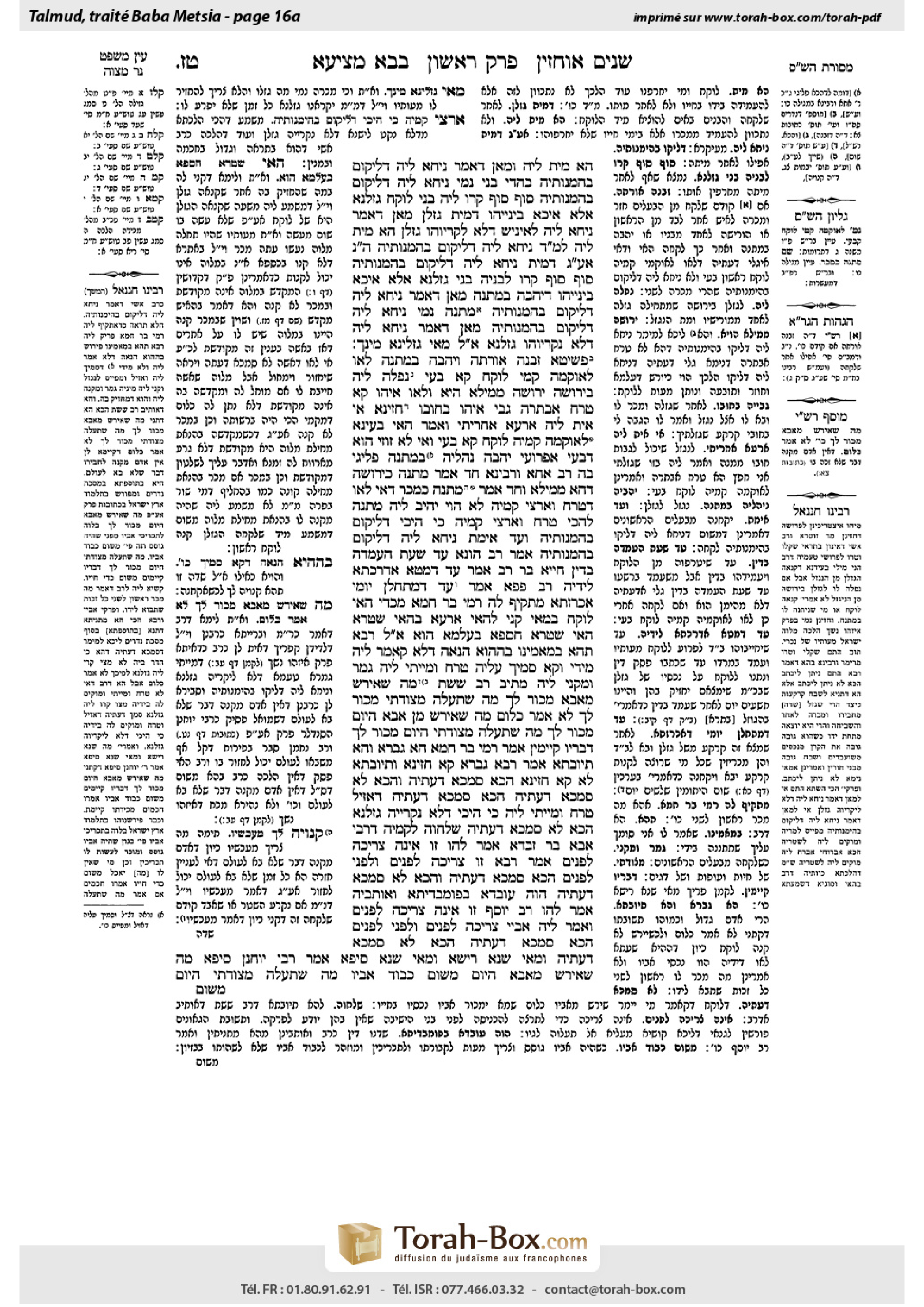
Bava Metzia 16a: Talmud study for Daf Yomi
Study the Talmud for Daf Yomi with scanned pages, Hebrew text, English translations from Sefaria and AI-generated French translations.
Passage selection and English or AI-generated French translation are available where the scan has annotations. Daf Study is independent of Torah-Box and Sefaria.
Browse Bava Metzia · בבא מציעא · All tractatesBava Metzia 16a text and translations
This page of Bava Metzia includes the Aramaic text, an English translation and an AI-generated French translation, alongside the scan above.
בבא מציעא י״ו א · Aramaic and Hebrew text
הָא מִית לֵיהּ. וּמַאן דְּאָמַר: נִיחָא לֵיהּ דְּלֵיקוּם בְּהֵמָנוּתֵיהּ – בַּהֲדֵי בְּנֵי נָמֵי נִיחָא לֵיהּ דְּלֵיקוּם בְּהֵמָנוּתֵיהּ.
סוֹף סוֹף קָרוּ לֵיהּ בְּנֵי לוֹקֵחַ ״גַּזְלָנָא״!
אֶלָּא: אִיכָּא בֵּינַיְיהוּ דְּמִית גַּזְלָן. מַאן דְּאָמַר נִיחָא לֵיהּ לְאִינִישׁ דְּלָא לִקְרְיוּהּו ״גַּזְלָן״, הָא מִית לֵיהּ. לְמַאן דְּאָמַר נִיחָא לֵיהּ דְּלֵיקוּם בְּהֵמָנוּתֵיהּ, הָכִי נָמֵי אַף עַל גַּב דְּמִית – נִיחָא לֵיהּ דְּלֵיקוּם בְּהֵמָנוּתֵיהּ!
סוֹף סוֹף קָרוּ לִבְנֵיהּ: ״בְּנֵי גַּזְלָנָא״.
אֶלָּא אִיכָּא בֵּינַיְיהוּ דְּיַהֲבַהּ בְּמַתָּנָה. מַאן דְּאָמַר נִיחָא לֵיהּ דְּלֵיקוּם בְּהֵמָנוּתֵיהּ – מַתָּנָה נָמֵי נִיחָא לֵיהּ דְּלֵיקוּם בְּהֵמָנוּתֵיהּ. מַאן דְּאָמַר נִיחָא לֵיהּ דְּלָא נִקְרְיוּהּו ״גַּזְלָנָא״ – אָמַר לֵיהּ: מַאי גְּזַלִי מִינָּךְ.
פְּשִׁיטָא: זַבְּנַהּ, אוֹרְתַהּ, וְיַהֲבַהּ בְּמַתָּנָה – לָאו לְאוֹקֹמַהּ קַמֵּי לוֹקֵחַ קָא בָּעֵי.
נְפַלָה לֵיהּ בִּירוּשָׁה, יְרוּשָּׁה מִמֵּילָא הִיא, וְלָאו אִיהוּ קָא טָרַח אַבָּתְרַהּ.
גַּבְיַ[הּ] (אִיהוּ) בְּחוֹבוֹ, חָזֵינַן אִי אִית לֵיהּ אַרְעָא אַחֲרִיתִי וַאֲמַר: הַאי בָּעֵינָא, לְאוֹקֹמַהּ קַמֵּיהּ לוֹקֵחַ קָא בָּעֵי.
וְאִי לָא, זוּזֵי הוּא דְּבָעֵי אִפְּרוֹעֵי.
יַהֲבַהּ נִהֲלֵיהּ בְּמַתָּנָה, פְּלִיגִי בַּהּ רַב אַחָא וְרָבִינָא. חַד אָמַר: מַתָּנָה כִּירוּשָּׁה, דְּהָא מִמֵּילָא. וְחַד אָמַר: מַתָּנָה כְּמֶכֶר, דְּאִי לָאו דְּטָרַח וְאַרְצִי קַמֵּיהּ לָא הָוֵי יָהֵיב לֵיהּ מַתָּנָה, לְהָכִי טְרַח וְאַרְצִי קַמֵּיהּ, כִּי הֵיכִי דְּלֵיקוּם בְּהֵמָנוּתֵיהּ.
וְעַד אֵימַת נִיחָא לֵיהּ דְּלֵיקוּם בְּהֵמָנוּתֵיהּ? אָמַר רַב הוּנָא: עַד שְׁעַת הַעֲמָדָה בַּדִּין.
חִיָּיא בַּר רַב אָמַר: עַד דְּמָטְ[יָ]א אַדְרַכְתָּא לִידֵיהּ. רַב פָּפָּא אָמַר: עַד דְּמַתְחֲלִן יוֹמֵי אַכְרַזְתָּא.
מַתְקֵיף לַהּ רָמֵי בַּר חָמָא: מִכְּדִי הַאי לוֹקֵחַ בְּמַאי קָנֵי לְהַאי אַרְעָא – בְּהַאי שְׁטָרָא, הַאי שְׁטָרָא חַסְפָּא בְּעָלְמָא הוּא!
אֲמַר לֵיהּ רָבָא: תְּהֵא בְּמַאֲמִינוֹ, בְּהָהִיא הֲנָאָה דְּלָא קָאָמַר לֵיהּ מִידֵּי וְקָא סָמֵיךְ עֲלֵיהּ טָרַח וּמַיְיתֵי לֵיהּ, גָּמַר וּמַקְנֵי לֵיהּ.
מֵתִיב רַב שֵׁשֶׁת: מַה שֶּׁאִירַשׁ מֵאַבָּא מָכוּר לָךְ, מַה שֶּׁתַּעֲלֶה מְצוּדָתִי מָכוּר לָךְ – לֹא אָמַר כְּלוּם. מַה שֶּׁאִירַשׁ מִן אַבָּא הַיּוֹם מָכוּר לָךְ, מַה שֶּׁתַּעֲלֶה מְצוּדָתִי הַיּוֹם מָכוּר לָךְ – דְּבָרָיו קַיָּימִין!
אָמַר רָמֵי בַּר חָמָא: הָא גַּבְרָא וְהָא תְּיוּבְתָּא!
אָמַר רָבָא: גַּבְרָא קָא חָזֵינָא, וּתְיוּבְתָּא לָא קָא חָזֵינָא. הָכָא סָמְכָא דַּעְתֵּיהּ, וְהָכָא לָא סָמְכָא דַּעְתֵּיהּ. הָכָא סָמְכָא דַּעְתֵּיהּ – דְּאָזֵיל טָרַח וּמַיְיתֵי לֵיהּ כִּי הֵיכִי, דְּלָא נִקְרְיֵיהּ ״גַּזְלָנָא״. הָכָא לָא סָמְכָא דַּעְתֵּיהּ.
שַׁלְחוּהָ לְקַמֵּיהּ דְּרַבִּי אַבָּא בַּר זַבְדָּא. אֲמַר לְהוּ: זוֹ אֵינָהּ צְרִיכָה לִפְנִים. אָמַר רָבָא: זוֹ צְרִיכָה לִפְנִים וְלִפְנַי לִפְנִים. הָכָא סָמְכָא דַּעְתֵּיהּ, וְהָכָא לָא סָמְכָא דַּעְתֵּיהּ.
הֲוָה עוֹבָדָא בְּפוּמְבְּדִיתָא וְאוֹתְבֵיהּ. אֲמַר לְהוּ רַב יוֹסֵף: זוֹ אֵינָהּ צְרִיכָה לְפָנִים. וַאֲמַר לֵיהּ אַבָּיֵי: צְרִיכָה לִפְנִים וְלִפְנַי לִפְנִים, הָכָא סָמְכָא דַּעְתֵּיהּ, הָכָא לָא סָמְכָא דַּעְתֵּיהּ.
וּמַאי שְׁנָא רֵישָׁא וּמַאי שְׁנָא סֵיפָא? אָמַר רַבִּי יוֹחָנָן: סֵיפָא ״מַה שֶּׁאִירַשׁ מֵאַבָּא הַיּוֹם״ – מִשּׁוּם כְּבוֹד אָבִיו. ״מַה שֶּׁתַּעֲלֶה מְצוּדָתִי הַיּוֹם״ –
Bava Metzia 16a · English translation
in this case, since the purchaser already died, the owner is not present to call the seller a robber, so he presumably did not intend to retroactively validate the sale. And conversely, according to the one who says that he bought the land because it is preferable for him to maintain his reliability, it is preferable for him to maintain his reliability with regard to the purchaser’s children too.
The Gemara challenges this distinction: Ultimately, the purchaser’s children will also call the seller a robber if the field is appropriated from them. Therefore, there is no difference between the two explanations of Rav’s ruling in a case where the purchaser has died.
Rather, the practical difference between them is in a case where the robber himself died, and his children subsequently bought the field from its owner. According to the one who says that the motivation is that it is preferable for a person not to be called a robber, he already died and this motive is not applicable. While according to the one who says that his motivation is that it is preferable for him to maintain his reliability, in this case also, even though the robber died, it is still preferable for him to maintain his reliability, i.e., one is concerned about the reputation he will have after his death, not only while he is alive.
The Gemara rejects this distinction as well: Ultimately, if the sale is revoked after his death, people will call his children the children of a robber. Just as one does not want to be called a robber during his lifetime, one presumably does not want his children to be called the children of a robber after his death.
Rather, the practical difference between them is in a case where the robber gave the land to the recipient as a gift rather than selling it. According to the one who says that it is preferable for him to maintain his reliability, in the case of a gift also, it is preferable for him to maintain his reliability. While according to the one who says that the motivation is that it is preferable for him not to be called a robber, in this case the robber could say to the recipient of the gift: What did I rob you of? You incurred no loss.
§ The Gemara discusses various scenarios relating to the halakha of one who sold stolen land and then acquired it from the robbery victim. It is obvious that if, after selling the stolen land, the robber sold it again to another person, or bequeathed it, or gave it as a gift, it is clear that the robber does not want to establish it before, i.e., transfer ownership of it to, the original buyer. Therefore, the robber’s purchase of the land from the robbery victim is not assumed to be for the purpose of validating the original sale. The buyer can demand compensation from the robber for the invalid sale, but the land remains in the possession of the second buyer or the recipient of the gift or the inheritance.
Likewise, it is clear that if the land that he stole and then sold later came into his possession not by purchase but as an inheritance, the buyer does not have the rights to it, as an inheritance is acquired passively, and the robber did not make an effort to acquire it. Here too, the buyer can claim only compensation and not the land itself.
If the robber collected the land that he had sold as payment for a debt owed to him by the robbery victim, we need to see the circumstances. If the robbery victim has other land from which the robber could have collected the debt, and nevertheless the robber said: I want to collect this land, apparently the robber wanted to establish it before the buyer and validate the sale.
And if the robbery victim does not have other land, and the robber had no choice as to which land to collect, there is no reason to assume that the robber was attempting to validate the sale. He merely wanted to be paid money for his debt, and not to secure the land for the buyer.
With regard to a case where the robbery victim gave the land as a gift to the robber, Rav Aḥa and Ravina disagree. One says that a gift has the same status as an inheritance, as it is also acquired passively, and one says that a gift has the same status as a sale. This is because were it not for the fact that the robber took the trouble to ingratiate himself with the owner, he would not have given it to him as a gift. It is clearly for this reason that the robber took the trouble to ingratiate himself with him, i.e., in order to validate the sale and thereby maintain his reliability.
The Gemara asks: And until when can it be assumed that the robber bought the land because it is preferable for him to maintain his reliability? Rav Huna says: Until the time of standing trial. Once the purchaser takes the robber to court, it is too late for the robber to protect his reputation, as the purchaser has demonstrated that he does not consider the robber to be trustworthy.
Ḥiyya bar Rav says that the robber would still buy the land from the owner in order to maintain his reliability up until the time that a document of authorization by the court to locate and seize property from the robber comes into the purchaser’s possession. It is only once the robber avoids immediately reimbursing the purchaser and the court is compelled to authorize the purchaser to appropriate the robber’s property that the robber’s reliability is no longer a factor. Rav Pappa says that the robber’s reliability remains a motive to acquire the field until the days of announcement begin. During the days of announcement the court assesses the value of the robber’s property in order to compensate the purchaser.
§ Rami bar Ḥama objects to Rav’s statement, the focal point of this discussion, that the robber transfers to the buyer any rights to the land that he might acquire; after all, by means of what mode of acquisition does this purchaser acquire this land? It is by means of this deed of sale that the robber gave him. The purchase is invalid, as this document is merely a shard, since the robber did not own, at the time of the sale, the land he purported to sell.
Rava said to him in response: Let Rav’s statement be understood as applying to a case where the buyer said to the robber that he trusts him to resolve the legal issue. By virtue of that satisfaction that the robber received from the buyer’s not having said anything to him to question his rights to the land, but rather having relied on him, the robber therefore takes the trouble and brings to him the opportunity to purchase the land and resolves to transfer the land’s ownership to him.
Rav Sheshet raises an objection to Rav’s statement from a baraita that states that if one says: That which I will inherit from my father is hereby sold to you, or: That which my net will catch is sold to you, he has said nothing, as one cannot sell that which he does not yet own. But if one says: That which I will inherit from my father today is hereby sold to you, or: That which my net will catch today is sold to you, his statement stands. The first halakha of the baraita indicates that one cannot sell that which he does not yet own, which contradicts Rav’s ruling.
Rami bar Ḥama said about this objection: This is the great man and this is his refutation of Rav’s opinion; i.e., this refutation is compelling.
Rava said in response: I see that he is a great man, but I do not see the conclusive refutation. Here, in the case of validating a sale, the purchaser relies on the seller and is confident he will acquire the land; but there, in the case of the baraita, the purchaser does not fully rely on the seller. The Gemara explains: Here, in the case of validating the sale, the purchaser relies on the seller to go take the trouble and provide him with the land so that he will not be called a robber. Whereas there, in the case of the baraita, the purchaser does not fully rely on the seller, as it is uncertain whether the seller will actually inherit his father’s property or catch anything with his net.
The Gemara relates that the Sages sent Rav Sheshet’s objection and presented it before Rabbi Abba bar Zavda for his evaluation. Rabbi Abba bar Zavda said to them: This objection need not be introduced inside the study hall for further clarification, as it is clear and compelling. Rava disagreed and said: This objection needs to be brought inside the study hall and inside the innermost area of the study hall. In other words, it should be examined carefully, as it is not compelling. This is because here, the purchaser relies on the seller, whereas there, in the case of the baraita, the purchaser does not fully rely on the seller.
There was an incident in Pumbedita where the court ruled in accordance with the opinion of Rav, and the Sages refuted the ruling based on the baraita cited earlier. Rav Yosef said to them: This objection need not be introduced inside the study hall for further clarification, as the objection is clear and compelling. And Abaye said to him: It needs to be brought inside the study hall and inside the innermost area of the study hall, as here the purchaser relies on the seller, whereas there the purchaser does not fully rely on the seller.
The Gemara asks concerning the baraita cited earlier: And what is different in the first clause, where the sale is not valid, and what is different in the latter clause, where the sale is valid? In both cases, the seller does not yet own the merchandise. Rabbi Yoḥanan said: In the latter clause, when the seller states: I am selling that which I will inherit from my father today, he does so for the honor of his father. He believes that his father will die that day, and his intention is to raise money for the burial. Consequently, the Sages instituted an ordinance that the sale is valid. Similarly, in the case of a person who says: That which my net will catch today is sold to you,
Bava Metzia 16a · Traduction française (IA)
Dans ce cas, puisque l'acheteur est déjà décédé, le propriétaire n'est pas présent pour appeler le vendeur de voleur, donc il ne présumait probablement pas valider la vente en rétroaction. Et inversement, selon celui qui dit qu'il a acheté la terre parce qu'il est préférable pour lui de maintenir sa réputation, il est préférable pour lui de maintenir sa réputation concernant les enfants de l'acheteur également.
La Guemara conteste cette distinction : Finalement, les enfants de l'acheteur appelleront également le vendeur de voleur si la terre est confisquée à leur encontre. Ainsi, il n'y a pas de différence entre les deux explications de la décision de Rav dans un cas où l'acheteur est décédé.
Au contraire, la différence pratique entre eux est dans le cas où le voleur lui-même est décédé, et ses enfants ont ensuite acheté la terre à son propriétaire. Selon celui qui dit que la motivation est qu'il est préférable pour une personne de ne pas être appelé de voleur, il est déjà décédé et cette motivation n'est plus applicable. En revanche, selon celui qui dit que sa motivation est qu'il est préférable pour lui de maintenir sa réputation, dans ce cas également, même si le voleur est décédé, il est encore préférable pour lui de maintenir sa réputation, c'est-à-dire qu'on s'occupe de la réputation qu'il aura après sa mort, pas seulement pendant sa vie.
La Guemara rejette cette distinction également : Finalement, si la vente est annulée après sa mort, les gens appelleront ses enfants les enfants d'un voleur. Tout comme on ne veut pas être appelé voleur pendant sa vie, on ne veut probablement pas que ses enfants soient appelés les enfants d'un voleur après sa mort.
Au contraire, la différence pratique entre eux est dans le cas où le voleur a donné la terre au destinataire en tant que cadeau plutôt que de la vendre. Selon celui qui dit que c'est préférable pour lui de maintenir sa réputation, dans le cas d'un cadeau également, il est préférable pour lui de maintenir sa réputation. En revanche, selon celui qui dit que la motivation est qu'il est préférable pour lui de ne pas être appelé voleur, dans ce cas le voleur pourrait dire au destinataire du cadeau : Qu'est-ce que j'ai volé à toi ? Tu n'as subi aucun préjudice.
§ La Guemara discute divers scénarios relatifs à la halakha d'une personne qui a vendu une terre volée et a ensuite acquis cette terre du victime du vol. Il est évident que si, après avoir vendu la terre volée, le voleur a revendu cette terre à une autre personne, ou l'a légué, ou l'a donné en cadeau, il est clair que le voleur ne veut pas établir cela avant, c'est-à-dire transférer la propriété à, l'acheteur initial. Ainsi, l'achat de la terre par le voleur auprès du victime du vol n'est pas supposé avoir pour but de valider la vente initiale. L'acheteur peut exiger une compensation auprès du voleur pour la vente invalide, mais la terre reste en possession du second acheteur ou du destinataire du cadeau ou de l'héritier.
De même, il est clair que si la terre qu'il a volée et ensuite vendue est entrée en son possession non par achat mais par héritage, l'acheteur n'a pas les droits sur cette terre, car un héritage est acquis passivement, et le voleur n'a pas fait d'effort pour l'acquérir. Ici aussi, l'acheteur peut réclamer uniquement une compensation et non la terre elle-même.
Si le voleur a récupéré la terre qu'il avait vendue en tant que paiement d'une dette envers la victime du vol, il faut examiner les circonstances. Si la victime du vol possède d'autres terres à partir desquelles le voleur pourrait récupérer la dette, et pourtant le voleur a dit : Je veux récupérer cette terre, apparemment le voleur voulait établir cela devant l'acheteur et valider la vente.
Et si la victime du vol n'a pas d'autres terres, et que le voleur n'avait pas le choix quant à la terre à récupérer, il n'y a pas de raison de supposer que le voleur cherchait à valider la vente. Il voulait simplement être payé pour sa dette, et non sécuriser la terre pour l'acheteur.
En ce qui concerne le cas où la victime du vol a donné la terre en cadeau au voleur, Rav Aḥa et Ravina sont en désaccord. L'un dit qu'un cadeau a le même statut qu'un héritage, car il est également acquis passivement, et l'autre dit qu'un cadeau a le même statut qu'une vente. Cela est dû au fait que, sans que le voleur n'ait pris la peine de s'ingénier à s'attirer la confiance du propriétaire, il ne lui aurait pas donné ce cadeau. C'est clairement pour cette raison que le voleur a pris la peine de s'ingénier à s'attirer sa confiance, c'est-à-dire afin de valider la vente et ainsi maintenir sa réputation.
La Guemara pose la question : Et jusqu'à quand peut-on supposer que le voleur a acheté la terre parce qu'il est préférable pour lui de maintenir sa réputation ? Rav Huna dit : Jusqu'au moment de l'audience. Une fois que l'acheteur porte le voleur en justice, il est trop tard pour que le voleur protège sa réputation, car l'acheteur a montré qu'il ne considère pas le voleur comme digne de confiance.
Ḥiyya bar Rav dit que le voleur achèterait la terre auprès du propriétaire afin de maintenir sa réputation jusqu'au moment où un document d'autorisation de la cour pour localiser et saisir les biens du voleur arrive entre les mains de l'acheteur. C'est seulement une fois que le voleur évite immédiatement de rembourser l'acheteur et que la cour est contrainte d'autoriser l'acheteur à confisquer les biens du voleur que la réputation du voleur n'est plus un facteur. Rav Pappa dit que la réputation du voleur reste un motif d'acheter la terre jusqu'aux jours de l'annonce. Pendant les jours de l'annonce, la cour évalue la valeur des biens du voleur afin de compenser l'acheteur.
§ Rami bar Ḥama s’oppose à la déclaration de Rav, le point central de cette discussion, selon laquelle le voleur transfère à l’acheteur tout droit sur la terre qu’il pourrait acquérir ; après tout, par quel mode d’acquisition l’acheteur acquiert-il cette terre ? C’est par ce contrat de vente que le voleur lui a donné. La vente est nulle, car ce document n’est qu’un fragment, puisque le voleur ne possédait pas, au moment de la vente, la terre qu’il prétendait vendre.
Rava répondit à lui en disant : Comprendons la déclaration de Rav comme s’appliquant à un cas où l’acheteur dit au voleur qu’il lui fait confiance pour résoudre la question juridique. Par la satisfaction que le voleur a reçue du fait que l’acheteur n’a pas dit quelque chose pour contester ses droits sur la terre, mais plutôt s’est appuyé sur lui, le voleur se donne la peine de lui offrir l’opportunité d’acheter la terre et s’engage à transférer la propriété de la terre à l’acheteur.
Rav Sheshet émet un objet contre la déclaration de Rav, en se basant sur une baraïta qui stipule que si l’on dit : Ce que je hériterai de mon père est ici vendu à vous, ou : Ce que mon filet attrapera est vendu à vous, il n’a rien dit, car on ne peut vendre ce que l’on ne possède pas encore. Mais si l’on dit : Ce que je hériterai de mon père aujourd’hui est ici vendu à vous, ou : Ce que mon filet attrapera aujourd’hui est vendu à vous, sa déclaration est valable. La première halakha de la baraïta indique que l’on ne peut vendre ce que l’on ne possède pas encore, ce qui contredit la décision de Rav.
Rami bar Ḥama dit à ce sujet : C’est un grand homme et c’est sa réfutation de l’opinion de Rav ; c’est-à-dire que cette réfutation est convaincante.
Rava répondit en disant : Je vois qu’il est un grand homme, mais je ne vois pas la réfutation concluante. Ici, dans le cas de la validation d’une vente, l’acheteur s’appuie sur le vendeur et est confiant qu’il acquerra la terre ; mais là, dans le cas de la baraïta, l’acheteur ne s’appuie pas pleinement sur le vendeur. La Guemara explique : Ici, dans le cas de la validation de la vente, l’acheteur s’appuie sur le vendeur pour qu’il prenne la peine de lui fournir la terre afin qu’il ne soit pas appelé voleur. En revanche, là, dans le cas de la baraïta, l’acheteur ne s’appuie pas pleinement sur le vendeur, car il est incertain que le vendeur héritera effectivement de la propriété de son père ou attrapera quelque chose avec son filet.
La Guemara rapporte qu’on a envoyé l’objection de Rav Sheshet aux Sages pour qu’elle soit évaluée par Rabbi Abba bar Zavda. Rabbi Abba bar Zavda dit à ceux-ci : Cette objection n’a pas besoin d’être introduite dans la salle de étude pour une clarification supplémentaire, car elle est claire et convaincante. Rava s’est opposé et a dit : Cette objection a besoin d’être apportée dans la salle de étude et dans la partie la plus intime de la salle de étude. En d’autres termes, elle doit être examinée avec soin, car elle n’est pas convaincante. Cela est dû au fait que ici, l’acheteur s’appuie sur le vendeur, alors que là, dans le cas de la baraïta, l’acheteur ne s’appuie pas pleinement sur le vendeur.
Il y avait un incident à Pumbedita où le tribunal a rendu un jugement conformément à l’opinion de Rav, et les Sages ont réfuté ce jugement en se basant sur la baraïta citée plus tôt. Rav Yosef a dit à ceux-ci : Cette objection n’a pas besoin d’être introduite dans la salle de étude pour une clarification supplémentaire, car l’objection est claire et convaincante. Et Abaye a répondu à lui : Il faut l’apporter dans la salle de étude et dans la partie la plus intime de la salle de étude, car ici l’acheteur s’appuie sur le vendeur, alors que là, dans le cas de la baraïta, l’acheteur ne s’appuie pas pleinement sur le vendeur.
La Guemara pose une question concernant la baraïta citée plus tôt : Et qu’est-ce qui diffère dans la première clause, où la vente n’est pas valide, et qu’est-ce qui diffère dans la seconde clause, où la vente est valide ? Dans les deux cas, le vendeur ne possède pas encore le bien. Rabbi Yoḥanan a dit : Dans la seconde clause, lorsque le vendeur dit : Je vends ce que je hériterai de mon père aujourd’hui, il le fait par l’honneur de son père. Il croit que son père mourra ce jour-là, et son intention est de lever de l’argent pour le funérarium. Les Sages ont donc institué un ordonnance selon laquelle la vente est valide. De même, dans le cas d’une personne qui dit : Ce que mon filet attrapera aujourd’hui est vendu à vous,
Traduction française générée par IA à partir de l’édition anglaise de Sefaria. Vérifie toujours un passage avec le texte source.
Text from Sefaria: William Davidson Edition - Vocalized Aramaic (CC BY NC); William Davidson Edition - English (CC BY NC).